
Recessive Epistasis Complete dominance at both loci but
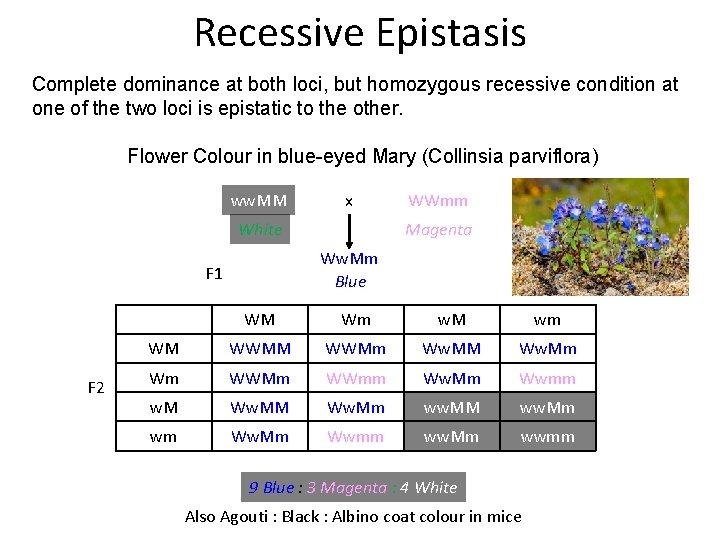
Recessive Epistasis Complete dominance at both loci, but homozygous recessive condition at one of the two loci is epistatic to the other. Flower Colour in blue-eyed Mary (Collinsia parviflora) ww. MM x White Magenta Ww. Mm Blue F 1 F 2 WWmm WM Wm w. M wm WM WWMm Ww. MM Ww. Mm Wm WWMm WWmm Ww. Mm Wwmm w. M Ww. Mm ww. MM ww. Mm wm Ww. Mm Wwmm ww. Mm wwmm 9 Blue : 3 Magenta : 4 White Also Agouti : Black : Albino coat colour in mice
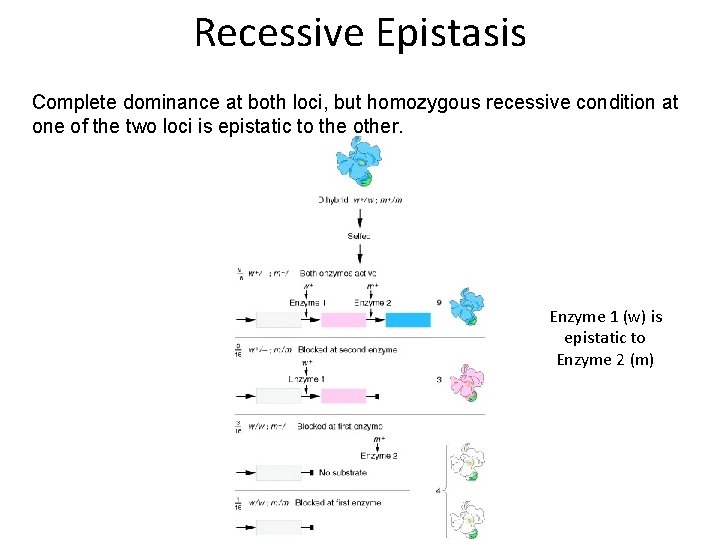
Recessive Epistasis Complete dominance at both loci, but homozygous recessive condition at one of the two loci is epistatic to the other. Enzyme 1 (w) is epistatic to Enzyme 2 (m)
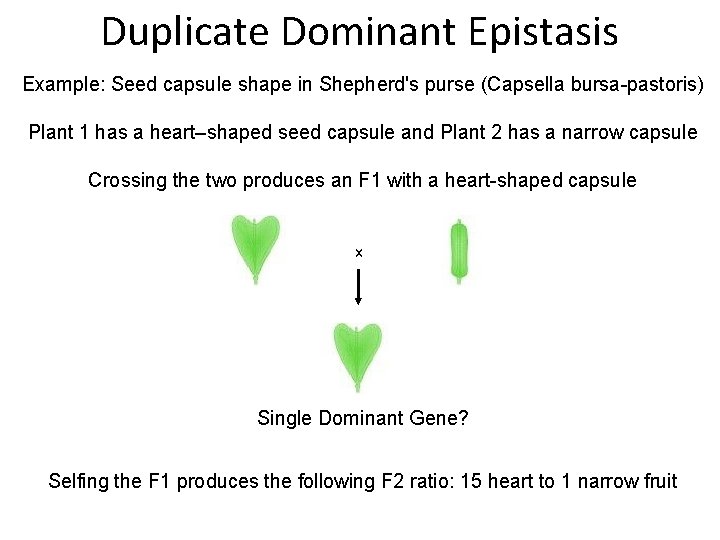
Duplicate Dominant Epistasis Example: Seed capsule shape in Shepherd's purse (Capsella bursa-pastoris) Plant 1 has a heart–shaped seed capsule and Plant 2 has a narrow capsule Crossing the two produces an F 1 with a heart-shaped capsule x Single Dominant Gene? Selfing the F 1 produces the following F 2 ratio: 15 heart to 1 narrow fruit
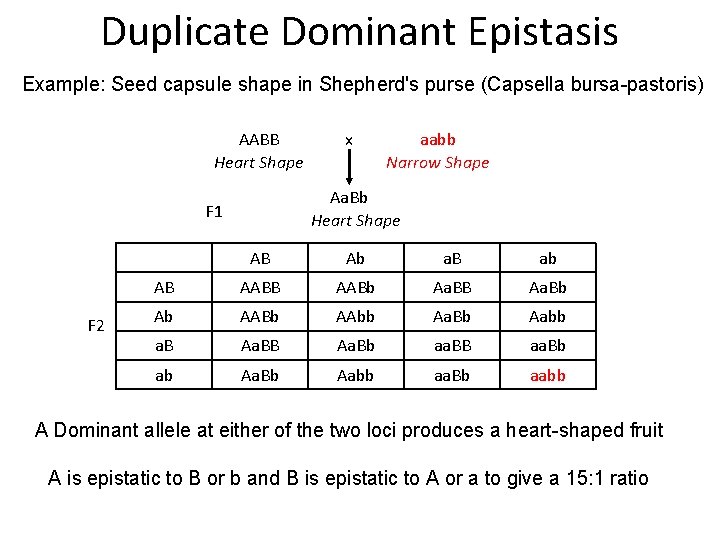
Duplicate Dominant Epistasis Example: Seed capsule shape in Shepherd's purse (Capsella bursa-pastoris) AABB Heart Shape aabb Narrow Shape Aa. Bb Heart Shape F 1 F 2 x AB Ab a. B ab AB AABb Aa. BB Aa. Bb Ab AABb AAbb Aa. Bb Aabb a. B Aa. Bb aa. BB aa. Bb ab Aa. Bb Aabb aa. Bb aabb A Dominant allele at either of the two loci produces a heart-shaped fruit A is epistatic to B or b and B is epistatic to A or a to give a 15: 1 ratio
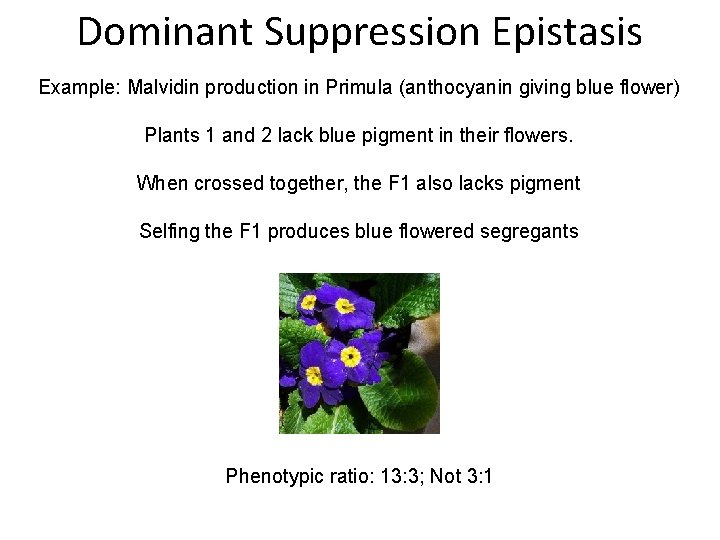
Dominant Suppression Epistasis Example: Malvidin production in Primula (anthocyanin giving blue flower) Plants 1 and 2 lack blue pigment in their flowers. When crossed together, the F 1 also lacks pigment Selfing the F 1 produces blue flowered segregants Phenotypic ratio: 13: 3; Not 3: 1
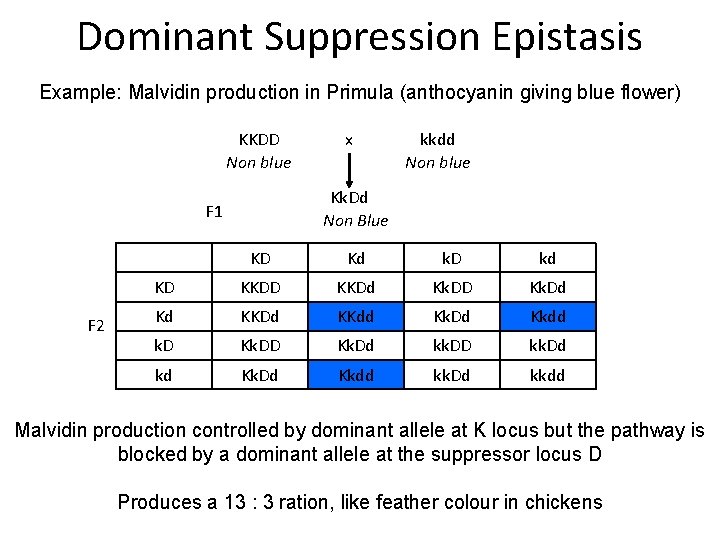
Dominant Suppression Epistasis Example: Malvidin production in Primula (anthocyanin giving blue flower) KKDD Non blue kkdd Non blue Kk. Dd Non Blue F 1 F 2 x KD Kd k. D kd KD KKDd Kk. DD Kk. Dd Kd KKDd KKdd Kk. Dd Kkdd k. D Kk. Dd kk. DD kk. Dd kd Kk. Dd Kkdd kk. Dd kkdd Malvidin production controlled by dominant allele at K locus but the pathway is blocked by a dominant allele at the suppressor locus D Produces a 13 : 3 ration, like feather colour in chickens
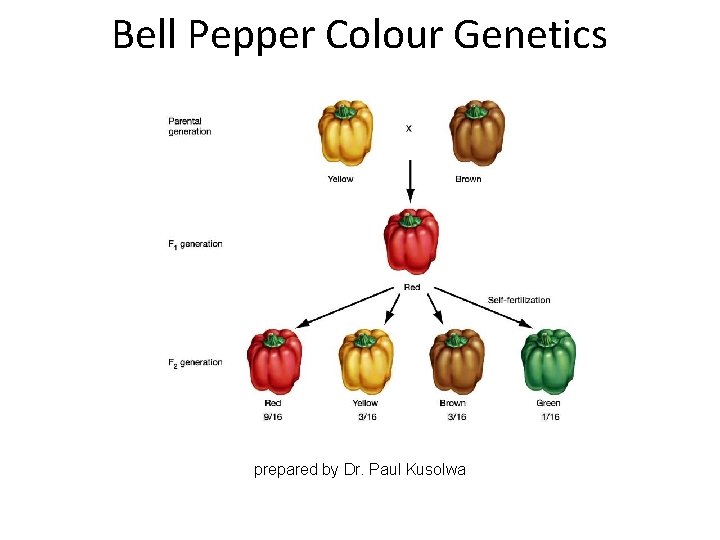
Bell Pepper Colour Genetics prepared by Dr. Paul Kusolwa
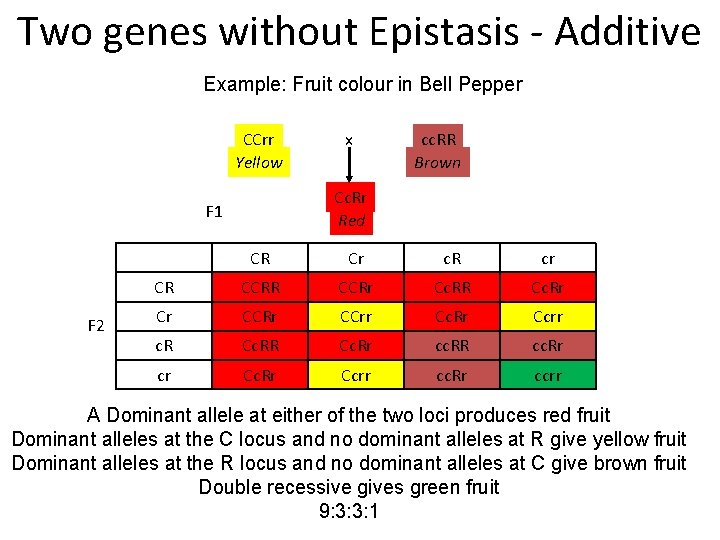
Two genes without Epistasis - Additive Example: Fruit colour in Bell Pepper CCrr Yellow cc. RR Brown Cc. Rr Red F 1 F 2 x CR Cr c. R cr CR CCRr Cc. RR Cc. Rr Cr CCRr CCrr Cc. Rr Ccrr c. R Cc. Rr cc. RR cc. Rr cr Cc. Rr Ccrr cc. Rr ccrr A Dominant allele at either of the two loci produces red fruit Dominant alleles at the C locus and no dominant alleles at R give yellow fruit Dominant alleles at the R locus and no dominant alleles at C give brown fruit Double recessive gives green fruit 9: 3: 3: 1
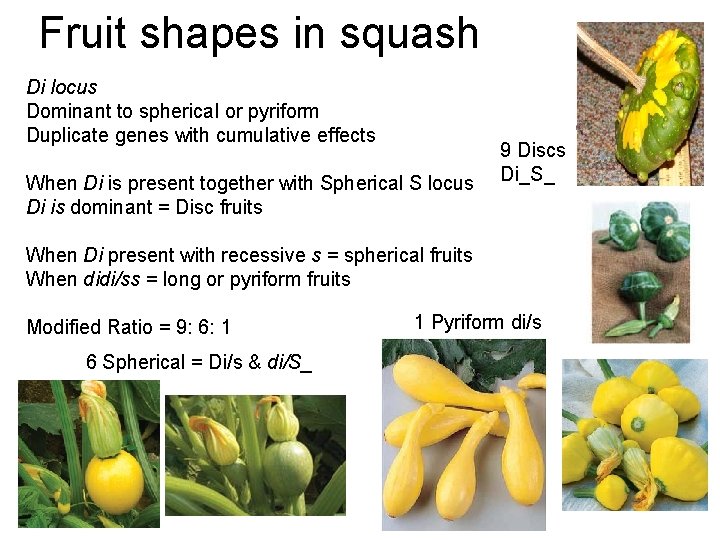
Fruit shapes in squash Di locus Dominant to spherical or pyriform Duplicate genes with cumulative effects When Di is present together with Spherical S locus Di is dominant = Disc fruits 9 Discs Di_S_ When Di present with recessive s = spherical fruits When didi/ss = long or pyriform fruits Modified Ratio = 9: 6: 1 6 Spherical = Di/s & di/S_ 1 Pyriform di/s
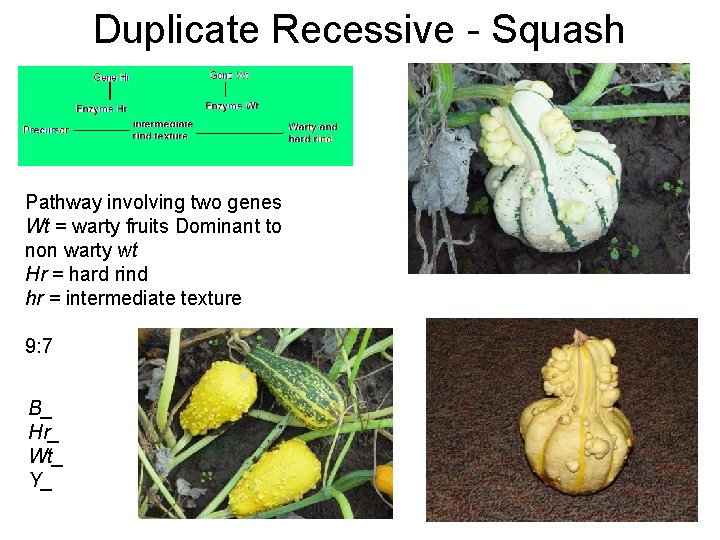
Duplicate Recessive - Squash Pathway involving two genes Wt = warty fruits Dominant to non warty wt Hr = hard rind hr = intermediate texture 9: 7 B_ Hr_ Wt_ Y_
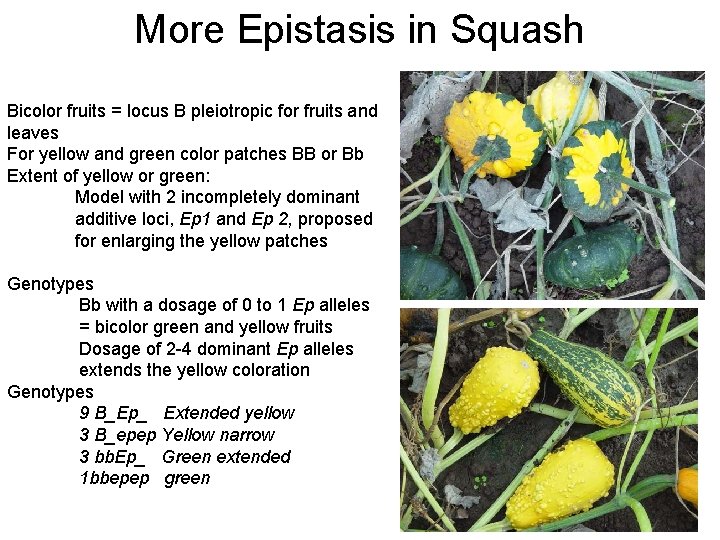
More Epistasis in Squash Bicolor fruits = locus B pleiotropic for fruits and leaves For yellow and green color patches BB or Bb Extent of yellow or green: Model with 2 incompletely dominant additive loci, Ep 1 and Ep 2, proposed for enlarging the yellow patches Genotypes Bb with a dosage of 0 to 1 Ep alleles = bicolor green and yellow fruits Dosage of 2 -4 dominant Ep alleles extends the yellow coloration Genotypes 9 B_Ep_ Extended yellow 3 B_epep Yellow narrow 3 bb. Ep_ Green extended 1 bbepep green
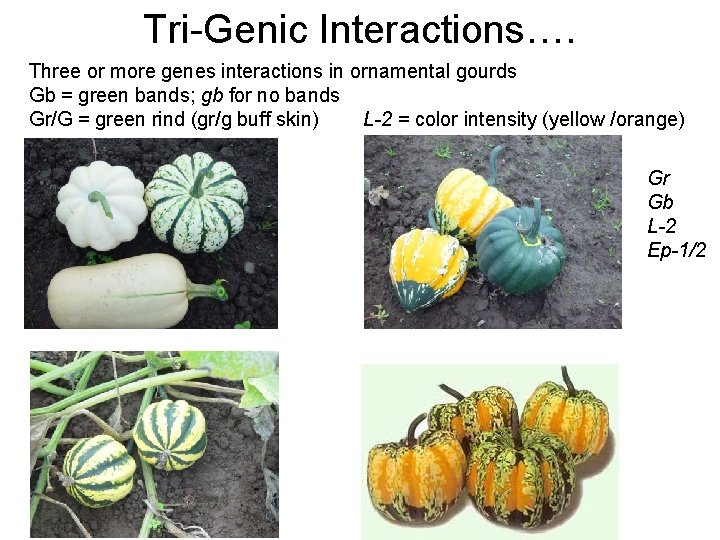
Tri-Genic Interactions…. Three or more genes interactions in ornamental gourds Gb = green bands; gb for no bands Gr/G = green rind (gr/g buff skin) L-2 = color intensity (yellow /orange) Gr Gb L-2 Ep-1/2
- Slides: 12