
Receptors 1 Electrical signals produced by excitable cells
Receptors 1

Electrical signals produced by excitable cells Neurons, muscle fibers Potentials n n Action Graded Threshold 2

Electrical signals produced by excitable cells Types of Synapses Excitatory and Inhibitory Post synaptic potentials Neurotransmitters n n Neuromuscular junction-acetylcholine Biogenic Amines-epinepherine, norepinepherine, serotonin, dopamine Amino Acids Peptides-endorphins, substance P 3
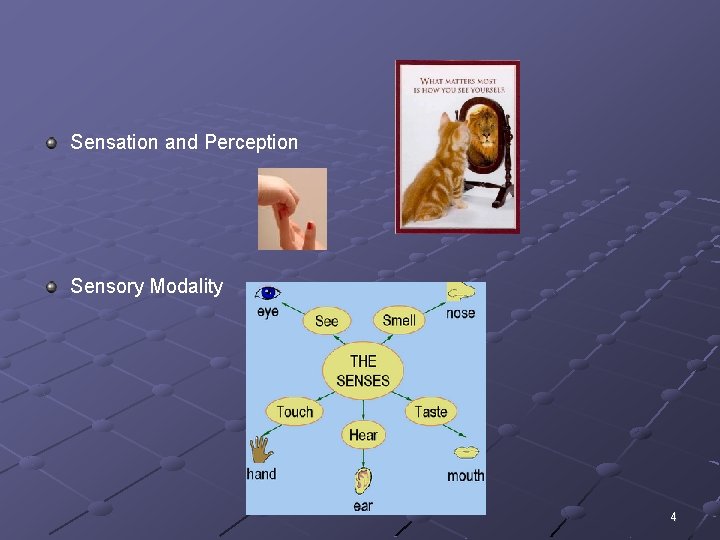
Sensation and Perception Sensory Modality 4

Processing at the Receptor Level ---The process of sensation l l Stimulation Transduction Generation of nerve impulse Integration 5

Sensory input via receptors Types of receptors: 1. free nerve endings n Merkel disk n Follicle receptor n Itch receptor 2. encapsulated n Meissner’s corpuscle n Pacinian n Ruffini n Golgi tendon organ n Muscle spindles n Kinesthetic receptors 6
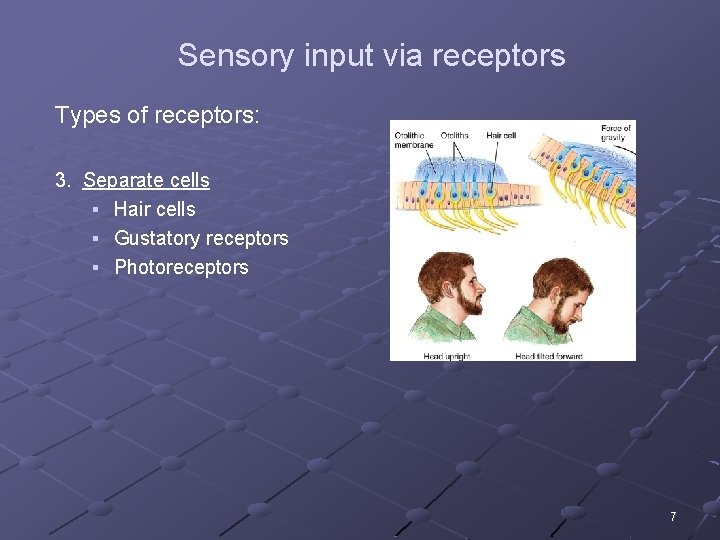
Sensory input via receptors Types of receptors: 3. Separate cells § Hair cells § Gustatory receptors § Photoreceptors 7

Types of Receptors Stimulus: Ø Thermoreceptors Ø Chemoreceptors Ø Photoreceptors Ø Mechanoreceptors Ø Nociceptors Location: ØExteroreceptors ØInteroreceptors ØProprioreceptors 8
Adaptation occurs when sensory receptors are subjected to an unchanging stimulus Exception: Nociceptors and Proprioceptors 9
Checkpoint questions: 12. 25 How are graded potentials and the action potential threshold related? 12. 26 What is the all or none principle? Are graded potentials all-or-none? 12. 36 Explain the effects of excitatory and inhibitory postsynaptic potentials on the postsynaptic neuron. 15. 2 Distinguish between general and special senses. 15. 4 What four events must occur for a sensation to occur? 15. 5 What is transduction? 15. 7 What is adaptation? How does it occur? 15. 10 Why do we need pain receptors? How are they activated? 15. 13 What is the function of joint kinesthetic receptors? 10
- Slides: 10