
Receptor terminology Proteinligand properties specificity saturation affinity competition






![Calcium as a second messenger extracellular [Ca++] ~1. 2 m. M; cytosolic [Ca++] ~10](https://slidetodoc.com/presentation_image/0dec67808114cc9c346f45e7a53fe115/image-17.jpg "Calcium as a second messenger extracellular [Ca++] ~1. 2 m. M; cytosolic [Ca++] ~10")
- Slides: 20
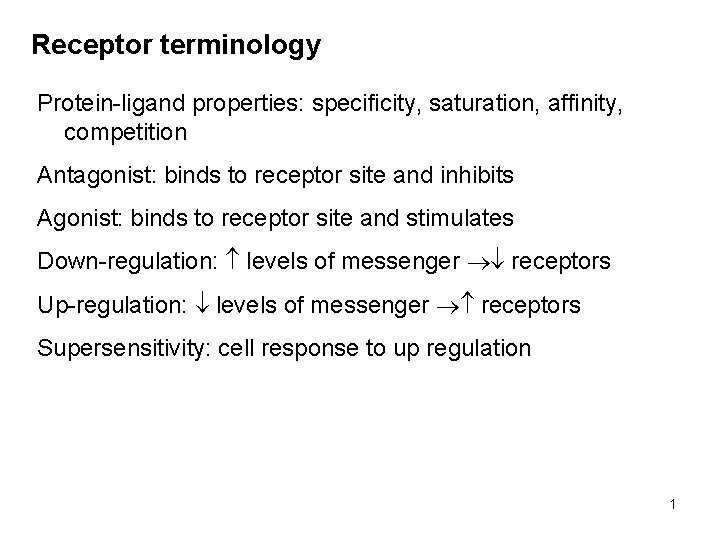
Receptor terminology Protein-ligand properties: specificity, saturation, affinity, competition Antagonist: binds to receptor site and inhibits Agonist: binds to receptor site and stimulates Down-regulation: levels of messenger receptors Up-regulation: levels of messenger receptors Supersensitivity: cell response to up regulation 1
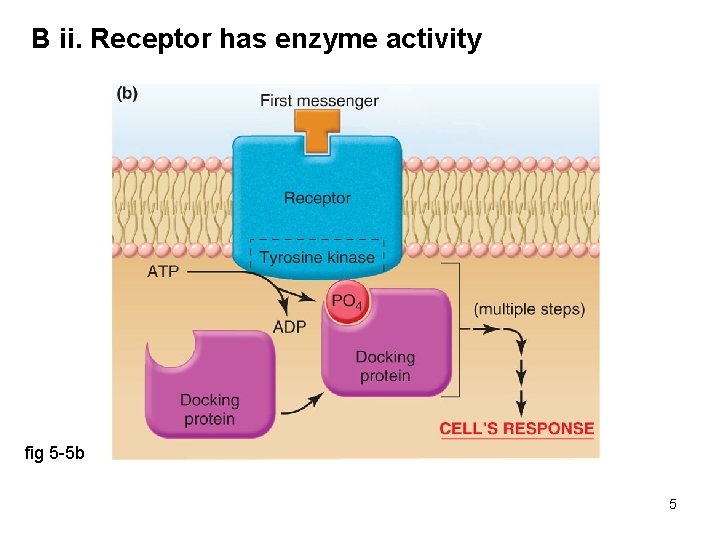
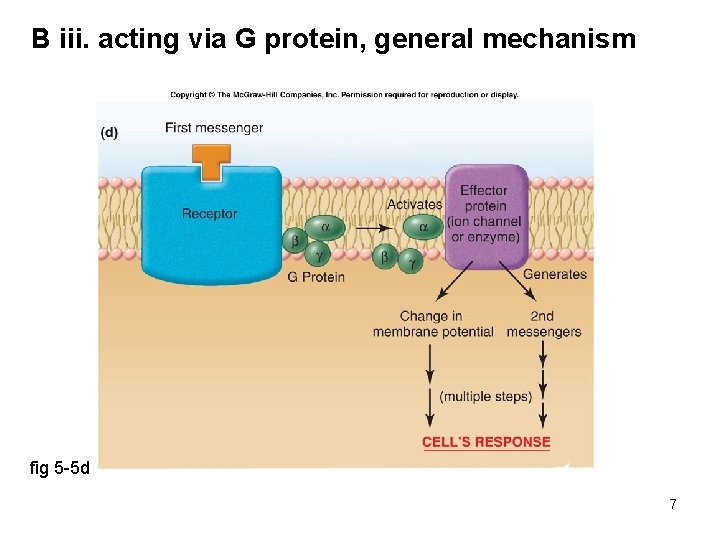
Receptor types A. Intracellular receptors (steroid, thyroid hormones) B. Cell membrane receptors i. ion selective channels (acetyl choline) ii. receptor has enzyme activity (insulin) iii. receptors acting via G proteins a. adenylate cyclase ( adrenergic, glucagon, TSH, etc. ) b. phospholipase C ( adrenergic, angiotensin II, etc. ) (b. G proteins directly on ion selective channels-ignore) 2
A. Intracellular receptors Examples: thyroid hormones (T 3 & T 4), steroids (estrogen, progesterone, testosterone, aldosterone, cortisol) fig 5 -4 3
B i. Ion selective channels e. g. acetyl choline (nicotinic), many CNS neurotransmitters (glutamate, glycine, GABA) fig 5 -5 a 4
B ii. Receptor has enzyme activity fig 5 -5 b 5
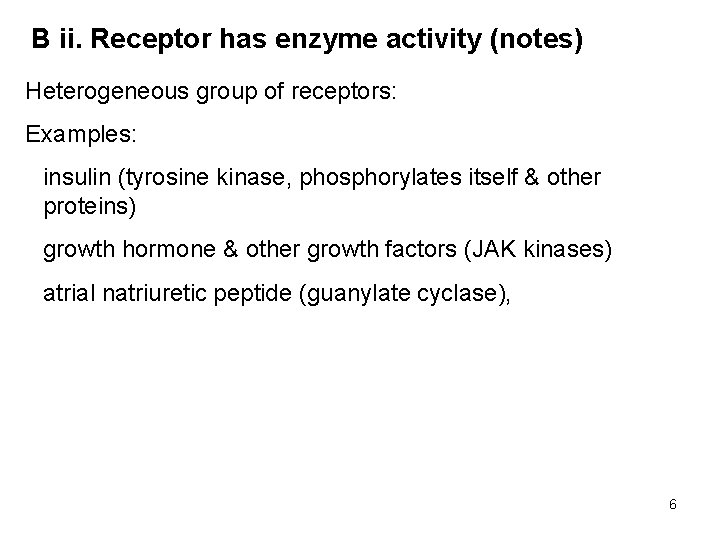
B ii. Receptor has enzyme activity (notes) Heterogeneous group of receptors: Examples: insulin (tyrosine kinase, phosphorylates itself & other proteins) growth hormone & other growth factors (JAK kinases) atrial natriuretic peptide (guanylate cyclase), 6
B iii. acting via G protein, general mechanism fig 5 -5 d 7
B iii. Why are they called G proteins? Notes: subunit has GTPase activity reassembly of γ-GDP G proteins transmit signals from >1000 receptors 8
B iiia. Adenylate cyclase & cyclic AMP fig 5 -6 9
Adenylate cyclase & cyclic AMP (notes) Examples: where G protein is Gs (G stimulating); 1 adrenergic receptors, glucagon, antidiuretic hormone in kidney (V 2 receptor), oxytocin, thyroid stimulating hormone (TSH), adrenocorticotropic hormone (ACTH), luteinizing hormone (LH), follicle stimulating hormone (FSH), parathyroid hormone (PTH), histamine, cholecystokinin (CCK), corticotrophin releasing hormone (CRH) where G protein is Gi (G inhibiting) 2 adrenergic receptors c. AMP dependent protein kinase = protein kinase A phosphorylates serine or threonine residues 10
Cyclic AMP synthesis & degradation fig 5 -7 11
Amplification of c. AMP effect fig 5 -8 12
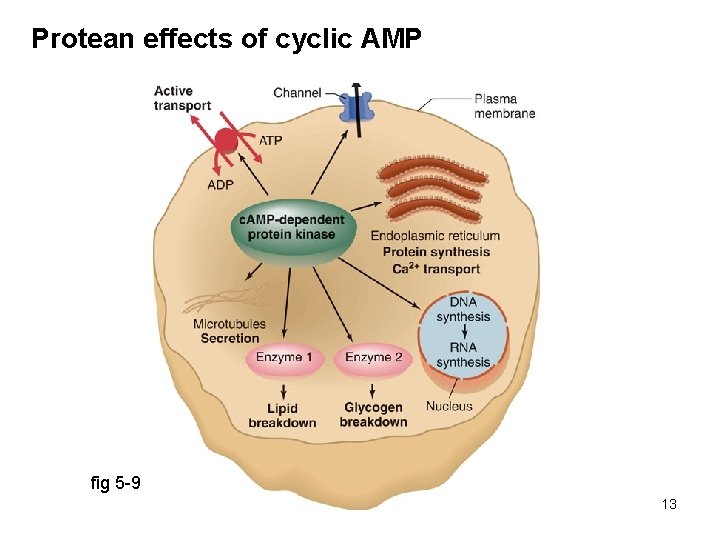
Protean effects of cyclic AMP fig 5 -9 13
B iiib. Phospholipase C 14
B iiib. Phospholipase C action 15
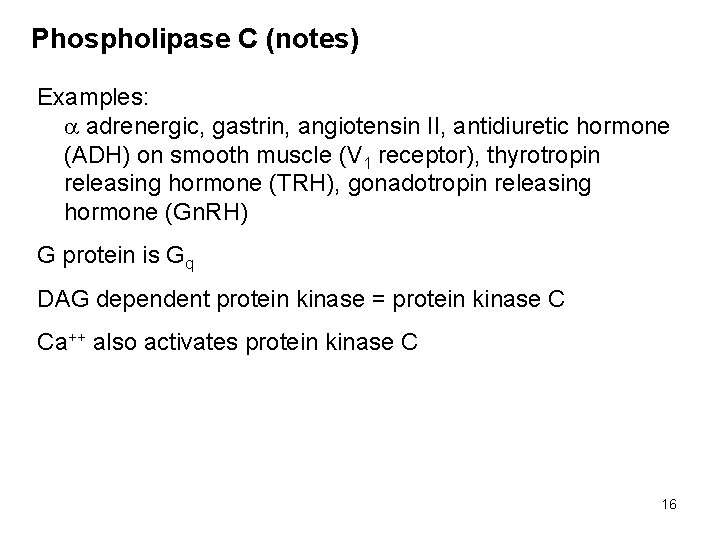
Phospholipase C (notes) Examples: adrenergic, gastrin, angiotensin II, antidiuretic hormone (ADH) on smooth muscle (V 1 receptor), thyrotropin releasing hormone (TRH), gonadotropin releasing hormone (Gn. RH) G protein is Gq DAG dependent protein kinase = protein kinase C Ca++ also activates protein kinase C 16
Calcium as a second messenger extracellular [Ca++] ~1. 2 m. M; cytosolic [Ca++] ~10 -4 m. M (0. 0001 m. M) Entry of Ca++ into cytosol via voltage-gated ion channels via ligand-gated ion channels via intracellular Ca++ gated channels (heart muscle) via covalently modified (phosphorylated) ion channels from endoplasmic reticulum after IP 3 action 17
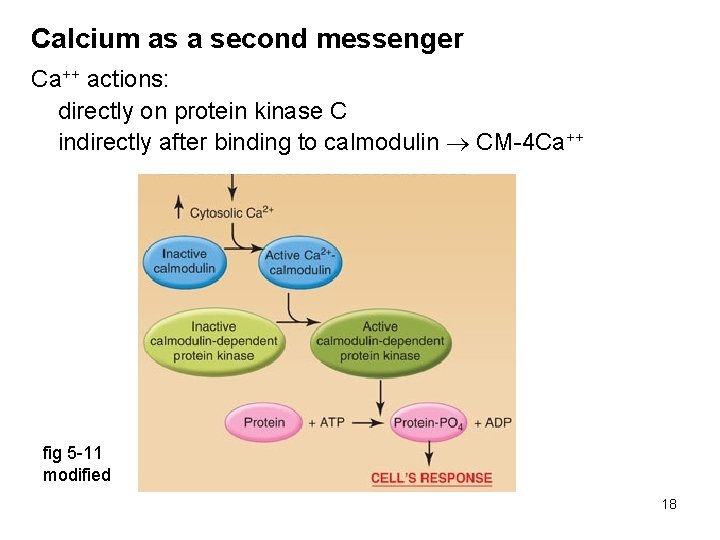
Calcium as a second messenger Ca++ actions: directly on protein kinase C indirectly after binding to calmodulin CM-4 Ca++ fig 5 -11 modified 18
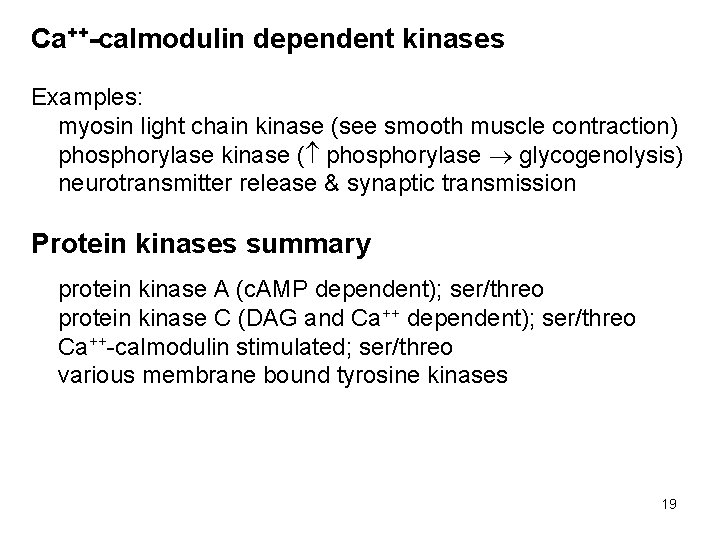
Ca++-calmodulin dependent kinases Examples: myosin light chain kinase (see smooth muscle contraction) phosphorylase kinase ( phosphorylase glycogenolysis) neurotransmitter release & synaptic transmission Protein kinases summary protein kinase A (c. AMP dependent); ser/threo protein kinase C (DAG and Ca++ dependent); ser/threo Ca++-calmodulin stimulated; ser/threo various membrane bound tyrosine kinases 19
Some actions of calcium (when free in cytosol) release of neurotransmitters by exocytosis release of peptide and catecholamine hormones contraction of smooth, cardiac and skeletal muscle 20