
Receptive and Productive Vocabulary Learning Stuart Webb 2008
Receptive and Productive Vocabulary Learning Stuart Webb 2008. 11. 20. Kim, Kwi-hyun, Cha, Ji-eun
1. Introduction ü Investigation on the Effects of Receptive and Productive Learning Tasks on Word Knowledge
Contents 1. Introduction 2. Experiment Design 3. Experiment 1 4. Experiment 2 5. Results 6. Discussion 7. Conclusion & Limitation
1. Introduction ü Prevalence of receptive vocabulary learning - The majority of vocabulary is learned receptively through reading or listening. (Jenkins, Stein, & Wysocki, 1984; Nagy, Anderson, & Herman, 1987; Nagy &Herman, 1987; Nagy, Herman, & Anderson, 1985)
1. Introduction However, little research that proves its efficacy In Fact, the opposite may be true
1. Introduction ü Research on learning word pairs - the type of learning affects the type and amount of knowledge gained (Griffin & Harley, 1996; Stoddard, 1929; Waring, 1997 b)
1. Introduction ü Research on learning word pairs - receptive task more receptive knowledge - productive task more productive knowledge - only one task is used receptive task < productive task
1. Introduction ü Research on learning word pairs - weakness vocabulary gains were measured only with tests of meaning and form ØKnowing a Word - More than meaning and form - Nine different aspects , broken into receptive and productive knowledge(Nation, 2001)
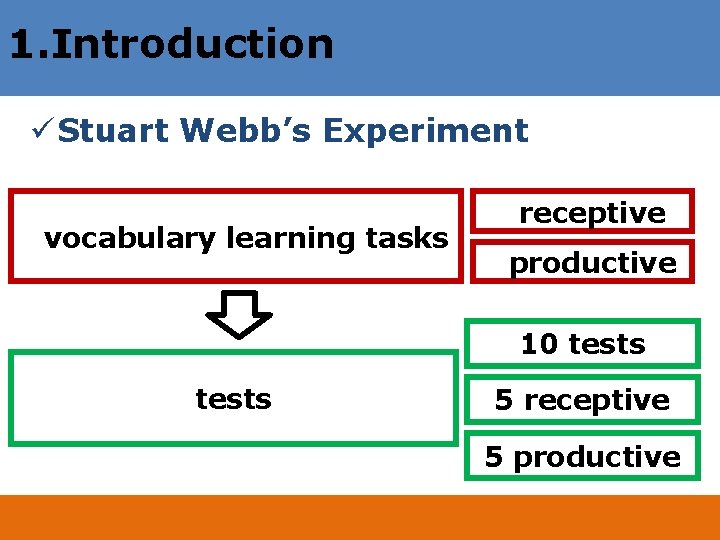
1. Introduction ü Stuart Webb’s Experiment vocabulary learning tasks receptive productive 10 tests 5 receptive 5 productive
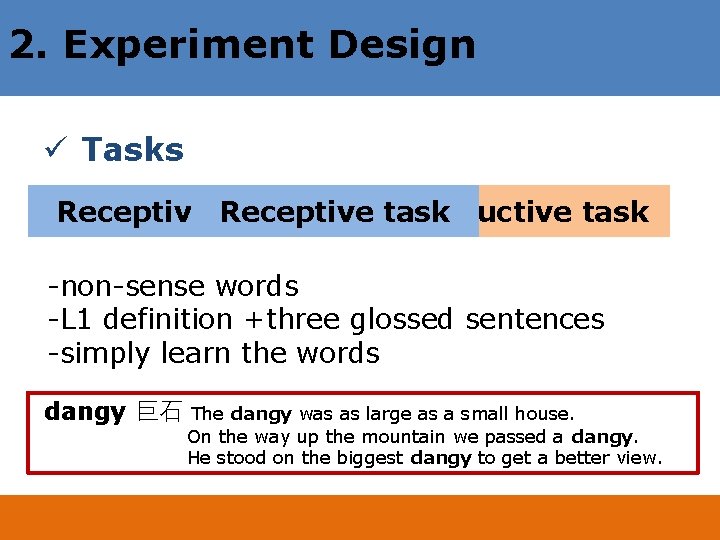
2. Experiment Design ü Tasks Receptive task Productive task -non-sense words -L 1 definition +three glossed sentences -simply learn the words dangy 巨石 The dangy was as large as a small house. On the way up the mountain we passed a dangy. He stood on the biggest dangy to get a better view.
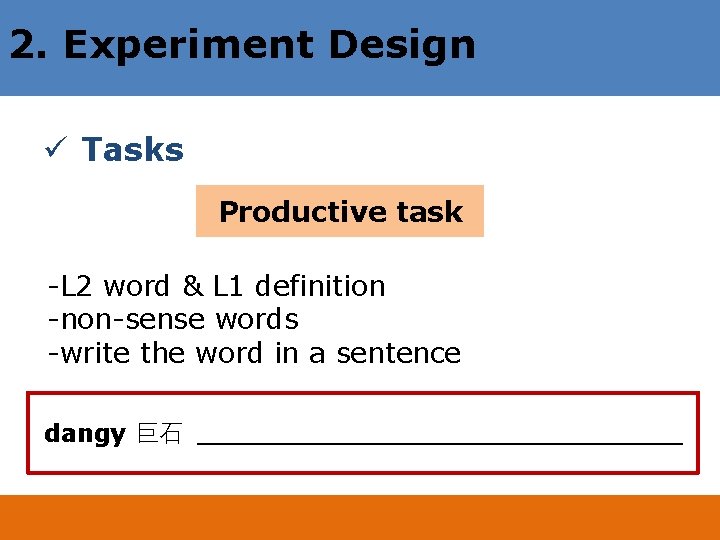
2. Experiment Design ü Tasks Productive task -L 2 word & L 1 definition -non-sense words -write the word in a sentence dangy 巨石 ___________________
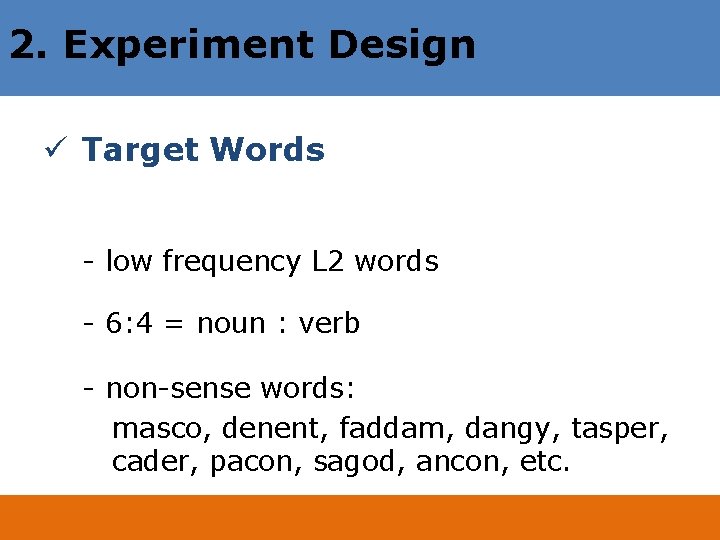
2. Experiment Design ü Target Words - low frequency L 2 words - 6: 4 = noun : verb - non-sense words: masco, denent, faddam, dangy, tasper, cader, pacon, sagod, ancon, etc.
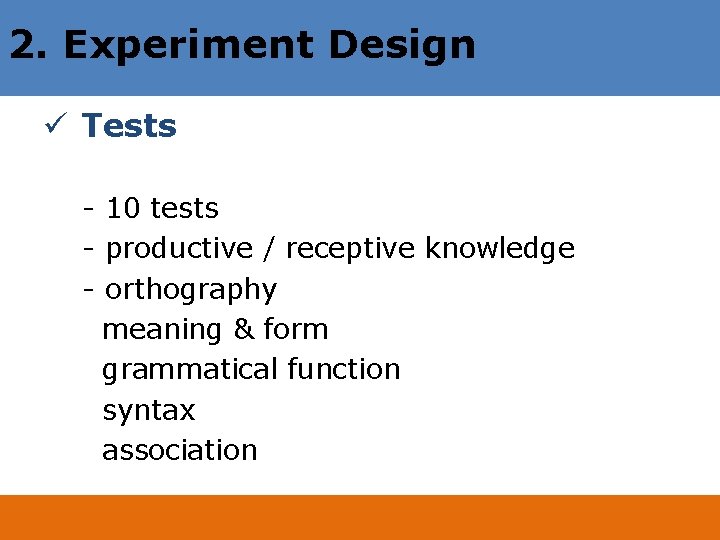
2. Experiment Design ü Tests - 10 tests - productive / receptive knowledge - orthography meaning & form grammatical function syntax association
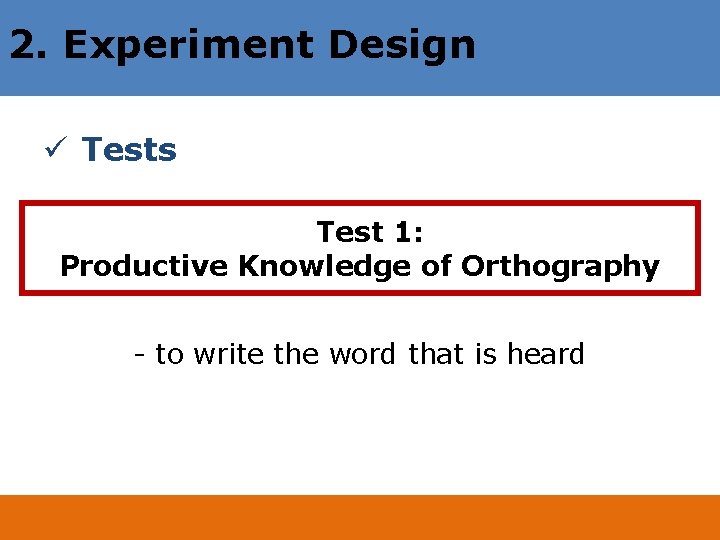
2. Experiment Design ü Tests Test 1: Productive Knowledge of Orthography - to write the word that is heard
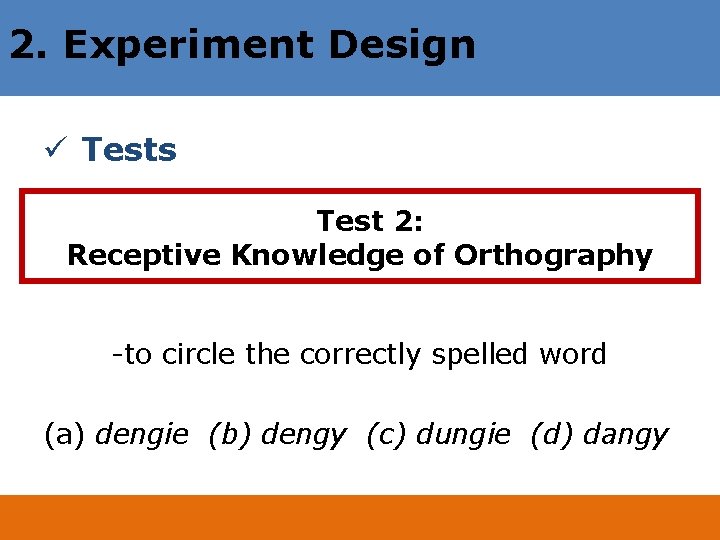
2. Experiment Design ü Tests Test 2: Receptive Knowledge of Orthography -to circle the correctly spelled word (a) dengie (b) dengy (c) dungie (d) dangy
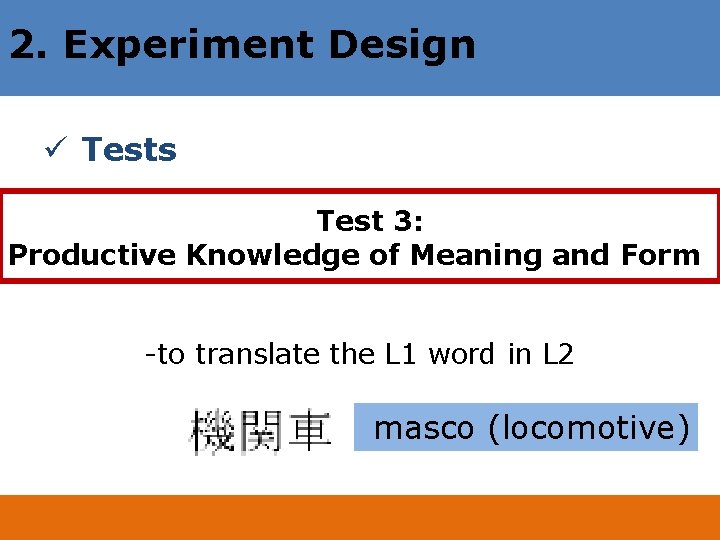
2. Experiment Design ü Tests Test 3: Productive Knowledge of Meaning and Form -to translate the L 1 word in L 2 masco (locomotive)
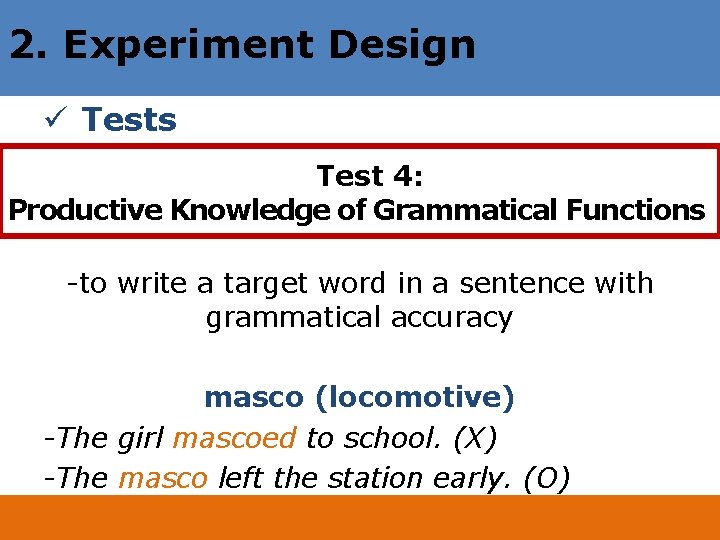
2. Experiment Design ü Tests Test 4: Productive Knowledge of Grammatical Functions -to write a target word in a sentence with grammatical accuracy masco (locomotive) -The girl mascoed to school. (X) -The masco left the station early. (O)
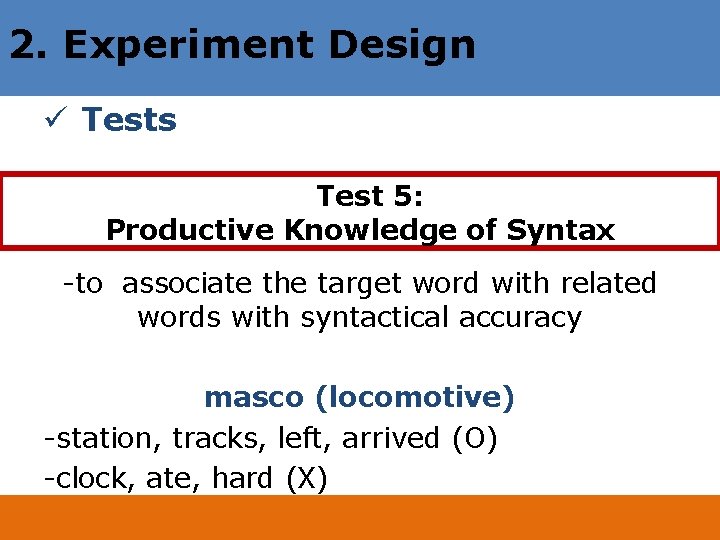
2. Experiment Design ü Tests Test 5: Productive Knowledge of Syntax -to associate the target word with related words with syntactical accuracy masco (locomotive) -station, tracks, left, arrived (O) -clock, ate, hard (X)
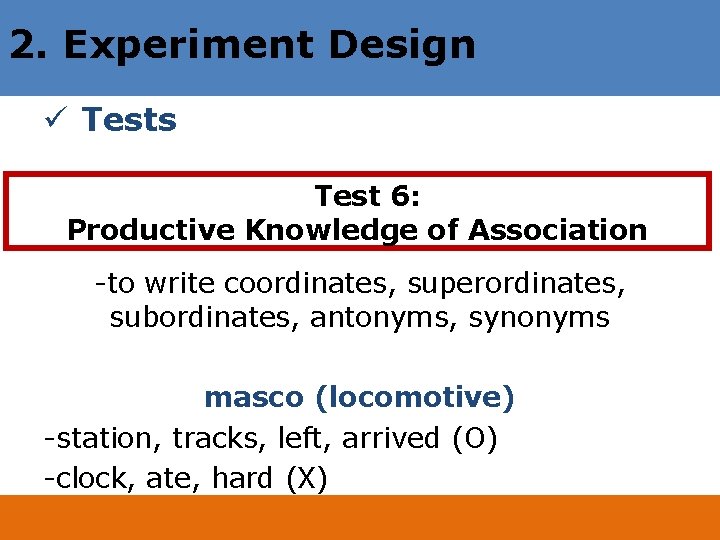
2. Experiment Design ü Tests Test 6: Productive Knowledge of Association -to write coordinates, superordinates, subordinates, antonyms, synonyms masco (locomotive) -station, tracks, left, arrived (O) -clock, ate, hard (X)
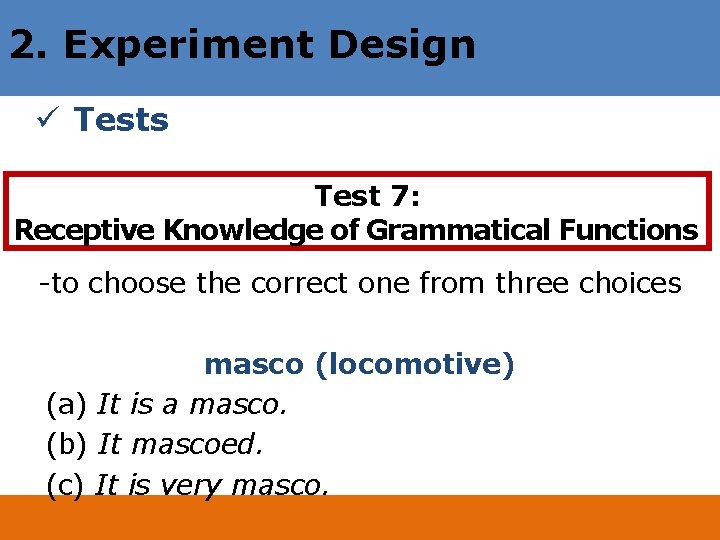
2. Experiment Design ü Tests Test 7: Receptive Knowledge of Grammatical Functions -to choose the correct one from three choices masco (locomotive) (a) It is a masco. (b) It mascoed. (c) It is very masco.
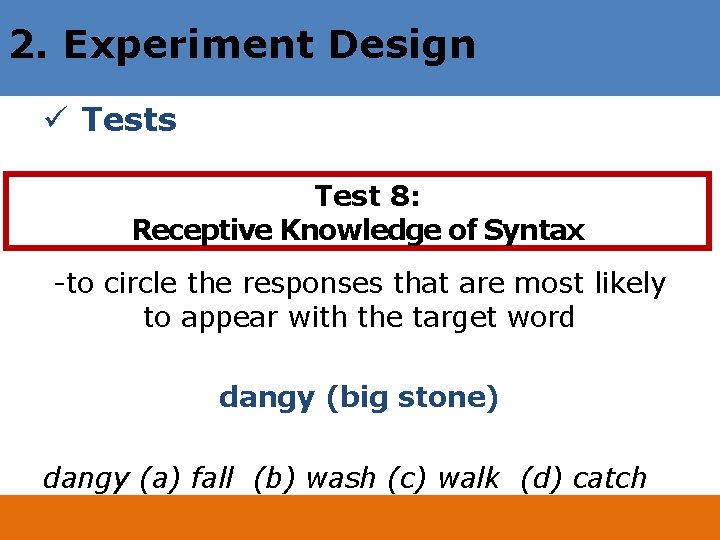
2. Experiment Design ü Tests Test 8: Receptive Knowledge of Syntax -to circle the responses that are most likely to appear with the target word dangy (big stone) dangy (a) fall (b) wash (c) walk (d) catch
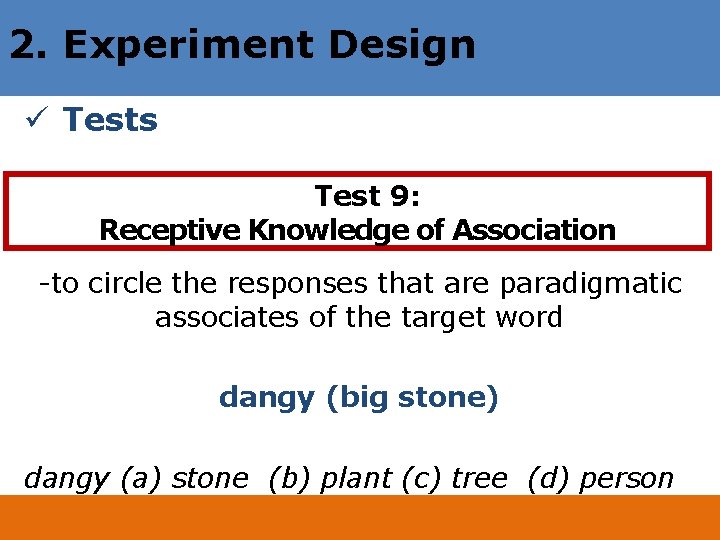
2. Experiment Design ü Tests Test 9: Receptive Knowledge of Association -to circle the responses that are paradigmatic associates of the target word dangy (big stone) dangy (a) stone (b) plant (c) tree (d) person
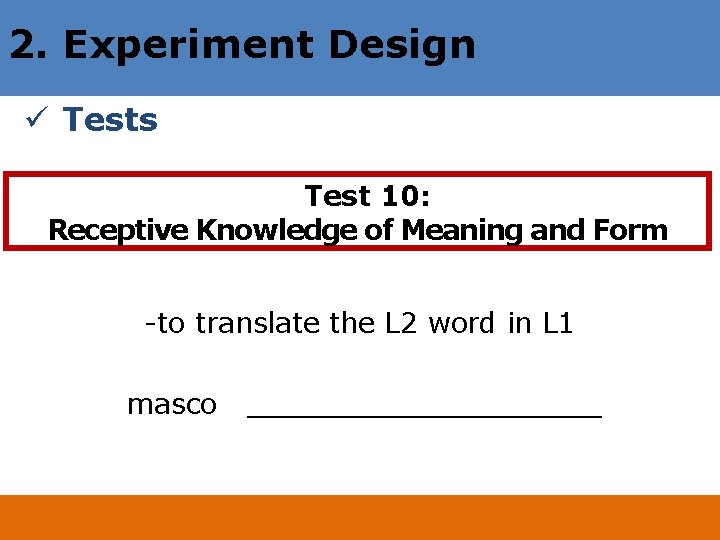
2. Experiment Design ü Tests Test 10: Receptive Knowledge of Meaning and Form -to translate the L 2 word in L 1 masco __________
3. Experiment 1 ü Subjects - 66 Japanese EFL university students - receptive / productive knowledge of 2, 000 most frequent words
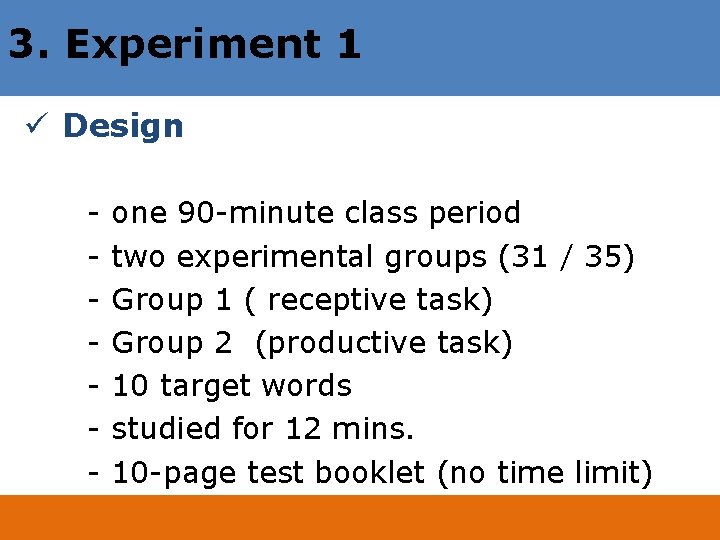
3. Experiment 1 ü Design - one 90 -minute class period two experimental groups (31 / 35) Group 1 ( receptive task) Group 2 (productive task) 10 target words studied for 12 mins. 10 -page test booklet (no time limit)
4. Experiment 2 ü Subjects - 49 Japanese EFL university students - receptive / productive knowledge of 2, 000 most frequent words
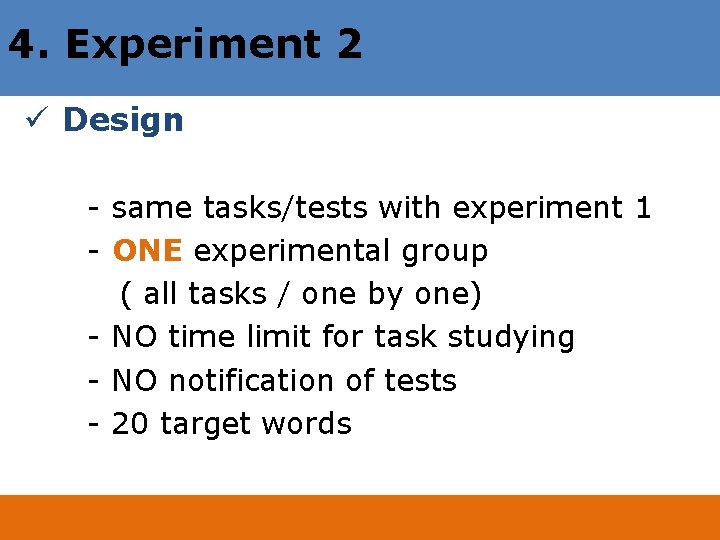
4. Experiment 2 ü Design - same tasks/tests with experiment 1 - ONE experimental group ( all tasks / one by one) - NO time limit for task studying - NO notification of tests - 20 target words
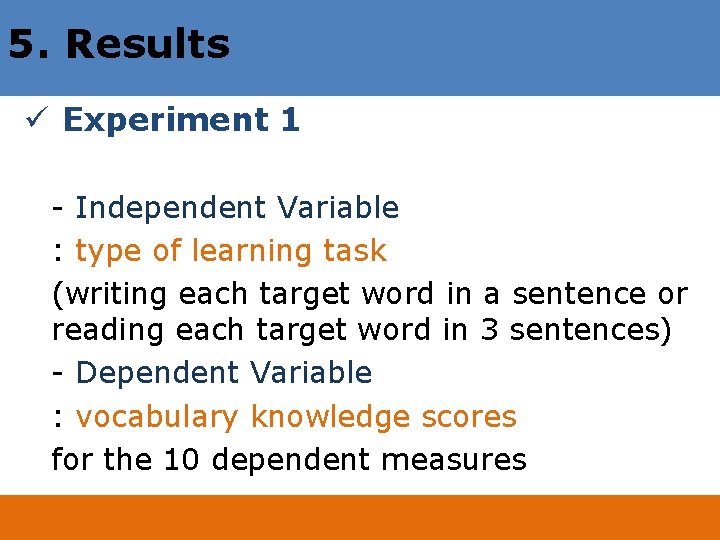
5. Results ü Experiment 1 - Independent Variable : type of learning task (writing each target word in a sentence or reading each target word in 3 sentences) - Dependent Variable : vocabulary knowledge scores for the 10 dependent measures
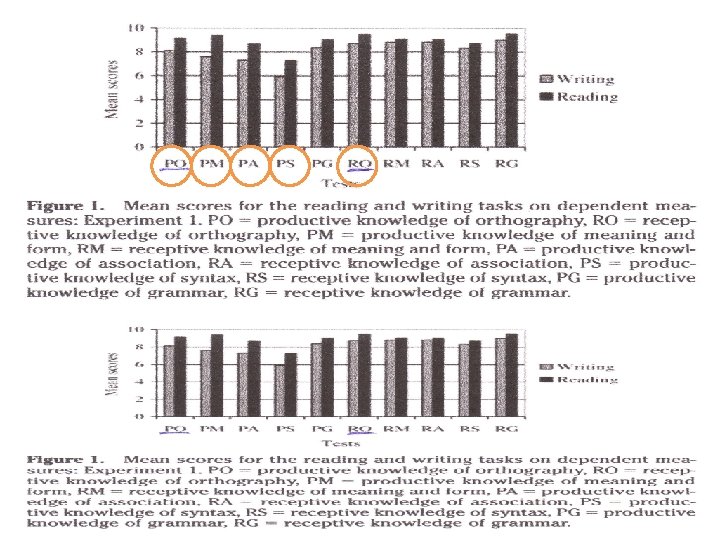
5. Results ü Experiment 1 - MANOVA - overall significant difference between the two tasks (receptive > productive) - significant differences on productive orthography, receptive orthography, productive meaning, productive association & productive syntax
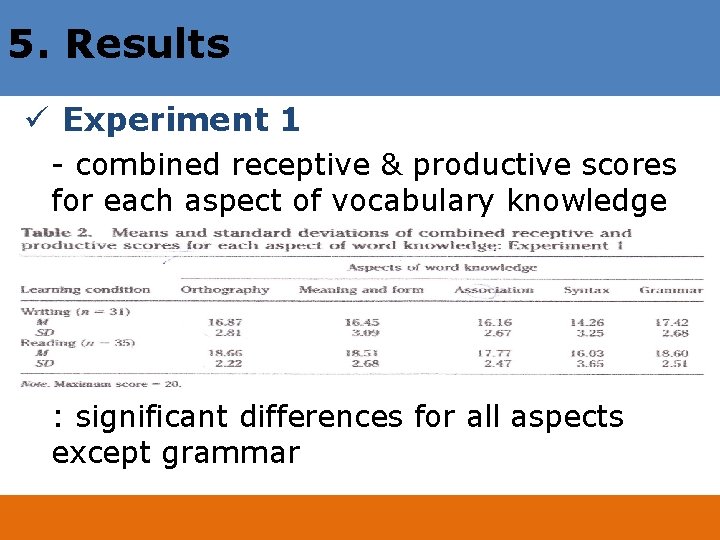
5. Results ü Experiment 1 - combined receptive & productive scores for each aspect of vocabulary knowledge : significant differences for all aspects except grammar
5. Results ü Experiment 1 - both treatments were effective receptive task > productive task one possible contributing factor: time receptive group: alternative strategies
5. Results ü Experiment 2 - repeated measures MANOVA - Independent Variable : type of learning task - Dependent Variable : vocabulary knowledge scores for the 10 dependent measures
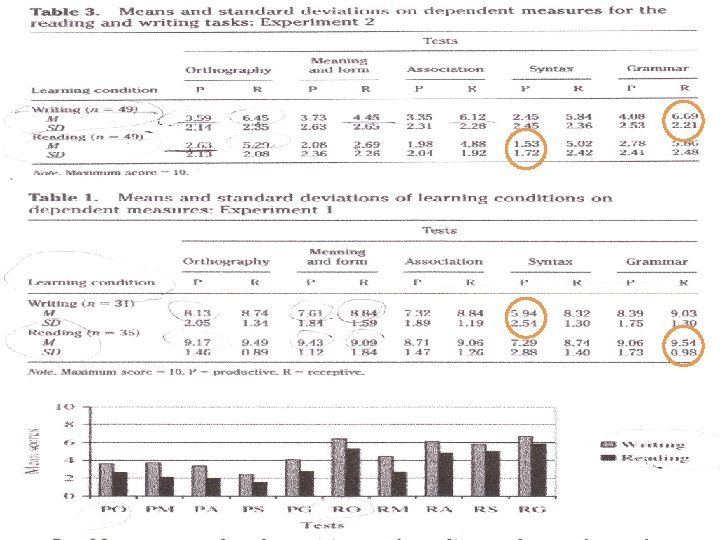
5. Results ü Experiment 2 - overall significant difference between two tasks (writing task > reading tasks) - significance differences on all aspects of productive & receptive vocabulary knowledge - lower scores than those in experiment 1
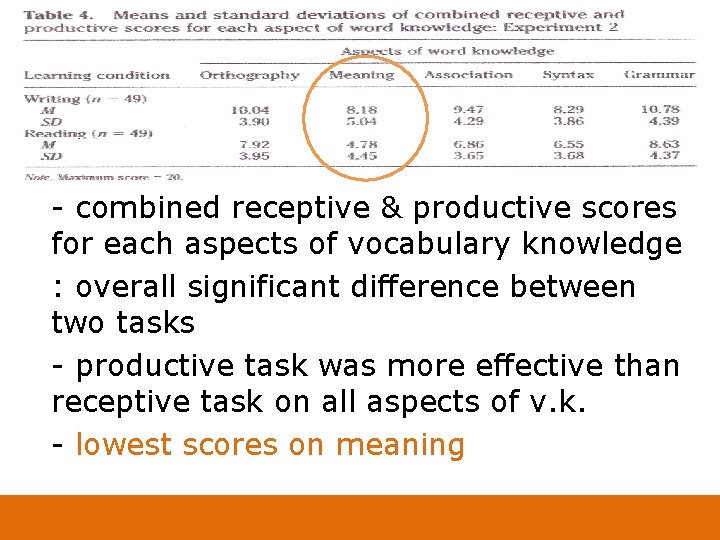
5. Results ü Experiment 2 - combined receptive & productive scores for each aspects of vocabulary knowledge : overall significant difference between two tasks - productive task was more effective than receptive task on all aspects of v. k. - lowest scores on meaning
6. Discussion ü Experiment 1 - both tasks were very effective - contrast with earlier findings : reading group > writing group : significance differences on productive measures
6. Discussion ü Experiment 1 : : possible explanations receptive knowledge trait multiple choice format ceiling effects on receptive tests experimental design
6. Discussion ü Experiment 1 - receptive learning tasks may be better! receptive knowledge + productive knowledge
6. Discussion ü Experiment 2 - to clarify the results of experiment 1 NO control on time writing tasks > reading tasks authenticity issue ecologically valid
6. Discussion ü Experiment 2 - writing task may be more effective! productive knowledge + receptive knowledge
6. Discussion ü Experiment 2 - lower overall gain scores in experiment 2 : result of increase in target words : vocabulary learning limits issue (learners & teachers)
6. Discussion ü Experiment 2 - issue on necessity of multiple tests in measuring vocabulary gains ex) receptive measure of meaning in experiment 1 : use both receptive & productive tests! : test multiple aspects of knowledge!
7. Conclusion - both contextualized tasks contribute to all five aspects of knowledge! - measuring multiple aspects of knowledge is necessary to determine relative efficacy of providing tasks!
7. Limitation ? - experimental design : If the researcher used a same-subjects design in experiment 1 as well? : If the researcher didn’t inform that the participants will be tested after completing the tasks in experiment 1?
Thank you!
- Slides: 44