
Reception Writing Task for the Week Dear Parents


- Slides: 30
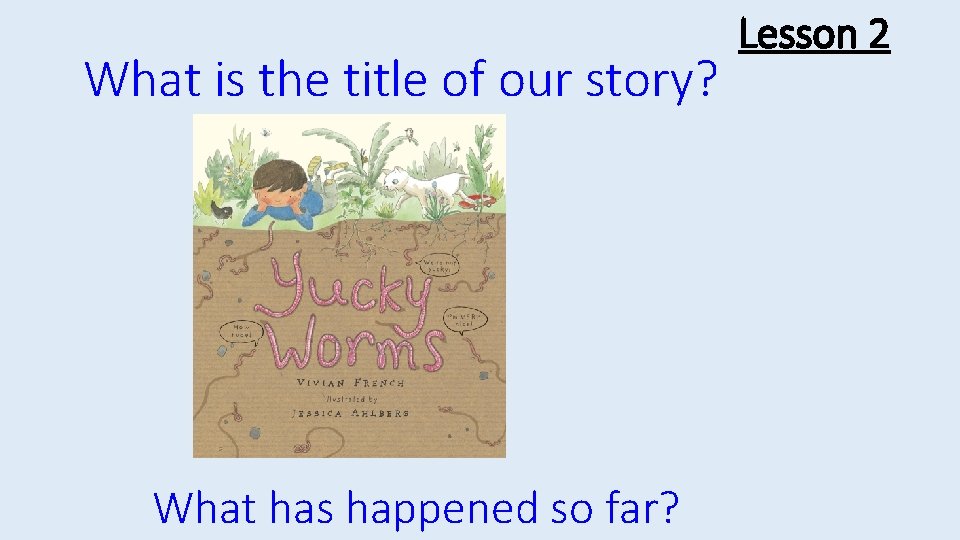
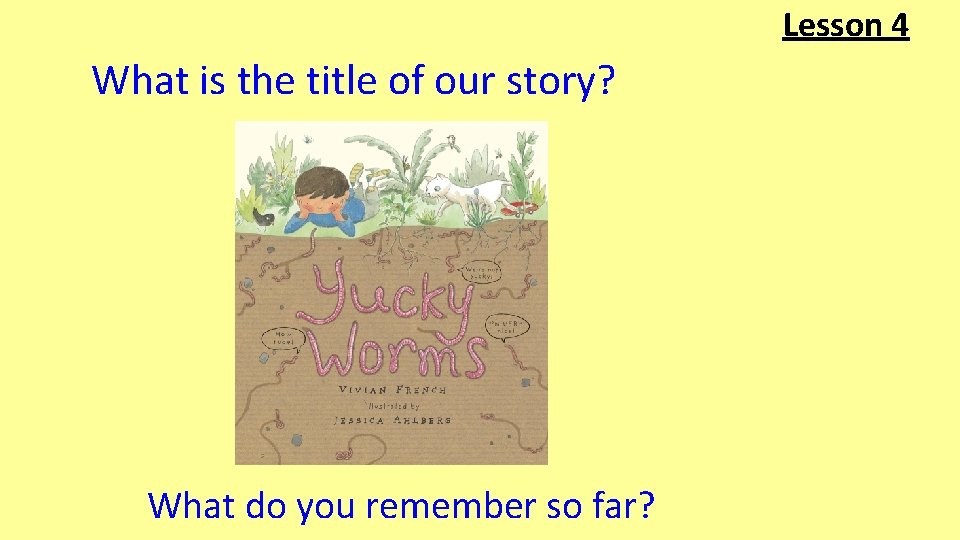
Reception Writing Task for the Week. Dear Parents, This week, we are starting a new book. The new book is called ‘Yucky Worms!’ The lessons during the week involve a set of tasks associated with the learning. As you read, ask questions to develop speaking and check understanding of what is being read. It is important children answer in complete sentences so that they can use the ideas in their writing. Each day, do go back to the previous day’s learning and recap the story. Enjoy learning. From, The Reception Team.
Notes for parents 1) Explain that you will be sharing a book together. 2) Read the title: ‘Yucky worms!’ 3) This book is about worms and the environment. Read the book with your child. 4) When talking about the story, encourage your child to speak in full sentences.
Lesson 1 This is a speaking and listening lesson.
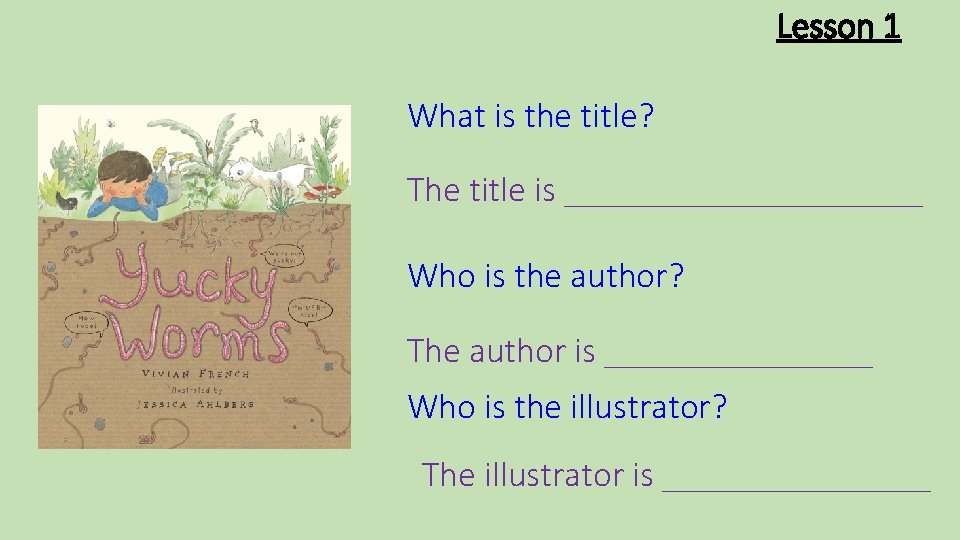
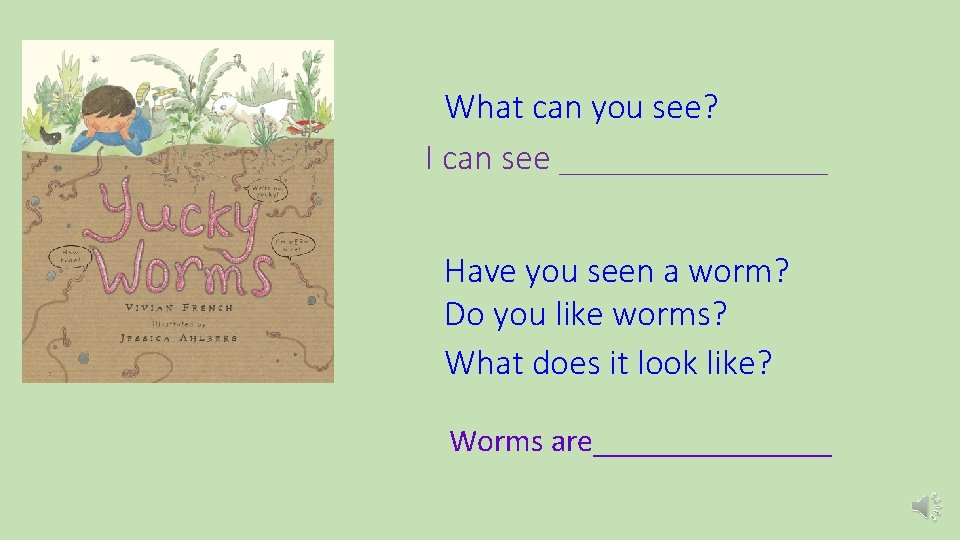
Lesson 1 What is the title? The title is __________ Who is the author? The author is ________ Who is the illustrator? The illustrator is ________
What can you see? I can see ________ Have you seen a worm? Do you like worms? What does it look like? Worms are________
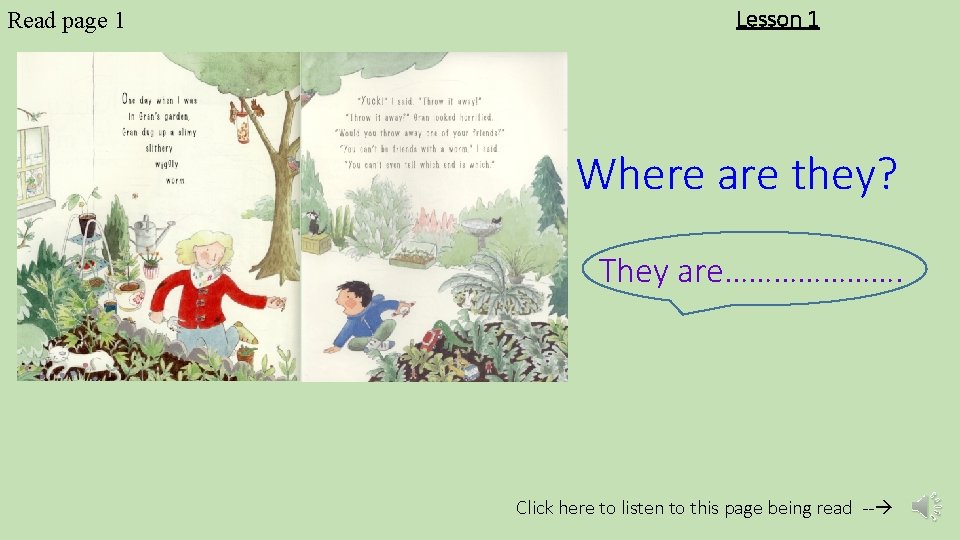
Read page 1 Lesson 1 Where are they? They are…………………. Click here to listen to this page being read --
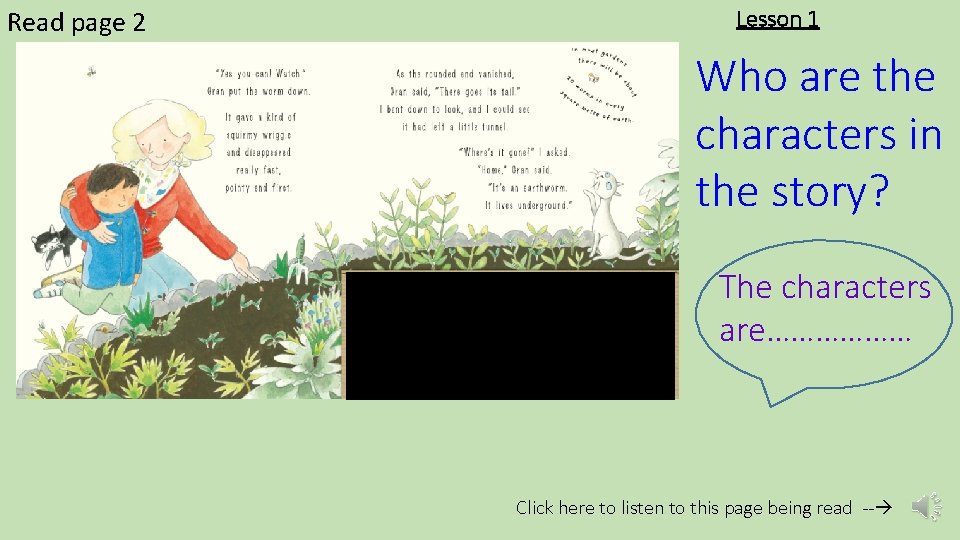
Read page 2 Lesson 1 Who are the characters in the story? The characters are……………… Click here to listen to this page being read --
Lesson 1 task Task 1: Answer this question Why are worms called Earth worms? They are called Earth worms because ____ Task 2: Go outside, where there is soil and try to find a worm. Can you spot which end is the head(pointy) and which is the tail(round)?
Lesson 2 This is a writing lesson. You will need paper and a pencil.
What is the title of our story? What has happened so far? Lesson 2
• Talk to your child about books. • Highlight that some books are fiction (made up story) and some are non-fiction (true and factual) • Show them examples of these books you may have around the house. • Look at the differences between fiction and nonfiction • Explain to them that ‘Yucky Worms’ is an interesting book because it has both. For example, there is a story with Gran and the boy. But it also has some facts that you can learn.
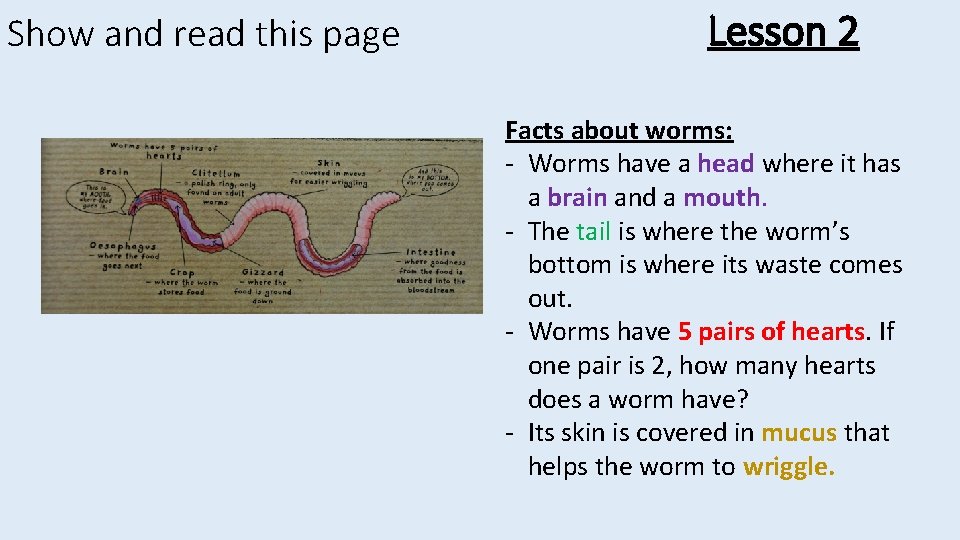
Show and read this page Lesson 2 Facts about worms: - Worms have a head where it has a brain and a mouth. - The tail is where the worm’s bottom is where its waste comes out. - Worms have 5 pairs of hearts. If one pair is 2, how many hearts does a worm have? - Its skin is covered in mucus that helps the worm to wriggle.
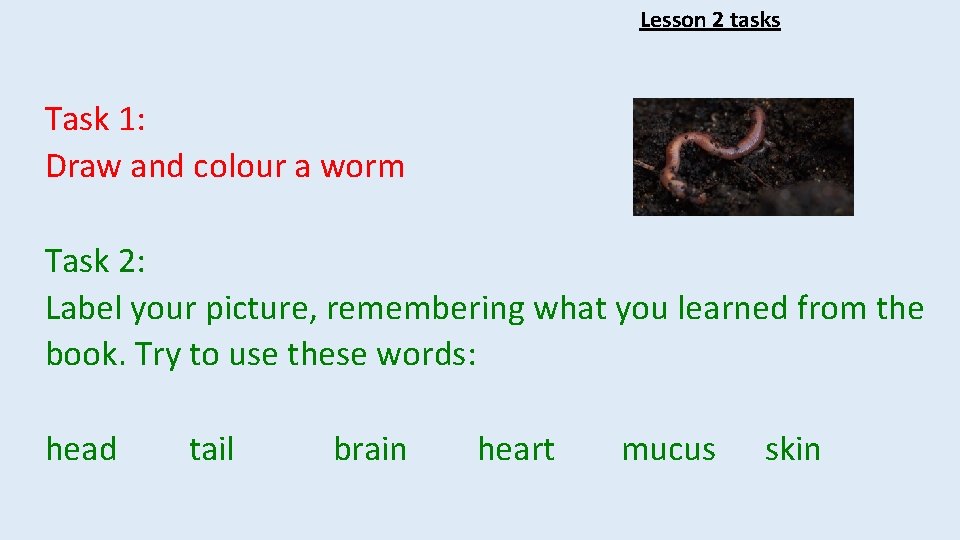
Lesson 2 tasks Task 1: Draw and colour a worm Task 2: Label your picture, remembering what you learned from the book. Try to use these words: head tail brain heart mucus skin
Lesson 3 This is a writing lesson. You will need paper and a pencil.
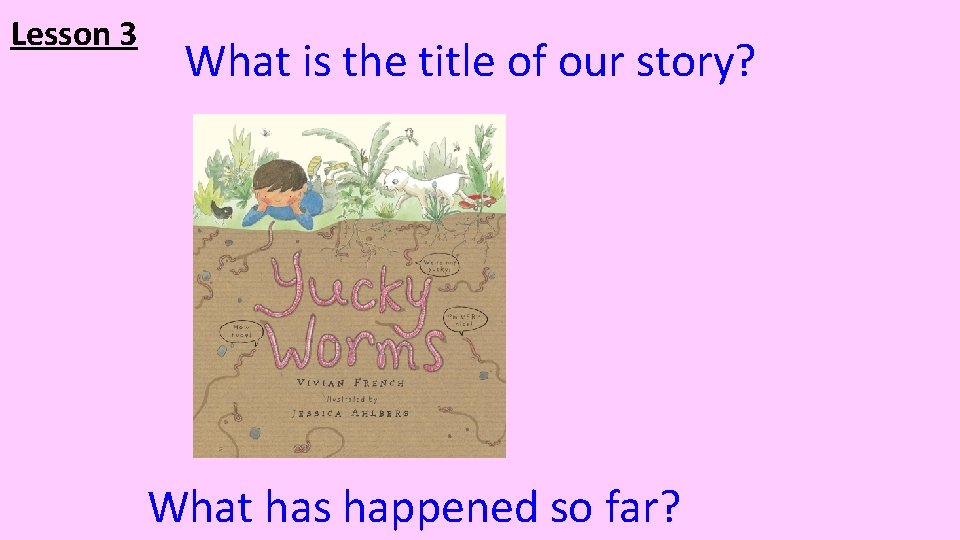
Lesson 3 What is the title of our story? What has happened so far?
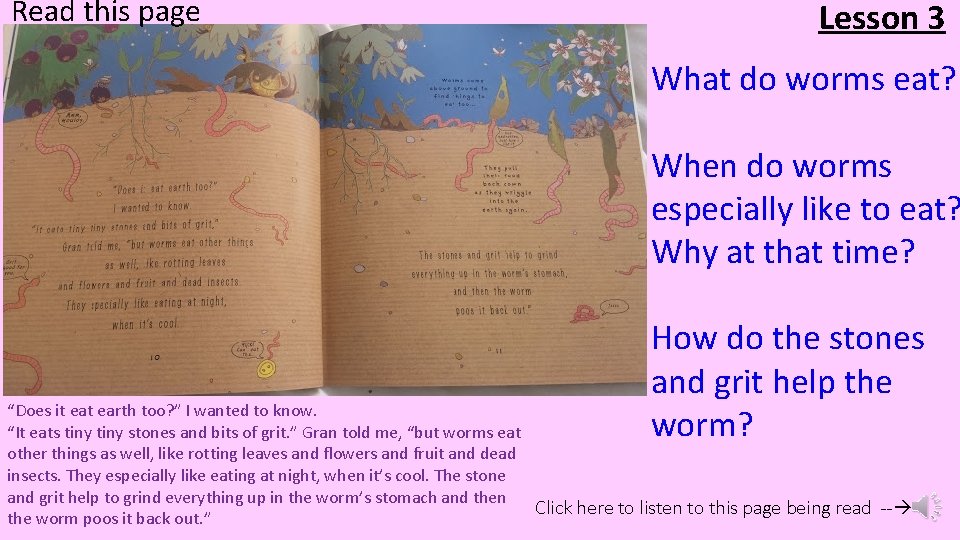
Read this page Lesson 3 What do worms eat? When do worms especially like to eat? Why at that time? How do the stones and grit help the worm? “Does it earth too? ” I wanted to know. “It eats tiny stones and bits of grit. ” Gran told me, “but worms eat other things as well, like rotting leaves and flowers and fruit and dead insects. They especially like eating at night, when it’s cool. The stone and grit help to grind everything up in the worm’s stomach and then Click here to listen to this page being read -- the worm poos it back out. ”
Lesson 3 tasks Task 1 Draw pictures of what a worm eats. E. g rotting leaves, flowers fruits and dead insects. Label your pictures. Task 2 Write one/two sentences about a worm’s diet. Remember to use the conjunction and in you sentence, for example: (Don’t forget to use your sounds to help you spell. ) Worms eat small stones and bits of grit.
Lesson 4 This is a speaking and listening lesson.
Lesson 4 What is the title of our story? What do you remember so far?
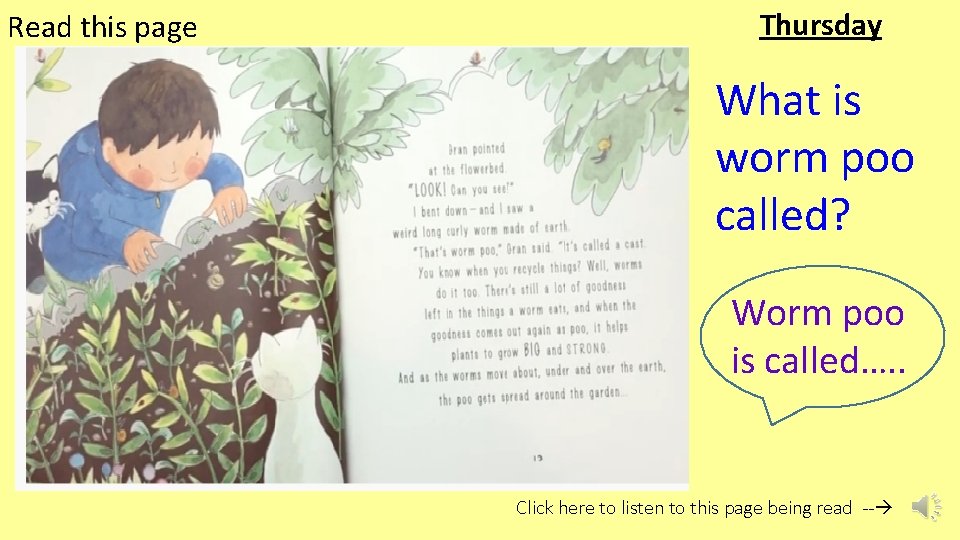
Read this page Thursday What is worm poo called? Worm poo is called…. . Click here to listen to this page being read --
How do you recycle? Recycling is when you turn rubbish into something new. We recycle to help protect the environment! Switch Power point presentation to a full screen mode and then click on the recycling symbol to watch a video.
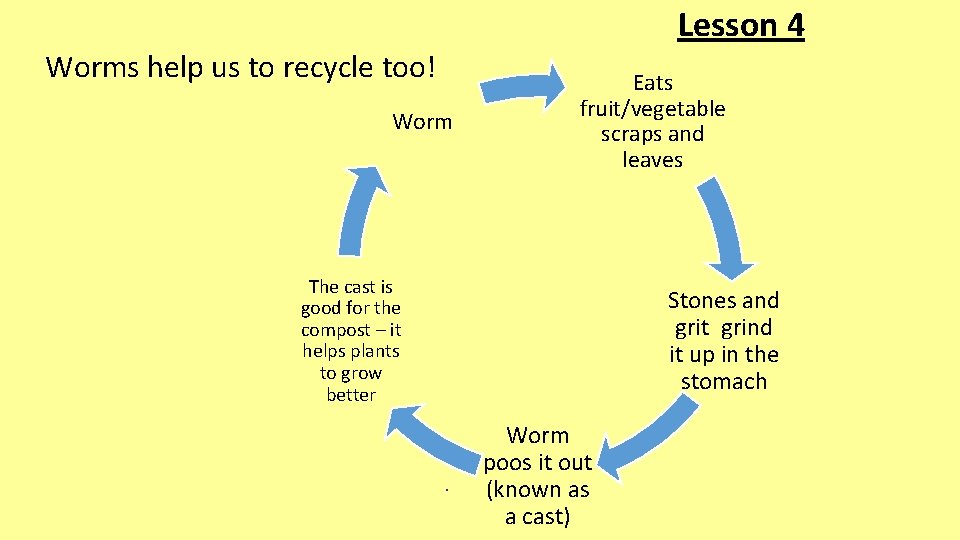
Lesson 4 Worms help us to recycle too! Worm Eats fruit/vegetable scraps and leaves The cast is good for the compost – it helps plants to grow better Stones and grit grind it up in the stomach . Worm poos it out (known as a cast)
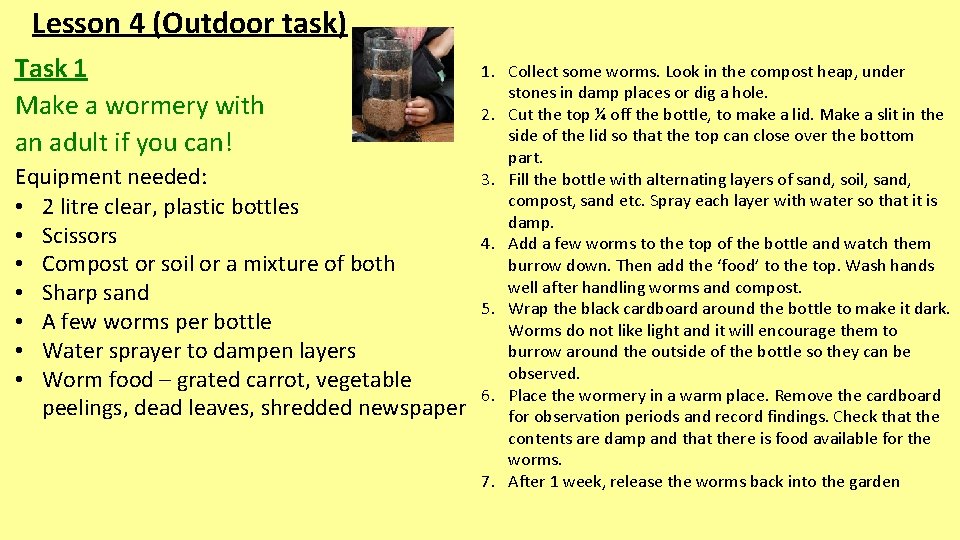
Lesson 4 (Outdoor task) Task 1 Make a wormery with an adult if you can! Equipment needed: • 2 litre clear, plastic bottles • Scissors • Compost or soil or a mixture of both • Sharp sand • A few worms per bottle • Water sprayer to dampen layers • Worm food – grated carrot, vegetable peelings, dead leaves, shredded newspaper 1. Collect some worms. Look in the compost heap, under stones in damp places or dig a hole. 2. Cut the top ¼ off the bottle, to make a lid. Make a slit in the side of the lid so that the top can close over the bottom part. 3. Fill the bottle with alternating layers of sand, soil, sand, compost, sand etc. Spray each layer with water so that it is damp. 4. Add a few worms to the top of the bottle and watch them burrow down. Then add the ‘food’ to the top. Wash hands well after handling worms and compost. 5. Wrap the black cardboard around the bottle to make it dark. Worms do not like light and it will encourage them to burrow around the outside of the bottle so they can be observed. 6. Place the wormery in a warm place. Remove the cardboard for observation periods and record findings. Check that the contents are damp and that there is food available for the worms. 7. After 1 week, release the worms back into the garden
Lesson 5 This is a writing lesson. You will need paper and a pencil.
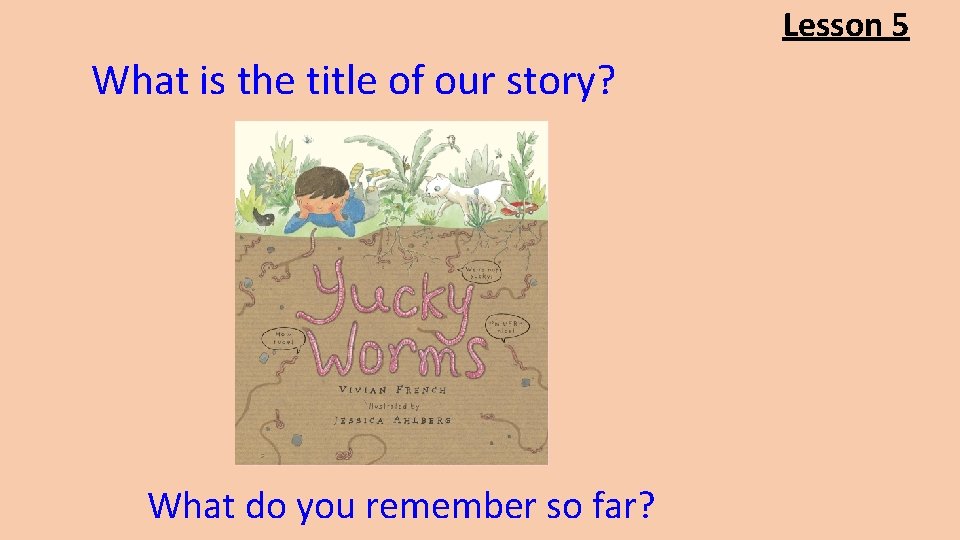
Lesson 5 What is the title of our story? What do you remember so far?
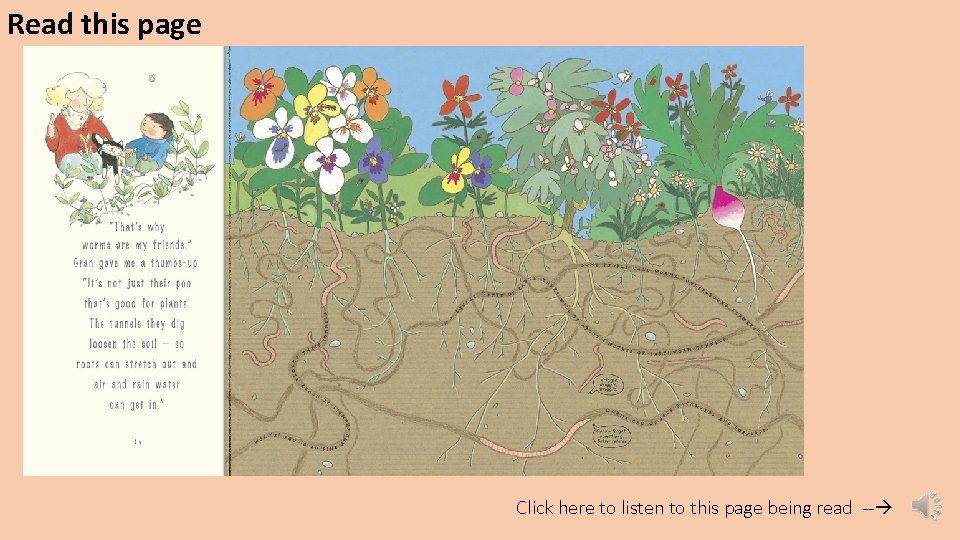
Read this page Click here to listen to this page being read --
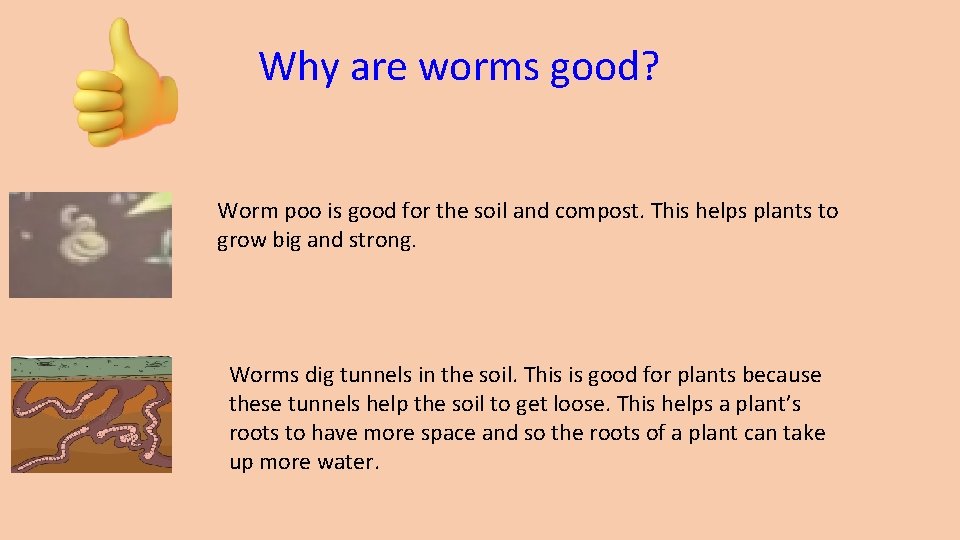
Why are worms good? Worm poo is good for the soil and compost. This helps plants to grow big and strong. Worms dig tunnels in the soil. This is good for plants because these tunnels help the soil to get loose. This helps a plant’s roots to have more space and so the roots of a plant can take up more water.
Lesson 5 tasks Task 1 Write down your answer to these questions: 1)Why do you think some people find worms yucky? 2) Why are worms good?
Lesson 5 tasks Potential answers 1)Why do you think some people find worms yucky? Some people find worms yucky because they are slimy. They feel a little weird and they wriggle around without legs. 2) Why are worms good? Worms are good because they help the environment. Their poo helps plants grow big and strong. Worms dig tunnels that help the plant to get air and water.
We hope you have enjoyed reading the beginning of ‘Yucky Worms!’ and completing the tasks. We hope you have learned about worms and perhaps like worms more! Have a great weekend.