
RECEPTION PARENTS MEETING The Characteristics of Effective Learning

- Slides: 22
RECEPTION PARENTS MEETING • • The Characteristics of Effective Learning Early Years curriculum Assessment and statutory assessment Good level of development
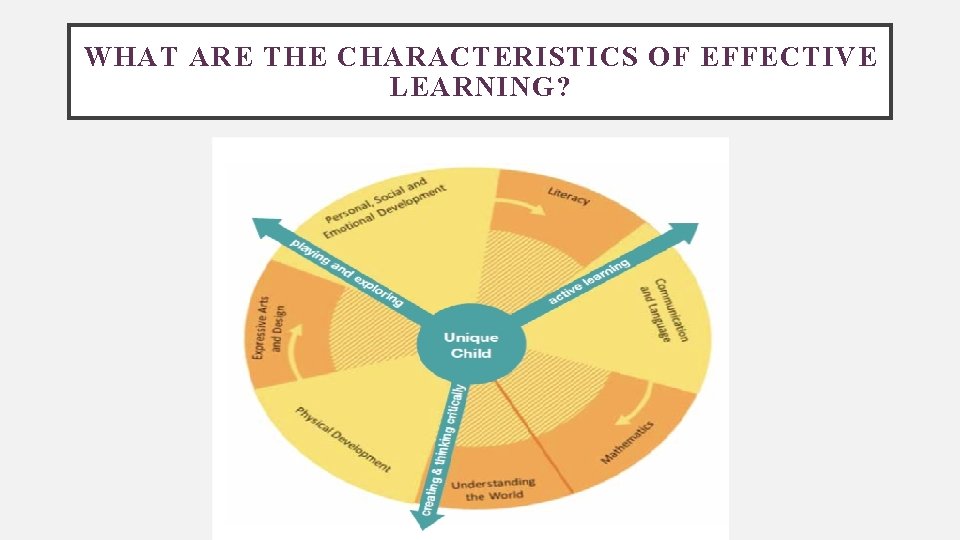
WHAT ARE THE CHARACTERISTICS OF EFFECTIVE LEARNING?
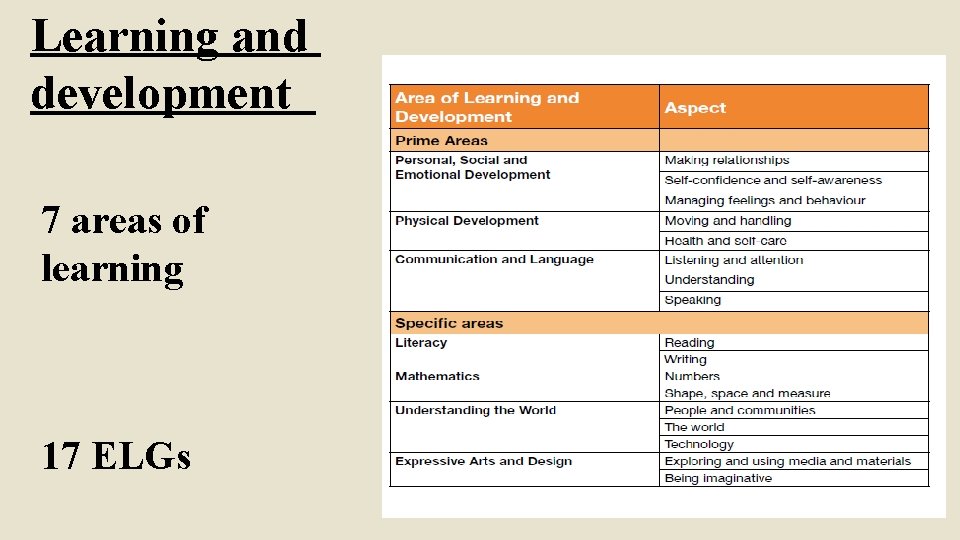
Learning and development 7 areas of learning 17 ELGs
Each area of learning and development must be implemented through planned, purposeful play and through a mix of adult-led and child-initiated activity. Play is essential for children’s development, building their confidence as they learn to explore, to think about problems, and relate to others. Children learn by leading their own play, and by taking part in play which is guided by adults.
EYFS ASSESSMENT – HELPS TO… “recognise children’s progress, understand their needs, and to plan activities and support. ” Statutory Framework for EYFS 2014 “Observational assessment is the most reliable way of building up an accurate picture of children’s development and learning. This is especially true where the attainment demonstrated is not dependent on overt adult support. Observational assessment is central to understanding what children really know and can do. ” EYFS Handbook 2016
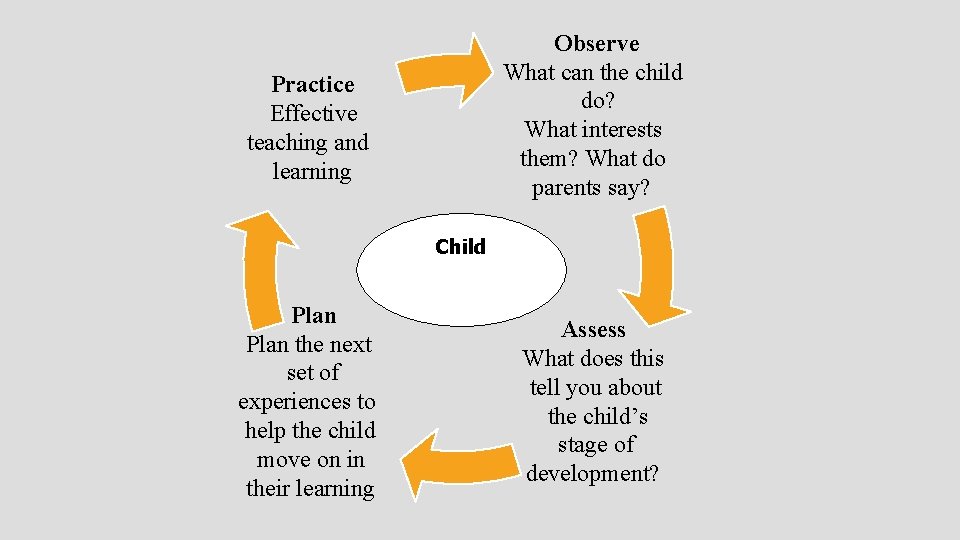
Observe What can the child do? What interests them? What do parents say? Practice Effective teaching and learning Child Plan the next set of experiences to help the child move on in their learning Assess What does this tell you about the child’s stage of development?
SO HOW ARE ASSESSMENTS MADE? • Observations are levelled using Development Matters over time and used to plan next steps in children’s learning (formative assessment) • Judgements are collated, reviewed, and summarised half termly using ‘best fit’ (summative assessment) • End of year judgements are made in relation to the 17 Early Learning Goals (ELGs)
THE GOOD LEVEL OF DEVELOPMENT IN EYFS • GLD – Good level of development • Children are defined as having reached a good level of development at the end of the EYFS if they have achieved at least the expected level in: • the early learning goals in the prime areas of learning (personal, social and emotional development; physical development; and communication and language) • the early learning goals in the specific areas of mathematics and literacy.
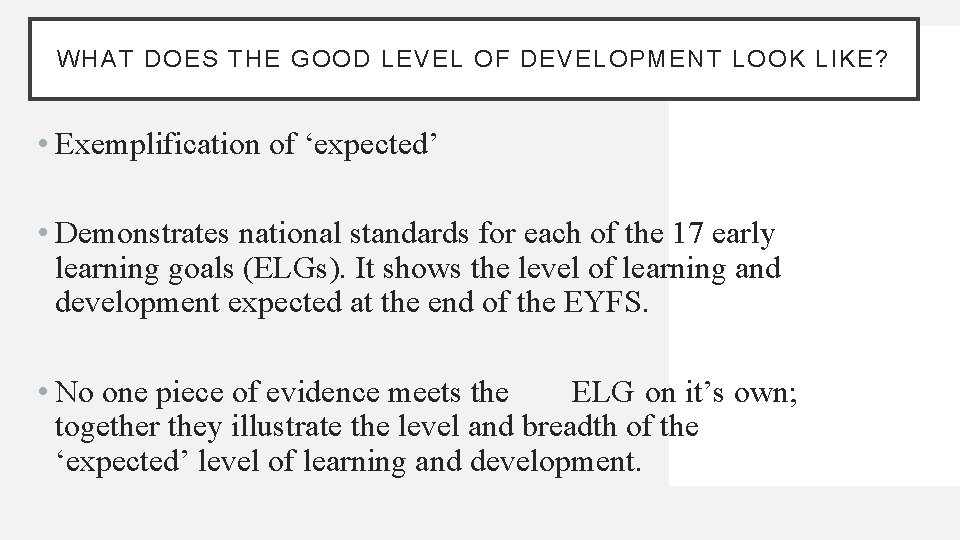
WHAT DOES THE GOOD LEVEL OF DEVELOPMENT LOOK LIKE? • Exemplification of ‘expected’ • Demonstrates national standards for each of the 17 early learning goals (ELGs). It shows the level of learning and development expected at the end of the EYFS. • No one piece of evidence meets the ELG on it’s own; together they illustrate the level and breadth of the ‘expected’ level of learning and development.
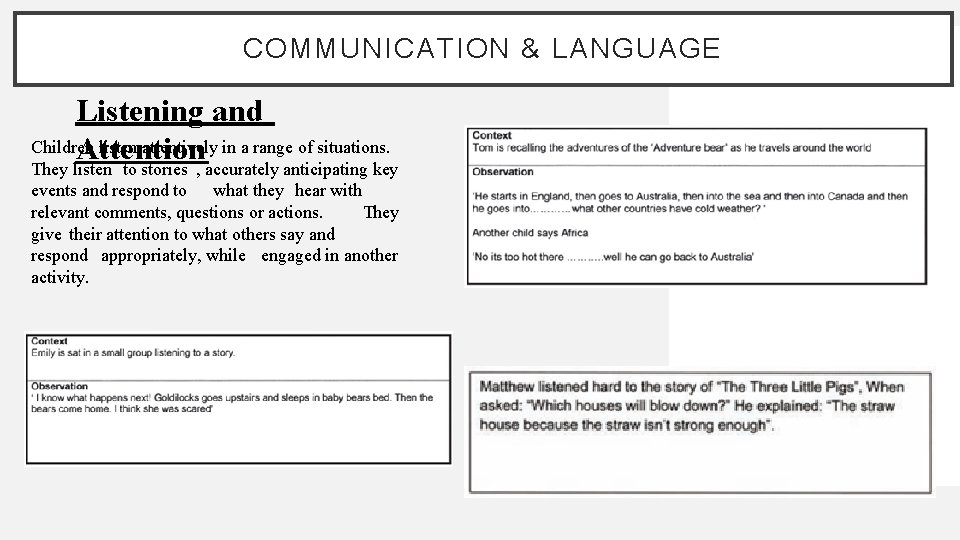
COMMUNICATION & LANGUAGE Listening and Children listen attentively in a range of situations. Attention They listen to stories , accurately anticipating key events and respond to what they hear with relevant comments, questions or actions. They give their attention to what others say and respond appropriately, while engaged in another activity.
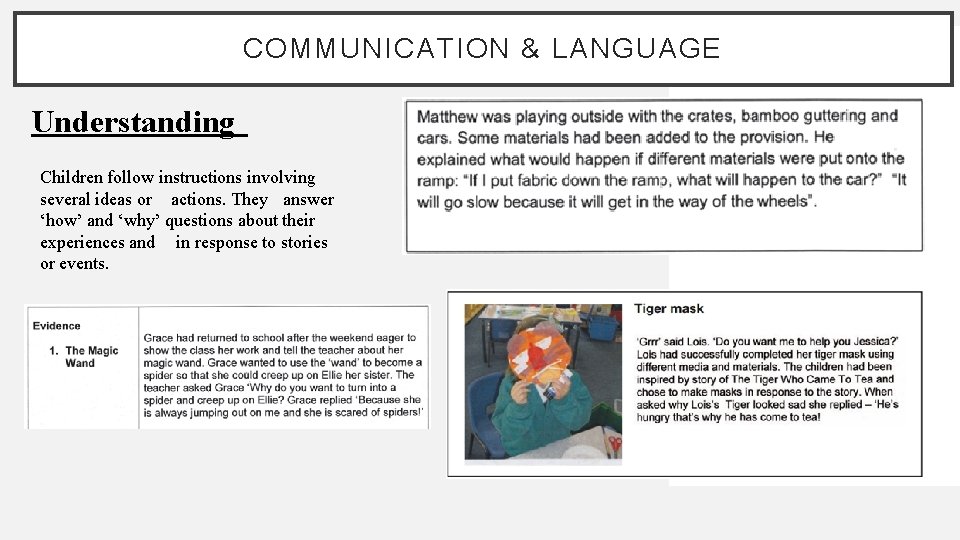
COMMUNICATION & LANGUAGE Understanding Children follow instructions involving several ideas or actions. They answer ‘how’ and ‘why’ questions about their experiences and in response to stories or events.
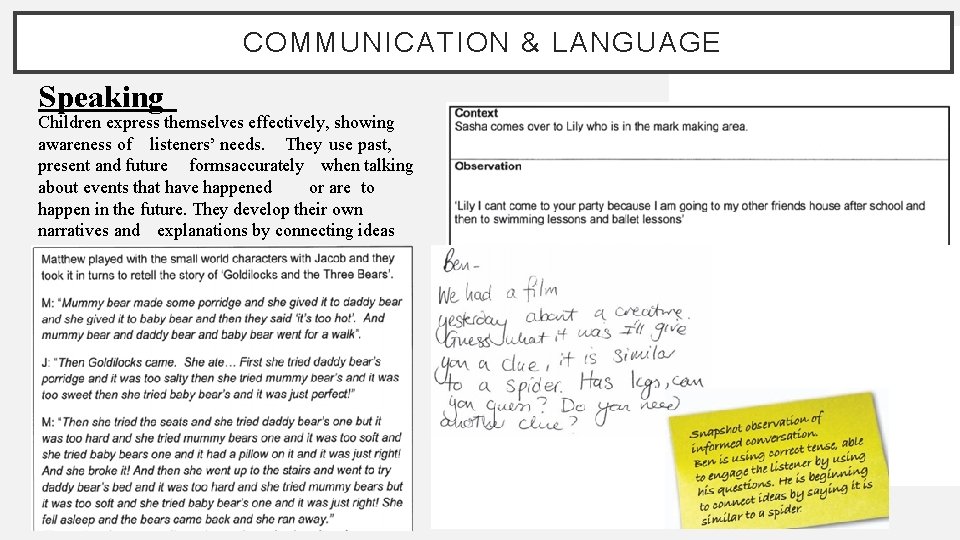
COMMUNICATION & LANGUAGE Speaking Children express themselves effectively, showing awareness of listeners’ needs. They use past, present and future formsaccurately when talking about events that have happened or are to happen in the future. They develop their own narratives and explanations by connecting ideas or events.
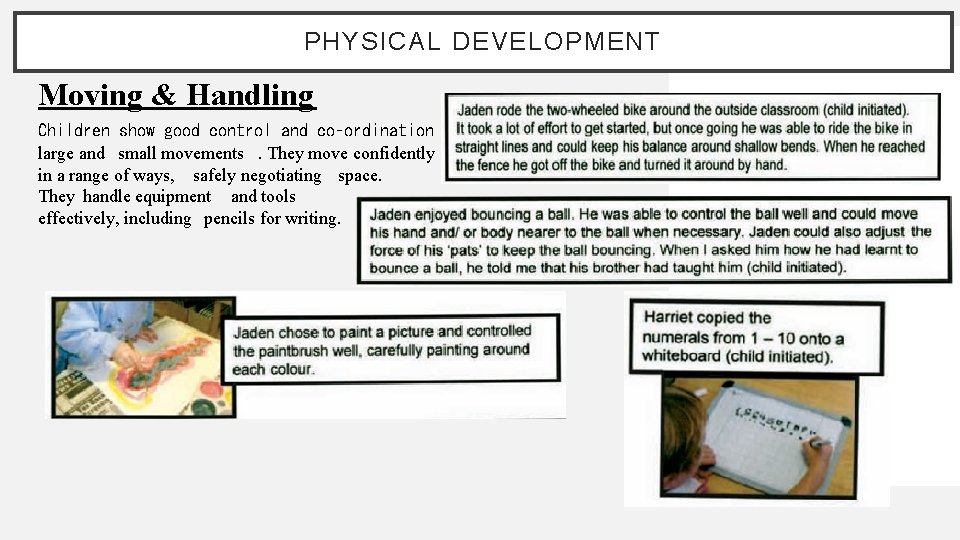
PHYSICAL DEVELOPMENT Moving & Handling Children show good control and co‑ordination in large and small movements. They move confidently in a range of ways, safely negotiating space. They handle equipment and tools effectively, including pencils for writing.
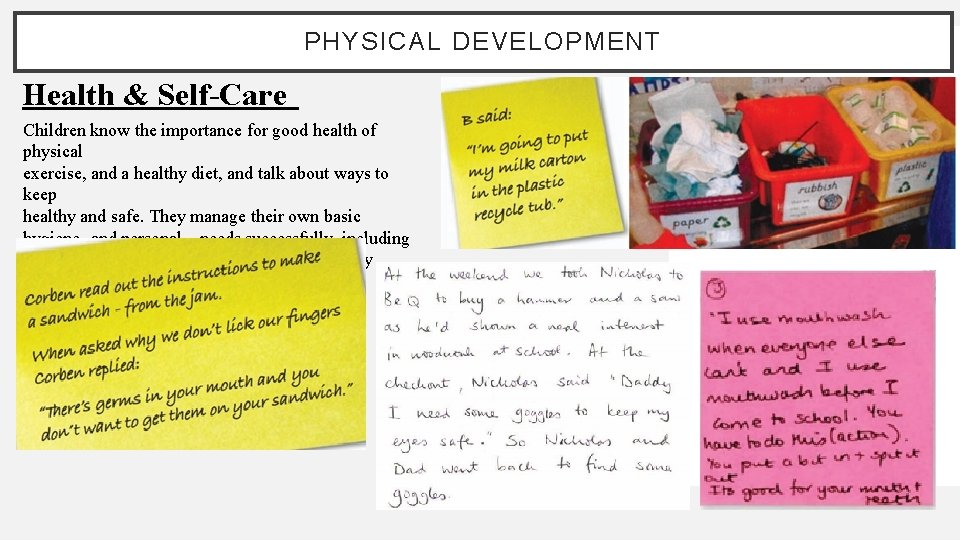
PHYSICAL DEVELOPMENT Health & Self-Care Children know the importance for good health of physical exercise, and a healthy diet, and talk about ways to keep healthy and safe. They manage their own basic hygiene and personal needs successfully, including dressing and going to the toilet independently
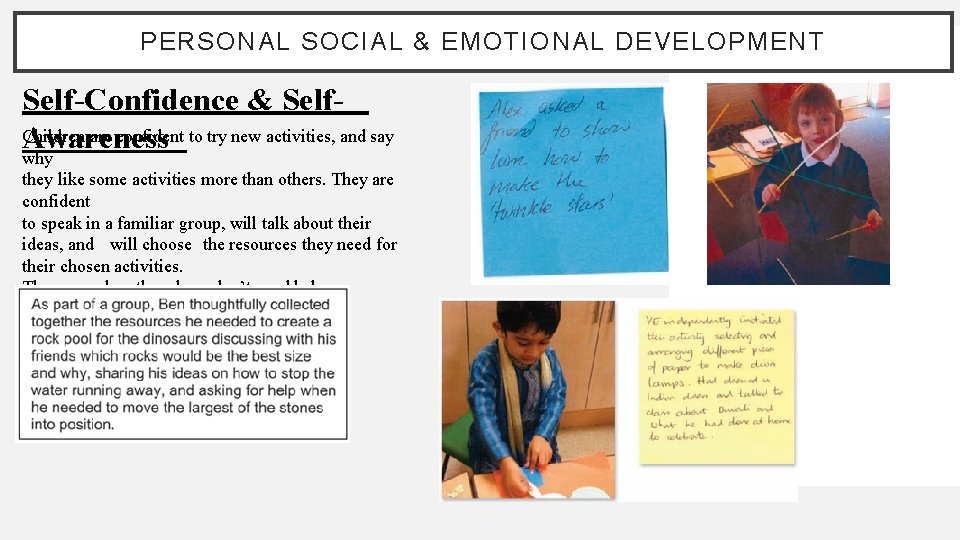
PERSONAL SOCIAL & EMOTIONAL DEVELOPMENT Self-Confidence & Self. Children are confident to try new activities, and say Awareness why they like some activities more than others. They are confident to speak in a familiar group, will talk about their ideas, and will choose the resources they need for their chosen activities. They say when they do or don’t need help.
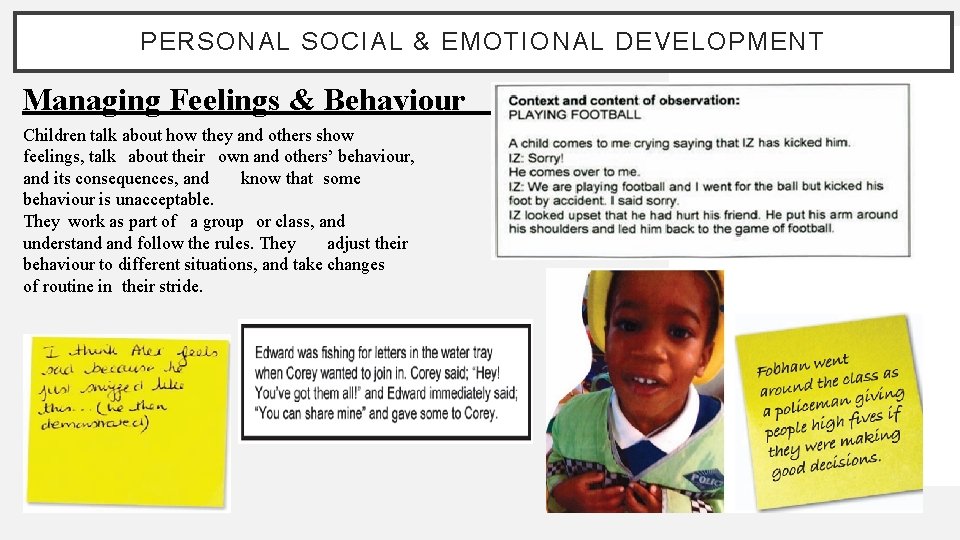
PERSONAL SOCIAL & EMOTIONAL DEVELOPMENT Managing Feelings & Behaviour Children talk about how they and others show feelings, talk about their own and others’ behaviour, and its consequences, and know that some behaviour is unacceptable. They work as part of a group or class, and understand follow the rules. They adjust their behaviour to different situations, and take changes of routine in their stride.
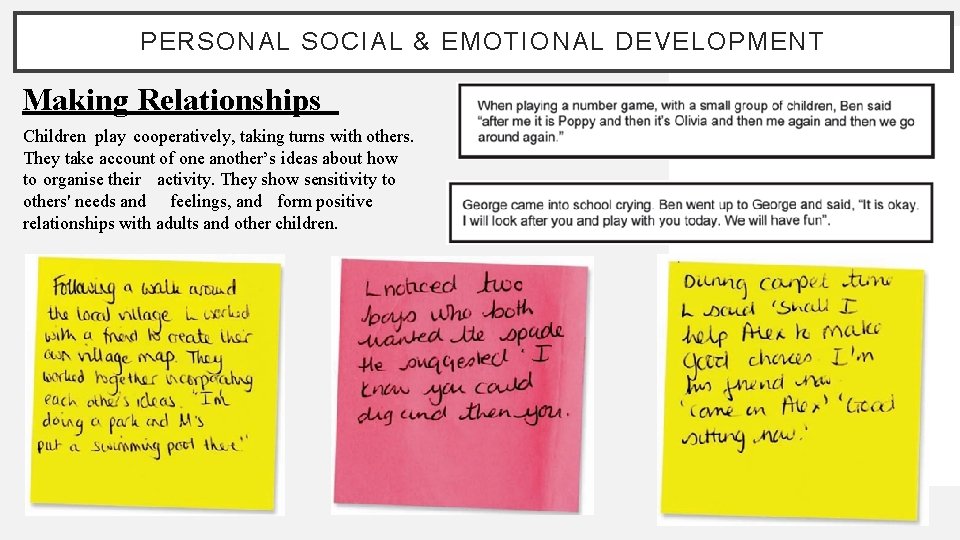
PERSONAL SOCIAL & EMOTIONAL DEVELOPMENT Making Relationships Children play cooperatively, taking turns with others. They take account of one another’s ideas about how to organise their activity. They show sensitivity to others' needs and feelings, and form positive relationships with adults and other children.
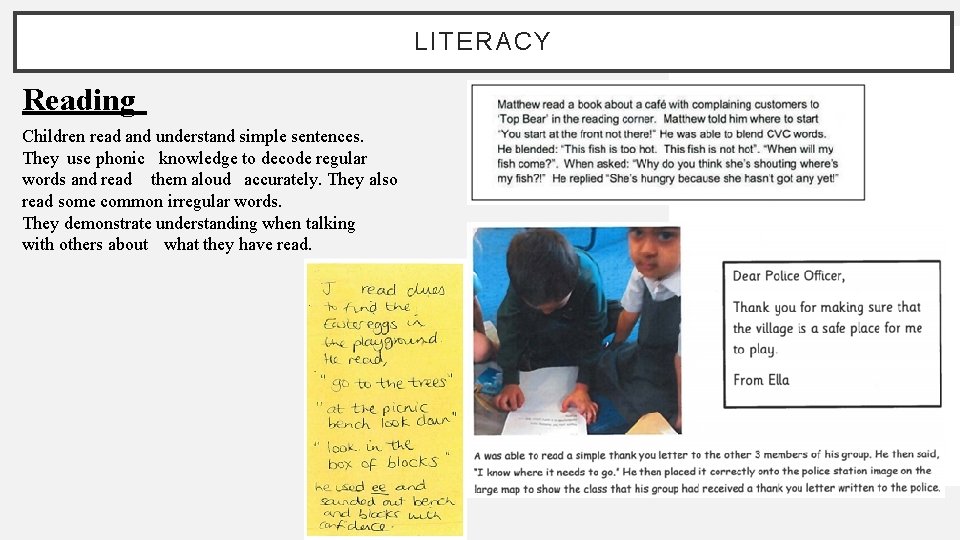
LITERACY Reading Children read and understand simple sentences. They use phonic knowledge to decode regular words and read them aloud accurately. They also read some common irregular words. They demonstrate understanding when talking with others about what they have read.
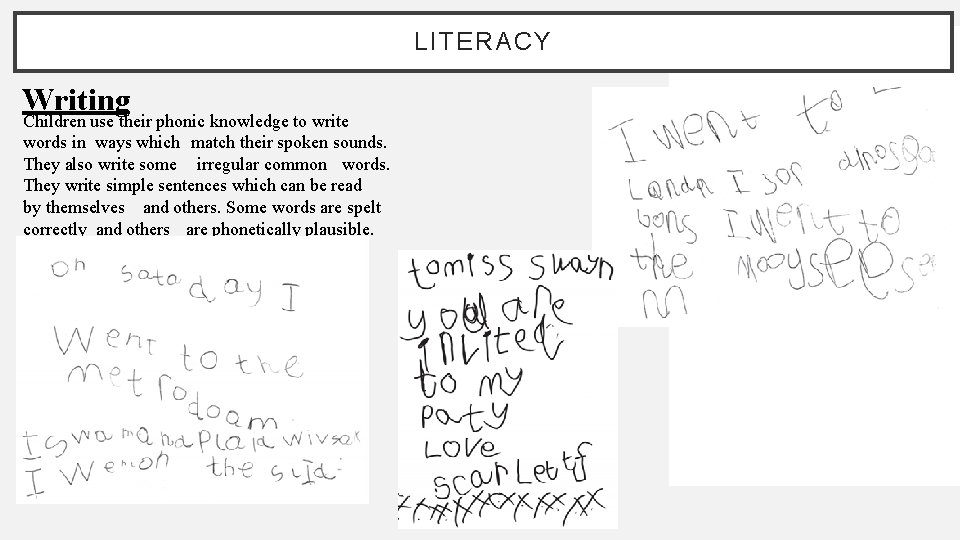
LITERACY Writing Children use their phonic knowledge to write words in ways which match their spoken sounds. They also write some irregular common words. They write simple sentences which can be read by themselves and others. Some words are spelt correctly and others are phonetically plausible.
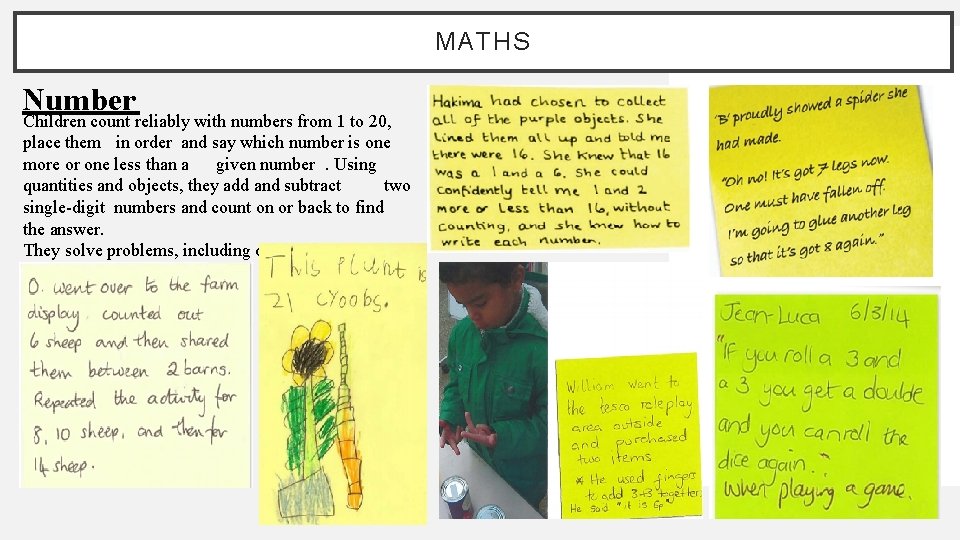
MATHS Number Children count reliably with numbers from 1 to 20, place them in order and say which number is one more or one less than a given number. Using quantities and objects, they add and subtract two single-digit numbers and count on or back to find the answer. They solve problems, including doubling, halving and sharing.
MATHS Shape, Space and Measures Children use everyday language to talk about size, weight, capacity , position, distance, time and money to compare quantities and objects and to solve problems. They recognise, create and describe patterns. They explore characteristics of everyday objects and shapes and use mathematical language to describe them.
FINALLY… • Any questions?