
Reception Mathematics Workshop March 2018 Mathematics Workshop What
- Slides: 17
Reception Mathematics Workshop March 2018
Mathematics Workshop What is maths? How is maths taught in Reception? Why is maths important? How can I help my child at home? Vocabulary
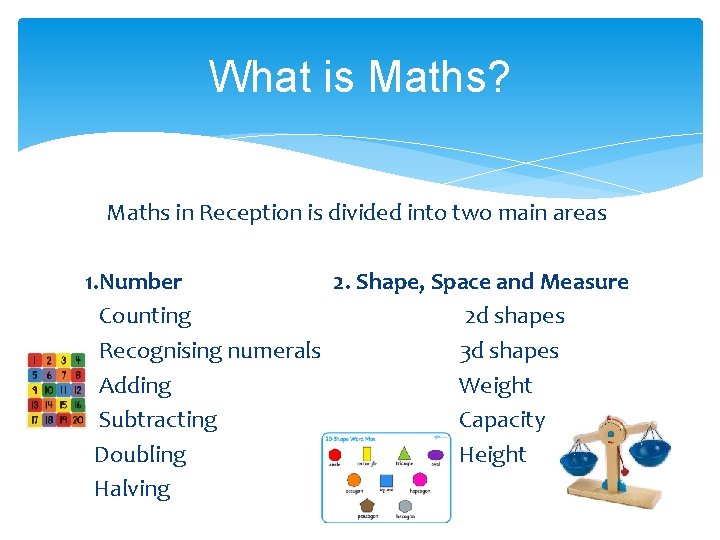
What is Maths? Maths in Reception is divided into two main areas 1. Number 2. Shape, Space and Measure Counting 2 d shapes Recognising numerals 3 d shapes Adding Weight Subtracting Capacity Doubling Height Halving
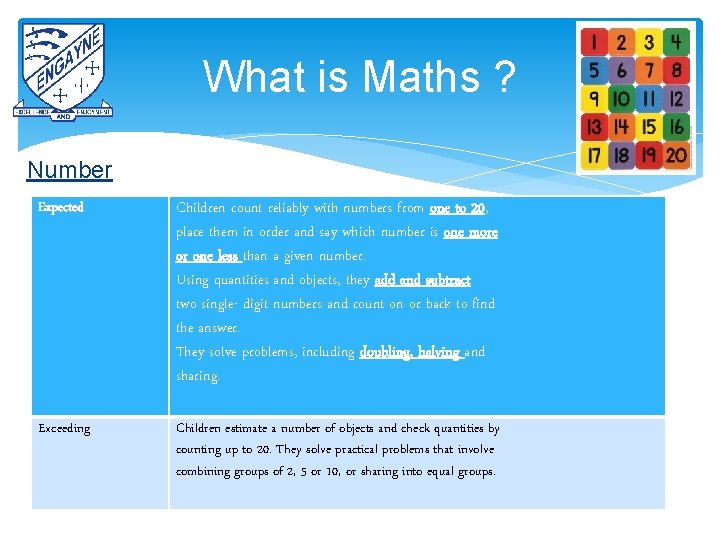
What is Maths ? Number Expected Children count reliably with numbers from one to 20, place them in order and say which number is one more or one less than a given number. Using quantities and objects, they add and subtract two single- digit numbers and count on or back to find the answer. They solve problems, including doubling, halving and sharing. Exceeding Children estimate a number of objects and check quantities by counting up to 20. They solve practical problems that involve combining groups of 2, 5 or 10, or sharing into equal groups.
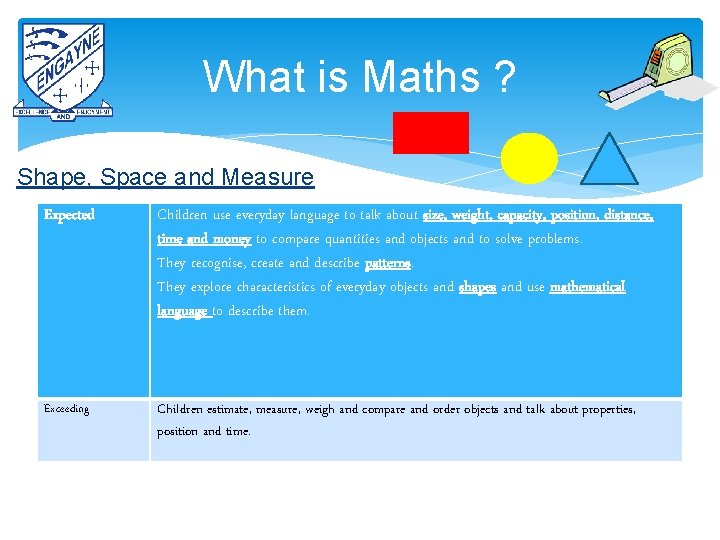
What is Maths ? Shape, Space and Measure Expected Children use everyday language to talk about size, weight, capacity, position, distance, time and money to compare quantities and objects and to solve problems. They recognise, create and describe patterns. They explore characteristics of everyday objects and shapes and use mathematical language to describe them. Exceeding Children estimate, measure, weigh and compare and order objects and talk about properties, position and time.
How is maths taught in reception? Number rhymes (counting on and back) Eg: 5 little men in a flying saucer 1, 2, 3, 4, 5 once I caught a fish alive Practical activities Eg: number hunts, counting objects Games Eg: bingo, dominos Construction (Addition and Subtraction) Recording results
How is maths taught in reception? Space, space and measure Questions are asked throughout the activities and appropriate language is modelled. Practical activities eg: shape hunts Weighing objects Ordering size, height of objects Measuring in different ways eg: feet, hands, rulers Measuring time eg: sand timers, stop watches, daily routine)
How can I help my child at home? Complete the maths challenge card to support your child’s understand use mathematical language. Count footsteps when walking (can you count to 20… 50… 60? Give you children mathematical problems eg: when shopping ask your child to pick up 4 apples, How many apples will we have if I get 2 more apples? Lay the dinner table for 4 people, count out 4 knifes and 4 forks. One person can’t make dinner. How many people are coming for dinner? At bath time, play with different-sized containers Play card games – even a simple game of snap helps to develop number recognition Play board games
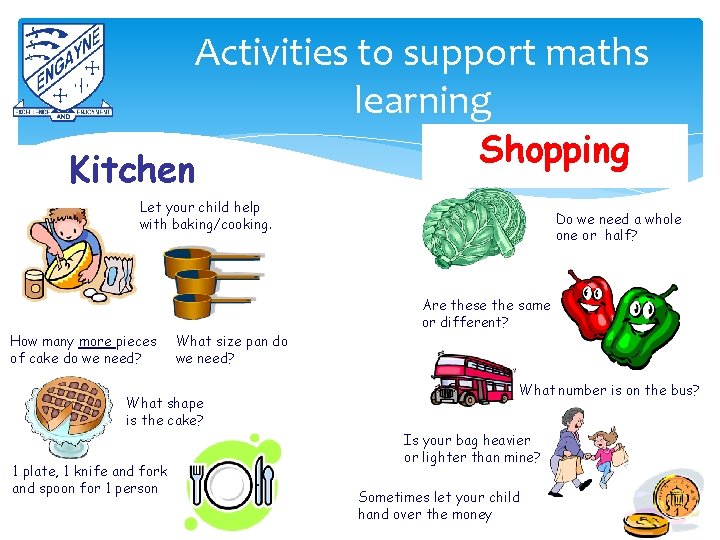
Activities to support maths learning Kitchen Shopping Let your child help with baking/cooking. Do we need a whole one or half? Are these the same or different? How many more pieces of cake do we need? What size pan do we need? What shape is the cake? 1 plate, 1 knife and fork and spoon for 1 person What number is on the bus? Is your bag heavier or lighter than mine? Sometimes let your child hand over the money
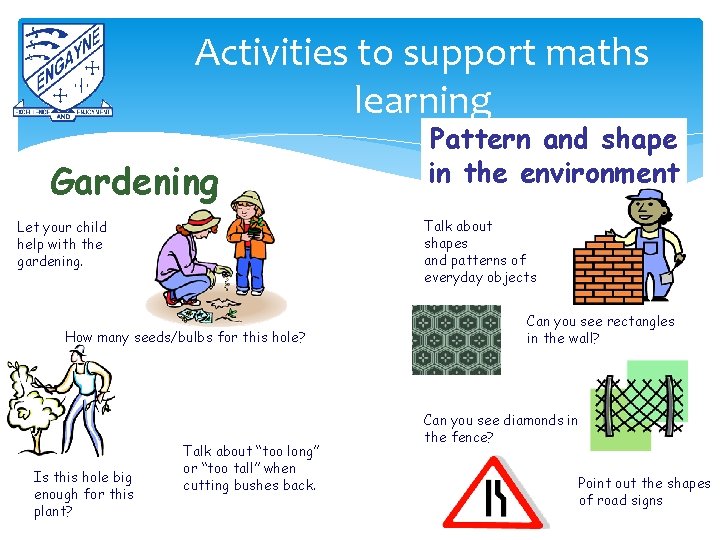
Activities to support maths learning Gardening Talk about shapes and patterns of everyday objects Let your child help with the gardening. How many seeds/bulbs for this hole? Is this hole big enough for this plant? Pattern and shape in the environment Talk about “too long” or “too tall” when cutting bushes back. Can you see rectangles in the wall? Can you see diamonds in the fence? Point out the shapes of road signs
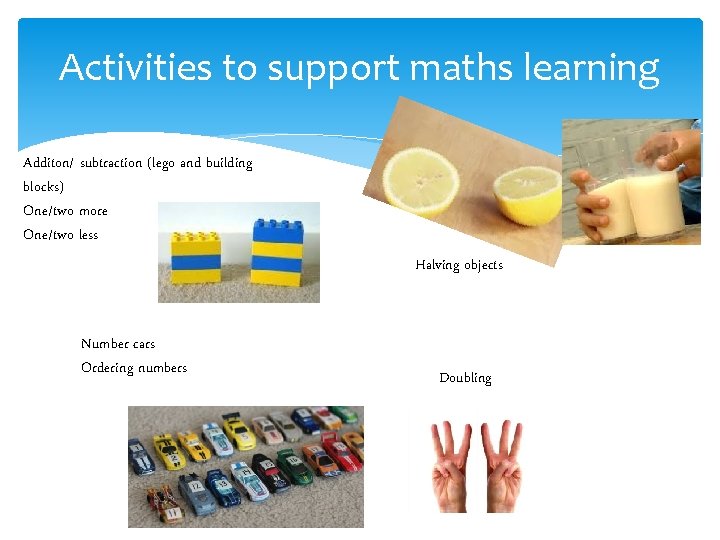
Activities to support maths learning Additon/ subtraction (lego and building blocks) One/two more One/two less Halving objects Number cars Ordering numbers Doubling
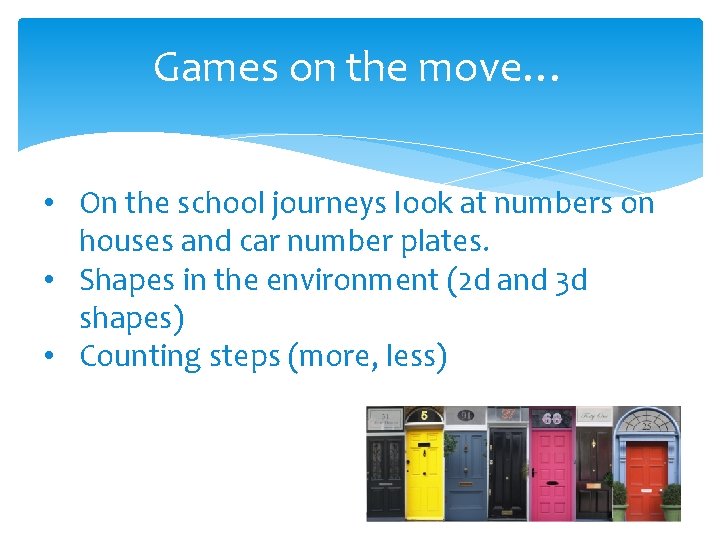
Games on the move… • On the school journeys look at numbers on houses and car number plates. • Shapes in the environment (2 d and 3 d shapes) • Counting steps (more, less)
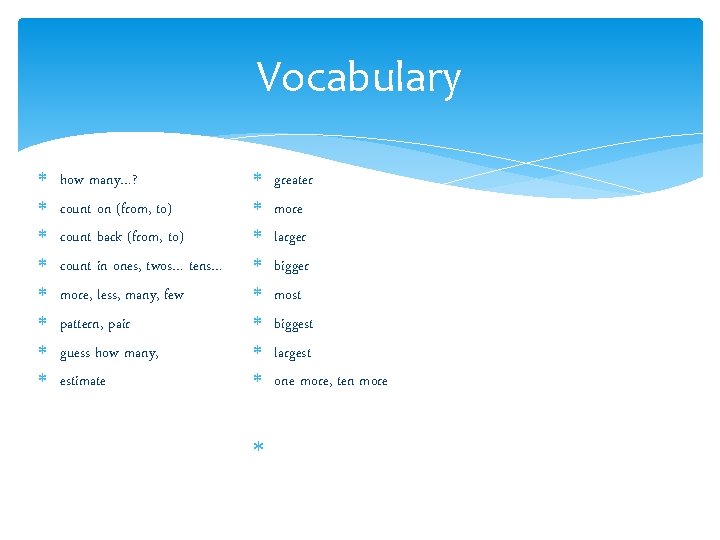
Vocabulary how many…? count on (from, to) count back (from, to) count in ones, twos… tens… more, less, many, few pattern, pair guess how many, estimate greater more larger bigger most biggest largest one more, ten more
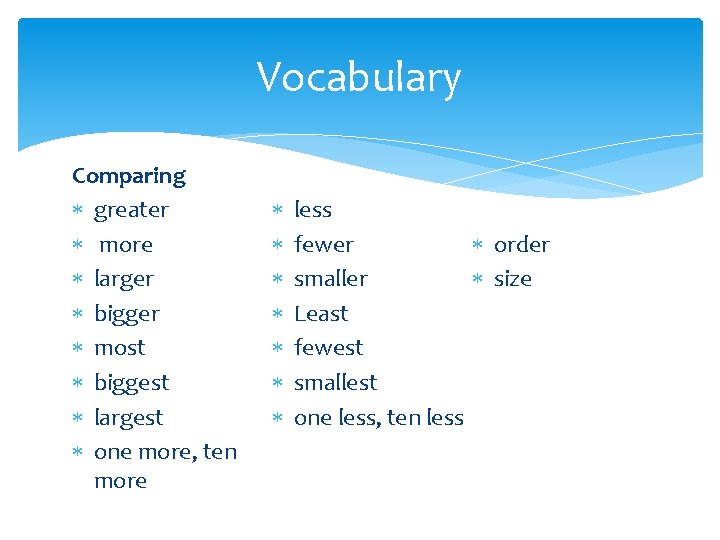
Vocabulary Comparing greater more larger bigger most biggest largest one more, ten more less fewer order smaller size Least fewest smallest one less, ten less
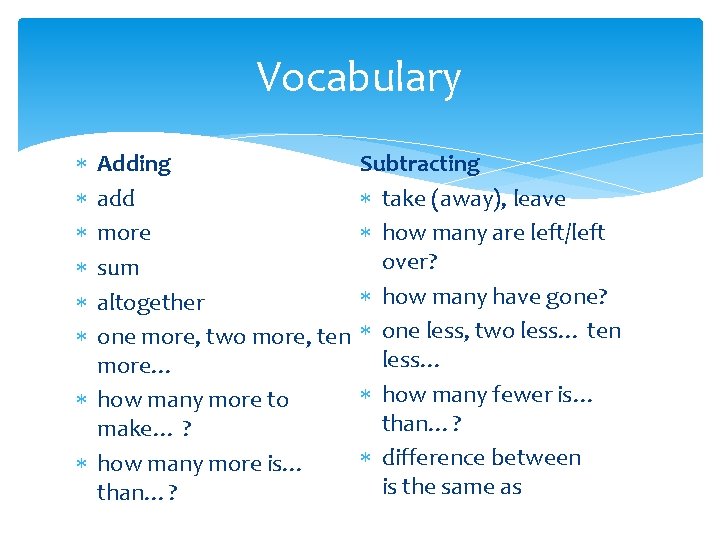
Vocabulary Adding add more sum altogether one more, two more, ten more… how many more to make… ? how many more is… than…? Subtracting take (away), leave how many are left/left over? how many have gone? one less, two less… ten less… how many fewer is… than…? difference between is the same as
Questions? ? ?
Useful Links https: //www. topmarks. co. uk/maths-games/5 -7 years/counting http: //www. ictgames. com/resources. html