
Recent Update on MODIS C 6 Deep Blue
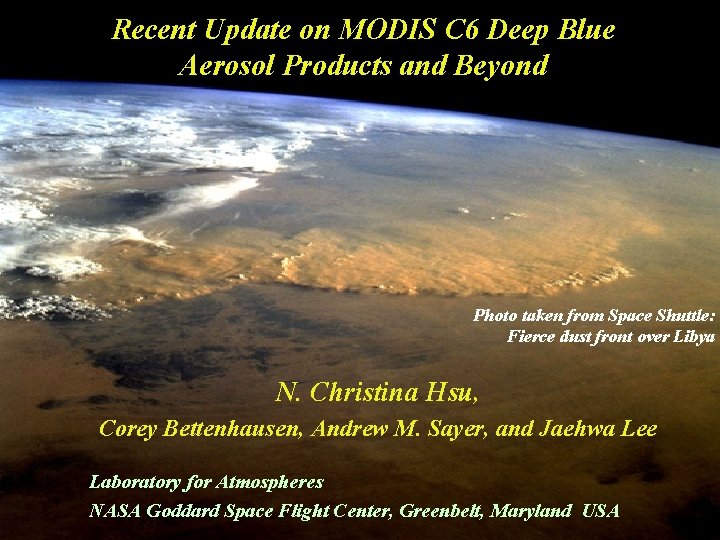
Recent Update on MODIS C 6 Deep Blue Aerosol Products and Beyond Photo taken from Space Shuttle: Fierce dust front over Libya N. Christina Hsu, Corey Bettenhausen, Andrew M. Sayer, and Jaehwa Lee Laboratory for Atmospheres N. Christina Hsu, Deputy NASA Goddard Space Flight Center, Greenbelt, Maryland USA NPP Project Scientist 1
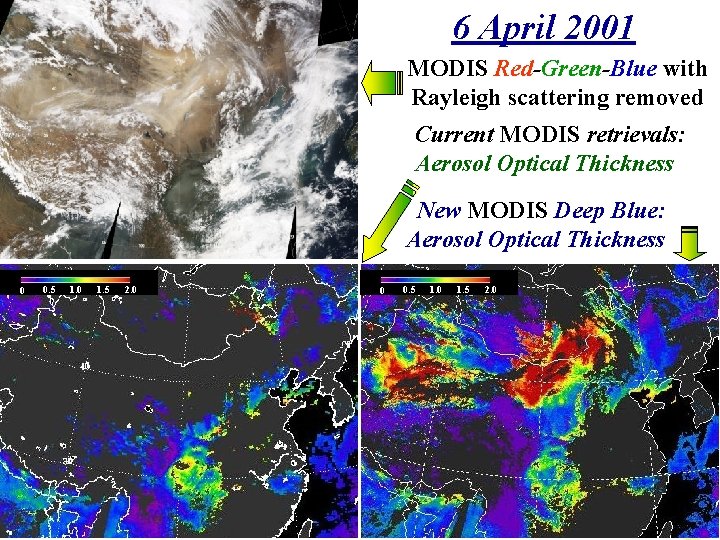
6 April 2001 MODIS Red-Green-Blue with Rayleigh scattering removed Current MODIS retrievals: Aerosol Optical Thickness New MODIS Deep Blue: Aerosol Optical Thickness 0 0. 5 1. 0 1. 5 2. 0 N. Christina Hsu, Deputy NPP Project Scientist 0 2 0. 5 1. 0 1. 5 2. 0

Recent Progress on Deep Blue Aerosol Algorithm in MODIS C 6 • Expand coverage from arid and semi-arid regions into vegetated (Sea. Wi. FS, MODIS C 6, and VIIRS) areas as well as oceans (Sea. Wi. FS and VIIRS only) • Move away from the static surface reflectance data bases – implemented dynamic surface reflectance determination into Deep Blue algorithm; – include changes in vegetation using NDVI. • Improve cloud screening scheme, particularly for the presence of thin cirrus under moist deprived regions • Better identify strongly absorbing mineral dust by using both visible and IR channels simultaneously 3
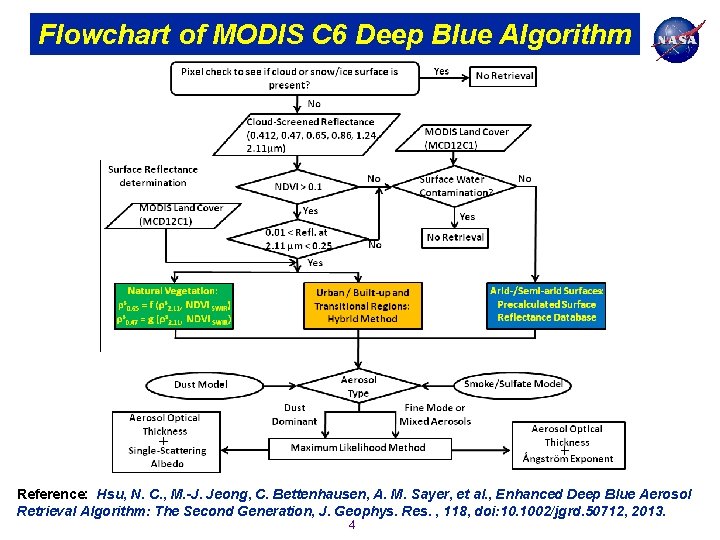
Flowchart of MODIS C 6 Deep Blue Algorithm Reference: Hsu, N. C. , M. -J. Jeong, C. Bettenhausen, A. M. Sayer, et al. , Enhanced Deep Blue Aerosol Retrieval Algorithm: The Second Generation, J. Geophys. Res. , 118, doi: 10. 1002/jgrd. 50712, 2013. 4
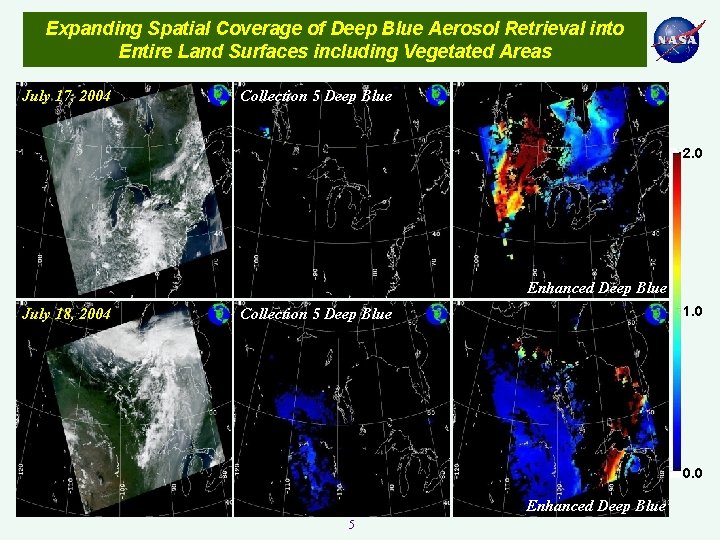
Expanding Spatial Coverage of Deep Blue Aerosol Retrieval into Entire Land Surfaces including Vegetated Areas July 17, 2004 Collection 5 Deep Blue 2. 0 Enhanced Deep Blue July 18, 2004 1. 0 Collection 5 Deep Blue 0. 0 Enhanced Deep Blue 5
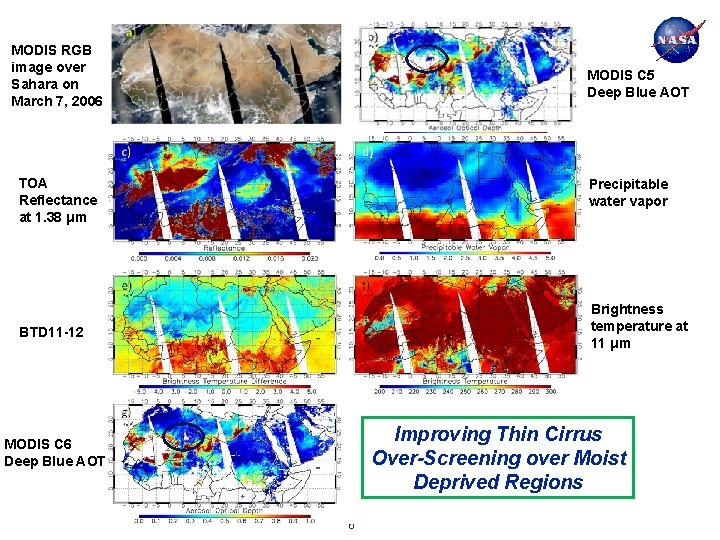
MODIS RGB image over Sahara on March 7, 2006 MODIS C 5 Deep Blue AOT TOA Reflectance at 1. 38 μm Precipitable water vapor Brightness temperature at 11 μm BTD 11 -12 Improving Thin Cirrus Over-Screening over Moist Deprived Regions MODIS C 6 Deep Blue AOT 6
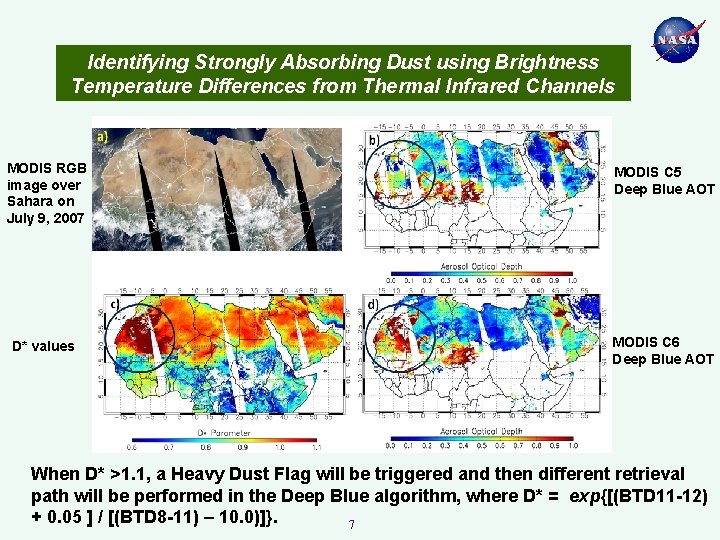
Identifying Strongly Absorbing Dust using Brightness Temperature Differences from Thermal Infrared Channels MODIS RGB image over Sahara on July 9, 2007 MODIS C 5 Deep Blue AOT D* values MODIS C 6 Deep Blue AOT When D* >1. 1, a Heavy Dust Flag will be triggered and then different retrieval path will be performed in the Deep Blue algorithm, where D* = exp{[(BTD 11 -12) + 0. 05 ] / [(BTD 8 -11) – 10. 0)]}. 7
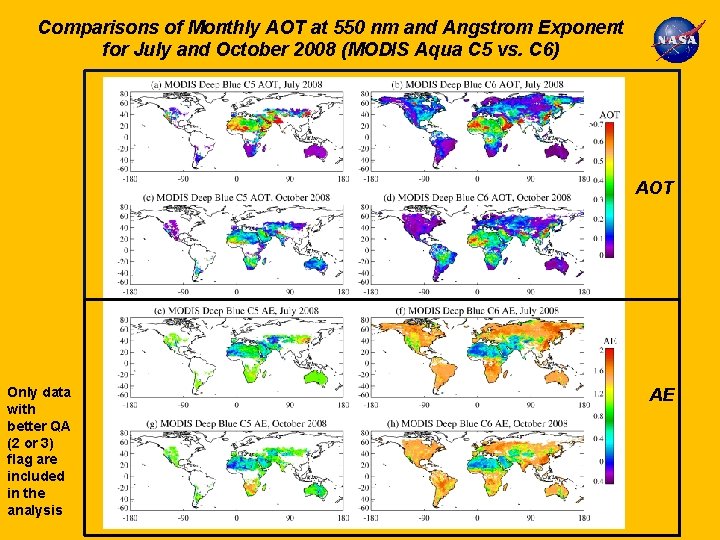
Comparisons of Monthly AOT at 550 nm and Angstrom Exponent for July and October 2008 (MODIS Aqua C 5 vs. C 6) AOT Only data with better QA (2 or 3) flag are included in the analysis AE 8
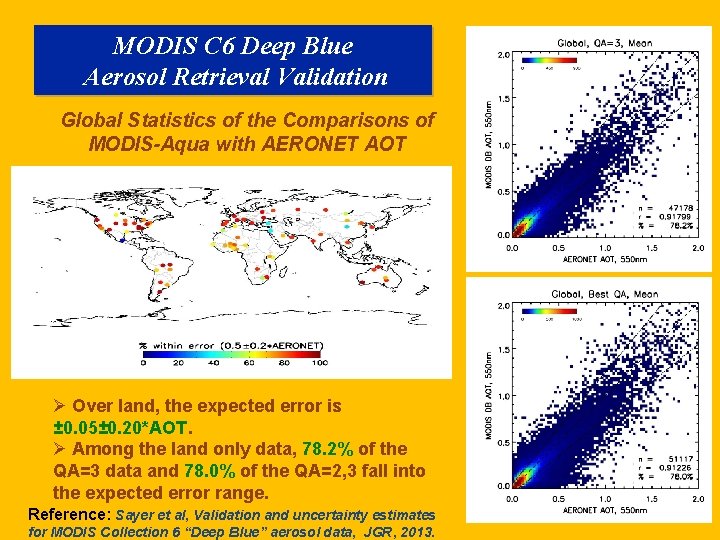
MODIS C 6 Deep Blue Aerosol Retrieval Validation Global Statistics of the Comparisons of MODIS-Aqua with AERONET AOT 0 50 100 Ø Over land, the expected error is ± 0. 05± 0. 20*AOT. Ø Among the land only data, 78. 2% of the QA=3 data and 78. 0% of the QA=2, 3 fall into the expected error range. Reference: Sayer et al, Validation and uncertainty estimates for MODIS Collection 6 “Deep Blue” aerosol data, JGR, 2013.
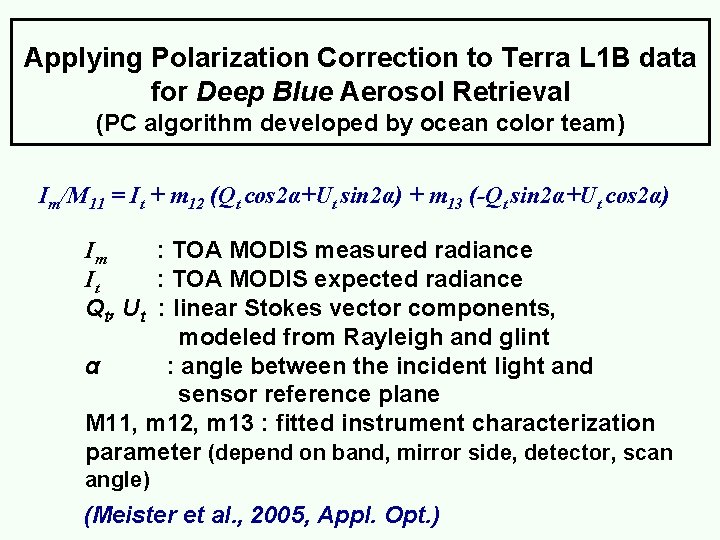
Applying Polarization Correction to Terra L 1 B data for Deep Blue Aerosol Retrieval (PC algorithm developed by ocean color team) Im/M 11 = It + m 12 (Qt cos 2α+Ut sin 2α) + m 13 (-Qt sin 2α+Ut cos 2α) Im : TOA MODIS measured radiance It : TOA MODIS expected radiance Qt, Ut : linear Stokes vector components, modeled from Rayleigh and glint α : angle between the incident light and sensor reference plane M 11, m 12, m 13 : fitted instrument characterization parameter (depend on band, mirror side, detector, scan angle) (Meister et al. , 2005, Appl. Opt. )
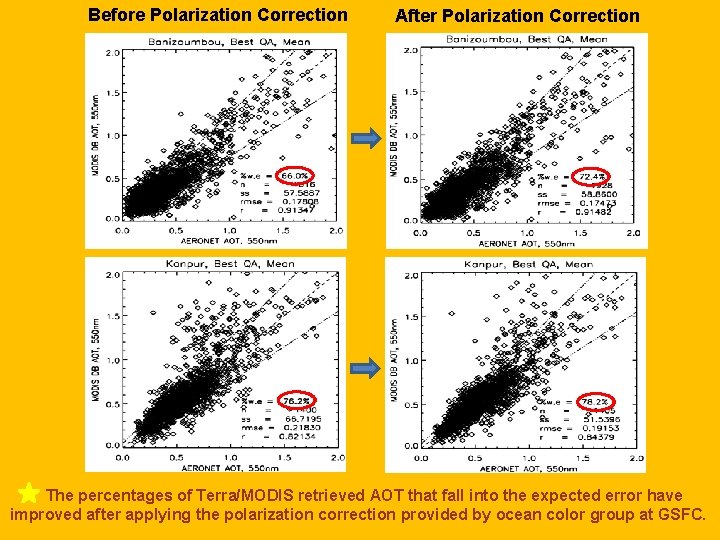
Before Polarization Correction After Polarization Correction The percentages of Terra/MODIS retrieved AOT that fall into the expected error have improved after applying the polarization correction provided by ocean color group at GSFC.
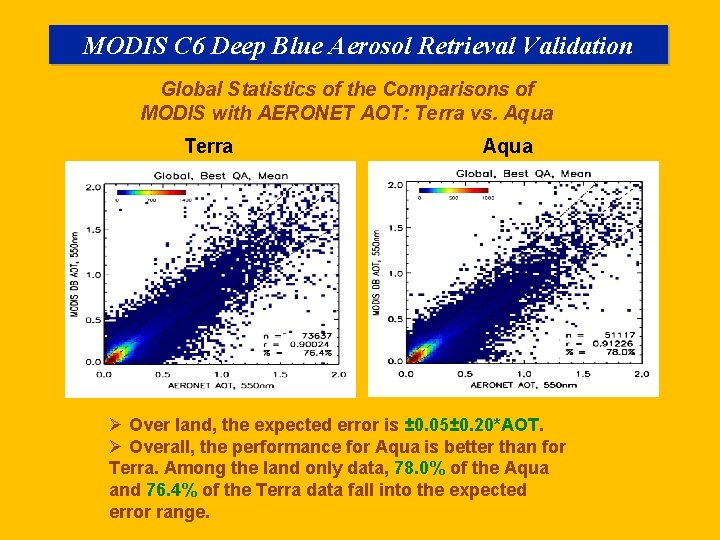
MODIS C 6 Deep Blue Aerosol Retrieval Validation Global Statistics of the Comparisons of MODIS with AERONET AOT: Terra vs. Aqua Terra Aqua Ø Over land, the expected error is ± 0. 05± 0. 20*AOT. Ø Overall, the performance for Aqua is better than for Terra. Among the land only data, 78. 0% of the Aqua and 76. 4% of the Terra data fall into the expected error range.
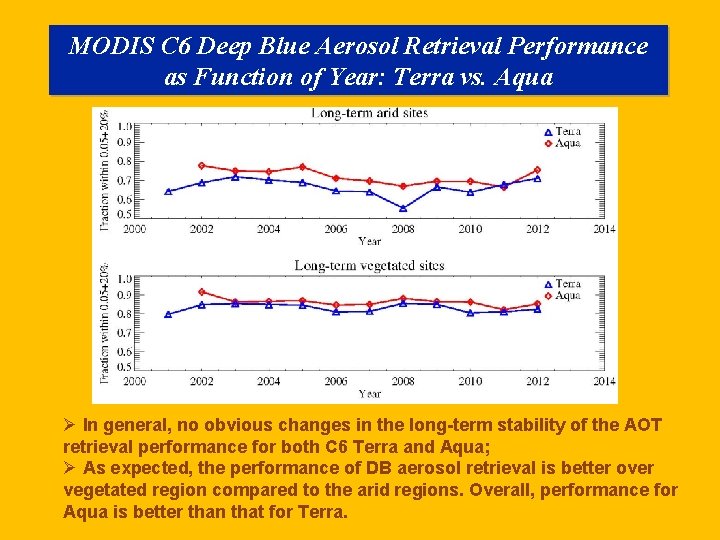
MODIS C 6 Deep Blue Aerosol Retrieval Performance as Function of Year: Terra vs. Aqua Ø In general, no obvious changes in the long-term stability of the AOT retrieval performance for both C 6 Terra and Aqua; Ø As expected, the performance of DB aerosol retrieval is better over vegetated region compared to the arid regions. Overall, performance for Aqua is better than that for Terra.
Planning for MODIS Collection 7: Extending Deep Blue Aerosol Products from Cloud free to Cloudy regions
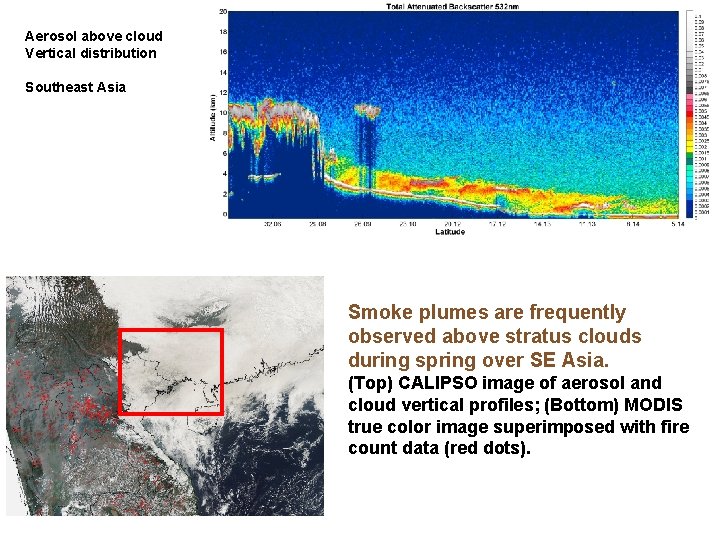
Aerosol above cloud Vertical distribution Southeast Asia Smoke plumes are frequently observed above stratus clouds during spring over SE Asia. (Top) CALIPSO image of aerosol and cloud vertical profiles; (Bottom) MODIS true color image superimposed with fire count data (red dots).
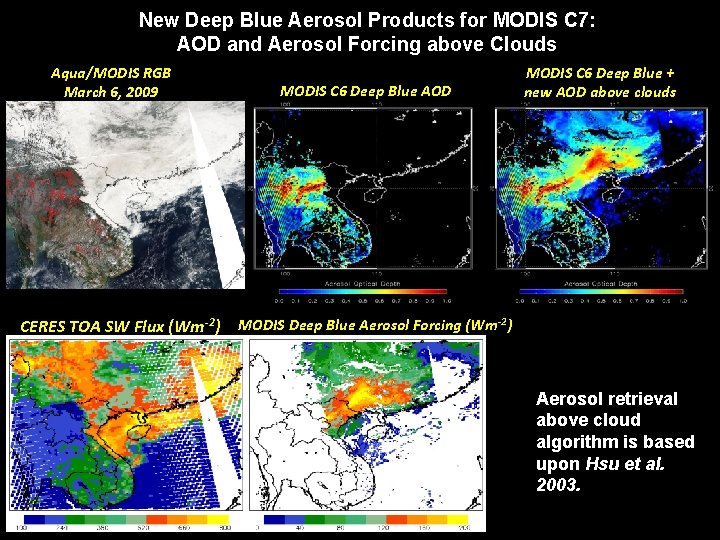
New Deep Blue Aerosol Products for MODIS C 7: AOD and Aerosol Forcing above Clouds Aqua/MODIS RGB March 6, 2009 CERES TOA SW Flux (Wm-2) MODIS C 6 Deep Blue AOD MODIS C 6 Deep Blue + new AOD above clouds MODIS Deep Blue Aerosol Forcing (Wm-2) Aerosol retrieval above cloud algorithm is based upon Hsu et al. 2003.
Summary • Both the spatial coverage and retrieval accuracy have been substantially improved in the MODIS C 6 Deep Blue aerosol products compared to C 5, as a result of the enhancement made in surface reflectance determination scheme and cloud screening as well as the utilization of thermal IR bands. • Based upon the comparisons with AERONET AOD global observations, the expected error for Aqua/MODIS C 6 DB is 0. 05± 20% over land. The performance for Terra is a little bit worse compared to that for Aqua, due to sensor degradation issue of Terra. • We have started planning for the MODIS C 7 reprocessing to implement the AOD and aerosol forcing above cloud retrievals into the Deep Blue algorithm. N. Christina Hsu, Deputy NPP Project Scientist 17 September 24, 2013 NASA/GSFC
For more details, See our posters: 1. Sayer et al. , MODIS Collection 6 Aerosol Products: Comparing “Deep Blue” and “Dark Target” Data 2. Lee et al. , Retrieval of Aerosol Optical Properties under Thin Cirrus from MODIS 3. Bettenhausen et al. , Validation of MODIS Collection 6 Deep Blue Aerosols
- Slides: 18