
Recent Transverse Spin Results From STAR Chris Perkins
- Slides: 30
Recent Transverse Spin Results From STAR Chris Perkins UC Berkeley/Space Sciences Laboratory Stony Brook University For the STAR Collaboration 6/1/2009
Outline • Introduction • Recent Results – Inclusive Particle Production – “Jet-like” Events – Particle Correlations – Heavy Mesons • Next Steps – Forward Hadron Calorimeter – Full Jets – Spin Transfer in Baryon production (polarimetry) – Direct Photons 6/1/2009 Chris Perkins 2
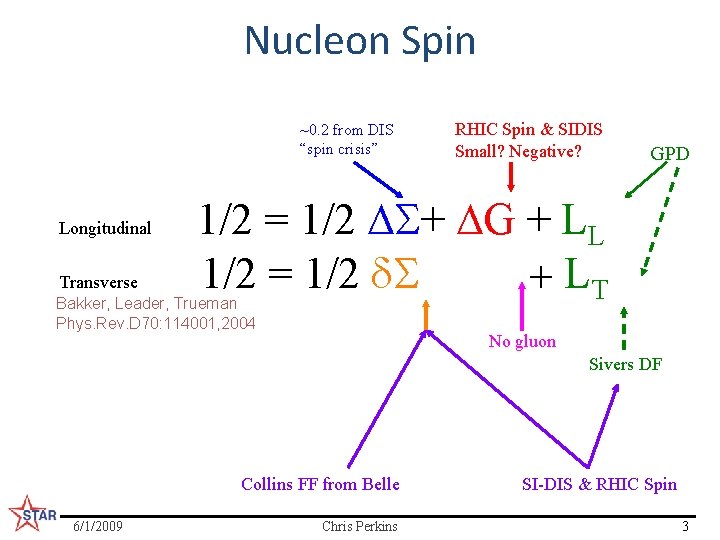
Nucleon Spin ~0. 2 from DIS “spin crisis” Longitudinal Transverse RHIC Spin & SIDIS Small? Negative? GPD 1/2 = 1/2 + G + LL 1/2 = 1/2 + LT Bakker, Leader, Trueman Phys. Rev. D 70: 114001, 2004 No gluon Sivers DF Collins FF from Belle 6/1/2009 Chris Perkins SI-DIS & RHIC Spin 3
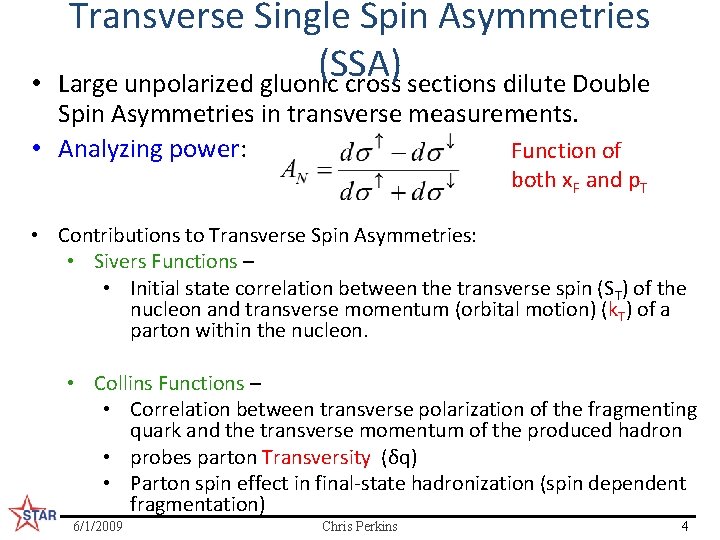
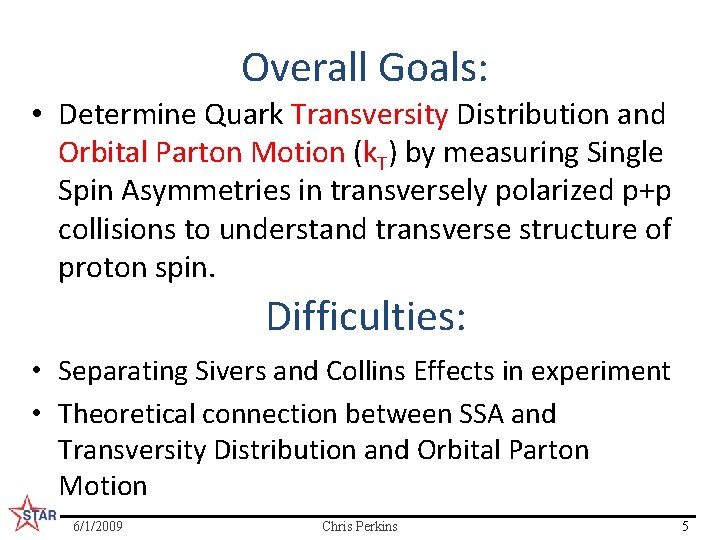
• Transverse Single Spin Asymmetries (SSA) Large unpolarized gluonic cross sections dilute Double Spin Asymmetries in transverse measurements. • Analyzing power: Function of both x. F and p. T • Contributions to Transverse Spin Asymmetries: • Sivers Functions – • Initial state correlation between the transverse spin (ST) of the nucleon and transverse momentum (orbital motion) (k. T) of a parton within the nucleon. • Collins Functions – • Correlation between transverse polarization of the fragmenting quark and the transverse momentum of the produced hadron • probes parton Transversity (δq) • Parton spin effect in final-state hadronization (spin dependent fragmentation) 6/1/2009 Chris Perkins 4
Overall Goals: • Determine Quark Transversity Distribution and Orbital Parton Motion (k. T) by measuring Single Spin Asymmetries in transversely polarized p+p collisions to understand transverse structure of proton spin. Difficulties: • Separating Sivers and Collins Effects in experiment • Theoretical connection between SSA and Transversity Distribution and Orbital Parton Motion 6/1/2009 Chris Perkins 5
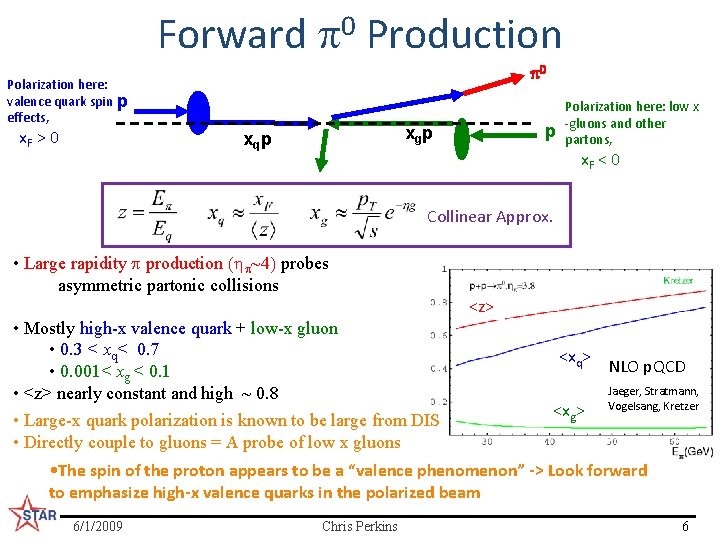
Forward p 0 Production p 0 Polarization here: valence quark spin p effects, x. F > 0 p xgp xqp Polarization here: low x -gluons and other partons, x. F < 0 Collinear Approx. • Large rapidity p production (hp~4) probes asymmetric partonic collisions <z> • Mostly high-x valence quark + low-x gluon • 0. 3 < xq< 0. 7 • 0. 001< xg < 0. 1 • <z> nearly constant and high ~ 0. 8 • Large-x quark polarization is known to be large from DIS • Directly couple to gluons = A probe of low x gluons <xq> <xg> NLO p. QCD Jaeger, Stratmann, Vogelsang, Kretzer • The spin of the proton appears to be a “valence phenomenon” -> Look forward to emphasize high-x valence quarks in the polarized beam 6/1/2009 Chris Perkins 6
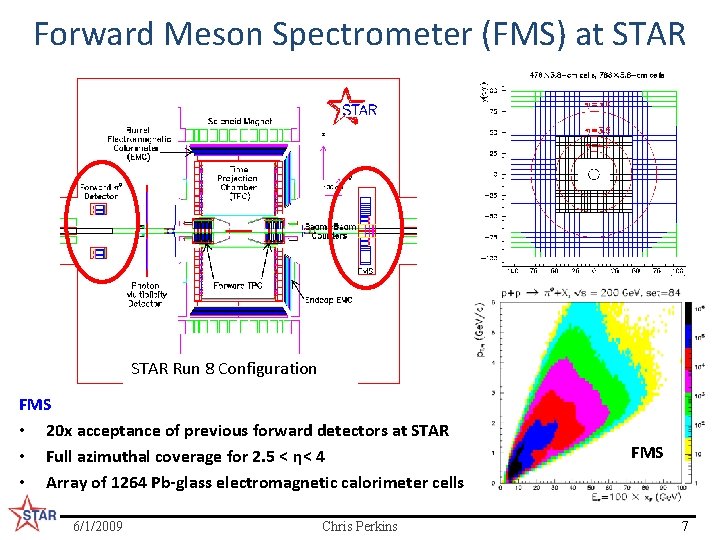
Forward Meson Spectrometer (FMS) at STAR Run 8 Configuration FMS FPD • 20 x Modular acceptance detector of previous forward detectors at STAR • Full Small azimuthal x. F, p. T range coverage compared for 2. 5 to FMS < η< 4 • Array of 1264 Pb-glass electromagnetic calorimeter cells 6/1/2009 Chris Perkins FMS FPD 7
Inclusive Forward Particle Production 6/1/2009 Chris Perkins 8
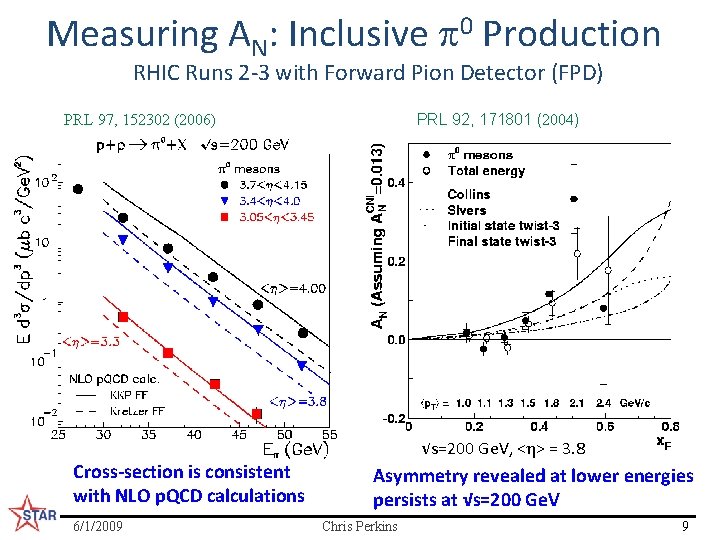
Measuring AN: Inclusive p 0 Production RHIC Runs 2 -3 with Forward Pion Detector (FPD) PRL 92, 171801 (2004) PRL 97, 152302 (2006) √s=200 Ge. V, <η> = 3. 8 Cross-section is consistent with NLO p. QCD calculations 6/1/2009 Asymmetry revealed at lower energies persists at √s=200 Ge. V Chris Perkins 9
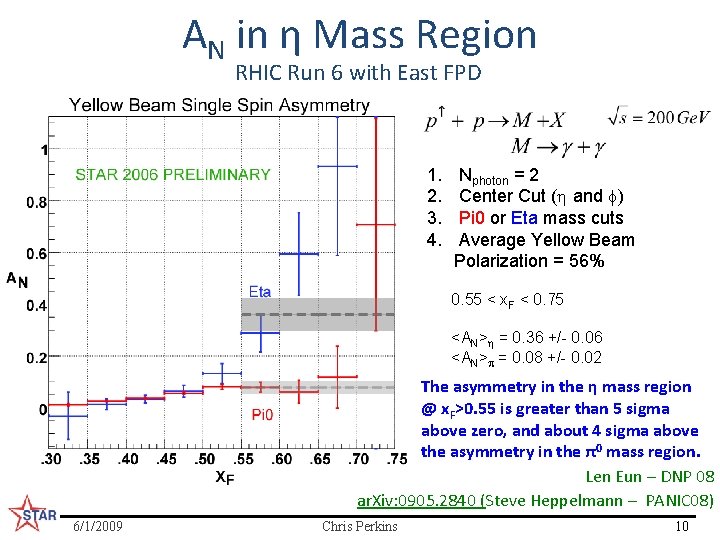
AN in η Mass Region RHIC Run 6 with East FPD 1. 2. 3. 4. Nphoton = 2 Center Cut (h and f) Pi 0 or Eta mass cuts Average Yellow Beam Polarization = 56% 0. 55 < x. F < 0. 75 <AN>h = 0. 36 +/- 0. 06 <AN>p = 0. 08 +/- 0. 02 The asymmetry in the η mass region @ x. F>0. 55 is greater than 5 sigma above zero, and about 4 sigma above the asymmetry in the π0 mass region. Len Eun – DNP 08 ar. Xiv: 0905. 2840 (Steve Heppelmann – PANIC 08) 6/1/2009 Chris Perkins 10
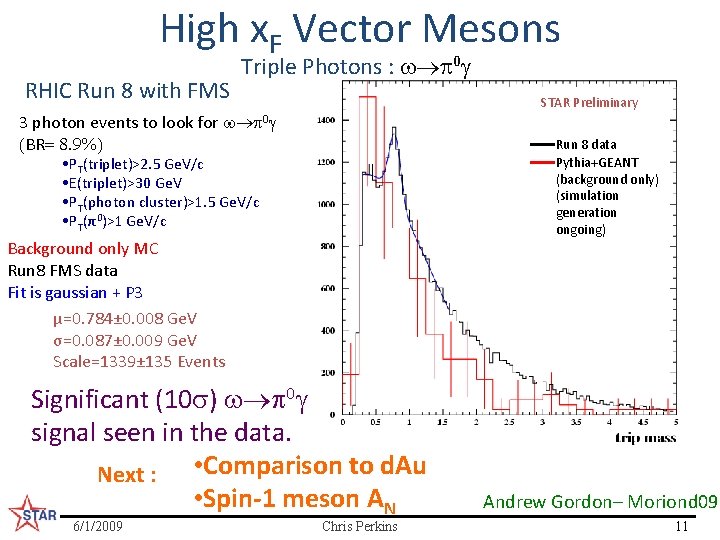
High x. F Vector Mesons RHIC Run 8 with FMS Triple Photons : w p 0 g STAR Preliminary 3 photon events to look for w p 0 g (BR= 8. 9%) Run 8 data Pythia+GEANT (background only) (simulation generation ongoing) • PT(triplet)>2. 5 Ge. V/c • E(triplet)>30 Ge. V • PT(photon cluster)>1. 5 Ge. V/c • PT(π0)>1 Ge. V/c Background only MC Run 8 FMS data Fit is gaussian + P 3 μ=0. 784± 0. 008 Ge. V σ=0. 087± 0. 009 Ge. V Scale=1339± 135 Events Significant (10 s) w p 0 g signal seen in the data. • Comparison to d. Au Next : • Spin-1 meson AN 6/1/2009 Chris Perkins Andrew Gordon– Moriond 09 11
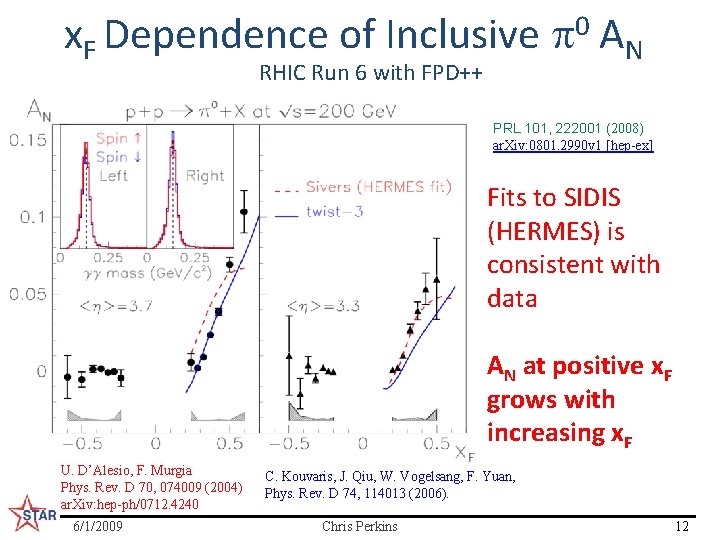
x. F Dependence of Inclusive p 0 AN RHIC Run 6 with FPD++ PRL 101, 222001 (2008) ar. Xiv: 0801. 2990 v 1 [hep-ex] Fits to SIDIS (HERMES) is consistent with data AN at positive x. F grows with increasing x. F U. D’Alesio, F. Murgia Phys. Rev. D 70, 074009 (2004) ar. Xiv: hep-ph/0712. 4240 6/1/2009 C. Kouvaris, J. Qiu, W. Vogelsang, F. Yuan, Phys. Rev. D 74, 114013 (2006). Chris Perkins 12
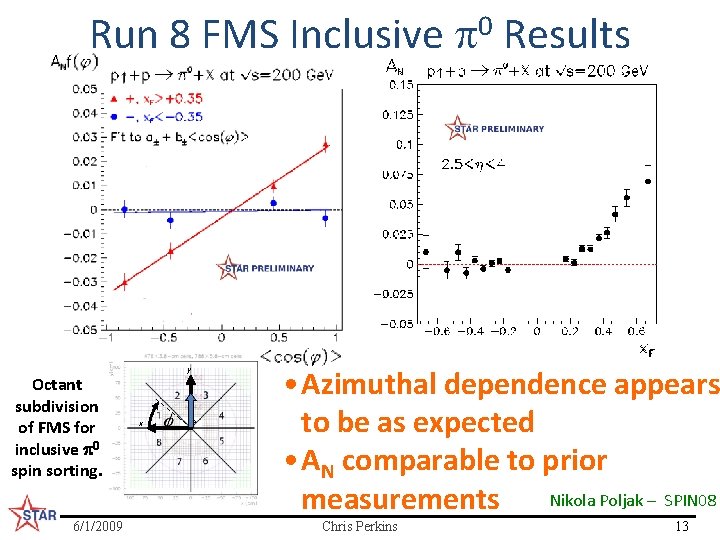
Run 8 FMS Inclusive p 0 Results Octant subdivision of FMS for inclusive p 0 spin sorting. 6/1/2009 y x P • Azimuthal dependence appears to be as expected • AN comparable to prior Nikola Poljak – SPIN 08 measurements Chris Perkins 13
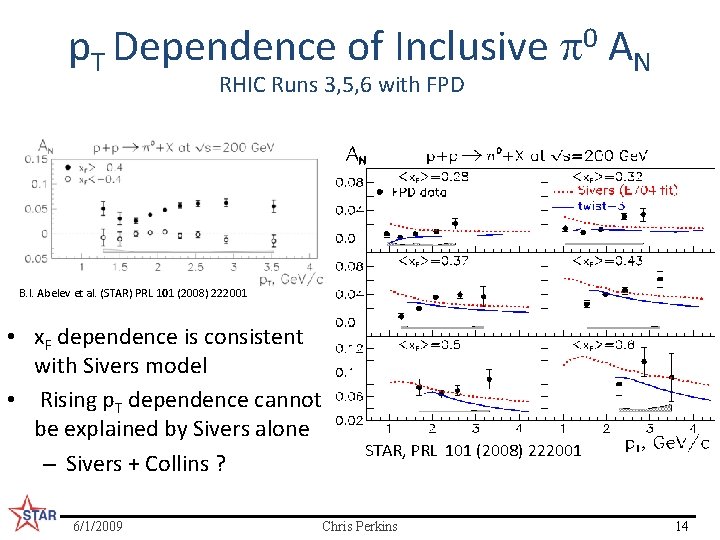
p. T Dependence of Inclusive p 0 AN RHIC Runs 3, 5, 6 with FPD B. I. Abelev et al. (STAR) PRL 101 (2008) 222001 • x. F dependence is consistent with Sivers model • Rising p. T dependence cannot be explained by Sivers alone – Sivers + Collins ? 6/1/2009 STAR, PRL 101 (2008) 222001 Chris Perkins 14
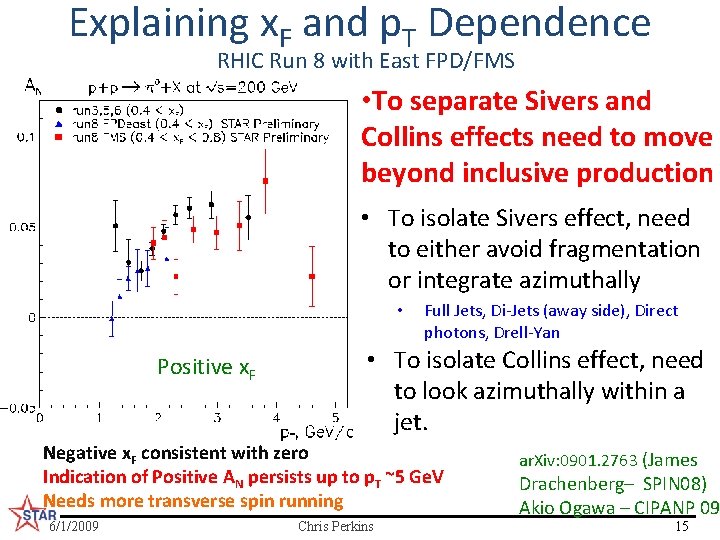
Explaining x. F and p. T Dependence RHIC Run 8 with East FPD/FMS • To separate Sivers and Collins effects need to move beyond inclusive production Negative x. F • To isolate Sivers effect, need to either avoid fragmentation or integrate azimuthally • Positive x. F Full Jets, Di-Jets (away side), Direct photons, Drell-Yan • To isolate Collins effect, need to look azimuthally within a jet. Negative x. F consistent with zero Indication of Positive AN persists up to p. T ~5 Ge. V Needs more transverse spin running 6/1/2009 Chris Perkins ar. Xiv: 0901. 2763 (James Drachenberg– SPIN 08) Akio Ogawa – CIPANP 09 15
Forward “Jet-like” Events • FMS currently has no hadronic capabilities -> can’t reconstruct full jets • First things first - Test procedures on unpolarized before moving on to polarized 6/1/2009 Chris Perkins 16
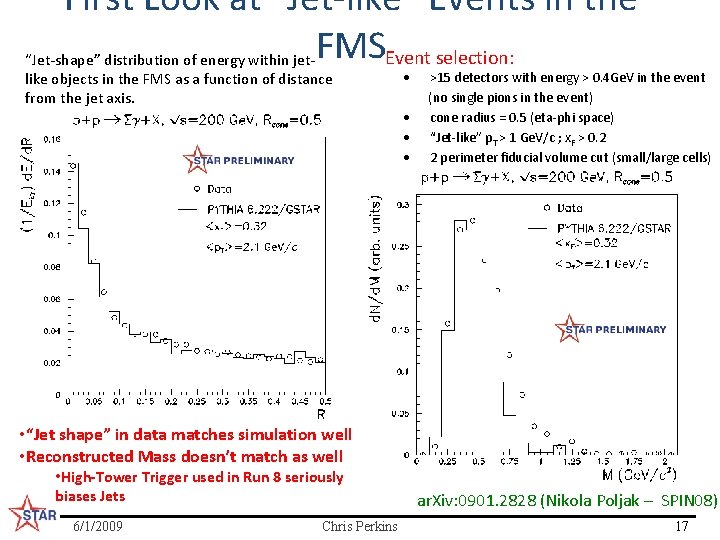
First Look at “Jet-like” Events in the FMSEvent selection: “Jet-shape” distribution of energy within jetlike objects in the FMS as a function of distance from the jet axis. • >15 detectors with energy > 0. 4 Ge. V in the event (no single pions in the event) • cone radius = 0. 5 (eta-phi space) • “Jet-like” p. T > 1 Ge. V/c ; x. F > 0. 2 • 2 perimeter fiducial volume cut (small/large cells) • “Jet shape” in data matches simulation well • Reconstructed Mass doesn’t match as well • High-Tower Trigger used in Run 8 seriously biases Jets 6/1/2009 Chris Perkins ar. Xiv: 0901. 2828 (Nikola Poljak – SPIN 08) 17
Di-hadron Correlations 6/1/2009 Chris Perkins 18
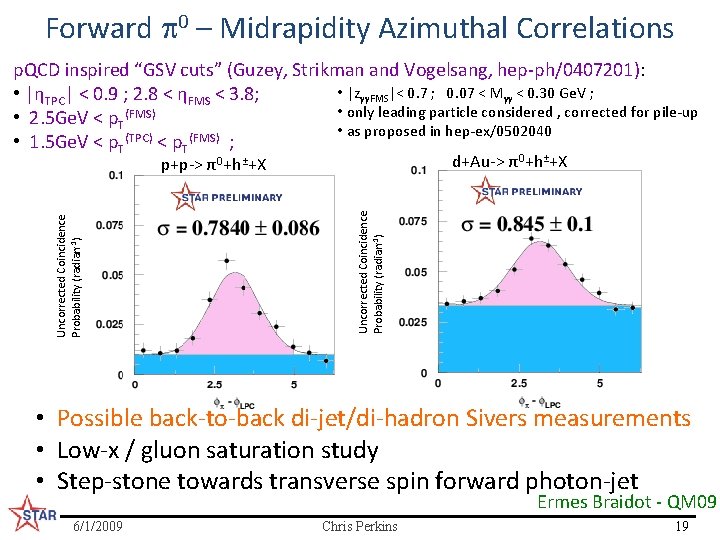
Forward p 0 – Midrapidity Azimuthal Correlations p. QCD inspired “GSV cuts” (Guzey, Strikman and Vogelsang, hep-ph/0407201): • |zγγFMS|< 0. 7 ; 0. 07 < Mγγ < 0. 30 Ge. V ; • |ηTPC| < 0. 9 ; 2. 8 < ηFMS < 3. 8; • only leading particle considered , corrected for pile-up • 2. 5 Ge. V < p. T(FMS) • as proposed in hep-ex/0502040 (TPC) (FMS) • 1. 5 Ge. V < p. T ; d+Au-> π0+h±+X Uncorrected Coincidence Probability (radian-1) p+p-> π0+h±+X • Possible back-to-back di-jet/di-hadron Sivers measurements • Low-x / gluon saturation study • Step-stone towards transverse spin forward photon-jet Ermes Braidot - QM 09 6/1/2009 Chris Perkins 19
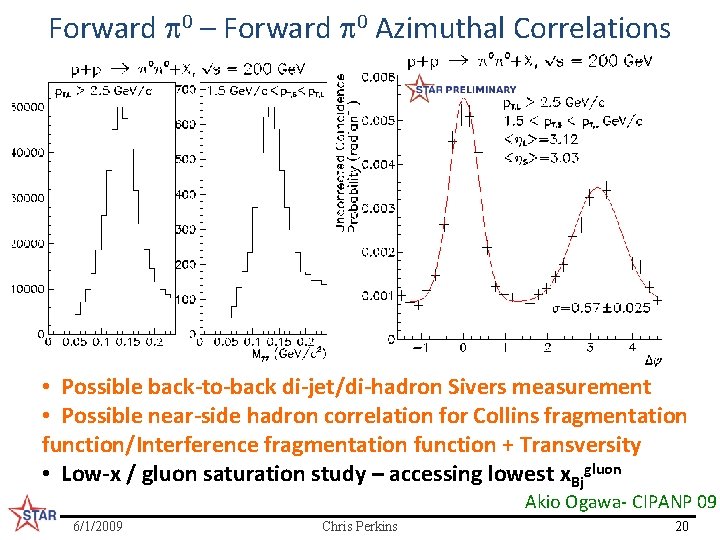
Forward p 0 – Forward p 0 Azimuthal Correlations • Possible back-to-back di-jet/di-hadron Sivers measurement • Possible near-side hadron correlation for Collins fragmentation function/Interference fragmentation function + Transversity • Low-x / gluon saturation study – accessing lowest x. Bjgluon Akio Ogawa- CIPANP 09 6/1/2009 Chris Perkins 20
Drell-Yan 6/1/2009 Chris Perkins 21
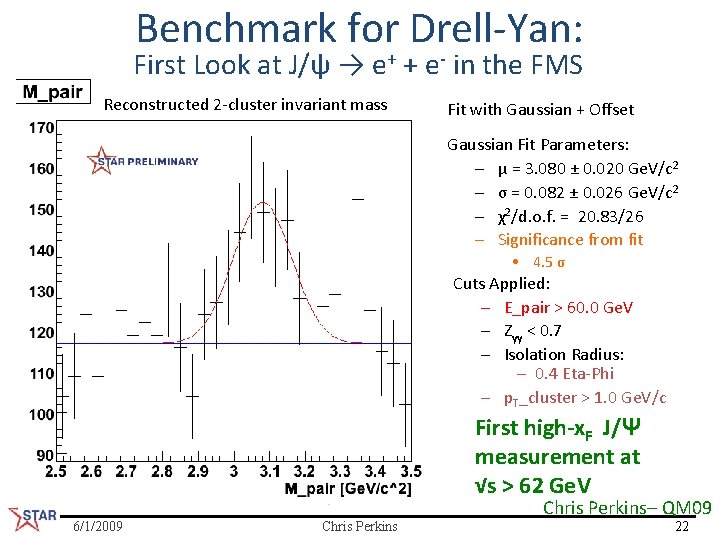
Benchmark for Drell-Yan: First Look at J/ψ → e+ + e- in the FMS Reconstructed 2 -cluster invariant mass Fit with Gaussian + Offset Gaussian Fit Parameters: – μ = 3. 080 ± 0. 020 Ge. V/c 2 – σ = 0. 082 ± 0. 026 Ge. V/c 2 F – χ2/d. o. f. = 20. 83/26 – Significance from fit High-x , high mass dilepton pairs are • 4. 5 σ difficult to Cuts Applied: – E_pair > 60. 0 Ge. V reconstruct – Zγγ < 0. 7 – Isolation Radius: – 0. 4 Eta-Phi – p. T_cluster > 1. 0 Ge. V/c First high-x. F J/Ψ measurement at √s > 62 Ge. V 6/1/2009 Chris Perkins– QM 09 22
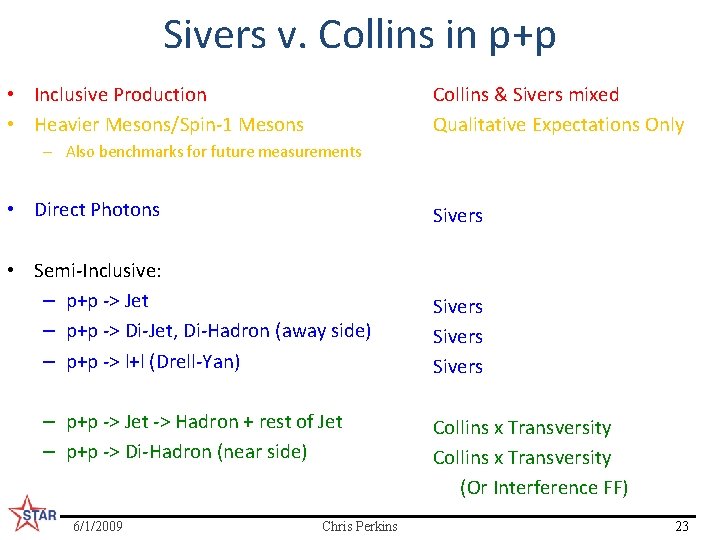
Sivers v. Collins in p+p • Inclusive Production • Heavier Mesons/Spin-1 Mesons Collins & Sivers mixed Qualitative Expectations Only – Also benchmarks for future measurements • Direct Photons Sivers • Semi-Inclusive: – p+p -> Jet – p+p -> Di-Jet, Di-Hadron (away side) – p+p -> l+l (Drell-Yan) Sivers – p+p -> Jet -> Hadron + rest of Jet – p+p -> Di-Hadron (near side) 6/1/2009 Chris Perkins Collins x Transversity (Or Interference FF) 23
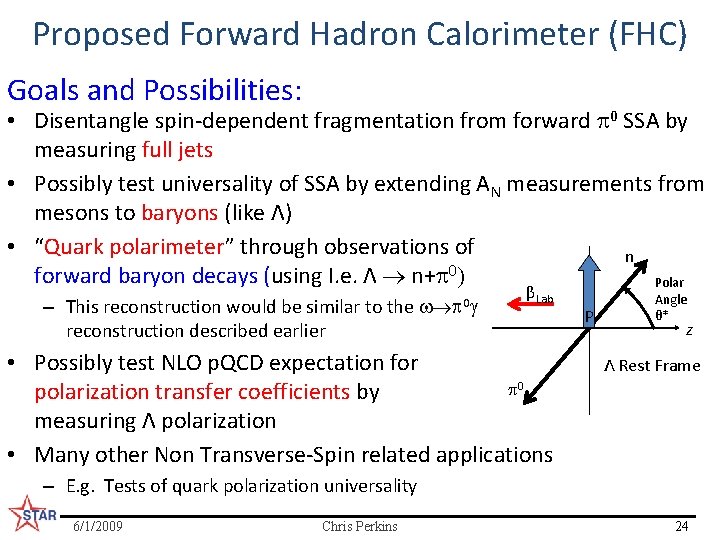
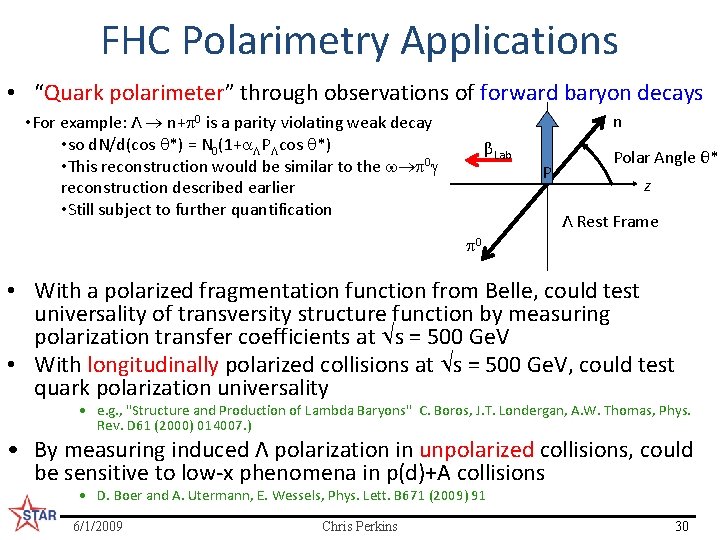
Proposed Forward Hadron Calorimeter (FHC) Goals and Possibilities: • Disentangle spin-dependent fragmentation from forward p 0 SSA by measuring full jets • Possibly test universality of SSA by extending AN measurements from mesons to baryons (like Λ) • “Quark polarimeter” through observations of n 0 forward baryon decays (using I. e. Λ n+p ) Polar – This reconstruction would be similar to the w p 0 g βLab reconstruction described earlier • Possibly test NLO p. QCD expectation for p 0 polarization transfer coefficients by measuring Λ polarization • Many other Non Transverse-Spin related applications P Angle θ* z Λ Rest Frame – E. g. Tests of quark polarization universality 6/1/2009 Chris Perkins 24
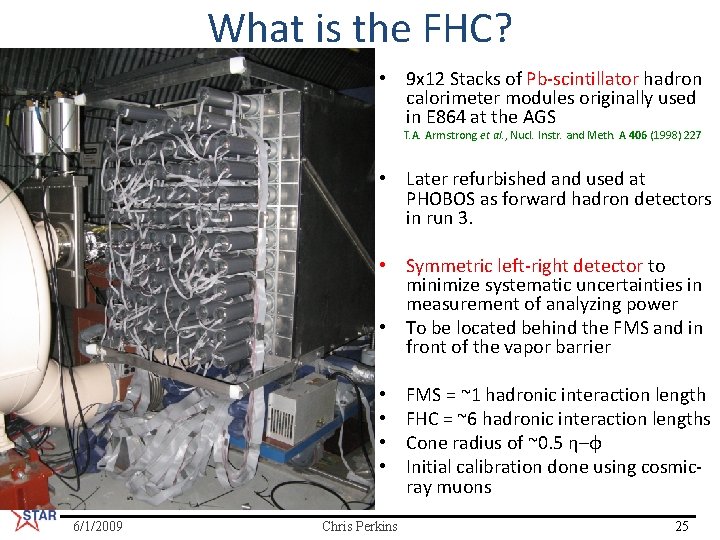
What is the FHC? • 9 x 12 Stacks of Pb-scintillator hadron calorimeter modules originally used in E 864 at the AGS T. A. Armstrong et al. , Nucl. Instr. and Meth. A 406 (1998) 227 • Later refurbished and used at PHOBOS as forward hadron detectors in run 3. • Symmetric left-right detector to minimize systematic uncertainties in measurement of analyzing power • To be located behind the FMS and in front of the vapor barrier • • 6/1/2009 Chris Perkins FMS = ~1 hadronic interaction length FHC = ~6 hadronic interaction lengths Cone radius of ~0. 5 η–φ Initial calibration done using cosmicray muons 25
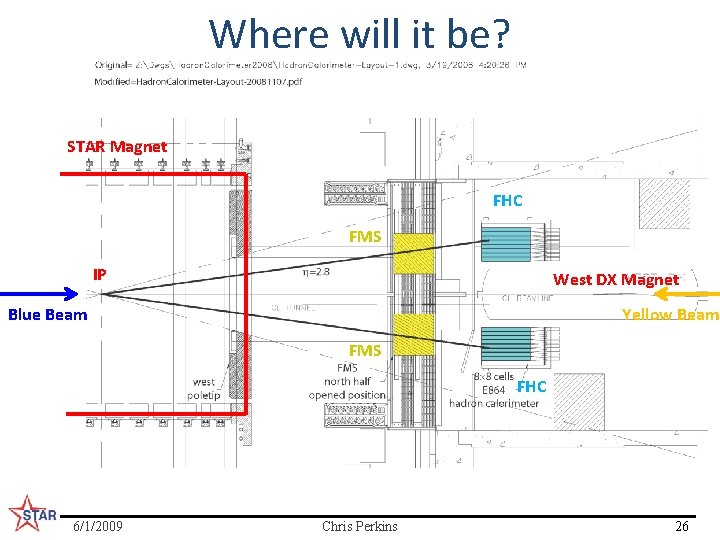
Where will it be? STAR Magnet FHC FMS IP West DX Magnet Blue Beam Yellow Beam FMS FHC 6/1/2009 Chris Perkins 26
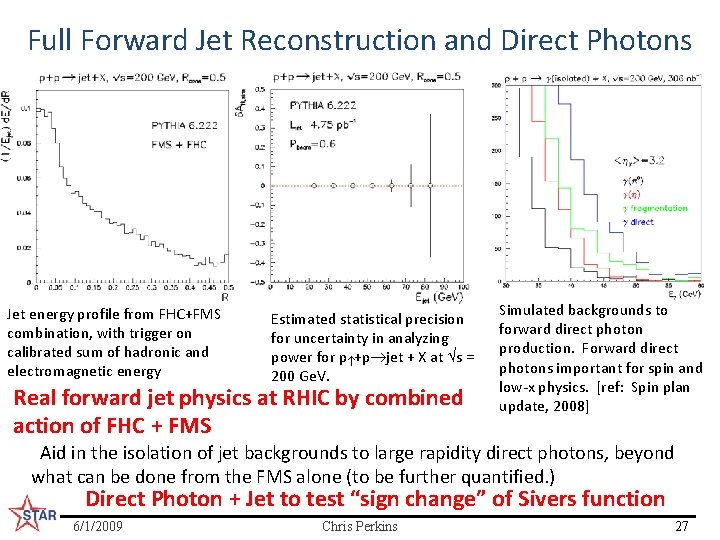
Full Forward Jet Reconstruction and Direct Photons Jet energy profile from FHC+FMS combination, with trigger on calibrated sum of hadronic and electromagnetic energy Estimated statistical precision for uncertainty in analyzing power for p +p jet + X at s = 200 Ge. V. Real forward jet physics at RHIC by combined action of FHC + FMS Simulated backgrounds to forward direct photon production. Forward direct photons important for spin and low-x physics. [ref: Spin plan update, 2008] Aid in the isolation of jet backgrounds to large rapidity direct photons, beyond what can be done from the FMS alone (to be further quantified. ) Direct Photon + Jet to test “sign change” of Sivers function 6/1/2009 Chris Perkins 27
Summary • Wide range of Forward Inclusive Particle AN have either been reported or are in progress – Results show AN tends to increase with x. F, as expected – p. T dependence does not appear to follow expected trend • To separate Sivers and Collins effects, we need to move beyond Inclusive particles – Full Jets, Correlations, Direct Photons, Drell-Yan • A Forward Hadron Calorimeter (FHC) will move us closer to these measurements in addition to possibly testing universality of quark polarization and single spin asymmetries – Proposed to be in place for RHIC Run 10 6/1/2009 Chris Perkins 28
29 BACKUP
FHC Polarimetry Applications • “Quark polarimeter” through observations of forward baryon decays n • For example: Λ n+p 0 is a parity violating weak decay • so d. N/d(cos *) = N 0(1+a. LPLcos *) • This reconstruction would be similar to the w p 0 g reconstruction described earlier • Still subject to further quantification βLab P Polar Angle θ* z Λ Rest Frame p 0 • With a polarized fragmentation function from Belle, could test universality of transversity structure function by measuring polarization transfer coefficients at s = 500 Ge. V • With longitudinally polarized collisions at s = 500 Ge. V, could test quark polarization universality • e. g. , "Structure and Production of Lambda Baryons" C. Boros, J. T. Londergan, A. W. Thomas, Phys. Rev. D 61 (2000) 014007. ) • By measuring induced Λ polarization in unpolarized collisions, could be sensitive to low-x phenomena in p(d)+A collisions • D. Boer and A. Utermann, E. Wessels, Phys. Lett. B 671 (2009) 91 6/1/2009 Chris Perkins 30