
Recent results on strangeness from the STAR experiment
- Slides: 23
Recent results on strangeness from the STAR experiment Matthew A. C. Lamont, Yale University for the STAR Collaboration Outline Bulk Measurements Production vs Energy Strangeness Enhancement Elliptic Flow Outside the Bulk p+p Collisions Identified Particle Ratios di-Hadron Correlations
STAR strangeness talks at SQM • Φ-meson production and flow in HIC at RHIC - S Blyth • Resonance studies with STAR - S Salur • E-by-E fluctuations in the K/π ratio at RHIC - S Das • Global polarization measurements in Au+Au - I Selyuzhenkov • Strange hadron v - M Oldenburg • Studying the sapce-time structure of multi 2 strange baryons - P Chaloupka SQM 2006: Matthew. Lamont@yale. edu 2
Strange particles - we’ve got ‘em > 95% of all particle production occurs below 2 Ge. V/c in p This region dominates the bulk properties of the system SQM 2006: Matthew. Lamont@yale. edu 3
Strange Particles vs Energy • • • Smooth increase in strange baryon production from 17 Ge. V to 200 Ge. V Expected behaviour for ratios with decreasing net baryon density observed K/π also smooth and shows ~ 50% enhancement over p+p collisions at RHIC energies SQM 2006: Matthew. Lamont@yale. edu 4
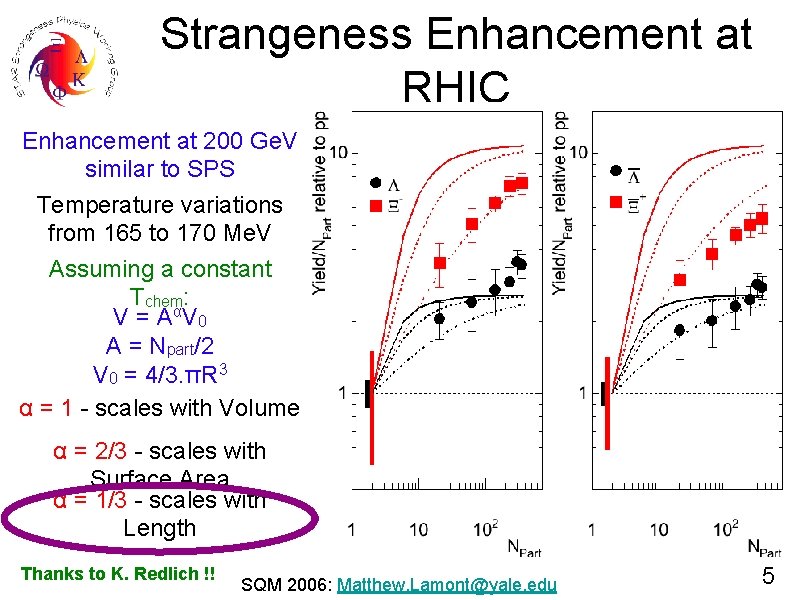
Strangeness Enhancement at RHIC Enhancement at 200 Ge. V similar to SPS Temperature variations from 165 to 170 Me. V Assuming a constant Tchem: V = A αV 0 A = Npart/2 V 0 = 4/3. πR 3 α = 1 - scales with Volume α = 2/3 - scales with Surface Area α = 1/3 - scales with Length Thanks to K. Redlich !! STAR NA 57 SQM 2006: Matthew. Lamont@yale. edu 5
Blast wave fits to data Strong centrality dependence on freeze out parameters for light hadrons 200 Ge. V Multi-strange hadrons freeze out earlier, with a lower <βT> Indicative of smaller cross -section for interactions of multiply strange hadrons with lighter species. Is this a signature of partonic collectivity? SQM 2006: Matthew. Lamont@yale. edu 6
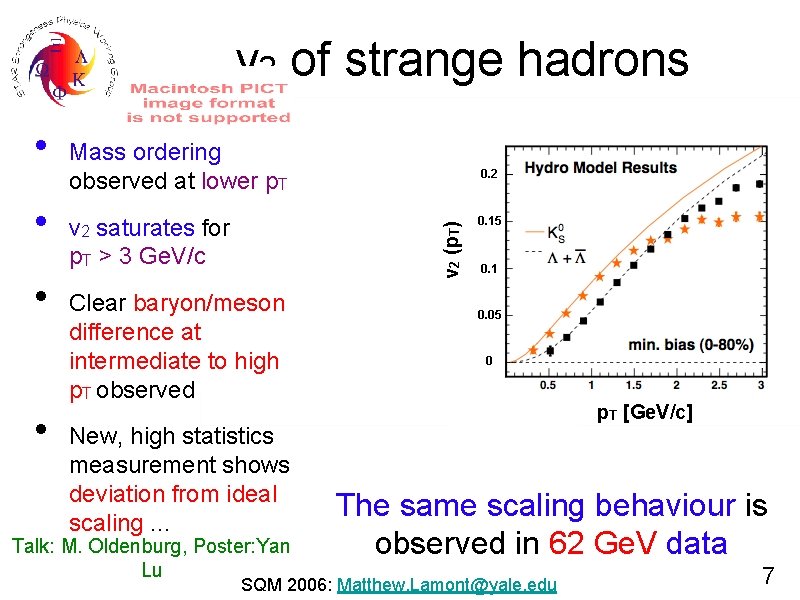
v 2 of strange hadrons • • • Mass ordering observed at lower p. T v 2 saturates for p. T > 3 Ge. V/c 0. 2 v 2 (p. T) • Clear baryon/meson difference at intermediate to high p. T observed New, high statistics measurement shows deviation from ideal scaling. . . Talk: M. Oldenburg, Poster: Yan Lu 0. 15 0. 1 0. 05 0 p. T [Ge. V/c] The same scaling behaviour is observed in 62 Ge. V data SQM 2006: Matthew. Lamont@yale. edu 7
v 2 of multi-strange hadrons Hydro: P. Huovinen, private communication Talks: M. Oldenburg S-L Blyth Poster: Yan Lu • • Multi-strange hadrons flow just as well as other baryons and mesons Collective flow is developed early, during partonic stage • Strange quarks flow like the light quarks. . SQM 2006: Matthew. Lamont@yale. edu 8
Moving away from the bulk. . . Strangeness in p+p collisions Strangeness at intermediate and high-p. T in Au+Au collisions SQM 2006: Matthew. Lamont@yale. edu 9
Strangeness in p+p • Large statistics data-set allows for the detailed analysis of data Using Pythia (LO) requires changing the K factor to match the data (See also talk by S Salur on Σ*) NLO calculations show good agreement with non-strange hadrons Agreement with strange hadrons is not as apparent, better for AKK than for Vogelsang EPOS has very good agreement with all particles, even Xi SQM 2006: Matthew. Lamont@yale. edu 10
• • m gluon vs quark jets @ 200 Ge. V Λ/Λ ratio show dominance of gluon jets when compared to Pythia, but is not conclusive. scaling first studied using ISR data T • no absolute scaling observed in p+p, but applying pre-factors shows some universal behaviour for baryons and mesons SQM 2006: Matthew. Lamont@yale. edu 11
m. T scaling in Pythia • • Pythia shows shape differences on the whole Gluon jet events show the difference • Quark jet events show no difference • Evidence for gluon jet domination at RHIC? SQM 2006: Matthew. Lamont@yale. edu 12
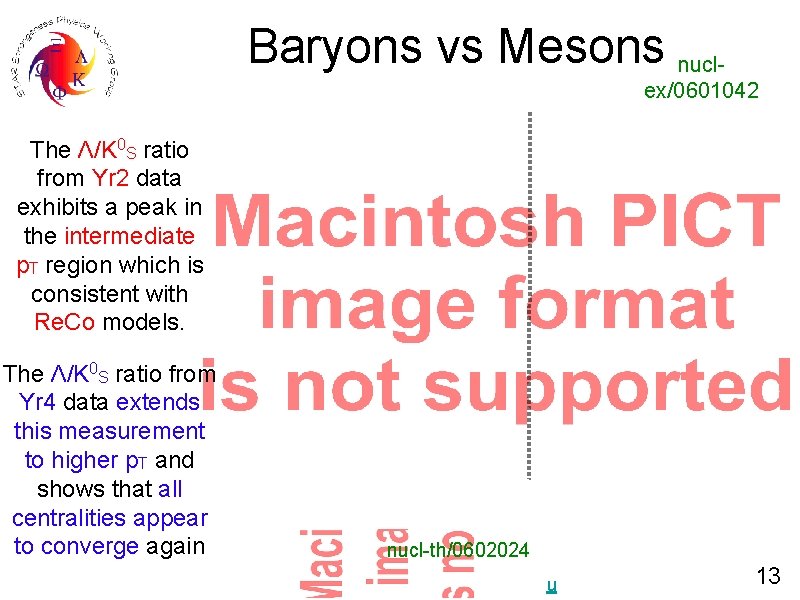
Baryons vs Mesons nuclex/0601042 The Λ/K 0 S ratio from Yr 2 data exhibits a peak in the intermediate p. T region which is consistent with Re. Co models. The Λ/K 0 S ratio from Yr 4 data extends this measurement to higher p. T and shows that all centralities appear to converge again Oregon nucl-th/0602024 SQM 2006: Matthew. Lamont@yale. edu 13
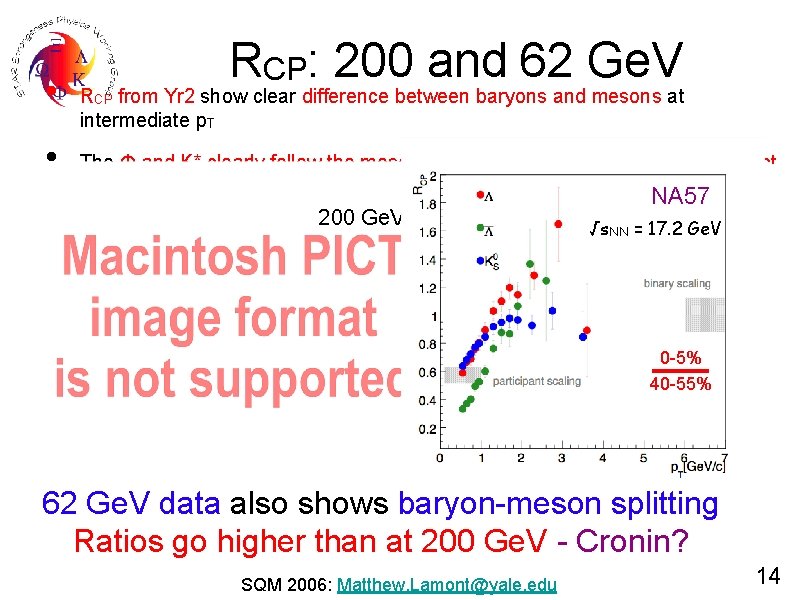
• • RCP: 200 and 62 Ge. V RCP from Yr 2 show clear difference between baryons and mesons at intermediate p. T The Φ and K* clearly follow the mesons and not the baryons, not a mass effect 200 Ge. V NA 57 200 Ge. V √s = 17. 2 Ge. V NN • Data from Yr 4 extend the measurement out to much higher p. T • The strange and non- strange baryons and mesons are consistent and appear to show a similar suppression for p. T > 5 Ge. V/c. 0 -5% 40 -55% 62 Ge. V data also shows baryon-meson splitting Ratios go higher than at 200 Ge. V - Cronin? SQM 2006: Matthew. Lamont@yale. edu 14
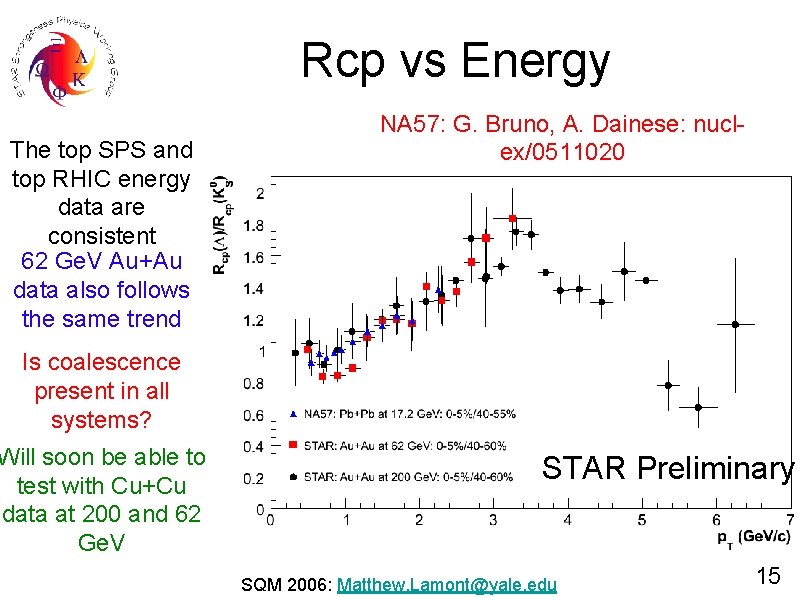
Rcp vs Energy The top SPS and top RHIC energy data are consistent 62 Ge. V Au+Au data also follows the same trend NA 57: G. Bruno, A. Dainese: nuclex/0511020 Is coalescence present in all systems? Will soon be able to test with Cu+Cu data at 200 and 62 Ge. V STAR Preliminary SQM 2006: Matthew. Lamont@yale. edu 15
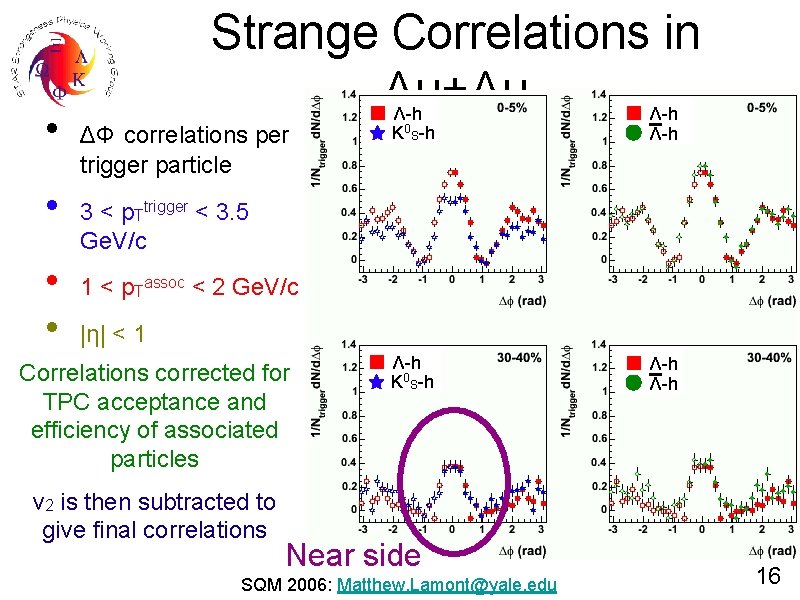
• • Strange Correlations in Au+Au ΔΦ correlations per trigger particle Λ-h K 0 S-h Λ-h Λ-h 3 < p. Ttrigger < 3. 5 Ge. V/c 1 < p. Tassoc < 2 Ge. V/c |η| < 1 Correlations corrected for TPC acceptance and efficiency of associated particles v 2 is then subtracted to give final correlations Near side SQM 2006: Matthew. Lamont@yale. edu 16
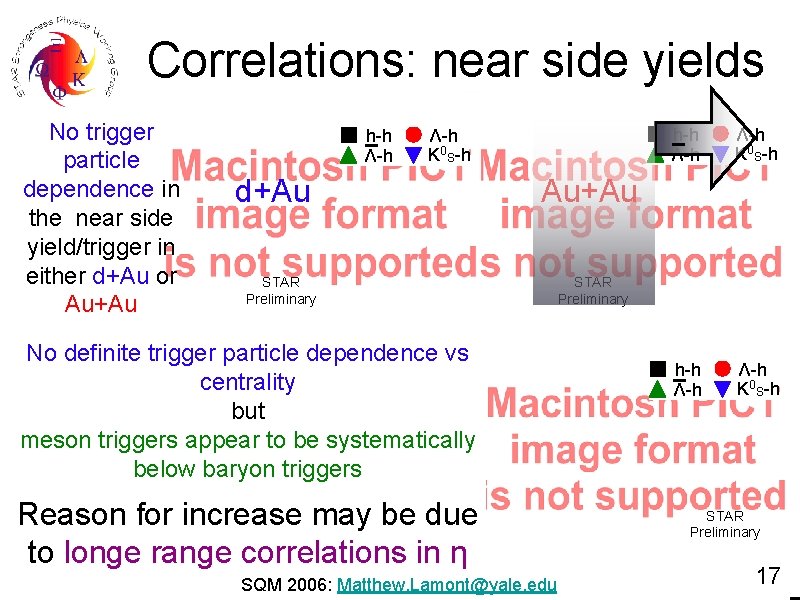
Correlations: near side yields No trigger particle dependence in the near side yield/trigger in either d+Au or Au+Au h-h Λ-h K 0 S-h d+Au h-h Λ-h Λ-h K 0 S-h Au+Au STAR Preliminary No definite trigger particle dependence vs centrality but meson triggers appear to be systematically below baryon triggers Reason for increase may be due to longe range correlations in η SQM 2006: Matthew. Lamont@yale. edu STAR Preliminary 17
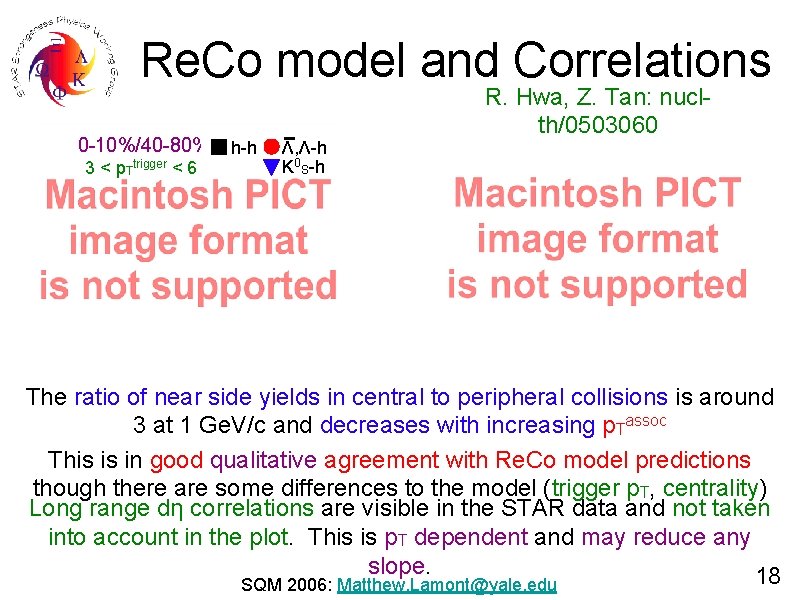
Re. Co model and Correlations 0 -10%/40 -80% 3 < p. T trigger <6 h-h Λ, Λ-h K 0 S-h R. Hwa, Z. Tan: nuclth/0503060 The ratio of near side yields in central to peripheral collisions is around 3 at 1 Ge. V/c and decreases with increasing p. Tassoc This is in good qualitative agreement with Re. Co model predictions though there are some differences to the model (trigger p. T, centrality) Long range dη correlations are visible in the STAR data and not taken into account in the plot. This is p. T dependent and may reduce any slope. 18 SQM 2006: Matthew. Lamont@yale. edu
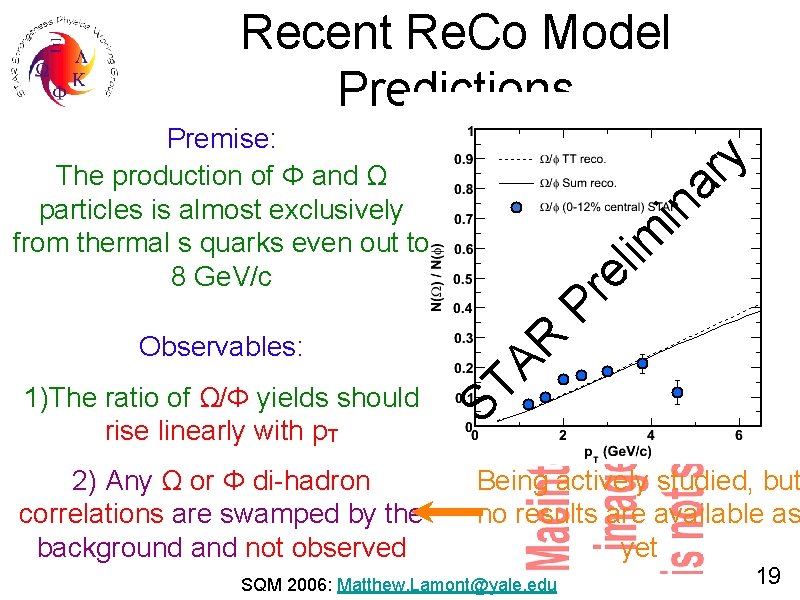
Recent Re. Co Model Predictions Premise: The production of Φ and Ω particles is almost exclusively from thermal s quarks even out to 8 Ge. V/c Observables: 1)The ratio of Ω/Φ yields should rise linearly with p. T 2) Any Ω or Φ di-hadron correlations are swamped by the background and not observed ST AR Pr el im in ar y STAR Preliminary Being actively studied, but no results are available as yet SQM 2006: Matthew. Lamont@yale. edu 19
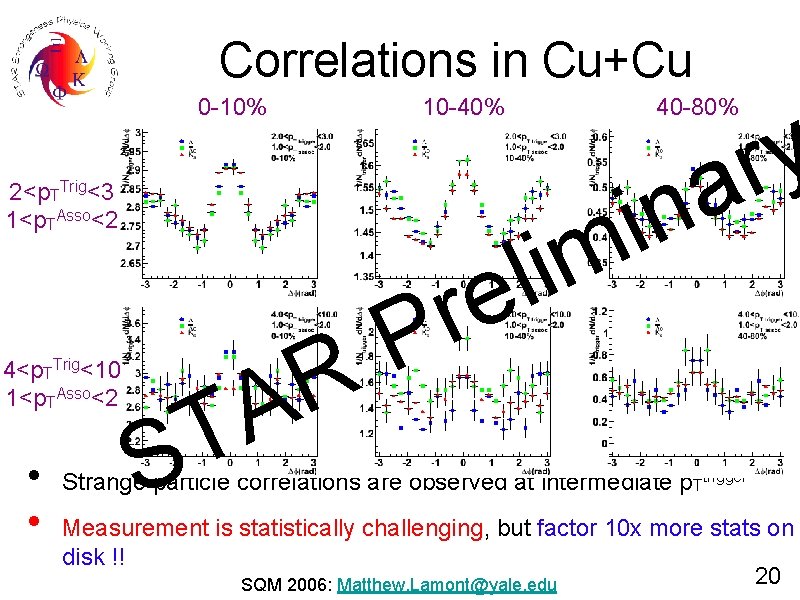
Correlations in Cu+Cu 0 -10% 10 -40% 2<p. TTrig<3 1<p. TAsso<2 4<p. TTrig<10 1<p. TAsso<2 • • A T S P R 40 -80% y r a n l re i im Strange particle correlations are observed at intermediate p. Ttrigger Measurement is statistically challenging, but factor 10 x more stats on disk !! 20 SQM 2006: Matthew. Lamont@yale. edu
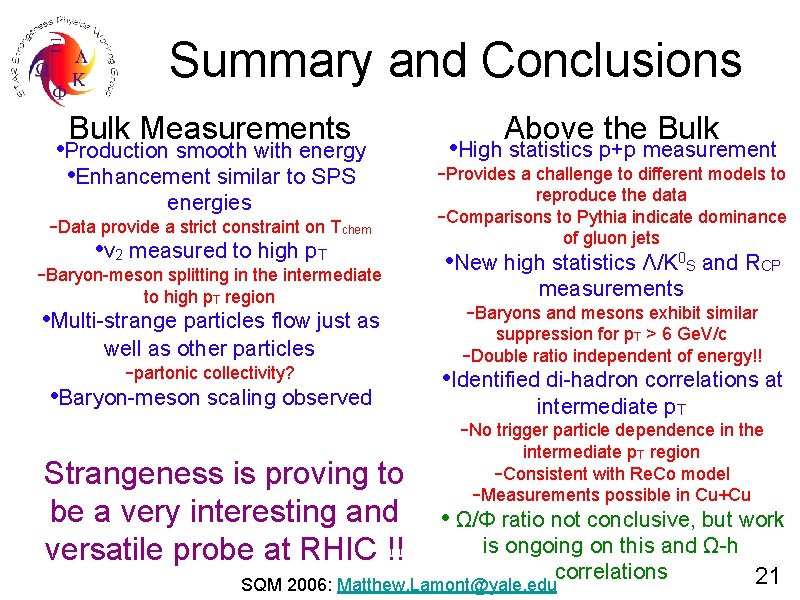
Summary and Conclusions Bulk Measurements • Production smooth with energy • Enhancement similar to SPS energies -Data provide a strict constraint on Tchem • v 2 measured to high p. T -Baryon-meson splitting in the intermediate to high p. T region • Multi-strange particles flow just as well as other particles -partonic collectivity? • Baryon-meson scaling observed Above the Bulk • High statistics p+p measurement -Provides a challenge to different models to reproduce the data -Comparisons to Pythia indicate dominance of gluon jets • New high statistics Λ/K 0 S and RCP measurements -Baryons and mesons exhibit similar suppression for p. T > 6 Ge. V/c -Double ratio independent of energy!! • Identified di-hadron correlations at intermediate p. T -No trigger particle dependence in the Strangeness is proving to be a very interesting and versatile probe at RHIC !! intermediate p. T region -Consistent with Re. Co model -Measurements possible in Cu+Cu • Ω/Φ ratio not conclusive, but work is ongoing on this and Ω-h correlations 21 SQM 2006: Matthew. Lamont@yale. edu
SQM 2006: Matthew. Lamont@yale. edu 22
Δη correlations - the ridge SQM 2006: Matthew. Lamont@yale. edu 23