
Recent results from KLOE Cesare Bini Universita La
Recent results from KLOE Cesare Bini Universita’ “La Sapienza” and INFN Roma 1. 2. 3. 4. 5. 6. The KLOE physics program The KLOE detector Status of the experiment Results on neutral kaon decays Results on f radiative decays Conclusions and perspectives
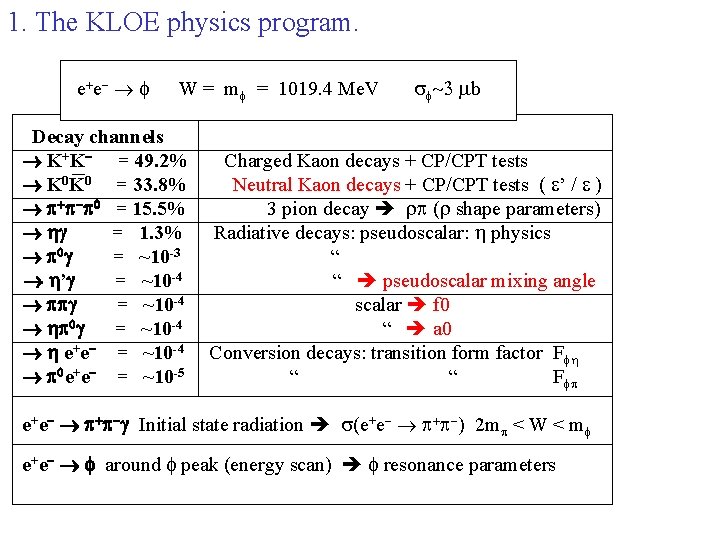
1. The KLOE physics program. e+ e f W = mf = 1019. 4 Me. V Decay channels K+K = 49. 2% K 0 K 0 = 33. 8% p+p p 0 = 15. 5% hg = 1. 3% p 0 g = ~10 -3 h’g = ~10 -4 ppg = ~10 -4 hp 0 g = ~10 -4 h e+e = ~10 -4 p 0 e+e = ~10 -5 sf~3 mb Charged Kaon decays + CP/CPT tests Neutral Kaon decays + CP/CPT tests ( e’ / e ) 3 pion decay rp (r shape parameters) Radiative decays: pseudoscalar: h physics “ “ pseudoscalar mixing angle scalar f 0 “ a 0 Conversion decays: transition form factor Ffh “ “ Ffp e+e p+p g Initial state radiation s(e+e p+p ) 2 mp < W < mf e+e f around f peak (energy scan) f resonance parameters
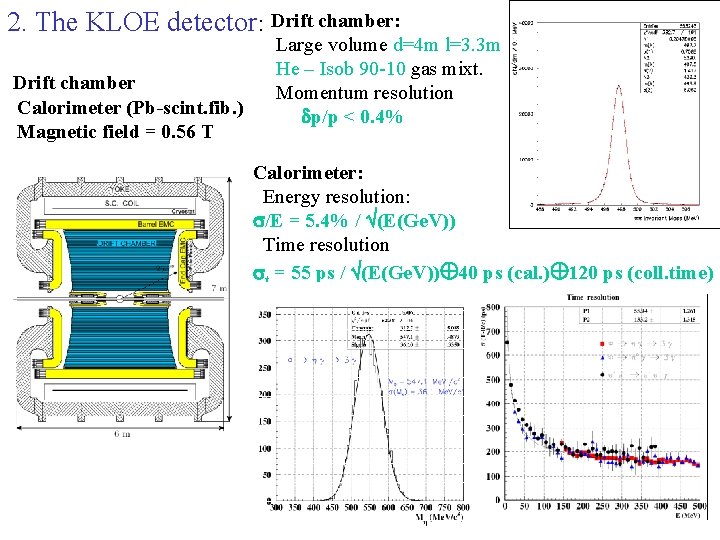
2. The KLOE detector: Drift chamber Calorimeter (Pb-scint. fib. ) Magnetic field = 0. 56 T Large volume d=4 m l=3. 3 m He – Isob 90 -10 gas mixt. Momentum resolution dp/p < 0. 4% Calorimeter: Energy resolution: s/E = 5. 4% / (E(Ge. V)) Time resolution st = 55 ps / (E(Ge. V)) 40 ps (cal. ) 120 ps (coll. time)

3. Status of the experiment Data taken from april 1999 to december 2001~ at f peak + 1 energy scan Present day performance: peak L(cm 2 s 1) 5· 1031 day L dt (pb 1) 3 Analysis status: 2000 data ~completed (25 pb-1 7. 5 x 10⁷ f) 2001 data in progress (190 pb-1 5. 7 x 10⁸ f) average 3. 5· 1031 1. 8 All results are still preliminary
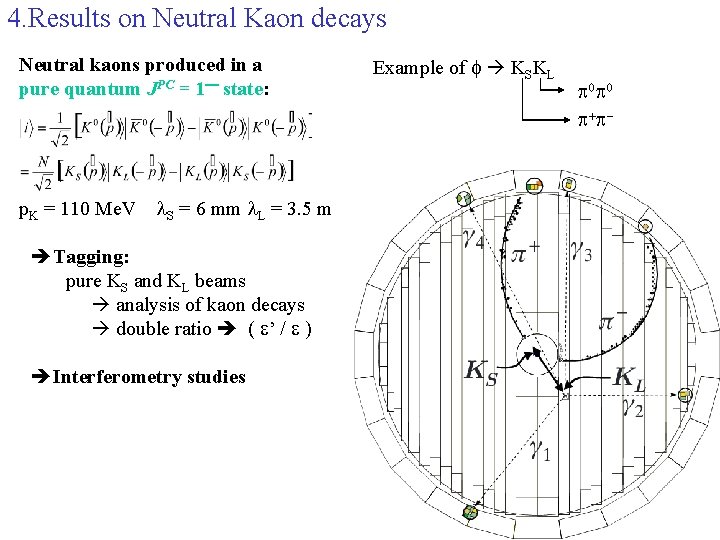
4. Results on Neutral Kaon decays Neutral kaons produced in a pure quantum JPC = 1 state: p. K = 110 Me. V l. S = 6 mm l. L = 3. 5 m Tagging: pure KS and KL beams analysis of kaon decays double ratio ( e’ / e ) Interferometry studies Example of f KSKL p 0 p+p
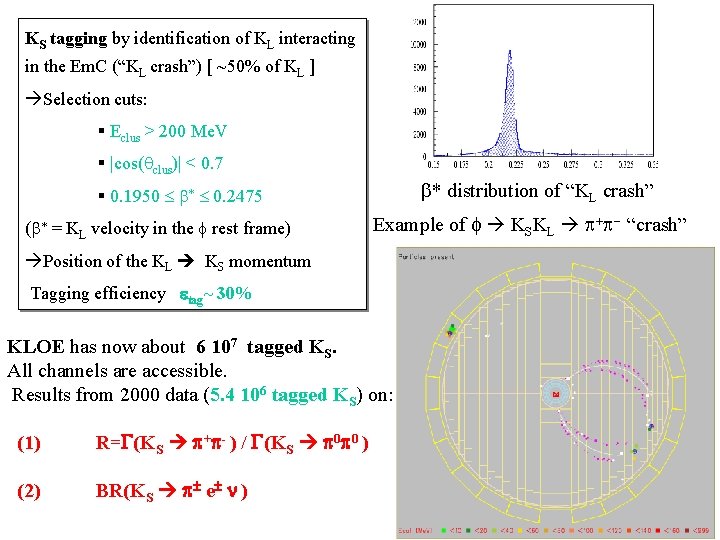
KS tagging by identification of KL interacting in the Em. C (“KL crash”) [ ~50% of KL ] Selection cuts: § Eclus > 200 Me. V § |cos(qclus)| < 0. 7 b* distribution of “KL crash” § 0. 1950 b* 0. 2475 (b* = KL velocity in the f rest frame) Example of f KSKL p+p “crash” Position of the KL KS momentum Tagging efficiency etag~ 30% KLOE has now about 6 107 tagged KS. All channels are accessible. Results from 2000 data (5. 4 106 tagged KS) on: (1) R=G(KS p+p- ) / G(KS p 0 p 0 ) (2) BR(KS p e n )
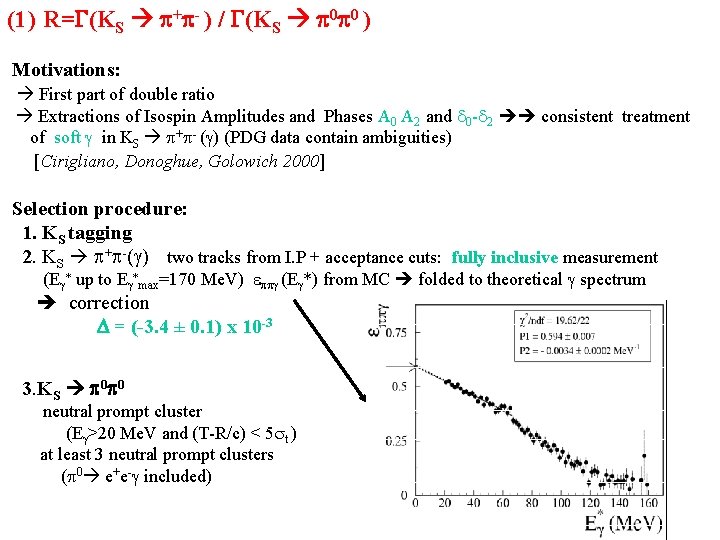
(1) R=G(KS p+p- ) / G(KS p 0 p 0 ) Motivations: First part of double ratio Extractions of Isospin Amplitudes and Phases A 0 A 2 and d 0 -d 2 consistent treatment of soft g in KS p+p- (g) (PDG data contain ambiguities) [Cirigliano, Donoghue, Golowich 2000] Selection procedure: 1. KS tagging 2. KS p+p-(g) two tracks from I. P + acceptance cuts: fully inclusive measurement (Eg* up to Eg*max=170 Me. V) eppg (Eg*) from MC folded to theoretical g spectrum correction D = (-3. 4 ± 0. 1) x 10 -3 3. KS p 0 p 0 neutral prompt cluster (Eg>20 Me. V and (T-R/c) < 5 st ) at least 3 neutral prompt clusters (p 0 e+e-g included)
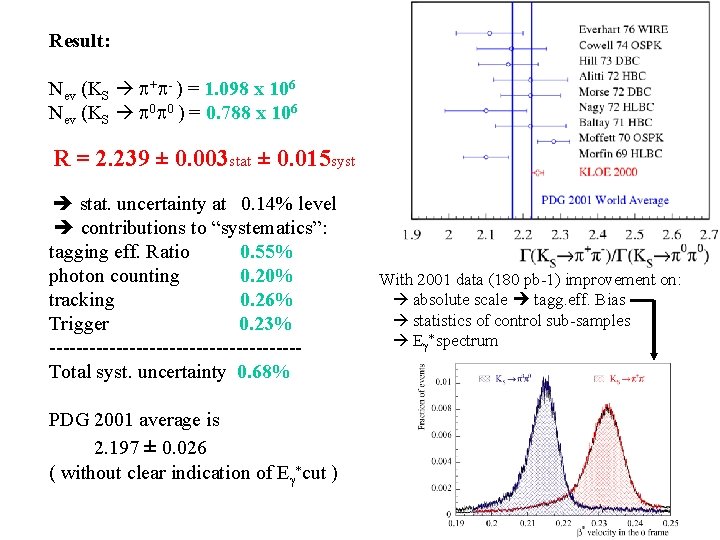
Result: Nev (KS p+p- ) = 1. 098 x 106 Nev (KS p 0 p 0 ) = 0. 788 x 106 R = 2. 239 ± 0. 003 stat ± 0. 015 syst stat. uncertainty at 0. 14% level contributions to “systematics”: tagging eff. Ratio 0. 55% photon counting 0. 20% tracking 0. 26% Trigger 0. 23% -------------------Total syst. uncertainty 0. 68% PDG 2001 average is 2. 197 ± 0. 026 ( without clear indication of Eg*cut ) With 2001 data (180 pb-1) improvement on: absolute scale tagg. eff. Bias statistics of control sub-samples Eg* spectrum
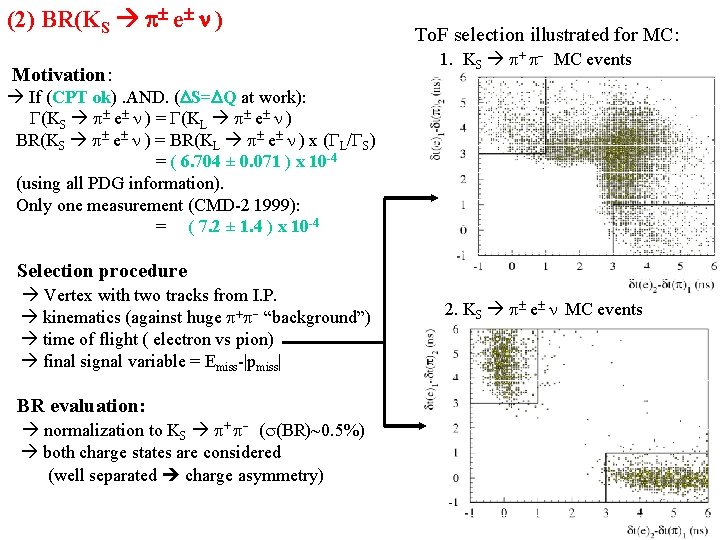
(2) BR(KS p e n ) Motivation: To. F selection illustrated for MC: 1. KS p+ p MC events If (CPT ok). AND. (DS=DQ at work): G(KS p e n ) = G(KL p e n ) BR(KS p e n ) = BR(KL p e n ) x (GL/GS) = ( 6. 704 ± 0. 071 ) x 10 -4 (using all PDG information). Only one measurement (CMD-2 1999): = ( 7. 2 ± 1. 4 ) x 10 -4 Selection procedure Vertex with two tracks from I. P. kinematics (against huge p+p “background”) time of flight ( electron vs pion) final signal variable = Emiss-|pmiss| BR evaluation: normalization to KS p+ p (s(BR)~0. 5%) both charge states are considered (well separated charge asymmetry) 2. KS p e n MC events
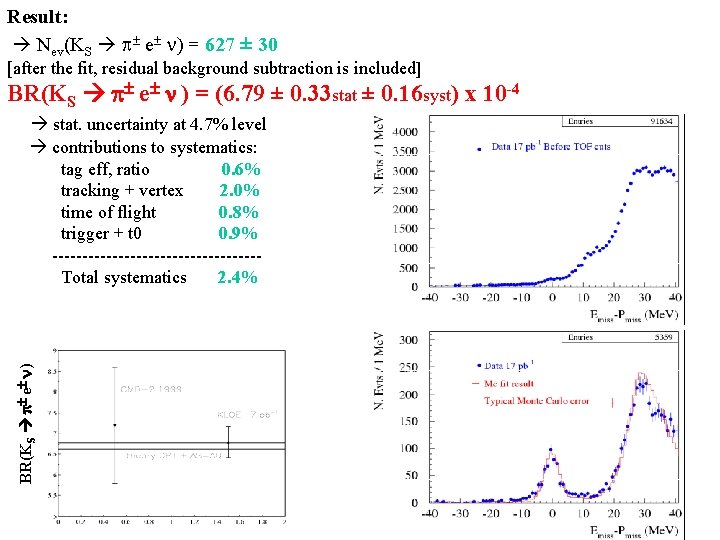
Result: Nev(KS p e n) = 627 ± 30 [after the fit, residual background subtraction is included] BR(KS p e n ) = (6. 79 ± 0. 33 stat ± 0. 16 syst) x 10 -4 BR(KS p e n ) stat. uncertainty at 4. 7% level contributions to systematics: tag eff, ratio 0. 6% tracking + vertex 2. 0% time of flight 0. 8% trigger + t 0 0. 9% -----------------Total systematics 2. 4%
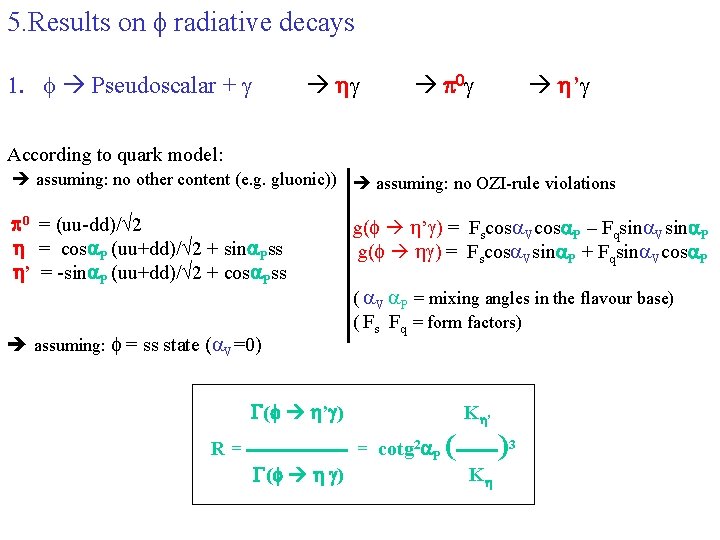
5. Results on f radiative decays 1. f Pseudoscalar + g hg p 0 g h’g According to quark model: assuming: no other content (e. g. gluonic)) assuming: no OZI-rule violations p 0 = (uu-dd)/ 2 h = cosa. P (uu+dd)/ 2 + sina. Pss h’ = -sina. P (uu+dd)/ 2 + cosa. Pss assuming: f = ss state (a. V=0) g(f h’g) = Fscosa. Vcosa. P – Fqsina. Vsina. P g(f hg) = Fscosa. Vsina. P + Fqsina. Vcosa. P ( a. V a. P = mixing angles in the flavour base) ( Fs Fq = form factors) G(f h’g) R= G(f h g) = cotg 2 a. P ( Kh’ Kh )3
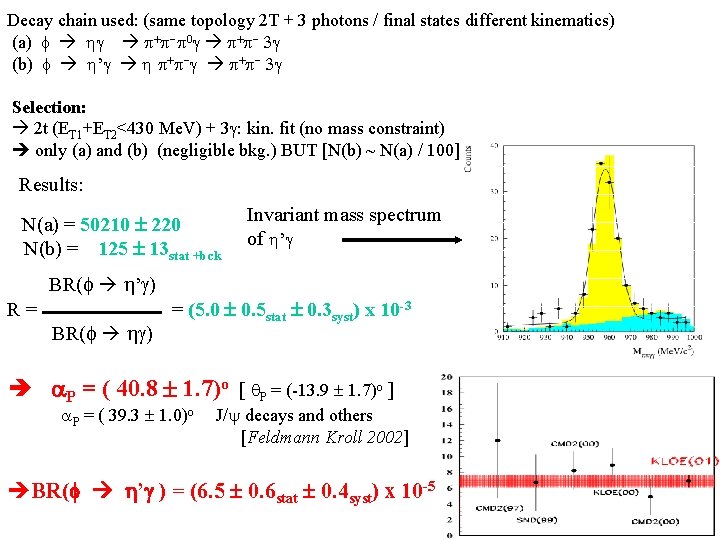
Decay chain used: (same topology 2 T + 3 photons / final states different kinematics) (a) f hg p+p p 0 g p+p 3 g (b) f h’g h p+p g p+p 3 g Selection: 2 t (ET 1+ET 2<430 Me. V) + 3 g: kin. fit (no mass constraint) only (a) and (b) (negligible bkg. ) BUT [N(b) ~ N(a) / 100] Results: N(a) = 50210 220 N(b) = 125 13 stat +bck Invariant mass spectrum of h’g BR(f h’g) R= BR(f hg) = (5. 0 0. 5 stat 0. 3 syst) x 10 -3 a. P = ( 40. 8 1. 7)o [ q. P = (-13. 9 1. 7)o ] a. P = ( 39. 3 1. 0)o J/y decays and others [Feldmann Kroll 2002] BR(f h’g ) = (6. 5 0. 6 stat 0. 4 syst) x 10 -5
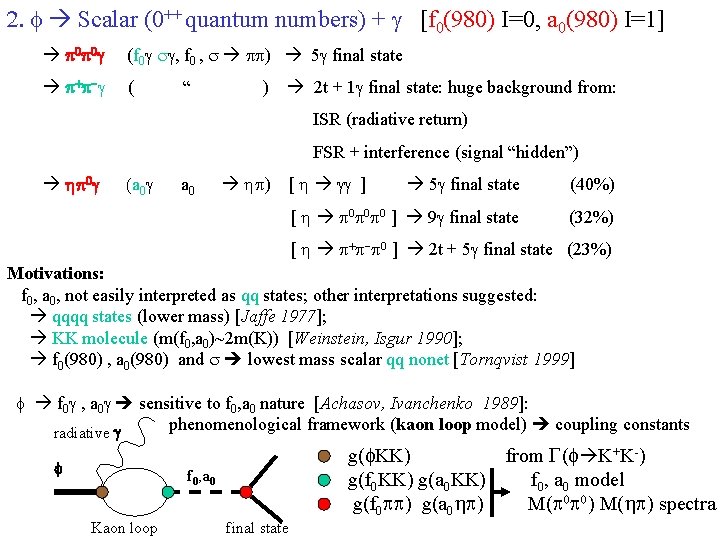
2. f Scalar (0++ quantum numbers) + g [f 0(980) I=0, a 0(980) I=1] p 0 g (f 0 g sg, f 0 , s pp) 5 g final state p+p g ( “ ) 2 t + 1 g final state: huge background from: ISR (radiative return) FSR + interference (signal “hidden”) hp 0 g (a 0 g a 0 hp) [ h gg ] 5 g final state (40%) [ h p 0 p 0 p 0 ] 9 g final state (32%) [ h p+p p 0 ] 2 t + 5 g final state (23%) Motivations: f 0, a 0, not easily interpreted as qq states; other interpretations suggested: qqqq states (lower mass) [Jaffe 1977]; KK molecule (m(f 0, a 0)~2 m(K)) [Weinstein, Isgur 1990]; f 0(980) , a 0(980) and s lowest mass scalar qq nonet [Tornqvist 1999] f f 0 g , a 0 g sensitive to f 0, a 0 nature [Achasov, Ivanchenko 1989]: phenomenological framework (kaon loop model) coupling constants radiative g f g(f. KK) from G(f K+K-) g(f 0 KK) g(a 0 KK) f 0, a 0 model g(f 0 pp) g(a 0 hp) M(p 0 p 0) M(hp) spectra f 0, a 0 Kaon loop final state
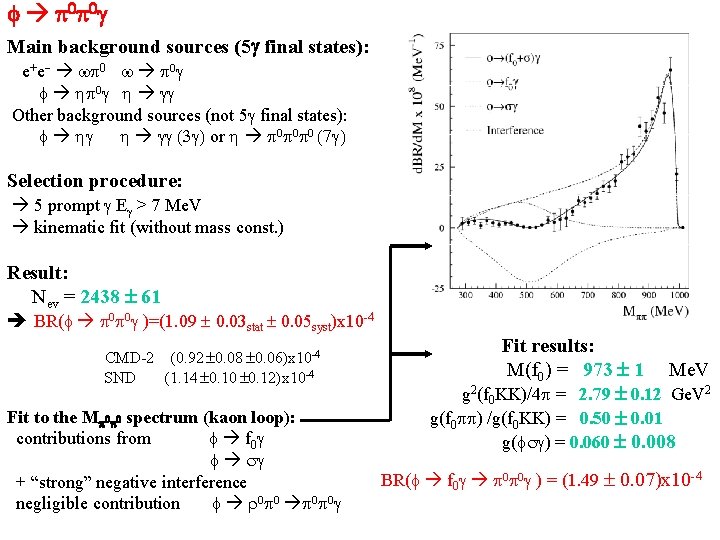
f p 0 p 0 g Main background sources (5 g final states): e+e wp 0 w p 0 g f hp 0 g h gg Other background sources (not 5 g final states): f hg h gg (3 g) or h p 0 p 0 p 0 (7 g) Selection procedure: 5 prompt g Eg > 7 Me. V kinematic fit (without mass const. ) Result: Nev = 2438 61 BR(f p 0 p 0 g )=(1. 09 0. 03 stat 0. 05 syst)x 10 -4 CMD-2 (0. 92 0. 08 0. 06)x 10 -4 SND (1. 14 0. 10 0. 12)x 10 -4 Fit to the Mp 0 p 0 spectrum (kaon loop): contributions from f f 0 g f sg + “strong” negative interference negligible contribution f r 0 p 0 p 0 p 0 g Fit results: M(f 0) = 973 1 Me. V g 2(f 0 KK)/4 p = 2. 79 0. 12 Ge. V 2 g(f 0 pp) /g(f 0 KK) = 0. 50 0. 01 g(fsg) = 0. 060 0. 008 BR(f f 0 g p 0 p 0 g ) = (1. 49 0. 07)x 10 -4
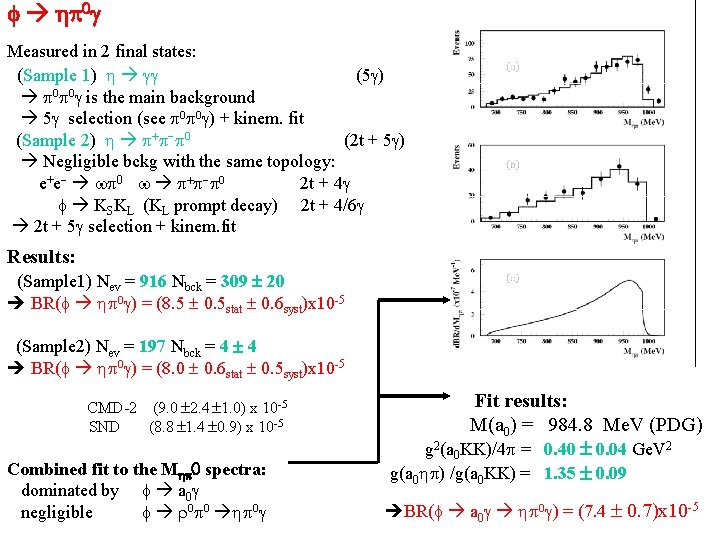
f hp 0 g Measured in 2 final states: (Sample 1) h gg (5 g) p 0 p 0 g is the main background 5 g selection (see p 0 p 0 g) + kinem. fit (Sample 2) h p+p p 0 (2 t + 5 g) Negligible bckg with the same topology: e+e wp 0 w p+p p 0 2 t + 4 g f KSKL (KL prompt decay) 2 t + 4/6 g 2 t + 5 g selection + kinem. fit Results: (Sample 1) Nev = 916 Nbck = 309 20 BR(f hp 0 g) = (8. 5 0. 5 stat 0. 6 syst)x 10 -5 (Sample 2) Nev = 197 Nbck = 4 4 BR(f hp 0 g) = (8. 0 0. 6 stat 0. 5 syst)x 10 -5 CMD-2 (9. 0 2. 4 1. 0) x 10 -5 SND (8. 8 1. 4 0. 9) x 10 -5 Combined fit to the Mhp 0 spectra: dominated by f a 0 g negligible f r 0 p 0 hp 0 g Fit results: M(a 0) = 984. 8 Me. V (PDG) g 2(a 0 KK)/4 p = 0. 40 0. 04 Ge. V 2 g(a 0 hp) /g(a 0 KK) = 1. 35 0. 09 BR(f a 0 g hp 0 g) = (7. 4 0. 7)x 10 -5
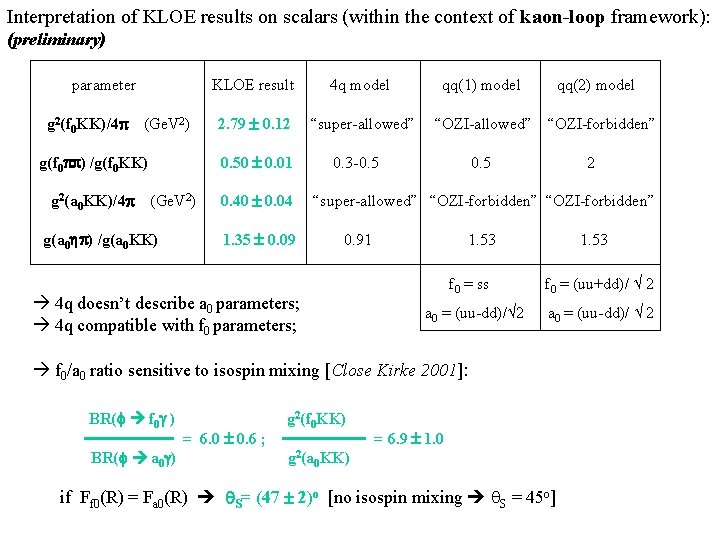
Interpretation of KLOE results on scalars (within the context of kaon-loop framework): (preliminary) parameter g 2(f 0 KK)/4 p (Ge. V 2) g(f 0 pp) /g(f 0 KK) g 2(a 0 KK)/4 p KLOE result 4 q model qq(1) model 2. 79 0. 12 “super-allowed” “OZI-allowed” 0. 50 0. 01 (Ge. V 2) g(a 0 hp) /g(a 0 KK) 0. 40 0. 04 1. 35 0. 09 0. 3 -0. 5 qq(2) model “OZI-forbidden” 0. 5 2 “super-allowed” “OZI-forbidden” 0. 91 4 q doesn’t describe a 0 parameters; 4 q compatible with f 0 parameters; 1. 53 f 0 = ss a 0 = (uu-dd)/ 2 1. 53 f 0 = (uu+dd)/ 2 a 0 = (uu-dd)/ 2 f 0/a 0 ratio sensitive to isospin mixing [Close Kirke 2001]: BR(f f 0 g ) BR(f a 0 g) = 6. 0 0. 6 ; g 2(f 0 KK) = 6. 9 1. 0 g 2(a 0 KK) if Ff 0(R) = Fa 0(R) q. S= (47 2)o [no isospin mixing q. S = 45 o]
6. Conclusions and perspectives DAFNE performance has improved considerably during the first two years of KLOE data taking KLOE detector well performing and under control From 2000 data (25 pb-1) results on: KS decays f radiative decays improve previous “PDG” knowledge Analysis of 2001 data (190 pb-1) in progress. Expected new results will be: rare KS decays [ p+p g , gg , limits on 3 p] KL decays [ gg , p 0 p 0 …. ] K decays h decays (6 x 10⁶ h produced) [chiral perturbation theory checks] hadronic cross-section s(e+e p+p ) 2 mp < W < mf Data taking 2002 starting now 500 pb-1 realistic by end of the year
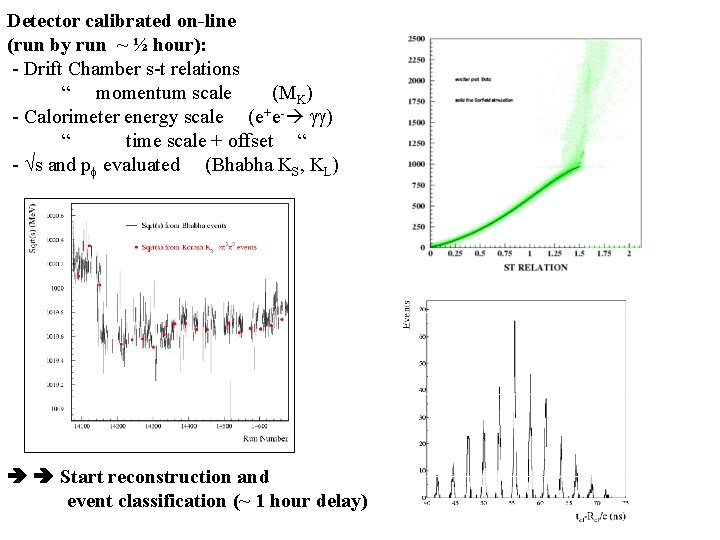
Detector calibrated on-line (run by run ~ ½ hour): - Drift Chamber s-t relations “ momentum scale (MK) - Calorimeter energy scale (e+e- gg) “ time scale + offset “ - s and pf evaluated (Bhabha KS, KL) Start reconstruction and event classification (~ 1 hour delay)
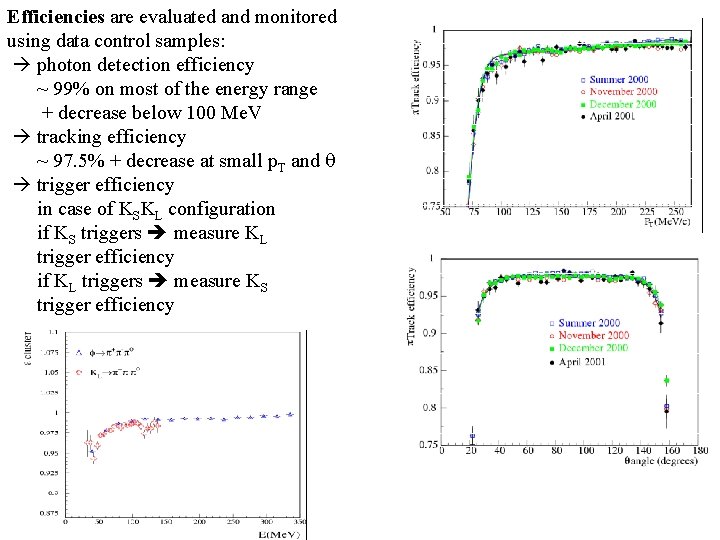
Efficiencies are evaluated and monitored using data control samples: photon detection efficiency ~ 99% on most of the energy range + decrease below 100 Me. V tracking efficiency ~ 97. 5% + decrease at small p. T and q trigger efficiency in case of KSKL configuration if KS triggers measure KL trigger efficiency if KL triggers measure KS trigger efficiency
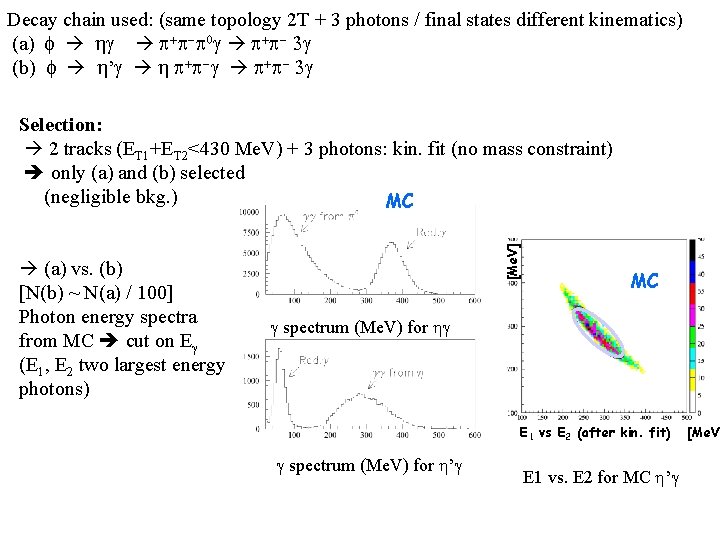
Decay chain used: (same topology 2 T + 3 photons / final states different kinematics) (a) f hg p+p p 0 g p+p 3 g (b) f h’g h p+p g p+p 3 g (a) vs. (b) [N(b) ~ N(a) / 100] Photon energy spectra from MC cut on Eg (E 1, E 2 two largest energy photons) [Me. V] Selection: 2 tracks (ET 1+ET 2<430 Me. V) + 3 photons: kin. fit (no mass constraint) only (a) and (b) selected (negligible bkg. ) MC MC g spectrum (Me. V) for hg E 1 vs E 2 (after kin. fit) g spectrum (Me. V) for h’g E 1 vs. E 2 for MC h’g [Me. V]
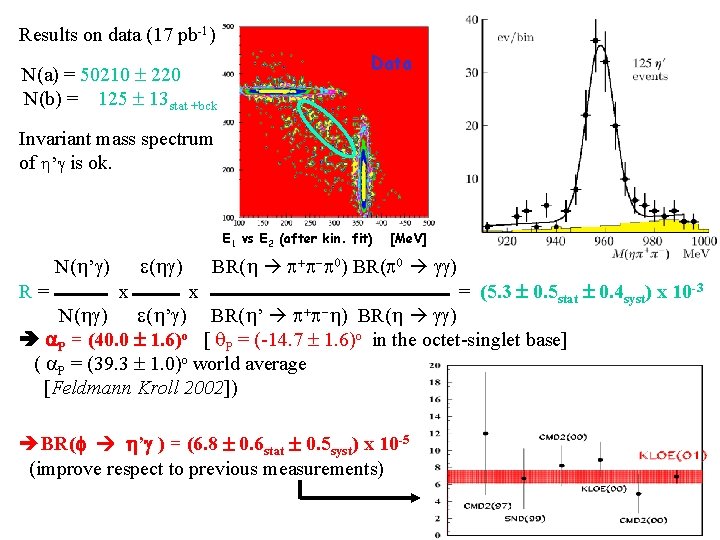
Results on data (17 pb-1) N(a) = 50210 220 N(b) = 125 13 stat +bck Data Invariant mass spectrum of h’g is ok. E 1 vs E 2 (after kin. fit) e(hg) N(h’g) R= x [Me. V] BR(h p+p p 0) BR(p 0 gg) x = (5. 3 0. 5 stat 0. 4 syst) x 10 -3 N(hg) e(h’g) BR(h’ p+p h) BR(h gg) a. P = (40. 0 1. 6)o [ q. P = (-14. 7 1. 6)o in the octet-singlet base] ( a. P = (39. 3 1. 0)o world average [Feldmann Kroll 2002]) BR(f h’g ) = (6. 8 0. 6 stat 0. 5 syst) x 10 -5 (improve respect to previous measurements)
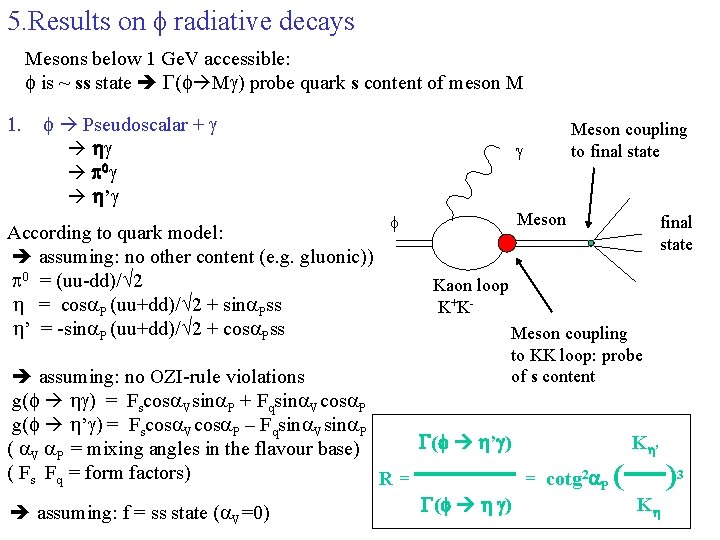
5. Results on f radiative decays Mesons below 1 Ge. V accessible: f is ~ ss state G(f Mg) probe quark s content of meson M 1. f Pseudoscalar + g hg p 0 g h’g g According to quark model: assuming: no other content (e. g. gluonic)) p 0 = (uu-dd)/ 2 h = cosa. P (uu+dd)/ 2 + sina. Pss h’ = -sina. P (uu+dd)/ 2 + cosa. Pss Meson coupling to final state Meson f Kaon loop K+ K- Meson coupling to KK loop: probe of s content assuming: no OZI-rule violations g(f hg) = Fscosa. Vsina. P + Fqsina. Vcosa. P g(f h’g) = Fscosa. Vcosa. P – Fqsina. Vsina. P G(f h’g) ( a. V a. P = mixing angles in the flavour base) ( Fs Fq = form factors) R= = cotg 2 a. P G(f h g) assuming: f = ss state (a =0) V final state ( Kh’ Kh )3
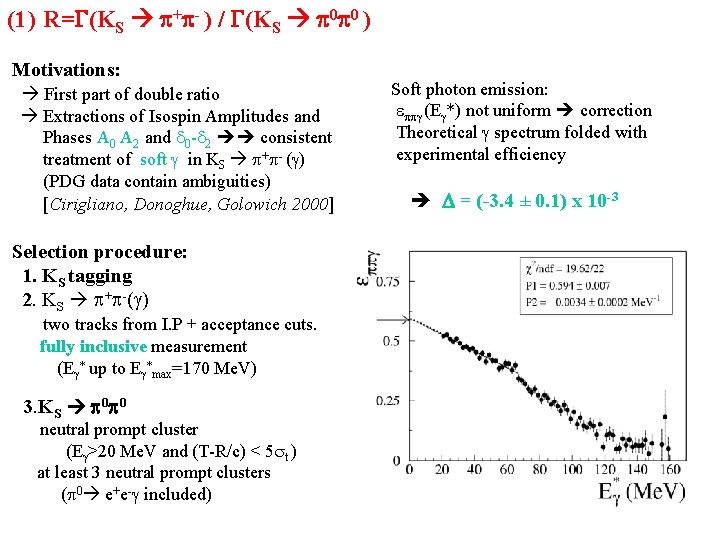
(1) R=G(KS p+p- ) / G(KS p 0 p 0 ) Motivations: First part of double ratio Extractions of Isospin Amplitudes and Phases A 0 A 2 and d 0 -d 2 consistent treatment of soft g in KS p+p- (g) (PDG data contain ambiguities) [Cirigliano, Donoghue, Golowich 2000] Selection procedure: 1. KS tagging 2. KS p+p-(g) two tracks from I. P + acceptance cuts. fully inclusive measurement (Eg* up to Eg*max=170 Me. V) 3. KS p 0 p 0 neutral prompt cluster (Eg>20 Me. V and (T-R/c) < 5 st ) at least 3 neutral prompt clusters (p 0 e+e-g included) Soft photon emission: eppg (Eg*) not uniform correction Theoretical g spectrum folded with experimental efficiency D = (-3. 4 ± 0. 1) x 10 -3
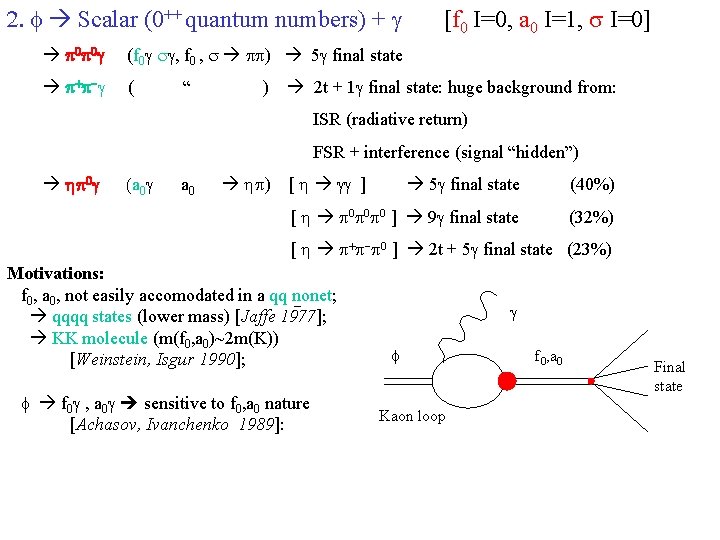
2. f Scalar (0++ quantum numbers) + g p 0 g (f 0 g sg, f 0 , s pp) 5 g final state p+p g ( “ ) [f 0 I=0, a 0 I=1, s I=0] 2 t + 1 g final state: huge background from: ISR (radiative return) FSR + interference (signal “hidden”) hp 0 g (a 0 g a 0 hp) [ h gg ] 5 g final state (40%) [ h p 0 p 0 p 0 ] 9 g final state (32%) [ h p+p p 0 ] 2 t + 5 g final state (23%) Motivations: f 0, a 0, not easily accomodated in a qq nonet; qqqq states (lower mass) [Jaffe 1977]; KK molecule (m(f 0, a 0)~2 m(K)) [Weinstein, Isgur 1990]; f f 0 g , a 0 g sensitive to f 0, a 0 nature [Achasov, Ivanchenko 1989]: g f Kaon loop f 0, a 0 Final state
- Slides: 24