
Recent results from Daya Bay Mingchung Chu The
Recent results from Daya Bay Ming-chung Chu The Chinese University of Hong Kong, Hong Kong On behalf of the Daya Bay Collaboration Partial support: CUHK VC Discretionary Fund, RGC CUHK 3/CRF/10 R 29 th Recontres de Blois May 28 – June 03, 2017, Blois, France 1
Recent results from Daya Bay • • • The Daya Bay Reactor Neutrino Experiment Recent oscillation results Absolute reactor anti-neutrino flux and spectrum Search for a light sterile neutrino More searches 2
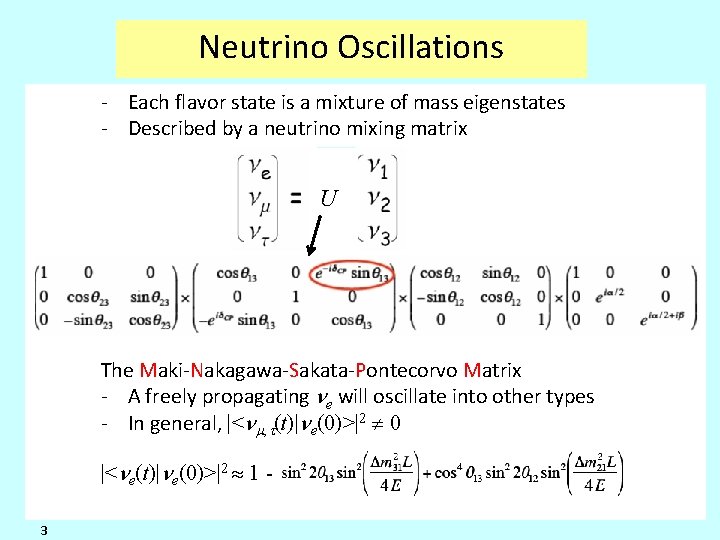
Neutrino Oscillations - Each flavor state is a mixture of mass eigenstates - Described by a neutrino mixing matrix U The Maki-Nakagawa-Sakata-Pontecorvo Matrix - A freely propagating e will oscillate into other types - In general, |< , (t)| e(0)>|2 0 |< e(t)| e(0)>|2 1 3
The Daya Bay Reactor Neutrino Experiment F. P. An et al. , Daya Bay Collaboration, NIM A 811, 133 (2016); PRD 95, 072006 (2017). 4
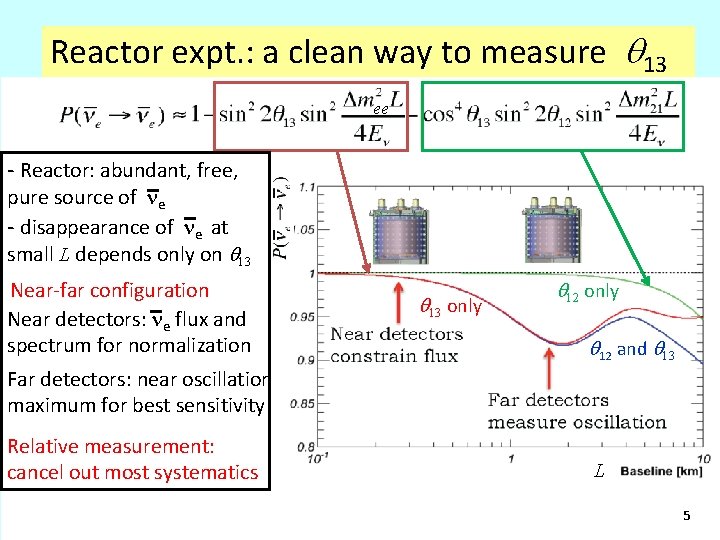
Reactor expt. : a clean way to measure 13 ee - Reactor: abundant, free, pure source of e - disappearance of e at small L depends only on 13 Near-far configuration Near detectors: e flux and spectrum for normalization 13 only 12 only 12 and 13 Far detectors: near oscillation maximum for best sensitivity Relative measurement: cancel out most systematics L 5
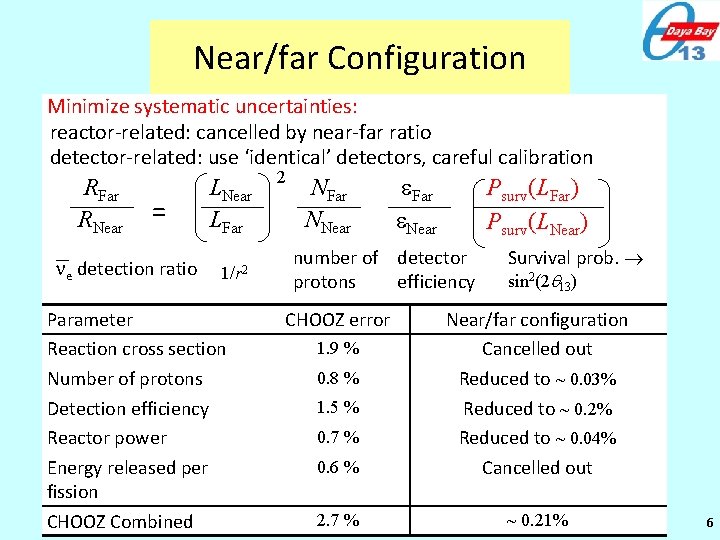
Near/far Configuration Minimize systematic uncertainties: reactor-related: cancelled by near-far ratio detector-related: use ‘identical’ detectors, careful calibration RFar RNear = e detection ratio LNear LFar 1/r 2 Parameter Reaction cross section Number of protons Detection efficiency Reactor power Energy released per fission CHOOZ Combined 2 NFar NNear Far Near Psurv(LFar) Psurv(LNear) number of detector efficiency protons CHOOZ error Survival prob. sin 2(2 13) 0. 6 % Near/far configuration Cancelled out Reduced to ~ 0. 03% Reduced to ~ 0. 2% Reduced to ~ 0. 04% Cancelled out 2. 7 % ~ 0. 21% 1. 9 % 0. 8 % 1. 5 % 0. 7 % 6
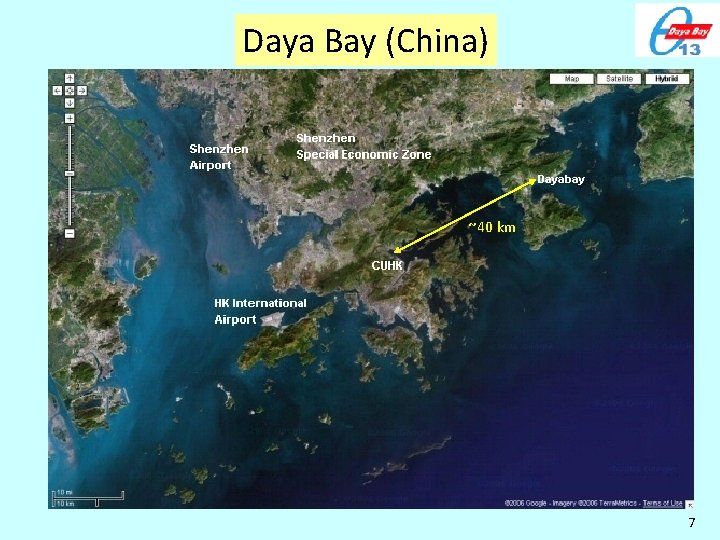
Daya Bay (China) ~40 km 7
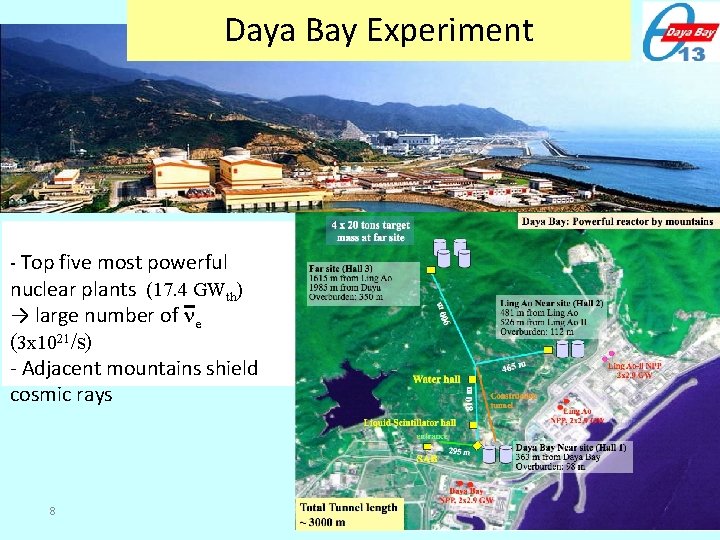
Daya Bay Experiment - Top five most powerful nuclear plants (17. 4 GWth) → large number of e (3 x 10²¹/s) - Adjacent mountains shield cosmic rays 8
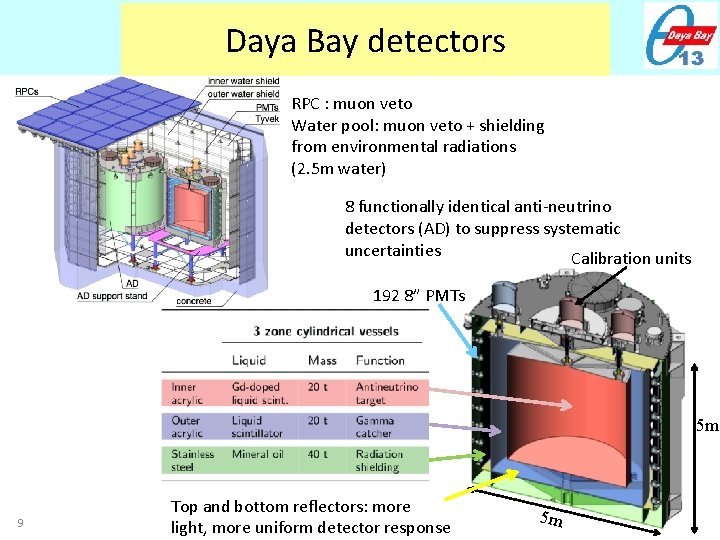
Daya Bay detectors RPC : muon veto Water pool: muon veto + shielding from environmental radiations (2. 5 m water) 8 functionally identical anti-neutrino detectors (AD) to suppress systematic uncertainties Calibration units 192 8” PMTs 5 m 9 Top and bottom reflectors: more light, more uniform detector response 5 m
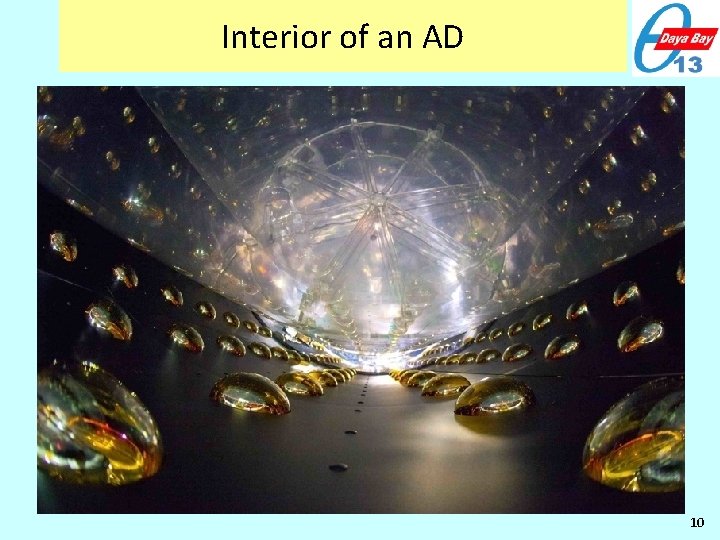
Interior of an AD 10
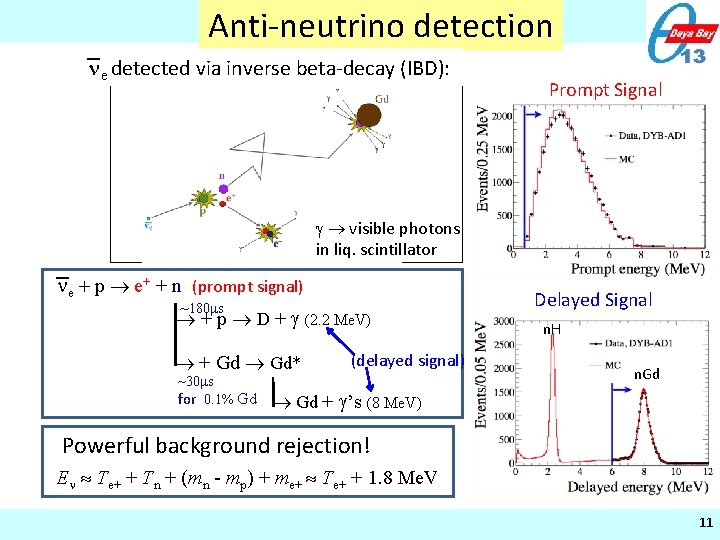
Anti-neutrino detection e detected via inverse beta-decay (IBD): Prompt Signal visible photons in liq. scintillator e p e+ + n (prompt signal) ~180 s + p D + (2. 2 Me. V) + Gd Gd* ~30 s for 0. 1% Gd (delayed signal) Delayed Signal n. H n. Gd + ’s (8 Me. V) Powerful background rejection! E Te+ + Tn + (mn - mp) + me+ Te+ + 1. 8 Me. V 11
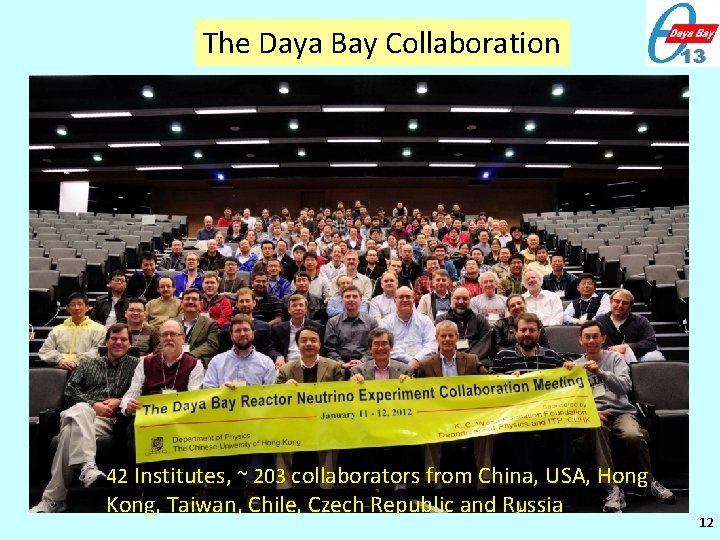
The Daya Bay Collaboration 42 Institutes, ~ 203 collaborators from China, USA, Hong Kong, Taiwan, Chile, Czech Republic and Russia 12

AD Installation - Near Hall 13

AD Installation - Far Hall 14
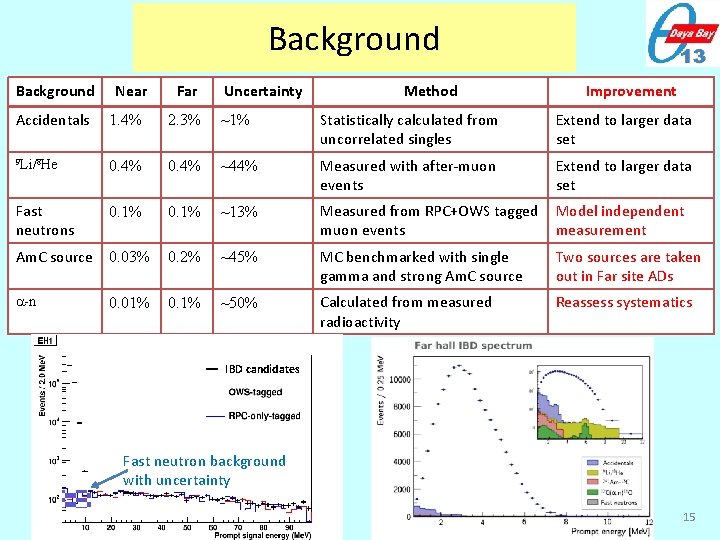
Background Near Far Uncertainty Method Improvement Accidentals 1. 4% 2. 3% ~1% Statistically calculated from uncorrelated singles Extend to larger data set 9 Li/8 He 0. 4% ~44% Measured with after-muon events Extend to larger data set Fast neutrons 0. 1% ~13% Measured from RPC+OWS tagged muon events Model independent measurement Am. C source 0. 03% 0. 2% ~45% MC benchmarked with single gamma and strong Am. C source Two sources are taken out in Far site ADs -n 0. 01% 0. 1% ~50% Calculated from measured radioactivity Reassess systematics IBD candidates Fast neutron background with uncertainty 15
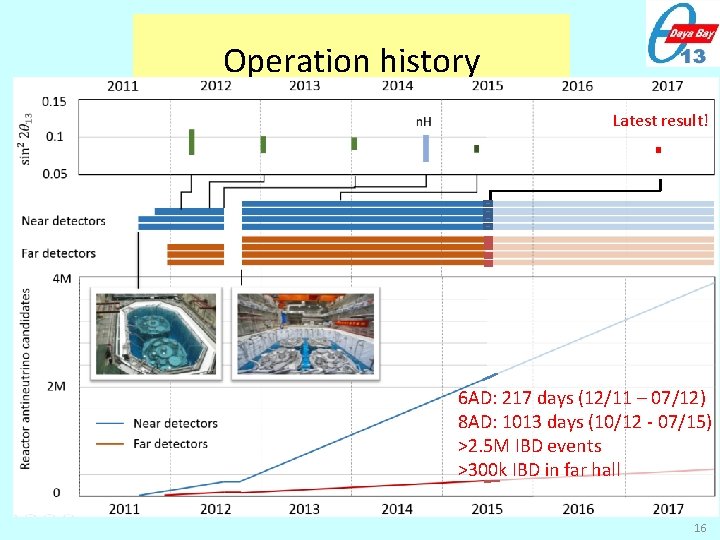
Operation history Latest result! 6 AD: 217 days (12/11 – 07/12) 8 AD: 1013 days (10/12 - 07/15) >2. 5 M IBD events >300 k IBD in far hall 16
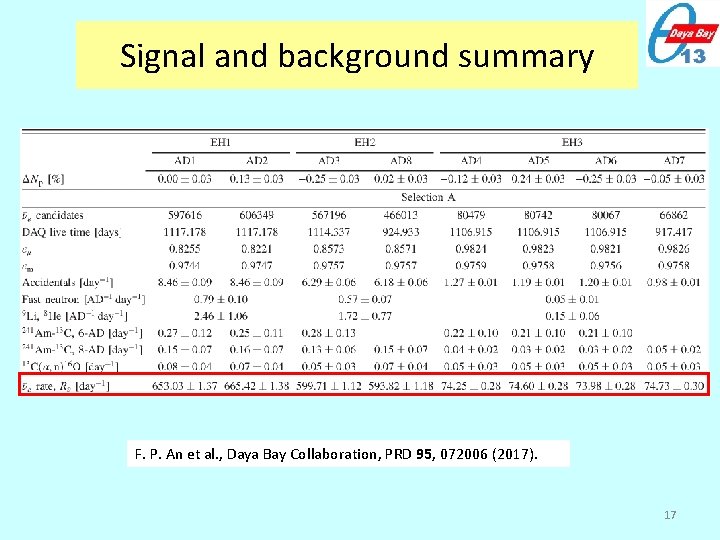
Signal and background summary F. P. An et al. , Daya Bay Collaboration, PRD 95, 072006 (2017). 17
Recent Oscillation Results F. P. An et al. , Daya Bay Collaboration, PRD 95, 072006 (2017). 18
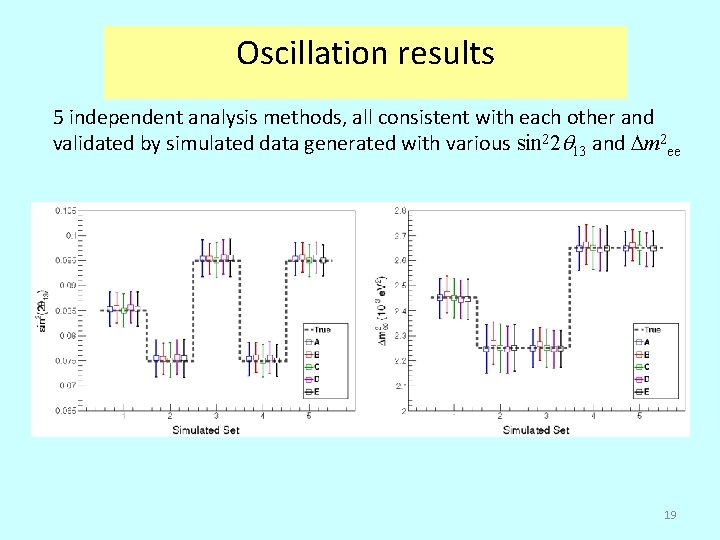
Oscillation results 5 independent analysis methods, all consistent with each other and validated by simulated data generated with various sin 22 13 and m 2 ee 19
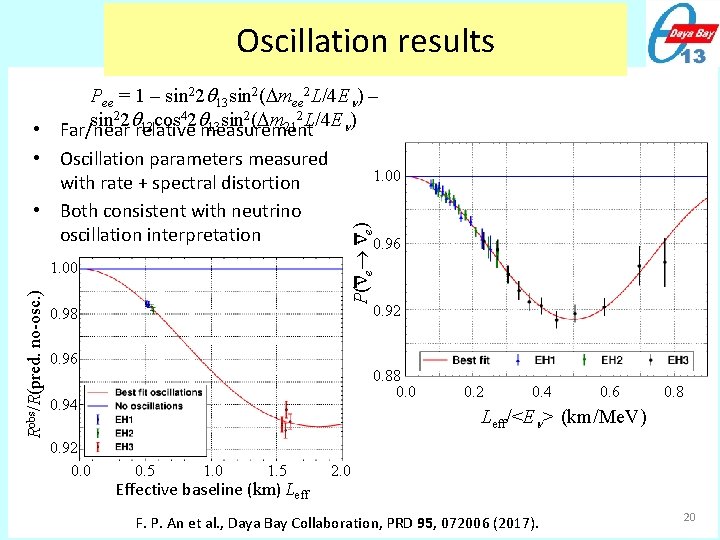
Oscillation results P( e e) Pee = 1 – sin 22 13 sin 2( mee 2 L/4 E ) – 22 cos 42 sin 2( m 2 L/4 E ) sin 12 13 21 • Far/near relative measurement • Oscillation parameters measured 1. 00 with rate + spectral distortion • Both consistent with neutrino oscillation interpretation 0. 96 Robs/R(pred. no-osc. ) 1. 00 0. 92 0. 98 0. 96 0. 88 0. 0 0. 94 0. 92 0. 0 0. 2 0. 4 0. 6 0. 8 Leff/<E > (km/Me. V) 0. 5 1. 0 1. 5 Effective baseline (km) Leff 2. 0 F. P. An et al. , Daya Bay Collaboration, PRD 95, 072006 (2017). 20
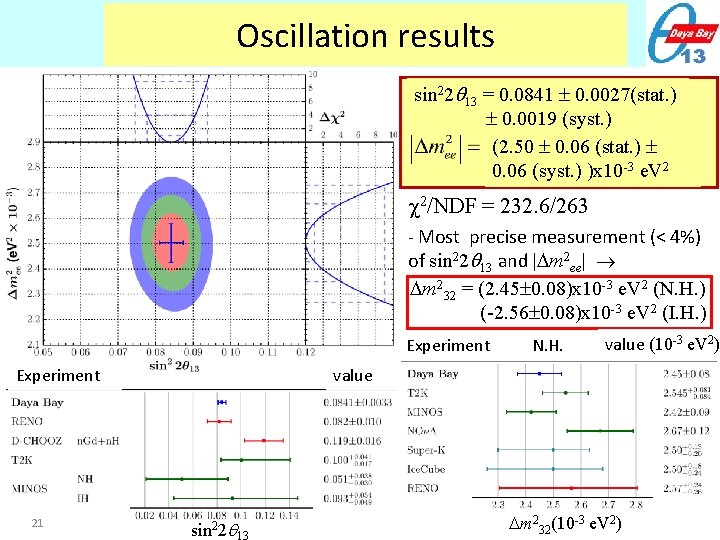
Oscillation results sin 22 13 = 0. 0841 0. 0027(stat. ) 0. 0019 (syst. ) (2. 50 0. 06 (stat. ) 0. 06 (syst. ) )x 10 -3 e. V 2 2/NDF = 232. 6/263 - Most precise measurement (< 4%) of sin 22 13 and | m 2 ee| m 232 = (2. 45 0. 08)x 10 -3 e. V 2 (N. H. ) (-2. 56 0. 08)x 10 -3 e. V 2 (I. H. ) Experiment 21 N. H. value (10 -3 e. V 2) value sin 22 m 232(10 -3 e. V 2)
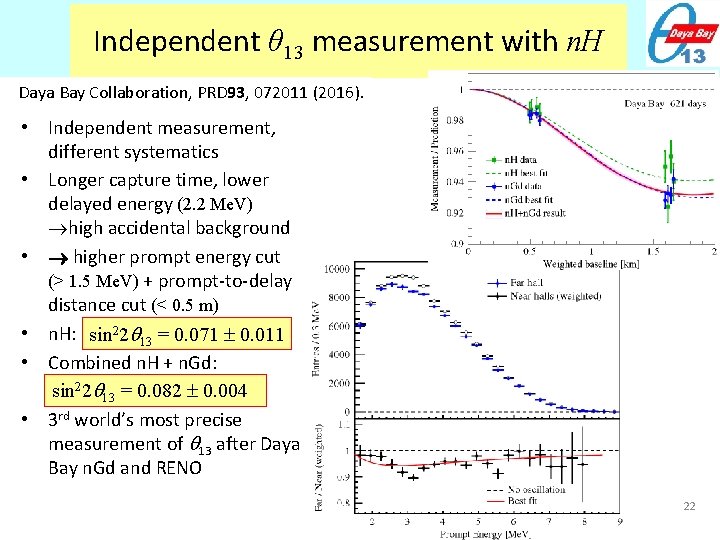
Independent θ 13 measurement with n. H Daya Bay Collaboration, PRD 93, 072011 (2016). • Independent measurement, different systematics • Longer capture time, lower delayed energy (2. 2 Me. V) high accidental background • higher prompt energy cut (> 1. 5 Me. V) + prompt-to-delay distance cut (< 0. 5 m) • n. H: sin 22 13 = 0. 071 0. 011 • Combined n. H + n. Gd: sin 22 13 = 0. 082 0. 004 • 3 rd world’s most precise measurement of 13 after Daya Bay n. Gd and RENO 22
Absolute reactor anti-neutrino flux and spectrum F. P. An et al. , Daya Bay Collaboration, PRL 116, 061801 (2016); Chinese Physics C 41(1), 13002 (2017); ar. Xiv: 1704. 01082 v 1, PRL 2017. 23
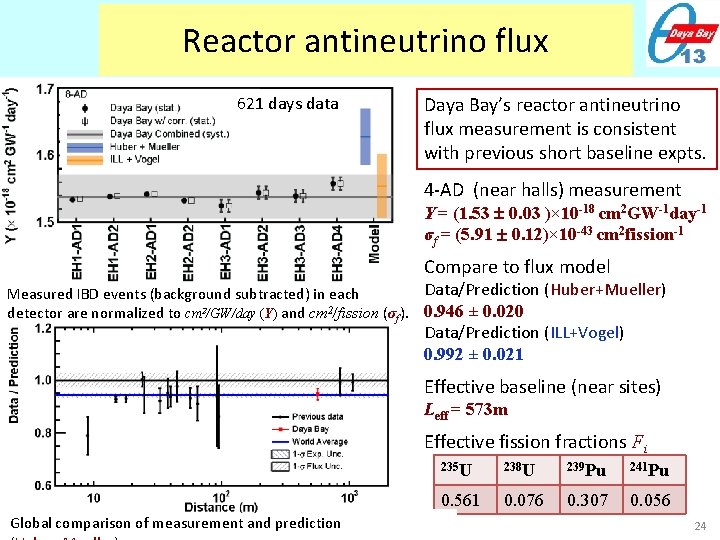
Reactor antineutrino flux 621 days data Daya Bay’s reactor antineutrino flux measurement is consistent with previous short baseline expts. 4 -AD (near halls) measurement Y = (1. 53 0. 03 )× 10 -18 cm 2 GW-1 day-1 σf = (5. 91 0. 12)× 10 -43 cm 2 fission-1 Compare to flux model Data/Prediction (Huber+Mueller) Measured IBD events (background subtracted) in each detector are normalized to cm 2/GW/day (Y) and cm 2/fission (σf). 0. 946 ± 0. 020 Data/Prediction (ILL+Vogel) 0. 992 ± 0. 021 Effective baseline (near sites) Leff = 573 m Effective fission fractions Fi Global comparison of measurement and prediction 235 U 238 U 239 Pu 241 Pu 0. 561 0. 076 0. 307 0. 056 24
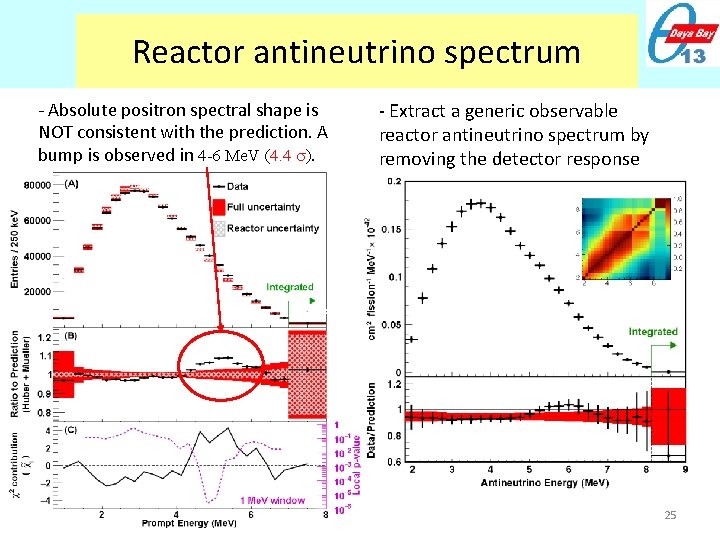
Reactor antineutrino spectrum - Absolute positron spectral shape is NOT consistent with the prediction. A bump is observed in 4 -6 Me. V (4. 4 ). - Extract a generic observable reactor antineutrino spectrum by removing the detector response 25
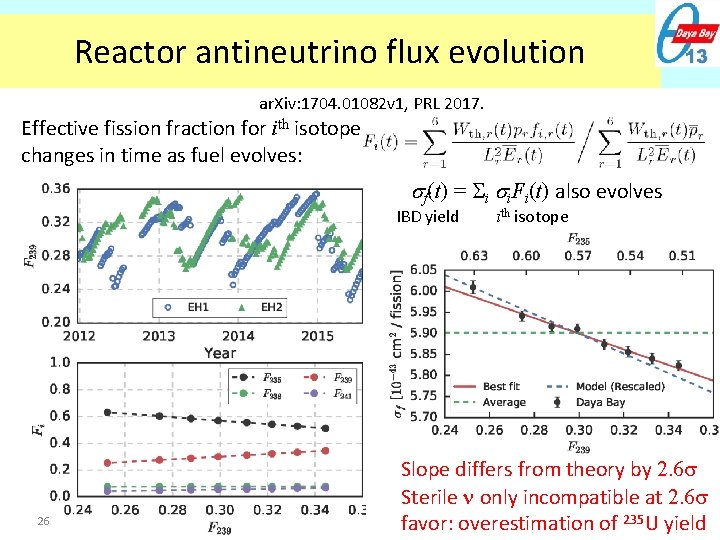
Reactor antineutrino flux evolution ar. Xiv: 1704. 01082 v 1, PRL 2017. Effective fission fraction for ith isotope changes in time as fuel evolves: f(t) = i i. Fi(t) also evolves IBD yield 26 ith isotope Slope differs from theory by 2. 6 Sterile only incompatible at 2. 6 favor: overestimation of 235 U yield
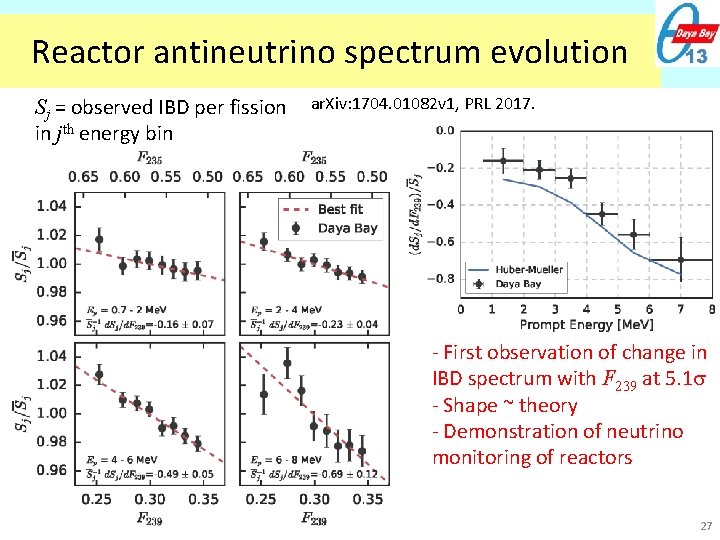
Reactor antineutrino spectrum evolution Sj = observed IBD per fission in jth energy bin ar. Xiv: 1704. 01082 v 1, PRL 2017. - First observation of change in IBD spectrum with F 239 at 5. 1 - Shape ~ theory - Demonstration of neutrino monitoring of reactors 27
Search for a light sterile neutrino F. P. An et al. , Daya Bay Collaboration, PRL 117, 151802 (2016); PRL 113, 141802 (2014). Daya Bay and MINOS Collaborations, PRL 117, 151801 (2016). 28
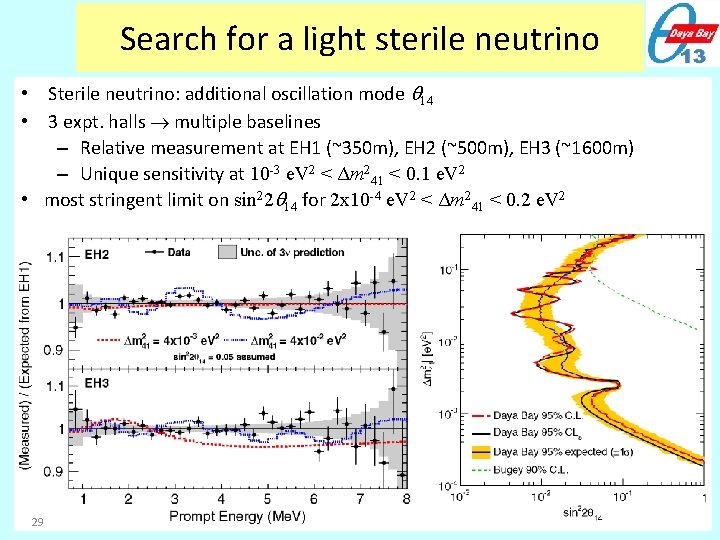
Search for a light sterile neutrino • Sterile neutrino: additional oscillation mode 14 • 3 expt. halls multiple baselines – Relative measurement at EH 1 (~350 m), EH 2 (~500 m), EH 3 (~1600 m) – Unique sensitivity at 10 -3 e. V 2 < Δm 241 < 0. 1 e. V 2 • most stringent limit on sin 22 14 for 2 x 10 -4 e. V 2 < Δm 241 < 0. 2 e. V 2 29
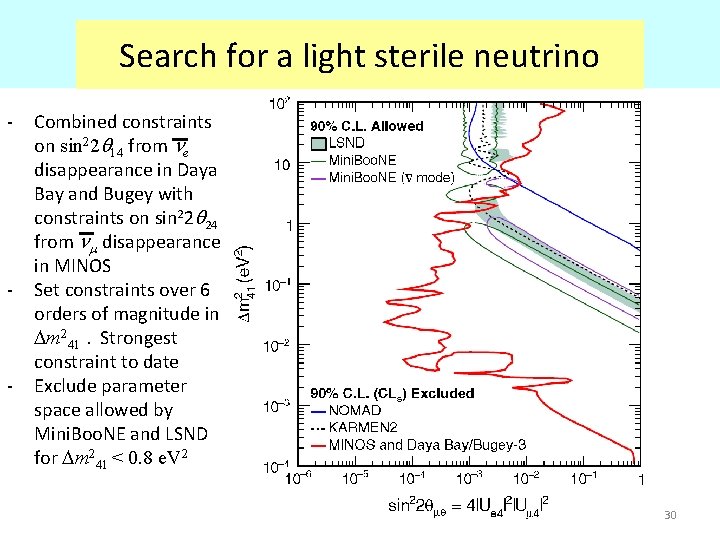
Search for a light sterile neutrino - - - Combined constraints on sin 22 14 from e disappearance in Daya Bay and Bugey with constraints on sin 22 24 from disappearance in MINOS Set constraints over 6 orders of magnitude in m 241. Strongest constraint to date Exclude parameter space allowed by Mini. Boo. NE and LSND for m 241 < 0. 8 e. V 2 30
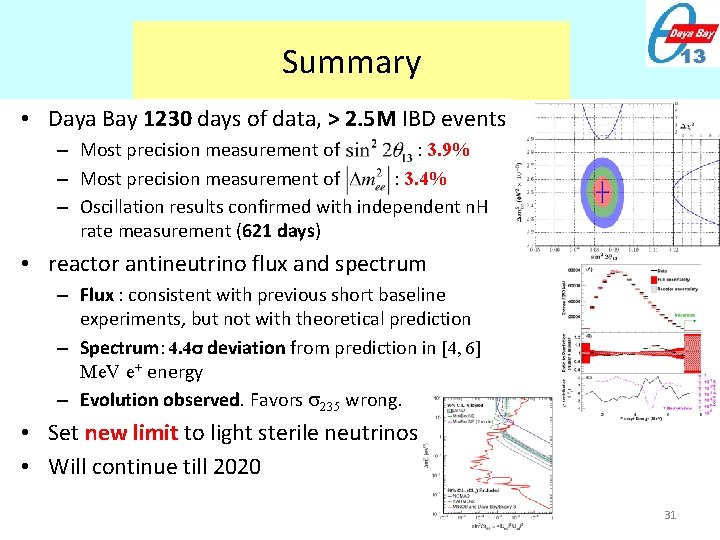
Summary • Daya Bay 1230 days of data, > 2. 5 M IBD events – Most precision measurement of : 3. 9% – Most precision measurement of : 3. 4% – Oscillation results confirmed with independent n. H rate measurement (621 days) • reactor antineutrino flux and spectrum – Flux : consistent with previous short baseline experiments, but not with theoretical prediction – Spectrum: 4. 4 deviation from prediction in [4, 6] Me. V e+ energy – Evolution observed. Favors 235 wrong. • Set new limit to light sterile neutrinos • Will continue till 2020 31
Recent results from Daya Bay Ming-chung Chu The Chinese University of Hong Kong, Hong Kong On behalf of the Daya Bay Collaboration Partial support: CUHK VC Discretionary Fund, RGC CUHK 3/CRF/10 R 29 th Recontres de Blois May 28 – June 03, 2017, Blois, France 32

backup 33
More searches • Precision measurement of spectral distortion: - neutrino decoherence - sterile neutrino mixing - CPT violation/NSI - mass-varying neutrinos • Precision measurement of neutrino rate: - sidereal modulation (CPT violation, …) - supernova neutrinos • High energy events: - neutron-anti-neutron oscillation 34
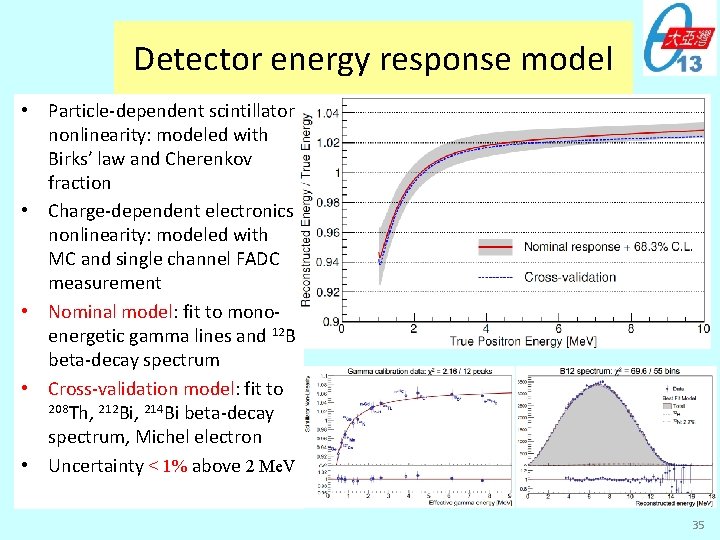
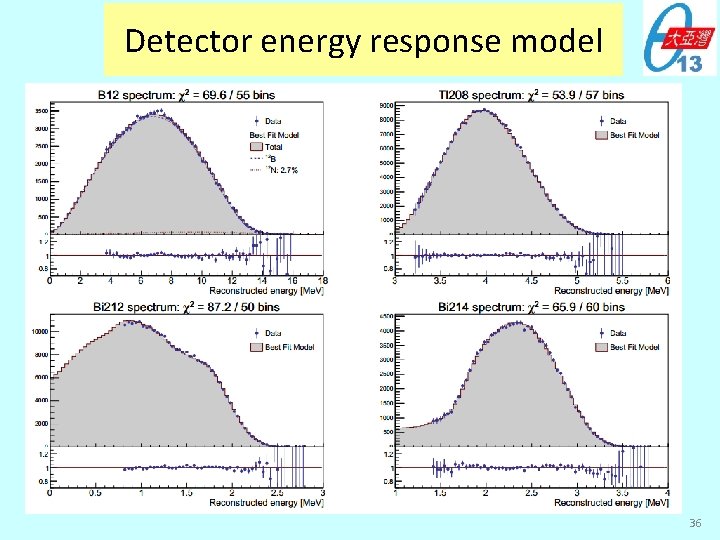
Detector energy response model • Particle-dependent scintillator nonlinearity: modeled with Birks’ law and Cherenkov fraction • Charge-dependent electronics nonlinearity: modeled with MC and single channel FADC measurement • Nominal model: fit to monoenergetic gamma lines and 12 B beta-decay spectrum • Cross-validation model: fit to 208 Th, 212 Bi, 214 Bi beta-decay spectrum, Michel electron • Uncertainty < 1% above 2 Me. V 35
Detector energy response model 36
AD Calibration 37
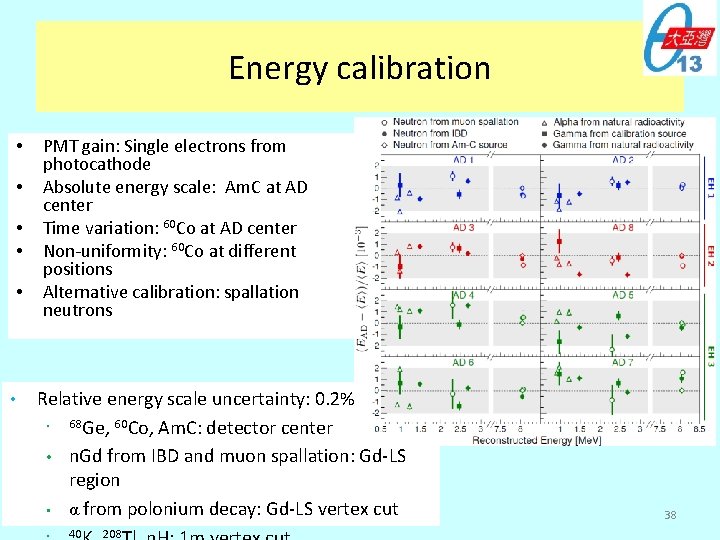
Energy calibration • • • PMT gain: Single electrons from photocathode Absolute energy scale: Am. C at AD center Time variation: 60 Co at AD center Non-uniformity: 60 Co at different positions Alternative calibration: spallation neutrons Relative energy scale uncertainty: 0. 2% 68 Ge, 60 Co, Am. C: detector center • • n. Gd from IBD and muon spallation: Gd-LS region • α from polonium decay: Gd-LS vertex cut • 40 208 38
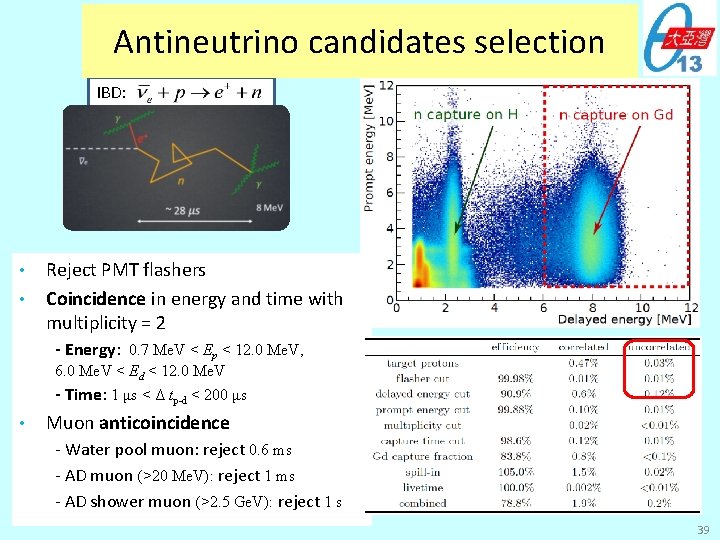
Antineutrino candidates selection IBD: • • Reject PMT flashers Coincidence in energy and time with multiplicity = 2 - Energy: 0. 7 Me. V < Ep < 12. 0 Me. V, 6. 0 Me. V < Ed < 12. 0 Me. V - Time: 1 μs < Δ tp-d < 200 μs • Muon anticoincidence - Water pool muon: reject 0. 6 ms - AD muon (>20 Me. V): reject 1 ms - AD shower muon (>2. 5 Ge. V): reject 1 s 39
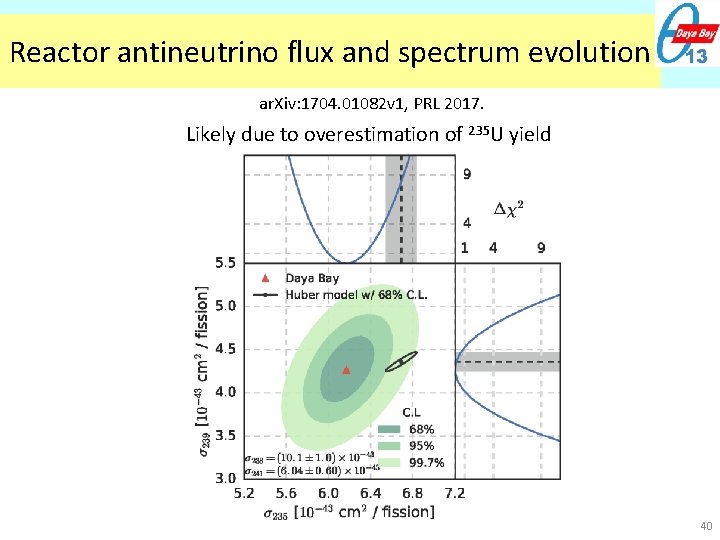
Reactor antineutrino flux and spectrum evolution ar. Xiv: 1704. 01082 v 1, PRL 2017. Likely due to overestimation of 235 U yield 40
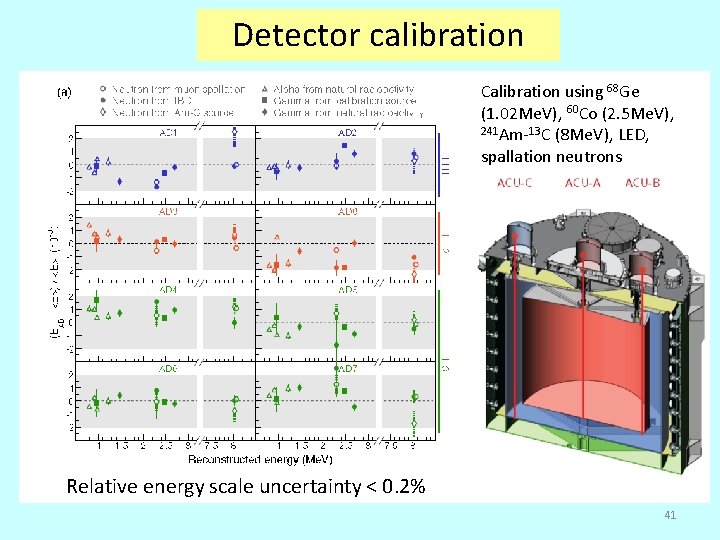
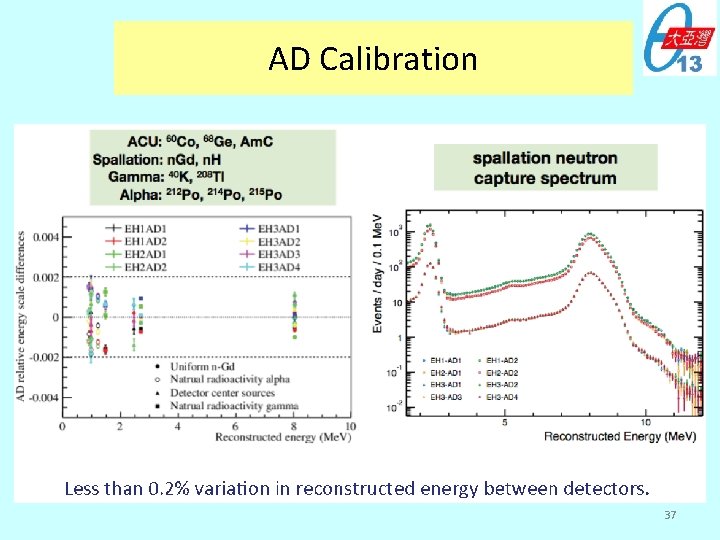
Detector calibration Calibration using 68 Ge (1. 02 Me. V), 60 Co (2. 5 Me. V), 241 Am-13 C (8 Me. V), LED, spallation neutrons Relative energy scale uncertainty < 0. 2% 41
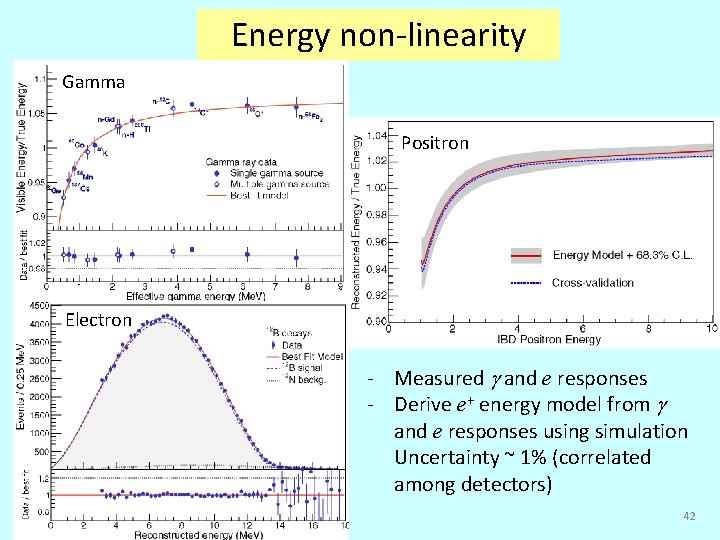
Energy non-linearity Gamma Positron Electron - Measured and e responses - Derive e+ energy model from and e responses using simulation Uncertainty ~ 1% (correlated among detectors) 42
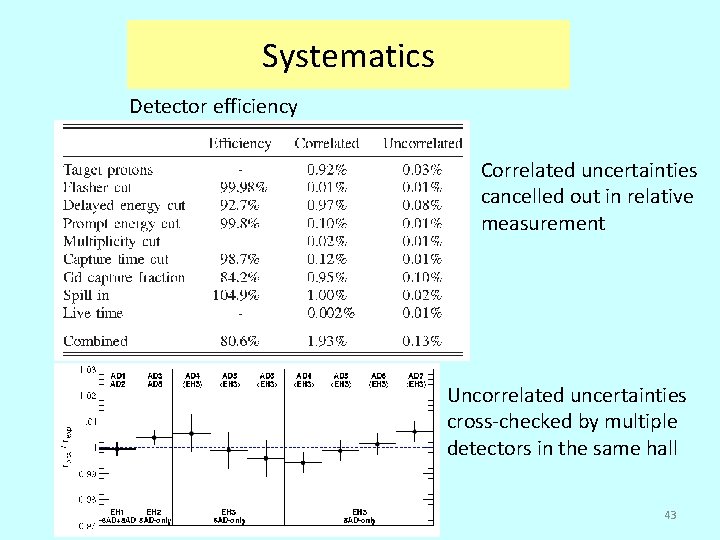
Systematics Detector efficiency Correlated uncertainties cancelled out in relative measurement Uncorrelated uncertainties cross-checked by multiple detectors in the same hall 43
- Slides: 43