
Recent progress in N physics from Kaon photoproduction
- Slides: 15
Recent progress in N* physics from Kaon photoproduction experiments at CLAS using polarization observabes. Ken Livingston, University of Glasgow The Rutherford Centennial Conference on Nuclear Physics. The University of Manchester on 8 -12 August 2011 • Motivation • Missing resonances • 1 st complete measurement in pseudoscalar meson production • Polarization observables at CLAS • Progress towards a complete measurement in K+ photoproduction on p • Measurements on the neutron • Summary
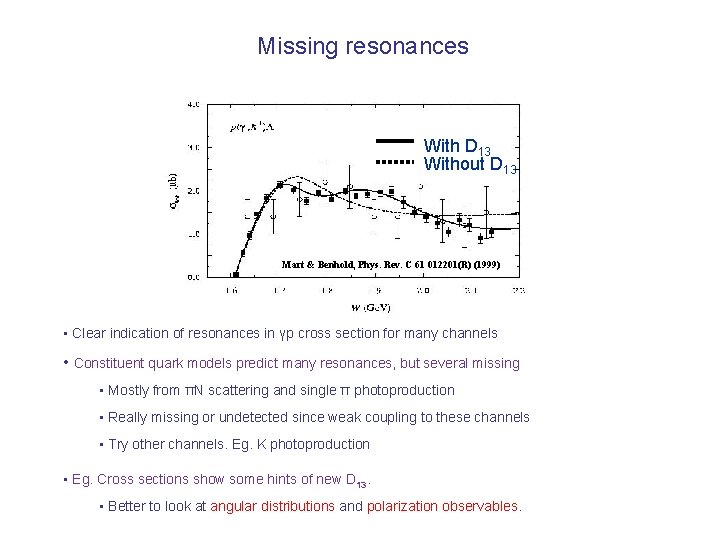
Missing resonances With D 13 Without D 13 Mart & Benhold, Phys. Rev. C 61 012201(R) (1999) • Clear indication of resonances in γp cross section for many channels • Constituent quark models predict many resonances, but several missing • Mostly from πN scattering and single π photoproduction • Really missing or undetected since weak coupling to these channels • Try other channels. Eg. K photoproduction • Eg. Cross sections show some hints of new D 13. • Better to look at angular distributions and polarization observables.
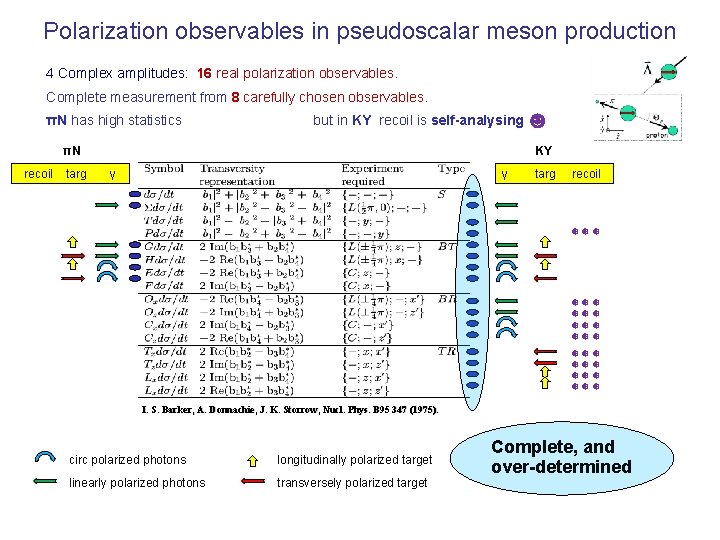
Polarization observables in pseudoscalar meson production 4 Complex amplitudes: 16 real polarization observables. Complete measurement from 8 carefully chosen observables. πN has high statistics but in KY recoil is self-analysing πN recoil targ ☻ KY γ γ targ recoil ☻☻☻ ☻☻☻ ☻☻☻ I. S. Barker, A. Donnachie, J. K. Storrow, Nucl. Phys. B 95 347 (1975). circ polarized photons longitudinally polarized target linearly polarized photons transversely polarized target Complete, and over-determined
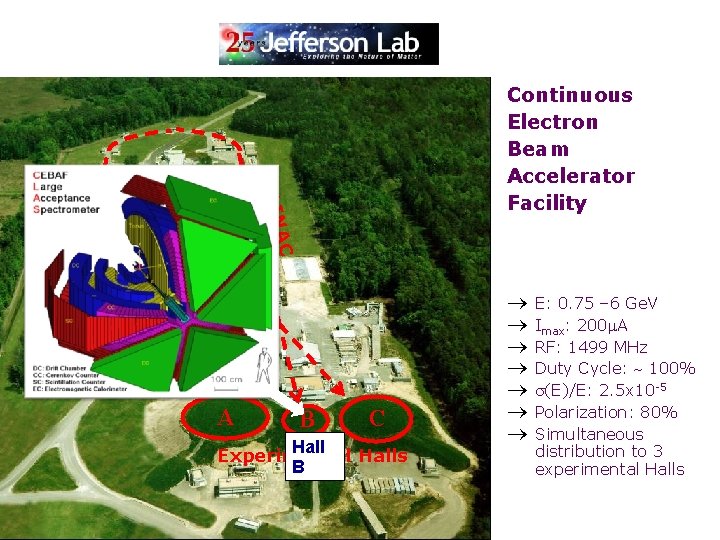
Continuous Electron Beam Accelerator Facility LINAC Jefferson Lab C Injector A B C Hall Experimental Halls B ® ® ® ® E: 0. 75 – 6 Ge. V Imax: 200 m. A RF: 1499 MHz Duty Cycle: 100% s(E)/E: 2. 5 x 10 -5 Polarization: 80% Simultaneous distribution to 3 experimental Halls
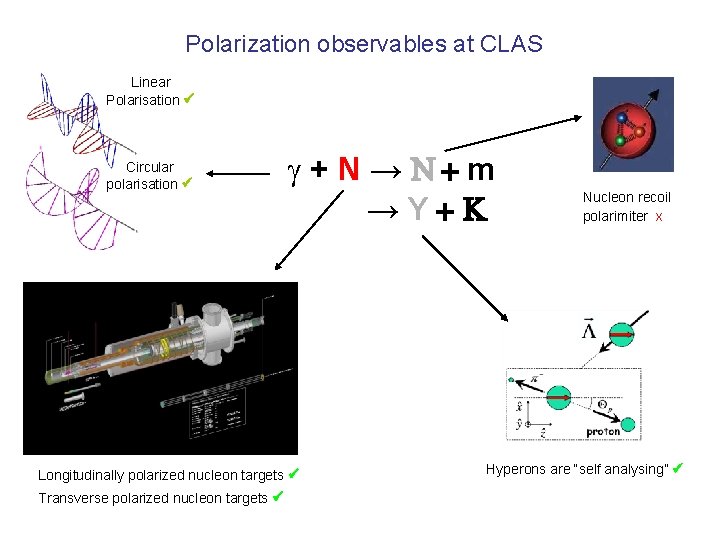
Polarization observables at CLAS Linear Polarisation Circular polarisation g+N→N+m →Y+ Longitudinally polarized nucleon targets Transverse polarized nucleon targets Nucleon recoil polarimiter x Hyperons are “self analysing”
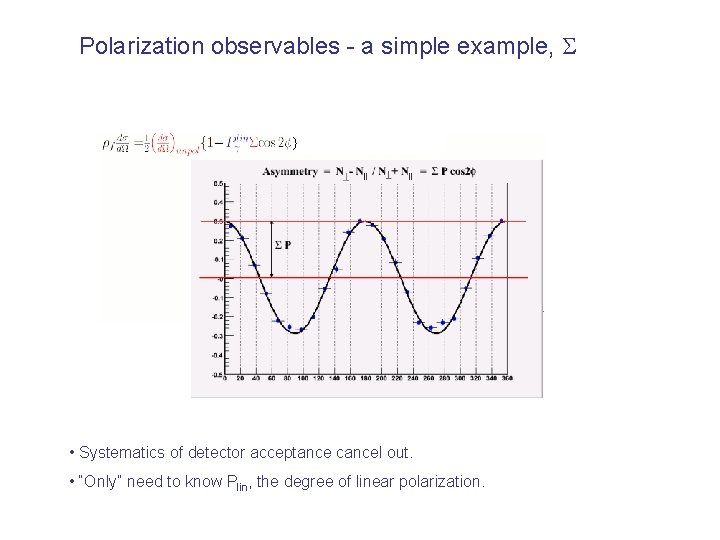
Polarization observables - a simple example, S } • Systematics of detector acceptance cancel out. • “Only” need to know Plin, the degree of linear polarization.
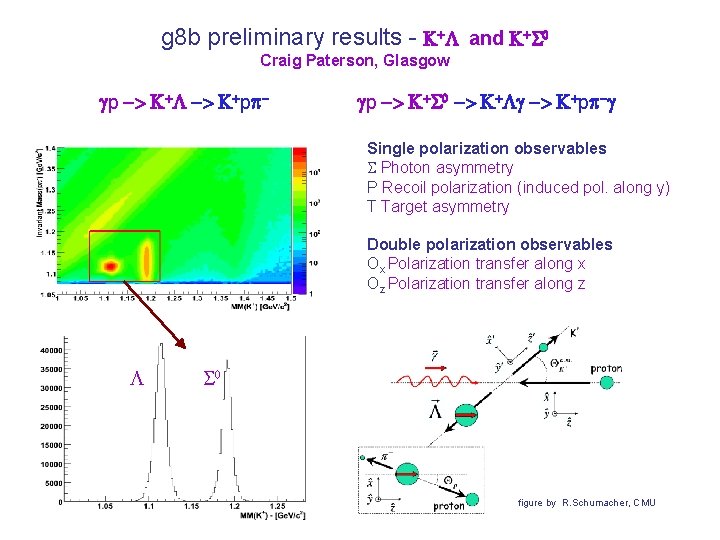
g 8 b preliminary results - +L and +S 0 Craig Paterson, Glasgow gp -> +L -> +pp- gp -> +S 0 -> +Lg -> +pp-g Single polarization observables S Photon asymmetry P Recoil polarization (induced pol. along y) T Target asymmetry Double polarization observables Ox Polarization transfer along x Oz Polarization transfer along z L S 0 figure by R. Schumacher, CMU
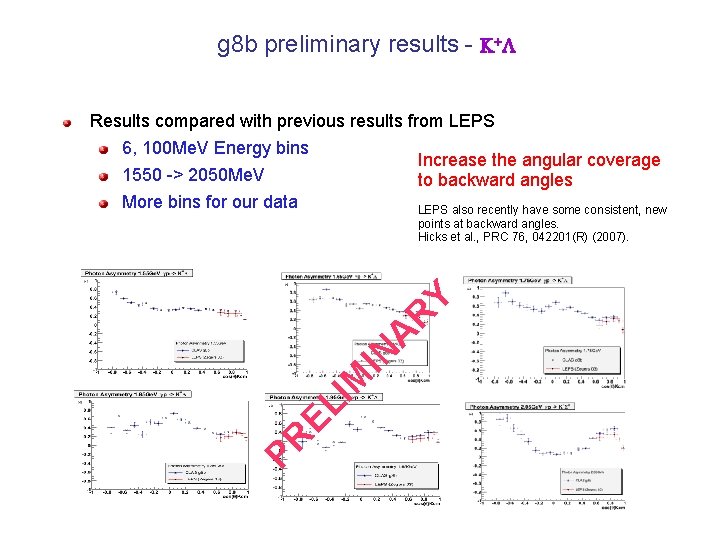
g 8 b preliminary results - +L Results compared with previous results from LEPS 6, 100 Me. V Energy bins Increase the angular coverage to backward angles 1550 -> 2050 Me. V More bins for our data PR EL IM IN A R Y LEPS also recently have some consistent, new points at backward angles. Hicks et al. , PRC 76, 042201(R) (2007).
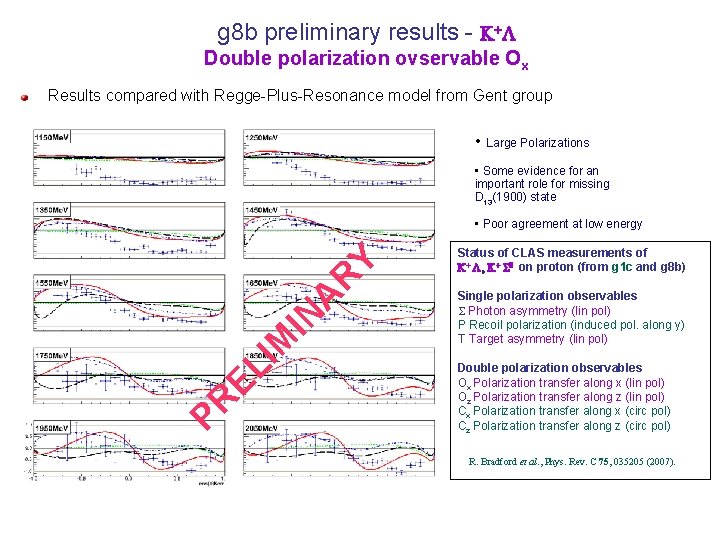
g 8 b preliminary results - +L Double polarization ovservable Ox Results compared with Regge-Plus-Resonance model from Gent group • Large Polarizations • Some evidence for an important role for missing D 13(1900) state PR EL IM IN A R Y • Poor agreement at low energy Status of CLAS measurements of + L, + S 0 on proton (from g 1 c and g 8 b) Single polarization observables S Photon asymmetry (lin pol) P Recoil polarization (induced pol. along y) T Target asymmetry (lin pol) Double polarization observables Ox Polarization transfer along x (lin pol) Oz Polarization transfer along z (lin pol) Cx Polarization transfer along x (circ pol) Cz Polarization transfer along z (circ pol) R. Bradford et al. , Phys. Rev. C 75, 035205 (2007).
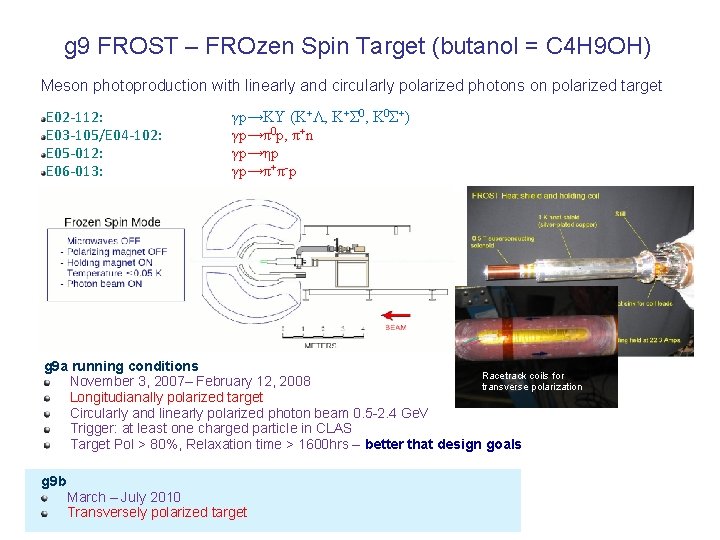
g 9 FROST – FROzen Spin Target (butanol = C 4 H 9 OH) Meson photoproduction with linearly and circularly polarized photons on polarized target E 02 -112: E 03 -105/E 04 -102: E 05 -012: E 06 -013: γp→KY (K+Λ, K+Σ 0, K 0Σ+) γp→π0 p, π+n γp→ηp γp→π+π-p g 9 a running conditions Racetrack coils for November 3, 2007– February 12, 2008 transverse polarization Longitudianally polarized target Circularly and linearly polarized photon beam 0. 5 -2. 4 Ge. V Trigger: at least one charged particle in CLAS Target Pol > 80%, Relaxation time > 1600 hrs – better that design goals g 9 b March – July 2010 Transversely polarized target
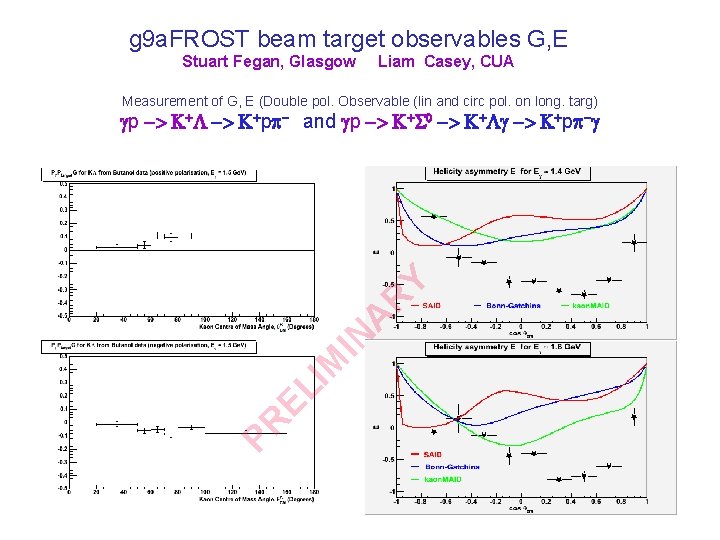
g 9 a. FROST beam target observables G, E Stuart Fegan, Glasgow Liam Casey, CUA Measurement of G, E (Double pol. Observable (lin and circ pol. on long. targ) gp -> +L -> +pp- and gp -> +S 0 -> +Lg -> +pp-g 12 C L CH 2 S 0 Butanol is not a pure proton target. Background from 12 C butanol C CH Kenneth. Livingston@glasgow. ac. uk 12 IM IN A R Y 2 12 C CH 2 EL butanol PR butanol Based on ~2% of statistics Subtract events from 12 C Pol observables corrected by dilution factor.
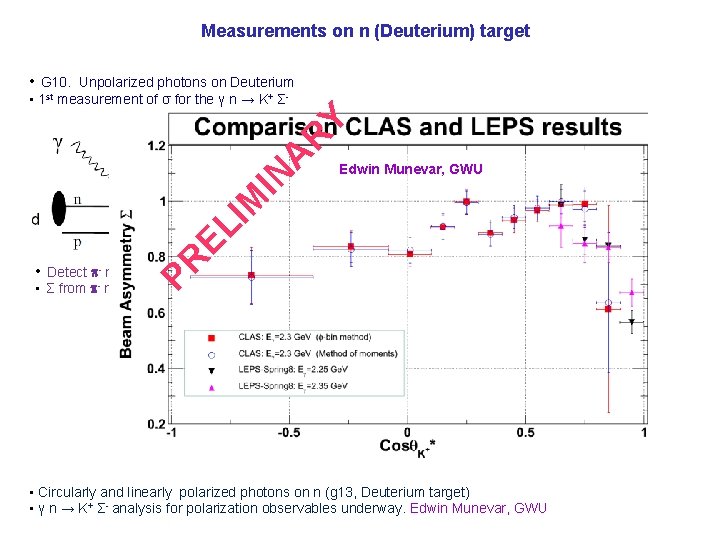
Measurements on n (Deuterium) target • G 10. • 1 st Unpolarized photons on Deuterium measurement of σ for the γ n → K+ Σ- Edwin Munevar, GWU • Detect p- n, K+ PR EL IM IN A R Y Sergio Anefalos Pereira, INFN. Phys. Lett. B 688 (2010) 289 -293 • Σ from p- n inv. mass • CLAS Data ▲ LEPS _____ Gent RPR model • Circularly and linearly polarized photons on n (g 13, Deuterium target) • γ n → K+ Σ- analysis for polarization observables underway. Edwin Munevar, GWU
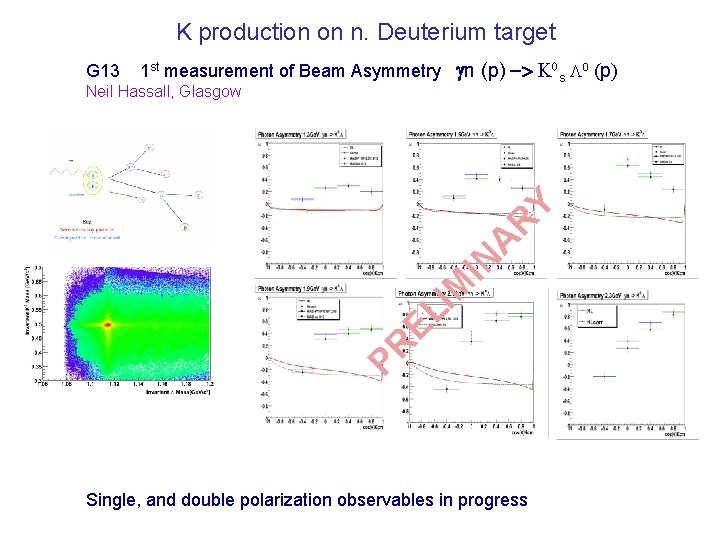
K production on n. Deuterium target G 13 1 st measurement of Beam Asymmetry gn (p) -> K 0 s L 0 (p) PR EL IM IN A R Y Neil Hassall, Glasgow Single, and double polarization observables in progress
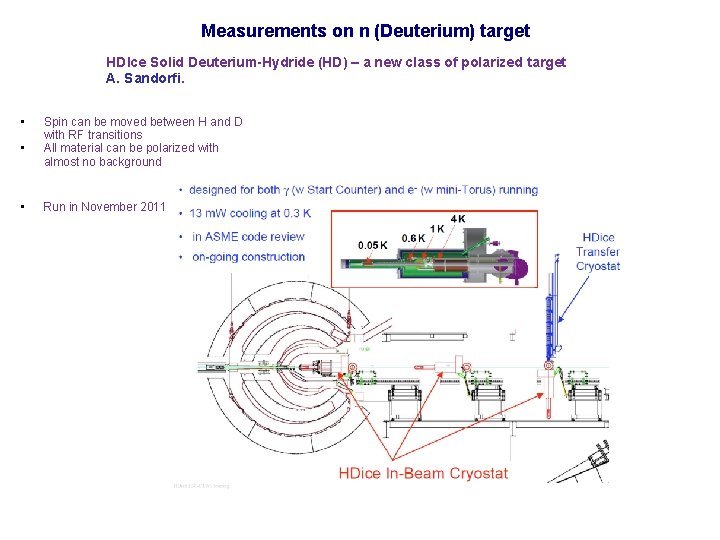
Measurements on n (Deuterium) target HDIce Solid Deuterium-Hydride (HD) – a new class of polarized target A. Sandorfi. • • • Spin can be moved between H and D with RF transitions All material can be polarized with almost no background Run in November 2011
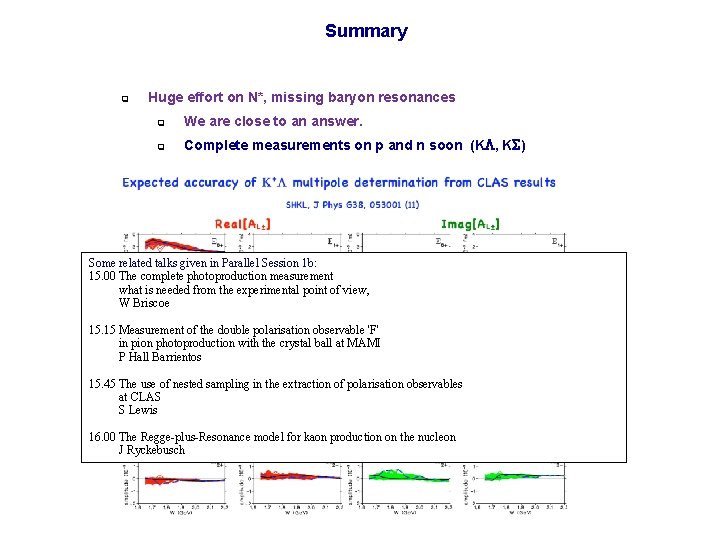
Summary q Huge effort on N*, missing baryon resonances q We are close to an answer. q Complete measurements on p and n soon (KL, KS) Some related talks given in Parallel Session 1 b: 15. 00 The complete photoproduction measurement what is needed from the experimental point of view, W Briscoe 15. 15 Measurement of the double polarisation observable 'F' in pion photoproduction with the crystal ball at MAMI P Hall Barrientos 15. 45 The use of nested sampling in the extraction of polarisation observables at CLAS S Lewis 16. 00 The Regge-plus-Resonance model for kaon production on the nucleon J Ryckebusch