
Recent Progress in Flibe Chemistry Control Corrosion and
Recent Progress in Flibe Chemistry Control, Corrosion, and Tritium Behavior Phil Sharpe Fusion Safety Program Idaho National Laboratory, USA HAPL Program Meeting ORNL 21 -22 March 2006
Fusion Safety Program Topics for Review • Research Program Logic • Purification • Mobilization • REDOX • Corrosion • Deuterium/tritium Permeation Behavior in Flibe Slide 1
Fusion Safety Program Slide 2
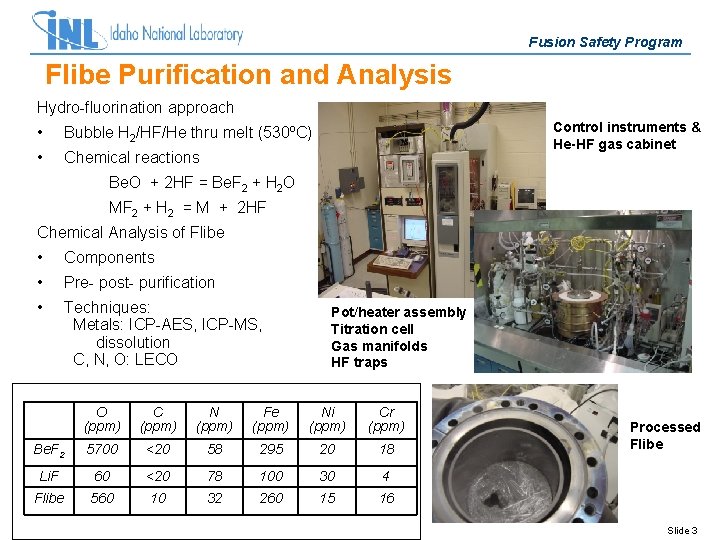
Fusion Safety Program Flibe Purification and Analysis Hydro-fluorination approach • Bubble H 2/HF/He thru melt (530ºC) • Chemical reactions Control instruments & He-HF gas cabinet Be. O + 2 HF = Be. F 2 + H 2 O MF 2 + H 2 = M + 2 HF Chemical Analysis of Flibe • Components • Pre- post- purification • Techniques: Metals: ICP-AES, ICP-MS, dissolution C, N, O: LECO Pot/heater assembly Titration cell Gas manifolds HF traps O (ppm) C (ppm) N (ppm) Fe (ppm) Ni (ppm) Cr (ppm) Be. F 2 5700 <20 58 295 20 18 Li. F 60 <20 78 100 30 4 Flibe 560 10 32 260 15 16 Processed Flibe Slide 3
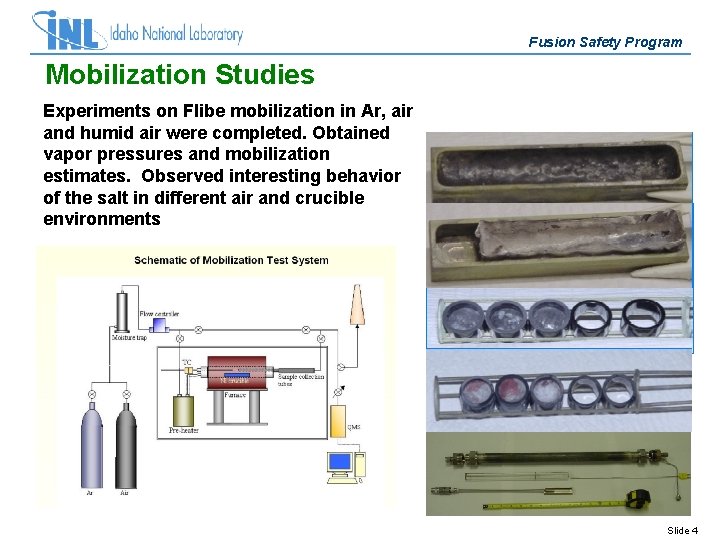
Fusion Safety Program Mobilization Studies Experiments on Flibe mobilization in Ar, air and humid air were completed. Obtained vapor pressures and mobilization estimates. Observed interesting behavior of the salt in different air and crucible environments Slide 4
Fusion Safety Program Mobilization Studies, cont. • • Approach: Expose molten Flibe to Ar, air, moist air at 500 -800ºC, quantify and characterize mobilized material Tests in argon agree with Knudsen mass spec data but are less than ORNL extrapolations and calculations Mobilized deposits were analyzed by ICP-AES. Vapor pressures were derived assuming Be. F 2 and Li. Be. F 3 vapor species Tests in air and moist air show no significant differences from tests in argon Slide 5

Fusion Safety Program Flibe REDOX Control Studies- Needs • Flibe under neutron irradiation will generate free fluorine and/or TF which can be quite corrosive • Need to control fluorine potential to minimize corrosion • Use Beryllium as the redox agent to tie up the free fluorine • Be. F 2 has the lowest free energy of formation for all metal fluorides except Li. F. Thus, Be. F 2 is the most stable with respect to other metal fluorides and TF as well • Be is also useful for neutron multiplication in a blanket system. Slide 6

Fusion Safety Program Flibe REDOX Control Studies- Rationale • Reactor calculations by DK Sze and APEX team suggest F- and/or TF concentration would be ~ 10 wppb per pass in the reactor • This level corresponds to ~ 10 Pa which is 10 -100 times below measurement sensitivity • Evaluate REDOX behavior of Be in Flibe at different concentration levels of HF • Evaluate Be solubility behavior in Flibe • Develop kinetics model to guide experiments at very low HF level that are more representative of fusion blanket conditions • Establish data needed for key checkpoint prior to tritium/corrosion testing Metal Wall, M M (surface) Fn+Li. F T+ Be+ (surface or dissolved) Key issue is chemical competition between T+, Be+ and metal wall for the free fluorine. REDOX control is expected to tie up F- and minimize formation of TF and MF Slide 7

Fusion Safety Program Flibe REDOX Control Studies- Approach • Three key reactions: Be +2 HF <--> Be. F 2+ H 2 + MF 2 <--> M + 2 HF HF(g) <--> HF(s) H 2(s) <--> H 2(g) • Inject HF into the Flibe and measure change in HF in the outlet gas as a signature of the REDOX potential • Insert Be rod into Flibe for a specified time and then remove • If Be solubility in Flibe is enough to provide REDOX control, then HF will be converted to H 2. If not, then REDOX is controlled by H 2/HF reaction itself and we would expect to see no change in the gas Be rod Measure HF in the gas phase as a signature of REDOX potential Inject HF into the Flibe • On line measurement of HF in the gas with titrator and mass spectrometer allows dynamic time dependent information to be obtained • Can change HF level, temperature, Be exposure time and see dynamic change in system Slide 8
Fusion Safety Program Be Dissolution Kinetics: Preliminary Data Simple Mass Transfer Model • • • Both titrator and QMS used to estimate Be concentration in the salt after dunking with comparable results Even after 1 hr, the Be concentration is an order of magnitude less than that measured from dissolution test samples Need long term Be dunk in redox system to more accurately determine Csat in the model Slide 9
Fusion Safety Program Redox Results: HF Concentration vs time • • • Be dunked in the salt for varying lengths of time HF concentration in the gas phase measured via QMS HF feed for these experiments was nominally 1000 ppm HF is initially reacted almost entirely by the Be As Be is depleted via reaction with HF, reaction rate slows Times on the plot are Be exposure times Slide 10
Fusion Safety Program REDOX Results: HF conversion versus time • HF conversion, f, is defined by: • High conversion while Be remains immersed in Flibe Reduction in conversion as Be dissolved in Flibe is consumed Shape of curve is “inverted S” • • Slide 11
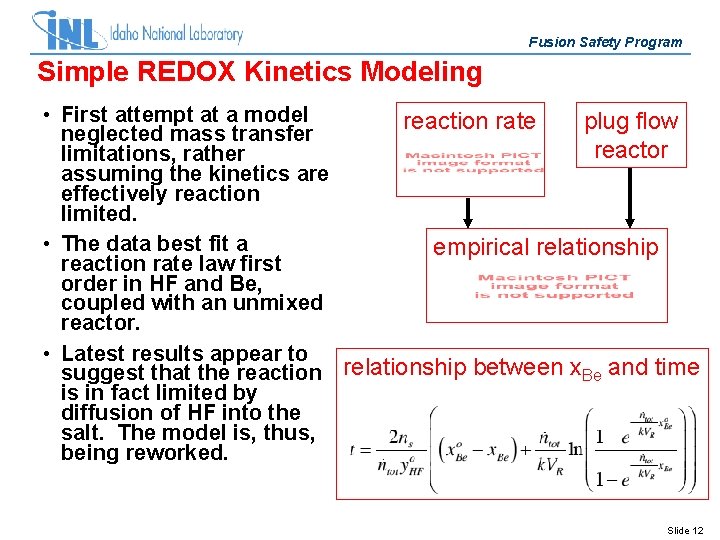
Fusion Safety Program Simple REDOX Kinetics Modeling • First attempt at a model reaction rate plug flow neglected mass transfer reactor limitations, rather assuming the kinetics are effectively reaction limited. • The data best fit a empirical relationship reaction rate law first order in HF and Be, coupled with an unmixed reactor. • Latest results appear to suggest that the reaction relationship between x. Be and time is in fact limited by diffusion of HF into the salt. The model is, thus, being reworked. Slide 12
Fusion Safety Program Simple REDOX Kinetics Modeling- Results • When plotted in this dimensionless terms (f vs. x. Be), the results are remarkably consistent • Conversion (f) is based on mass spec data and Be mole fraction (x. Be) is from titrator data • Model predicts results very well • Lower HF concentration data is currently being used to improve the model. Slide 13

Fusion Safety Program Corrosion Tests in Flibe Pot-arrangement corrosion tests (stagnant fluid): He He+H 2+HF TC He He+H 2+HF Slide 14
Fusion Safety Program Planned Corrosion Tests • Baseline Redox test with 5 -hour Be exposure. HF=1075 ppmv, H 2/HF=11, Flow Rate=140 sccm Measure HF output with QMS and by titration Dissolve salt for H 2 release, i. e. , Be metal content • Test with 5 -hour Be dunk, then expose ferritic steel Sample salt, ICP analyses for Fe, Cr, W and Ni Continue test beyond Be Redox control point • Remove metallic impurities by electrodeposition Test another ferritic steel coupon without the Be Redox pretreatment. • Post-test Analyses: fracture, clean and examine sample by various methods, e. g. , SEM, AES, XPS, XRD, and RBS Slide 15
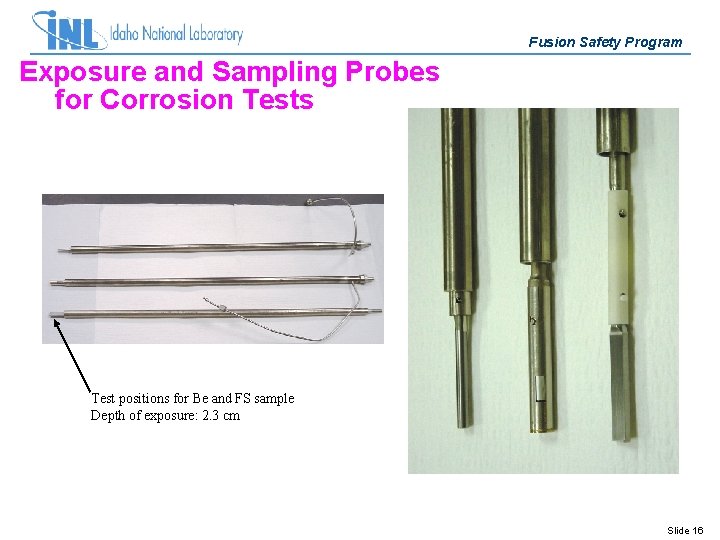
Fusion Safety Program Exposure and Sampling Probes for Corrosion Tests Test positions for Be and FS sample Depth of exposure: 2. 3 cm Slide 16
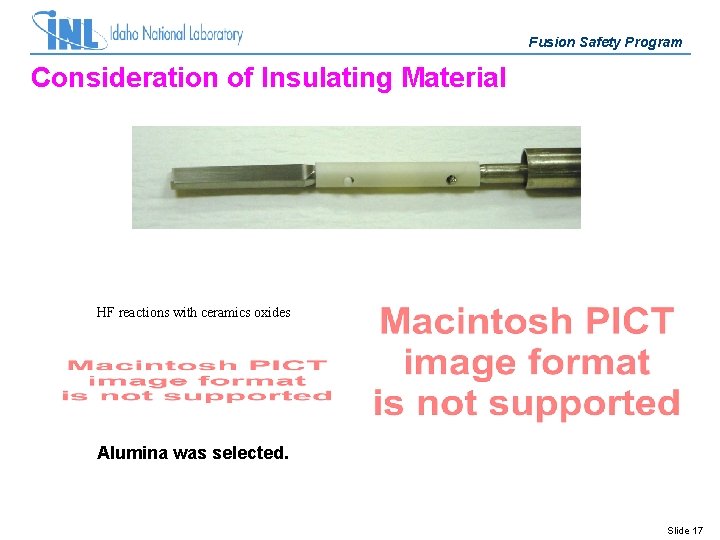
Fusion Safety Program Consideration of Insulating Material HF reactions with ceramics oxides Alumina was selected. Slide 17
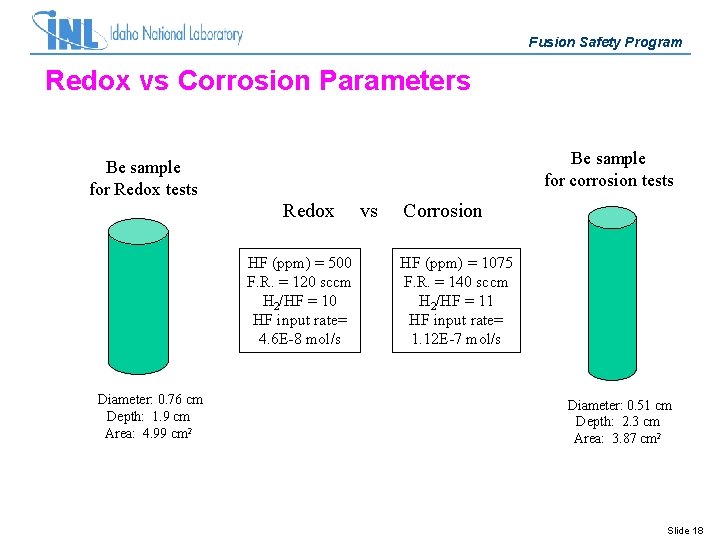
Fusion Safety Program Redox vs Corrosion Parameters Be sample for corrosion tests Be sample for Redox tests Redox HF (ppm) = 500 F. R. = 120 sccm H 2/HF = 10 HF input rate= 4. 6 E-8 mol/s Diameter: 0. 76 cm Depth: 1. 9 cm Area: 4. 99 cm 2 vs Corrosion HF (ppm) = 1075 F. R. = 140 sccm H 2/HF = 11 HF input rate= 1. 12 E-7 mol/s Diameter: 0. 51 cm Depth: 2. 3 cm Area: 3. 87 cm 2 Slide 18

Fusion Safety Program Analyses of Salt Samples Salt Sample: ~1. 3 grams ~ 1 gram Sulfuric acid dissolutions: H 2 release, i. e. , Be metal determinations ~ 0. 3 gram Nitric acid dissolutions: ICP-AES determinations For Fe, Cr, W and Ni Slide 19
Fusion Safety Program Be Determinationed from Acid Tests Be Solubility Slide 20

Fusion Safety Program Chemical Analyses of Flibe following FS exposure Predicted increases of Fe in Flibe Batch: 475 g (14. 7 moles) Size of salt sample: 1. 4 gram Ferritic steel sample: Composition: 89 Fe-9 Cr-2 W Exposed area: 0. 65 cm 2 Slide 21
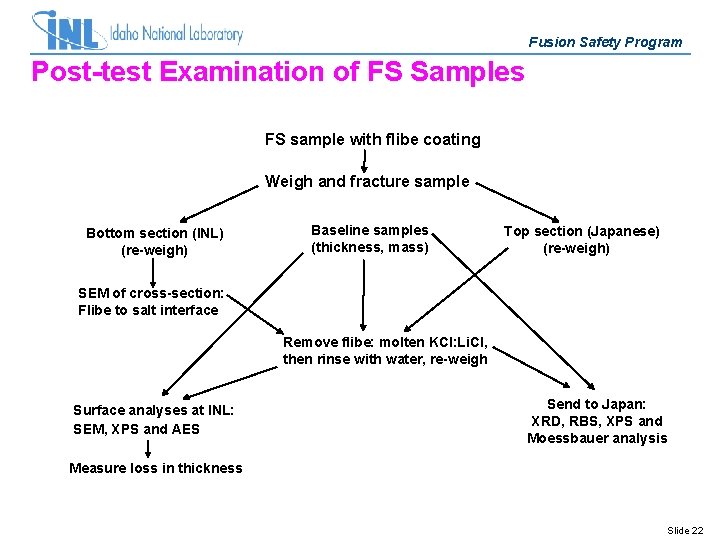
Fusion Safety Program Post-test Examination of FS Samples FS sample with flibe coating Weigh and fracture sample Bottom section (INL) (re-weigh) Baseline samples (thickness, mass) Top section (Japanese) (re-weigh) SEM of cross-section: Flibe to salt interface Remove flibe: molten KCl: Li. Cl, then rinse with water, re-weigh Surface analyses at INL: SEM, XPS and AES Send to Japan: XRD, RBS, XPS and Moessbauer analysis Measure loss in thickness Slide 22
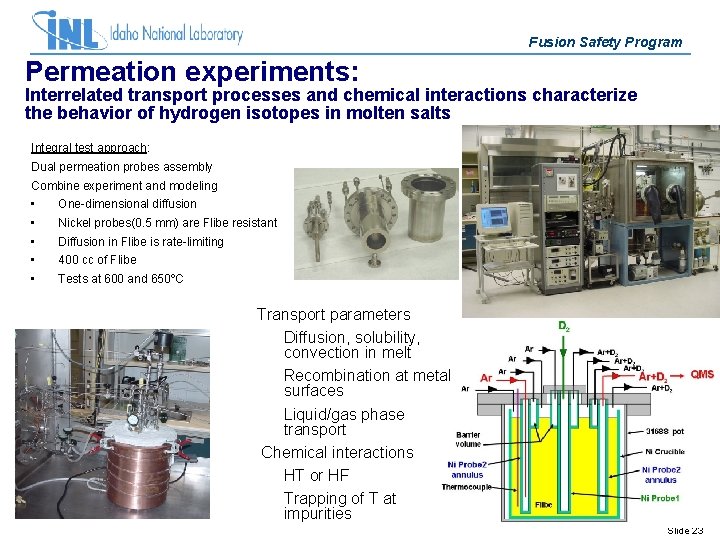
Fusion Safety Program Permeation experiments: Interrelated transport processes and chemical interactions characterize the behavior of hydrogen isotopes in molten salts Integral test approach: Dual permeation probes assembly Combine experiment and modeling • • • One-dimensional diffusion Nickel probes(0. 5 mm) are Flibe resistant Diffusion in Flibe is rate-limiting 400 cc of Flibe Tests at 600 and 650ºC Transport parameters Diffusion, solubility, convection in melt Recombination at metal surfaces Liquid/gas phase transport Chemical interactions HT or HF Trapping of T at impurities Slide 23
Fusion Safety Program Results of experiments: without/with Flibe Derived permeabilities in empty pot show good agreement with Robertson’s correlation for Ni Reduction in probe-2 concentration of D 2 (due to low solubility in Flibe) Time delay for observation of permeation signal in probe 2 (due to slow diffusivity in flibe) D 2 Partial Pressure Without & with Flibe D 2 Partial Pressure Without Flibe Slide 24
Fusion Safety Program Correlation of D diffusivity and solubility in Flibe • > D from viscosity estimate • < D from capillary experiment • activation E similar to F- diffusion Derived solubilities are comparable to those reported by Field et al. for DF in Flibe Solubility Coefficient Solubility data Diffusion Coefficient (m 2/s) Diffusion data Slide 25
Fusion Safety Program Activities for the FLi. Be Tritium Permeation Experiment Activity 1: Installation and testing of permeation chamber in pot furnace arrangement Activity 2: TMAP modeling of permeation chamber Activity 3: Design of tritium handling and diagnostics systems Slide 26
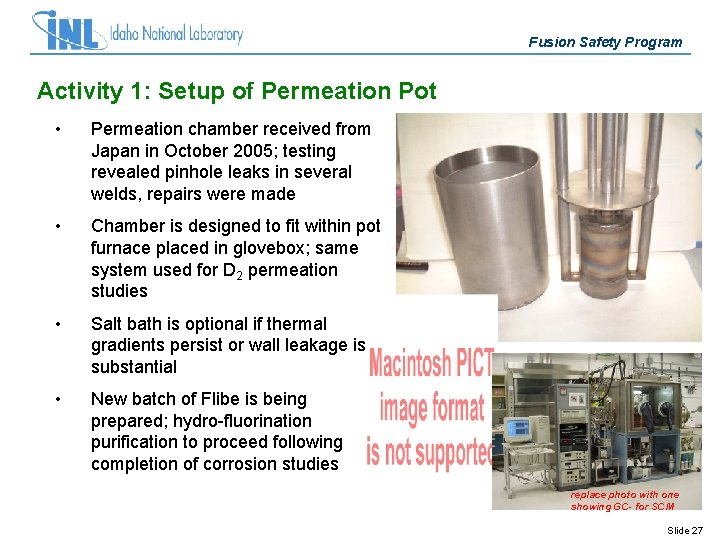
Fusion Safety Program Activity 1: Setup of Permeation Pot • Permeation chamber received from Japan in October 2005; testing revealed pinhole leaks in several welds, repairs were made • Chamber is designed to fit within pot furnace placed in glovebox; same system used for D 2 permeation studies • Salt bath is optional if thermal gradients persist or wall leakage is substantial • New batch of Flibe is being prepared; hydro-fluorination purification to proceed following completion of corrosion studies replace photo with one showing GC- for SCM Slide 27
Fusion Safety Program Activity 2: TMAP modeling of Permeation Chamber • Straightforward modeling tool will help optimize experiment layout, e. g. required sweep gas flow rates, need for use of salt bath, thickness of Flibe for appropriately timed experiments, etc. • 1 -D axial model with sink terms to simulate radial loss of T • Builds on success of TMAP modeling with D 2 permeation experiment • Suitable study for graduate student, but need to perform soon Model basis for permeation pot by Fukada et al. Slide 28
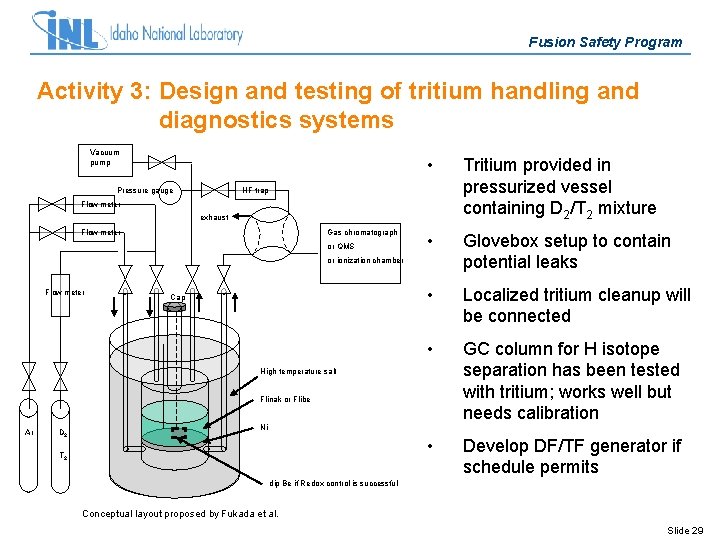
Fusion Safety Program Activity 3: Design and testing of tritium handling and diagnostics systems Vacuum pump Pressure gauge • Tritium provided in pressurized vessel containing D 2/T 2 mixture • Glovebox setup to contain potential leaks • Localized tritium cleanup will be connected • GC column for H isotope separation has been tested with tritium; works well but needs calibration • Develop DF/TF generator if schedule permits HF trap Flow meter exhaust Flow meter Gas chromatograph or QMS or ionization chamber Flow meter Cap High temperature salt Flinak or Flibe Ar D 2 Ni T 2 dip Be if Redox control is successful Conceptual layout proposed by Fukada et al. Slide 29
- Slides: 30