
RECENT ISSUES IN LOCAL FINANCIAL MANAGEMENT BANGLADESH PERSPECTIVE

RECENT ISSUES IN LOCAL FINANCIAL MANAGEMENT: BANGLADESH PERSPECTIVE

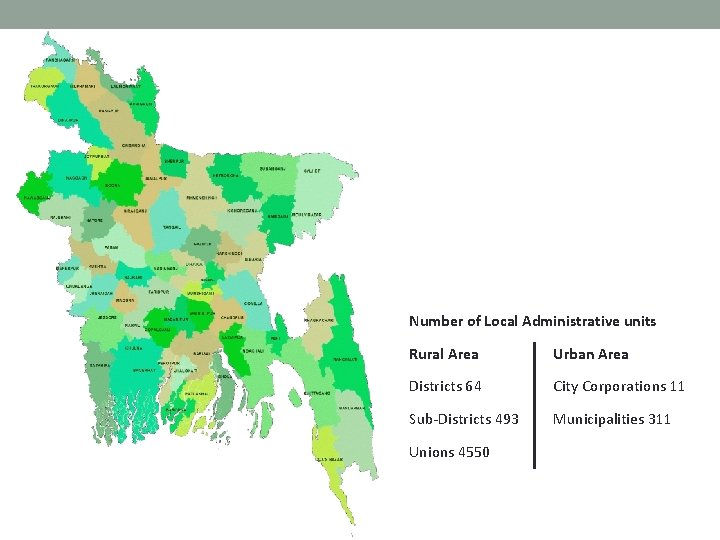
Number of Local Administrative units Rural Area Urban Area Districts 64 City Corporations 11 Sub-Districts 493 Municipalities 311 Unions 4550
Present Structure of Local Government in Bangladesh According to article 59 of the Constitution of the People’s Republic of Bangladesh local government in every administrative unit of the Republic shall be entrusted to bodies, composed of persons elected in accordance with law. Article 60 of the Constitution states that the Parliament shall, by law, confer powers on the local government bodies referred to in article 59, including power to impose taxes for local purposes, to prepare their budgets and to maintain funds. As per the directions of the Constitution government has updated the structural and functional capacities of local government in rural areas with the Zilla Parishad Act 2000, the Local Government (Union Parishad) Act 2009 and Upazila Parishad (Amended) Act 2011. For urban areas the Local Government (Pourashava) Amended Act of 2010 the Local Government (City Corporation) Act, 2009 were promulgated. So at present, independence of the local bodies has been established by law.
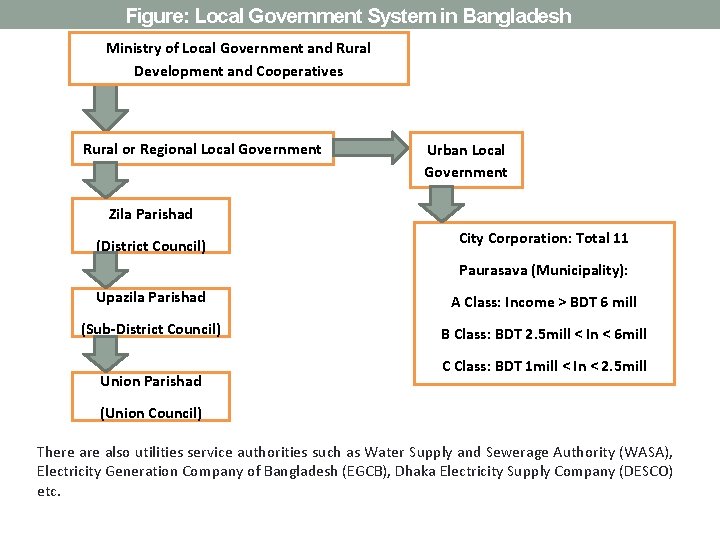
Figure: Local Government System in Bangladesh Ministry of Local Government and Rural Development and Cooperatives Rural or Regional Local Government Urban Local Government Zila Parishad (District Council) City Corporation: Total 11 Paurasava (Municipality): Upazila Parishad A Class: Income > BDT 6 mill (Sub-District Council) B Class: BDT 2. 5 mill < In < 6 mill Union Parishad C Class: BDT 1 mill < In < 2. 5 mill (Union Council) There also utilities service authorities such as Water Supply and Sewerage Authority (WASA), Electricity Generation Company of Bangladesh (EGCB), Dhaka Electricity Supply Company (DESCO) etc.
Zila Parishad (District Council) Formed under the Zila Parishad Act, 2000, till date no elections have been held at this level of LG. Deputy Commissioner, the representative of central government at District level is the ex officio chairman of Zila Parishad. It’s functions include construction and maintenance of roads, and bridges, building hospitals and dispensaries, schools and educational institutions, health facilities and sanitation, tube wells for drinking water, rest houses, and coordination of activities of the Union Parishads within the District etc. Income source: In addition to grants from the government, District Councils are empowered to generate funds through taxes, rates, fees, tolls etc. • Tax on exchange of immovable property • Income from leasing bus stops, ferries etc. • Registration and license renewal fee from contractors • Income through lease of govt. land, water bodies etc. • Income from markets and shops • Income from residential areas, govt. rest houses and such facilities
Financial Management of Upazila Parishad (Sub-District Council) With open elections, Upazila Parishads were revived under the Upazila Parishad Act (Amended) 2009. Due to some apprehensions among the elected representatives on the role of local MP and UNO in Upazila Parishad, the Act was again amended in 2011, which has created possibilities to make the Upazila an effective and vibrant local government (LG) unit. To support the Government of Bangladesh in achieving the expected results from the Upazila system, a donor-driven program, namely the Upazila Parishad Governance Project (UZGP) has been initiated in 14 Upazilas on a pilot basis for the period 20112016 with an aim to provide performance-linked fiscal facilities. The redefined role of the UZP includes, among others, local level development planning (both annual and five year) and budgeting, inclusive development by giving more emphasis on MDGs by shifting focus from only on infrastructure-led development, making functionaries more effective and pro-poor service oriented etc.
Cont. In practice most elected representatives of UZPs lack training in comprehensive planning and budgeting. So in most upazilas, UNOs and Upazila Engineers or LGED Accountants prepare UZP budget. Major areas of revenue of the UZP are • 2% land development tax • Income form Hat-Bazar (market) • Income from house rent • Tax from business • Schedule sell • Previous balance • Festival and amusement tax (Hat during Eid-Ul-Adha, Fairs) Majority of Upazilas’ main source of development fund is development grants (ADP) from the central government.
Cont. Major development expenditure of the UZPs are in • infrastructure (both physical and socio-economic) • agriculture and irrigation • Education • Health (sanitation, immunization program etc) • disaster and relief Smaller sectors are social safety net and institutional support for the poor. There is a brief section in UZP Manual on how to use development funds. However, no complete and comprehensive annual development plan guideline is so far available for UZP officials have not been trained to prepare a comprehensive annual development plan. Till now very few Upazilas have prepared five year plans (FYP). However, none of the Upazilas has any guideline for preparing FYP.
Financial Management of Union Parishad (Union Council) Union Parishads are the smallest rural administrative and local government units in Bangladesh. Each Union is made up of nine Wards. Union Parishads are formed under the Local Government (Union Parishads) Act, 2009. A Union Council is primarily responsible for agricultural, industrial and community development within the local limits of the union. Deputy Commissioner is the approval authority of the UP budget. If a UP fails to prepare its budget within 30 th June, the DC gives budget at his discretion for that UP in pursuance of his authority. The major sources of revenue of the UP are Property tax, Revenues and Grants • all taxes, rates and fees imposed on the citizen in accordance with law; • the profit and rent from the property under the control of or managed by the UP; • any fund collected under the Ordinance or other temporary law; • funds received from any individual, organization, or local authority; • funds received from the income of trusts managed by the UP;
Cont. • all grants from the government or any other source; • all profits from investments; and • the income from other sources determined by the central government. Approved Areas of Expenditure • payment of salary and allowance of all appointed officials of the UP; • meeting of expenditure generated from carrying out responsibilities as • assigned with the UP by ordinances or laws; • other expenditures made on approval of the DC; • expenditures that are to be made from the UP fund as per government order; • expenditures that are to be made from the UP fund under the 1983 Ordinance Major Challenges in Tax Collection • Politics of vote; • Insufficient authority to take effective actions against tax defaulters;
Cont. • Manpower shortage in Ups; and • Negligence of tax collectors. In addition, despite the chairman of the UP is to be the ex-officio chair of the local market management committee, this post persistently lies outside of his de facto jurisdiction which greatly hampers revenue generation. Absence of effective financial management has made the UP a weaker institution. Also traditional totalitarian tendency of many UP chairmen creates problems in decisionmaking, project formulation and financial management.
Municipalities & City Corporations A pourashava (municipality) is an urban administrative division having corporate status and powers of self-government or jurisdiction. Pourashavas are built and operated in Bangladesh according to the Local Government (Pourashava) Amended Act of 2010. The pourashava is run by a panel of an elected mayor and ward councilors including one third women councilors in reserved seats City corporations are upgraded pourashavas operating in big cities formed under the Local Government (City Corporation) Act, 2009. There a total of 11 city corporations at present in Bangladesh. Functions of Pourashava and City Corporations broadly relate to • Public health (includes water supply, sewerage and sanitation, etc. ) • Welfare (includes public facilities such as education, recreation, etc. ) • Regulatory functions (Includes enforcing building bye-laws, encroachments on public land etc. ) • Public safety (includes fire protection, street lighting, etc. )
Cont. • Public works (includes construction and maintenance of roads, culverts and drainage, etc. ) • Development activities (Includes town planning and development of commercial markets, etc. ) Pourashava Councilors are mostly unaware of important pourashava affairs and developments, even their rights and obligations. Pourashavas are legally compelled to form standing committees to ensure participation of residents in development projects and activities. There are provisions in the law to form Ward-Level Coordination Committee (WLCC) and Town-Level Coordination Committees (TLCC) though in many pourashavas such committees are non-existent. Own source revenue of Pourashava & City Corporations Property-based revenue Activity-based revenue Revenue from own property
Cont. Property based revenue is the major source of Pourashava and City Corporation revenue and it includes tax and rates. Tax is imposed on residential and commercial properties and rates are collected for providing street lighting, conservancy and water supply. There is another property based tax known as Immovable Property Transfer Tax (IPTT) which is collected directly by central government at the time of transfer of property and 2 percent (of the value of every deed of transfer) of this revenue is shared with the Pourashava and City Corporations. There are several ‘activity or benefit based revenue’ sources. These are, tax on profession, trades and callings, tax on the application for erection and re-erection of buildings, taxes on advertisement, amusement, vehicles, fees on shops and licenses, and tolls on ferries, bus stands and sand deposits etc.
Cont. Problems associated with assessment of holding tax • ownership identification problem • irregularity of assessment • lack of commitment of elected officials • lack of skilled assessors Problems associated with holding tax collection • Irregularity of billing • Attitudes and ignorance of the Residents • Corruption and tax evasion • Lack of political will of the Pourashavas to enforce penalties
Cont. High dependence on Central Grant Central grant is primarily provided to undertake development and maintenance activities in the shape of ADP block grant and special block grant. SBG is a discretionary grant and quite often than not, is allocated upon political considerations. Pourashava and City Corporation Borrowing Under Local Authorities Loans Act, 1914, a Pourashava can borrow money from the banks with an advance approval from the central government. There is a World Bank supported Go. B project known as Bangladesh Municipal Development Fund (BMDF) for Pourashavas to borrow money to complete important development works. Pourashavas and City Corporations which have been able to demonstrate increasingly higher level of own source revenue generation can claim to have additional financial resources from the Urban Governance and Infrastructural Improvement Project (UGIIP).
Cont. Budget and budgetary process Pourashavas treat budgets more as a legal exercise than as a control (efficiency, transparency and accountability) tool and end up using the budget as an instrument for obtaining government funds. Budget preparation is done in a traditional manner. The account section in discussion with the Pourashava Mayor and Councilors selects projects and allocates funds. The revenue estimates are prepared by totaling arrears and current demand for taxes and by increasing other revenue by a certain percentages. Pourashavas are legally required to have a balanced budget. The municipal expenditures are thus conditioned by the level of resources available. In the pourashsvas where the receipts are very low, the expenditures are also low. These low expenditures have a crucial impact on the quality and nature of services provided by the municipality.
Cont. In most Pourashavas a good part of arrears taxes remain unrealized therefore the actual revenue falls short of expected revenue by a big margin. Only about one third of the budgeted property, taxes and rates are realized annually. The budget is divided into three basic categories. These are current, capital and special fund account. Due to absence of proper definition of these three categories of accounts, Pourashava mainly use the first category. However, the items are not separated according to salaries, capital expenditure and recurrent expenditure properly. Auditing Practice Internal auditing is rare in pourashavas, external audit is carried out by auditors from local revenue audit department of the office of the Accountant General of Bangladesh. Audit reports concentrate on the accuracy of financial records and overlook financial management aspects such as realistic budgeting, tax collection performance, cash management, earning interest from bank deposit etc.
Cont. Financial Accountability and Transparency Open budget meetings are held where the budget is shared with the citizenry. Only the local influential people are invited. Common people of Pourashava have little idea about this practice. Councillors are not aware about the audit report or objections. Copy of the audit report, annual financial statement, tax assessment or annual budget are not displayed or shared with wider population of the Pourashavas. The current accounting system, which is used in Pourashava, is single entry accounting system. The activities of Pourashava authority lack transparency and accountability. For lack of monitoring, general people have little idea about budget allocation system, implementation of development and maintenance activities, income and expenditure of the Pourashava.
- Slides: 21