
Recent Experiments Involving FewNucleon Systems Werner Tornow Duke




- Slides: 71
Recent Experiments Involving Few-Nucleon Systems Werner Tornow Duke University & Triangle Universities Nuclear Laboratory
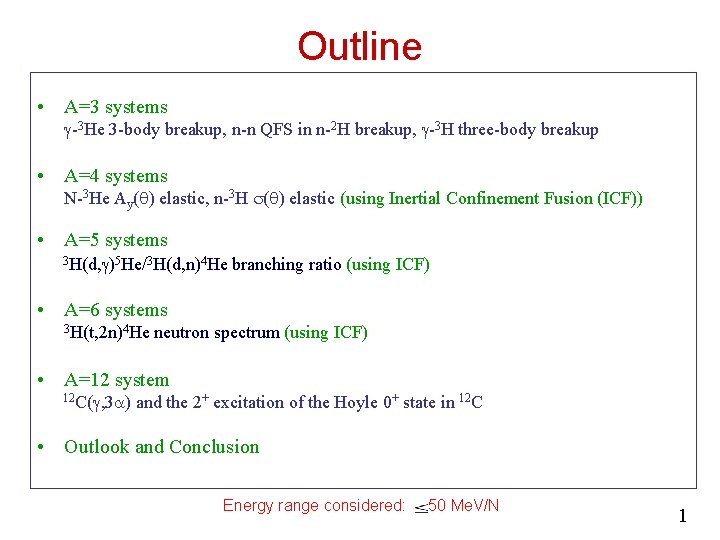
Outline • A=3 systems g-3 He 3 -body breakup, n-n QFS in n-2 H breakup, g-3 H three-body breakup • A=4 systems N-3 He Ay(q) elastic, n-3 H s(q) elastic (using Inertial Confinement Fusion (ICF)) • A=5 systems 3 H(d, g)5 He/3 H(d, n)4 He branching ratio (using ICF) • A=6 systems 3 H(t, 2 n)4 He neutron spectrum (using ICF) • A=12 system 12 C(g, 3 a) and the 2+ excitation of the Hoyle 0+ state in 12 C • Outlook and Conclusion Energy range considered: 50 Me. V/N 1
A=3 g + 3 He -> p + n 2
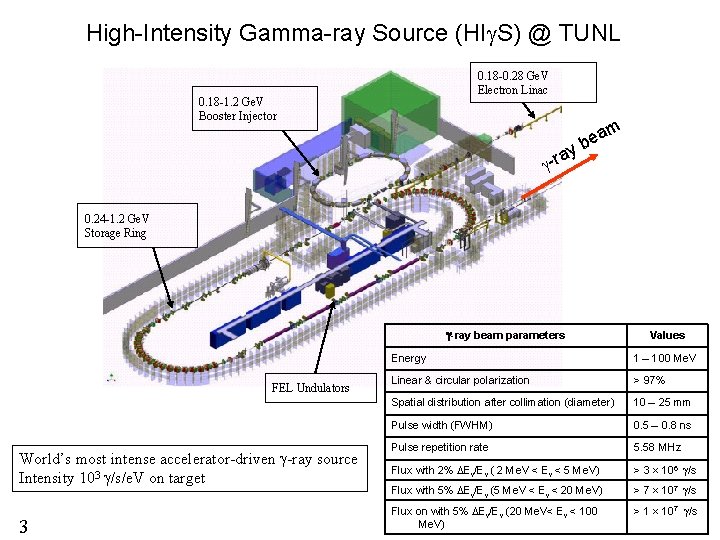
High-Intensity Gamma-ray Source (HIg. S) @ TUNL 0. 18 -0. 28 Ge. V Electron Linac 0. 18 -1. 2 Ge. V Booster Injector am e b ay g-r 0. 24 -1. 2 Ge. V Storage Ring g-ray beam parameters FEL Undulators World’s most intense accelerator-driven g-ray source Intensity 103 g/s/e. V on target 3 Values Energy 1 – 100 Me. V Linear & circular polarization > 97% Spatial distribution after collimation (diameter) 10 – 25 mm Pulse width (FWHM) 0. 5 – 0. 8 ns Pulse repetition rate 5. 58 MHz Flux with 2% Eg/Eg ( 2 Me. V < Eg < 5 Me. V) > 3 × 10⁶ g/s Flux with 5% Eg/Eg (5 Me. V < Eg < 20 Me. V) > 7 × 10⁷ g/s Flux on with 5% Eg/Eg (20 Me. V< Eg < 100 Me. V) > 1 × 10⁷ g/s
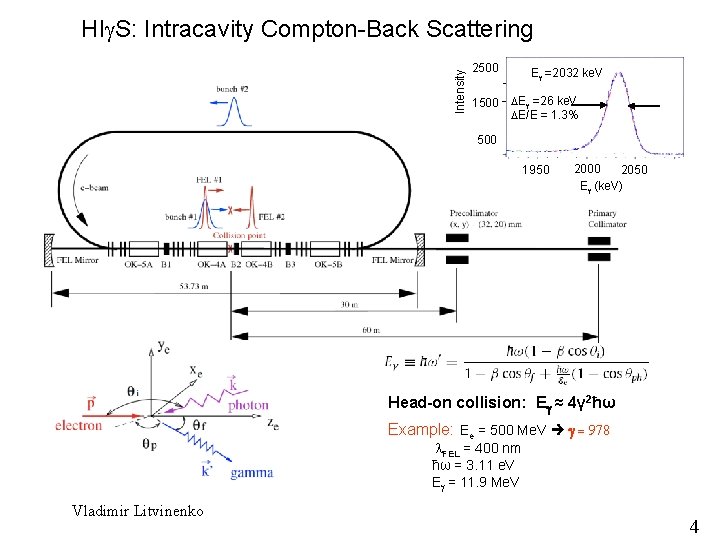
Intensity HIg. S: Intracavity Compton-Back Scattering 2500 1500 Eg =2032 ke. V Eg =26 ke. V E/E = 1. 3% 500 1950 2000 2050 Eg (ke. V) Head-on collision: Eg ≈ 4γ 2ħω Example: Ee = 500 Me. V g = 978 l. FEL = 400 nm ħω = 3. 11 e. V Eg = 11. 9 Me. V Vladimir Litvinenko 4
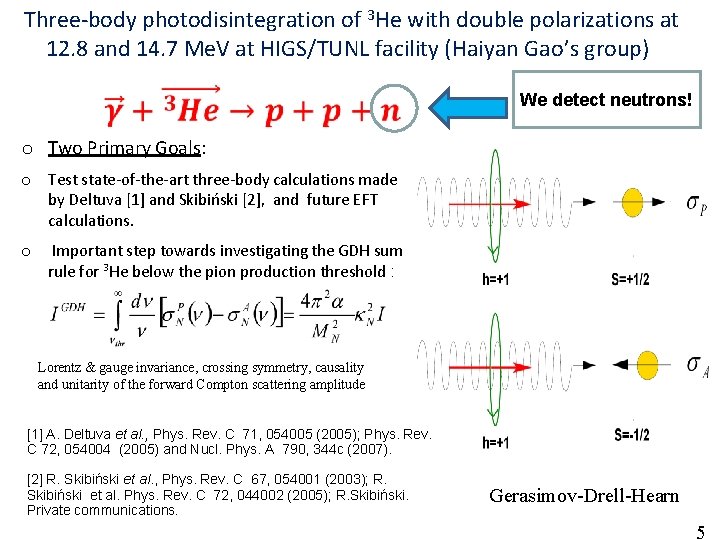
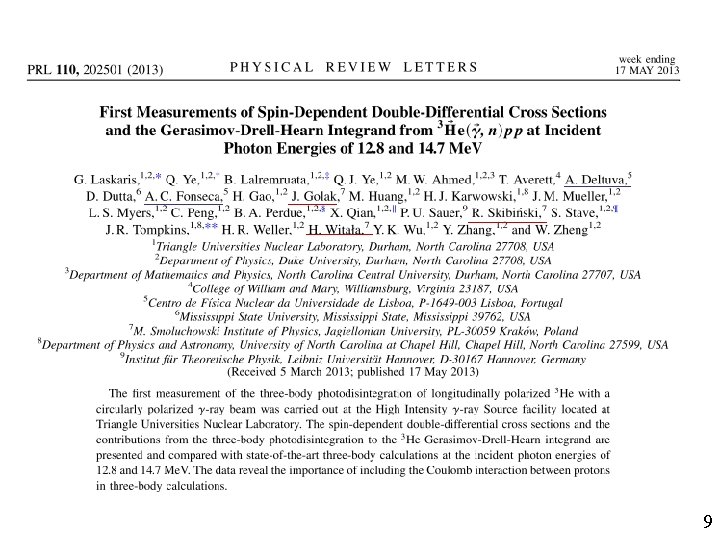
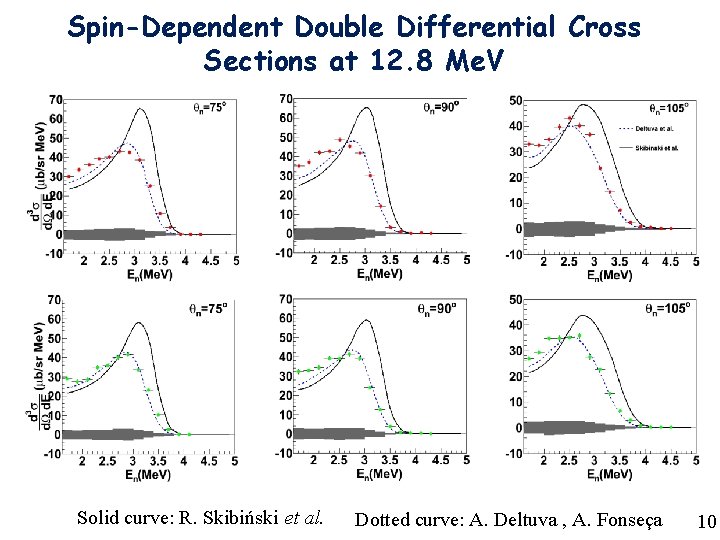
Three-body photodisintegration of 3 He with double polarizations at 12. 8 and 14. 7 Me. V at HIGS/TUNL facility (Haiyan Gao’s group) We detect neutrons! o Two Primary Goals: o Test state-of-the-art three-body calculations made by Deltuva [1] and Skibiński [2], and future EFT calculations. o Important step towards investigating the GDH sum rule for 3 He below the pion production threshold : Lorentz & gauge invariance, crossing symmetry, causality and unitarity of the forward Compton scattering amplitude [1] A. Deltuva et al. , Phys. Rev. C 71, 054005 (2005); Phys. Rev. C 72, 054004 (2005) and Nucl. Phys. A 790, 344 c (2007). [2] R. Skibiński et al. , Phys. Rev. C 67, 054001 (2003); R. Skibiński et al. Phys. Rev. C 72, 044002 (2005); R. Skibiński. Private communications. Gerasimov-Drell-Hearn 5
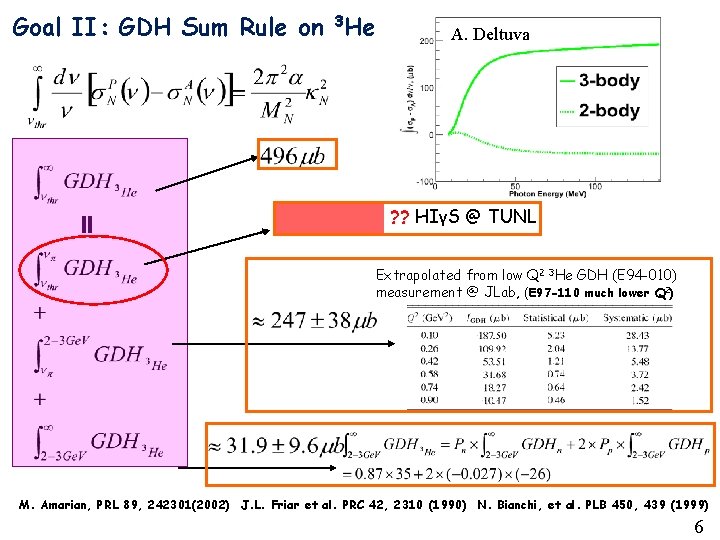
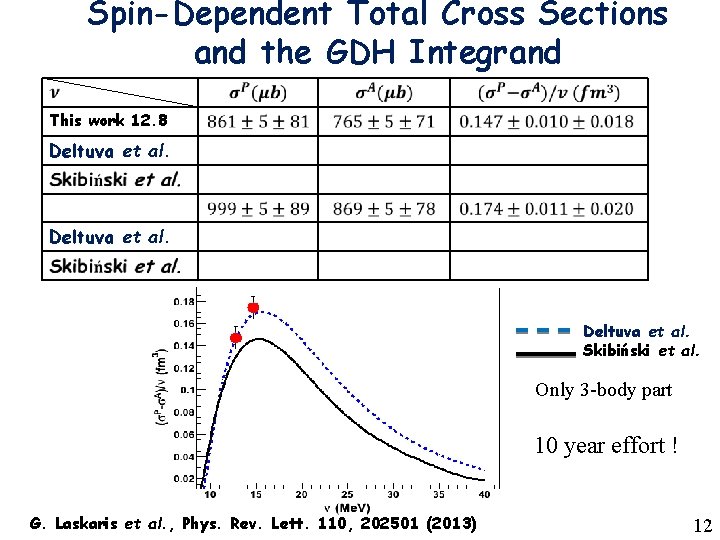
Goal II: GDH Sum Rule on 3 He A. Deltuva ? ? HIγS @ TUNL Extrapolated from low Q 2 3 He GDH (E 94 -010) measurement @ JLab, (E 97 -110 much lower Q 2) M. Amarian, PRL 89, 242301(2002) J. L. Friar et al. PRC 42, 2310 (1990) N. Bianchi, et al. PLB 450, 439 (1999) 6
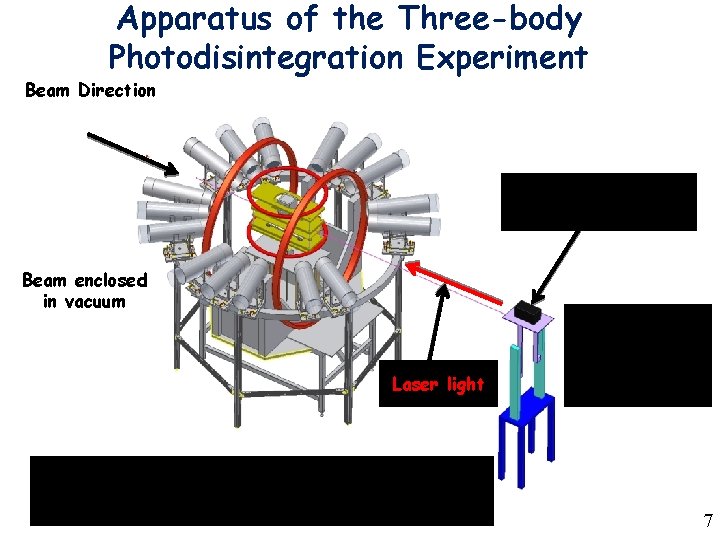
Apparatus of the Three-body Photodisintegration Experiment Beam Direction Optics Table Beam enclosed in vacuum Laser light 1. Automatically movable target and optical table 2. Detectors in mu-metal shielding tubes D 2 O cell-flux monitor not shown in the schematic 7
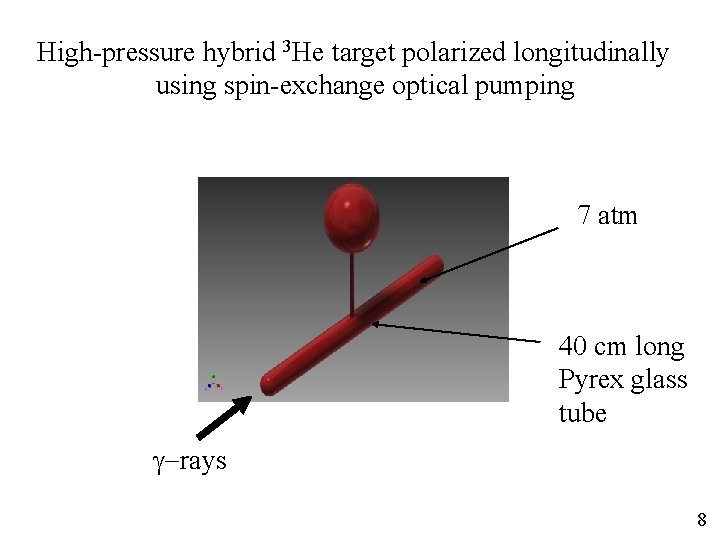
High-pressure hybrid 3 He target polarized longitudinally using spin-exchange optical pumping 7 atm 40 cm long Pyrex glass tube g-rays 8
9
Spin-Dependent Double Differential Cross Sections at 12. 8 Me. V Solid curve: R. Skibiński et al. Dotted curve: A. Deltuva , A. Fonseça 10
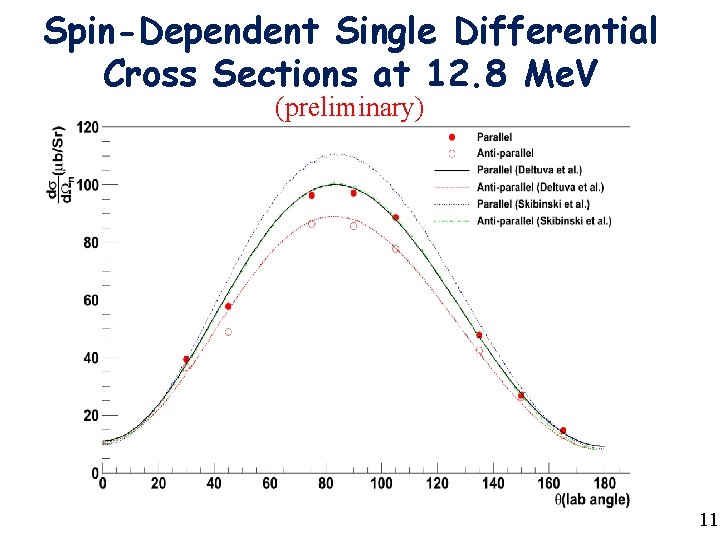
Spin-Dependent Single Differential Cross Sections at 12. 8 Me. V (preliminary) 11
Spin-Dependent Total Cross Sections and the GDH Integrand This work 12. 8 Deltuva et al. 872 777 0. 146 956 872 0. 131 1026 900 0. 168 1079 970 0. 146 This work 14. 7 Deltuva et al. Skibiński et al. Only 3 -body part 10 year effort ! G. Laskaris et al. , Phys. Rev. Lett. 110, 202501 (2013) 12
A=3 nn QFS in n + d breakup & g + 3 H three-body breakup 13
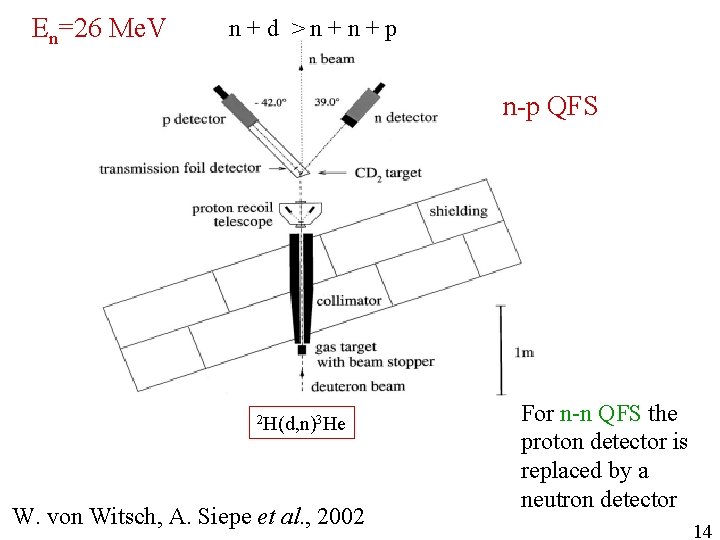
En=26 Me. V n+d >n+n+p n-p QFS 2 H(d, n)3 He W. von Witsch, A. Siepe et al. , 2002 For n-n QFS the proton detector is replaced by a neutron detector 14
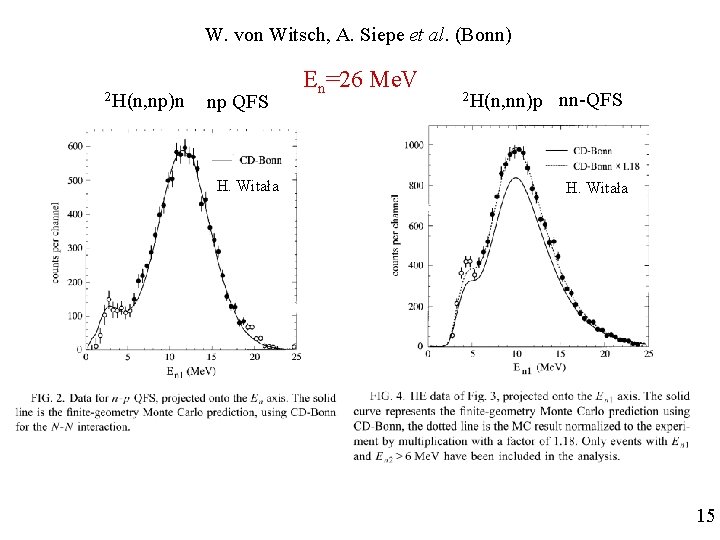
W. von Witsch, A. Siepe et al. (Bonn) 2 H(n, np)n np QFS H. Witała En=26 Me. V 2 H(n, nn)p nn-QFS H. Witała 15
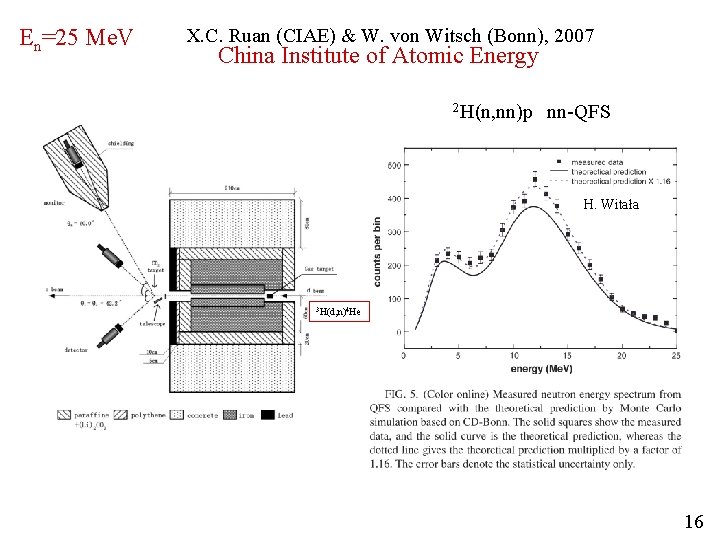
En=25 Me. V X. C. Ruan (CIAE) & W. von Witsch (Bonn), 2007 China Institute of Atomic Energy 2 H(n, nn)p nn-QFS H. Witała 3 H(d, n)4 He 16
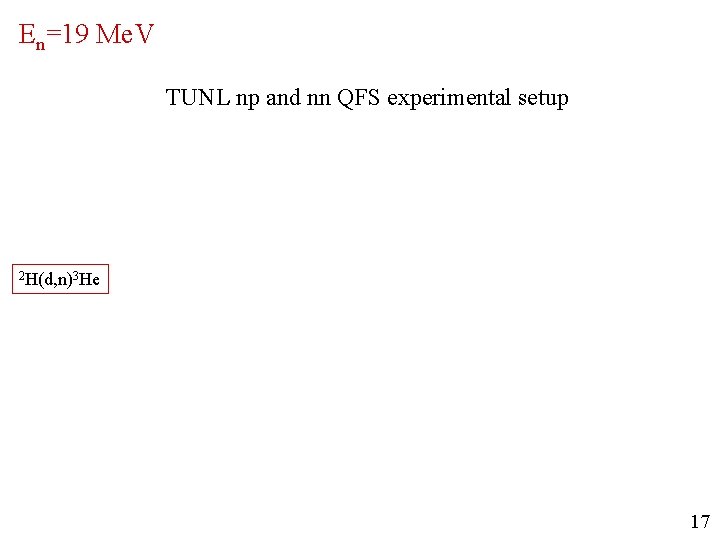
En=19 Me. V TUNL np and nn QFS experimental setup 2 H(d, n)3 He 17
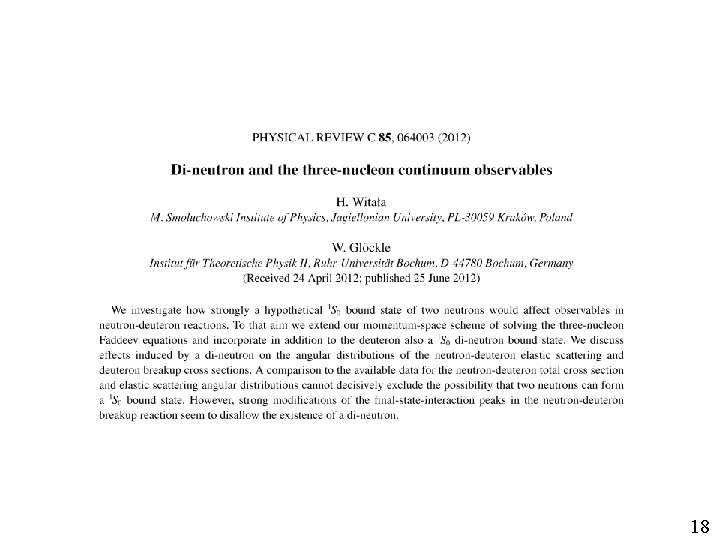
18
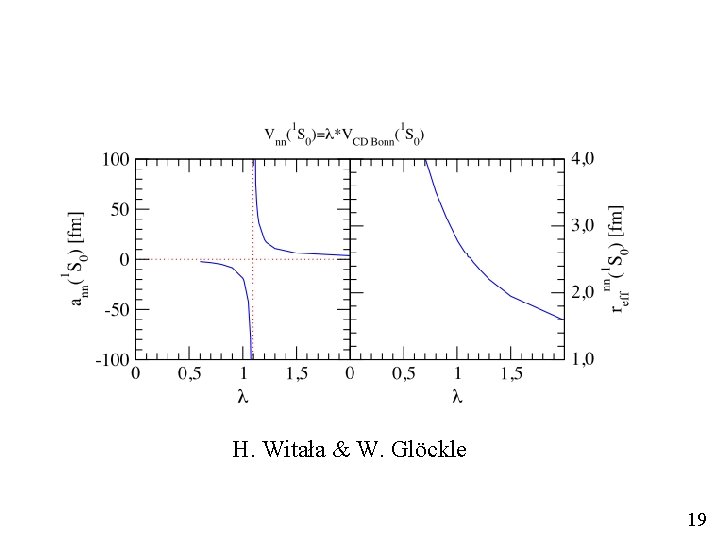
H. Witała & W. Glöckle 19
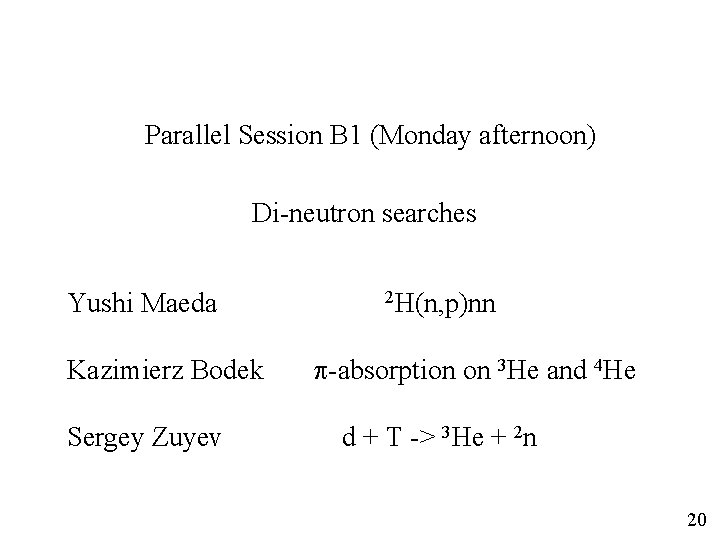
Parallel Session B 1 (Monday afternoon) Di-neutron searches Yushi Maeda Kazimierz Bodek Sergey Zuyev 2 H(n, p)nn p-absorption on 3 He and 4 He d + T -> 3 He + 2 n 20
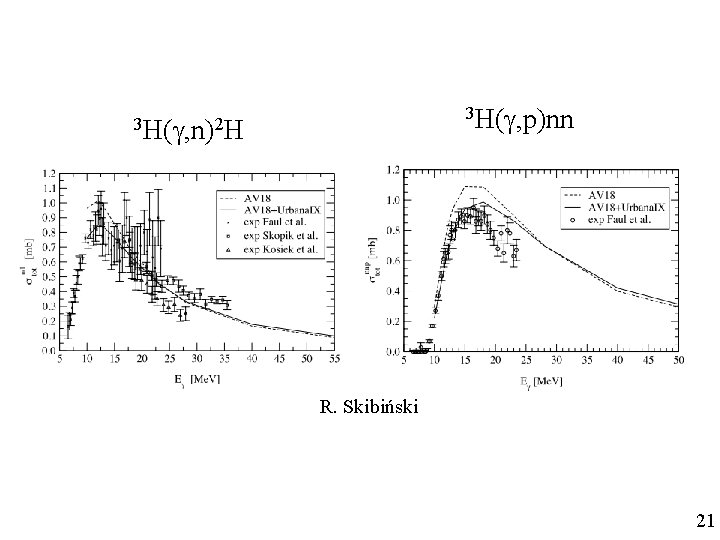
3 H(g, p)nn 3 H(g, n)2 H R. Skibiński 21
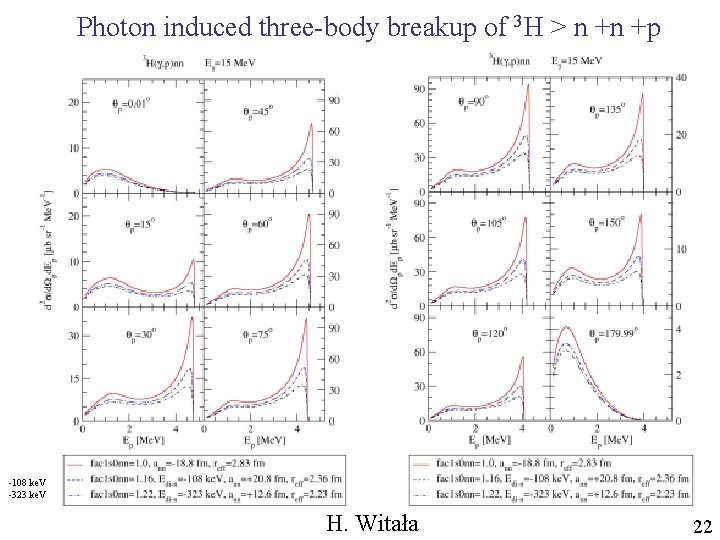
Photon induced three-body breakup of 3 H > n +n +p -108 ke. V -323 ke. V H. Witała 22
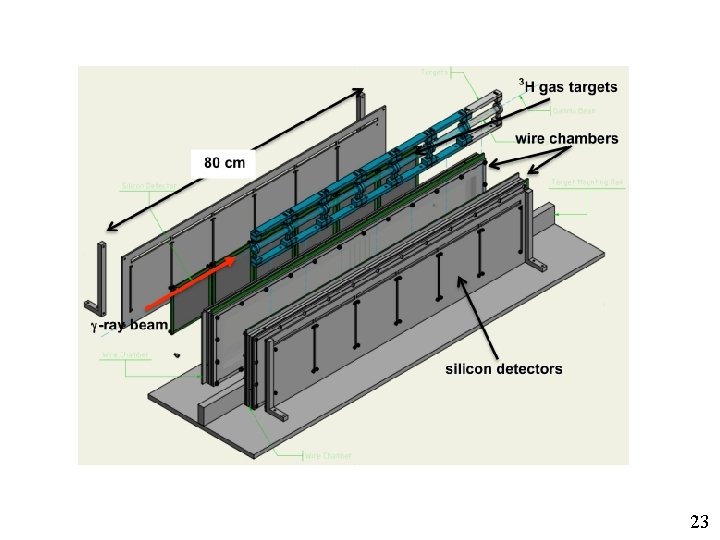
23
A=4 N – 3 He Analyzing Power Ay(q) at low energies 24
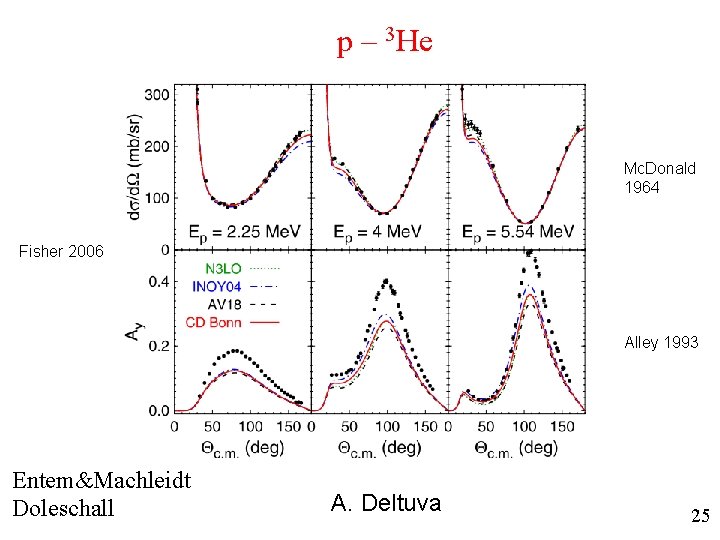
p – 3 He Mc. Donald 1964 Fisher 2006 Alley 1993 Entem&Machleidt Doleschall A. Deltuva 25
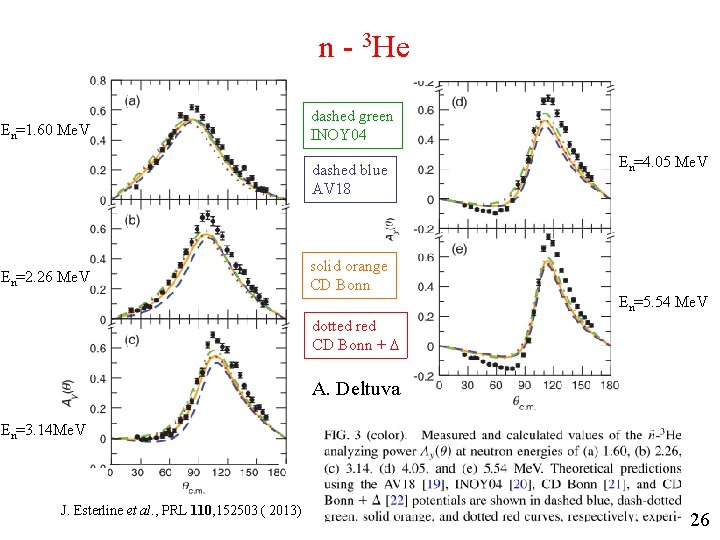
n - 3 He En=1. 60 Me. V dashed green INOY 04 dashed blue AV 18 En=2. 26 Me. V solid orange CD Bonn En=4. 05 Me. V En=5. 54 Me. V dotted red CD Bonn + A. Deltuva En=3. 14 Me. V J. Esterline et al. , PRL 110, 152503 ( 2013) 26
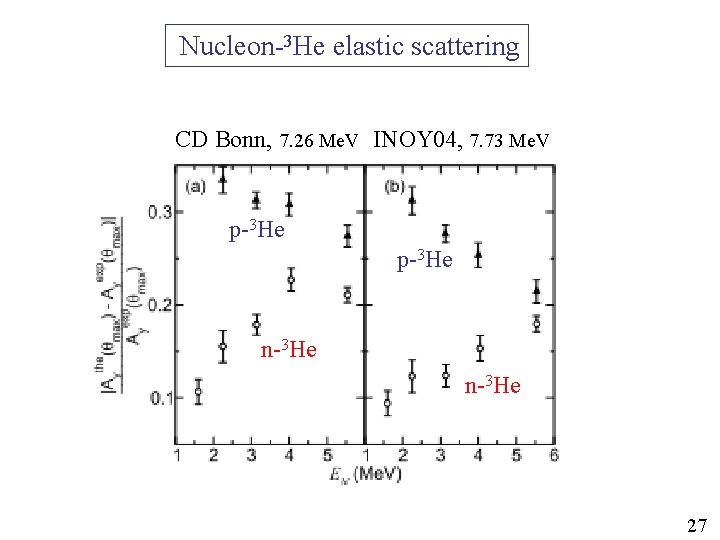
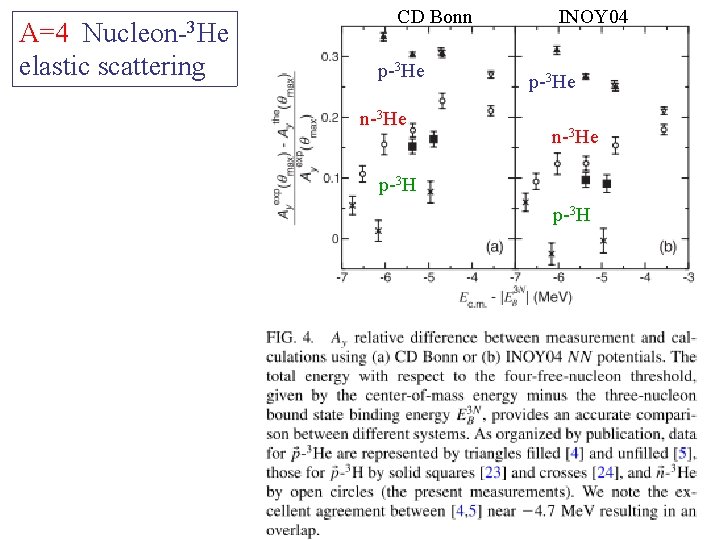
Nucleon-3 He elastic scattering CD Bonn, 7. 26 Me. V INOY 04, 7. 73 Me. V p-3 He n-3 He 27
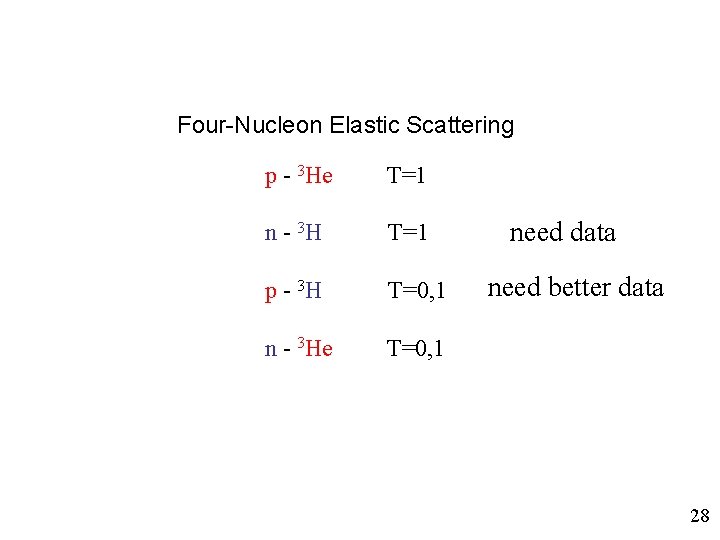
Four-Nucleon Elastic Scattering p - 3 He T=1 n - 3 H T=1 p - 3 H T=0, 1 n - 3 He T=0, 1 need data need better data 28
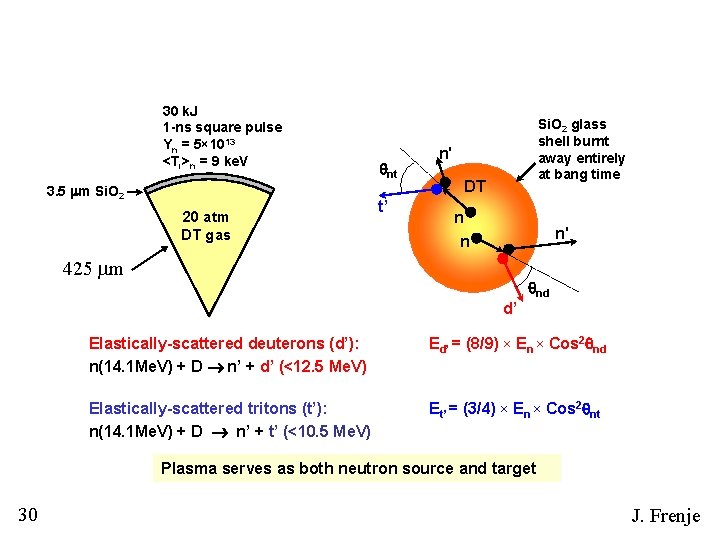
A=4 n -3 H elastic s(q) at 14. 1 Me. V from Inertial Confinement Fusion (ICF) OMEGA @ University of Rochester 29
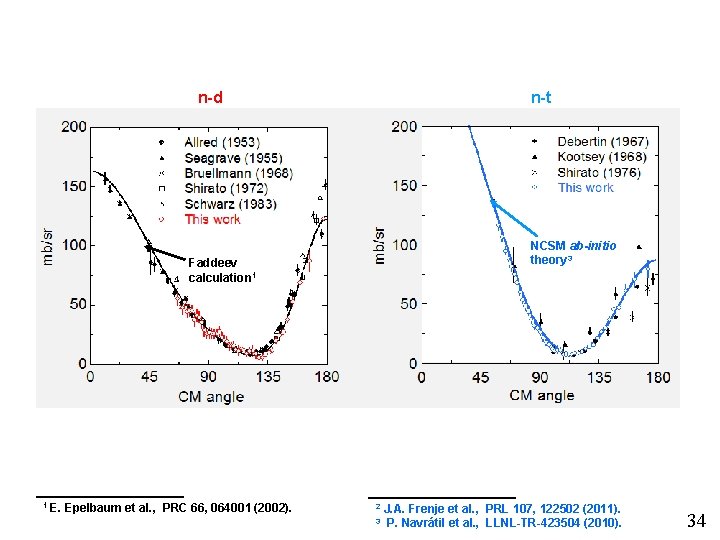
30 k. J 1 -ns square pulse Yn = 5× 10¹³ <Ti>n = 9 ke. V 3. 5 mm Si. O 2 20 atm DT gas qnt t’ Si. O 2 glass shell burnt away entirely at bang time n' DT n n n' 425 mm d’ qnd Elastically-scattered deuterons (d’): n(14. 1 Me. V) + D ® n’ + d’ (<12. 5 Me. V) Ed’ = (8/9) × En × Cos 2 qnd Elastically-scattered tritons (t’): n(14. 1 Me. V) + D ® n’ + t’ (<10. 5 Me. V) Et’ = (3/4) × En × Cos 2 qnt Plasma serves as both neutron source and target 30 J. Frenje
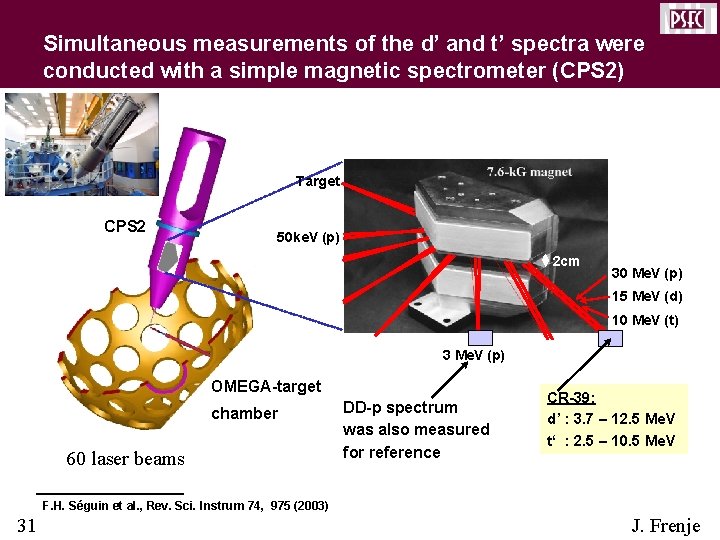
Simultaneous measurements of the d’ and t’ spectra were conducted with a simple magnetic spectrometer (CPS 2) Target CPS 2 50 ke. V (p) 2 cm 30 Me. V (p) 15 Me. V (d) 10 Me. V (t) 3 Me. V (p) OMEGA-target chamber 60 laser beams DD-p spectrum was also measured for reference CR-39: d’ : 3. 7 – 12. 5 Me. V t‘ : 2. 5 – 10. 5 Me. V F. H. Séguin et al. , Rev. Sci. Instrum 74, 975 (2003) 31 J. Frenje
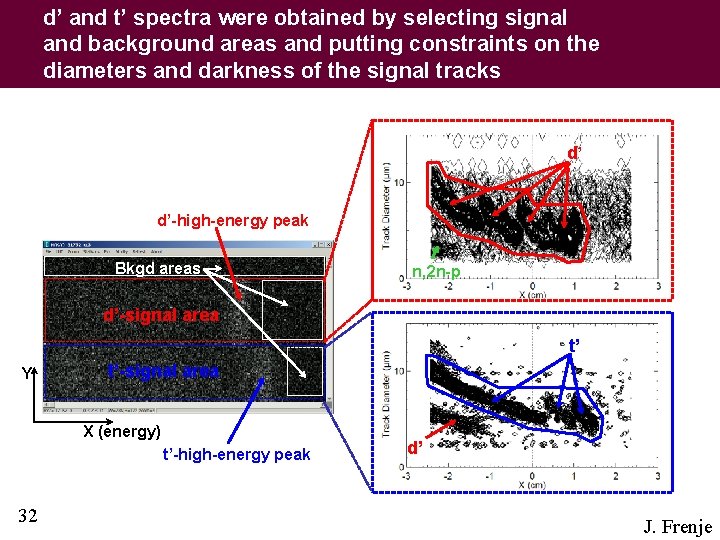
d’ and t’ spectra were obtained by selecting signal and background areas and putting constraints on the diameters and darkness of the signal tracks d’ d’-high-energy peak Bkgd areas n, 2 n-p d’-signal area t’ Y t’-signal area X (energy) t’-high-energy peak 32 d’ J. Frenje
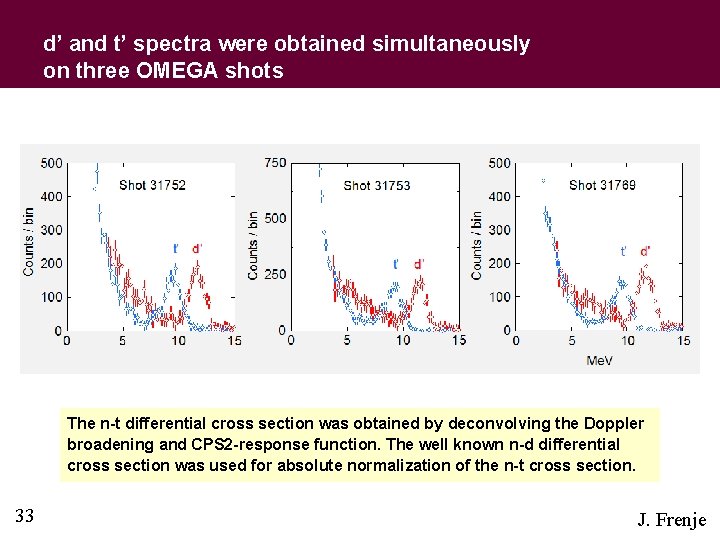
d’ and t’ spectra were obtained simultaneously on three OMEGA shots The n-t differential cross section was obtained by deconvolving the Doppler broadening and CPS 2 -response function. The well known n-d differential cross section was used for absolute normalization of the n-t cross section. 33 J. Frenje
n-d n-t NCSM ab-initio theory 3 Faddeev calculation 1 1 E. Epelbaum et al. , PRC 66, 064001 (2002). 2 3 J. A. Frenje et al. , PRL 107, 122502 (2011). P. Navrátil et al. , LLNL-TR-423504 (2010). 34
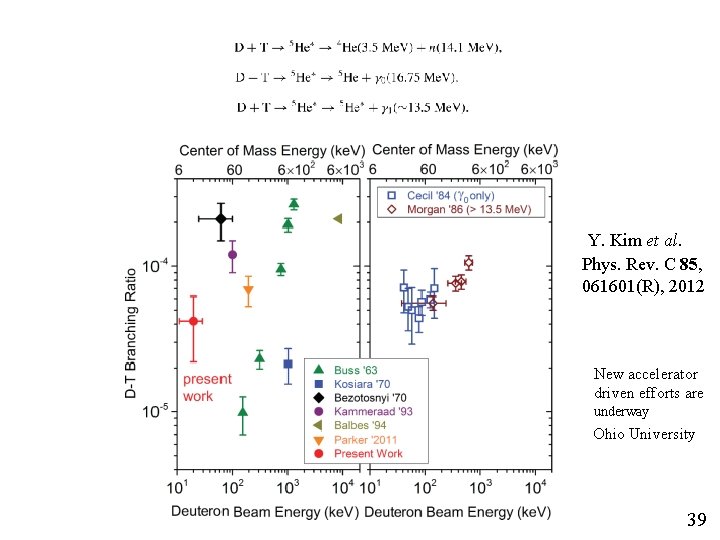
A=5 3 H(d, g)5 He/3 H(d, n)4 He gamma-to-neutron branching ratio from Inertial Confinement Fusion (ICF) National Ignition Facility (NIF) Lawrence Livermore National Laboratory 35
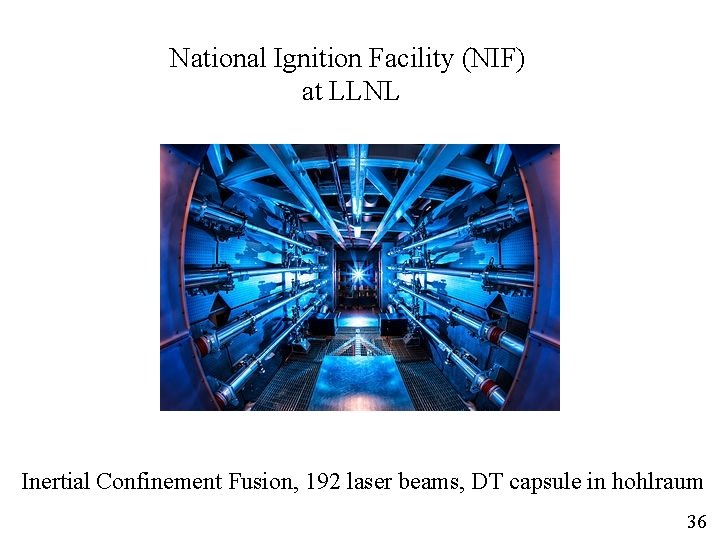
National Ignition Facility (NIF) at LLNL Inertial Confinement Fusion, 192 laser beams, DT capsule in hohlraum 36
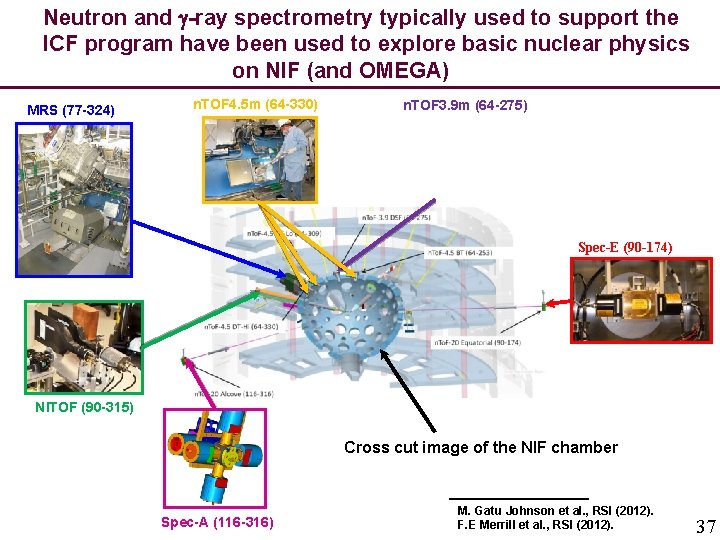
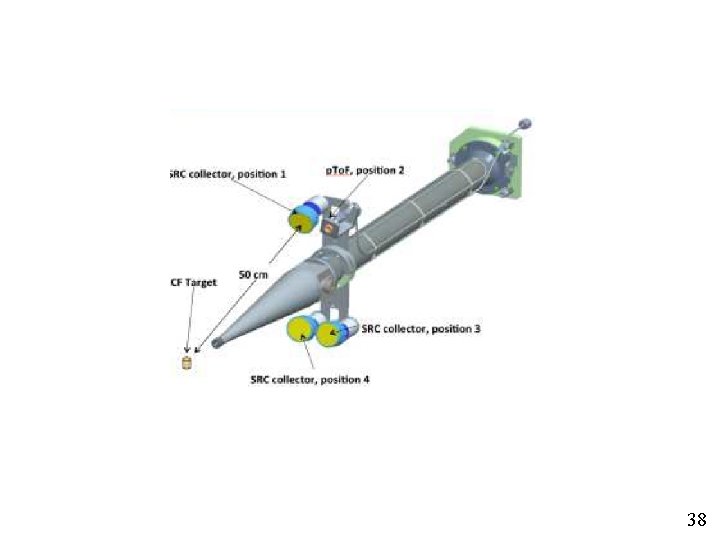
Neutron and g-ray spectrometry typically used to support the ICF program have been used to explore basic nuclear physics on NIF (and OMEGA) MRS (77 -324) n. TOF 4. 5 m (64 -330) n. TOF 3. 9 m (64 -275) Spec-E (90 -174) NITOF (90 -315) Cross cut image of the NIF chamber Spec-A (116 -316) M. Gatu Johnson et al. , RSI (2012). F. E Merrill et al. , RSI (2012). 37
38
Y. Kim et al. Phys. Rev. C 85, 061601(R), 2012 New accelerator driven efforts are underway Ohio University 39
A=6 T + T neutron spectrum from OMEGA and NIF 40
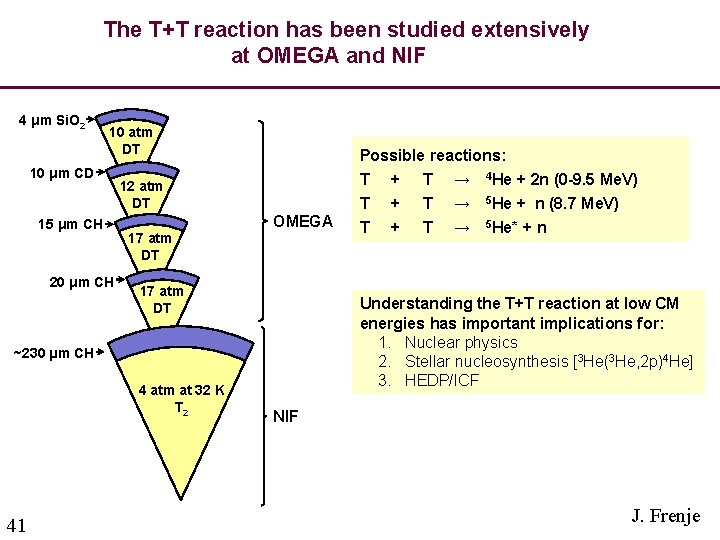
The T+T reaction has been studied extensively at OMEGA and NIF 4 μm Si. O 2 10 atm DT 10 μm CD 15 μm CH 20 μm CH Possible reactions: 12 atm DT OMEGA 17 atm DT 41 + T → 4 He T T + + T T → → 5 He + 2 n (0 -9. 5 Me. V) + n (8. 7 Me. V) 5 He* + n Understanding the T+T reaction at low CM energies has important implications for: 1. Nuclear physics 2. Stellar nucleosynthesis [3 He(3 He, 2 p)4 He] 3. HEDP/ICF ~230 µm CH 4 atm at 32 K T 2 T NIF J. Frenje
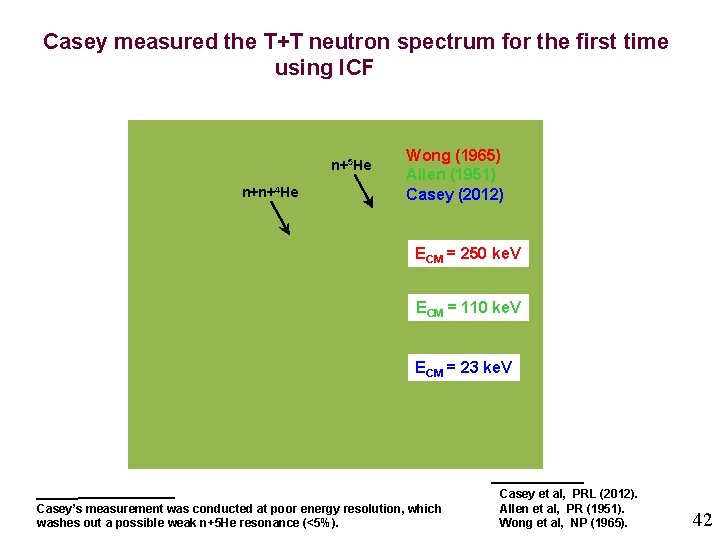
Casey measured the T+T neutron spectrum for the first time using ICF n+5 He n+n+4 He Wong (1965) Allen (1951) Casey (2012) ECM = 250 ke. V ECM = 110 ke. V ECM = 23 ke. V Casey’s measurement was conducted at poor energy resolution, which washes out a possible weak n+5 He resonance (<5%). Casey et al, PRL (2012). Allen et al, PR (1951). Wong et al, NP (1965). 42
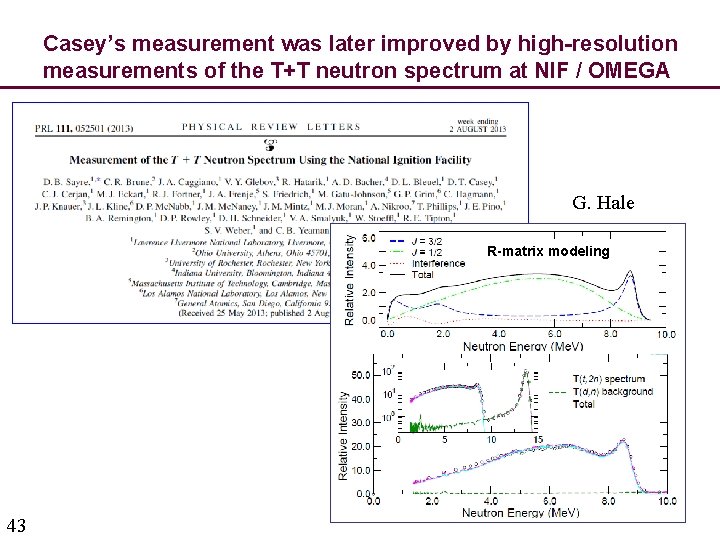
Casey’s measurement was later improved by high-resolution measurements of the T+T neutron spectrum at NIF / OMEGA G. Hale R-matrix modeling 43
A=12 Nuclear Astrophysics The 2 nd 2+ state in 12 C 44
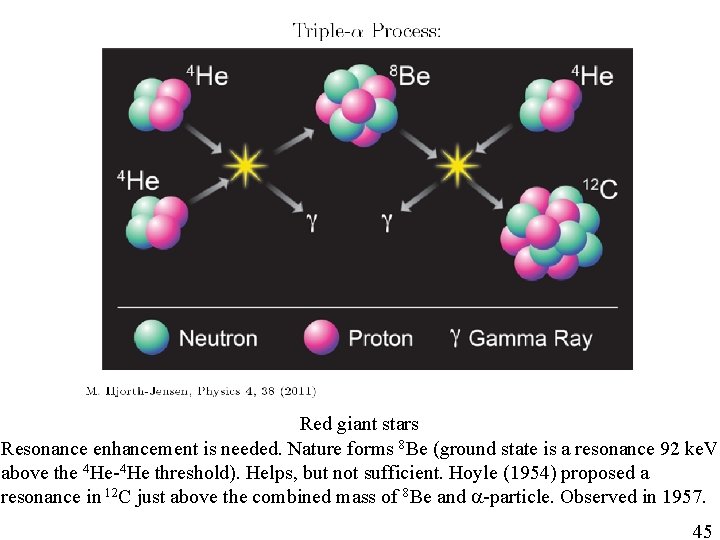
Red giant stars Resonance enhancement is needed. Nature forms 8 Be (ground state is a resonance 92 ke. V above the 4 He-4 He threshold). Helps, but not sufficient. Hoyle (1954) proposed a resonance in 12 C just above the combined mass of 8 Be and a-particle. Observed in 1957. 45
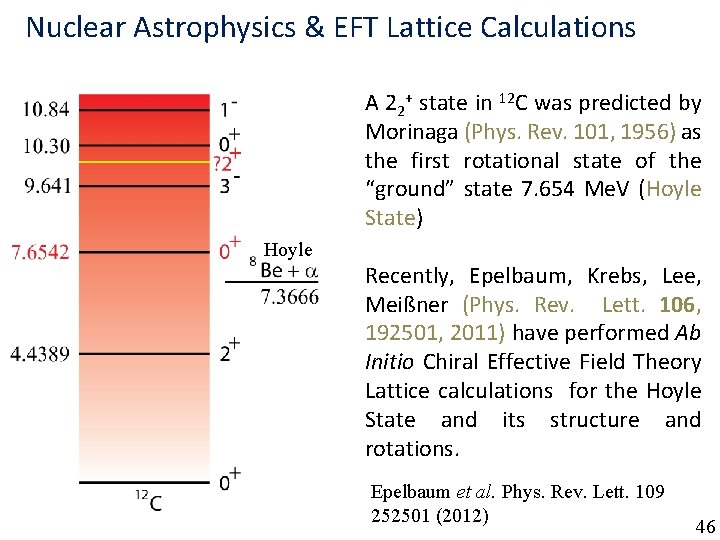
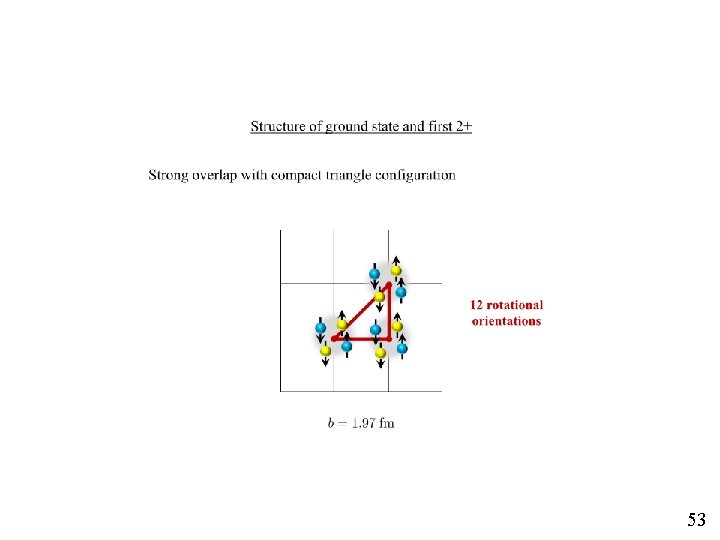
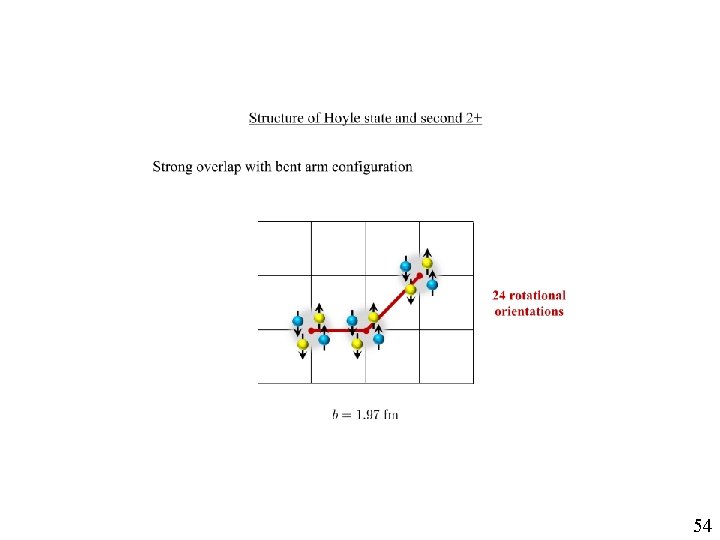
Nuclear Astrophysics & EFT Lattice Calculations A 22+ state in 12 C was predicted by Morinaga (Phys. Rev. 101, 1956) as the first rotational state of the “ground” state 7. 654 Me. V (Hoyle State) Hoyle Recently, Epelbaum, Krebs, Lee, Meißner (Phys. Rev. Lett. 106, 192501, 2011) have performed Ab Initio Chiral Effective Field Theory Lattice calculations for the Hoyle State and its structure and rotations. Epelbaum et al. Phys. Rev. Lett. 109 252501 (2012) 46
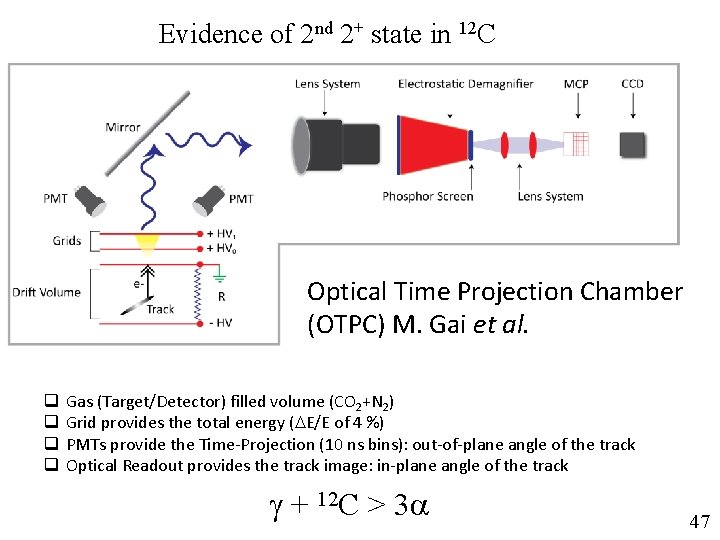
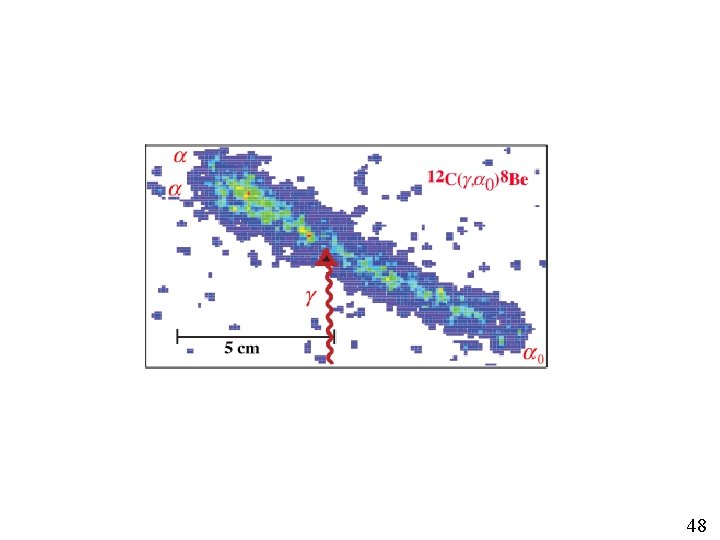
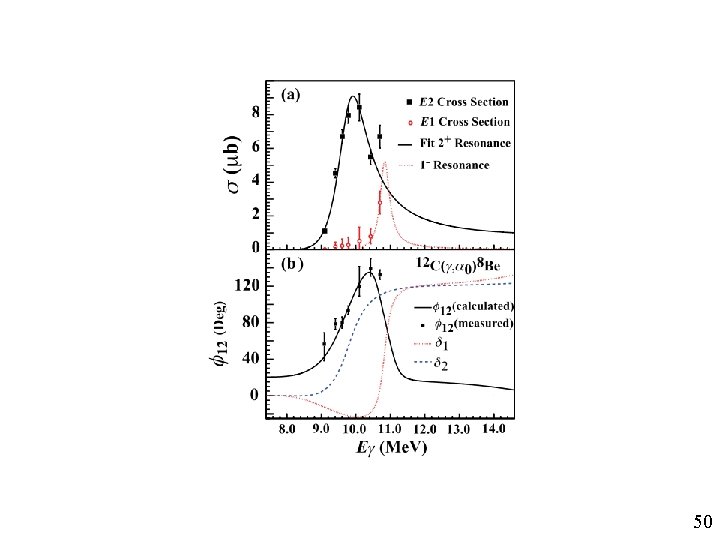
Evidence of 2 nd 2+ state in 12 C Optical Time Projection Chamber (OTPC) M. Gai et al. q q Gas (Target/Detector) filled volume (CO 2+N 2) Grid provides the total energy ( E/E of 4 %) PMTs provide the Time-Projection (10 ns bins): out-of-plane angle of the track Optical Readout provides the track image: in-plane angle of the track g + 12 C > 3 a 47
48
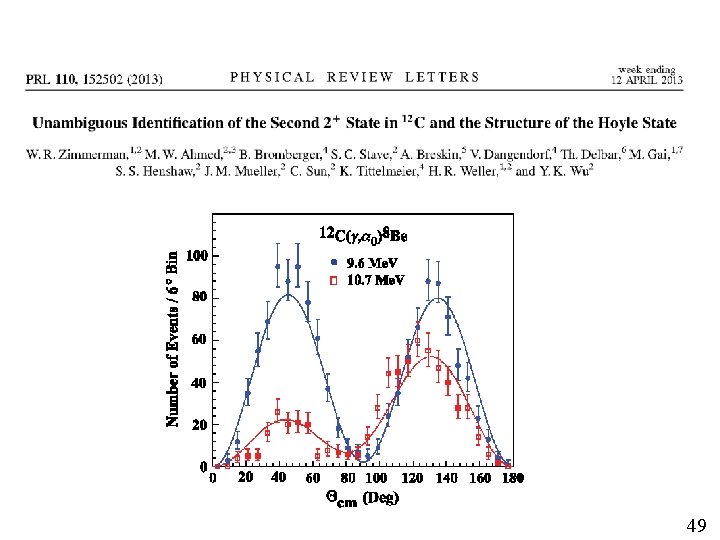
49
50
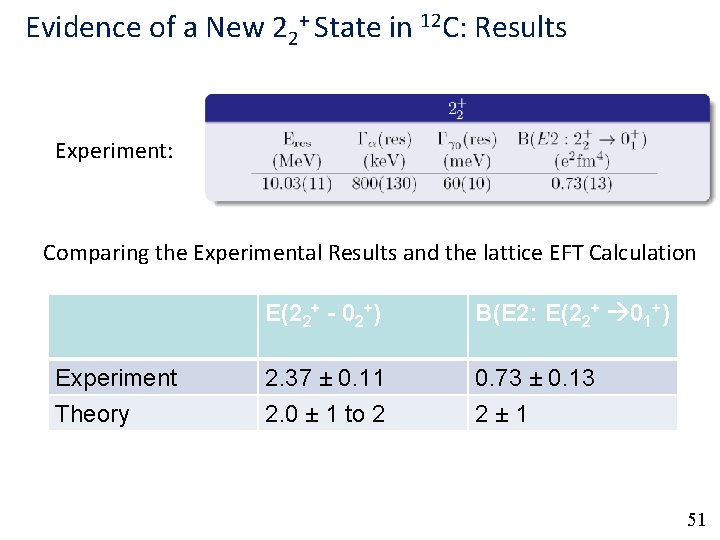
Evidence of a New 22+ State in 12 C: Results Experiment: Comparing the Experimental Results and the lattice EFT Calculation Experiment Theory E(22+ - 02+) B(E 2: E(22+ 01+) 2. 37 ± 0. 11 2. 0 ± 1 to 2 0. 73 ± 0. 13 2 ± 1 51
53
54
Nuclear Astrophysics Impact of the 22+ State o Helium burning occurs at a temperature of 108– 109 K, and is completely governed by the Hoyle state; o However, during type II supernovae, g-ray bursts and other astrophysical phenomena, the temperature rises well above 109 K, and higher energy states in 12 C can have a significant effect on the triple-a reaction rate; o Preliminary calculations suggest a dependence of high mass number (>140) abundances on the triple alpha reaction rate based on the parameters of the 22+ state. 55
Outlook What’s next at TUNL ? 56
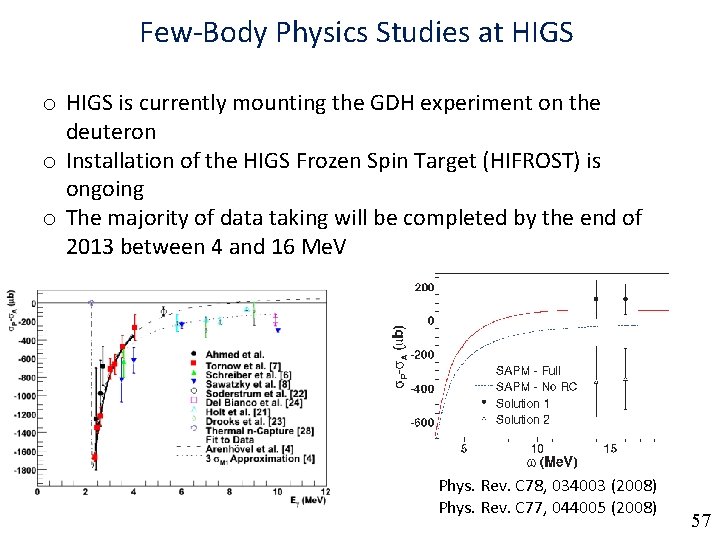
Few-Body Physics Studies at HIGS o HIGS is currently mounting the GDH experiment on the deuteron o Installation of the HIGS Frozen Spin Target (HIFROST) is ongoing o The majority of data taking will be completed by the end of 2013 between 4 and 16 Me. V Phys. Rev. C 78, 034003 (2008) Phys. Rev. C 77, 044005 (2008) 57
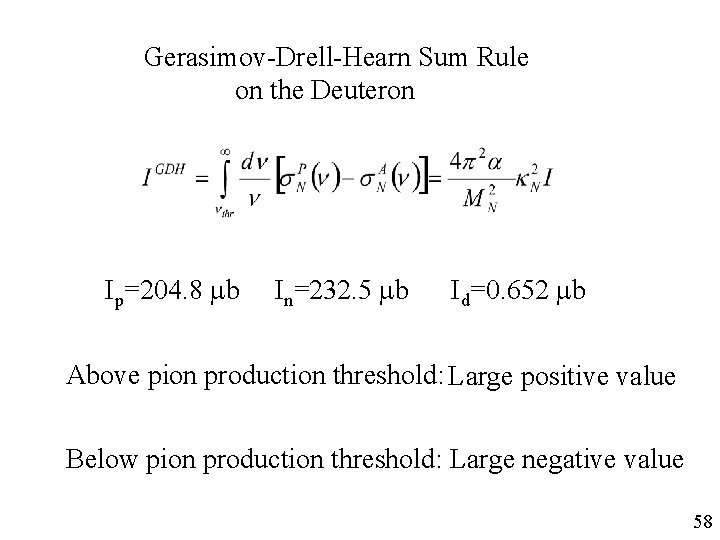
Gerasimov-Drell-Hearn Sum Rule on the Deuteron Ip=204. 8 mb In=232. 5 mb Id=0. 652 mb Above pion production threshold: Large positive value Below pion production threshold: Large negative value 58
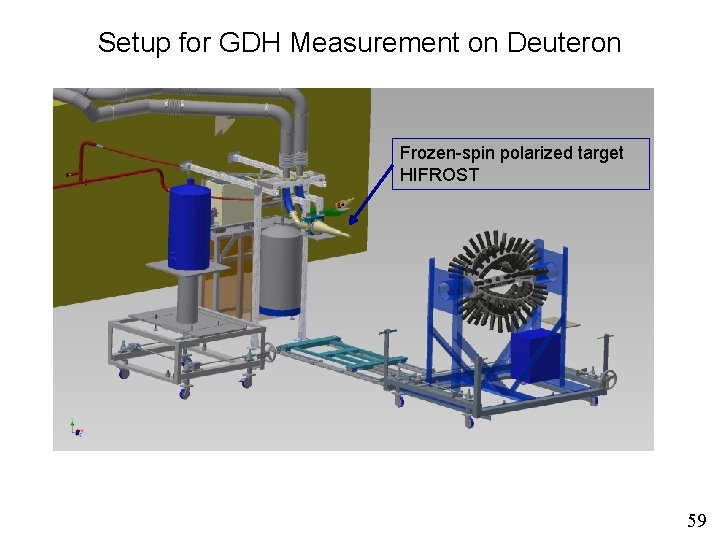
Setup for GDH Measurement on Deuteron Frozen-spin polarized target HIFROST 59
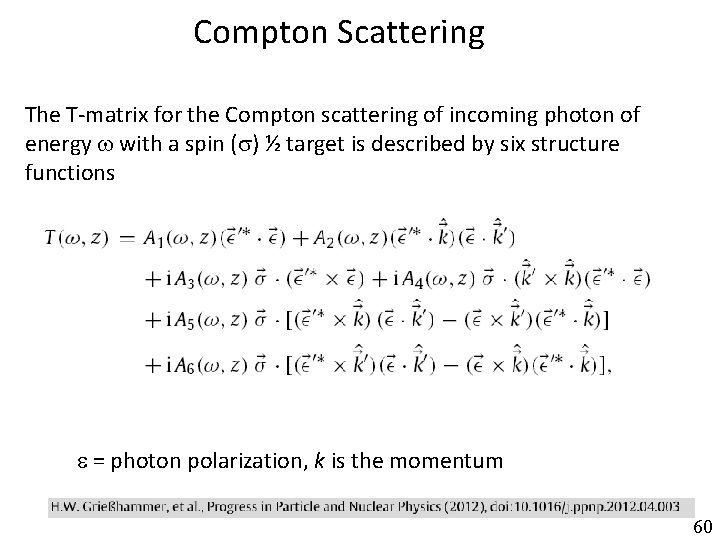
Compton Scattering The T-matrix for the Compton scattering of incoming photon of energy w with a spin (s) ½ target is described by six structure functions e = photon polarization, k is the momentum 60
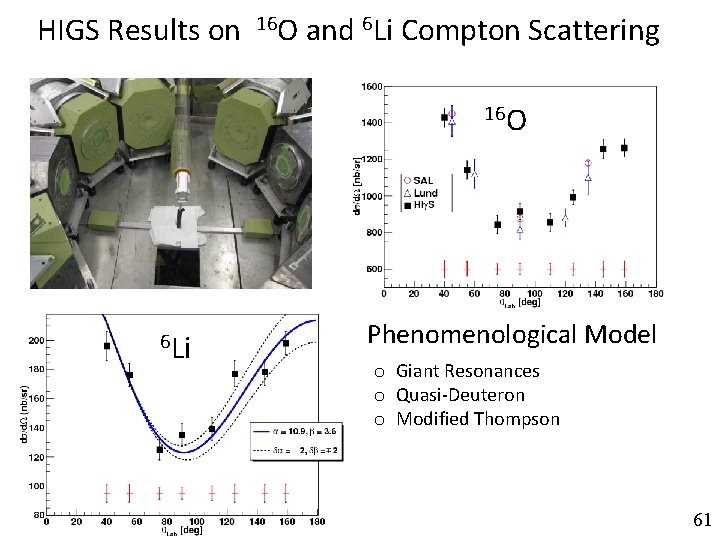
HIGS Results on 16 O and 6 Li Compton Scattering 16 O 6 Li Phenomenological Model o Giant Resonances o Quasi-Deuteron o Modified Thompson 61
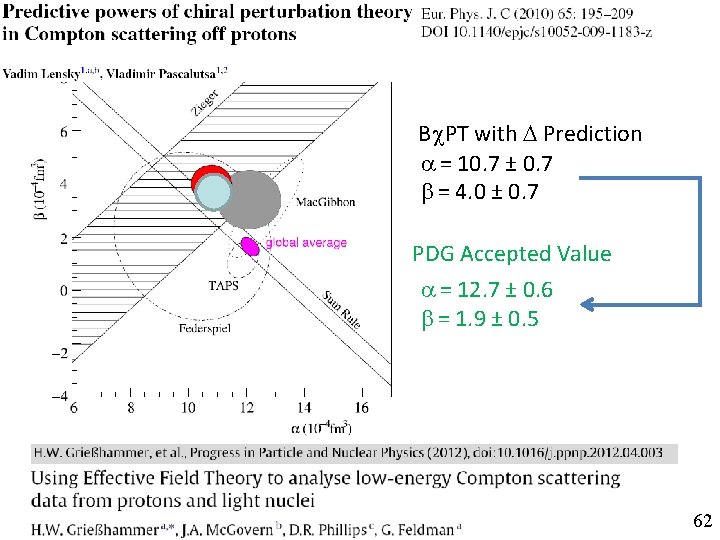
Bc. PT with Prediction a = 10. 7 ± 0. 7 b = 4. 0 ± 0. 7 PDG Accepted Value a = 12. 7 ± 0. 6 b = 1. 9 ± 0. 5 62
What’s next elsewhere at low energies? ICF facilities may play a major role in experimental Few-Body Physics 63
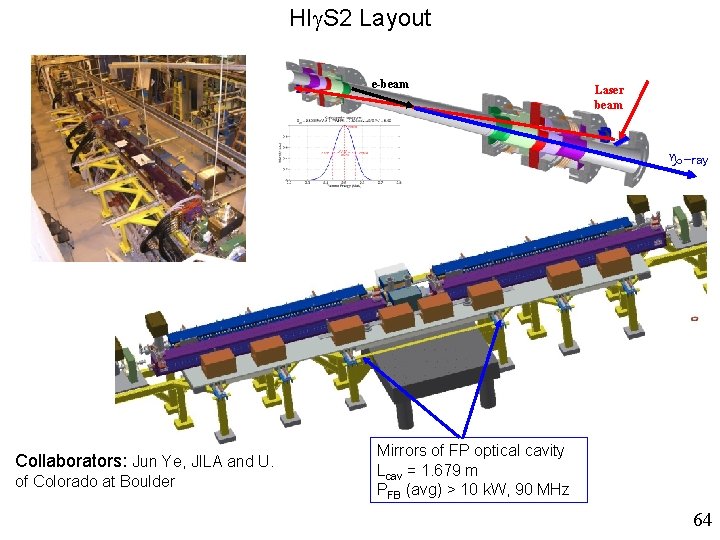
HIg. S 2 Layout e-beam Laser beam -ray Collaborators: Jun Ye, JILA and U. of Colorado at Boulder Mirrors of FP optical cavity Lcav = 1. 679 m PFB (avg) > 10 k. W, 90 MHz 64
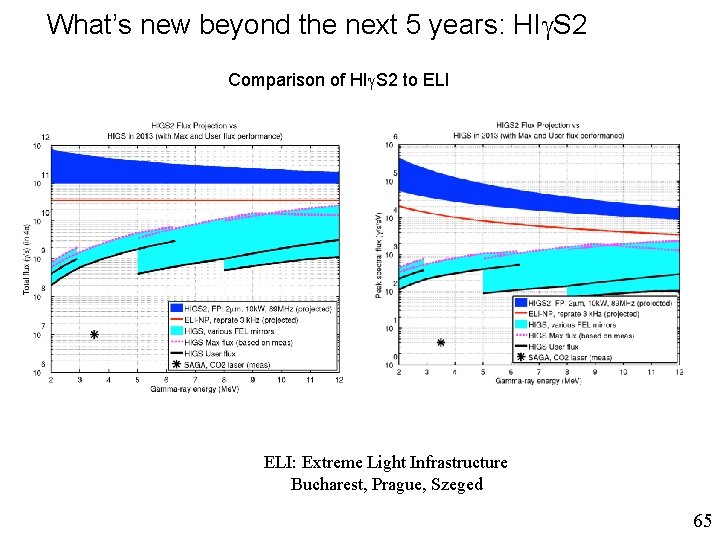
What’s new beyond the next 5 years: HIg. S 2 Comparison of HIg. S 2 to ELI: Extreme Light Infrastructure Bucharest, Prague, Szeged 65
Backup Slides
Nucleon-3 He A=4 elastic scattering CD Bonn p-3 He n-3 He INOY 04 p-3 He n-3 He p-3 H
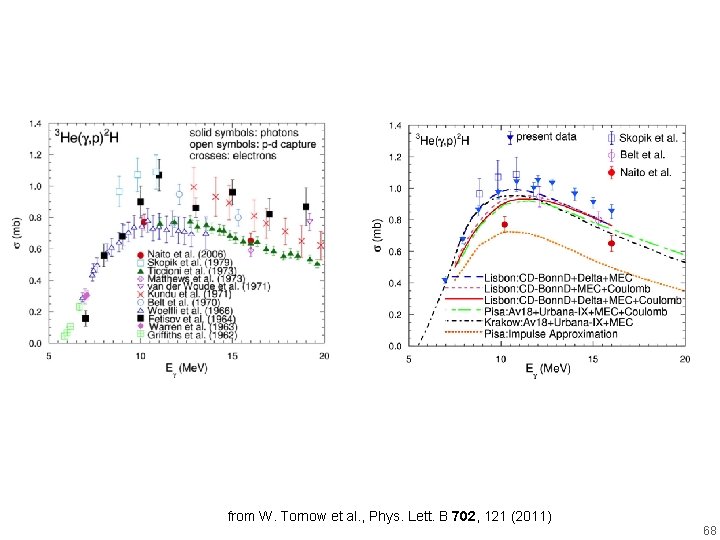
from W. Tornow et al. , Phys. Lett. B 702, 121 (2011) 68
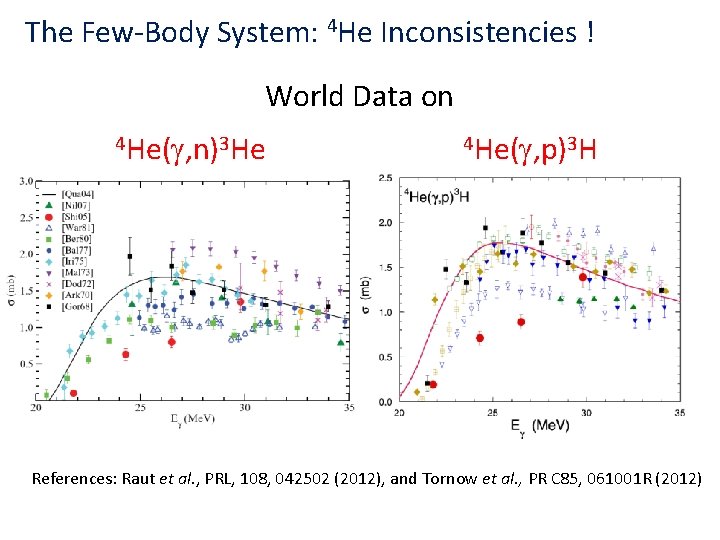
The Few-Body System: 4 He Inconsistencies ! World Data on 4 He(g, n)3 He 4 He(g, p)3 H References: Raut et al. , PRL, 108, 042502 (2012), and Tornow et al. , PR C 85, 061001 R (2012)
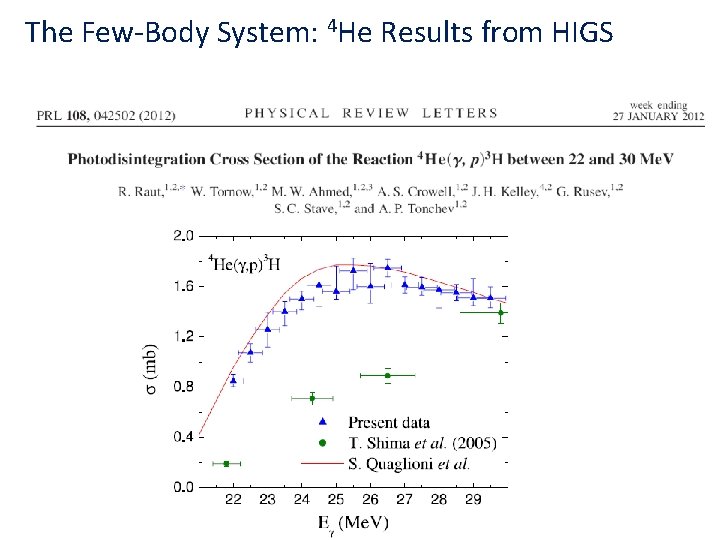
The Few-Body System: 4 He Results from HIGS
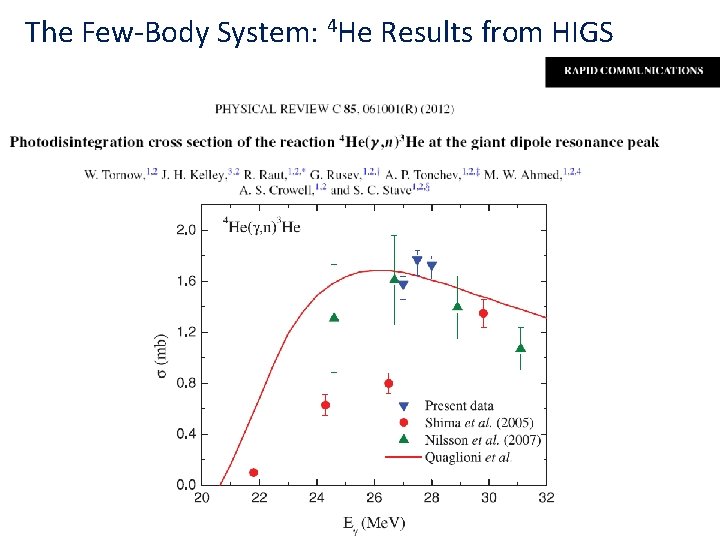
The Few-Body System: 4 He Results from HIGS