
Recent experience from modern synchrotron light sources S
- Slides: 35
Recent experience from modern synchrotron light sources S. M. Liuzzo
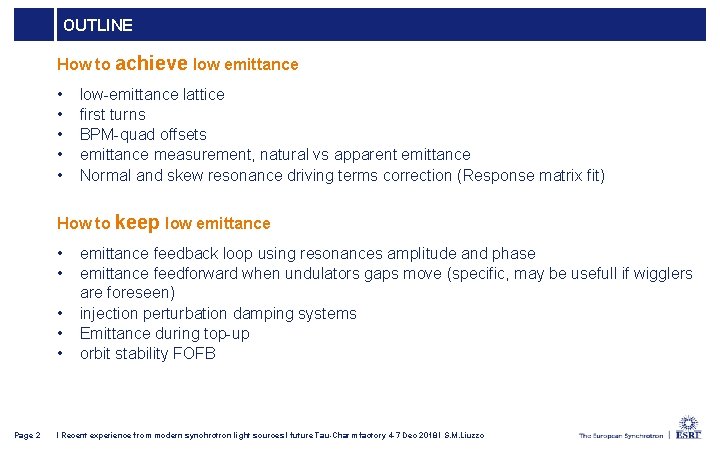
OUTLINE How to achieve low emittance • • • low-emittance lattice first turns BPM-quad offsets emittance measurement, natural vs apparent emittance Normal and skew resonance driving terms correction (Response matrix fit) How to keep low emittance • • • Page 2 emittance feedback loop using resonances amplitude and phase emittance feedforward when undulators gaps move (specific, may be usefull if wigglers are foreseen) injection perturbation damping systems Emittance during top-up orbit stability FOFB l Recent experience from modern synchrotron light sources l future Tau-Charm factory 4 -7 Dec 2018 l S. M. Liuzzo
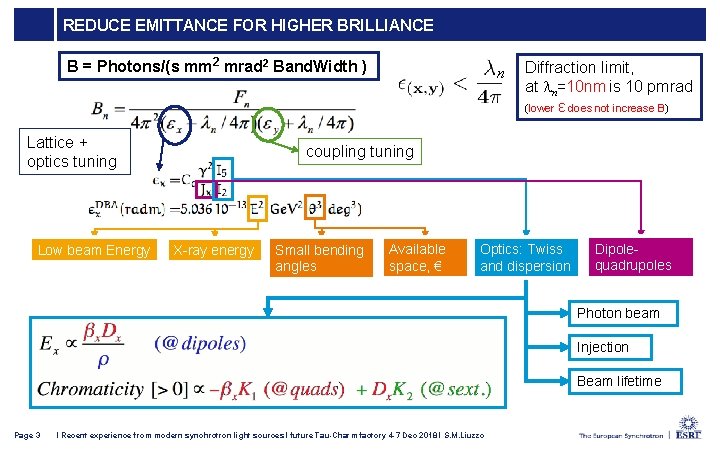
REDUCE EMITTANCE FOR HIGHER BRILLIANCE B = Photons/(s mm 2 mrad 2 Band. Width ) Lattice + optics tuning Low beam Energy n Diffraction limit, at ln=10 nm is 10 pmrad (lower ε does not increase B) coupling tuning X-ray energy Small bending angles Available space, € Optics: Twiss and dispersion Dipolequadrupoles Photon beam Injection Beam lifetime Page 3 l Recent experience from modern synchrotron light sources l future Tau-Charm factory 4 -7 Dec 2018 l S. M. Liuzzo
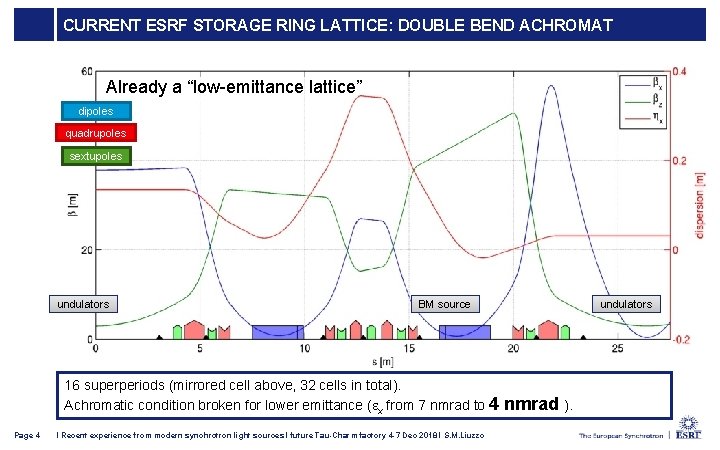
CURRENT ESRF STORAGE RING LATTICE: DOUBLE BEND ACHROMAT Already a “low-emittance lattice” dipoles quadrupoles sextupoles undulators BM source 16 superperiods (mirrored cell above, 32 cells in total). Achromatic condition broken for lower emittance (ex from 7 nmrad to 4 Page 4 l Recent experience from modern synchrotron light sources l future Tau-Charm factory 4 -7 Dec 2018 l S. M. Liuzzo undulators nmrad ).
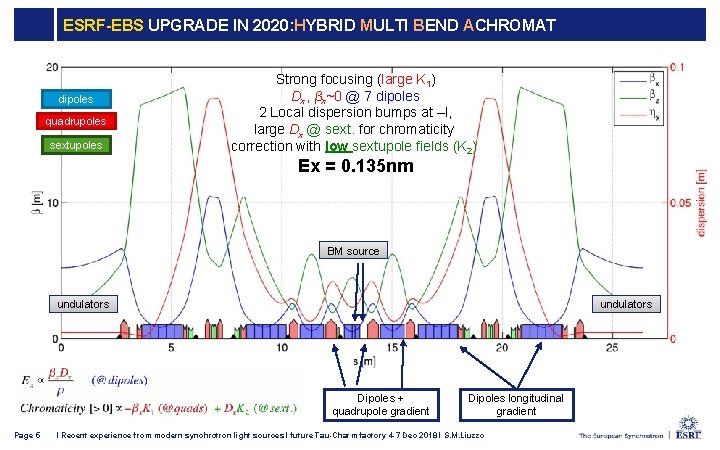
ESRF-EBS UPGRADE IN 2020: HYBRID MULTI BEND ACHROMAT dipoles quadrupoles sextupoles Strong focusing (large K 1) Dx, βx~0 @ 7 dipoles 2 Local dispersion bumps at –I, large Dx @ sext. for chromaticity correction with low sextupole fields (K 2) Ex = 0. 135 nm BM source undulators Dipoles + quadrupole gradient Page 5 Dipoles longitudinal gradient l Recent experience from modern synchrotron light sources l future Tau-Charm factory 4 -7 Dec 2018 l S. M. Liuzzo
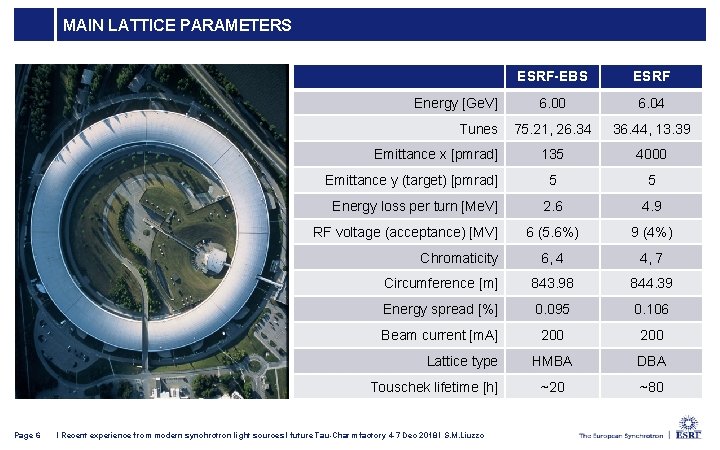
MAIN LATTICE PARAMETERS ESRF-EBS ESRF 6. 00 6. 04 75. 21, 26. 34 36. 44, 13. 39 135 4000 Emittance y (target) [pmrad] 5 5 Energy loss per turn [Me. V] 2. 6 4. 9 6 (5. 6%) 9 (4%) 6, 4 4, 7 Circumference [m] 843. 98 844. 39 Energy spread [%] 0. 095 0. 106 Beam current [m. A] 200 HMBA DBA ~20 ~80 Energy [Ge. V] S 28 Tunes Emittance x [pmrad] RF voltage (acceptance) [MV] Chromaticity S 28 A Lattice type Touschek lifetime [h] Page 6 l Recent experience from modern synchrotron light sources l future Tau-Charm factory 4 -7 Dec 2018 l S. M. Liuzzo
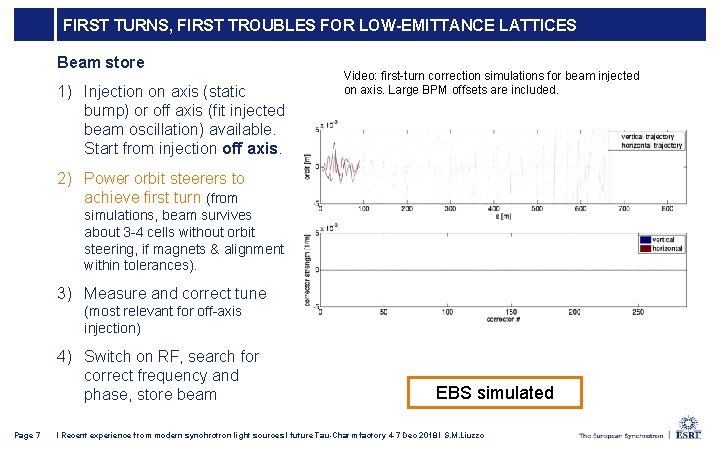
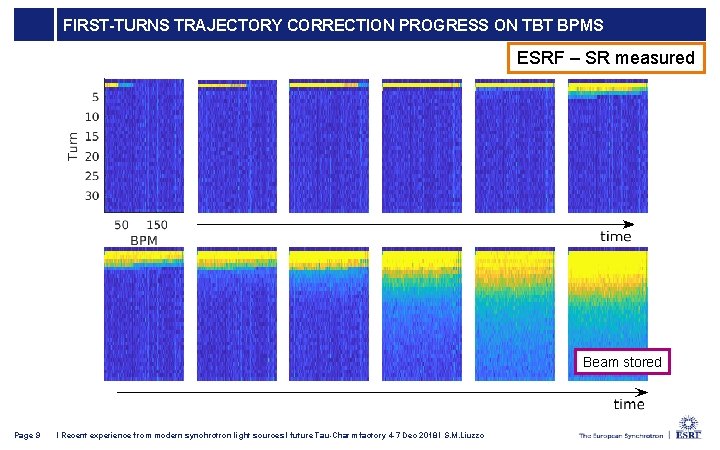
FIRST TURNS, FIRST TROUBLES FOR LOW-EMITTANCE LATTICES Beam store 1) Injection on axis (static bump) or off axis (fit injected beam oscillation) available. Start from injection off axis. Video: first-turn correction simulations for beam injected on axis. Large BPM offsets are included. 2) Power orbit steerers to achieve first turn (from simulations, beam survives about 3 -4 cells without orbit steering, if magnets & alignment within tolerances). 3) Measure and correct tune (most relevant for off-axis injection) 4) Switch on RF, search for correct frequency and phase, store beam Page 7 EBS simulated l Recent experience from modern synchrotron light sources l future Tau-Charm factory 4 -7 Dec 2018 l S. M. Liuzzo
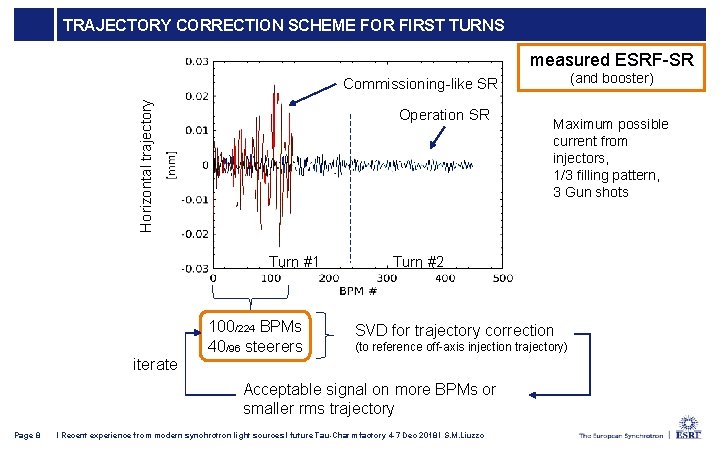
TRAJECTORY CORRECTION SCHEME FOR FIRST TURNS measured ESRF-SR (and booster) Horizontal trajectory Commissioning-like SR Operation SR Turn #1 100/224 BPMs 40/96 steerers Turn #2 SVD for trajectory correction (to reference off-axis injection trajectory) iterate Acceptable signal on more BPMs or smaller rms trajectory Page 8 Maximum possible current from injectors, 1/3 filling pattern, 3 Gun shots l Recent experience from modern synchrotron light sources l future Tau-Charm factory 4 -7 Dec 2018 l S. M. Liuzzo
FIRST-TURNS TRAJECTORY CORRECTION PROGRESS ON TBT BPMS ESRF – SR measured Beam stored Page 9 l Recent experience from modern synchrotron light sources l future Tau-Charm factory 4 -7 Dec 2018 l S. M. Liuzzo
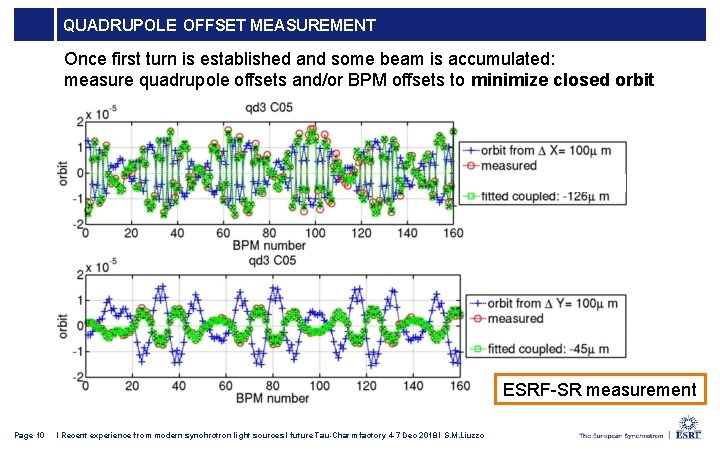
QUADRUPOLE OFFSET MEASUREMENT Once first turn is established and some beam is accumulated: measure quadrupole offsets and/or BPM offsets to minimize closed orbit ESRF-SR measurement Page 10 l Recent experience from modern synchrotron light sources l future Tau-Charm factory 4 -7 Dec 2018 l S. M. Liuzzo
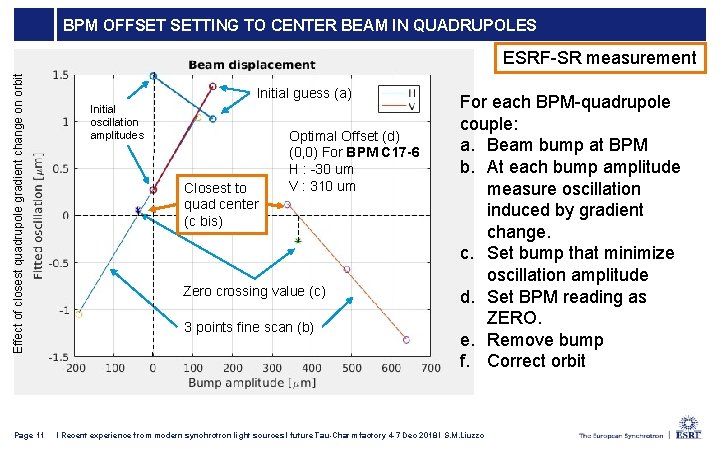
BPM OFFSET SETTING TO CENTER BEAM IN QUADRUPOLES Effect of closest quadrupole gradient change on orbit ESRF-SR measurement Page 11 Initial guess (a) Initial oscillation amplitudes Closest to quad center (c bis) Optimal Offset (d) (0, 0) For BPM C 17 -6 H : -30 um V : 310 um Zero crossing value (c) 3 points fine scan (b) For each BPM-quadrupole couple: a. Beam bump at BPM b. At each bump amplitude measure oscillation induced by gradient change. c. Set bump that minimize oscillation amplitude d. Set BPM reading as ZERO. e. Remove bump f. Correct orbit l Recent experience from modern synchrotron light sources l future Tau-Charm factory 4 -7 Dec 2018 l S. M. Liuzzo
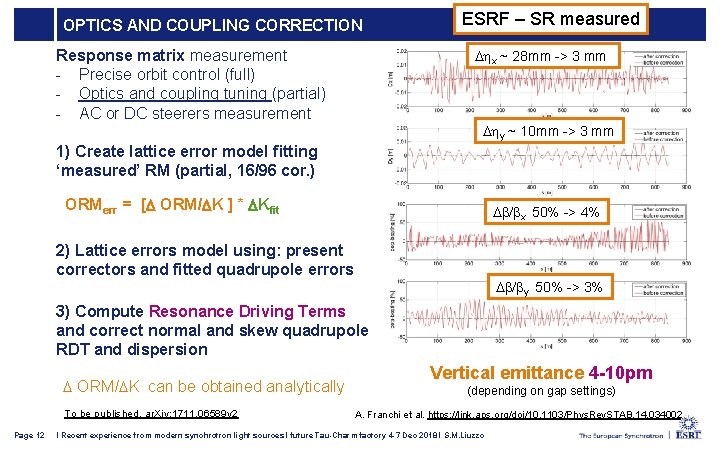
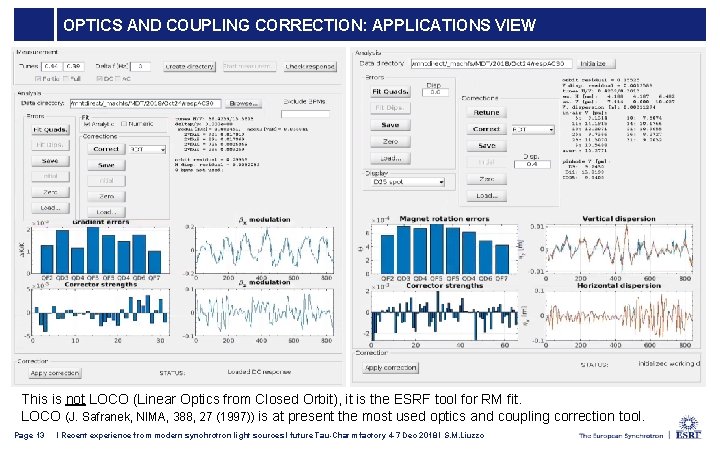
OPTICS AND COUPLING CORRECTION ESRF – SR measured hx ~ 28 mm -> 3 mm Response matrix measurement - Precise orbit control (full) - Optics and coupling tuning (partial) - AC or DC steerers measurement hy ~ 10 mm -> 3 mm 1) Create lattice error model fitting ‘measured’ RM (partial, 16/96 cor. ) ORMerr = [ ORM/ K ] * Kfit b/bx 50% -> 4% 2) Lattice errors model using: present correctors and fitted quadrupole errors b/by 50% -> 3% 3) Compute Resonance Driving Terms and correct normal and skew quadrupole RDT and dispersion ORM/ K can be obtained analytically To be published, ar. Xiv: 1711. 06589 v 2 Page 12 Vertical emittance 4 -10 pm (depending on gap settings) A. Franchi et al. https: //link. aps. org/doi/10. 1103/Phys. Rev. STAB. 14. 034002 l Recent experience from modern synchrotron light sources l future Tau-Charm factory 4 -7 Dec 2018 l S. M. Liuzzo
OPTICS AND COUPLING CORRECTION: APPLICATIONS VIEW This is not LOCO (Linear Optics from Closed Orbit), it is the ESRF tool for RM fit. LOCO (J. Safranek, NIMA, 388, 27 (1997)) is at present the most used optics and coupling correction tool. Page 13 l Recent experience from modern synchrotron light sources l future Tau-Charm factory 4 -7 Dec 2018 l S. M. Liuzzo
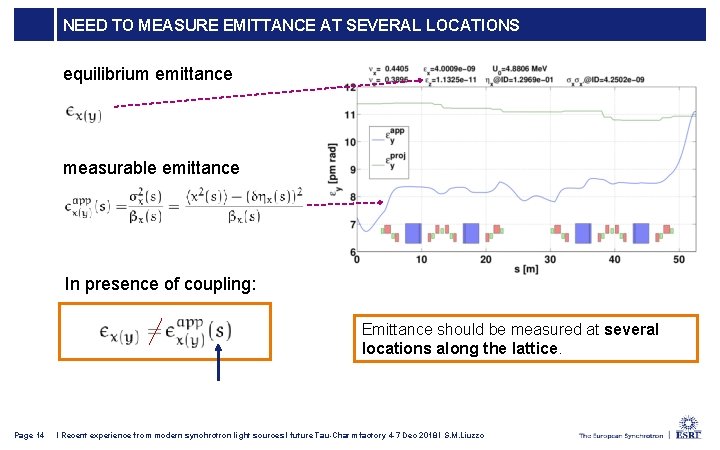
NEED TO MEASURE EMITTANCE AT SEVERAL LOCATIONS equilibrium emittance measurable emittance In presence of coupling: Emittance should be measured at several locations along the lattice. Page 14 l Recent experience from modern synchrotron light sources l future Tau-Charm factory 4 -7 Dec 2018 l S. M. Liuzzo
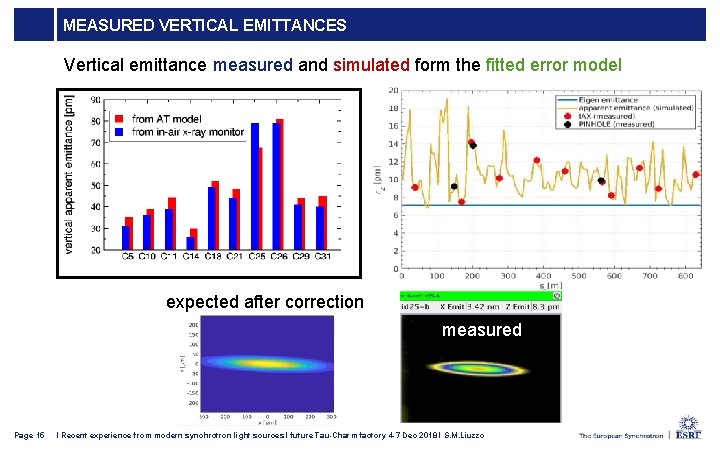
MEASURED VERTICAL EMITTANCES Vertical emittance measured and simulated form the fitted error model expected after correction measured Page 15 l Recent experience from modern synchrotron light sources l future Tau-Charm factory 4 -7 Dec 2018 l S. M. Liuzzo
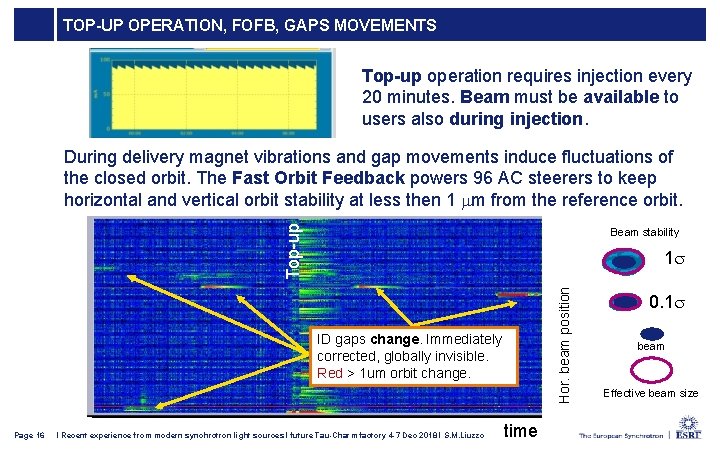
TOP-UP OPERATION, FOFB, GAPS MOVEMENTS Top-up operation requires injection every 20 minutes. Beam must be available to users also during injection. Top-up During delivery magnet vibrations and gap movements induce fluctuations of the closed orbit. The Fast Orbit Feedback powers 96 AC steerers to keep horizontal and vertical orbit stability at less then 1 mm from the reference orbit. Beam stability Hor. beam position 1 s ID gaps change. Immediately corrected, globally invisible. Red > 1 um orbit change. Page 16 l Recent experience from modern synchrotron light sources l future Tau-Charm factory 4 -7 Dec 2018 l S. M. Liuzzo time 0. 1 s beam Effective beam size
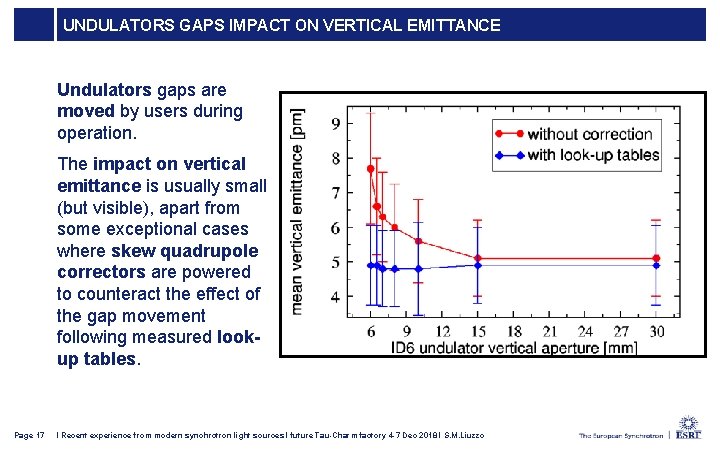
UNDULATORS GAPS IMPACT ON VERTICAL EMITTANCE Undulators gaps are moved by users during operation. The impact on vertical emittance is usually small (but visible), apart from some exceptional cases where skew quadrupole correctors are powered to counteract the effect of the gap movement following measured lookup tables. Page 17 l Recent experience from modern synchrotron light sources l future Tau-Charm factory 4 -7 Dec 2018 l S. M. Liuzzo
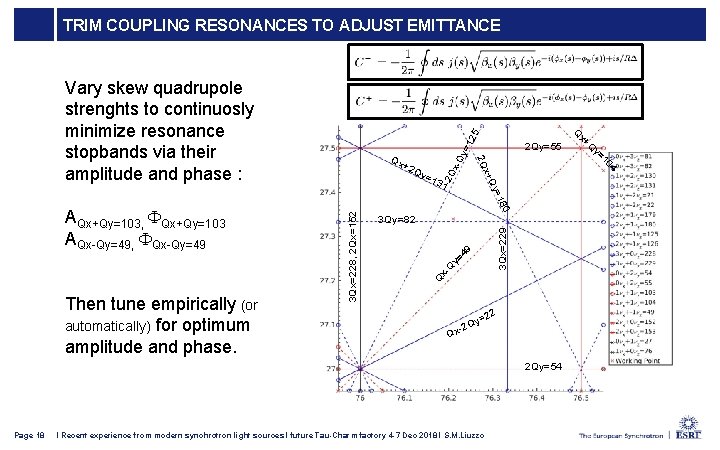
TRIM COUPLING RESONANCES TO ADJUST EMITTANCE 12 x-Q y= 2 Q =1 31 80 Q x- Q y= 49 3 Qx=229 3 Qy=82 2 y=2 Q x-2 Q 2 Qy=54 Page 18 l Recent experience from modern synchrotron light sources l future Tau-Charm factory 4 -7 Dec 2018 l S. M. Liuzzo x+ Q y= 10 4 y=1 3 Qx=228, 2 Qx=152 Qy x+Q Then tune empirically (or automatically) for optimum amplitude and phase. Qx +2 2 Qy=55 2 Q AQx+Qy=103, FQx+Qy=103 AQx-Qy=49, FQx-Qy=49 Q 5 Vary skew quadrupole strenghts to continuosly minimize resonance stopbands via their amplitude and phase :
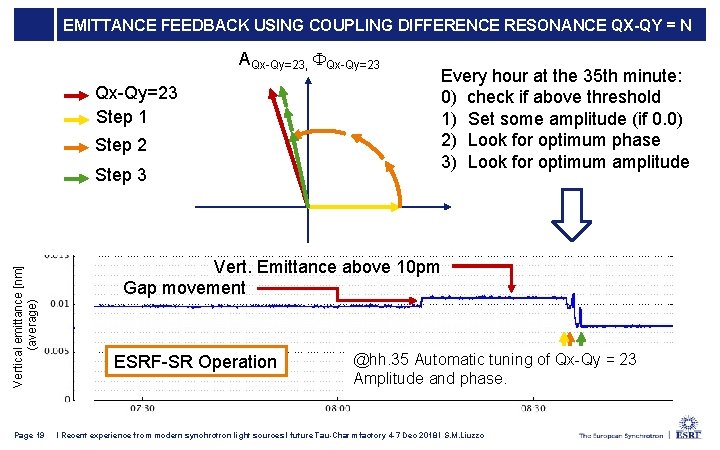
EMITTANCE FEEDBACK USING COUPLING DIFFERENCE RESONANCE QX-QY = N AQx-Qy=23, FQx-Qy=23 Step 1 Step 2 Vertical emittance [nm] (average) Step 3 Page 19 Every hour at the 35 th minute: 0) check if above threshold 1) Set some amplitude (if 0. 0) 2) Look for optimum phase 3) Look for optimum amplitude Vert. Emittance above 10 pm Gap movement ESRF-SR Operation @hh. 35 Automatic tuning of Qx-Qy = 23 Amplitude and phase. l Recent experience from modern synchrotron light sources l future Tau-Charm factory 4 -7 Dec 2018 l S. M. Liuzzo
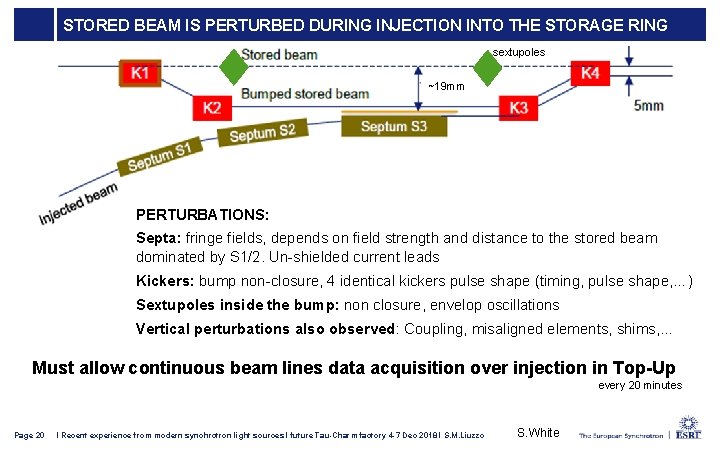
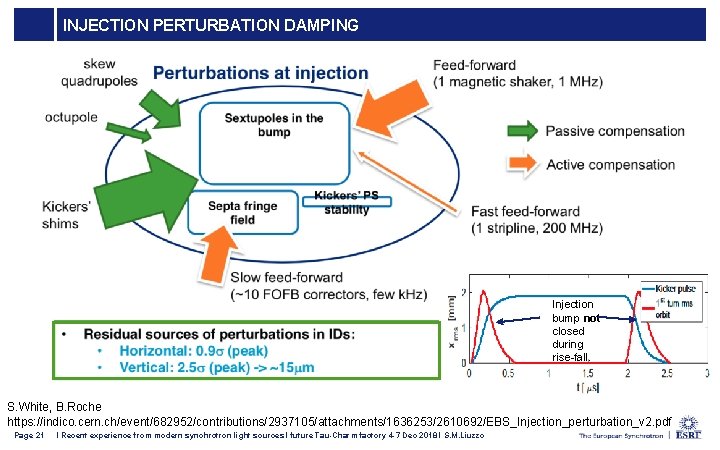
STORED BEAM IS PERTURBED DURING INJECTION INTO THE STORAGE RING sextupoles ~19 mm PERTURBATIONS: Septa: fringe fields, depends on field strength and distance to the stored beam dominated by S 1/2. Un-shielded current leads Kickers: bump non-closure, 4 identical kickers pulse shape (timing, pulse shape, …) Sextupoles inside the bump: non closure, envelop oscillations Vertical perturbations also observed: Coupling, misaligned elements, shims, . . . Must allow continuous beam lines data acquisition over injection in Top-Up every 20 minutes Page 20 l Recent experience from modern synchrotron light sources l future Tau-Charm factory 4 -7 Dec 2018 l S. M. Liuzzo S. White
INJECTION PERTURBATION DAMPING Injection bump not closed during rise-fall. S. White, B. Roche https: //indico. cern. ch/event/682952/contributions/2937105/attachments/1636253/2610692/EBS_Injection_perturbation_v 2. pdf Page 21 l Recent experience from modern synchrotron light sources l future Tau-Charm factory 4 -7 Dec 2018 l S. M. Liuzzo
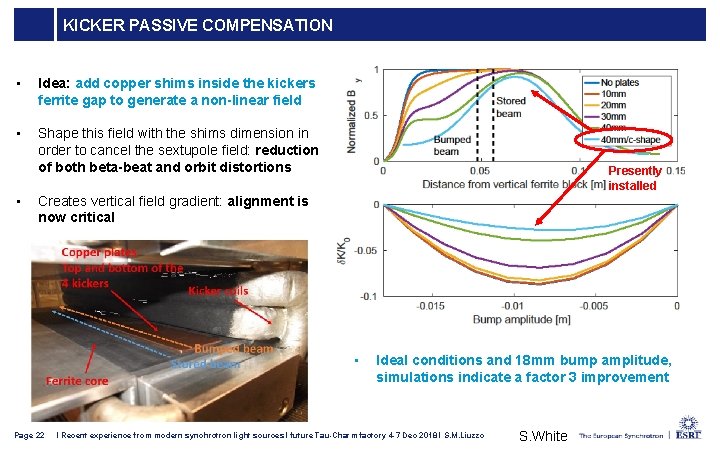
KICKER PASSIVE COMPENSATION • Idea: add copper shims inside the kickers ferrite gap to generate a non-linear field • Shape this field with the shims dimension in order to cancel the sextupole field: reduction of both beta-beat and orbit distortions • Presently installed Creates vertical field gradient: alignment is now critical • Page 22 Ideal conditions and 18 mm bump amplitude, simulations indicate a factor 3 improvement l Recent experience from modern synchrotron light sources l future Tau-Charm factory 4 -7 Dec 2018 l S. M. Liuzzo S. White
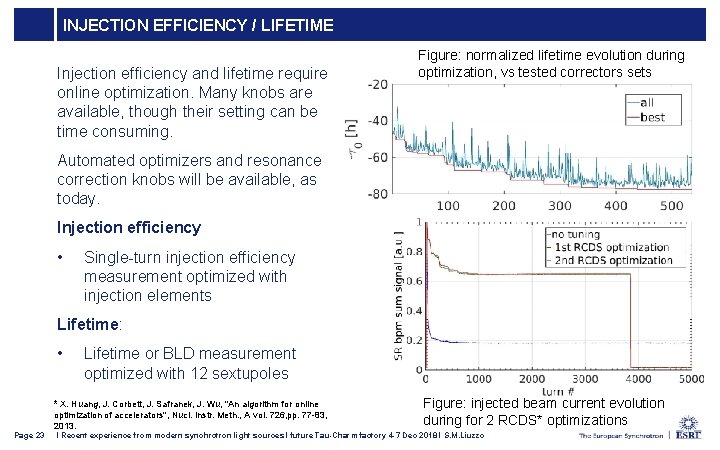
INJECTION EFFICIENCY / LIFETIME Injection efficiency and lifetime require online optimization. Many knobs are available, though their setting can be time consuming. Figure: normalized lifetime evolution during optimization, vs tested correctors sets Automated optimizers and resonance correction knobs will be available, as today. Injection efficiency • Single-turn injection efficiency measurement optimized with injection elements Lifetime: • Lifetime or BLD measurement optimized with 12 sextupoles * X. Huang, J. Corbett, J. Safranek, J. Wu, "An algorithm for online Page 23 optimization of accelerators", Nucl. Instr. Meth. , A vol. 726, pp. 77 -83, 2013. Figure: injected beam current evolution during for 2 RCDS* optimizations l Recent experience from modern synchrotron light sources l future Tau-Charm factory 4 -7 Dec 2018 l S. M. Liuzzo
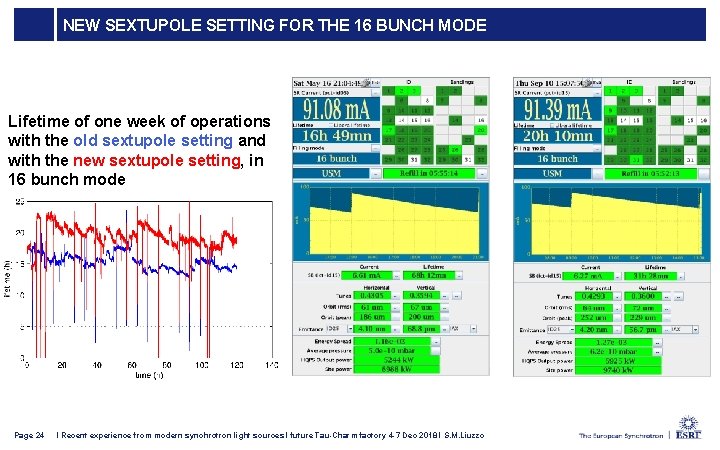
NEW SEXTUPOLE SETTING FOR THE 16 BUNCH MODE Lifetime of one week of operations with the old sextupole setting and with the new sextupole setting, in 16 bunch mode Page 24 l Recent experience from modern synchrotron light sources l future Tau-Charm factory 4 -7 Dec 2018 l S. M. Liuzzo
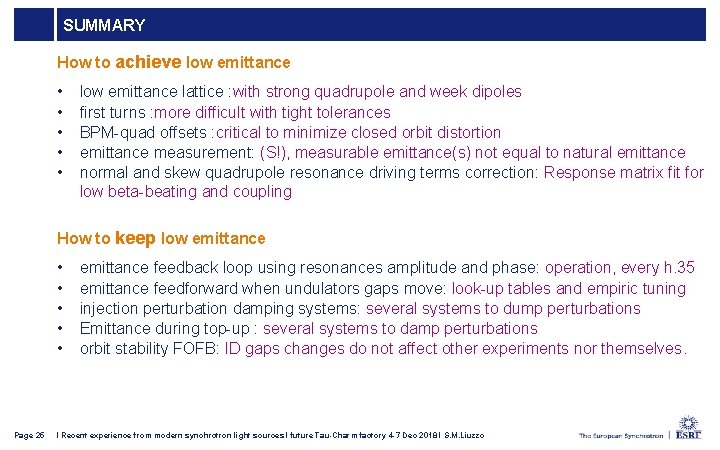
SUMMARY How to achieve low emittance • • • low emittance lattice : with strong quadrupole and week dipoles first turns : more difficult with tight tolerances BPM-quad offsets : critical to minimize closed orbit distortion emittance measurement: (S!), measurable emittance(s) not equal to natural emittance normal and skew quadrupole resonance driving terms correction: Response matrix fit for low beta-beating and coupling How to keep low emittance • • • Page 25 emittance feedback loop using resonances amplitude and phase: operation, every h. 35 emittance feedforward when undulators gaps move: look-up tables and empiric tuning injection perturbation damping systems: several systems to dump perturbations Emittance during top-up : several systems to damp perturbations orbit stability FOFB: ID gaps changes do not affect other experiments nor themselves. l Recent experience from modern synchrotron light sources l future Tau-Charm factory 4 -7 Dec 2018 l S. M. Liuzzo
BACKUP Page 26 l Recent experience from modern synchrotron light sources l future Tau-Charm factory 4 -7 Dec 2018 l S. M. Liuzzo
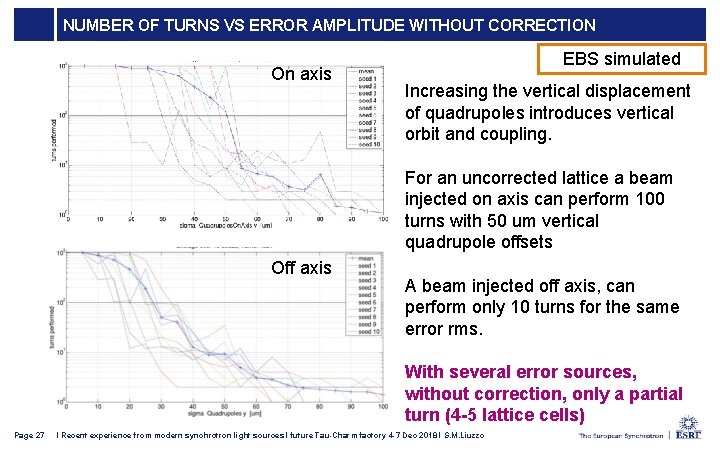
NUMBER OF TURNS VS ERROR AMPLITUDE WITHOUT CORRECTION On axis EBS simulated Increasing the vertical displacement of quadrupoles introduces vertical orbit and coupling. For an uncorrected lattice a beam injected on axis can perform 100 turns with 50 um vertical quadrupole offsets Off axis A beam injected off axis, can perform only 10 turns for the same error rms. With several error sources, without correction, only a partial turn (4 -5 lattice cells) Page 27 l Recent experience from modern synchrotron light sources l future Tau-Charm factory 4 -7 Dec 2018 l S. M. Liuzzo
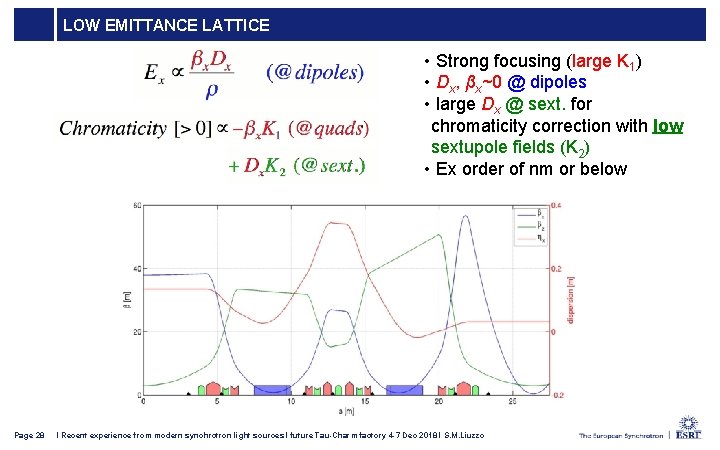
LOW EMITTANCE LATTICE • Strong focusing (large K 1) • Dx, βx~0 @ dipoles • large Dx @ sext. for chromaticity correction with low sextupole fields (K 2) • Ex order of nm or below Page 28 l Recent experience from modern synchrotron light sources l future Tau-Charm factory 4 -7 Dec 2018 l S. M. Liuzzo
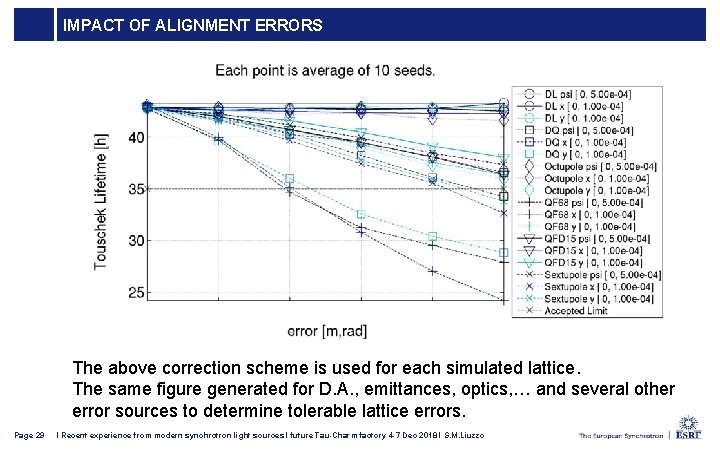
IMPACT OF ALIGNMENT ERRORS The above correction scheme is used for each simulated lattice. The same figure generated for D. A. , emittances, optics, … and several other error sources to determine tolerable lattice errors. Page 29 l Recent experience from modern synchrotron light sources l future Tau-Charm factory 4 -7 Dec 2018 l S. M. Liuzzo
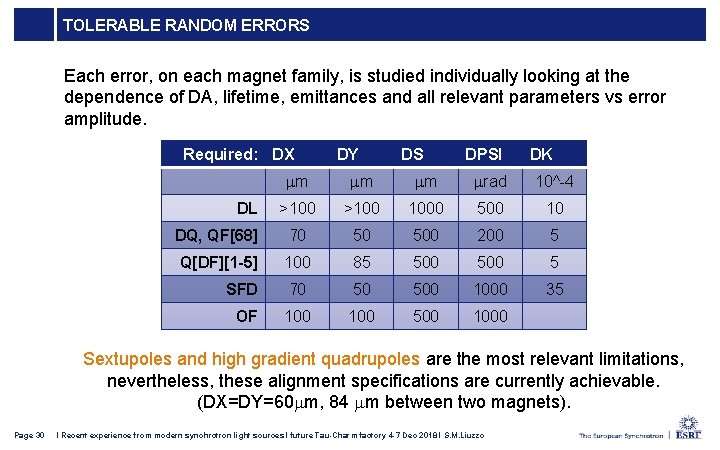
TOLERABLE RANDOM ERRORS Each error, on each magnet family, is studied individually looking at the dependence of DA, lifetime, emittances and all relevant parameters vs error amplitude. Required: DX DY DS DPSI DK mm mm mm mrad 10^-4 >100 1000 500 10 DQ, QF[68] 70 50 500 200 5 Q[DF][1 -5] 100 85 500 5 SFD 70 50 500 1000 35 OF 100 500 1000 DL Sextupoles and high gradient quadrupoles are the most relevant limitations, nevertheless, these alignment specifications are currently achievable. (DX=DY=60 mm, 84 mm between two magnets). Page 30 l Recent experience from modern synchrotron light sources l future Tau-Charm factory 4 -7 Dec 2018 l S. M. Liuzzo
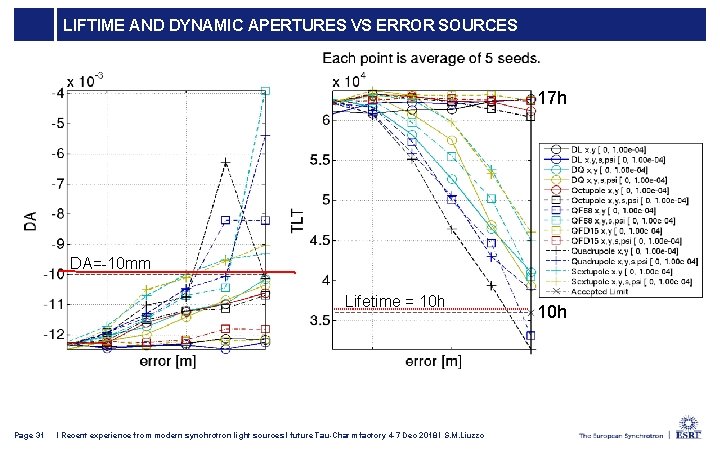
LIFTIME AND DYNAMIC APERTURES VS ERROR SOURCES 17 h DA=-10 mm Lifetime = 10 h Page 31 l Recent experience from modern synchrotron light sources l future Tau-Charm factory 4 -7 Dec 2018 l S. M. Liuzzo 10 h
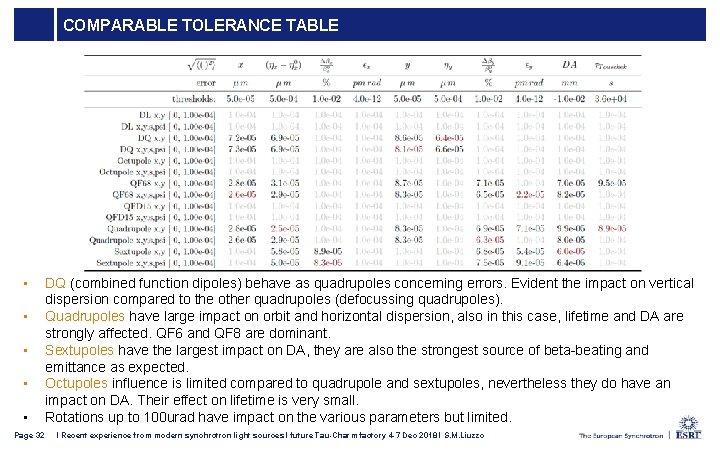
COMPARABLE TOLERANCE TABLE • • • Page 32 DQ (combined function dipoles) behave as quadrupoles concerning errors. Evident the impact on vertical dispersion compared to the other quadrupoles (defocussing quadrupoles). Quadrupoles have large impact on orbit and horizontal dispersion, also in this case, lifetime and DA are strongly affected. QF 6 and QF 8 are dominant. Sextupoles have the largest impact on DA, they are also the strongest source of beta-beating and emittance as expected. Octupoles influence is limited compared to quadrupole and sextupoles, nevertheless they do have an impact on DA. Their effect on lifetime is very small. Rotations up to 100 urad have impact on the various parameters but limited. l Recent experience from modern synchrotron light sources l future Tau-Charm factory 4 -7 Dec 2018 l S. M. Liuzzo
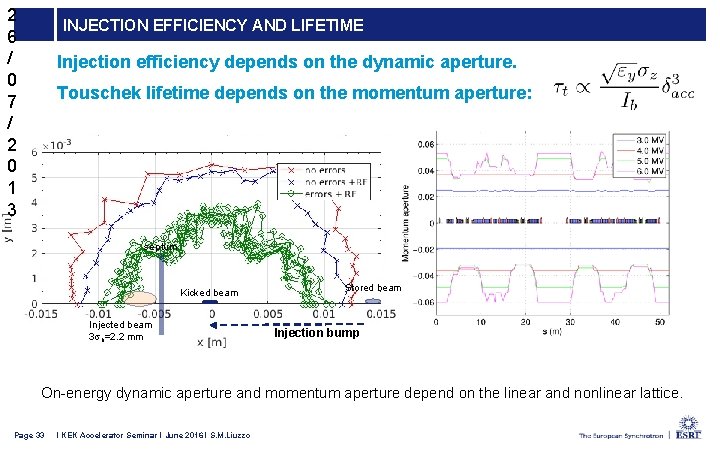
2 6 / 0 7 / 2 0 1 3 INJECTION EFFICIENCY AND LIFETIME Injection efficiency depends on the dynamic aperture. Touschek lifetime depends on the momentum aperture: septum Kicked beam Injected beam 3 sh=2. 2 mm Stored beam Injection bump On-energy dynamic aperture and momentum aperture depend on the linear and nonlinear lattice. Page 33 l KEK Accelerator Seminar l June 2016 l S. M. Liuzzo
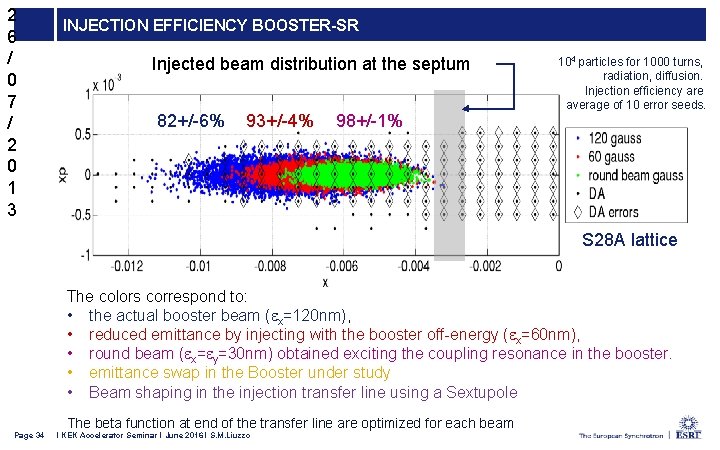
2 6 / 0 7 / 2 0 1 3 INJECTION EFFICIENCY BOOSTER-SR Injected beam distribution at the septum 82+/-6% 93+/-4% 98+/-1% 104 particles for 1000 turns, radiation, diffusion. Injection efficiency are average of 10 error seeds. S 28 A lattice The colors correspond to: • the actual booster beam (ex=120 nm), • reduced emittance by injecting with the booster off-energy (ex=60 nm), • round beam (ex=ey=30 nm) obtained exciting the coupling resonance in the booster. • emittance swap in the Booster under study • Beam shaping in the injection transfer line using a Sextupole Page 34 The beta function at end of the transfer line are optimized for each beam l KEK Accelerator Seminar l June 2016 l S. M. Liuzzo
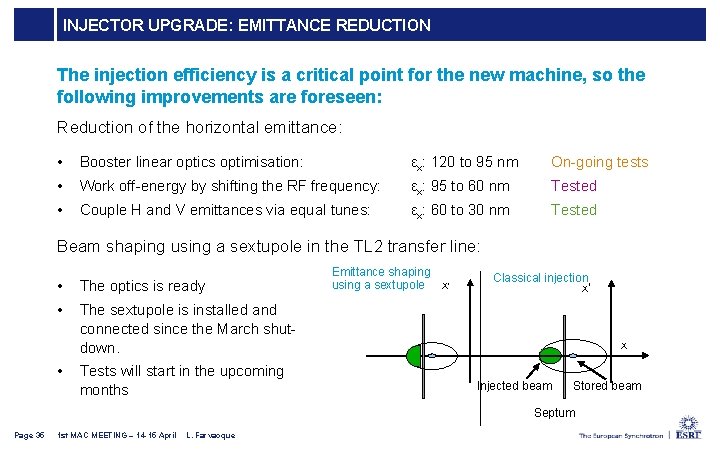
INJECTOR UPGRADE: EMITTANCE REDUCTION The injection efficiency is a critical point for the new machine, so the following improvements are foreseen: Reduction of the horizontal emittance: • Booster linear optics optimisation: εx: 120 to 95 nm On-going tests • Work off-energy by shifting the RF frequency: εx: 95 to 60 nm Tested • Couple H and V emittances via equal tunes: εx: 60 to 30 nm Tested Beam shaping using a sextupole in the TL 2 transfer line: • The optics is ready • The sextupole is installed and connected since the March shutdown. • Tests will start in the upcoming months Emittance shaping using a sextupole X' Classical injection X' X Injected beam Stored beam Septum Page 35 1 st MAC MEETING – 14 -15 April L. Farvacque