
Recent Evidence for Treatment Augmentation With SecondGeneration Antipsychotics
![MDD Treatment Augmentation: Second-Generation Antipsychotics Agent FDA Approval for MDD Treatment Augmentation Aripiprazole[1] 2007](https://slidetodoc.com/presentation_image_h2/69370a5937f3a30dd53d0d1b384c8d17/image-7.jpg "MDD Treatment Augmentation: Second-Generation Antipsychotics Agent FDA Approval for MDD Treatment Augmentation Aripiprazole[1] 2007")
![Second-Generation Antipsychotics: Sexual AEs § Review based on few systemic studies[1] Antipsychotic Agent Clozapine](https://slidetodoc.com/presentation_image_h2/69370a5937f3a30dd53d0d1b384c8d17/image-30.jpg "Second-Generation Antipsychotics: Sexual AEs § Review based on few systemic studies[1] Antipsychotic Agent Clozapine")
- Slides: 36
Recent Evidence for Treatment Augmentation With Second-Generation Antipsychotics in Major Depressive Disorder Rakesh Jain, MD, MPH Clinical Professor Department of Psychiatry Texas Tech Health Sciences Center, School of Medicine Midland, Texas Supported by an educational grant from Otsuka and Lundbeck Alliance
About These Slides § Please feel free to use, update, and share some or all of these slides in your noncommercial presentations to colleagues or patients § When using our slides, please retain the source attribution: Slide credit: clinicaloptions. com § These slides may not be published, posted online, or used in commercial presentations without permission. Please contact permissions@clinicaloptions. com for details
Disclosures The faculty reported the following financial relationships or relationships to products or devices they or their spouse/life partner have with commercial interests related to the content of this CME/CE activity: Rakesh Jain, MD, MPH, has disclosed that he has received consulting fees from Acadia, Alfasigma, Alkermes, Allergan, Eisai, Evidera, Impel, Janssen, Lilly, Lundbeck, Merck, Neos Therapeutics, Neurocrine, Osmotica, Otsuka, Pamlab, Pfizer, Shire, Sunovion, Supernus, Takeda, and Teva; has received fees for non‐CME services from Alkermes, Allergan, Ironshore, Janssen, Lilly, Lundbeck, Merck, Neos Therapeutics, Neurocrine, Otsuka, Pamlab, Pfizer, Shire, Sunovion, Takeda, Teva, and Tris; has received funds for research support from Allergan, Lilly, Lundbeck, Otsuka, Pfizer, Shire, and Takeda; and that his spouse/partner has received consulting fees from Lilly, Otsuka, Pamlab, and Sunovion and fees for non‐CME services from Lilly.
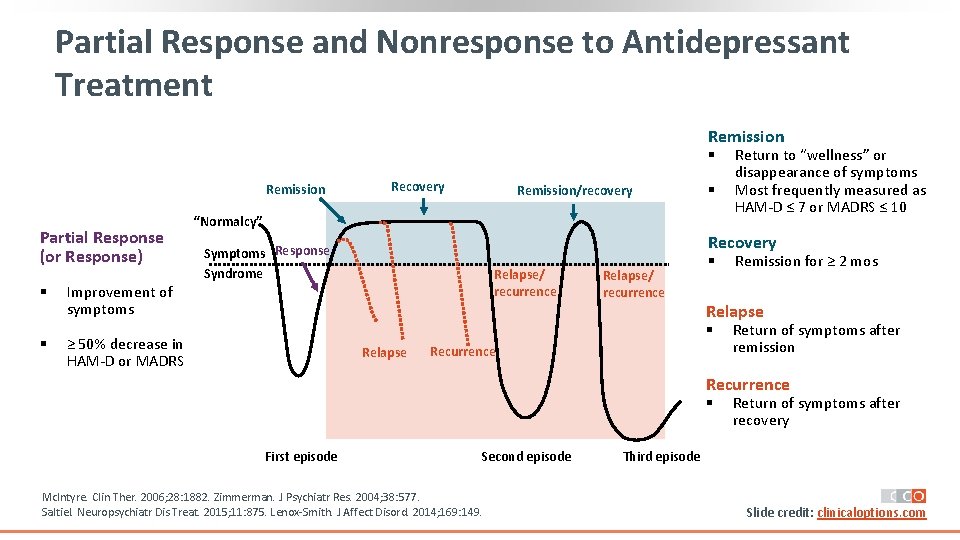
Partial Response and Nonresponse to Antidepressant Treatment Remission § Remission Partial Response (or Response) § § Recovery Remission/recovery § “Normalcy” Recovery Symptoms Response Syndrome Relapse/ recurrence Improvement of symptoms Relapse/ recurrence § Relapse Remission for ≥ 2 mos Relapse § ≥ 50% decrease in HAM‐D or MADRS Return to “wellness” or disappearance of symptoms Most frequently measured as HAM‐D ≤ 7 or MADRS ≤ 10 Recurrence Return of symptoms after remission Recurrence § First episode Second episode Mc. Intyre. Clin Ther. 2006; 28: 1882. Zimmerman. J Psychiatr Res. 2004; 38: 577. Saltiel. Neuropsychiatr Dis Treat. 2015; 11: 875. Lenox‐Smith. J Affect Disord. 2014; 169: 149. Return of symptoms after recovery Third episode Slide credit: clinicaloptions. com
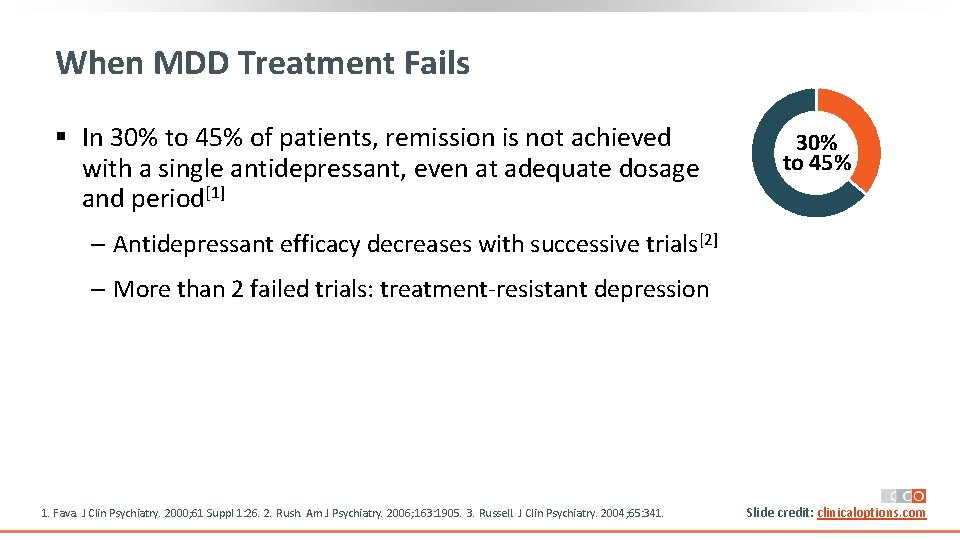
When MDD Treatment Fails § In 30% to 45% of patients, remission is not achieved with a single antidepressant, even at adequate dosage and period[1] 30% 70% to 45% ‒ Antidepressant efficacy decreases with successive trials[2] ‒ More than 2 failed trials: treatment‐resistant depression 1. Fava. J Clin Psychiatry. 2000; 61 Suppl 1: 26. 2. Rush. Am J Psychiatry. 2006; 163: 1905. 3. Russell. J Clin Psychiatry. 2004; 65: 341. Slide credit: clinicaloptions. com
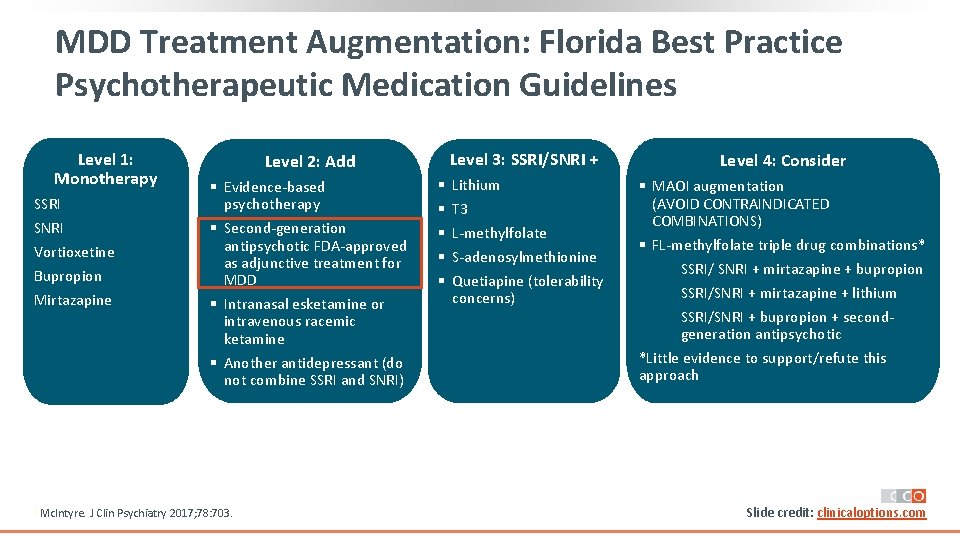
MDD Treatment Augmentation: Florida Best Practice Psychotherapeutic Medication Guidelines Level 1: Monotherapy SSRI SNRI Vortioxetine Bupropion Mirtazapine Level 2: Add § Evidence‐based psychotherapy § Second‐generation antipsychotic FDA‐approved as adjunctive treatment for MDD § Intranasal esketamine or intravenous racemic ketamine § Another antidepressant (do not combine SSRI and SNRI) §Mc. Intyre. J Clin Psychiatry 2017; 78: 703. § § § Level 3: SSRI/SNRI + Level 4: Consider Lithium T 3 L‐methylfolate S‐adenosylmethionine Quetiapine (tolerability concerns) § MAOI augmentation (AVOID CONTRAINDICATED COMBINATIONS) § FL‐methylfolate triple drug combinations* SSRI/ SNRI + mirtazapine + bupropion SSRI/SNRI + mirtazapine + lithium SSRI/SNRI + bupropion + second‐ generation antipsychotic *Little evidence to support/refute this approach Slide credit: clinicaloptions. com
MDD Treatment Augmentation: Second-Generation Antipsychotics Agent FDA Approval for MDD Treatment Augmentation Aripiprazole[1] 2007 Olanzapine/ fluoxetine[2] 2009 Quetiapine XR[3] 2009 Brexpiprazole[4] 2015 1. Aripiprazole PI. 2. Olanzapine/fluoxetine PI. 3. Quetiapine XR PI. 4. Brexpiprazole PI. Agent FDA Approval for MDD Treatment Augmentation Asenapine No Clozapine No Cariprazine No Iloperidone No Lumateperone No Lurasidone No Paliperidone No Risperidone No Sulpiride No Ziprasidone No Slide credit: clinicaloptions. com
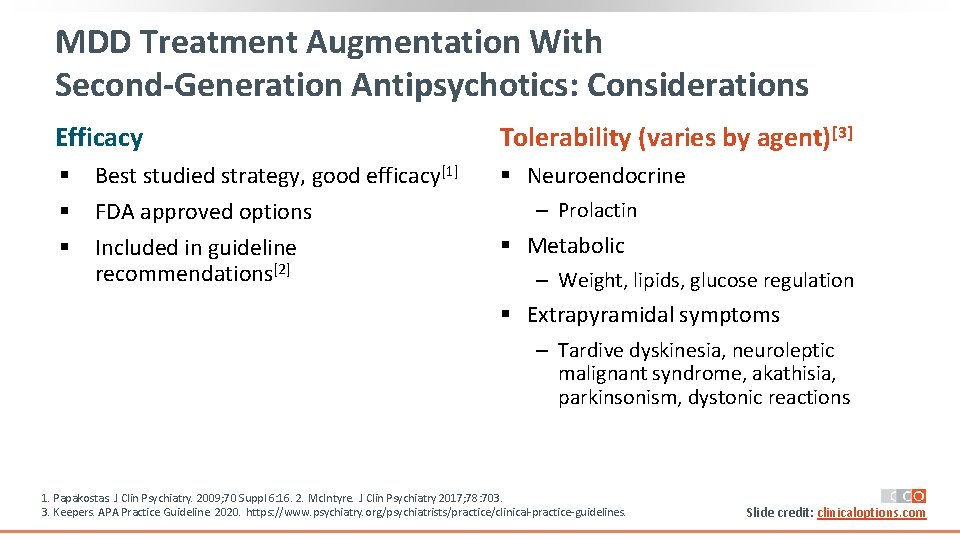
MDD Treatment Augmentation With Second-Generation Antipsychotics: Considerations Efficacy § § § Best studied strategy, good efficacy[1] FDA approved options Included in guideline recommendations[2] Tolerability (varies by agent)[3] § Neuroendocrine ‒ Prolactin § Metabolic ‒ Weight, lipids, glucose regulation § Extrapyramidal symptoms ‒ Tardive dyskinesia, neuroleptic malignant syndrome, akathisia, parkinsonism, dystonic reactions 1. Papakostas. J Clin Psychiatry. 2009; 70 Suppl 6: 16. 2. Mc. Intyre. J Clin Psychiatry 2017; 78: 703. 3. Keepers. APA Practice Guideline. 2020. https: //www. psychiatry. org/psychiatrists/practice/clinical‐practice‐guidelines. Slide credit: clinicaloptions. com
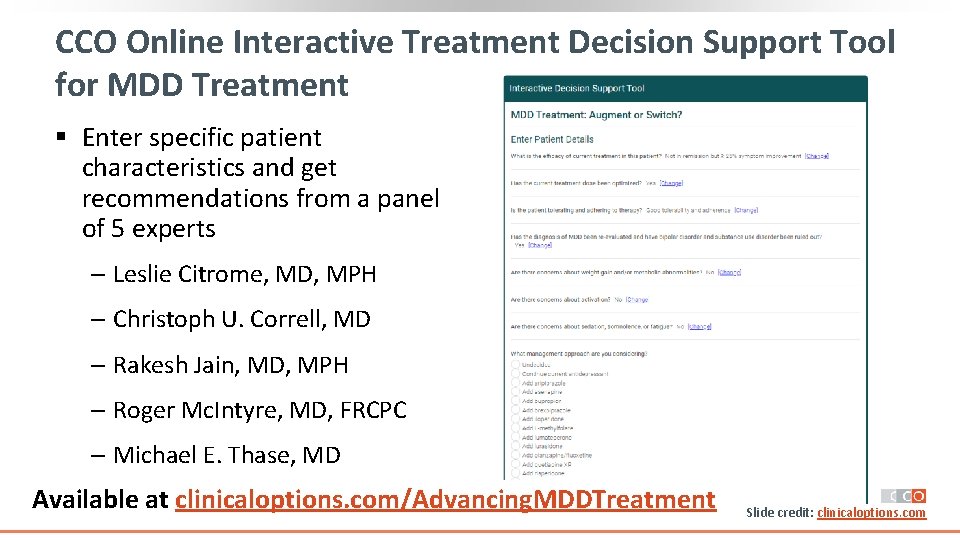
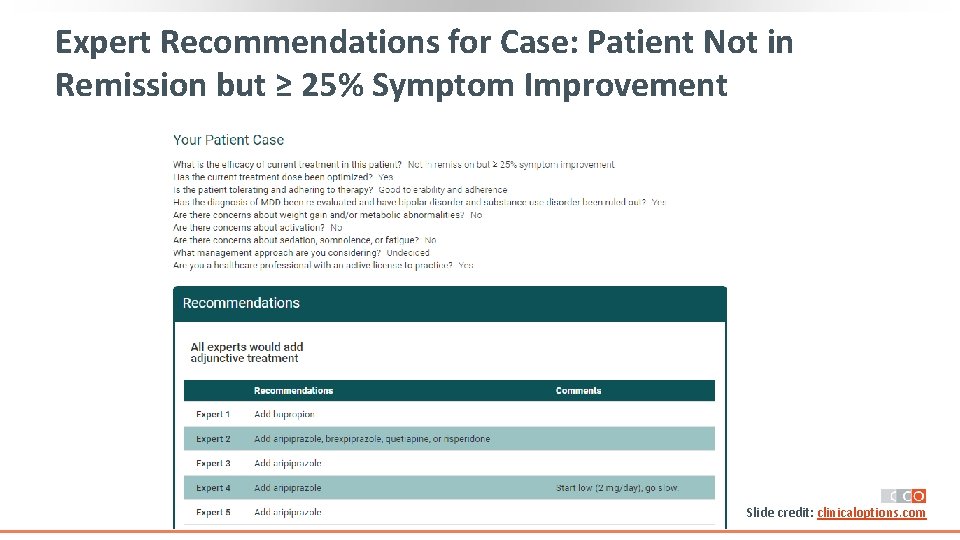
CCO Online Interactive Treatment Decision Support Tool for MDD Treatment § Enter specific patient characteristics and get recommendations from a panel of 5 experts ‒ Leslie Citrome, MD, MPH ‒ Christoph U. Correll, MD ‒ Rakesh Jain, MD, MPH ‒ Roger Mc. Intyre, MD, FRCPC ‒ Michael E. Thase, MD Available at clinicaloptions. com/Advancing. MDDTreatment Slide credit: clinicaloptions. com
Expert Recommendations for Case: Patient Not in Remission but ≥ 25% Symptom Improvement Slide credit: clinicaloptions. com
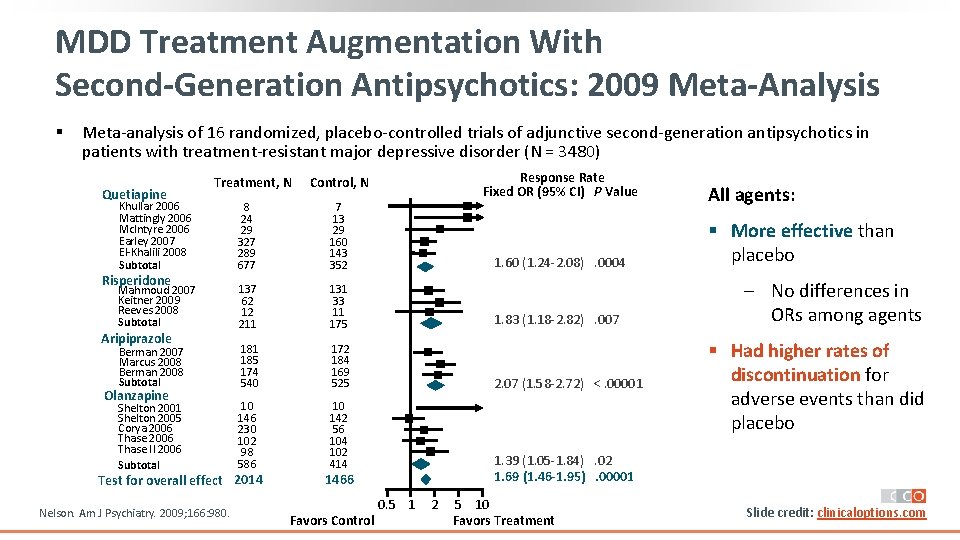
MDD Treatment Augmentation With Second-Generation Antipsychotics: 2009 Meta-Analysis § Meta‐analysis of 16 randomized, placebo‐controlled trials of adjunctive second‐generation antipsychotics in patients with treatment‐resistant major depressive disorder (N = 3480) Quetiapine Treatment, N Khullar 2006 Mattingly 2006 Mc. Intyre 2006 Earley 2007 El‐Khalili 2008 Subtotal 8 24 29 327 289 677 7 13 29 160 143 352 Mahmoud 2007 Keitner 2009 Reeves 2008 Subtotal 137 62 12 211 131 33 11 175 Berman 2007 Marcus 2008 Berman 2008 Subtotal 181 185 174 540 172 184 169 525 Shelton 2001 Shelton 2005 Corya 2006 Thase II 2006 Subtotal 10 146 230 102 98 586 10 142 56 104 102 414 Risperidone Aripiprazole Olanzapine Test for overall effect 2014 Nelson. Am J Psychiatry. 2009; 166: 980. Response Rate Fixed OR (95% CI) P Value Control, N 1. 60 (1. 24‐ 2. 08). 0004 1. 83 (1. 18‐ 2. 82). 007 2. 07 (1. 58‐ 2. 72) <. 00001 § More effective than placebo ‒ No differences in ORs among agents § Had higher rates of discontinuation for adverse events than did placebo 1. 39 (1. 05‐ 1. 84). 02 1. 69 (1. 46 -1. 95). 00001 1466 Favors Control All agents: 0. 5 1 2 5 10 Favors Treatment Slide credit: clinicaloptions. com
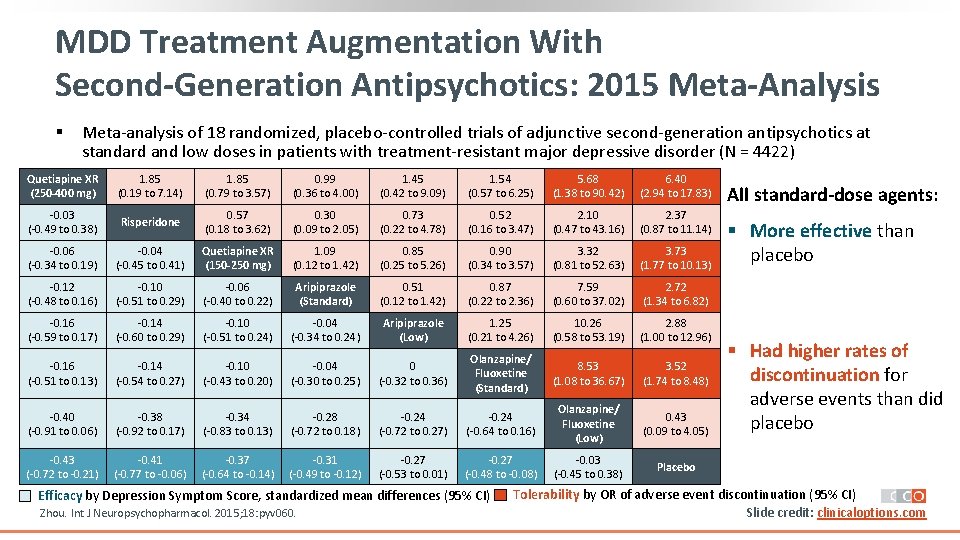
MDD Treatment Augmentation With Second-Generation Antipsychotics: 2015 Meta-Analysis § Meta‐analysis of 18 randomized, placebo‐controlled trials of adjunctive second‐generation antipsychotics at standard and low doses in patients with treatment‐resistant major depressive disorder (N = 4422) Quetiapine XR (250 -400 mg) 1. 85 (0. 19 to 7. 14) 1. 85 (0. 79 to 3. 57) 0. 99 (0. 36 to 4. 00) 1. 45 (0. 42 to 9. 09) 1. 54 (0. 57 to 6. 25) 5. 68 (1. 38 to 90. 42) 6. 40 (2. 94 to 17. 83) ‐ 0. 03 (‐ 0. 49 to 0. 38) Risperidone 0. 57 (0. 18 to 3. 62) 0. 30 (0. 09 to 2. 05) 0. 73 (0. 22 to 4. 78) 0. 52 (0. 16 to 3. 47) 2. 10 (0. 47 to 43. 16) 2. 37 (0. 87 to 11. 14) ‐ 0. 06 (‐ 0. 34 to 0. 19) ‐ 0. 04 (‐ 0. 45 to 0. 41) Quetiapine XR (150 -250 mg) 1. 09 (0. 12 to 1. 42) 0. 85 (0. 25 to 5. 26) 0. 90 (0. 34 to 3. 57) 3. 32 (0. 81 to 52. 63) 3. 73 (1. 77 to 10. 13) ‐ 0. 12 (‐ 0. 48 to 0. 16) ‐ 0. 10 (‐ 0. 51 to 0. 29) ‐ 0. 06 (‐ 0. 40 to 0. 22) Aripiprazole (Standard) 0. 51 (0. 12 to 1. 42) 0. 87 (0. 22 to 2. 36) 7. 59 (0. 60 to 37. 02) 2. 72 (1. 34 to 6. 82) ‐ 0. 16 (‐ 0. 59 to 0. 17) ‐ 0. 14 (‐ 0. 60 to 0. 29) ‐ 0. 10 (‐ 0. 51 to 0. 24) ‐ 0. 04 (‐ 0. 34 to 0. 24) Aripiprazole (Low) 1. 25 (0. 21 to 4. 26) 10. 26 (0. 58 to 53. 19) 2. 88 (1. 00 to 12. 96) ‐ 0. 16 (‐ 0. 51 to 0. 13) ‐ 0. 14 (‐ 0. 54 to 0. 27) ‐ 0. 10 (‐ 0. 43 to 0. 20) ‐ 0. 04 (‐ 0. 30 to 0. 25) 0 (‐ 0. 32 to 0. 36) Olanzapine/ Fluoxetine (Standard) 8. 53 (1. 08 to 36. 67) 3. 52 (1. 74 to 8. 48) ‐ 0. 40 (‐ 0. 91 to 0. 06) ‐ 0. 38 (‐ 0. 92 to 0. 17) ‐ 0. 34 (‐ 0. 83 to 0. 13) ‐ 0. 28 (‐ 0. 72 to 0. 18) ‐ 0. 24 (‐ 0. 72 to 0. 27) ‐ 0. 24 (‐ 0. 64 to 0. 16) Olanzapine/ Fluoxetine (Low) 0. 43 (0. 09 to 4. 05) ‐ 0. 43 (‐ 0. 72 to ‐ 0. 21) ‐ 0. 41 (‐ 0. 77 to ‐ 0. 06) ‐ 0. 37 (‐ 0. 64 to ‐ 0. 14) ‐ 0. 31 (‐ 0. 49 to ‐ 0. 12) ‐ 0. 27 (‐ 0. 53 to 0. 01) ‐ 0. 27 (‐ 0. 48 to ‐ 0. 08) ‐ 0. 03 (‐ 0. 45 to 0. 38) Placebo Efficacy by Depression Symptom Score, standardized mean differences (95% CI) Zhou. Int J Neuropsychopharmacol. 2015; 18: pyv 060. All standard-dose agents: § More effective than placebo § Had higher rates of discontinuation for adverse events than did placebo Tolerability by OR of adverse event discontinuation (95% CI) Slide credit: clinicaloptions. com
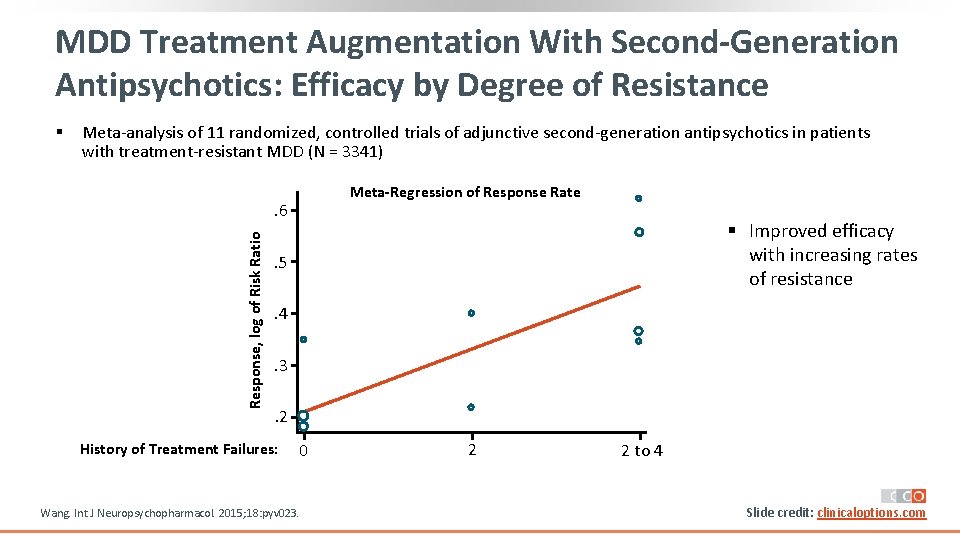
MDD Treatment Augmentation With Second-Generation Antipsychotics: Efficacy by Degree of Resistance § Meta‐analysis of 11 randomized, controlled trials of adjunctive second‐generation antipsychotics in patients with treatment‐resistant MDD (N = 3341) Meta-Regression of Response Rate Response, log of Risk Ratio . 6 § Improved efficacy with increasing rates of resistance . 5. 4. 3. 2 History of Treatment Failures: 0 Wang. Int J Neuropsychopharmacol. 2015; 18: pyv 023. 2 2 to 4 Slide credit: clinicaloptions. com
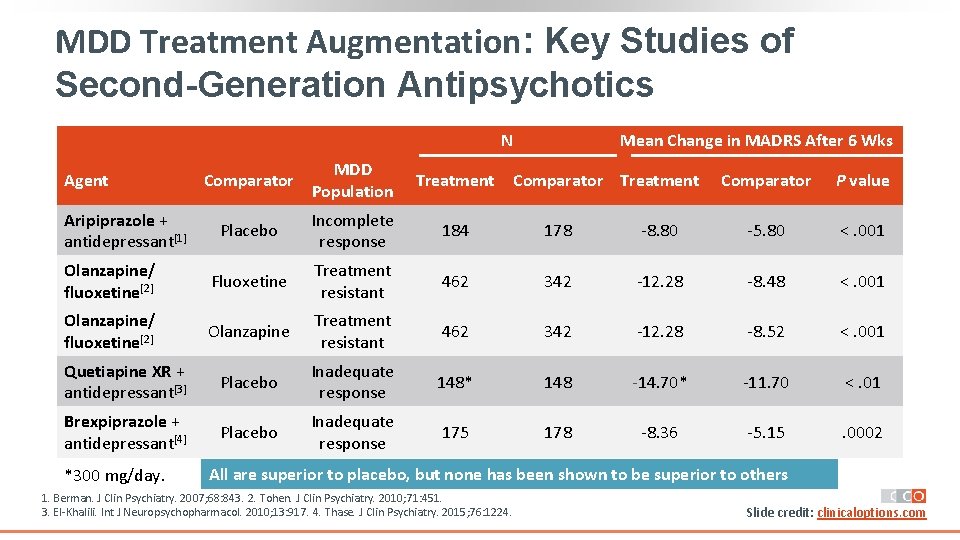
MDD Treatment Augmentation: Key Studies of Second-Generation Antipsychotics N Mean Change in MADRS After 6 Wks Comparator MDD Population Treatment Placebo Incomplete response 184 178 Olanzapine/ fluoxetine[2] Fluoxetine Treatment resistant 462 Olanzapine/ fluoxetine[2] Olanzapine Treatment resistant Quetiapine XR + antidepressant[3] Placebo Brexpiprazole + antidepressant[4] Placebo Agent Aripiprazole + antidepressant[1] *300 mg/day. Comparator Treatment Comparator P value ‐ 8. 80 ‐ 5. 80 <. 001 342 ‐ 12. 28 ‐ 8. 48 <. 001 462 342 ‐ 12. 28 ‐ 8. 52 <. 001 Inadequate response 148* 148 ‐ 14. 70* ‐ 11. 70 <. 01 Inadequate response 175 178 ‐ 8. 36 ‐ 5. 15 . 0002 All are superior to placebo, but none has been shown to be superior to others 1. Berman. J Clin Psychiatry. 2007; 68: 843. 2. Tohen. J Clin Psychiatry. 2010; 71: 451. 3. El‐Khalili. Int J Neuropsychopharmacol. 2010; 13: 917. 4. Thase. J Clin Psychiatry. 2015; 76: 1224. Slide credit: clinicaloptions. com
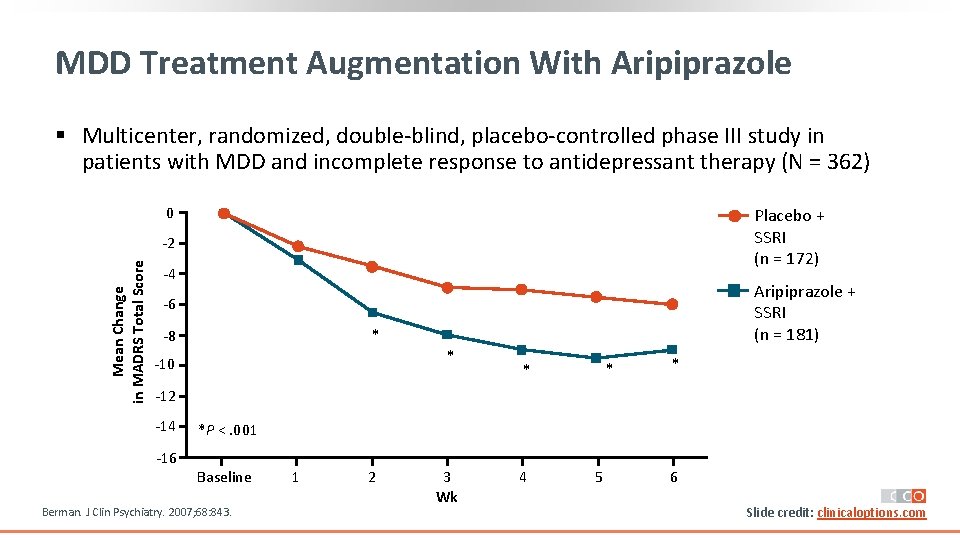
MDD Treatment Augmentation With Aripiprazole § Multicenter, randomized, double‐blind, placebo‐controlled phase III study in patients with MDD and incomplete response to antidepressant therapy (N = 362) 0 Placebo + SSRI (n = 172) Mean Change in MADRS Total Score ‐ 2 ‐ 4 Aripiprazole + SSRI (n = 181) ‐ 6 * ‐ 8 ‐ 10 * * ‐ 12 ‐ 14 ‐ 16 *P <. 001 Baseline Berman. J Clin Psychiatry. 2007; 68: 843. 1 2 3 Wk 4 5 6 Slide credit: clinicaloptions. com
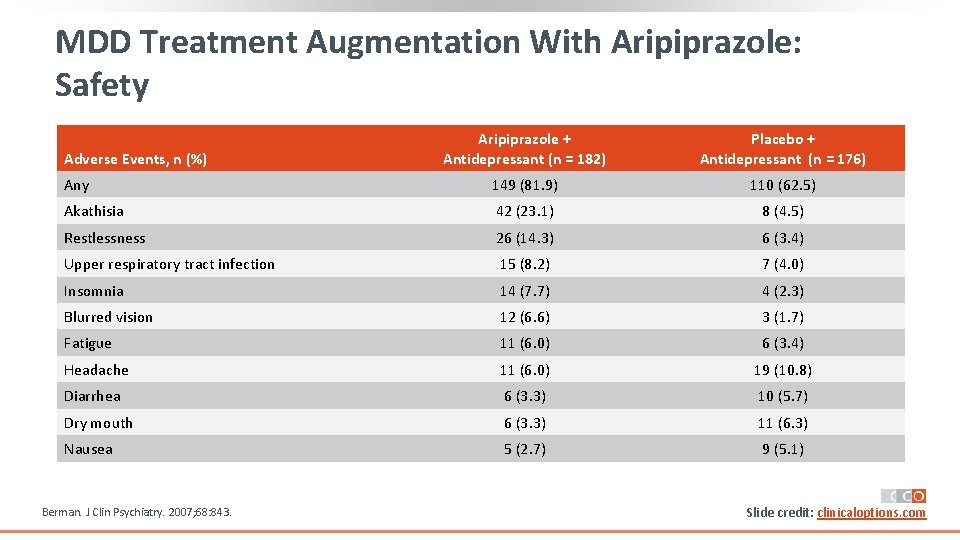
MDD Treatment Augmentation With Aripiprazole: Safety Aripiprazole + Antidepressant (n = 182) Placebo + Antidepressant (n = 176) Any 149 (81. 9) 110 (62. 5) Akathisia 42 (23. 1) 8 (4. 5) Restlessness 26 (14. 3) 6 (3. 4) Upper respiratory tract infection 15 (8. 2) 7 (4. 0) Insomnia 14 (7. 7) 4 (2. 3) Blurred vision 12 (6. 6) 3 (1. 7) Fatigue 11 (6. 0) 6 (3. 4) Headache 11 (6. 0) 19 (10. 8) Diarrhea 6 (3. 3) 10 (5. 7) Dry mouth 6 (3. 3) 11 (6. 3) Nausea 5 (2. 7) 9 (5. 1) Adverse Events, n (%) Berman. J Clin Psychiatry. 2007; 68: 843. Slide credit: clinicaloptions. com
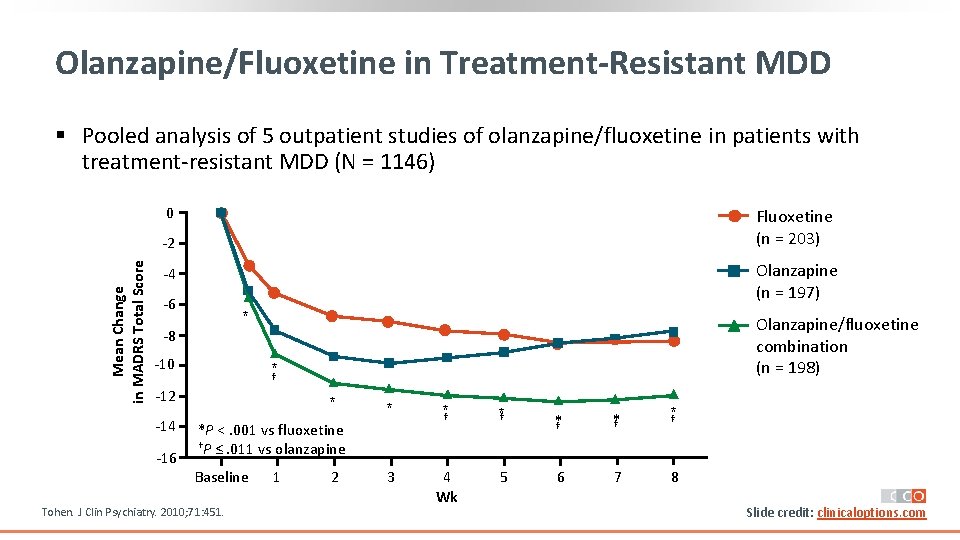
Olanzapine/Fluoxetine in Treatment-Resistant MDD § Pooled analysis of 5 outpatient studies of olanzapine/fluoxetine in patients with treatment‐resistant MDD (N = 1146) 0 Fluoxetine (n = 203) Mean Change in MADRS Total Score ‐ 2 Olanzapine (n = 197) ‐ 4 ‐ 6 * ‐ 8 ‐ 10 *† ‐ 12 ‐ 14 ‐ 16 Olanzapine/fluoxetine combination (n = 198) * * *† *† *† 3 4 Wk 5 6 7 8 *P <. 001 vs fluoxetine †P ≤. 011 vs olanzapine Baseline Tohen. J Clin Psychiatry. 2010; 71: 451. 1 2 Slide credit: clinicaloptions. com
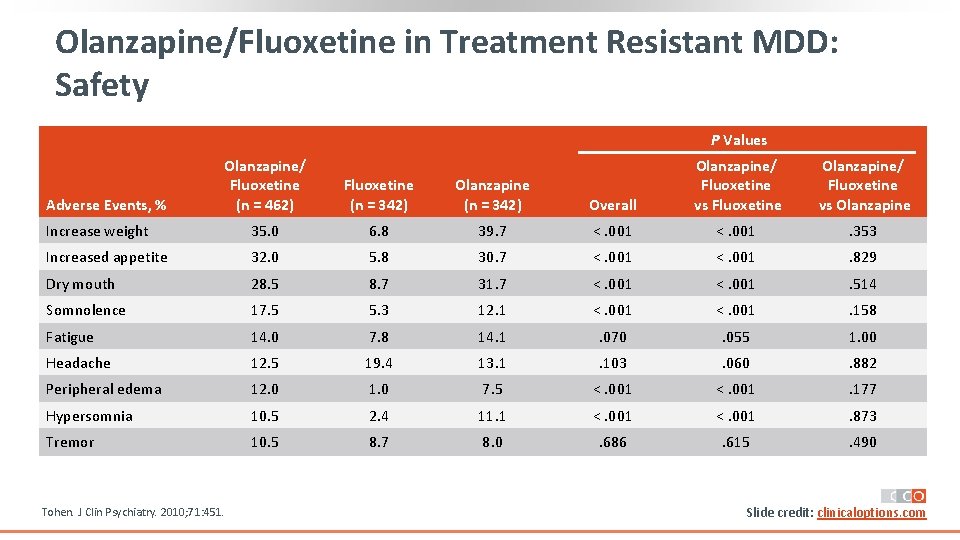
Olanzapine/Fluoxetine in Treatment Resistant MDD: Safety P Values Olanzapine/ Fluoxetine (n = 462) Fluoxetine (n = 342) Olanzapine (n = 342) Increase weight 35. 0 6. 8 Increased appetite 32. 0 Dry mouth Overall Olanzapine/ Fluoxetine vs Fluoxetine Olanzapine/ Fluoxetine vs Olanzapine 39. 7 <. 001 . 353 5. 8 30. 7 <. 001 . 829 28. 5 8. 7 31. 7 <. 001 . 514 Somnolence 17. 5 5. 3 12. 1 <. 001 . 158 Fatigue 14. 0 7. 8 14. 1 . 070 . 055 1. 00 Headache 12. 5 19. 4 13. 1 . 103 . 060 . 882 Peripheral edema 12. 0 1. 0 7. 5 <. 001 . 177 Hypersomnia 10. 5 2. 4 11. 1 <. 001 . 873 Tremor 10. 5 8. 7 8. 0 . 686 . 615 . 490 Adverse Events, % Tohen. J Clin Psychiatry. 2010; 71: 451. Slide credit: clinicaloptions. com
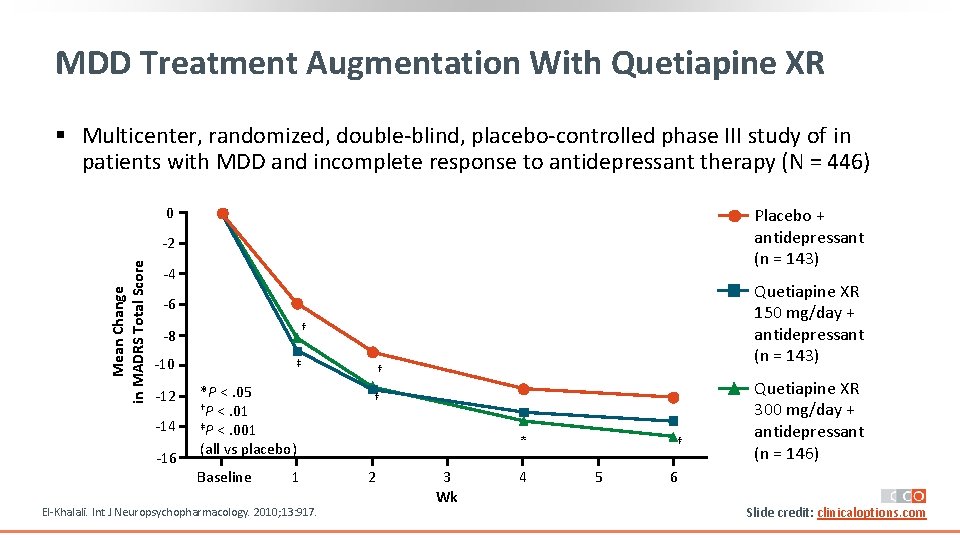
MDD Treatment Augmentation With Quetiapine XR § Multicenter, randomized, double‐blind, placebo‐controlled phase III study of in patients with MDD and incomplete response to antidepressant therapy (N = 446) 0 Placebo + antidepressant (n = 143) Mean Change in MADRS Total Score ‐ 2 ‐ 4 Quetiapine XR 150 mg/day + antidepressant (n = 143) ‐ 6 † ‐ 8 ‐ 10 ‐ 12 ‐ 14 ‐ 16 ‡ *P <. 05 †P <. 01 ‡P <. 001 (all vs placebo) Baseline 1 El‐Khalali. Int J Neuropsychopharmacology. 2010; 13: 917. † † * 2 3 Wk 4 † 5 Quetiapine XR 300 mg/day + antidepressant (n = 146) 6 Slide credit: clinicaloptions. com
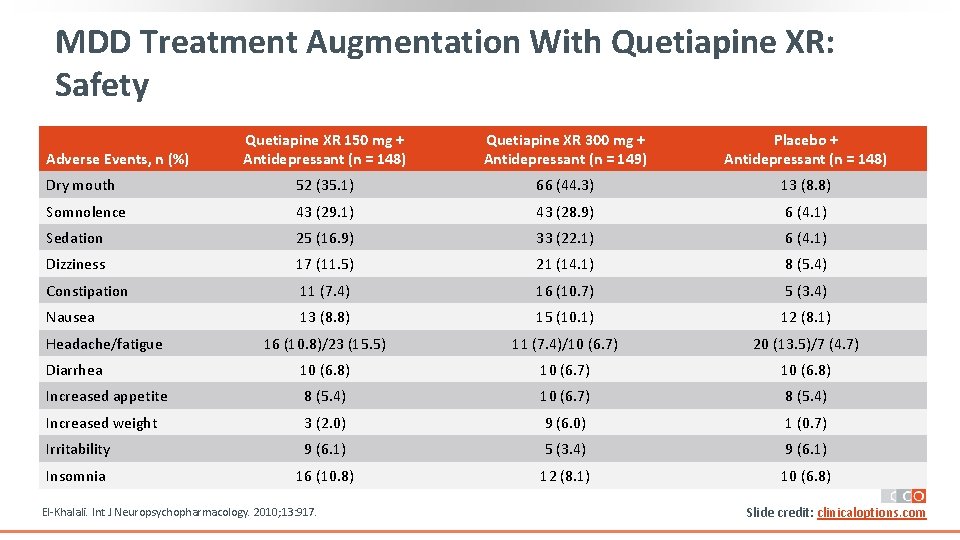
MDD Treatment Augmentation With Quetiapine XR: Safety Quetiapine XR 150 mg + Antidepressant (n = 148) Quetiapine XR 300 mg + Antidepressant (n = 149) Placebo + Antidepressant (n = 148) Dry mouth 52 (35. 1) 66 (44. 3) 13 (8. 8) Somnolence 43 (29. 1) 43 (28. 9) 6 (4. 1) Sedation 25 (16. 9) 33 (22. 1) 6 (4. 1) Dizziness 17 (11. 5) 21 (14. 1) 8 (5. 4) Constipation 11 (7. 4) 16 (10. 7) 5 (3. 4) Nausea 13 (8. 8) 15 (10. 1) 12 (8. 1) 16 (10. 8)/23 (15. 5) 11 (7. 4)/10 (6. 7) 20 (13. 5)/7 (4. 7) Diarrhea 10 (6. 8) 10 (6. 7) 10 (6. 8) Increased appetite 8 (5. 4) 10 (6. 7) 8 (5. 4) Increased weight 3 (2. 0) 9 (6. 0) 1 (0. 7) Irritability 9 (6. 1) 5 (3. 4) 9 (6. 1) Insomnia 16 (10. 8) 12 (8. 1) 10 (6. 8) Adverse Events, n (%) Headache/fatigue El‐Khalali. Int J Neuropsychopharmacology. 2010; 13: 917. Slide credit: clinicaloptions. com
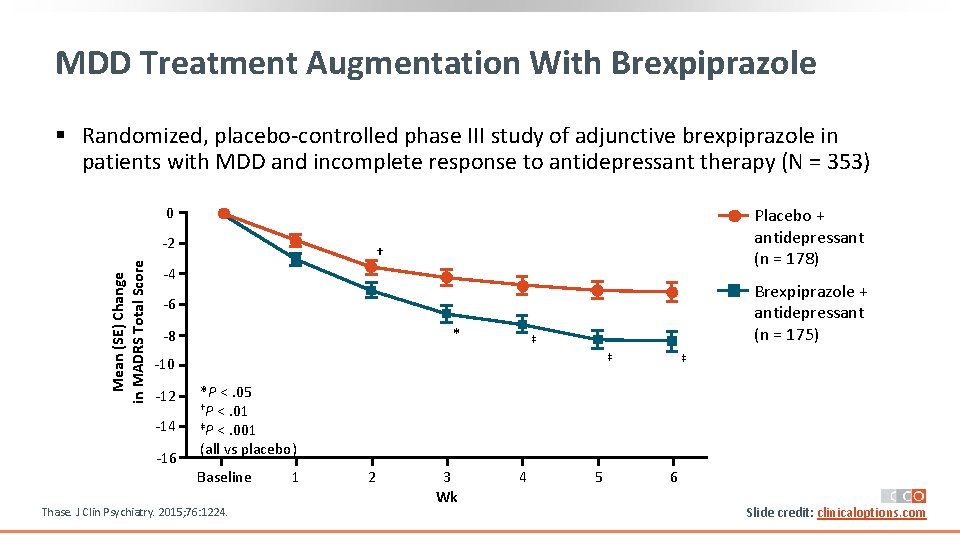
MDD Treatment Augmentation With Brexpiprazole § Randomized, placebo‐controlled phase III study of adjunctive brexpiprazole in patients with MDD and incomplete response to antidepressant therapy (N = 353) 0 Mean (SE) Change in MADRS Total Score ‐ 2 Placebo + antidepressant (n = 178) † ‐ 4 Brexpiprazole + antidepressant (n = 175) ‐ 6 * ‐ 8 ‡ ‡ ‐ 10 ‐ 12 ‐ 14 ‐ 16 ‡ *P <. 05 †P <. 01 ‡P <. 001 (all vs placebo) Baseline Thase. J Clin Psychiatry. 2015; 76: 1224. 1 2 3 Wk 4 5 6 Slide credit: clinicaloptions. com
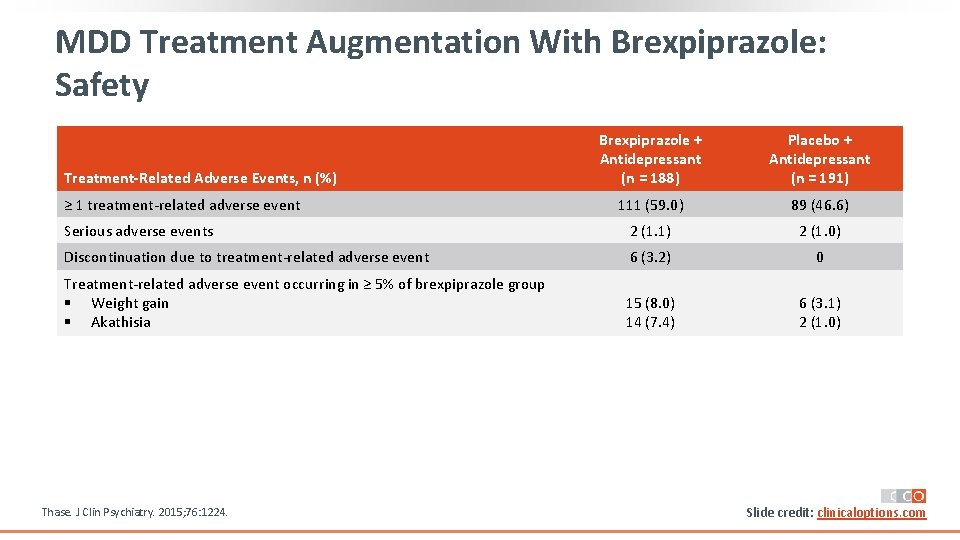
MDD Treatment Augmentation With Brexpiprazole: Safety Brexpiprazole + Antidepressant (n = 188) Placebo + Antidepressant (n = 191) 111 (59. 0) 89 (46. 6) Serious adverse events 2 (1. 1) 2 (1. 0) Discontinuation due to treatment‐related adverse event 6 (3. 2) 0 Treatment‐related adverse event occurring in ≥ 5% of brexpiprazole group § Weight gain § Akathisia 15 (8. 0) 14 (7. 4) 6 (3. 1) 2 (1. 0) Treatment-Related Adverse Events, n (%) ≥ 1 treatment‐related adverse event Thase. J Clin Psychiatry. 2015; 76: 1224. Slide credit: clinicaloptions. com
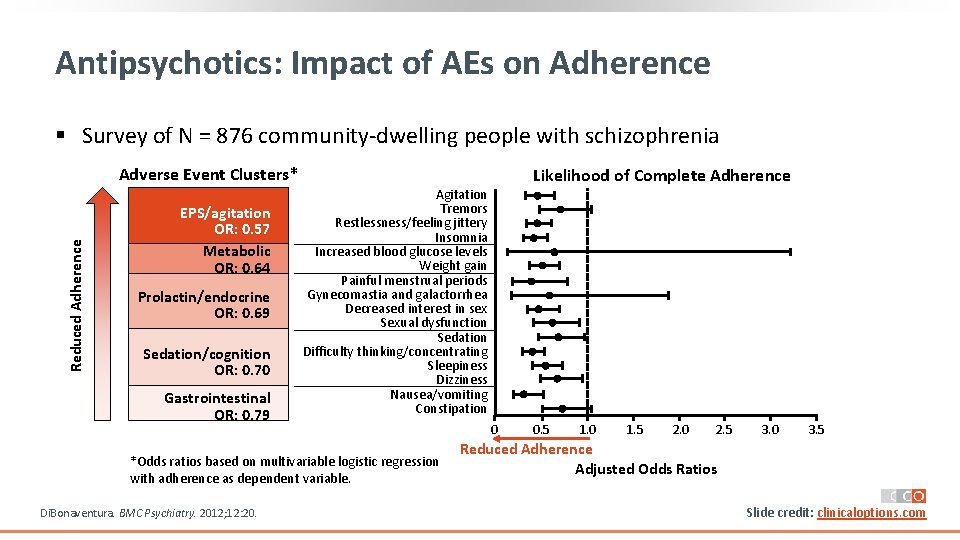
Antipsychotics: Impact of AEs on Adherence § Survey of N = 876 community‐dwelling people with schizophrenia Reduced Adherence Adverse Event Clusters* EPS/agitation OR: 0. 57 Metabolic OR: 0. 64 Prolactin/endocrine OR: 0. 69 Sedation/cognition OR: 0. 70 Gastrointestinal OR: 0. 79 Agitation Tremors Restlessness/feeling jittery Insomnia Increased blood glucose levels Weight gain Painful menstrual periods Gynecomastia and galactorrhea Decreased interest in sex Sexual dysfunction Sedation Difficulty thinking/concentrating Sleepiness Dizziness Nausea/vomiting Constipation *Odds ratios based on multivariable logistic regression with adherence as dependent variable. Di. Bonaventura. BMC Psychiatry. 2012; 12: 20. Likelihood of Complete Adherence 0 0. 5 1. 0 1. 5 2. 0 2. 5 3. 0 3. 5 Reduced Adherence Adjusted Odds Ratios Slide credit: clinicaloptions. com
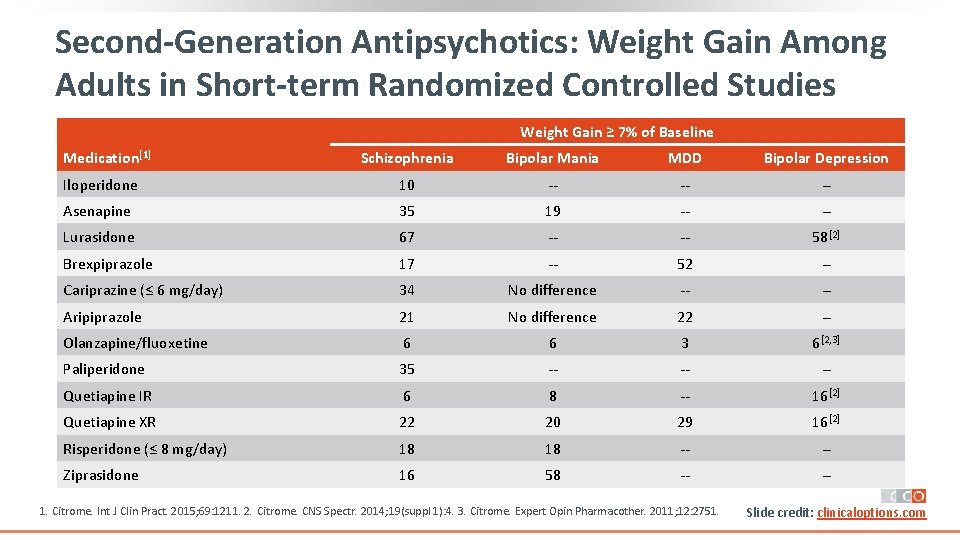
Second-Generation Antipsychotics: Weight Gain Among Adults in Short-term Randomized Controlled Studies Weight Gain ≥ 7% of Baseline Medication[1] Schizophrenia Bipolar Mania MDD Bipolar Depression Iloperidone 10 ‐‐ ‐‐ ‐‐ Asenapine 35 19 ‐‐ ‐‐ Lurasidone 67 ‐‐ ‐‐ 58[2] Brexpiprazole 17 ‐‐ 52 ‐‐ Cariprazine (≤ 6 mg/day) 34 No difference ‐‐ ‐‐ Aripiprazole 21 No difference 22 ‐‐ Olanzapine/fluoxetine 6 6 3 6[2, 3] Paliperidone 35 ‐‐ ‐‐ ‐‐ Quetiapine IR 6 8 ‐‐ 16[2] Quetiapine XR 22 20 29 16[2] Risperidone (≤ 8 mg/day) 18 18 ‐‐ ‐‐ Ziprasidone 16 58 ‐‐ ‐‐ 1. Citrome. Int J Clin Pract. 2015; 69: 1211. 2. Citrome. CNS Spectr. 2014; 19(suppl 1): 4. 3. Citrome. Expert Opin Pharmacother. 2011; 12: 2751. Slide credit: clinicaloptions. com
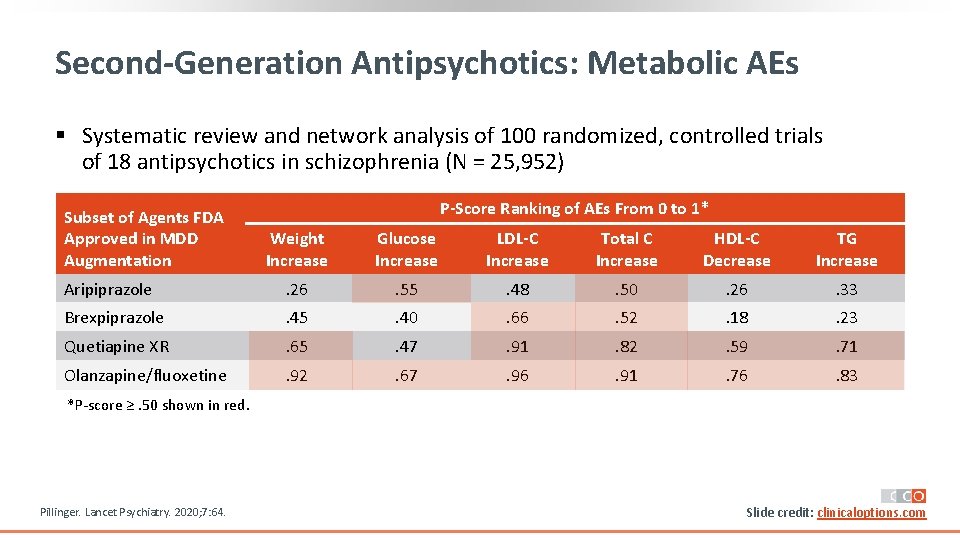
Second-Generation Antipsychotics: Metabolic AEs § Systematic review and network analysis of 100 randomized, controlled trials of 18 antipsychotics in schizophrenia (N = 25, 952) Subset of Agents FDA Approved in MDD Augmentation P-Score Ranking of AEs From 0 to 1* Weight Increase Glucose Increase LDL-C Increase Total C Increase HDL-C Decrease TG Increase Aripiprazole . 26 . 55 . 48 . 50 . 26 . 33 Brexpiprazole . 45 . 40 . 66 . 52 . 18 . 23 Quetiapine XR . 65 . 47 . 91 . 82 . 59 . 71 Olanzapine/fluoxetine . 92 . 67 . 96 . 91 . 76 . 83 *P‐score ≥. 50 shown in red. Pillinger. Lancet Psychiatry. 2020; 7: 64. Slide credit: clinicaloptions. com
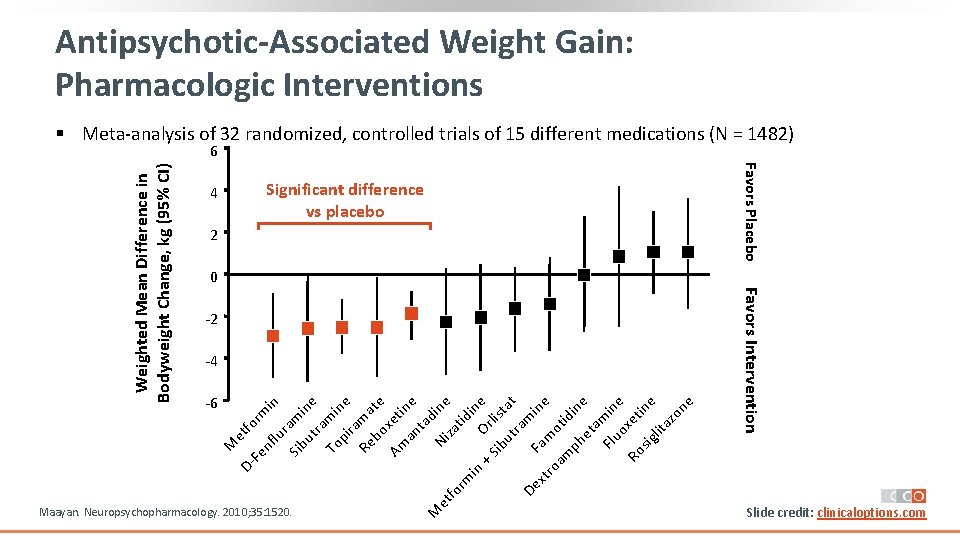
Antipsychotic-Associated Weight Gain: Pharmacologic Interventions § Meta‐analysis of 32 randomized, controlled trials of 15 different medications (N = 1482) Significant difference vs placebo 4 2 Favors Placebo 0 ‐ 2 D‐ Fe M et fo ‐ 6 r nf min lu r Sib am ut ine ra To min pi ra e Re ma bo te Am xeti an ne ta d M Ni ine et za fo tid rm i in Or ne + Sib lis ut tat ra m De in F xt a ro mo e am ti ph din et e a Flu min ox e e Ro sig tine lit az on e ‐ 4 Favors Intervention Weighted Mean Difference in Bodyweight Change, kg (95% CI) 6 Maayan. Neuropsychopharmacology. 2010; 35: 1520. Slide credit: clinicaloptions. com
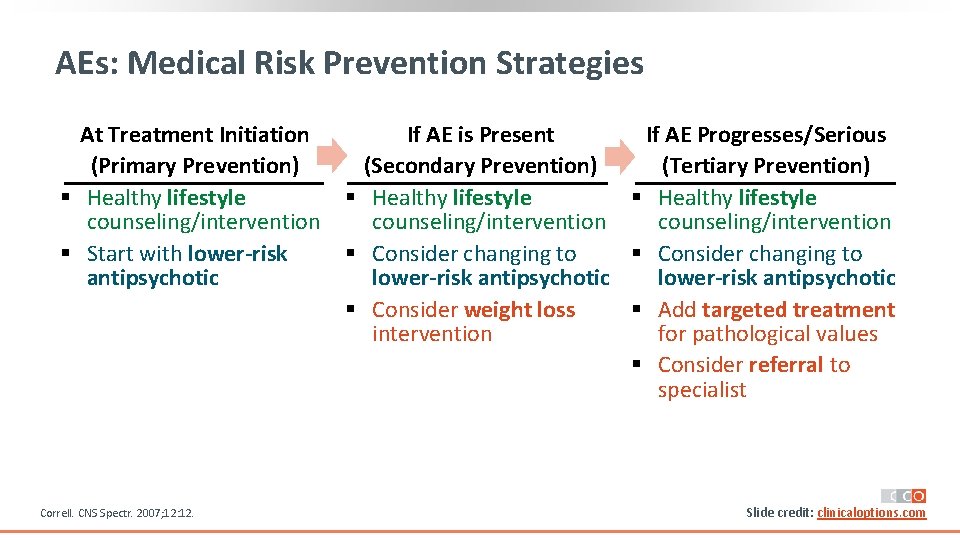
AEs: Medical Risk Prevention Strategies At Treatment Initiation (Primary Prevention) § Healthy lifestyle counseling/intervention § Start with lower-risk antipsychotic Correll. CNS Spectr. 2007; 12: 12. If AE is Present If AE Progresses/Serious (Secondary Prevention) (Tertiary Prevention) § Healthy lifestyle counseling/intervention § Consider changing to lower-risk antipsychotic § Consider weight loss § Add targeted treatment intervention for pathological values § Consider referral to specialist Slide credit: clinicaloptions. com
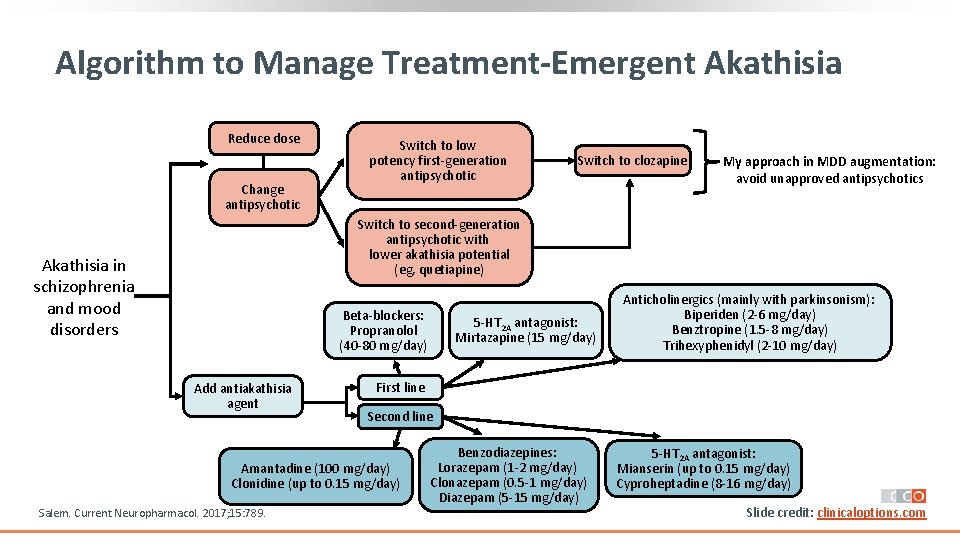
Algorithm to Manage Treatment-Emergent Akathisia Reduce dose Change antipsychotic Switch to low potency first‐generation antipsychotic Switch to clozapine My approach in MDD augmentation: avoid unapproved antipsychotics Switch to second‐generation antipsychotic with lower akathisia potential (eg, quetiapine) Akathisia in schizophrenia and mood disorders Beta‐blockers: Propranolol (40‐ 80 mg/day) Add antiakathisia agent First line Second line Amantadine (100 mg/day) Clonidine (up to 0. 15 mg/day) Salem. Current Neuropharmacol. 2017; 15: 789. 5‐HT 2 A antagonist: Mirtazapine (15 mg/day) Anticholinergics (mainly with parkinsonism): Biperiden (2‐ 6 mg/day) Benztropine (1. 5‐ 8 mg/day) Trihexyphenidyl (2‐ 10 mg/day) Benzodiazepines: Lorazepam (1‐ 2 mg/day) Clonazepam (0. 5‐ 1 mg/day) Diazepam (5‐ 15 mg/day) 5‐HT 2 A antagonist: Mianserin (up to 0. 15 mg/day) Cyproheptadine (8‐ 16 mg/day) Slide credit: clinicaloptions. com
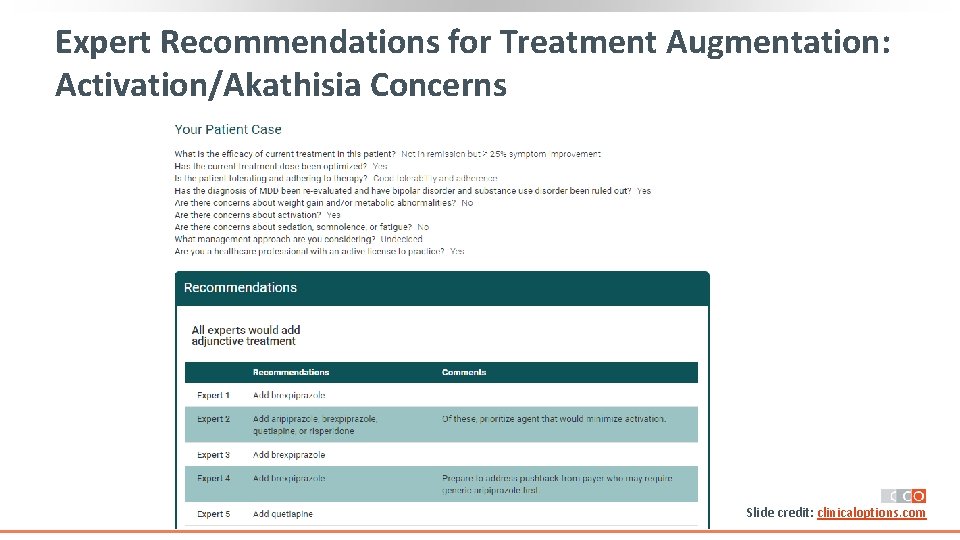
Expert Recommendations for Treatment Augmentation: Activation/Akathisia Concerns Slide credit: clinicaloptions. com
Second-Generation Antipsychotics: Sexual AEs § Review based on few systemic studies[1] Antipsychotic Agent Clozapine Olanzapine Risperidone Ziprasidone Sulpiride Quetiapine Libido/Arousal Orgasm Sedation Weight Other ↓↓ ↓ ↓ ↑↑↑ ↑ ↑ ↑↑ ↑↑↑ ↑ (↑) ↑ ↑ Priapism Symbols: ↓ = inhibits/reduces; ↑ = promotes/increases. § Aripiprazole, brexpiprazole also associated with sedation and weight gain, but no evidence of sexual dysfunction in registration trials[2‐ 4] 1. Kristensen E. Dan Med Bull. 2002; 49: 349. 2. Fava. Prim Care Companion CNS Disord. 2011; 13: PCC. 10 m 00994. 3. Pillinger. Lancet Psychiatry. 2020; 7: 64. 4. Brexpiprazole Prescribing Information. Slide credit: clinicaloptions. com
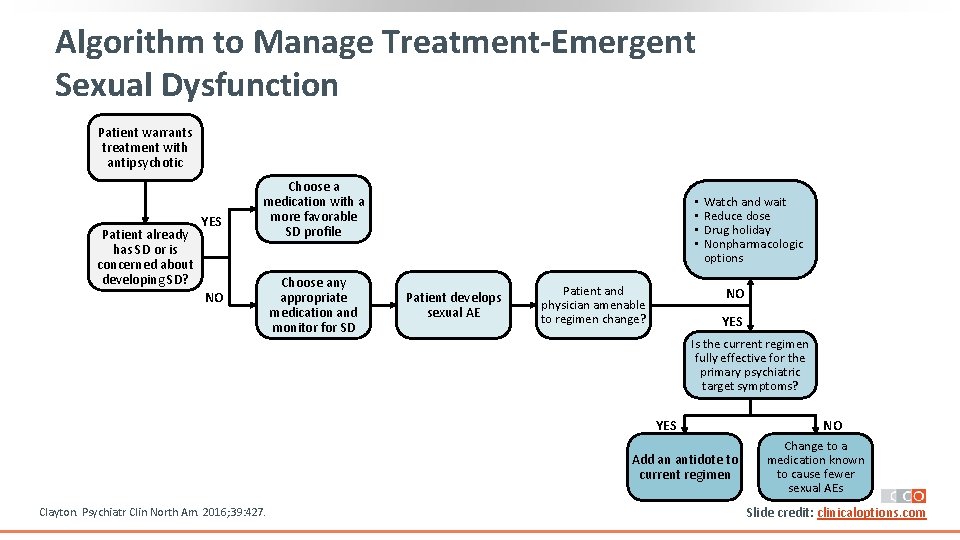
Algorithm to Manage Treatment-Emergent Sexual Dysfunction Patient warrants treatment with antipsychotic Patient already has SD or is concerned about developing SD? YES Choose a medication with a more favorable SD profile NO Choose any appropriate medication and monitor for SD • • Patient develops sexual AE Patient and physician amenable to regimen change? Watch and wait Reduce dose Drug holiday Nonpharmacologic options NO YES Is the current regimen fully effective for the primary psychiatric target symptoms? YES Add an antidote to current regimen Clayton. Psychiatr Clin North Am. 2016; 39: 427. NO Change to a medication known to cause fewer sexual AEs Slide credit: clinicaloptions. com
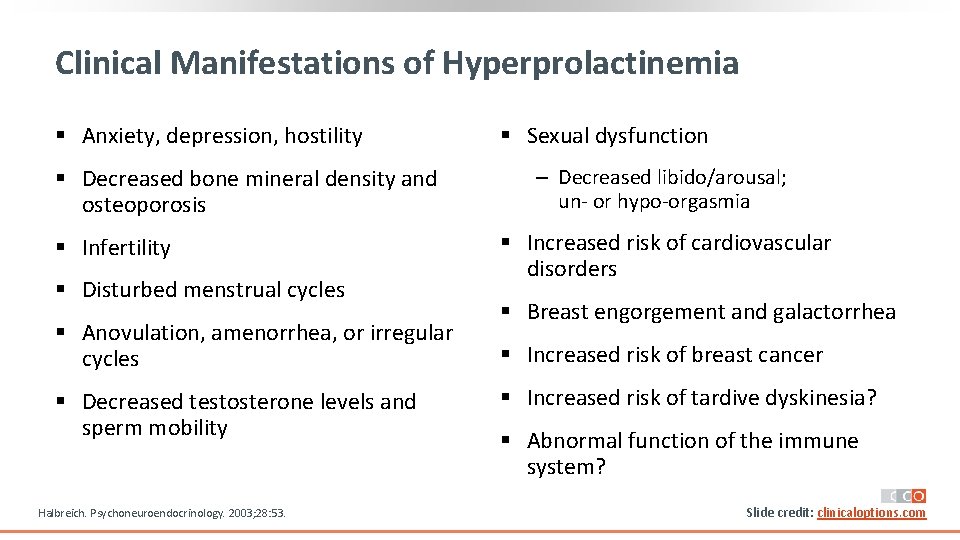
Clinical Manifestations of Hyperprolactinemia § Anxiety, depression, hostility § Decreased bone mineral density and osteoporosis § Infertility § Disturbed menstrual cycles § Anovulation, amenorrhea, or irregular cycles § Decreased testosterone levels and sperm mobility Halbreich. Psychoneuroendocrinology. 2003; 28: 53. § Sexual dysfunction ‒ Decreased libido/arousal; un‐ or hypo‐orgasmia § Increased risk of cardiovascular disorders § Breast engorgement and galactorrhea § Increased risk of breast cancer § Increased risk of tardive dyskinesia? § Abnormal function of the immune system? Slide credit: clinicaloptions. com
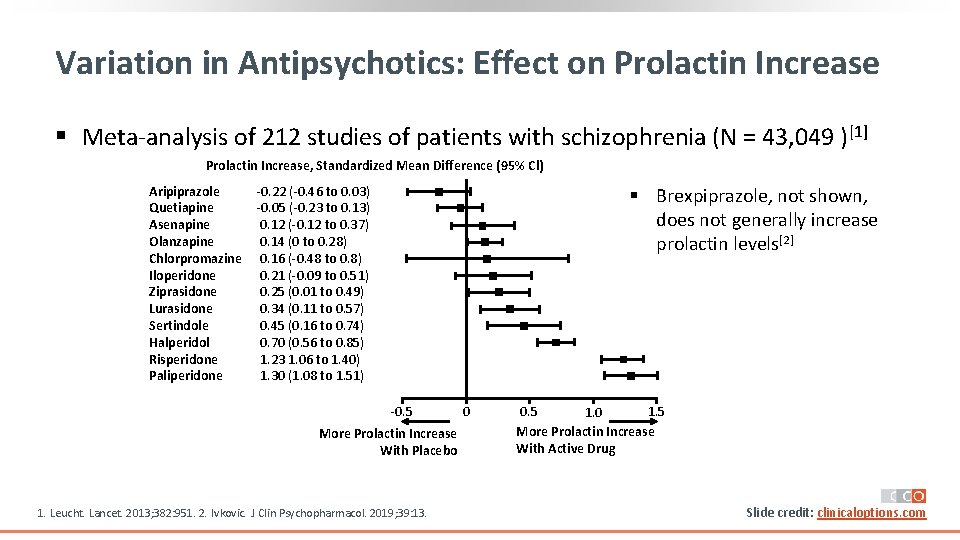
Variation in Antipsychotics: Effect on Prolactin Increase § Meta‐analysis of 212 studies of patients with schizophrenia (N = 43, 049 )[1] Prolactin Increase, Standardized Mean Difference (95% Cl) Aripiprazole Quetiapine Asenapine Olanzapine Chlorpromazine Iloperidone Ziprasidone Lurasidone Sertindole Halperidol Risperidone Paliperidone ‐ 0. 22 (‐ 0. 46 to 0. 03) ‐ 0. 05 (‐ 0. 23 to 0. 13) 0. 12 (‐ 0. 12 to 0. 37) 0. 14 (0 to 0. 28) 0. 16 (‐ 0. 48 to 0. 8) 0. 21 (‐ 0. 09 to 0. 51) 0. 25 (0. 01 to 0. 49) 0. 34 (0. 11 to 0. 57) 0. 45 (0. 16 to 0. 74) 0. 70 (0. 56 to 0. 85) 1. 23 1. 06 to 1. 40) 1. 30 (1. 08 to 1. 51) § Brexpiprazole, not shown, does not generally increase prolactin levels[2] ‐ 0. 5 More Prolactin Increase With Placebo 1. Leucht. Lancet. 2013; 382: 951. 2. Ivkovic. J Clin Psychopharmacol. 2019; 39: 13. 0 0. 5 1. 0 More Prolactin Increase With Active Drug Slide credit: clinicaloptions. com
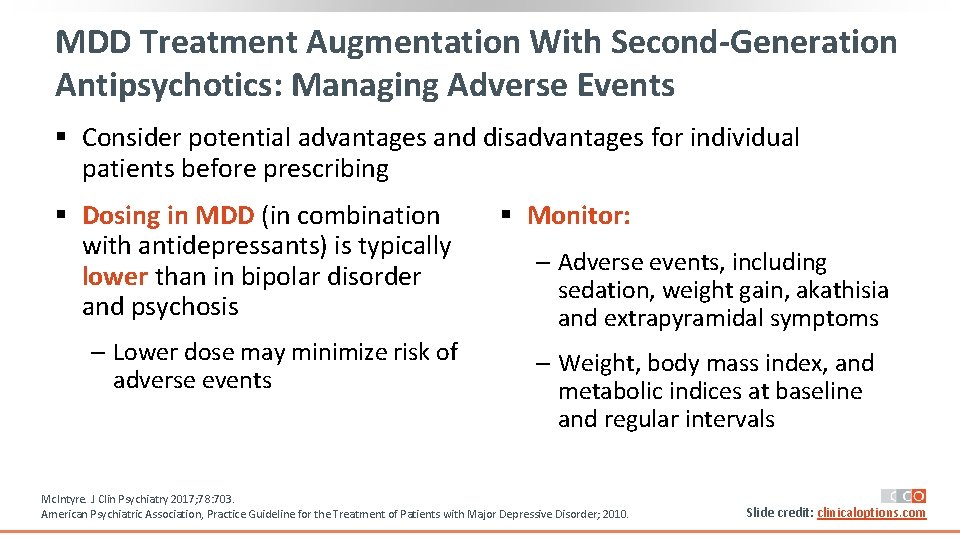
MDD Treatment Augmentation With Second-Generation Antipsychotics: Managing Adverse Events § Consider potential advantages and disadvantages for individual patients before prescribing § Dosing in MDD (in combination with antidepressants) is typically lower than in bipolar disorder and psychosis ‒ Lower dose may minimize risk of adverse events § Monitor: ‒ Adverse events, including sedation, weight gain, akathisia and extrapyramidal symptoms ‒ Weight, body mass index, and metabolic indices at baseline and regular intervals Mc. Intyre. J Clin Psychiatry 2017; 78: 703. American Psychiatric Association, Practice Guideline for the Treatment of Patients with Major Depressive Disorder; 2010. Slide credit: clinicaloptions. com
Summary § Goal of treating major depression remains full symptomatic and functional remission and recovery § 4 second‐generation antipsychotics are approved by the FDA for use as antidepressant augmentation ‒ All have demonstrated efficacy § Adverse events often manageable with short‐ and long‐term vigilance ‒ Weight gain, hyperprolactinemia, sexual dysfunction, tardive dyskinesia, are among the issues to monitor Slide credit: clinicaloptions. com
Go Online for More CCO Coverage of Depression! CME-certified activities with expert faculty commentary Additional unlocked slidesets with key information Interactive Decision Support Tool on when to augment or switch MDD treatment clinicaloptions. com/internalmedicine