
Recent EMEP MSCW model developments to improve secondary

- Slides: 18
Recent EMEP MSC-W model developments to improve secondary inorganic aerosols Presented by Svetlana Tsyro TFMM 20 -th meeting Madrid, May 7 -9, 2019
Recent and ongoing activities (which should be) contributing to SIA improvement ❑Finer model resolution: 0. 1 x 0. 1° and 50 m lowest layer ❑Finer resolution of national emissions : 0. 1 x 0. 1° ❑ Bi Directional Ammonia fluxes (David Simpson in cooperation with TNO) ❑ EQSAM 4 clim - new thermodynamic equilibrium model
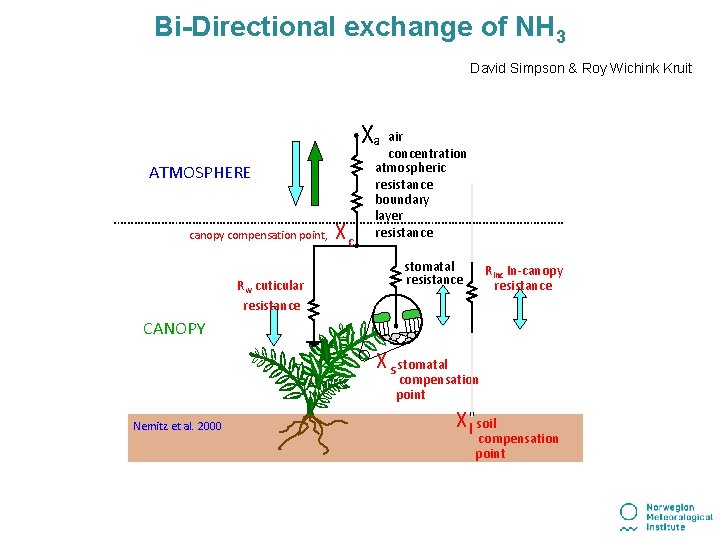
Bi-Directional exchange of NH 3 David Simpson & Roy Wichink Kruit χa ATMOSPHERE canopy compensation point, χ c air concentration atmospheric resistance boundary layer resistance stomatal resistance Rw cuticular resistance Rinc In-canopy resistance CANOPY χ s stomatal compensation point Nemitz et al. 2000 χ l soil compensation point
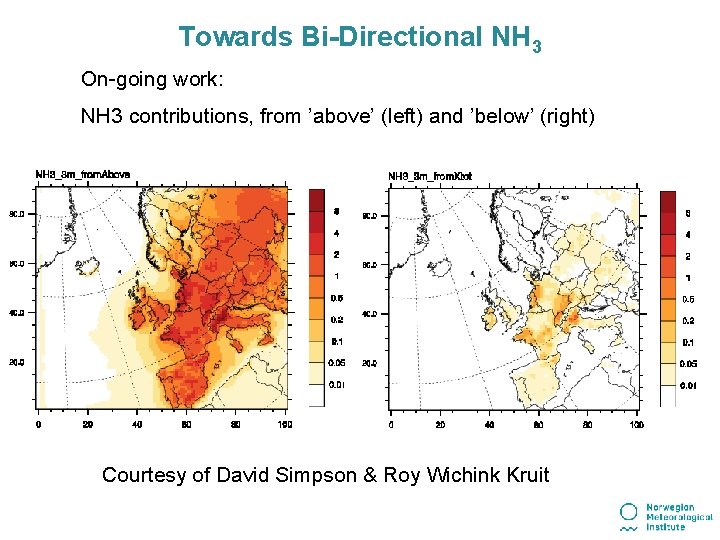
Towards Bi-Directional NH 3 On-going work: NH 3 contributions, from ’above’ (left) and ’below’ (right) Courtesy of David Simpson & Roy Wichink Kruit
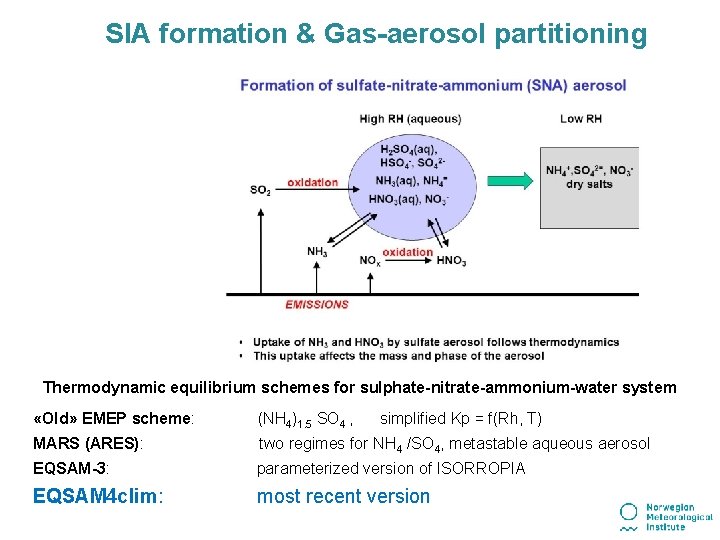
SIA formation & Gas-aerosol partitioning Thermodynamic equilibrium schemes for sulphate-nitrate-ammonium-water system «Old» EMEP scheme: (NH 4)1. 5 SO 4 , simplified Kp = f(Rh, T) MARS (ARES): two regimes for NH 4 /SO 4, metastable aqueous aerosol EQSAM-3: parameterized version of ISORROPIA EQSAM 4 clim: most recent version
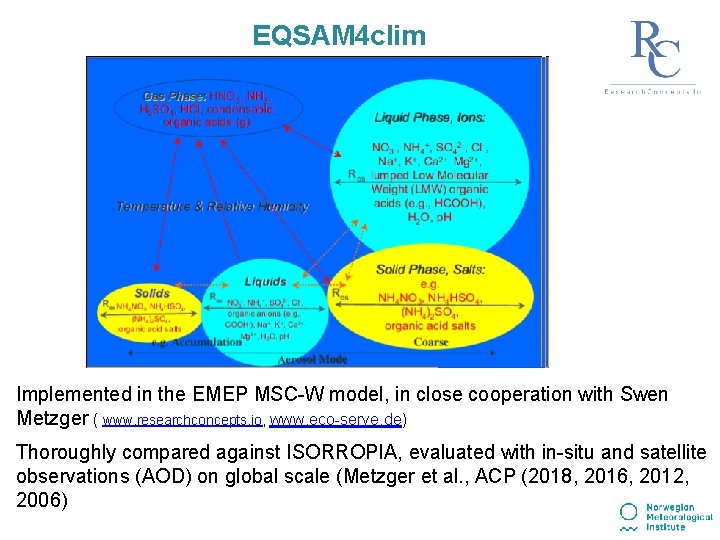
EQSAM 4 clim Implemented in the EMEP MSC-W model, in close cooperation with Swen Metzger ( www. researchconcepts. io, www. eco-serve. de) Thoroughly compared against ISORROPIA, evaluated with in-situ and satellite observations (AOD) on global scale (Metzger et al. , ACP (2018, 2016, 2012, 2006)
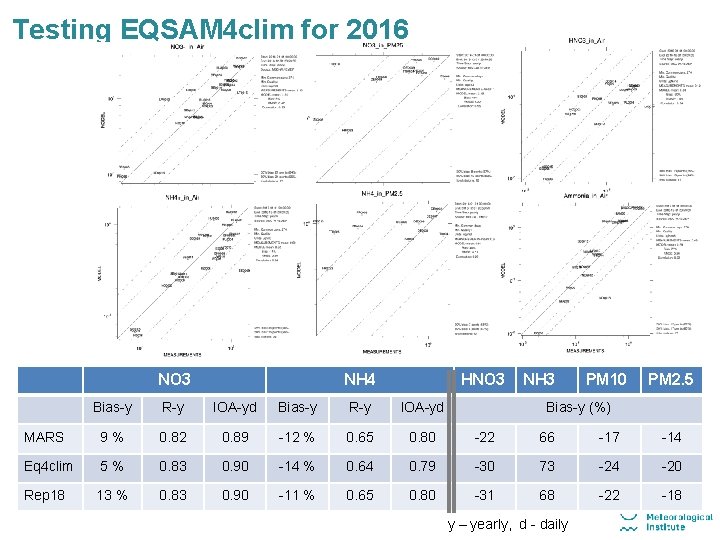
Testing EQSAM 4 clim for 2016 NO 3 NH 4 HNO 3 NH 3 PM 10 PM 2. 5 Bias-y R-y IOA-yd Bias-y (%) MARS 9% 0. 82 0. 89 -12 % 0. 65 0. 80 -22 66 -17 -14 Eq 4 clim 5% 0. 83 0. 90 -14 % 0. 64 0. 79 -30 73 -24 -20 Rep 18 13 % 0. 83 0. 90 -11 % 0. 65 0. 80 -31 68 -22 -18 y – yearly, d - daily
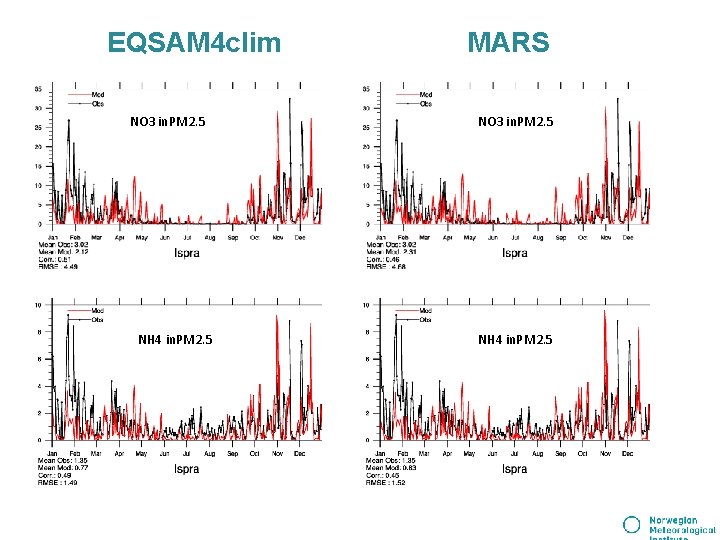
EQSAM 4 clim NO 3 in. PM 2. 5 NH 4 in. PM 2. 5 MARS NO 3 in. PM 2. 5 NH 4 in. PM 2. 5
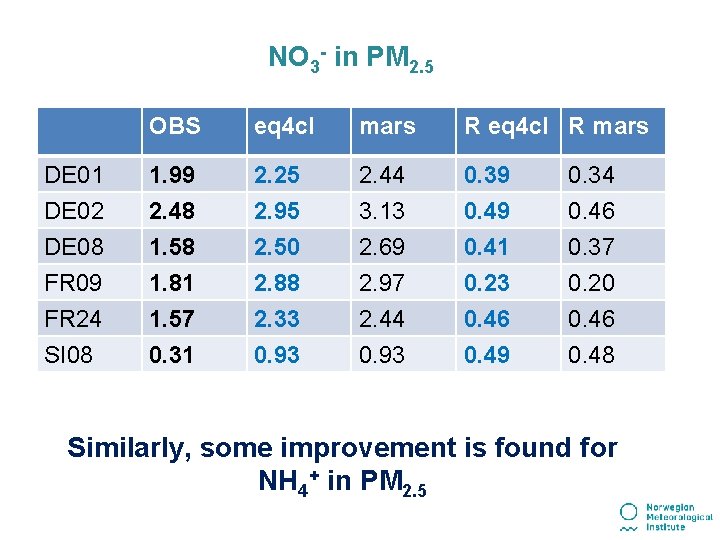
NO 3 - in PM 2. 5 OBS eq 4 cl mars R eq 4 cl R mars DE 01 1. 99 2. 25 2. 44 0. 39 0. 34 DE 02 2. 48 2. 95 3. 13 0. 49 0. 46 DE 08 1. 58 2. 50 2. 69 0. 41 0. 37 FR 09 1. 81 2. 88 2. 97 0. 23 0. 20 FR 24 1. 57 2. 33 2. 44 0. 46 SI 08 0. 31 0. 93 0. 49 0. 48 Similarly, some improvement is found for NH 4+ in PM 2. 5
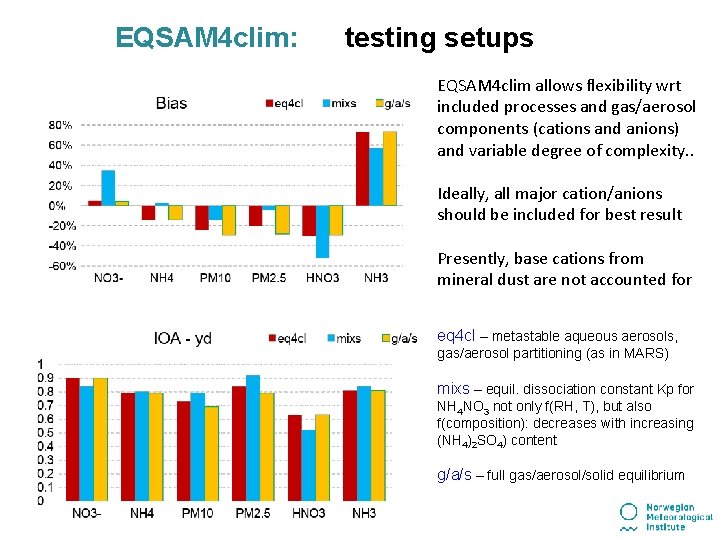
EQSAM 4 clim: testing setups EQSAM 4 clim allows flexibility wrt included processes and gas/aerosol components (cations and anions) and variable degree of complexity. . Ideally, all major cation/anions should be included for best result Presently, base cations from mineral dust are not accounted for eq 4 cl – metastable aqueous aerosols, gas/aerosol partitioning (as in MARS) mixs – equil. dissociation constant Kp for NH 4 NO 3 not only f(RH, T), but also f(composition): decreases with increasing (NH 4)2 SO 4) content g/a/s – full gas/aerosol/solid equilibrium
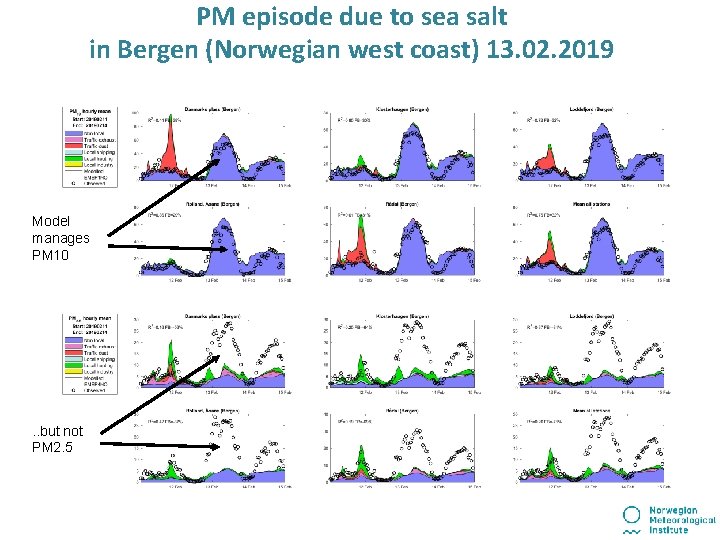
PM episode due to sea salt in Bergen (Norwegian west coast) 13. 02. 2019 Model manages PM 10 . . but not PM 2. 5
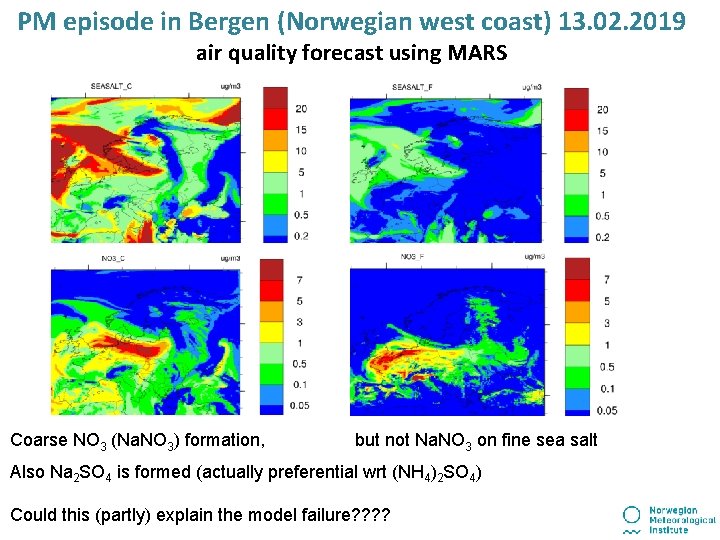
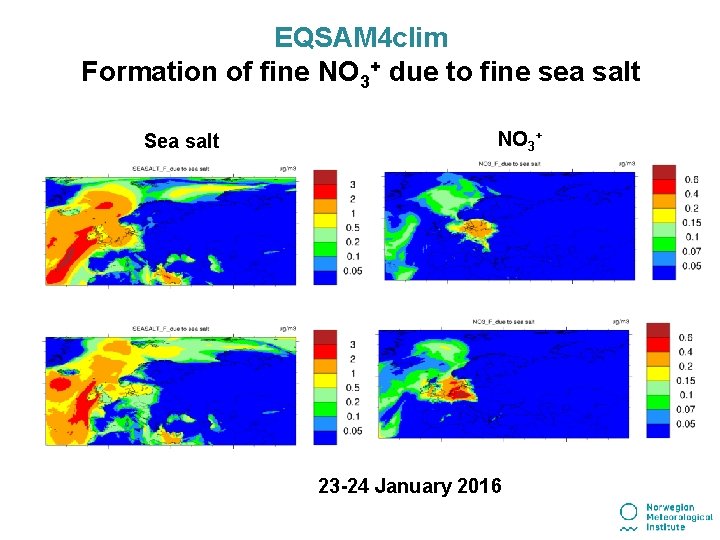
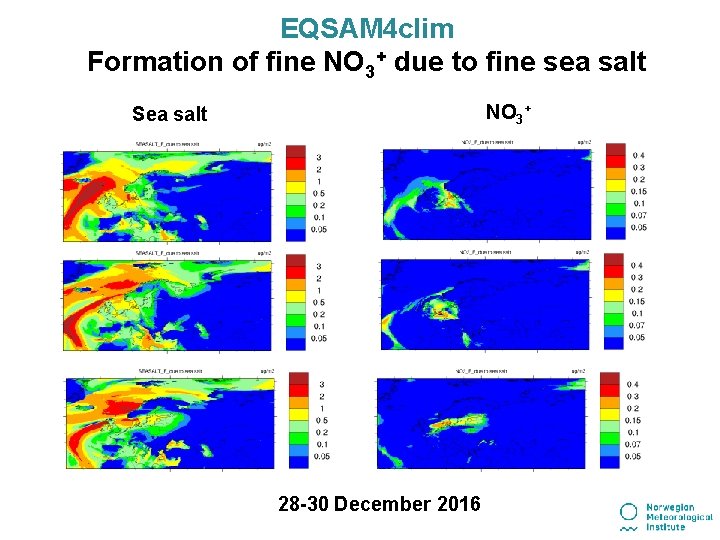
PM episode in Bergen (Norwegian west coast) 13. 02. 2019 air quality forecast using MARS Coarse NO 3 (Na. NO 3) formation, but not Na. NO 3 on fine sea salt Also Na 2 SO 4 is formed (actually preferential wrt (NH 4)2 SO 4) Could this (partly) explain the model failure? ?
EQSAM 4 clim Formation of fine NO 3+ due to fine sea salt Sea salt NO 3+ 23 -24 January 2016
EQSAM 4 clim Formation of fine NO 3+ due to fine sea salt NO 3+ Sea salt 28 -30 December 2016
Summary and outlook ★ The latest version of EQSAM - EQSAM 4 clim - has been implemented in the EMEP MSC-W model ★ Initial tests give positive results: - evaluation for 2016 - similar compared to MARS - inclusion of sea spray Na. Cl in the equilibrium allows formation of Na 2 SO 4 and Na. NO 3 (which can be important in coastal sea salt influenced regions) - several setups for equilibrium system complexity are tested needs more study for diff regions (episodes!!), evaluation with observations (ACSM data, gas/aerosol ) - more accurate calculation of PM water is expected, but depends on the setup (=completeness of cation/anion system)
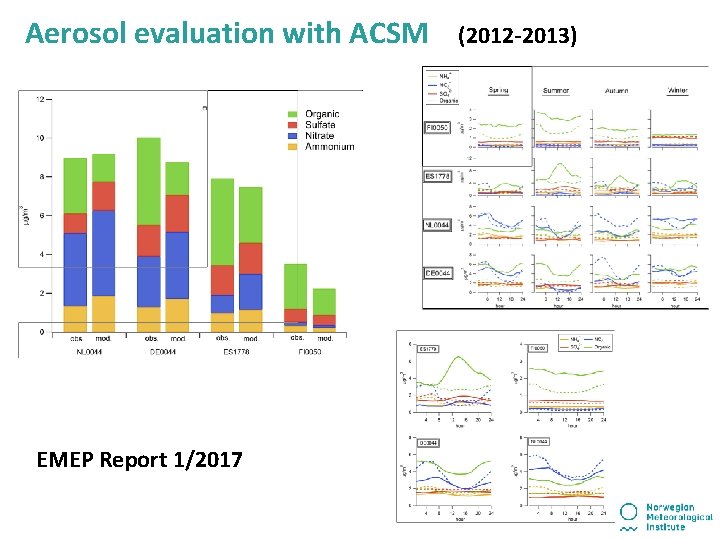
Aerosol evaluation with ACSM EMEP Report 1/2017 (2012 -2013)
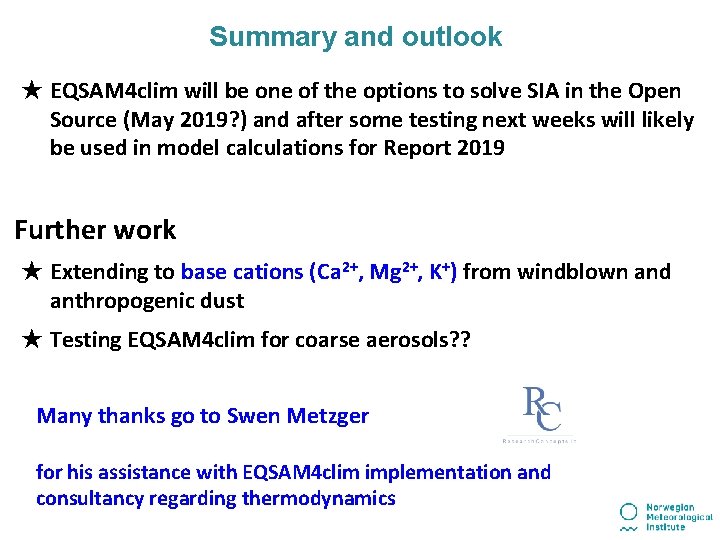
Summary and outlook ★ EQSAM 4 clim will be one of the options to solve SIA in the Open Source (May 2019? ) and after some testing next weeks will likely be used in model calculations for Report 2019 Further work ★ Extending to base cations (Ca 2+, Mg 2+, K+) from windblown and anthropogenic dust ★ Testing EQSAM 4 clim for coarse aerosols? ? Many thanks go to Swen Metzger for his assistance with EQSAM 4 clim implementation and consultancy regarding thermodynamics
Muchas gracias!