
RECENT ECONOMIC DEVELOPMENT BANK INDONESIAS SUPPORT FOR INVESTMENT
RECENT ECONOMIC DEVELOPMENT & BANK INDONESIA’S SUPPORT FOR INVESTMENT DEVELOPMENT Central Java Investment Business Forum 2018 “Developing Investment & Business in Tourism and Industrial Sectors in Central Java” 26 th November 2018 PERRY WARJIYO, Ph. D Governor
OUTLINE Recent Global and Domestic Economic Development Bank Indonesia Policy Mix Response to Strengthen External Resilience and Maintain Stability Bank Indonesia support for Investment Development
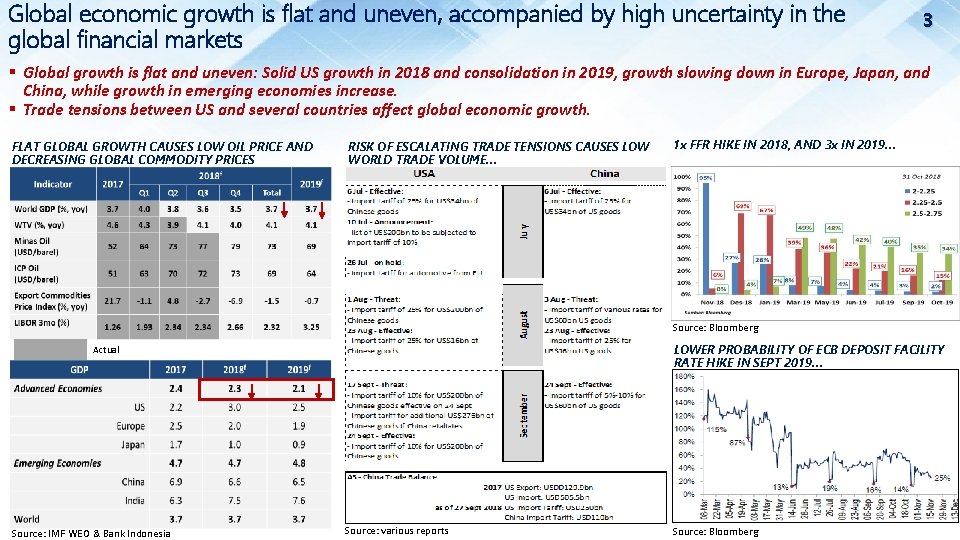
Global economic growth is flat and uneven, accompanied by high uncertainty in the global financial markets 3 § Global growth is flat and uneven: Solid US growth in 2018 and consolidation in 2019, growth slowing down in Europe, Japan, and China, while growth in emerging economies increase. § Trade tensions between US and several countries affect global economic growth. FLAT GLOBAL GROWTH CAUSES LOW OIL PRICE AND DECREASING GLOBAL COMMODITY PRICES RISK OF ESCALATING TRADE TENSIONS CAUSES LOW WORLD TRADE VOLUME… 1 x FFR HIKE IN 2018, AND 3 x IN 2019… Source: Bloomberg LOWER PROBABILITY OF ECB DEPOSIT FACILITY RATE HIKE IN SEPT 2019… Actual Source: IMF WEO & Bank Indonesia Source: various reports Source: Bloomberg
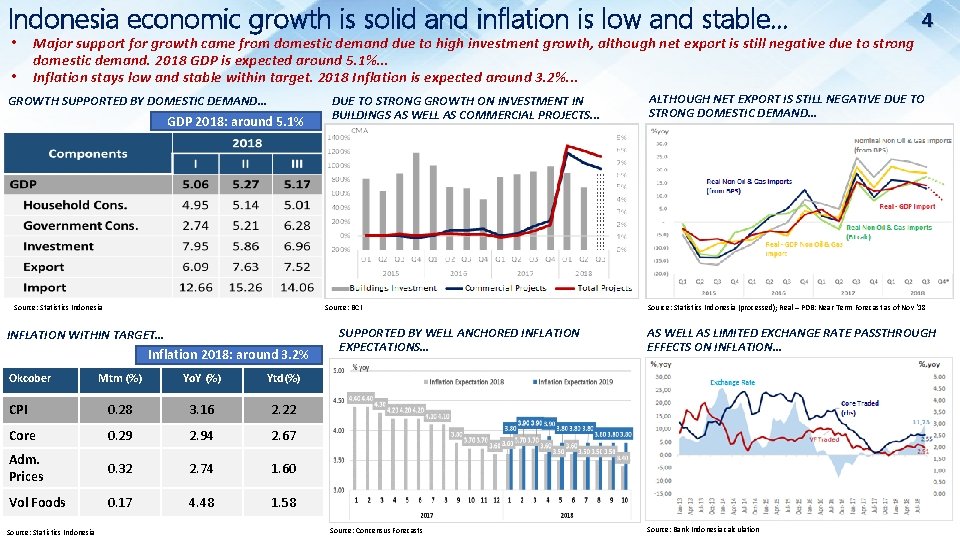
Indonesia economic growth is solid and inflation is low and stable… • • 4 Major support for growth came from domestic demand due to high investment growth, although net export is still negative due to strong domestic demand. 2018 GDP is expected around 5. 1%. . . Inflation stays low and stable within target. 2018 Inflation is expected around 3. 2%. . . GROWTH SUPPORTED BY DOMESTIC DEMAND… GDP 2018: around 5. 1% Source: Statistics Indonesia Source: BCI INFLATION WITHIN TARGET… Inflation 2018: around 3. 2% Okcober Mtm (%) Yo. Y (%) Ytd(%) CPI 0. 28 3. 16 2. 22 Core 0. 29 2. 94 2. 67 Adm. Prices 0. 32 2. 74 1. 60 Vol Foods 0. 17 4. 48 1. 58 Source: Statistics Indonesia DUE TO STRONG GROWTH ON INVESTMENT IN BUILDINGS AS WELL AS COMMERCIAL PROJECTS. . . SUPPORTED BY WELL ANCHORED INFLATION EXPECTATIONS… Source: Concensus Forecasts ALTHOUGH NET EXPORT IS STILL NEGATIVE DUE TO STRONG DOMESTIC DEMAND… Source: Statistics Indonesia (processed); Real – PDB: Near Term Forecast as of Nov ‘ 18 AS WELL AS LIMITED EXCHANGE RATE PASSTHROUGH EFFECTS ON INFLATION… Source: Bank Indonesia calculation
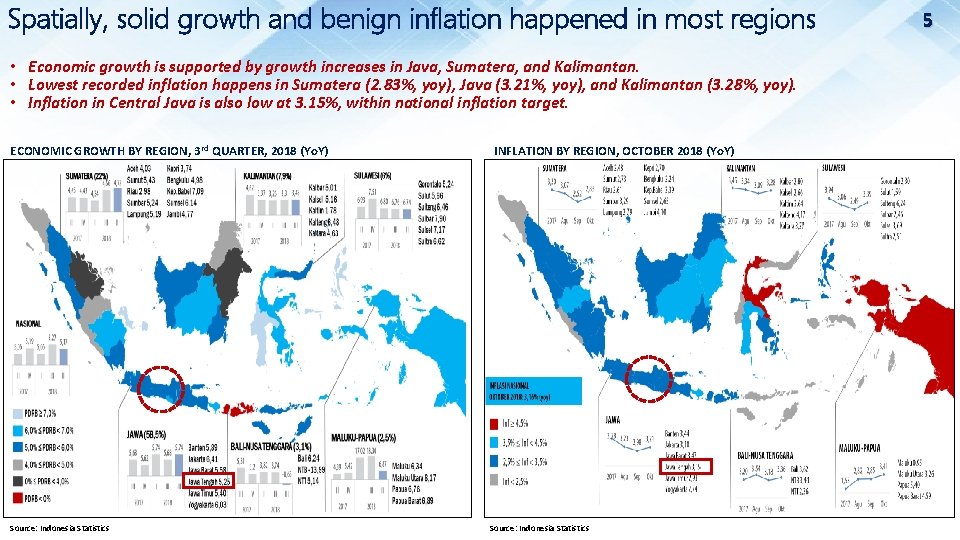
Spatially, solid growth and benign inflation happened in most regions • Economic growth is supported by growth increases in Java, Sumatera, and Kalimantan. • Lowest recorded inflation happens in Sumatera (2. 83%, yoy), Java (3. 21%, yoy), and Kalimantan (3. 28%, yoy). • Inflation in Central Java is also low at 3. 15%, within national inflation target. ECONOMIC GROWTH BY REGION, 3 rd QUARTER, 2018 (Yo. Y) Source: Indonesia Statistics INFLATION BY REGION, OCTOBER 2018 (Yo. Y) Source: Indonesia Statistics 5
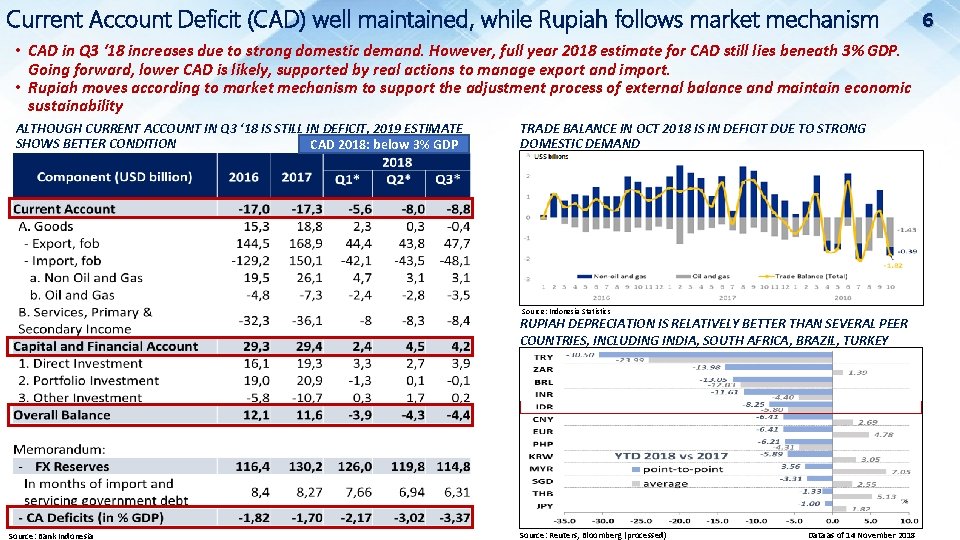
Current Account Deficit (CAD) well maintained, while Rupiah follows market mechanism • CAD in Q 3 ‘ 18 increases due to strong domestic demand. However, full year 2018 estimate for CAD still lies beneath 3% GDP. Going forward, lower CAD is likely, supported by real actions to manage export and import. • Rupiah moves according to market mechanism to support the adjustment process of external balance and maintain economic sustainability ALTHOUGH CURRENT ACCOUNT IN Q 3 ‘ 18 IS STILL IN DEFICIT, 2019 ESTIMATE SHOWS BETTER CONDITION CAD 2018: below 3% GDP TRADE BALANCE IN OCT 2018 IS IN DEFICIT DUE TO STRONG DOMESTIC DEMAND Source: Indonesia Statistics RUPIAH DEPRECIATION IS RELATIVELY BETTER THAN SEVERAL PEER COUNTRIES, INCLUDING INDIA, SOUTH AFRICA, BRAZIL, TURKEY Source: Bank Indonesia Source: Reuters, Bloomberg (processed) Data as of 14 November 2018 6

External Shocks’ Mitigation: Multi Layered Safety Net 1 st Line of Defense: National FX Reserves Accumulation, Prudential Management, and Strong Institutional Capacity RESERVES BUFFER IS ADEQUATE… REGULATION ON PRUDENTIAL PRINCIPLES IN MANAGING EXTERNAL DEBT Month US$ billions Official Reserves Month of Import and Govt. Debt Payments (rhs) 150 9 115 120 90 8 7 6. 2 60 6 30 5 0 4 1 2 3 4 5 6 7 8 9 10 11 12 1 2 3 4 5 6 7 8 9 10 2016 2017 2018 Source: Bank Indonesia South Korea • US$22. 76 billion swap line with Japan currently in place • The size of the swap line was increased from US$12 billion in Dec 2013 • Renewed a 3 year KRW/IDR swap arr. up to KRW 10. 7 tn / IDR 115 tn in Mar 2017 Australia Singapore China • Established a 3 year A$/IDR swap arr. up to A$ 10 bn / IDR 100 tn in Dec 2015 • Repo and Local Currency Swap Arr. equivalent to USD 10 bn in Oct 2018 • Amendment of Bilateral Currency Swap Arr. equivalent to USD 30 bn in Nov 2018 Regional Chiang Mai Initiative Multilaterali zation (CMIM) • Entitled to a maximum swap amount of US$ 22. 76 bn under the ASEAN+3 (Japan, China, and Korea) FX reserves pool created under the agreement • Came into effect in 2010 with a pool of US$120 bn • Doubled to US$240 bn effective July 2014 Global 2 nd Line of Defense: Swap Bilateral, Regional, Global IMF Global Financial Safety Net (GFSN) • Indonesia is entitled to access IMF facilities for crisis prevention to address potential (actual) Bo. P problem • Such facilities include Flexible Credit Line (FCL) and Precautionary and Liquidity Line (PLL) Bilateral Japan Source: Bank Indonesia ENCOURAGING CORPORATE COMPLIANCE ON HEDGING RATIO AND LIQUIDITY RATIO… *Data as of Q 2 2018, total corporation: 2727 Source: Bank Indonesia 7
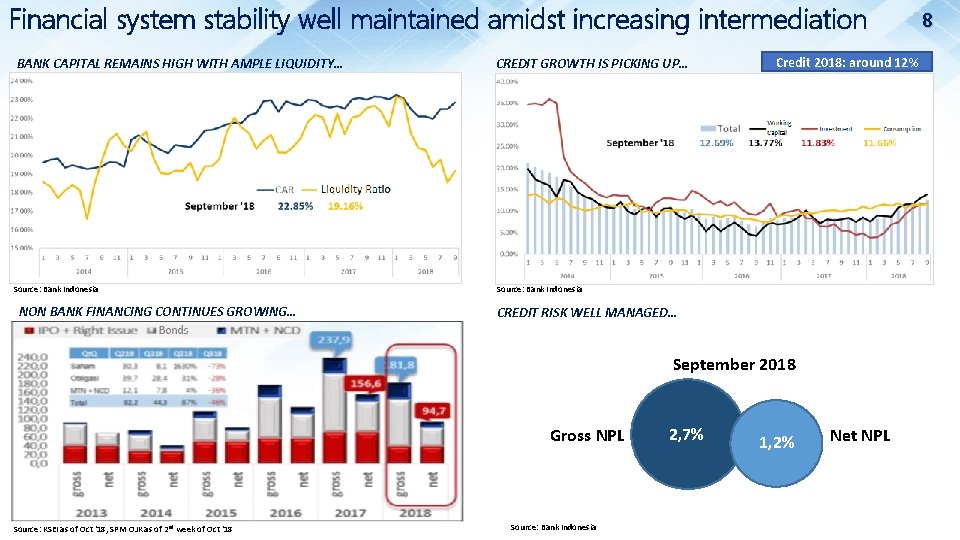
Financial system stability well maintained amidst increasing intermediation BANK CAPITAL REMAINS HIGH WITH AMPLE LIQUIDITY… Source: Bank Indonesia NON BANK FINANCING CONTINUES GROWING… CREDIT GROWTH IS PICKING UP… Credit 2018: around 12% Source: Bank Indonesia CREDIT RISK WELL MANAGED… September 2018 Gross NPL Source: KSEI as of Oct ‘ 18, SPM OJK as of 2 nd week of Oct ‘ 18 Source: Bank Indonesia 2, 7% 1, 2% Net NPL 8
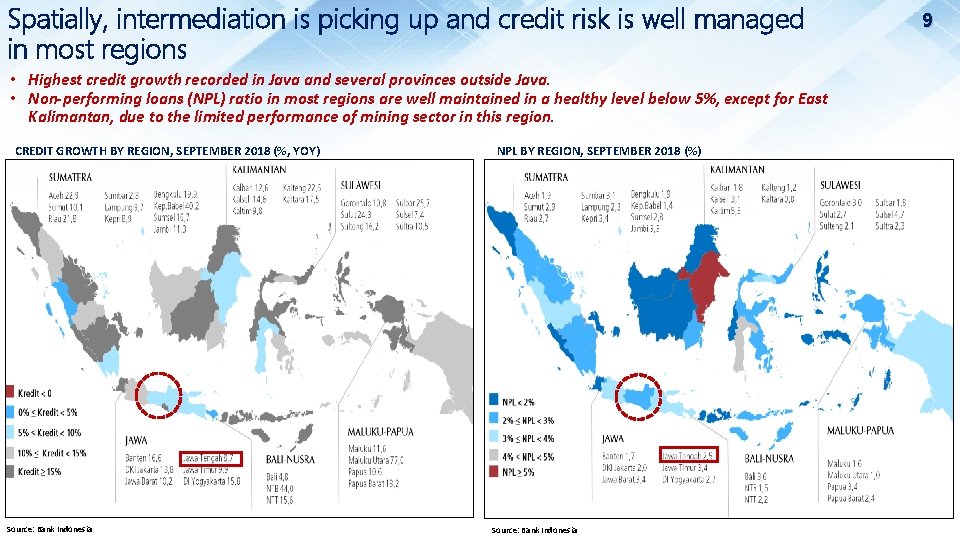
Spatially, intermediation is picking up and credit risk is well managed in most regions • Highest credit growth recorded in Java and several provinces outside Java. • Non-performing loans (NPL) ratio in most regions are well maintained in a healthy level below 5%, except for East Kalimantan, due to the limited performance of mining sector in this region. CREDIT GROWTH BY REGION, SEPTEMBER 2018 (%, YOY) Source: Bank Indonesia NPL BY REGION, SEPTEMBER 2018 (%) Source: Bank Indonesia 9
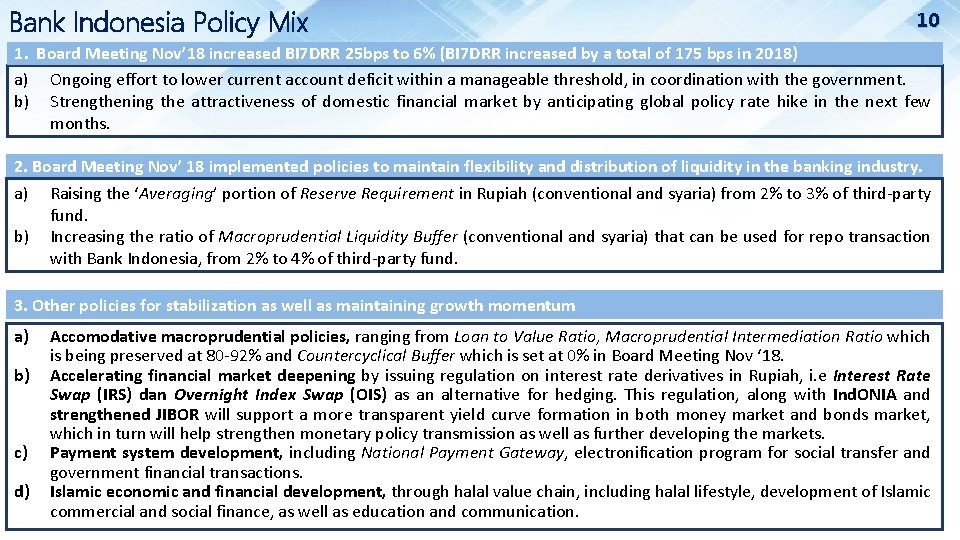
Bank Indonesia Policy Mix 10 1. Board Meeting Nov’ 18 increased BI 7 DRR 25 bps to 6% (BI 7 DRR increased by a total of 175 bps in 2018) a) Ongoing effort to lower current account deficit within a manageable threshold, in coordination with the government. b) Strengthening the attractiveness of domestic financial market by anticipating global policy rate hike in the next few months. 2. Board Meeting Nov’ 18 implemented policies to maintain flexibility and distribution of liquidity in the banking industry. a) b) Raising the ‘Averaging’ portion of Reserve Requirement in Rupiah (conventional and syaria) from 2% to 3% of third-party fund. Increasing the ratio of Macroprudential Liquidity Buffer (conventional and syaria) that can be used for repo transaction with Bank Indonesia, from 2% to 4% of third-party fund. 3. Other policies for stabilization as well as maintaining growth momentum a) b) c) d) Accomodative macroprudential policies, ranging from Loan to Value Ratio, Macroprudential Intermediation Ratio which is being preserved at 80 -92% and Countercyclical Buffer which is set at 0% in Board Meeting Nov ‘ 18. Accelerating financial market deepening by issuing regulation on interest rate derivatives in Rupiah, i. e Interest Rate Swap (IRS) dan Overnight Index Swap (OIS) as an alternative for hedging. This regulation, along with Ind. ONIA and strengthened JIBOR will support a more transparent yield curve formation in both money market and bonds market, which in turn will help strengthen monetary policy transmission as well as further developing the markets. Payment system development, including National Payment Gateway, electronification program for social transfer and government financial transactions. Islamic economic and financial development, through halal value chain, including halal lifestyle, development of Islamic commercial and social finance, as well as education and communication.
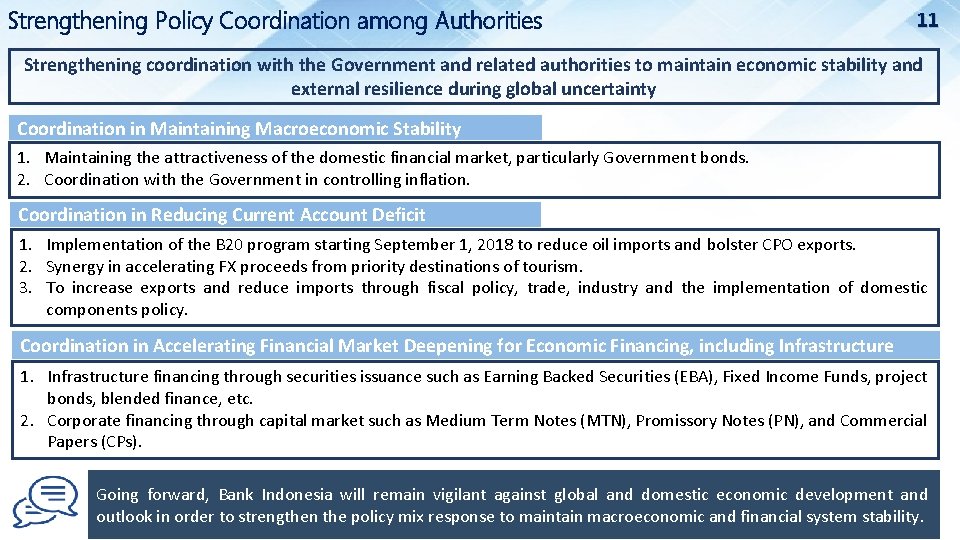
Strengthening Policy Coordination among Authorities 11 Strengthening coordination with the Government and related authorities to maintain economic stability and external resilience during global uncertainty Coordination in Maintaining Macroeconomic Stability 1. Maintaining the attractiveness of the domestic financial market, particularly Government bonds. 2. Coordination with the Government in controlling inflation. Coordination in Reducing Current Account Deficit 1. Implementation of the B 20 program starting September 1, 2018 to reduce oil imports and bolster CPO exports. 2. Synergy in accelerating FX proceeds from priority destinations of tourism. 3. To increase exports and reduce imports through fiscal policy, trade, industry and the implementation of domestic components policy. Coordination in Accelerating Financial Market Deepening for Economic Financing, including Infrastructure 1. Infrastructure financing through securities issuance such as Earning Backed Securities (EBA), Fixed Income Funds, project bonds, blended finance, etc. 2. Corporate financing through capital market such as Medium Term Notes (MTN), Promissory Notes (PN), and Commercial Papers (CPs). Going forward, Bank Indonesia will remain vigilant against global and domestic economic development and outlook in order to strengthen the policy mix response to maintain macroeconomic and financial system stability.
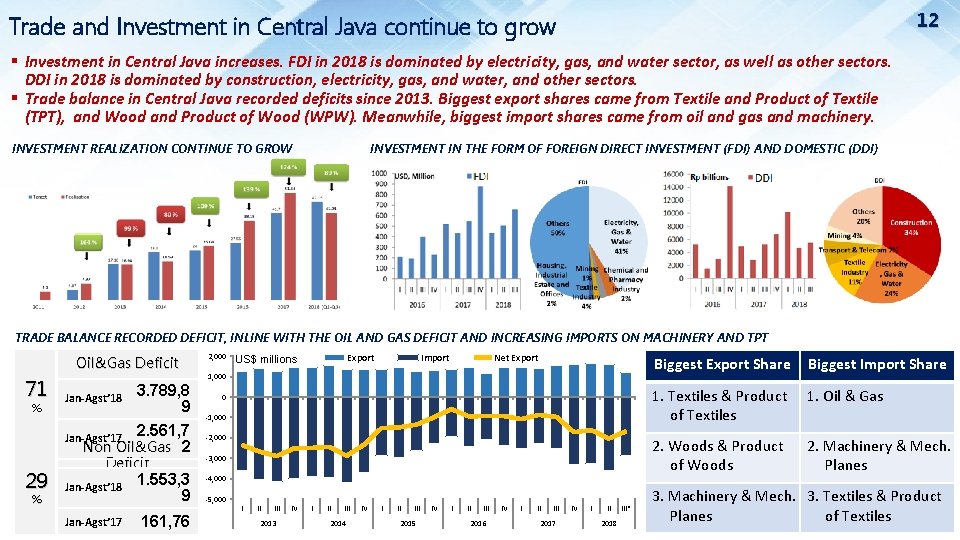
12 Trade and Investment in Central Java continue to grow § Investment in Central Java increases. FDI in 2018 is dominated by electricity, gas, and water sector, as well as other sectors. DDI in 2018 is dominated by construction, electricity, gas, and water, and other sectors. § Trade balance in Central Java recorded deficits since 2013. Biggest export shares came from Textile and Product of Textile (TPT), and Wood and Product of Wood (WPW). Meanwhile, biggest import shares came from oil and gas and machinery. INVESTMENT REALIZATION CONTINUE TO GROW INVESTMENT IN THE FORM OF FOREIGN DIRECT INVESTMENT (FDI) AND DOMESTIC (DDI) TRADE BALANCE RECORDED DEFICIT, INLINE WITH THE OIL AND GAS DEFICIT AND INCREASING IMPORTS ON MACHINERY AND TPT Oil&Gas Deficit 71 % 29 % 3. 789, 8 9 2. 561, 7 Jan-Agst’ 17 Non Oil&Gas 2 Jan-Agst’ 18 Deficit Jan-Agst’ 18 Jan-Agst’ 17 1. 553, 3 9 161, 76 2, 000 Export US$ millions Import Net Export 1, 000 0 -1, 000 -2, 000 -3, 000 -4, 000 -5, 000 I II III 2013 IV I II III 2014 IV I II III 2015 IV I II III 2016 IV I II III 2017 IV I II 2018 III* Biggest Export Share Biggest Import Share 1. Textiles & Product of Textiles 1. Oil & Gas 2. Woods & Product of Woods 2. Machinery & Mech. Planes 3. Machinery & Mech. 3. Textiles & Product Planes of Textiles
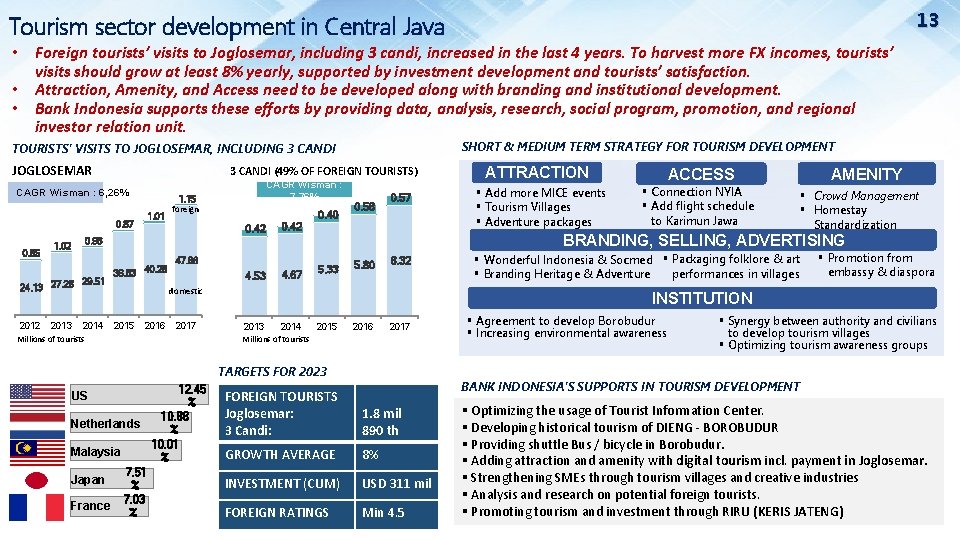
13 Tourism sector development in Central Java • Foreign tourists’ visits to Joglosemar, including 3 candi, increased in the last 4 years. To harvest more FX incomes, tourists’ visits should grow at least 8% yearly, supported by investment development and tourists’ satisfaction. • Attraction, Amenity, and Access need to be developed along with branding and institutional development. • Bank Indonesia supports these efforts by providing data, analysis, research, social program, promotion, and regional investor relation unit. SHORT & MEDIUM TERM STRATEGY FOR TOURISM DEVELOPMENT TOURISTS’ VISITS TO JOGLOSEMAR, INCLUDING 3 CANDI JOGLOSEMAR 3 CANDI (49% OF FOREIGN TOURISTS) CAGR Wisman : 6, 26% 0. 87 0. 85 1. 02 1. 01 1. 15 foreign CAGR Wisman : 7, 76% 0. 42 0. 40 0. 58 0. 57 29. 51 24. 13 27. 28 2012 2013 2014 Millions of tourists 47. 86 4. 53 4. 67 5. 33 5. 80 6. 32 domestic 2015 2016 2017 12. 45 % 10. 88 Netherlands % 10. 01 Malaysia % 7. 51 Japan % 7. 03 France % § Connection NYIA § Add flight schedule to Karimun Jawa AMENITY § Crowd Management § Homestay Standardization § Wonderful Indonesia & Socmed § Packaging folklore & art performances in villages § Branding Heritage & Adventure § Promotion from embassy & diaspora INSTITUTION 2013 2014 2015 Millions of tourists 2016 2017 TARGETS FOR 2023 US § Add more MICE events § Tourism Villages § Adventure packages ACCESS BRANDING, SELLING, ADVERTISING 0. 98 36. 83 40. 28 ATTRACTION § Agreement to develop Borobudur § Increasing environmental awareness § Synergy between authority and civilians to develop tourism villages § Optimizing tourism awareness groups BANK INDONESIA’S SUPPORTS IN TOURISM DEVELOPMENT FOREIGN TOURISTS Joglosemar: 3 Candi: 1. 8 mil 890 th GROWTH AVERAGE 8% INVESTMENT (CUM) USD 311 mil FOREIGN RATINGS Min 4. 5 § Optimizing the usage of Tourist Information Center. § Developing historical tourism of DIENG - BOROBUDUR § Providing shuttle Bus / bicycle in Borobudur. § Adding attraction and amenity with digital tourism incl. payment in Joglosemar. § Strengthening SMEs through tourism villages and creative industries § Analysis and research on potential foreign tourists. § Promoting tourism and investment through RIRU (KERIS JATENG)
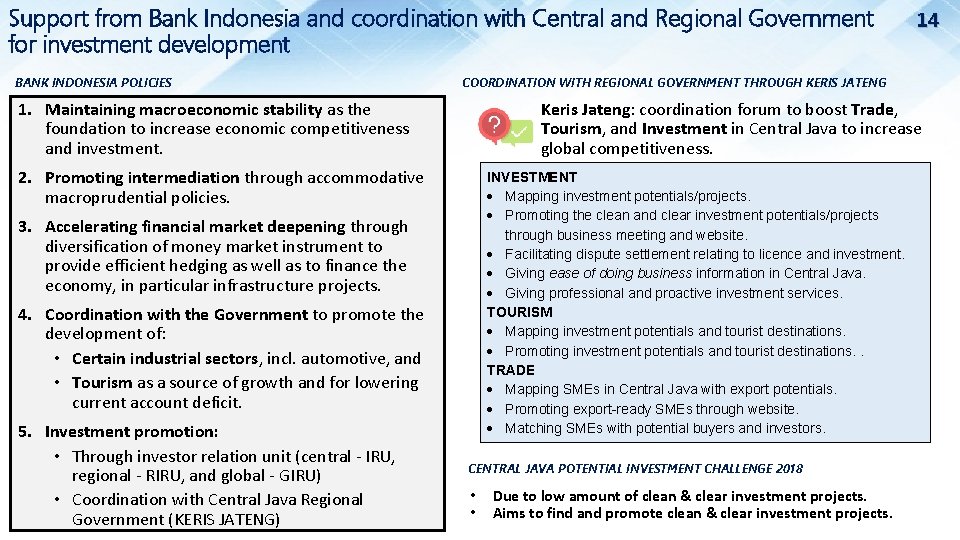
Support from Bank Indonesia and coordination with Central and Regional Government for investment development BANK INDONESIA POLICIES COORDINATION WITH REGIONAL GOVERNMENT THROUGH KERIS JATENG 1. Maintaining macroeconomic stability as the foundation to increase economic competitiveness and investment. Keris Jateng: coordination forum to boost Trade, Tourism, and Investment in Central Java to increase global competitiveness. 2. Promoting intermediation through accommodative macroprudential policies. INVESTMENT Mapping investment potentials/projects. Promoting the clean and clear investment potentials/projects through business meeting and website. Facilitating dispute settlement relating to licence and investment. Giving ease of doing business information in Central Java. Giving professional and proactive investment services. TOURISM Mapping investment potentials and tourist destinations. Promoting investment potentials and tourist destinations. . TRADE Mapping SMEs in Central Java with export potentials. Promoting export-ready SMEs through website. Matching SMEs with potential buyers and investors. 3. Accelerating financial market deepening through diversification of money market instrument to provide efficient hedging as well as to finance the economy, in particular infrastructure projects. 4. Coordination with the Government to promote the development of: • Certain industrial sectors, incl. automotive, and • Tourism as a source of growth and for lowering current account deficit. 5. Investment promotion: • Through investor relation unit (central - IRU, regional - RIRU, and global - GIRU) • Coordination with Central Java Regional Government (KERIS JATENG) 14 CENTRAL JAVA POTENTIAL INVESTMENT CHALLENGE 2018 • • Due to low amount of clean & clear investment projects. Aims to find and promote clean & clear investment projects.
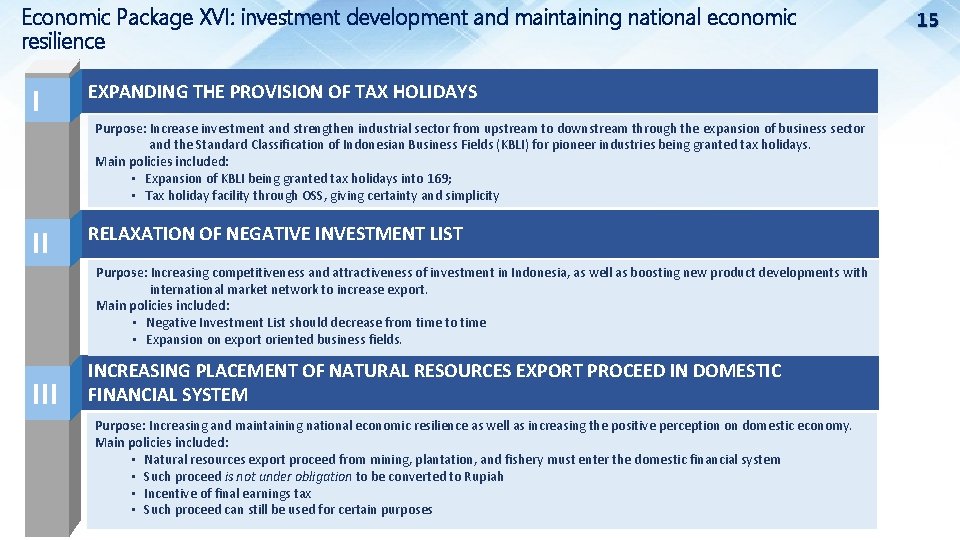
Economic Package XVI: investment development and maintaining national economic resilience I EXPANDING THE PROVISION OF TAX HOLIDAYS Purpose: Increase investment and strengthen industrial sector from upstream to downstream through the expansion of business sector and the Standard Classification of Indonesian Business Fields (KBLI) for pioneer industries being granted tax holidays. Main policies included: • Expansion of KBLI being granted tax holidays into 169; • Tax holiday facility through OSS, giving certainty and simplicity II RELAXATION OF NEGATIVE INVESTMENT LIST Purpose: Increasing competitiveness and attractiveness of investment in Indonesia, as well as boosting new product developments with international market network to increase export. Main policies included: • Negative Investment List should decrease from time to time • Expansion on export oriented business fields. III INCREASING PLACEMENT OF NATURAL RESOURCES EXPORT PROCEED IN DOMESTIC FINANCIAL SYSTEM Purpose: Increasing and maintaining national economic resilience as well as increasing the positive perception on domestic economy. Main policies included: • Natural resources export proceed from mining, plantation, and fishery must enter the domestic financial system • Such proceed is not under obligation to be converted to Rupiah • Incentive of final earnings tax • Such proceed can still be used for certain purposes 15
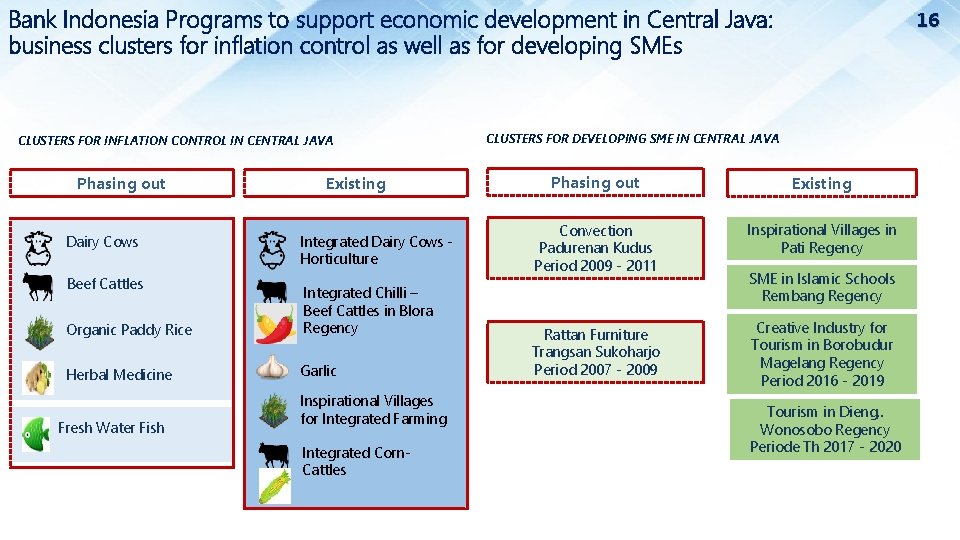
Bank Indonesia Programs to support economic development in Central Java: business clusters for inflation control as well as for developing SMEs CLUSTERS FOR INFLATION CONTROL IN CENTRAL JAVA Phasing out Dairy Cows Beef Cattles Existing Integrated Dairy Cows Horticulture Organic Paddy Rice Integrated Chilli – Beef Cattles in Blora Regency Herbal Medicine Garlic Fresh Water Fish Inspirational Villages for Integrated Farming Integrated Corn. Cattles 16 CLUSTERS FOR DEVELOPING SME IN CENTRAL JAVA Phasing out Existing Convection Padurenan Kudus Period 2009 - 2011 Inspirational Villages in Pati Regency Rattan Furniture Trangsan Sukoharjo Period 2007 - 2009 Creative Industry for Tourism in Borobudur Magelang Regency Period 2016 - 2019 SME in Islamic Schools Rembang Regency Tourism in Dieng, . Wonosobo Regency Periode Th 2017 - 2020
RECENT ECONOMIC DEVELOPMENT & BANK INDONESIA’S SUPPORT FOR INVESTMENT DEVELOPMENT Central Java Investment Business Forum 2018 “Developing Investment & Business in Tourism and Industrial Sectors in Central Java” 26 th November 2018 PERRY WARJIYO, Ph. D Governor
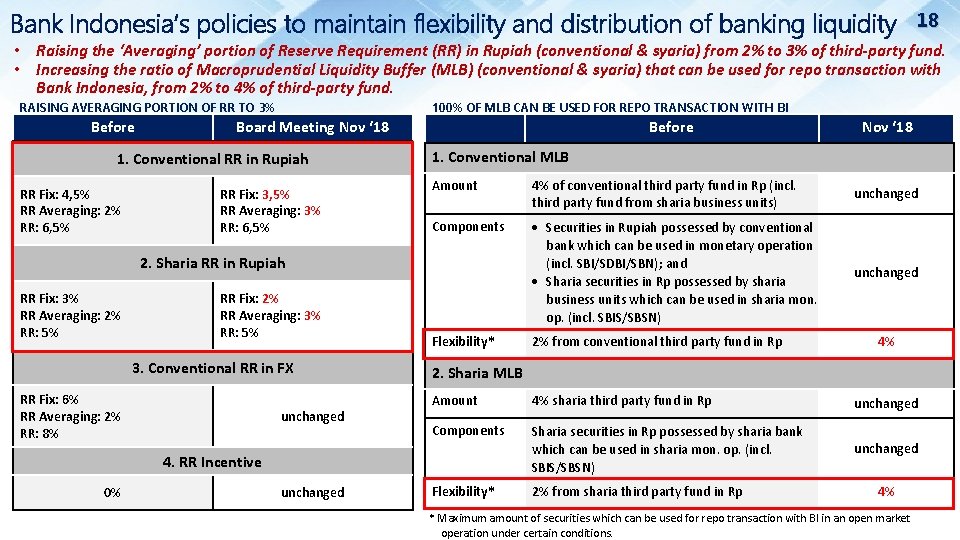
Bank Indonesia’s policies to maintain flexibility and distribution of banking liquidity 18 • Raising the ‘Averaging’ portion of Reserve Requirement (RR) in Rupiah (conventional & syaria) from 2% to 3% of third-party fund. • Increasing the ratio of Macroprudential Liquidity Buffer (MLB) (conventional & syaria) that can be used for repo transaction with Bank Indonesia, from 2% to 4% of third-party fund. RAISING AVERAGING PORTION OF RR TO 3% Before 100% OF MLB CAN BE USED FOR REPO TRANSACTION WITH BI Board Meeting Nov ‘ 18 1. Conventional RR in Rupiah RR Fix: 4, 5% RR Averaging: 2% RR: 6, 5% RR Fix: 3, 5% RR Averaging: 3% RR: 6, 5% Before 1. Conventional MLB Amount 4% of conventional third party fund in Rp (incl. third party fund from sharia business units) unchanged Components Securities in Rupiah possessed by conventional bank which can be used in monetary operation (incl. SBI/SDBI/SBN); and Sharia securities in Rp possessed by sharia business units which can be used in sharia mon. op. (incl. SBIS/SBSN) unchanged 2. Sharia RR in Rupiah RR Fix: 3% RR Averaging: 2% RR: 5% RR Fix: 2% RR Averaging: 3% RR: 5% 3. Conventional RR in FX RR Fix: 6% RR Averaging: 2% RR: 8% unchanged Flexibility* unchanged 2% from conventional third party fund in Rp 4% 2. Sharia MLB Amount 4% sharia third party fund in Rp unchanged Components Sharia securities in Rp possessed by sharia bank which can be used in sharia mon. op. (incl. SBIS/SBSN) unchanged 4. RR Incentive 0% Nov ‘ 18 Flexibility* 2% from sharia third party fund in Rp 4% * Maximum amount of securities which can be used for repo transaction with BI in an open market operation under certain conditions.

Bank Indonesia Offers FX Swap with Low and Competitive Pricing Two kinds of FX Swap in BI’s monetary operations: 1. FX Swap to manage banking liquidity - Executed through auction system - Tenor: 1, 3, 6, and 12 months - Auction period: 10. 00 - 11. 30 - Auction result announced before 14. 00 - Auction result reported in bank’s daily report and BI website 2. FX Swap Hedging - Tenor: 3, 6, and 12 months - Executed through “window” open daily at 14. 00 -16. 00 - Pricing: referring to price formation from FX Swap auction. - Mechanism: exporter, foreign loan debtor, foreign investor buying Govt. bills, and any business entity in the real sector can swap their FX money (USD, Euro, JPY, & CNH) to the commercial bank. Then, bank may reswap to BI. 19 BANK INDONESIA’S LOW FX SWAP RATE INCREASES MARKET APPETITE… BI Swap Rate (before) BI Swap Rate (current) Weighted Avg. (%) 1 mo 5. 02 4. 49 3 mo 5. 22 4. 96 6 mo 5. 42 5. 04 12 mo 5. 62 5. 16 Tenor BI FX Swap Auction Data as of 13 November 2018 MARKET SWAP RATE ALSO DECREASES AFTER BANK INDONESIA STRENGTHENS MONETARY OPERATIONS… Market Swap Rate (before) Market Swap Rate (current) Weighted Avg. (%) 1 mo 4. 85 4. 38 3 mo 4. 88 4. 86 6 mo 5. 01 4. 74 12 mo 5. 18 5. 13 Tenor Market FX Swap Data as of 13 November 2018

Bank Indonesia Offers Domestic Non-Deliverable Forward (DNDF) Transaction Definition DNDF transaction is a plain vanilla derivative FX against IDR transaction in the form of forward transaction with fixing mechanism, in the domestic market Purposes a. Strengthen efforts to stabilize the Rupiah exchange rate. b. Accelerate domestic FX market deepening. c. Provide an alternative hedging instrument for market players. 20 Settlement a. Settlements are done with fixing mechanism in Rupiah. b. Fixing mechanism is a settlement without full movement of the funds by counting the difference (netting) between forward transaction rate and the reference rate at a certain date which has been set in the contract (fixing date) c. The reference rates are JISDOR for USD/IDR and Bank Indonesia FX Transaction Midrate for non-USD/IDR Characteristics a. DNDF transaction can be done by banks with customer/foreign parties to hedge foreign exchange risks. b. DNDF transactions between bank and customer/foreign party must be supported by underlying transaction. c. The amount and period of a DND transaction must not exceed the amount and period of its underlying transaction. DNDF Underlying Transactions a. Trade in goods and services. b. Investment, loan, capital, and other investments, both onshore and offshore. c. Bank loan in foreign currency for trade and investment purposes.
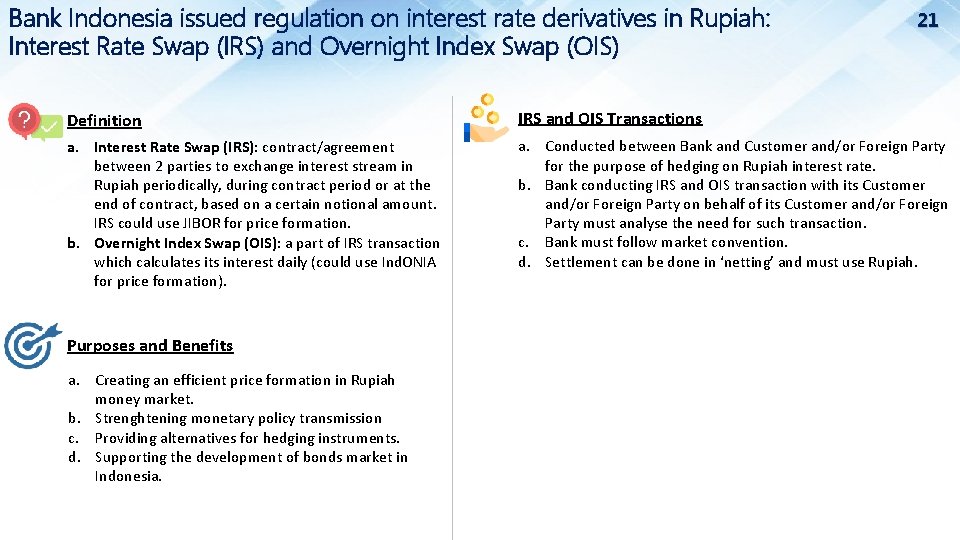
Bank Indonesia issued regulation on interest rate derivatives in Rupiah: Interest Rate Swap (IRS) and Overnight Index Swap (OIS) 21 Definition IRS and OIS Transactions a. Interest Rate Swap (IRS): contract/agreement between 2 parties to exchange interest stream in Rupiah periodically, during contract period or at the end of contract, based on a certain notional amount. IRS could use JIBOR for price formation. b. Overnight Index Swap (OIS): a part of IRS transaction which calculates its interest daily (could use Ind. ONIA for price formation). a. Conducted between Bank and Customer and/or Foreign Party for the purpose of hedging on Rupiah interest rate. b. Bank conducting IRS and OIS transaction with its Customer and/or Foreign Party on behalf of its Customer and/or Foreign Party must analyse the need for such transaction. c. Bank must follow market convention. d. Settlement can be done in ‘netting’ and must use Rupiah. Purposes and Benefits a. Creating an efficient price formation in Rupiah money market. b. Strenghtening monetary policy transmission c. Providing alternatives for hedging instruments. d. Supporting the development of bonds market in Indonesia.
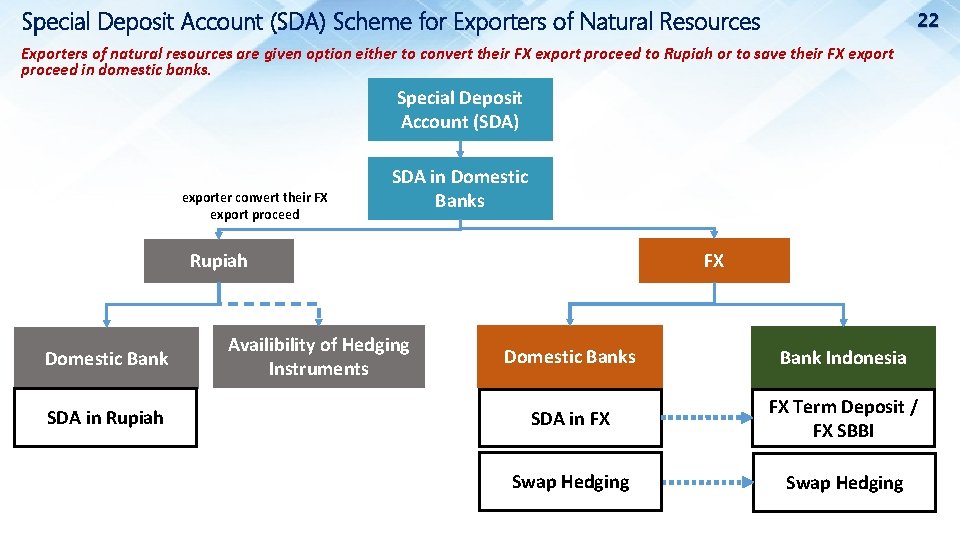
Special Deposit Account (SDA) Scheme for Exporters of Natural Resources 22 Exporters of natural resources are given option either to convert their FX export proceed to Rupiah or to save their FX export proceed in domestic banks. Special Deposit Account (SDA) exporter convert their FX export proceed SDA in Domestic Banks FX Rupiah Domestic Bank SDA in Rupiah Availibility of Hedging Instruments Domestic Banks Bank Indonesia SDA in FX FX Term Deposit / FX SBBI Swap Hedging
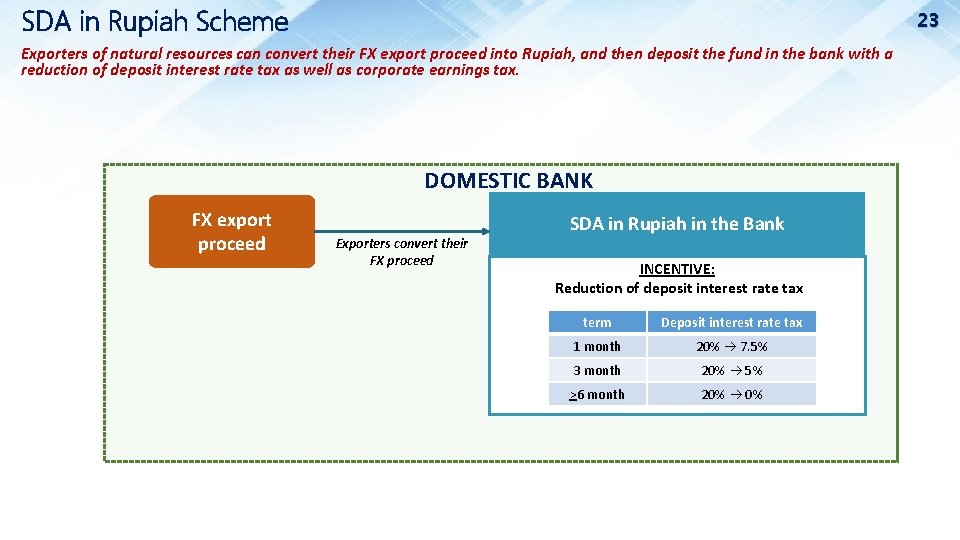
SDA in Rupiah Scheme 23 Exporters of natural resources can convert their FX export proceed into Rupiah, and then deposit the fund in the bank with a reduction of deposit interest rate tax as well as corporate earnings tax. DOMESTIC BANK FX export proceed Exporters convert their FX proceed SDA in Rupiah in the Bank INCENTIVE: Reduction of deposit interest rate tax term Deposit interest rate tax 1 month 20% 7. 5% 3 month 20% 5% >6 month 20% 0%
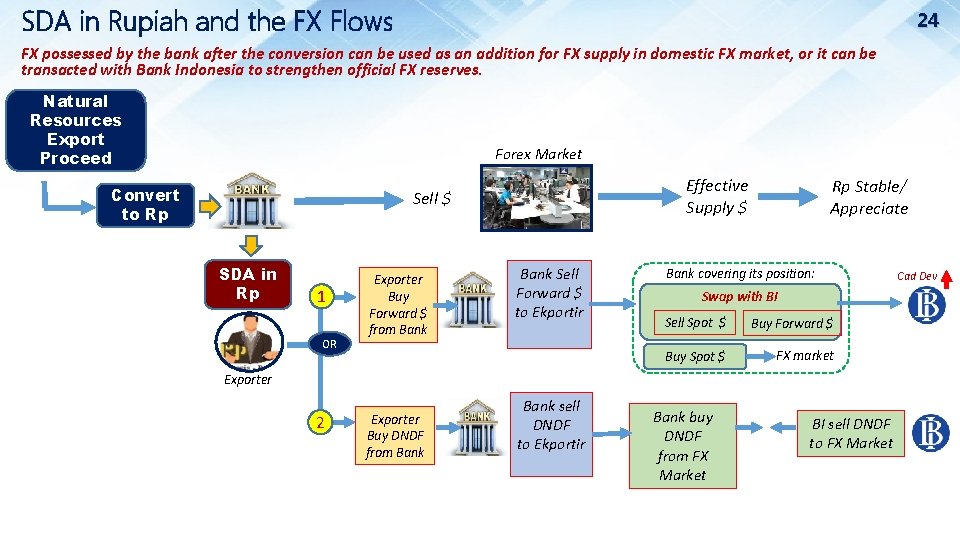
SDA in Rupiah and the FX Flows 24 FX possessed by the bank after the conversion can be used as an addition for FX supply in domestic FX market, or it can be transacted with Bank Indonesia to strengthen official FX reserves. Natural Resources Export Proceed Forex Market Convert to Rp Effective Supply $ Sell $ SDA in Rp 1 OR Exporter Buy Forward $ from Bank Sell Forward $ to Ekportir Rp Stable/ Appreciate Bank covering its position: Swap with BI Sell Spot $ Buy Forward $ Buy Spot $ FX market Exporter 2 Exporter Buy DNDF from Bank sell DNDF to Ekportir Bank buy DNDF from FX Market BI sell DNDF to FX Market Cad Dev
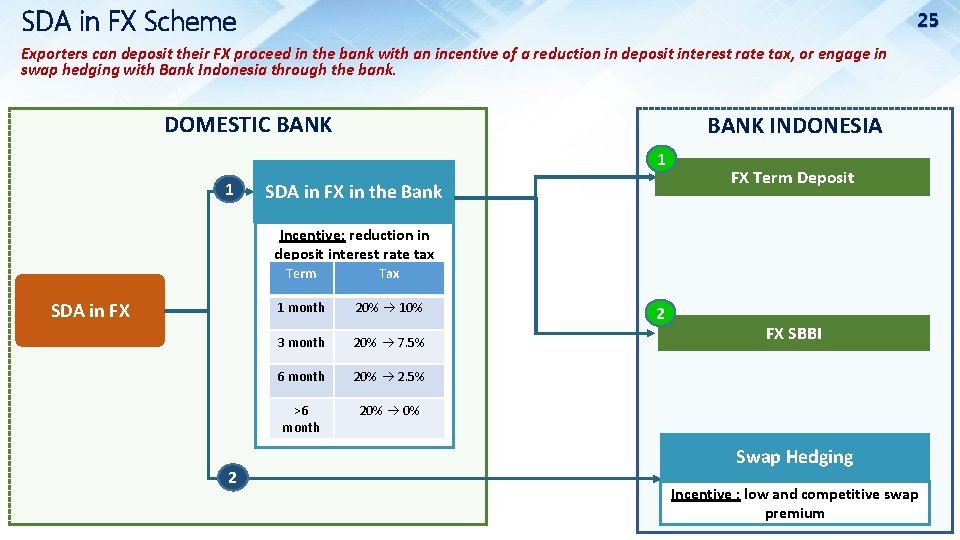
SDA in FX Scheme 25 Exporters can deposit their FX proceed in the bank with an incentive of a reduction in deposit interest rate tax, or engage in swap hedging with Bank Indonesia through the bank. DOMESTIC BANK INDONESIA 1 1 SDA in FX in the Bank FX Term Deposit Incentive: reduction in deposit interest rate tax SDA in FX 2 Term Tax 1 month 20% 10% 3 month 20% 7. 5% 6 month 20% 2. 5% >6 month 20% 0% 2 FX SBBI Swap Hedging Incentive : low and competitive swap premium
- Slides: 25