
Recent Developments of the PIGE setup at the
- Slides: 17
Recent Developments of the PIGE setup at the Tandem Accelerator Facility of N. C. S. R. “Demokritos” Anastasios Lagoyannis Tandem Accelerator Laboratory Institute of Nuclear Physics N. C. S. R. “Demokritos”
Outline Ø The Tandem @ I. N. P. Ø General Considerations for PIGE Ø Target preparation and characterization Ø Charge measurement Ø Experimental Apparatus Ø Proposed measurements Ø Conclusions A. Lagoyannis Institute of Nuclear Physics NCSR “Demokritos”
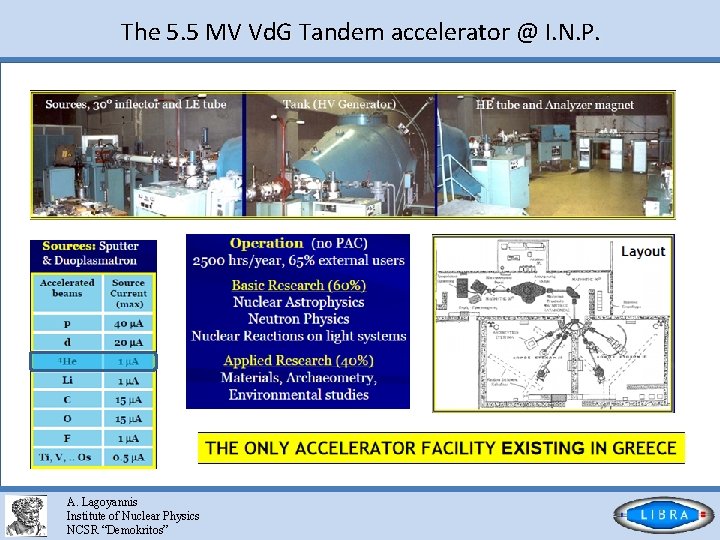
The 5. 5 MV Vd. G Tandem accelerator @ I. N. P. A. Lagoyannis Institute of Nuclear Physics NCSR “Demokritos”
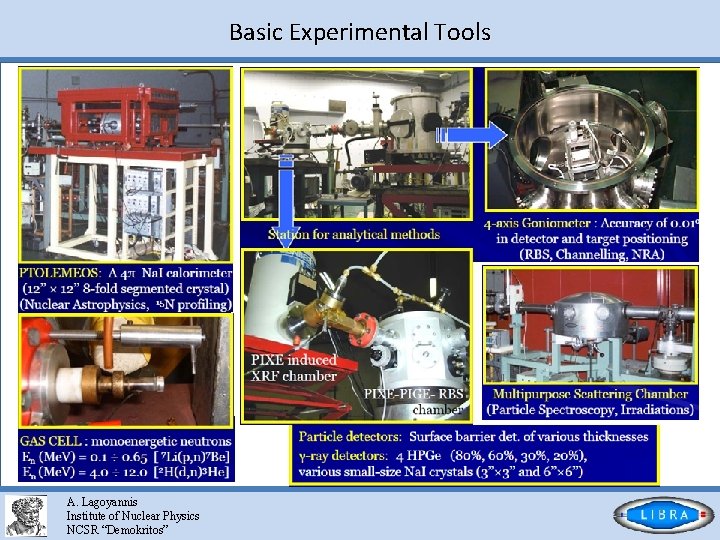
Basic Experimental Tools A. Lagoyannis Institute of Nuclear Physics NCSR “Demokritos”
General Considerations for PIGE Ø Suitable Targets thin for resonances thick for yield and validation well characterized Ø Charge measurement Effective way of measuring the current (cross checked if possible) Ø Experimental Apparatus High efficiency Good resolution Placed to appropriate angles Ø Analyzing Software A. Lagoyannis Institute of Nuclear Physics NCSR “Demokritos”
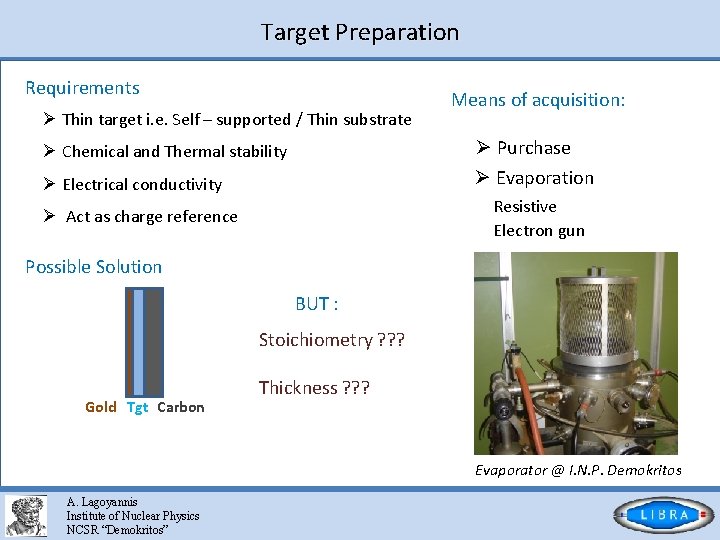
Target Preparation Requirements Ø Thin target i. e. Self – supported / Thin substrate Means of acquisition: Ø Purchase Ø Evaporation Ø Chemical and Thermal stability Ø Electrical conductivity Resistive Electron gun Ø Act as charge reference Possible Solution BUT : Stoichiometry ? ? ? Gold Tgt Carbon Thickness ? ? ? Evaporator @ I. N. P. Demokritos A. Lagoyannis Institute of Nuclear Physics NCSR “Demokritos”
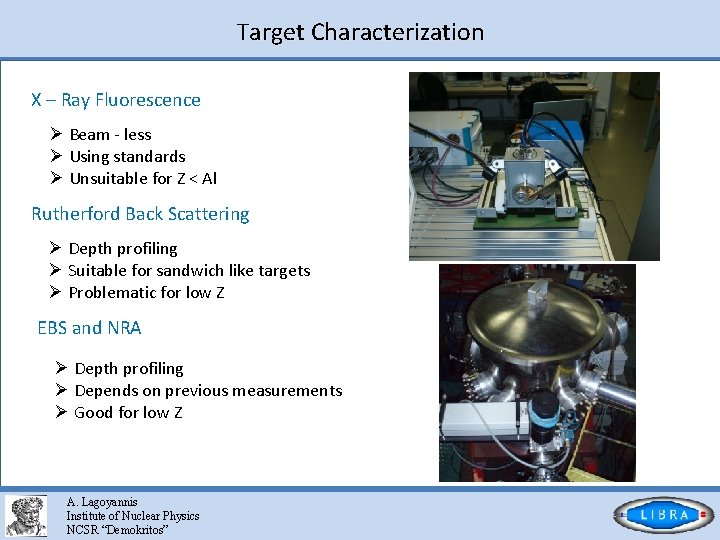
Target Characterization X – Ray Fluorescence Ø Beam - less Ø Using standards Ø Unsuitable for Z < Al Rutherford Back Scattering Ø Depth profiling Ø Suitable for sandwich like targets Ø Problematic for low Z EBS and NRA Ø Depth profiling Ø Depends on previous measurements Ø Good for low Z A. Lagoyannis Institute of Nuclear Physics NCSR “Demokritos”
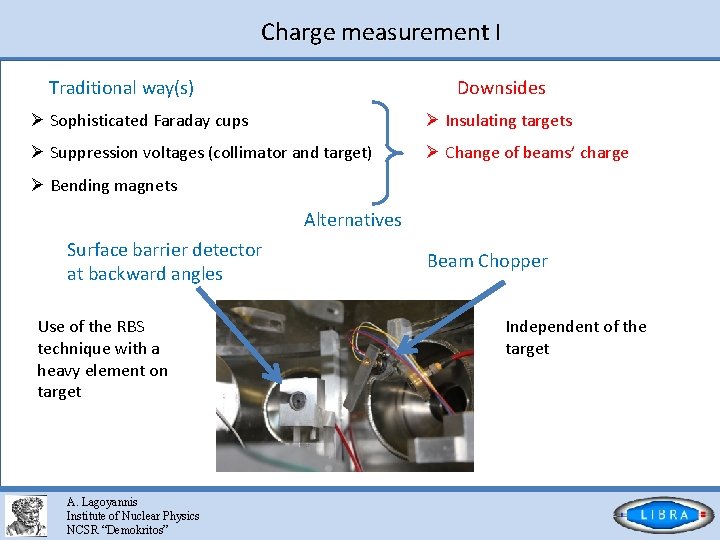
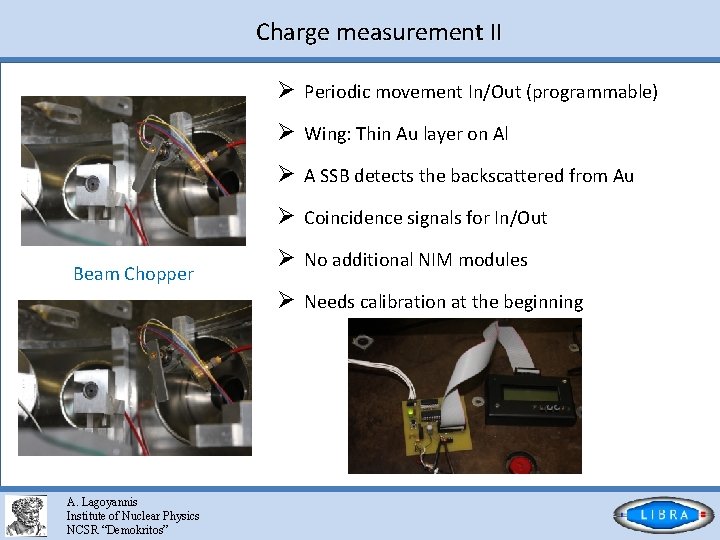
Charge measurement I Traditional way(s) Downsides Ø Sophisticated Faraday cups Ø Insulating targets Ø Suppression voltages (collimator and target) Ø Change of beams’ charge Ø Bending magnets Alternatives Surface barrier detector at backward angles Use of the RBS technique with a heavy element on target A. Lagoyannis Institute of Nuclear Physics NCSR “Demokritos” Beam Chopper Independent of the target
Charge measurement II Ø Periodic movement In/Out (programmable) Ø Wing: Thin Au layer on Al Ø A SSB detects the backscattered from Au Ø Coincidence signals for In/Out Beam Chopper A. Lagoyannis Institute of Nuclear Physics NCSR “Demokritos” Ø No additional NIM modules Ø Needs calibration at the beginning
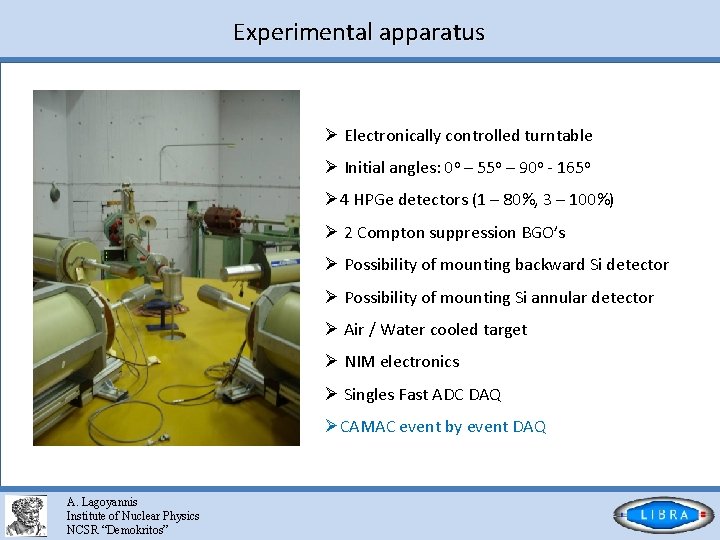
Experimental apparatus Ø Electronically controlled turntable Ø Initial angles: 0 o – 55 o – 90 o - 165 o Ø 4 HPGe detectors (1 – 80%, 3 – 100%) Ø 2 Compton suppression BGO’s Ø Possibility of mounting backward Si detector Ø Possibility of mounting Si annular detector Ø Air / Water cooled target Ø NIM electronics Ø Singles Fast ADC DAQ ØCAMAC event by event DAQ A. Lagoyannis Institute of Nuclear Physics NCSR “Demokritos”
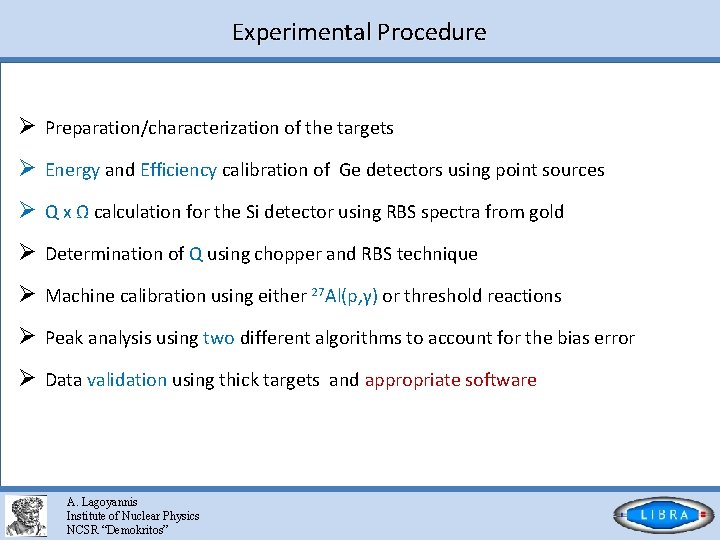
Experimental Procedure Ø Preparation/characterization of the targets Ø Energy and Efficiency calibration of Ge detectors using point sources Ø Q x Ω calculation for the Si detector using RBS spectra from gold Ø Determination of Q using chopper and RBS technique Ø Machine calibration using either 27 Al(p, γ) or threshold reactions Ø Peak analysis using two different algorithms to account for the bias error Ø Data validation using thick targets and appropriate software A. Lagoyannis Institute of Nuclear Physics NCSR “Demokritos”
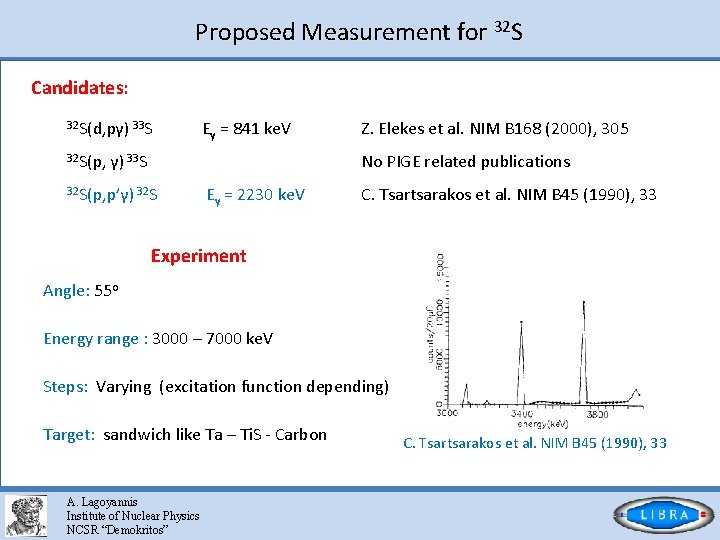
Proposed Measurement for 32 S Candidates: 32 S(d, pγ) 33 S 32 S(p, Εγ = 841 ke. V γ) 33 S Z. Elekes et al. NIM B 168 (2000), 305 No PIGE related publications 32 S(p, p’γ) 32 S Εγ = 2230 ke. V C. Tsartsarakos et al. NIM B 45 (1990), 33 Experiment Angle: 55 o Energy range : 3000 – 7000 ke. V Steps: Varying (excitation function depending) Target: sandwich like Ta – Ti. S - Carbon A. Lagoyannis Institute of Nuclear Physics NCSR “Demokritos” C. Tsartsarakos et al. NIM B 45 (1990), 33
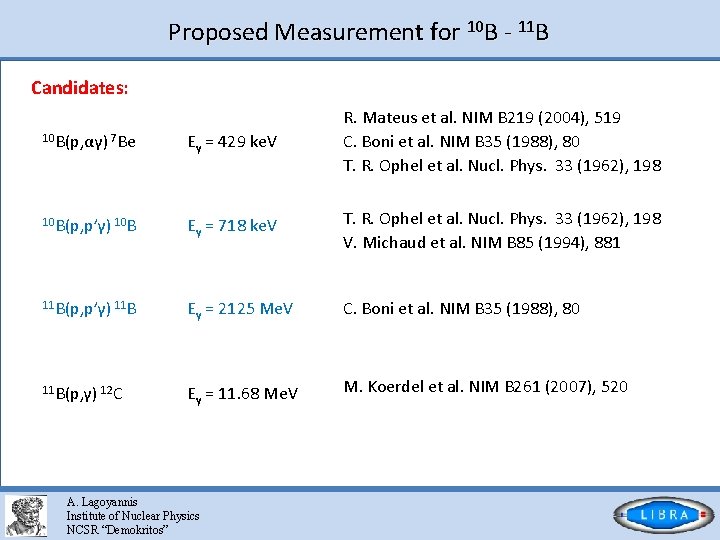
Proposed Measurement for 10 B - 11 B Candidates: 10 B(p, αγ) 7 Be Εγ = 429 ke. V R. Mateus et al. NIM B 219 (2004), 519 C. Boni et al. NIM B 35 (1988), 80 T. R. Ophel et al. Nucl. Phys. 33 (1962), 198 10 B(p, p’γ) 10 B Εγ = 718 ke. V T. R. Ophel et al. Nucl. Phys. 33 (1962), 198 V. Michaud et al. NIM B 85 (1994), 881 11 B(p, p’γ) 11 B Εγ = 2125 Me. V C. Boni et al. NIM B 35 (1988), 80 11 B(p, γ) 12 C Εγ = 11. 68 Me. V M. Koerdel et al. NIM B 261 (2007), 520 A. Lagoyannis Institute of Nuclear Physics NCSR “Demokritos”
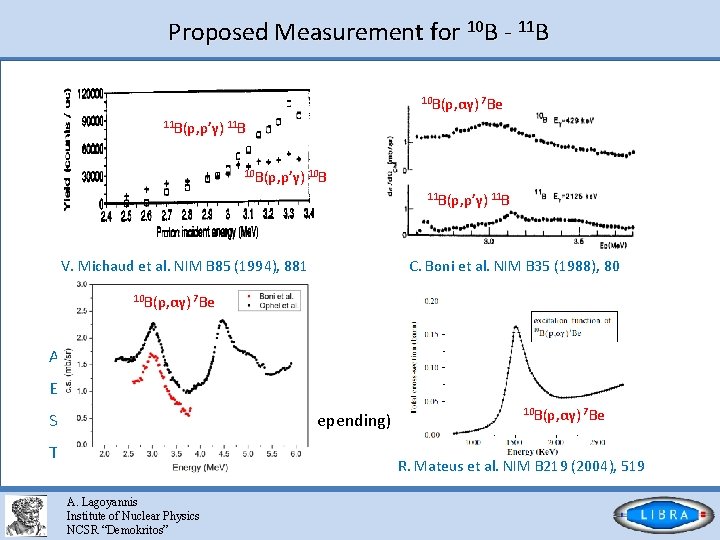
Proposed Measurement for 10 B - 11 B 10 B(p, αγ) 7 Be 11 B(p, p’γ) 11 B 10 B(p, p’γ) 10 B 11 B(p, p’γ) 11 B V. Michaud et al. NIM B 85 (1994), 881 C. Boni et al. NIM B 35 (1988), 80 10 B(p, αγ) 7 Be Experiment Angle: 55 o Energy range : 1000 – 5000 ke. V Steps: Varying (excitation function depending) Target: 11 B, 10 B on thick Ta A. Lagoyannis Institute of Nuclear Physics NCSR “Demokritos” 10 B(p, αγ) 7 Be R. Mateus et al. NIM B 219 (2004), 519
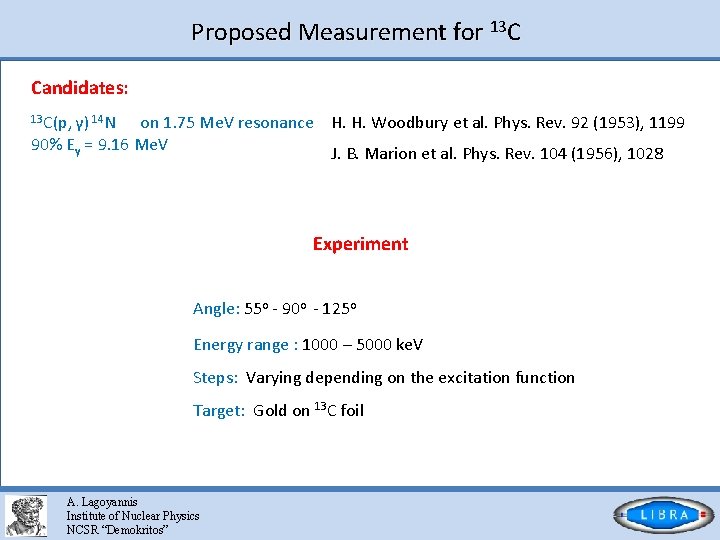
Proposed Measurement for 13 C Candidates: 13 C(p, γ) 14 N on 1. 75 Me. V resonance H. H. Woodbury et al. Phys. Rev. 92 (1953), 1199 90% Εγ = 9. 16 Me. V J. B. Marion et al. Phys. Rev. 104 (1956), 1028 Experiment Angle: 55 o - 90 o - 125 o Energy range : 1000 – 5000 ke. V Steps: Varying depending on the excitation function Target: Gold on 13 C foil A. Lagoyannis Institute of Nuclear Physics NCSR “Demokritos”
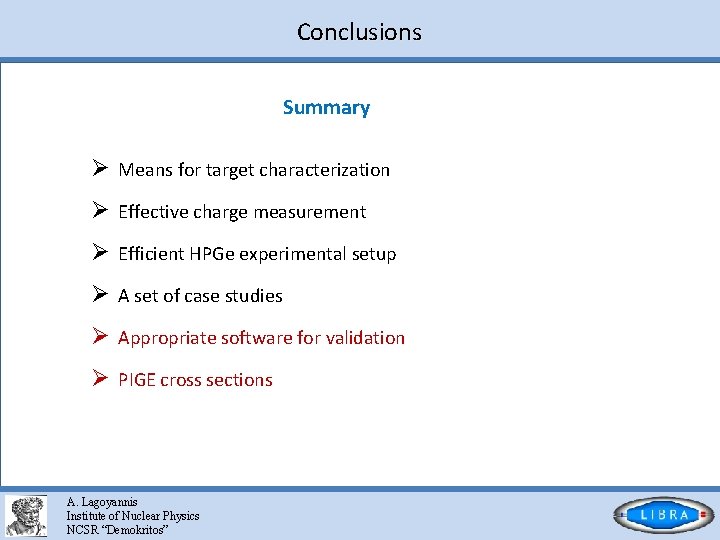
Conclusions Summary Ø Means for target characterization Ø Effective charge measurement Ø Efficient HPGe experimental setup Ø A set of case studies Ø Appropriate software for validation Ø PIGE cross sections A. Lagoyannis Institute of Nuclear Physics NCSR “Demokritos”
Collaborators A. Axiotis, V. Paneta and S. Harissopulos M. Kokkoris P. Misaelides A. Lagoyannis Institute of Nuclear Physics NCSR “Demokritos”