
RECENT DEVELOPMENTS IN MICROSCALE COMBUSTION CALORIMETRY Richard Walters
RECENT DEVELOPMENTS IN MICROSCALE COMBUSTION CALORIMETRY Richard Walters, Richard Lyon, Louise Speitel, FAA Natallia Safronava, TAMI Haiqing Guo, CFar Services
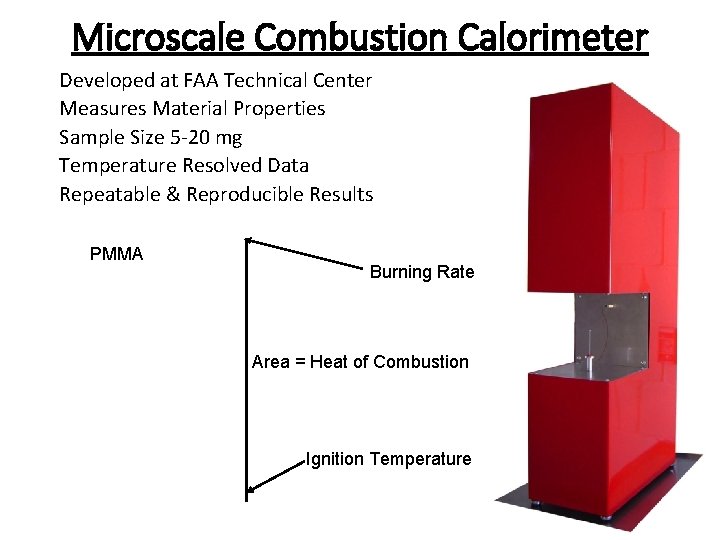
Microscale Combustion Calorimeter Developed at FAA Technical Center Measures Material Properties Sample Size 5 -20 mg Temperature Resolved Data Repeatable & Reproducible Results PMMA Burning Rate Area = Heat of Combustion Ignition Temperature
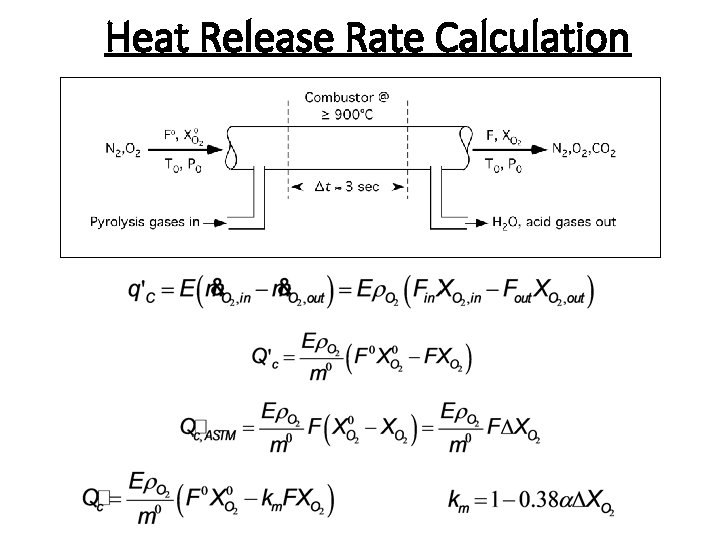
Heat Release Rate Calculation
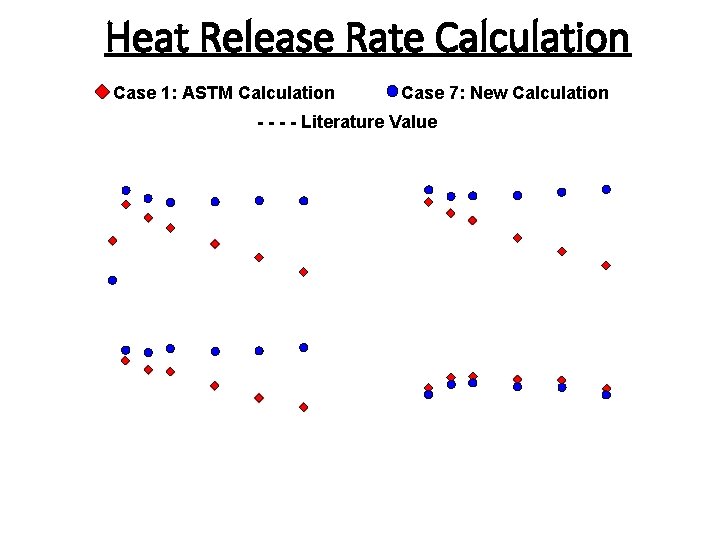
Heat Release Rate Calculation Case 1: ASTM Calculation Case 7: New Calculation - - Literature Value
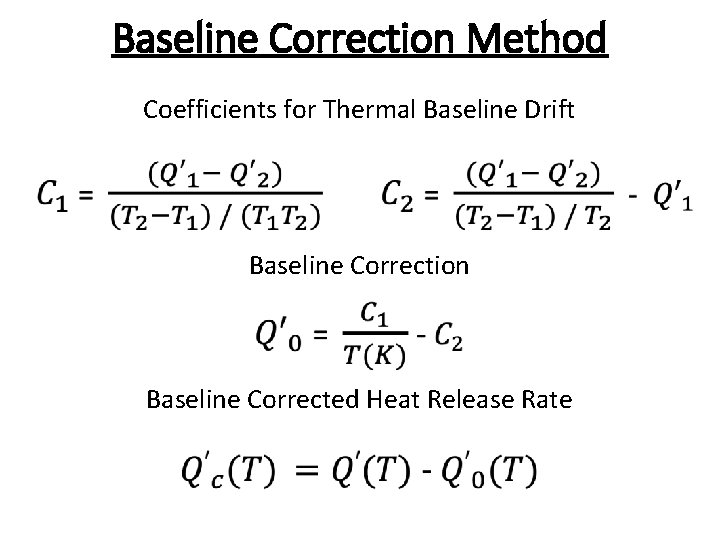
Baseline Correction Method Coefficients for Thermal Baseline Drift Baseline Correction Baseline Corrected Heat Release Rate

Baseline Correction Method
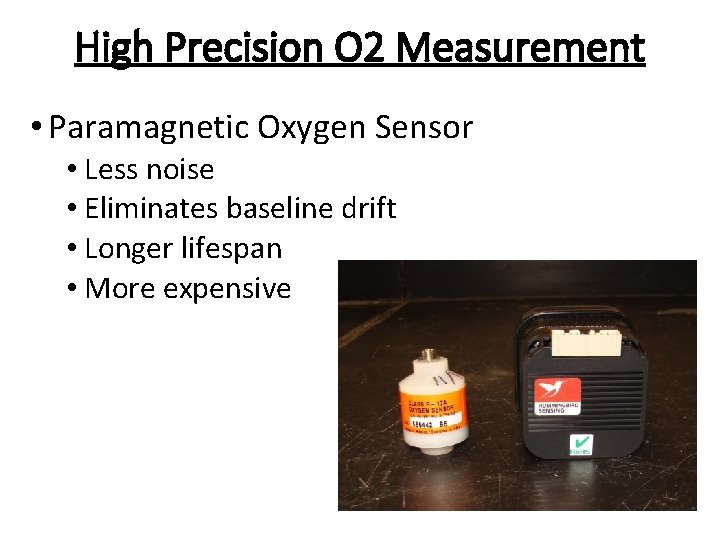
High Precision O 2 Measurement • Paramagnetic Oxygen Sensor • Less noise • Eliminates baseline drift • Longer lifespan • More expensive
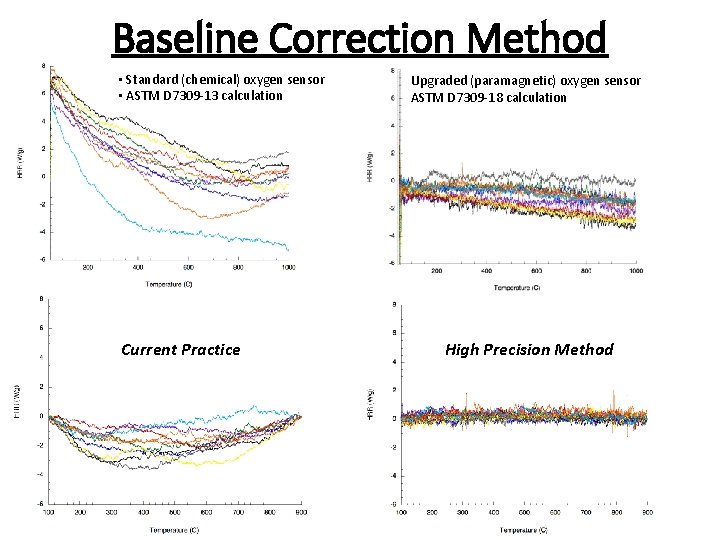
Baseline Correction Method • Standard (chemical) oxygen sensor • ASTM D 7309 -13 calculation Current Practice Upgraded (paramagnetic) oxygen sensor ASTM D 7309 -18 calculation High Precision Method
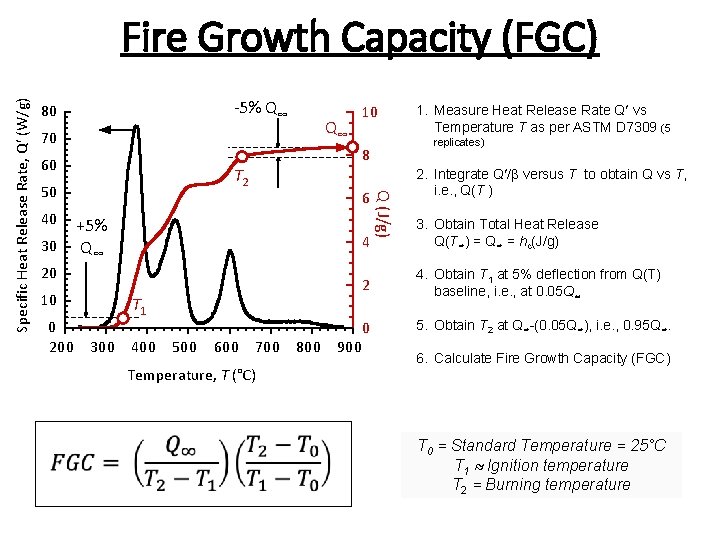
-5% Q∞ 80 Q∞ 70 T 2 50 30 6 +5% Q∞ 4 20 10 0 200 T 1 300 400 500 600 700 Temperature, T (°C) 800 900 1. Measure Heat Release Rate Q vs Temperature T as per ASTM D 7309 (5 replicates) 8 60 40 10 Q (J/g) Specific Heat Release Rate, Q (W/g) Fire Growth Capacity (FGC) 2. Integrate Q / versus T to obtain Q vs T, i. e. , Q(T ) 3. Obtain Total Heat Release Q(T∞) = Q∞ = hc(J/g) 2 4. Obtain T 1 at 5% deflection from Q(T) baseline, i. e. , at 0. 05 Q∞ 0 5. Obtain T 2 at Q∞-(0. 05 Q∞), i. e. , 0. 95 Q∞. 6. Calculate Fire Growth Capacity (FGC) T 0 = Standard Temperature = 25°C T 1 Ignition temperature T 2 = Burning temperature
FGC
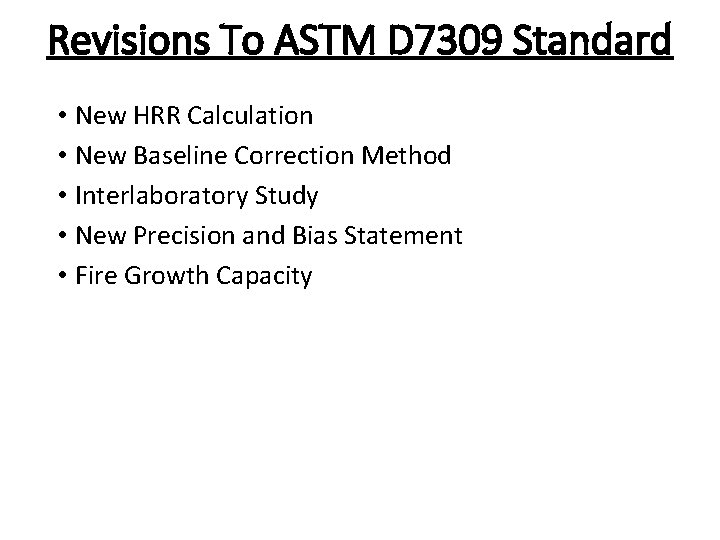
Revisions To ASTM D 7309 Standard • New HRR Calculation • New Baseline Correction Method • Interlaboratory Study • New Precision and Bias Statement • Fire Growth Capacity
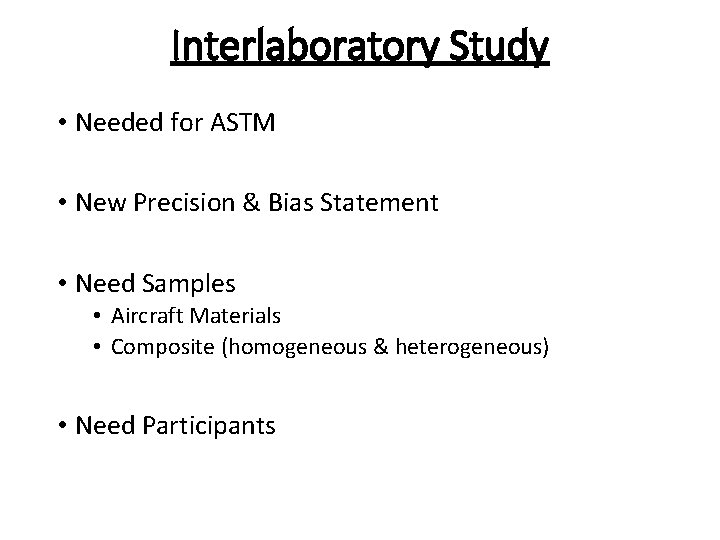
Interlaboratory Study • Needed for ASTM • New Precision & Bias Statement • Need Samples • Aircraft Materials • Composite (homogeneous & heterogeneous) • Need Participants
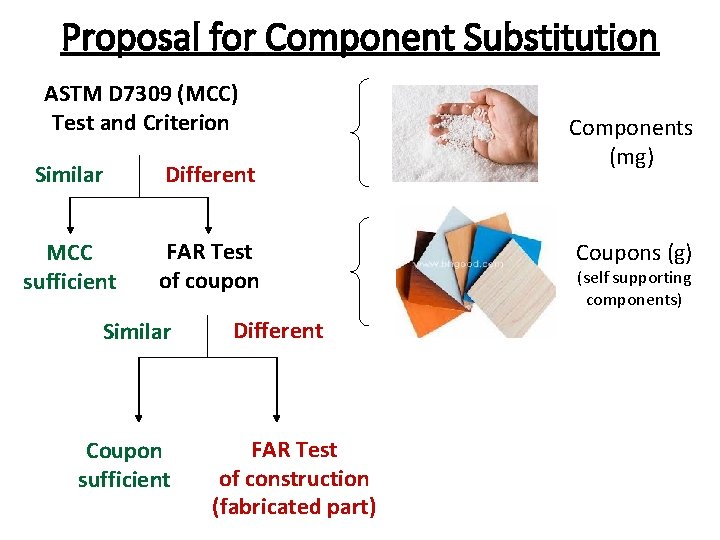
Proposal for Component Substitution ASTM D 7309 (MCC) Test and Criterion Similar Different MCC sufficient FAR Test of coupon Similar Coupon sufficient Different FAR Test of construction (fabricated part) Components (mg) Coupons (g) (self supporting components)
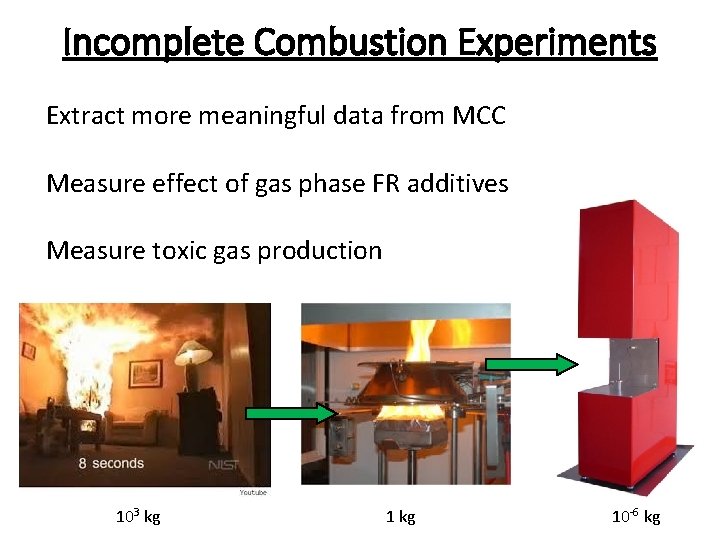
Incomplete Combustion Experiments Extract more meaningful data from MCC Measure effect of gas phase FR additives Measure toxic gas production 103 kg 10 -6 kg
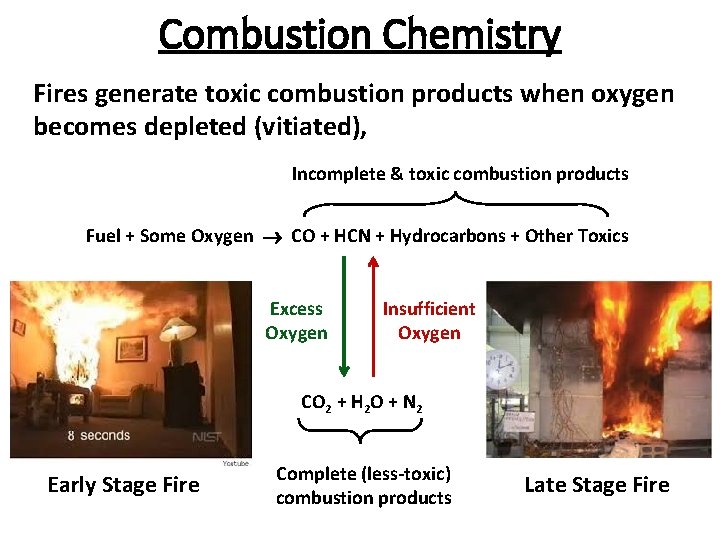
Combustion Chemistry Fires generate toxic combustion products when oxygen becomes depleted (vitiated), Incomplete & toxic combustion products Fuel + Some Oxygen CO + HCN + Hydrocarbons + Other Toxics Excess Oxygen Insufficient Oxygen CO 2 + H 2 O + N 2 Early Stage Fire Complete (less-toxic) combustion products Late Stage Fire
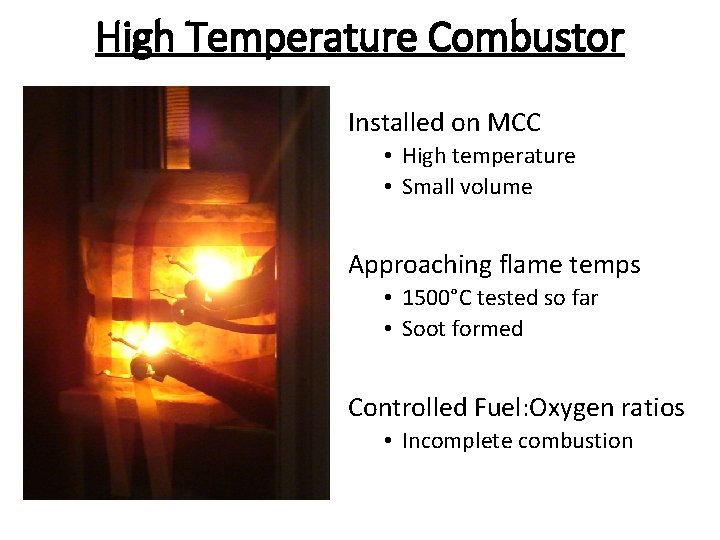
High Temperature Combustor Installed on MCC • High temperature • Small volume Approaching flame temps • 1500°C tested so far • Soot formed Controlled Fuel: Oxygen ratios • Incomplete combustion
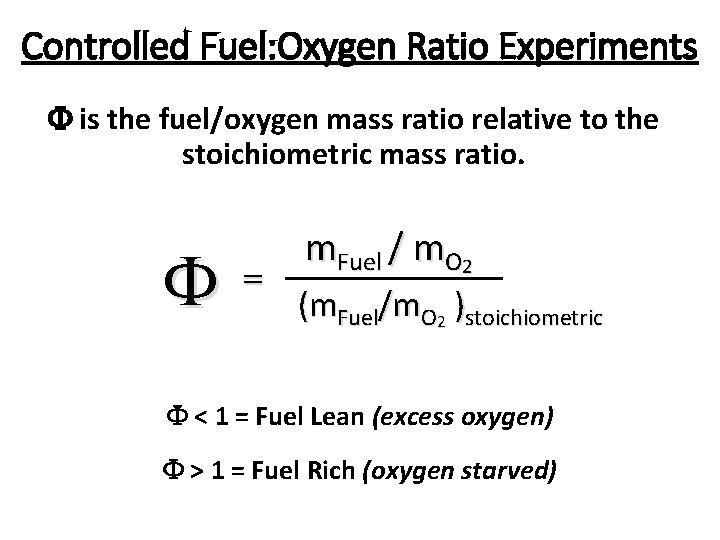
Controlled Fuel: Oxygen Ratio Experiments is the fuel/oxygen mass ratio relative to the stoichiometric mass ratio. = m. Fuel / m. O 2 (m. Fuel/m. O 2 )stoichiometric < 1 = Fuel Lean (excess oxygen) > 1 = Fuel Rich (oxygen starved)
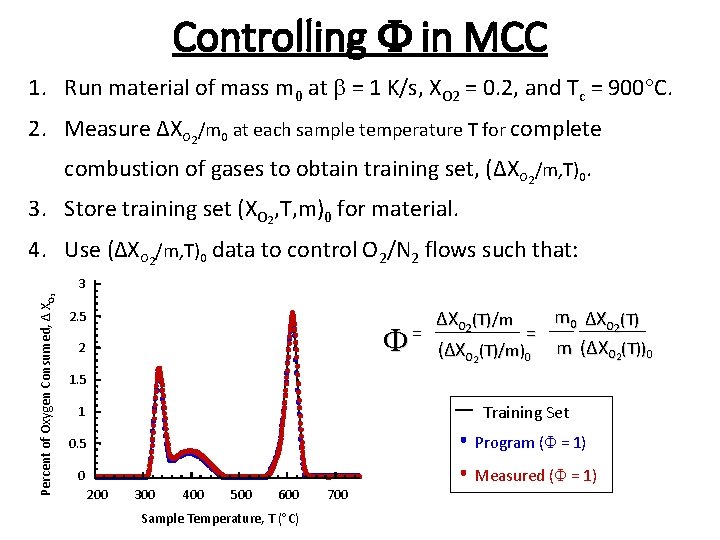
Controlling in MCC 1. Run material of mass m 0 at = 1 K/s, XO 2 = 0. 2, and Tc = 900 C. 2. Measure ∆XO 2/m 0 at each sample temperature T for complete combustion of gases to obtain training set, (∆XO 2/m, T)0. 3. Store training set (XO 2, T, m)0 for material. 4. Use (∆XO 2/m, T)0 data to control O 2/N 2 flows such that: Percent of Oxygen Consumed, ∆ XO 2 3 2. 5 2 m 0 ∆XO 2(T) = = (∆XO 2(T)/m)0 m (∆XO 2(T))0 ∆XO 2(T)/m 1. 5 Training Set 1 Program ( = 1) 0. 5 Measured ( = 1) 0 200 300 400 500 600 Sample Temperature, T ( C) 700
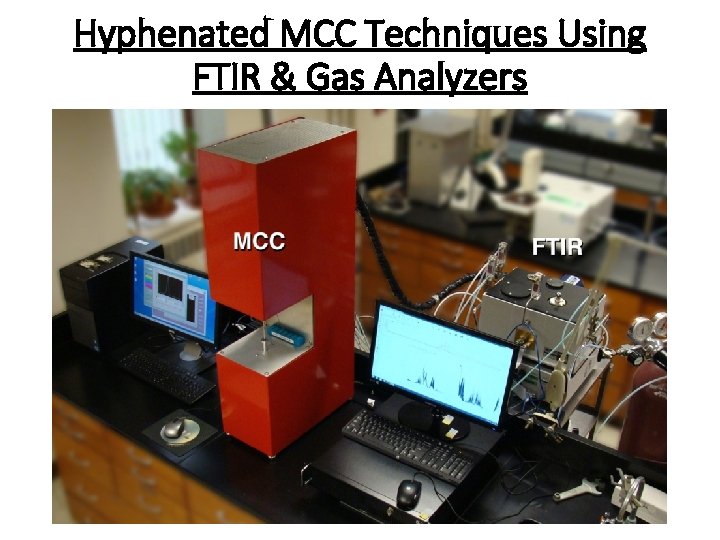
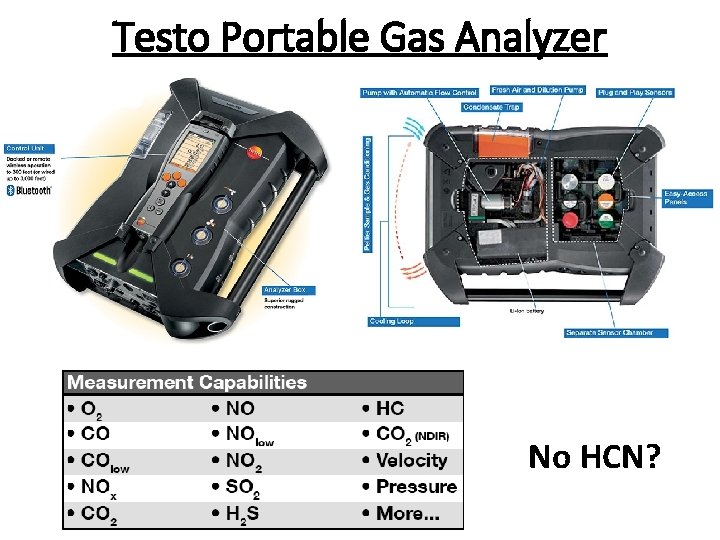
Hyphenated MCC Techniques Using FTIR & Gas Analyzers
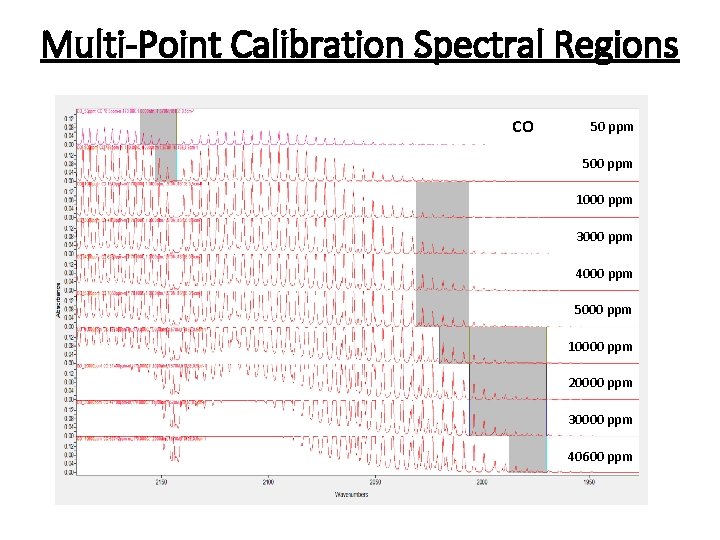
Multi-Point Calibration Spectral Regions CO 50 ppm 500 ppm 1000 ppm 3000 ppm 4000 ppm 5000 ppm 10000 ppm 20000 ppm 30000 ppm 40600 ppm
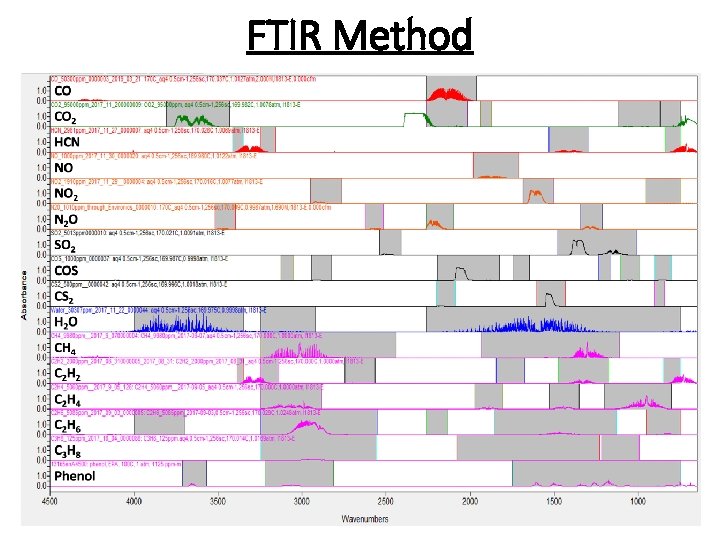
FTIR Method
Testo Portable Gas Analyzer No HCN?
Nylon Gas Analysis
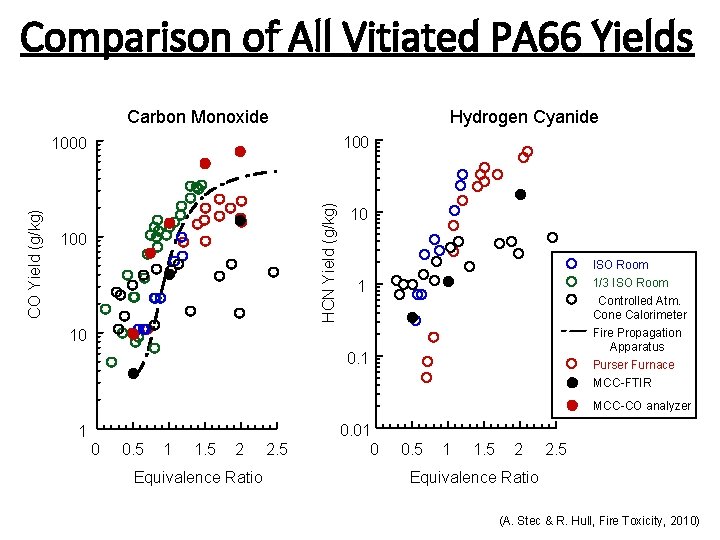
Comparison of All Vitiated PA 66 Yields Carbon Monoxide Hydrogen Cyanide 100 HCN Yield (g/kg) CO Yield (g/kg) 1000 10 ISO Room 1/3 ISO Room Controlled Atm. Cone Calorimeter Fire Propagation Apparatus Purser Furnace MCC-FTIR 1 10 0. 1 MCC-CO analyzer 1 0 0. 5 1 1. 5 2 Equivalence Ratio 2. 5 0. 01 0 0. 5 1 1. 5 2 2. 5 Equivalence Ratio (A. Stec & R. Hull, Fire Toxicity, 2010)
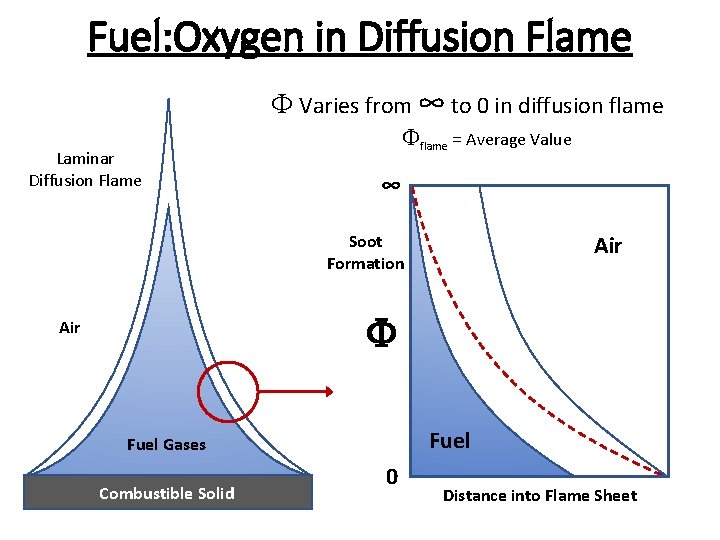
Fuel: Oxygen in Diffusion Flame Varies from ∞ to 0 in diffusion flame Laminar Diffusion Flame flame = Average Value ∞ Air Soot Formation Air Fuel Gases Combustible Solid 0 Distance into Flame Sheet
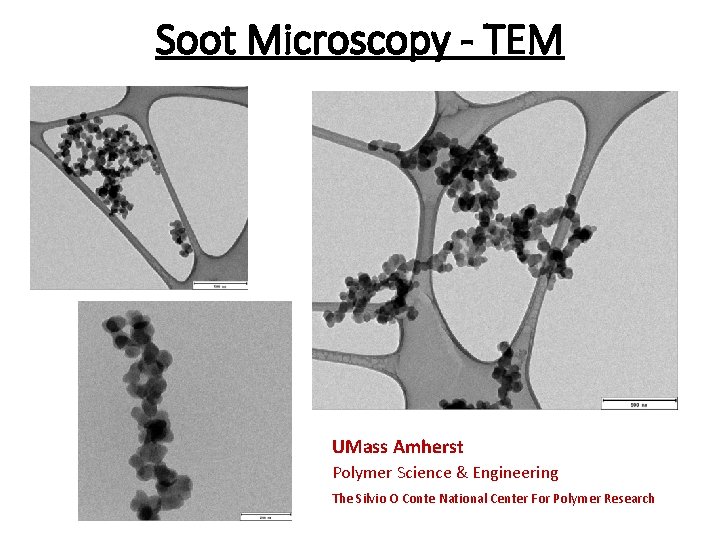
Soot Microscopy - TEM UMass Amherst Polymer Science & Engineering The Silvio O Conte National Center For Polymer Research
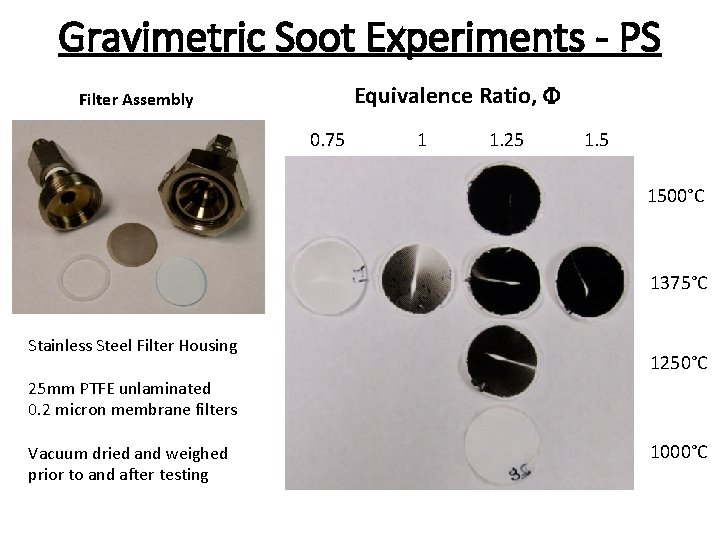
Gravimetric Soot Experiments - PS Equivalence Ratio, Filter Assembly 0. 75 1 1. 25 1. 5 1500°C 1375°C Stainless Steel Filter Housing 1250°C 25 mm PTFE unlaminated 0. 2 micron membrane filters Vacuum dried and weighed prior to and after testing 1000°C
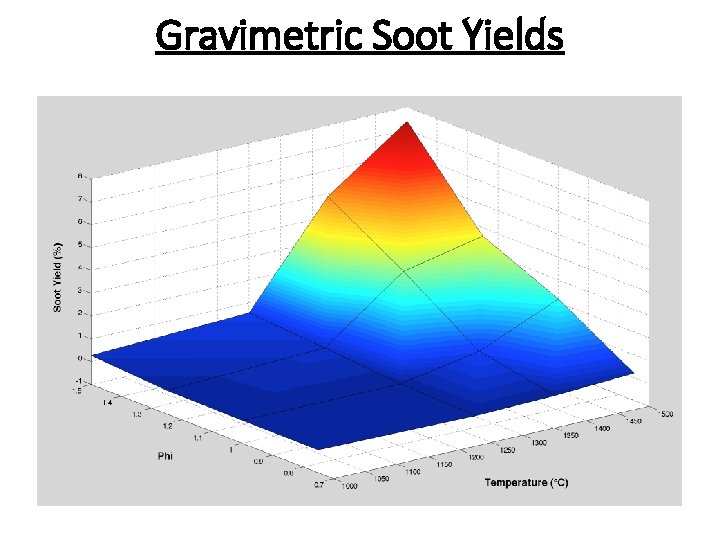
Gravimetric Soot Yields
Summary & Conclusions • Improved accuracy and precision of MCC data • HRR calculation • Baseline • O 2 analyzer • Fire growth capacity • Revisions to ASTM standard • ILS • Similarity determinations for small changes • Recreates flaming combustion products • Toxicity measurements • Gravimetric soot measurements
Contact Info Richard Walters Federal Aviation Administration Fire Safety Branch ANG-E 21 Atlantic City Int’l Airport, NJ 08405 USA richard. walters@faa. gov 609 -485 -4328
- Slides: 30