
Recent Developments and Applications of the DFTB Method

Recent Developments and Applications of the DFTB Method closed Keiji Morokuma Cherry L. Emerson Center for Scientific Computation and Department of Chemistry, Emory University, Atlanta, GA (from 9/06, also Fukui Institute for Fundamental Chemistry, Kyoto University, Kyoto, Japan) A Symposium on DFTB: Theory and Applications 232 st ACS National Meeting San Francisco, September 10 -14, 2006
Acknowledgment Emory Group Dr. Guishan Zheng (Gaussian, analytical functions, TM, nano) Prof. Henryk Witek (Hessian, TM) Dr. Stephan Irle (nano, TM) Paderborn Group Prof. Marcus Elstner (Braunschweig) Dr. Christof Köhler (Bremen) Prof. Thomas Frauenheim (Bremen) Zhi Wang (nano) Benjamin Finck (nano) Dr. Petia Bobadova-Parvanova (TM) Support National Science Foundation Dr. Djamaladdin G. Musaev (TM) Air Force Office of Scientific Research (DURIP) Prof. Rajeev Prabhakar (TM) Mitsubishi Chemical Corporation ACS, Petroleum Research Funds Gaussian, Inc. Dr. Michael J. Frisch Dr. Thom Vreven Gaussian, Inc. Pacific Northwest National Laboratory, EMSL Grand Challenge

I. Analytical Hessian in DFTB Witek, Irle and KM, J. Chem. Phys. 121, 5163 (2004). Witek, KM and Stradomska, J. Chem. Phys. , 121, 5171 (2004). Witek and KM, J. Comp. Chem. 25, 1858 (2004). Malolepsza, Witek and KM, Chem. Phys. Lett. 412 237 (2005). Witek, Stradomska and KM, J. Theo. Comp. Chem. 4, 639 (2005). Witek, Zheng, Irle, de Jong and KM, J. Chem. Phys. In revision.
Analytical Hessian
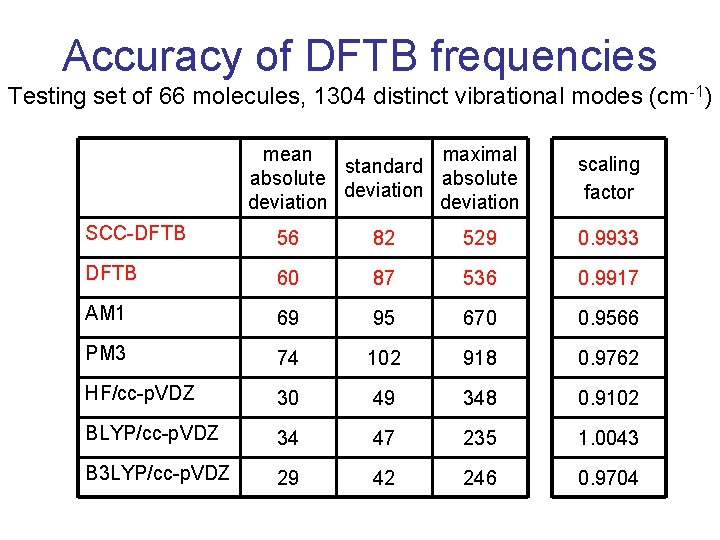
Accuracy of DFTB frequencies Testing set of 66 molecules, 1304 distinct vibrational modes (cm-1) mean maximal standard absolute deviation scaling factor SCC-DFTB 56 82 529 0. 9933 DFTB 60 87 536 0. 9917 AM 1 69 95 670 0. 9566 PM 3 74 102 918 0. 9762 HF/cc-p. VDZ 30 49 348 0. 9102 BLYP/cc-p. VDZ 34 47 235 1. 0043 B 3 LYP/cc-p. VDZ 29 42 246 0. 9704
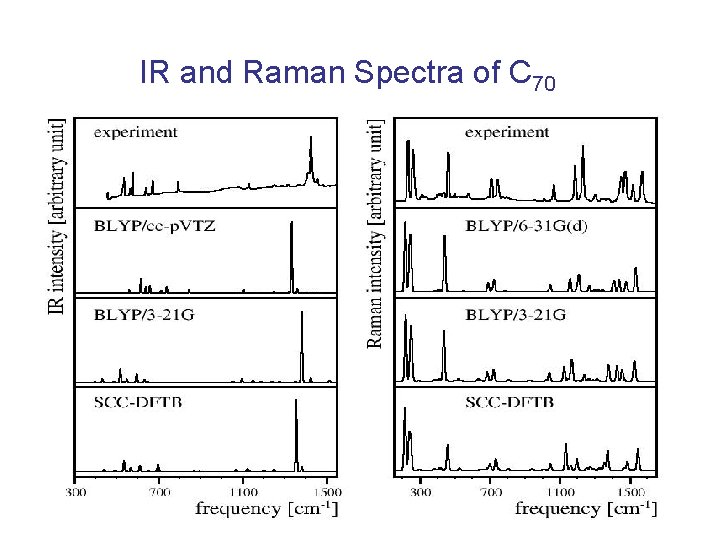
IR and Raman Spectra of C 70
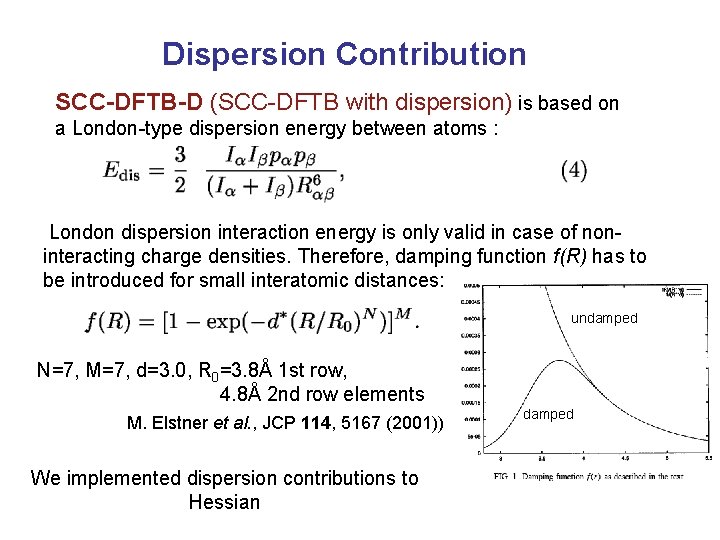
Dispersion Contribution SCC-DFTB-D (SCC-DFTB with dispersion) is based on a London-type dispersion energy between atoms : London dispersion interaction energy is only valid in case of noninteracting charge densities. Therefore, damping function f(R) has to be introduced for small interatomic distances: undamped N=7, M=7, d=3. 0, R 0=3. 8Å 1 st row, 4. 8Å 2 nd row elements M. Elstner et al. , JCP 114, 5167 (2001)) We implemented dispersion contributions to Hessian damped

II. Development of analytical functions for DFTB parameters Guishan Zheng, COMP 342, Wednesday, 4. 45 pm
Motivation and Form Ø Original two-center parameters (overlap, Hamiltonian and repulsion) given on several hundred 1 D grid points Ø Functions are smooth and accurate for high order energy derivative Ø Much smaller parameter data base Ø Functional form used:

An example of fitting: Overlap integral

An example of fitting: Core-core repulsion RMS and maximum deviation between fitted values and original grid values of repulsion curves. The unit used is Hartree.
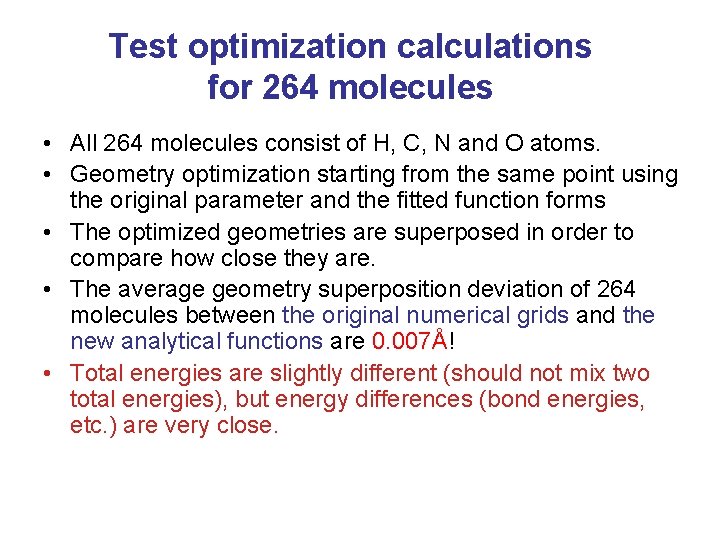
Test optimization calculations for 264 molecules • All 264 molecules consist of H, C, N and O atoms. • Geometry optimization starting from the same point using the original parameter and the fitted function forms • The optimized geometries are superposed in order to compare how close they are. • The average geometry superposition deviation of 264 molecules between the original numerical grids and the new analytical functions are 0. 007Å! • Total energies are slightly different (should not mix two total energies), but energy differences (bond energies, etc. ) are very close.
III. Development of DFTB parameters for first-row transition metal elements (Sc, Ti, Fe, Co, Ni) Guishan Zheng, Henryk Witek, Petia Bobadova-Parvanova, Stephan Irle, Djamaladdin G. Musaev, Rajeev Prabhakar, Keiji Morokuma, Marcus Elstner, Christof Köhler and Thomas Frauenheim, J. Chem. Theo. Comp. to be submitted Guishan Zheng, COMP 342, Wednesday, 4: 45 pm ----Aslo Henryk Witek, COMP 339, Wednesday, 3: 00 pm
Motivation • Extend the applicability of DFTB to problems containing transition metal elements. No reliable semiempirical method for TM. (Cu, Zn: Elstner, Cui, et al. 2003. Au: Koskinen, Seifert, . • Candidate for low-level QM method in the ONIOM(QM: QM) ot (QM: MM) method 2006)
Parameterization for First-Row Transition Metal Elements • Only 3 d, 4 s and 4 p orbitals are taken into account. • Spin-polarized DFTB scheme (SDFTB) needs to be considered. Self-consistency of and spin densities on each shell of atoms is important. • Analytical functions used for all two-center parameters • Parameters determined for M-M and M-X with M = Sc, Ti, Fe, Co, and Ni, and X = H, C, N, and O.

Comparison between DFTB and B 3 LYP/SDD results Absolute mean bond length difference (Å) between DFTB and B 3 LYP/SDD results Absolute mean bond angle difference (degree) between DFTB and B 3 LYP/SDD results
Energy differences of different spin states

Conclusions 1. SDFTB analytical parameters for M-M and M-X (M=Sc, Ti, Fe, CO, Ni; X=H, C, N, O) have been determined. 2. SDFTB optimized geometries for M-containing compounds agree well with B 3 LYP results, except for very weak bonding cases. 3. SDFTB energetic orders qualitatively agree with B 3 LYP in most cases. Quantitatively cases exist with over- and underestimation of as large as 50 kcal/mol. Use with care. More tests needed. 4. A good candidate as a low-level QM method in ONIOM. Calibration in progress. 5. These analytical parameters will be available for download very soon.
IV. Implementation of the DFTB method into Gaussian 03 COMP 342, Wednesday, 4. 45 pm: An efficient implementation of Density. Functional based Tight-Binding method (DFTB) in Gaussian 03 program: The calculation of energies, gradients, vibrational frequencies and IR spectrums Guishan Zheng, Michael Frisch and Keiji Morokuma
Motivation / Implementation • Extend the applicability of DFTB to wider range of problems, e. g. TS. • Take advantage of existing Gaussian functionalities, e. g. SCF convergence techniques, partial geometry optimization • A smooth combination with ONIOM method • Numerically efficient and stable implementation for dealing with large molecular systems, including Gradient, Hessian, IR and Raman intensities. • SDFTB (both restricted and unrestricted) formalism with explicit on-site charge interaction and “analytical” parameter functions.

V. Applications to Nano Structure and Dynamics COMP 126, Monday 425 pm: Quantum chemical molecular dynamics study of catalyst-free SWNT growth from Si. C-derived carbon Zhi Wang, Stephan Irle, Guishan Zheng, K. Morokuma, Michiko Kusunoki COMP 159, Tuesday 230 pm: DFTB-based QM/MD simulations of nanostructure formation processes far from thermodynamic equilibrium Stephan Irle, Zhi Wang, Guishan Zheng, Keiji Morokuma COMP 396, Thursday 1105 am: The use of ONIOM in computational nanomaterials research Stephan Irle, Zhi Wang, Keiji Morokuma PHYS 269, Tuesday 120 pm, QM/MD simulations of carbon nanotube and fullerene growth and dynamics Stephan Irle, Guishan Zheng, Zhi Wang, Keiji Morokuma

Va. Dynamics of formation of fullerenes and carbon nanotubes
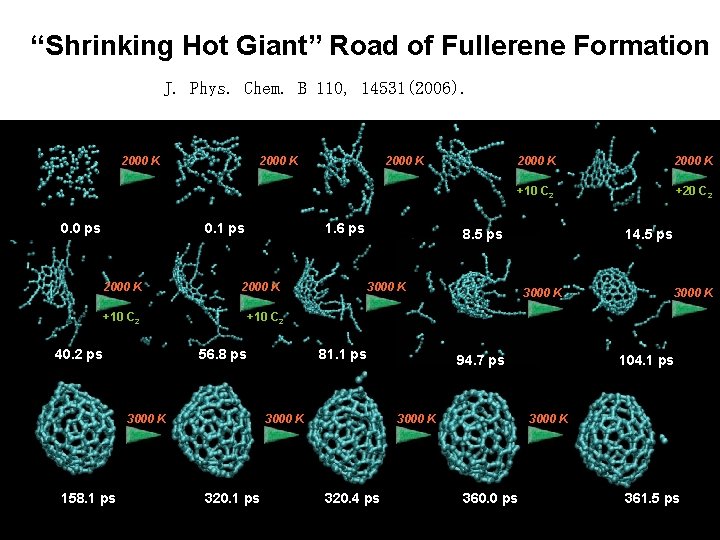
“Shrinking Hot Giant” Road of Fullerene Formation J. Phys. Chem. B 110, 14531(2006). 2000 K 0. 0 ps 2000 K 0. 1 ps 2000 K 1. 6 ps 2000 K +10 C 2 40. 2 ps 2000 K +10 C 2 +20 C 2 8. 5 ps 3000 K 14. 5 ps 3000 K +10 C 2 56. 8 ps 3000 K 158. 1 ps 2000 K 81. 1 ps 3000 K 320. 1 ps 94. 7 ps 3000 K 320. 4 ps 104. 1 ps 3000 K 360. 0 ps 361. 5 ps
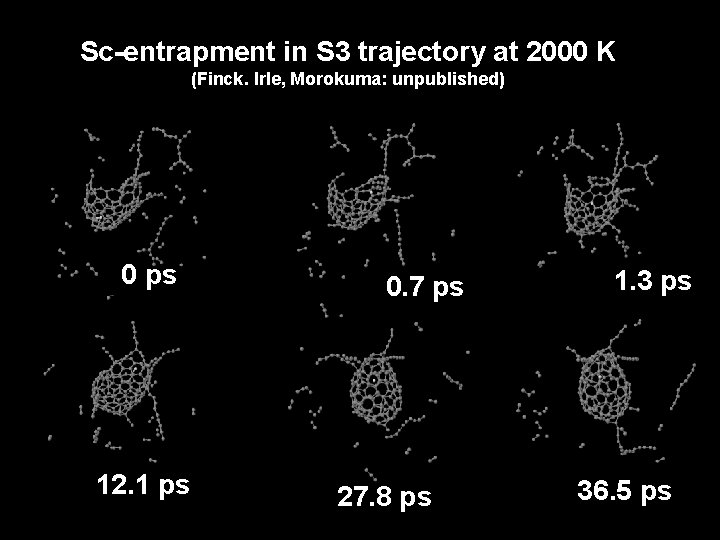
Sc-entrapment in S 3 trajectory at 2000 K (Finck. Irle, Morokuma: unpublished) 0 ps 12. 1 ps 0. 7 ps 27. 8 ps 1. 3 ps 36. 5 ps
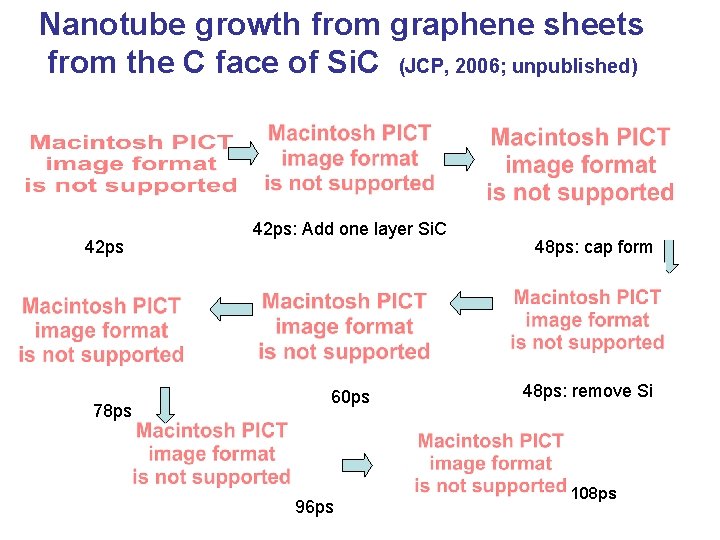
Nanotube growth from graphene sheets from the C face of Si. C (JCP, 2006; unpublished) 42 ps 78 ps 42 ps: Add one layer Si. C 60 ps 96 ps 48 ps: cap form 48 ps: remove Si 108 ps

Vb. The Origin of Linear Relationship between CH 2/NH/O-SWNT Reaction Energies and Sidewall Curvature: Armchair Nanotubes G. Zheng, Z. Wang, S. Irle, and K. Morokuma, J. Am. Chem. Soc. in press.
Linear relationship has long been recognized experimentally and computationally between the electrophile reaction energy and the sidewall curvature of SWCNT. What is the origin? • DFTB: SCC-DFTB, geometry optimizations by Gaussian’s ‘external’ keyword/script • DFT: B 3 LYP/6 -31 G(d) • System: 15 Å (n, n) SWNT+O/CH 2/NH DFTB: n=2~13 DFT: n=2~6 • Studied Thermodynamic stabilities of exo- and endo-Adducts

Closed vs. Open Form (DFTB) Endo-addition closed Exo-addition closed open

DFTB Stabilization Energy : Exo/Endo 1/d Plots open closed

Relationship of energy components vs 1/d Closed only endo exo A: E = DEF + INT for CH 2 adducts on the 15 Å SWNT with DFTB B: INT = ES + EX + ORB for CH 2 adducts on the 5 Å SWNT with HF/STO-3 G.
Comparison of Orbital Interaction between Exo vs. Endo Adducts
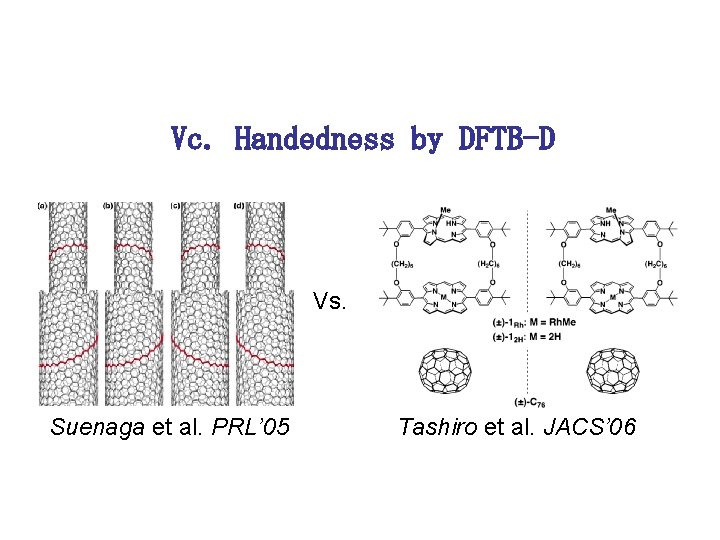
Vc. Handedness by DFTB-D Vs. Suenaga et al. PRL’ 05 Tashiro et al. JACS’ 06
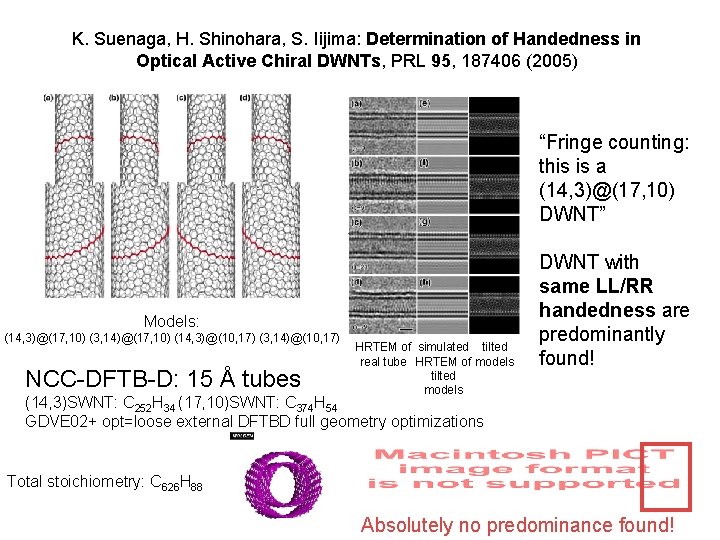
K. Suenaga, H. Shinohara, S. Iijima: Determination of Handedness in Optical Active Chiral DWNTs, PRL 95, 187406 (2005) “Fringe counting: this is a (14, 3)@(17, 10) DWNT” Models: (14, 3)@(17, 10) (3, 14)@(17, 10) (14, 3)@(10, 17) (3, 14)@(10, 17) NCC-DFTB-D: 15 Å tubes HRTEM of simulated tilted real tube HRTEM of models tilted models DWNT with same LL/RR handedness are predominantly found! (14, 3)SWNT: C 252 H 34 (17, 10)SWNT: C 374 H 54 GDVE 02+ opt=loose external DFTBD full geometry optimizations Total stoichiometry: C 626 H 88 Absolutely no predominance found!
Longer tube, different chirality: Still no predominance found! Our presumption holds: Chirality preference may be caused at DWNT nucleation stage What about defects? I-V defects are underway.

Using SCC-DFTB-D w/Co instead of Rh +y -y 0. 0 kcal/mol +2. 9 kcal/mol Found two different isomers corresponding to preference for a certain chirality over another.
Conclusion DFTB is a very useful approximate method for geometries and energies of large molecular systems. Parameters for transition metal elements (Sc, Ti, Fe, Co and Ni) have been determined. More general method of determination of inter-element parameters is needed. An excellent candidate for low-level QM in ONIOM(QM: QM) and ONIM(QM: MM) calculations. DFTB energy, gradient and Hessian will be available in the Gaussian code very soon.
- Slides: 37