
Recent Development on CMOS MAPS for the Silicon






- Slides: 27
Recent Development on CMOS MAPS for the Silicon Vertex Tracker Giuliana Rizzo INFN and University, Pisa on behalf of SVT-Super. B group 12 th Pisa Meeting on Advanced Detectors May 20 -26, 2012 La Biodola, Isola d’Elba, Italy G. Rizzo 12 th Pisa Meeting on Advanced Detector – May 24 th 2012 - La Biodola 1
Outline To be updated • The Super. B Project Status • The Silicon Vertex Tracker & Layer 0 • CMOS MAPS options for Layer 0 upgrade – DNW MAPS achieved performance – 3 D MAPS with vertical integration – 2 D MAPS with quadruple well process • Conclusions G. Rizzo 12 th Pisa Meeting on Advanced Detector – May 24 th 2012 - La Biodola 2
The Super. B Project To be updated • The physics case for a high luminosity B Factory is clearly established. – Flavour physics is rich, promises sensitivity to New Physics. . . but large statistics (50 -100 ab-1) is needed • First generation of B-Factories (PEP-II and KEKB) exceeded their design goals (L ~1. 2 -1. 7 x 1034 cm-2 s-1 , integrated 1. 2 ab-1) but an upgrade of ~2 orders of magnitude in L is needed to get 50 ab-1. • Increasing Luminosity by brute-force (higher currents) is expensive and difficult – wall plug power and detector background explosion – effective limitation around 5 x 1035 cm-2 s-1 • The Super. B italian accelerator concept allows to reach L =1036 cm-2 s-1 with moderate beam current (2 A) using very small beam size (~1/100 of present B-Factories beams exploiting the ILC R&D on damping rings & final focus) with the help of the Crab Waist scheme at the IP to keep the beams small & stable after collision (verified with tests on Dafne) • This approach allows to (re-) use parts of existing detectors and machine components. G. Rizzo 12 th Pisa Meeting on Advanced Detector – May 24 th 2012 - La Biodola 3
The Super. B Process • • • To be updated Super. B Conceptual Design Report published in 2007 All scientific reviews are positive. Presented to CERN Council and approved for preparatory phase. Growing international interest and participation with formal international collaboration being formed. Project structure defined. MOUs signed with France, Russia and SLAC and a letter of support from Canada. Technical Design Report phase approved by INFN in 2009 R&D is proceeding on various items (eg. SVT Layer 0) Intermediate Progress Report published this summer – http: //arxiv. org/abs/1007. 4241 Super. B inserted as first project in the National Research Plan by the Italian Research Ministry NEXT STEPS • Government approval expected very soon • Technical Design Report: summer 2011 • Operation by 2015. G. Rizzo 12 th Pisa Meeting on Advanced Detector – May 24 th 2012 - La Biodola 4
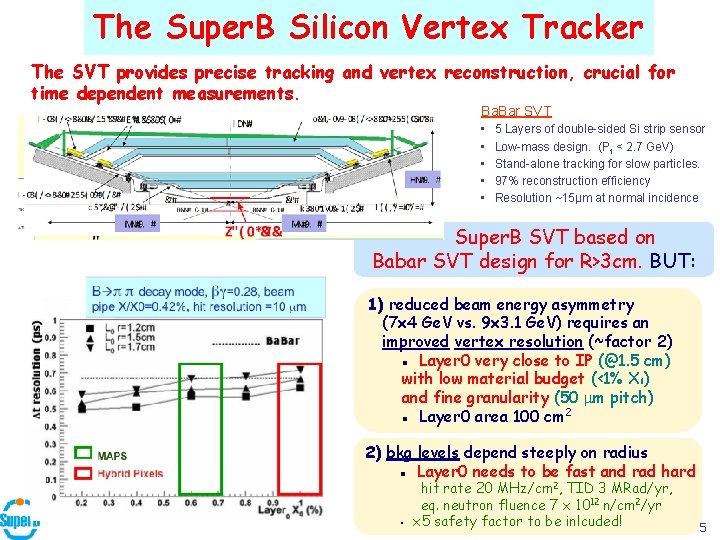
The Super. B Silicon Vertex Tracker The SVT provides precise tracking and vertex reconstruction, crucial for time dependent measurements. Bar SVT • • • 5 Layers of double-sided Si strip sensor Low-mass design. (Pt < 2. 7 Ge. V) Stand-alone tracking for slow particles. 97% reconstruction efficiency Resolution ~15μm at normal incidence Super. B SVT based on Babar SVT design for R>3 cm. BUT: 1) reduced beam energy asymmetry (7 x 4 Ge. V vs. 9 x 3. 1 Ge. V) requires an improved vertex resolution (~factor 2) Layer 0 very close to IP (@1. 5 cm) with low material budget (<1% X 0) and fine granularity (50 mm pitch) 2 Layer 0 area 100 cm 2) bkg levels depend steeply on radius Layer 0 needs to be fast and rad hard • hit rate 20 MHz/cm 2, TID 3 MRad/yr, eq. neutron fluence 7 x 10¹² n/cm 2/yr x 5 safety factor to be inlcuded! 5
Super. B SVT Layer 0 technology options • Striplets option: mature technology, not so robust against background occupancy. To be updated MAPS and 3 D integrated – Marginal with back. rate > 100 vertically MHz/cm – Moderate R&D needed on FE chip module interconnection/mechanics pixels are the two most advanced Hybrid Pixel option: viable, slightly marginal. options considered for Layer 0 upgrade: 2 • – Reduction of total material at 1%X 0 doable. – Reduction of front-end pitch to 50 x 50 μm 2 Produced and tested FE prototype chip with 50 x 50 μm 2 pitch & fast data push readout (already developed for DNW MAPS) - (4 k pixels, ST 130 nm) • CMOS MAPS option: new & challenging technology. – Sensor & readout in 50 μm thick chip! – Extensive R&D (SLIM 5 -INFN Collaboration) on • Deep N-well devices 50 x 50μm 2 with in-pixel sparsification. • Fast readout architecture implemented – CMOS MAPS (4 k pixels) successfully tested with beams. • Thin pixels with Vertical Integration: reduction of material and improved performance. Wafer bonding & electrical interconn. Digital tier – Two options are being pursued (VIPIX – INFN Collab. ) • DNW MAPS with 2 tiers • Hybrid Pixel: FE chip with 2 tiers + high resistivity sensor G. Rizzo 12 th Pisa Meeting on Advanced Detector – May 24 th 2012 - La Biodola Analog tier Sensor 6
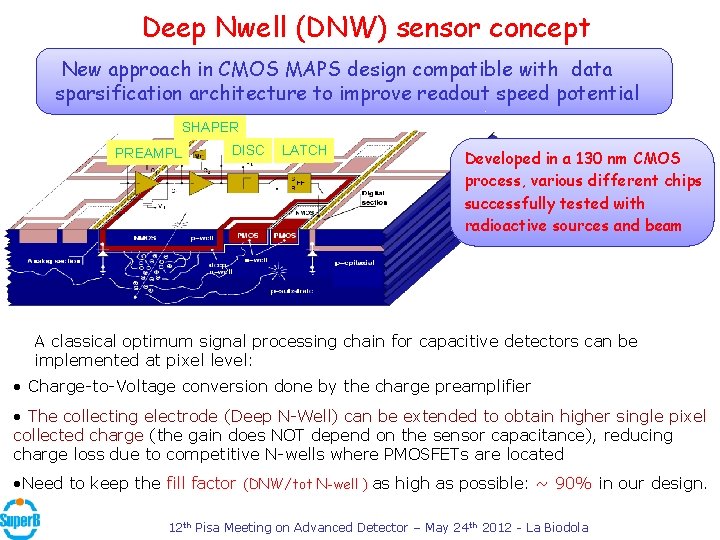
Deep Nwell (DNW) sensor concept New approach in CMOS MAPS design compatible with data sparsification architecture to improve readout speed potential SHAPER PREAMPL DISC LATCH Developed in a 130 nm CMOS process, various different chips successfully tested with radioactive sources and beam A classical optimum signal processing chain for capacitive detectors can be implemented at pixel level: • Charge-to-Voltage conversion done by the charge preamplifier • The collecting electrode (Deep N-Well) can be extended to obtain higher single pixel collected charge (the gain does NOT depend on the sensor capacitance), reducing charge loss due to competitive N-wells where PMOSFETs are located • Need to keep the fill factor (DNW/tot N-well ) as high as possible: ~ 90% in our design. 12 th Pisa Meeting on Advanced Detector – May 24 th 2012 - La Biodola
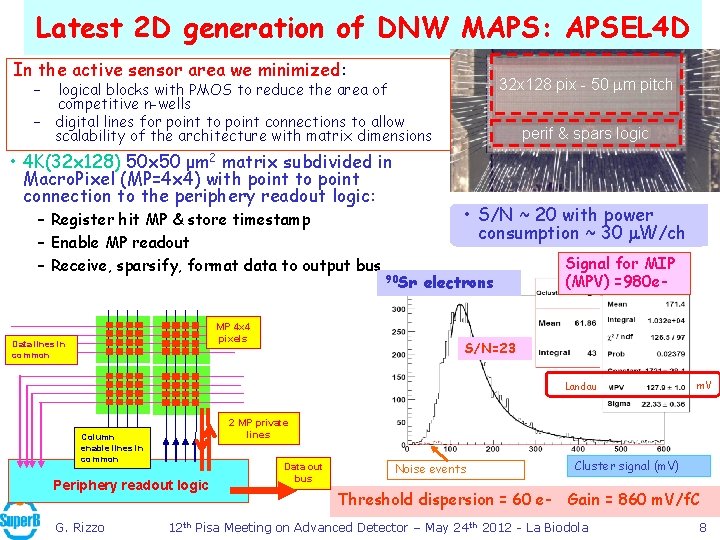
Latest 2 D generation of DNW MAPS: APSEL 4 D In the active sensor area we minimized: 32 x 128 pix - 50 mm pitch – logical blocks with PMOS to reduce the area of competitive n-wells – digital lines for point to point connections to allow scalability of the architecture with matrix dimensions • 4 K(32 x 128) 50 x 50 μm 2 matrix subdivided in Macro. Pixel (MP=4 x 4) with point to point connection to the periphery readout logic: – Register hit MP & store timestamp – Enable MP readout – Receive, sparsify, format data to output bus MP 4 x 4 pixels Data lines in common perif & spars logic • S/N ~ 20 with power consumption ~ 30 m. W/ch 90 Sr electrons Signal for MIP (MPV) =980 e- S/N=23 Landau 2 MP private lines Column enable lines in common Periphery readout logic G. Rizzo m. V Data out bus Noise events Threshold dispersion = 60 e- Cluster signal (m. V) Gain = 860 m. V/f. C 12 th Pisa Meeting on Advanced Detector – May 24 th 2012 - La Biodola 8
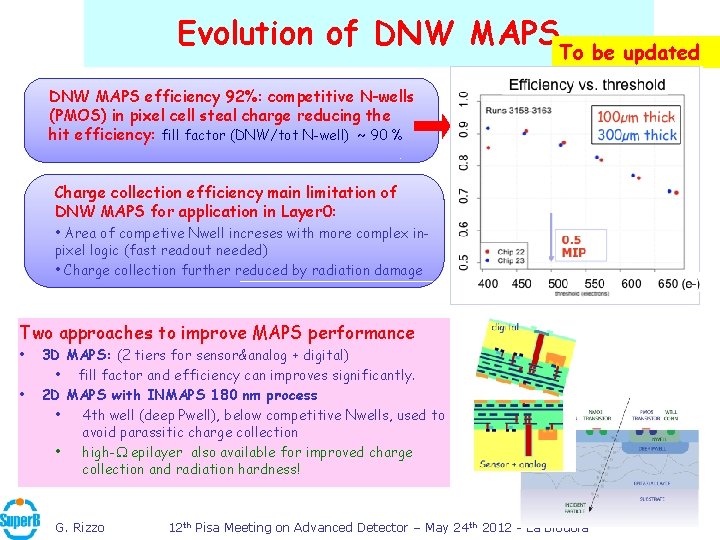
Evolution of DNW MAPSTo be updated DNW MAPS efficiency 92%: competitive N-wells (PMOS) in pixel cell steal charge reducing the hit efficiency: fill factor (DNW/tot N-well) ~ 90 % Charge collection efficiency main limitation of DNW MAPS for application in Layer 0: • Area of competive Nwell increses with more complex inpixel logic (fast readout needed) • Charge collection further reduced by radiation damage Two approaches to improve MAPS performance • • 3 D MAPS: (2 tiers for sensor&analog + digital) • fill factor and efficiency can improves significantly. 2 D MAPS with INMAPS 180 nm process • 4 th well (deep Pwell), below competitive Nwells, used to avoid parassitic charge collection • high-W epilayer also available for improved charge collection and radiation hardness! G. Rizzo 12 th Pisa Meeting on Advanced Detector – May 24 th 2012 - La Biodola
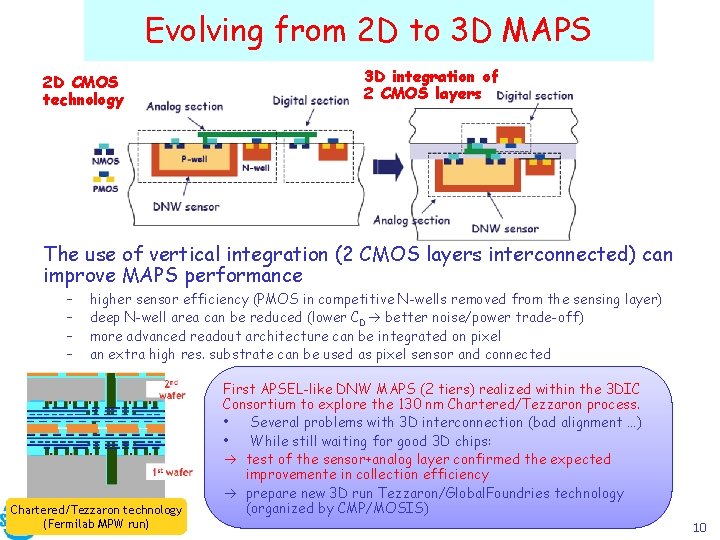
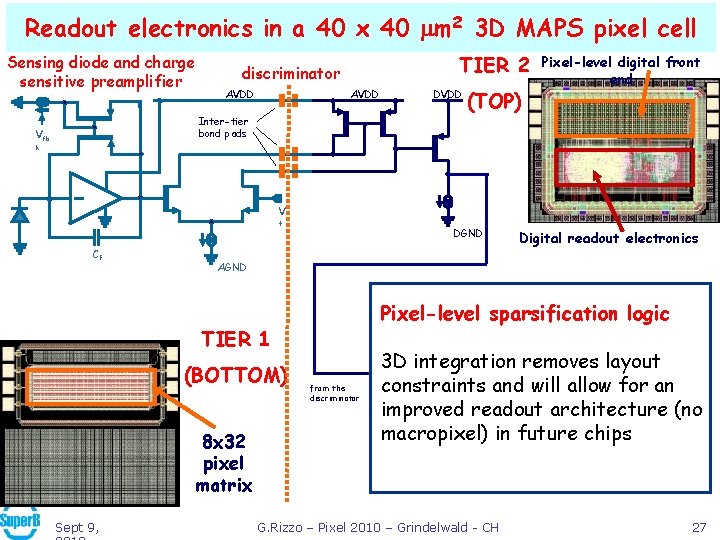
Evolving from 2 D to 3 D MAPS 2 D CMOS technology 3 D integration of 2 CMOS layers The use of vertical integration (2 CMOS layers interconnected) can improve MAPS performance – – higher sensor efficiency (PMOS in competitive N-wells removed from the sensing layer) deep N-well area can be reduced (lower CD better noise/power trade-off) more advanced readout architecture can be integrated on pixel an extra high res. substrate can be used as pixel sensor and connected Chartered/Tezzaron technology (Fermilab MPW run) First APSEL-like DNW MAPS (2 tiers) realized within the 3 DIC Consortium to explore the 130 nm Chartered/Tezzaron process. • Several problems with 3 D interconnection (bad alignment …) • While still waiting for good 3 D chips: test of the sensor+analog layer confirmed the expected improvemente in collection efficiency prepare new 3 D run Tezzaron/Global. Foundries technology (organized by CMP/MOSIS) • 10 10
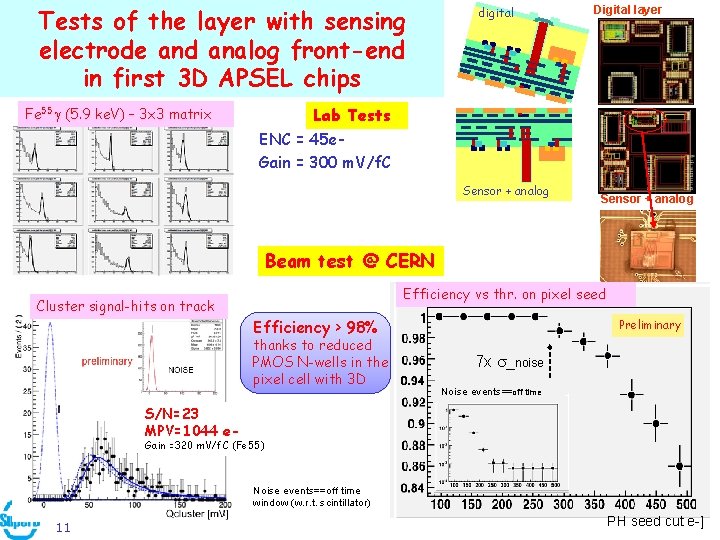
Tests of the layer with sensing electrode and analog front-end in first 3 D APSEL chips digital Digital layer Lab Tests Fe 55 (5. 9 ke. V) – 3 x 3 matrix ENC = 45 e. Gain = 300 m. V/f. C Sensor + analog Beam test @ CERN Efficiency vs thr. on pixel seed Cluster signal-hits on track Efficiency > 98% thanks to reduced PMOS N-wells in the pixel cell with 3 D Preliminary 7 x s_noise Noise events==off time S/N=23 MPV=1044 e- Gain =320 m. V/f. C (Fe 55) Noise events==off time window (w. r. t. scintillator) 11 PH seed cut e-]
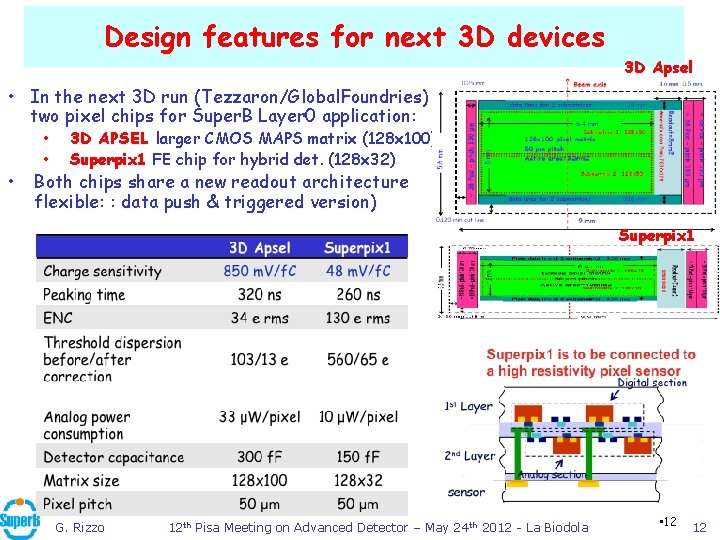
Design features for next 3 D devices 3 D Apsel • In the next 3 D run (Tezzaron/Global. Foundries) two pixel chips for Super. B Layer 0 application: • • • 3 D APSEL larger CMOS MAPS matrix (128 x 100) Superpix 1 FE chip for hybrid det. (128 x 32) Both chips share a new readout architecture flexible: : data push & triggered version) Superpix 1 3 D Apsel G. Rizzo 12 th Pisa Meeting on Advanced Detector – May 24 th 2012 - La Biodola • 12 12
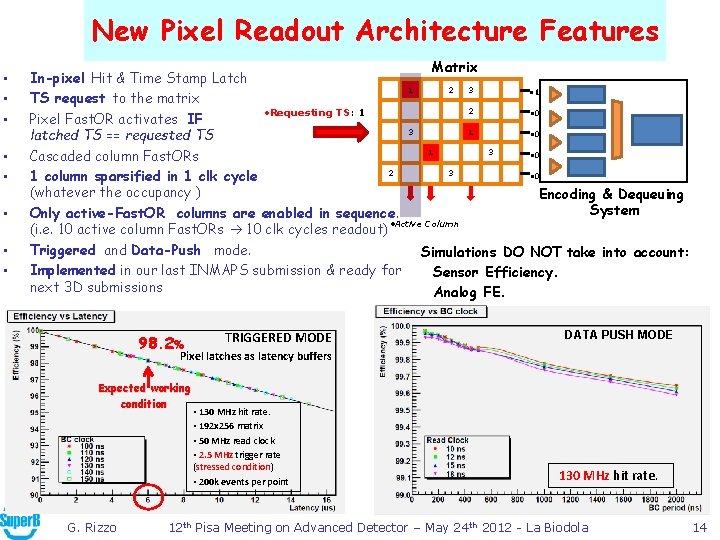
Readout logic architecture in the pixel readout cell: time-stamp latch In-pixel for a time-ordered and comparator for a time-ordered triggered readout Complex in-pixel logic can be implemented without reducing the pixel collection efficiency; readout can be data push or triggered (only selected time stamps are read out). Timestamp (TS) is broadcast to pixels and each pixel latches the current TS when fires. Matrix readout is TS ordered § A readout TS enters the pixel and an HIT-OR-OUT is generated for columns with hits associated to that TS § A column is read only if HIT -OR-OUT=1 § DATA_OUT is generated for pixels in the active columns with hits associated to that TS. G. Rizzo • 13 12 th Pisa Meeting on Advanced Detector – May 24 th 2012 - La Biodola 13
New Pixel Readout Architecture Features • • Matrix In-pixel Hit & Time Stamp Latch 1 2 3 • 1 TS request to the matrix 2 • Requesting TS: 1 • 0 Pixel Fast. OR activates IF 3 1 • 0 latched TS == requested TS 1 3 • 0 Cascaded column Fast. ORs 2 3 • 0 1 column sparsified in 1 clk cycle (whatever the occupancy ) Encoding & Dequeuing System Only active-Fast. OR columns are enabled in sequence. • Active Column (i. e. 10 active column Fast. ORs 10 clk cycles readout) Triggered and Data-Push mode. Simulations DO NOT take into account: Implemented in our last INMAPS submission & ready for Sensor Efficiency. next 3 D submissions Analog FE. 98. 2% TRIGGERED MODE DATA PUSH MODE Pixel latches as latency buffers Expected working condition G. Rizzo • 130 MHz hit rate. • 192 x 256 matrix • 50 MHz read clock • 2. 5 MHz trigger rate (stressed condition) • 200 k events per point 130 MHz hit rate. 12 th Pisa Meeting on Advanced Detector – May 24 th 2012 - La Biodola 14
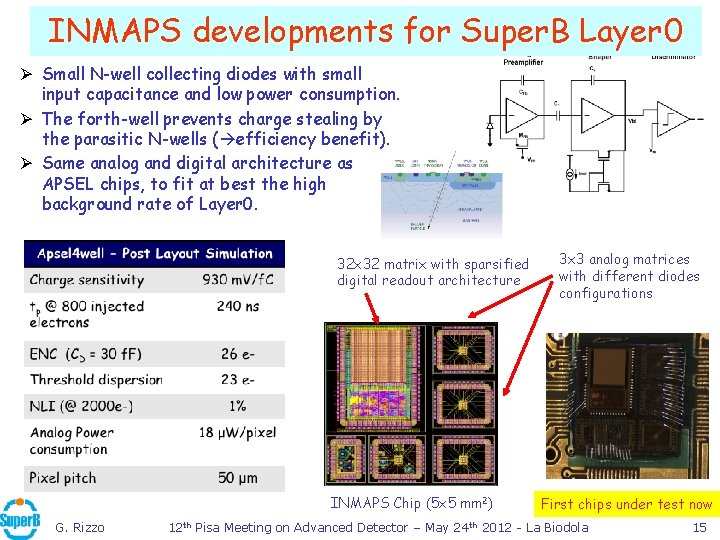
INMAPS developments for Super. B Layer 0 Ø Small N-well collecting diodes with small input capacitance and low power consumption. Ø The forth-well prevents charge stealing by the parasitic N-wells ( efficiency benefit). Ø Same analog and digital architecture as APSEL chips, to fit at best the high background rate of Layer 0. 32 x 32 matrix with sparsified digital readout architecture INMAPS Chip (5 x 5 mm 2) G. Rizzo 3 x 3 analog matrices with different diodes configurations First chips under test now 12 th Pisa Meeting on Advanced Detector – May 24 th 2012 - La Biodola 15
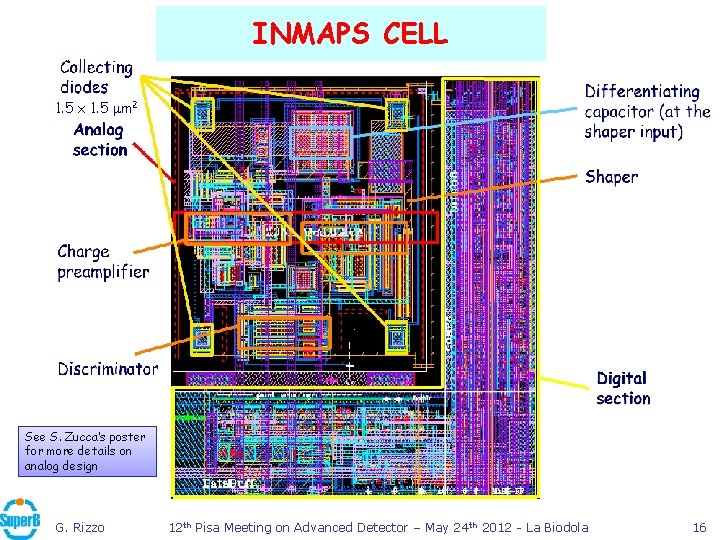
INMAPS CELL 1. 5 x 1. 5 mm 2 See S. Zucca’s poster for more details on analog design G. Rizzo 12 th Pisa Meeting on Advanced Detector – May 24 th 2012 - La Biodola 16
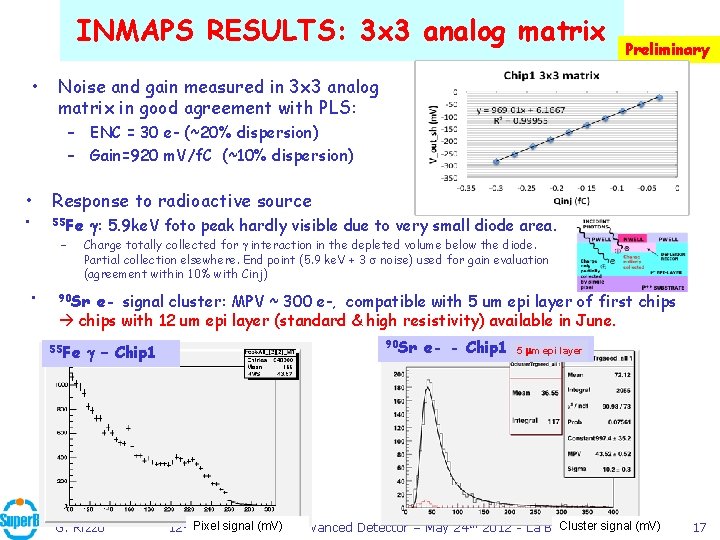
INMAPS RESULTS: 3 x 3 analog matrix • Preliminary Noise and gain measured in 3 x 3 analog matrix in good agreement with PLS: – ENC = 30 e- (~20% dispersion) – Gain=920 m. V/f. C (~10% dispersion) • • Response to radioactive source 55 Fe g: 5. 9 ke. V foto peak hardly visible due to very small diode area. – • Charge totally collected for interaction in the depleted volume below the diode. Partial collection elsewhere. End point (5. 9 ke. V + 3 s noise) used for gain evaluation (agreement within 10% with Cinj) 90 Sr e- signal cluster: MPV ~ 300 e-, compatible with 5 um epi layer of first chips with 12 um epi layer (standard & high resistivity) available in June. 55 Fe g – Chip 1 G. Rizzo 90 Sr e- - Chip 1 5 mm epi layer (m. V) Cluster signal (m. V) 12 th Pixel Pisa signal Meeting on Advanced Detector – May 24 th 2012 - La Biodola 17
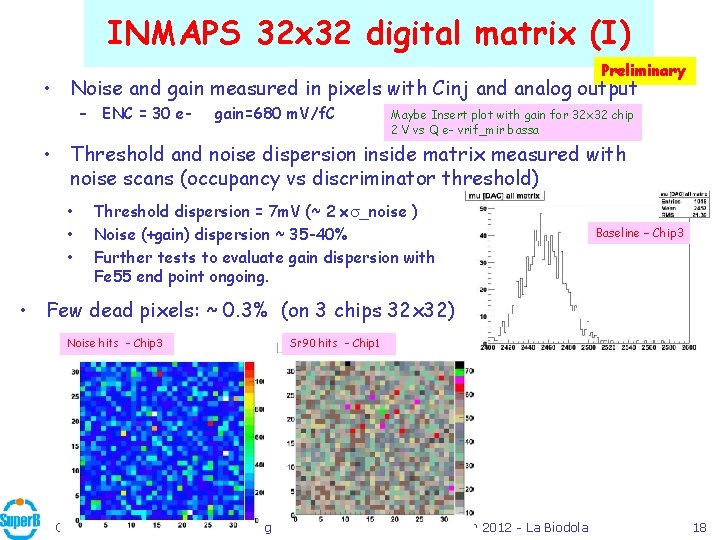
INMAPS 32 x 32 digital matrix (I) Preliminary • Noise and gain measured in pixels with Cinj and analog output – ENC = 30 e- gain=680 m. V/f. C Maybe Insert plot with gain for 32 x 32 chip 2 V vs Q e- vrif_mir bassa • Threshold and noise dispersion inside matrix measured with noise scans (occupancy vs discriminator threshold) • • • Threshold dispersion = 7 m. V (~ 2 xs_noise ) Noise (+gain) dispersion ~ 35 -40% Further tests to evaluate gain dispersion with Fe 55 end point ongoing. Baseline – Chip 3 • Few dead pixels: ~ 0. 3% (on 3 chips 32 x 32) Noise hits – Chip 3 G. Rizzo Sr 90 hits – Chip 1 12 th Pisa Meeting on Advanced Detector – May 24 th 2012 - La Biodola 18
INMAPS 32 x 32 digital matrix (II) Preliminary • Standard functionality of new readout architecture verified in the two operation modes available on chip: data push (all TS readout) and triggered (only selected TS readout). 1. Threshold scans similar in both operation modes. + data push + triggered 2. Triggered mode also verified with specific test retrieving data injected at selected TS. 1. Pulse injection @ TS = 0 high threshold no noise hits above threshold 2. Trigger arrives @ TS =2 with trigger latency setting = 3 TS triggered event TS = 0 3. Data out stream info: Ø TS =0: 0 pixels in submatrix 0 G. Rizzo Ø TS =0: 1 fired pixel in submatrix 1 12 th Pisa Meeting on Advanced Detector – May 24 th 2012 - La Biodola 19
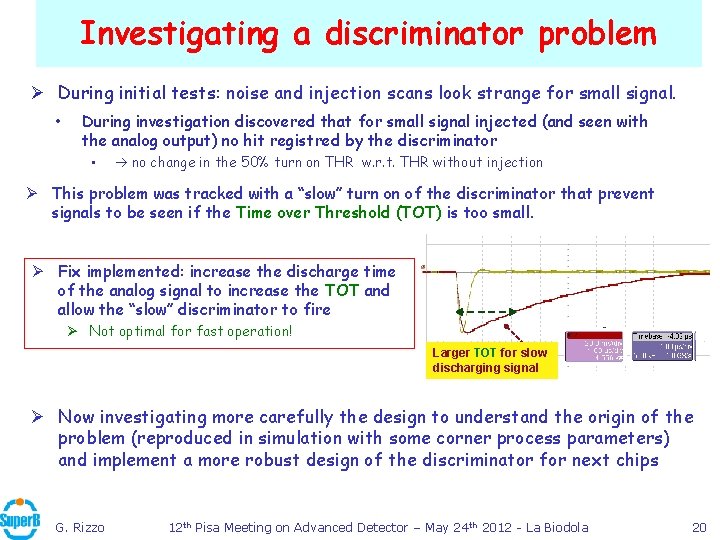
Investigating a discriminator problem Ø During initial tests: noise and injection scans look strange for small signal. • During investigation discovered that for small signal injected (and seen with the analog output) no hit registred by the discriminator • no change in the 50% turn on THR w. r. t. THR without injection Ø This problem was tracked with a “slow” turn on of the discriminator that prevent signals to be seen if the Time over Threshold (TOT) is too small. Ø Fix implemented: increase the discharge time of the analog signal to increase the TOT and allow the “slow” discriminator to fire Ø Not optimal for fast operation! Larger TOT for slow discharging signal Ø Now investigating more carefully the design to understand the origin of the problem (reproduced in simulation with some corner process parameters) and implement a more robust design of the discriminator for next chips G. Rizzo 12 th Pisa Meeting on Advanced Detector – May 24 th 2012 - La Biodola 20
Conclusions G. Rizzo 12 th Pisa Meeting on Advanced Detector – May 24 th 2012 - La Biodola 21
backup G. Rizzo 12 th Pisa Meeting on Advanced Detector – May 24 th 2012 - La Biodola 22
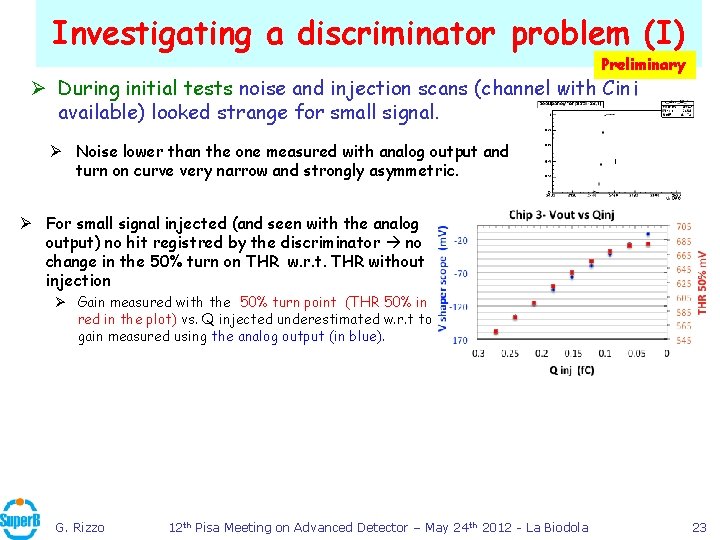
Investigating a discriminator problem (I) Preliminary Ø During initial tests noise and injection scans (channel with Cinj available) looked strange for small signal. Ø Noise lower than the one measured with analog output and turn on curve very narrow and strongly asymmetric. Ø For small signal injected (and seen with the analog output) no hit registred by the discriminator no change in the 50% turn on THR w. r. t. THR without injection Ø Gain measured with the 50% turn point (THR 50% in red in the plot) vs. Q injected underestimated w. r. t to gain measured using the analog output (in blue). G. Rizzo 12 th Pisa Meeting on Advanced Detector – May 24 th 2012 - La Biodola 23
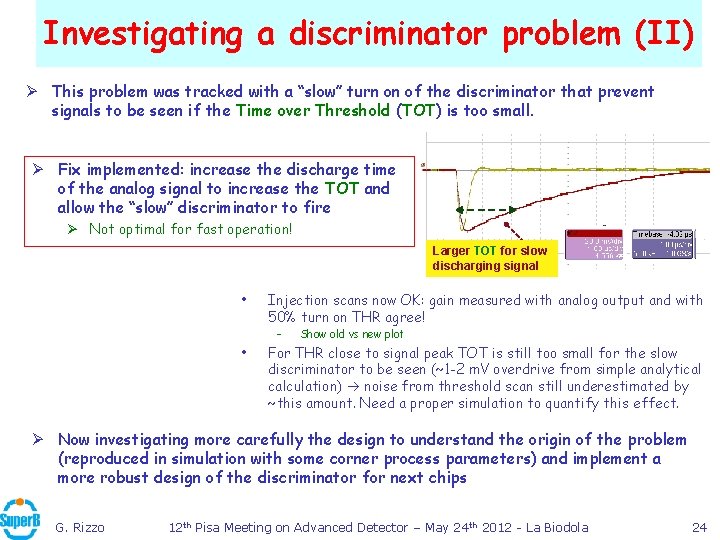
Investigating a discriminator problem (II) Ø This problem was tracked with a “slow” turn on of the discriminator that prevent signals to be seen if the Time over Threshold (TOT) is too small. Ø Fix implemented: increase the discharge time of the analog signal to increase the TOT and allow the “slow” discriminator to fire Ø Not optimal for fast operation! Larger TOT for slow discharging signal • Injection scans now OK: gain measured with analog output and with 50% turn on THR agree! – • Show old vs new plot For THR close to signal peak TOT is still too small for the slow discriminator to be seen (~1 -2 m. V overdrive from simple analytical calculation) noise from threshold scan still underestimated by ~this amount. Need a proper simulation to quantify this effect. Ø Now investigating more carefully the design to understand the origin of the problem (reproduced in simulation with some corner process parameters) and implement a more robust design of the discriminator for next chips G. Rizzo 12 th Pisa Meeting on Advanced Detector – May 24 th 2012 - La Biodola 24
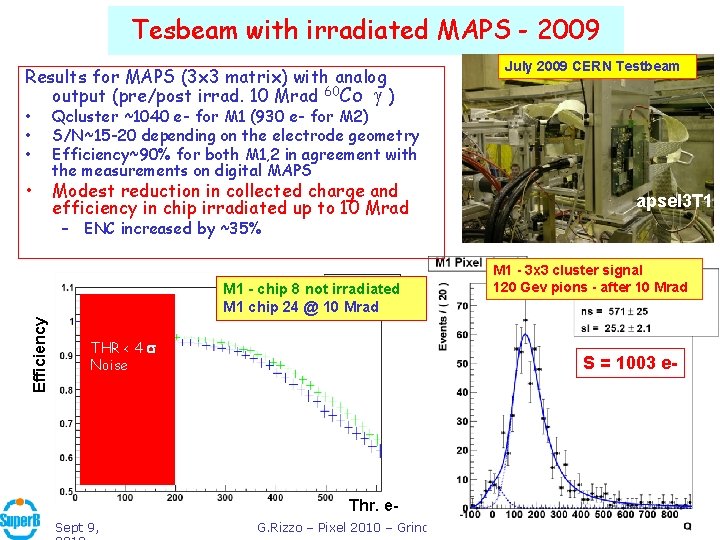
Tesbeam with irradiated MAPS - 2009 July 2009 CERN Testbeam Results for MAPS (3 x 3 matrix) with analog output (pre/post irrad. 10 Mrad 60 Co ) • • Qcluster ~1040 e- for M 1 (930 e- for M 2) S/N~15 -20 depending on the electrode geometry Efficiency~90% for both M 1, 2 in agreement with the measurements on digital MAPS Modest reduction in collected charge and efficiency in chip irradiated up to 10 Mrad apsel 3 T 1 – ENC increased by ~35% Efficiency M 1 - chip 8 not irradiated M 1 chip 24 @ 10 Mrad M 1 - 3 x 3 cluster signal 120 Gev pions - after 10 Mrad THR < 4 s Noise S = 1003 e- Thr. e. Sept 9, G. Rizzo – Pixel 2010 – Grindelwald - CH 25
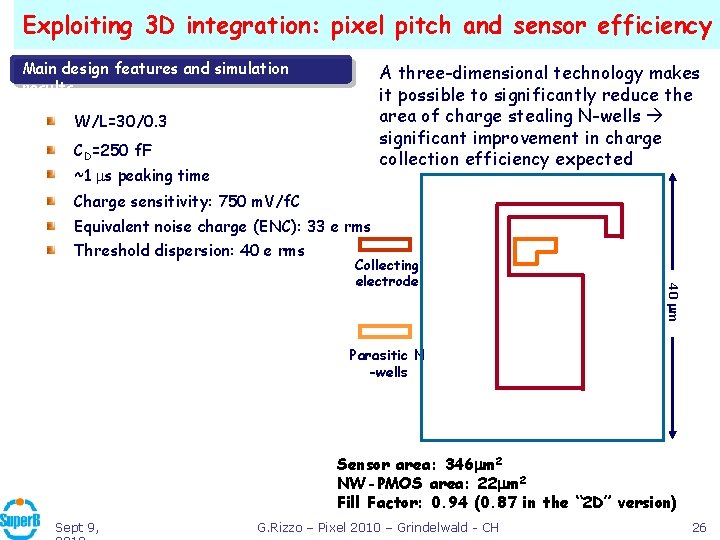
Exploiting 3 D integration: pixel pitch and sensor efficiency Main design features and simulation results A three-dimensional technology makes it possible to significantly reduce the area of charge stealing N-wells significant improvement in charge collection efficiency expected W/L=30/0. 3 CD=250 f. F ~1 ms peaking time Charge sensitivity: 750 m. V/f. C Equivalent noise charge (ENC): 33 e rms Threshold dispersion: 40 e rms 40 mm Collecting electrode Parasitic N -wells Sensor area: 346 mm 2 NW-PMOS area: 22 mm 2 Fill Factor: 0. 94 (0. 87 in the “ 2 D” version) Sept 9, G. Rizzo – Pixel 2010 – Grindelwald - CH 26
Readout electronics in a 40 x 40 mm 2 3 D MAPS pixel cell Sensing diode and charge sensitive preamplifier TIER 2 discriminator AVDD Inter-tier bond pads Vfb DVDD (TOP) Pixel-level digital front end k V t CF DGND Digital readout electronics AGND Pixel-level sparsification logic TIER 1 (BOTTOM) 8 x 32 pixel matrix from the discriminator 3 D integration removes layout constraints and will allow for an improved readout architecture (no macropixel) in future chips N-well Sept 9, G. Rizzo – Pixel 2010 – Grindelwald - CH 27