
Recent development of FTF model and validation of
![Smearing of resonance masses From: Johan Messchendorp [j. g. messchendorp@rug. nl] Sent: 24 May](https://slidetodoc.com/presentation_image_h2/9a1980517ab1c6bbd6b36162b9e0b91f/image-2.jpg "Smearing of resonance masses From: Johan Messchendorp [j. g. messchendorp@rug. nl] Sent: 24 May")




- Slides: 24
Recent development of FTF model, and validation of FTFP and BERT models V. Uzhinsky, 25 July 2017 Content 1. 2. 3. 4. 5. 6. Smearing of resonance masses Bertini and FTF for the HARP experiment Recoil of nuclear residuals in Bertini ? Pion-Nucleon reaction cross-sections Results of improved FTF Nucleus-nucleus interactions at 2 -8 Ge. V/N
Smearing of resonance masses From: Johan Messchendorp [j. g. messchendorp@rug. nl] Sent: 24 May 2017 14: 00 To: Makoto Asai; verderi@in 2 p 3. fr; Alberto Ribon; dwright@slac. stanford. edu Cc: Vladimir Uzhinsky; Galoyan Aida; Karin Schönning Subject: Request from the Panda collaboration Dear members of the Geant 4 Collaboration, The PANDA experiment aims to harvest data in the fields of hadron spectroscopy (especially, search for gluonic excitations, charmonium spectroscopy, D meson spectroscopy, baryon spectroscopy), hadrons in matter (medium modifications of hadrons embedded in hadronic matter), hypernuclei, and nucleon structure. To reach our physics goals, a measurement of the properties of hadronic resonances is of vital importance. The corresponding setups and physics performances are now under investigation using the Geant 4 toolkit, especially, the QGSP-BERT physics list. By running Monte Carlo simulations, we observed that Geant 4 produces resonances with no width , which for our studies can be problematic. It would be desirable for us to take properly into account the Breit-Wigner mass distributions of the various resonances, thereby accounting for the natural width of the states, while respecting momentum and energy conservation. We, therefore, like to ask you whether you could implement such a "smearing" scenario in Geant 4. This would be highly appreciated by our physics working groups. More information about our experiment can be found at http: //www. fair-center. eu/public/experiment-program/antiproton-physics/panda. html https: //panda. gsi. de/ Thank you in advance! Sincerely yours, The PANDA Collaboration ----------------------Johan Messchendorp Physics coordinator PAND 2
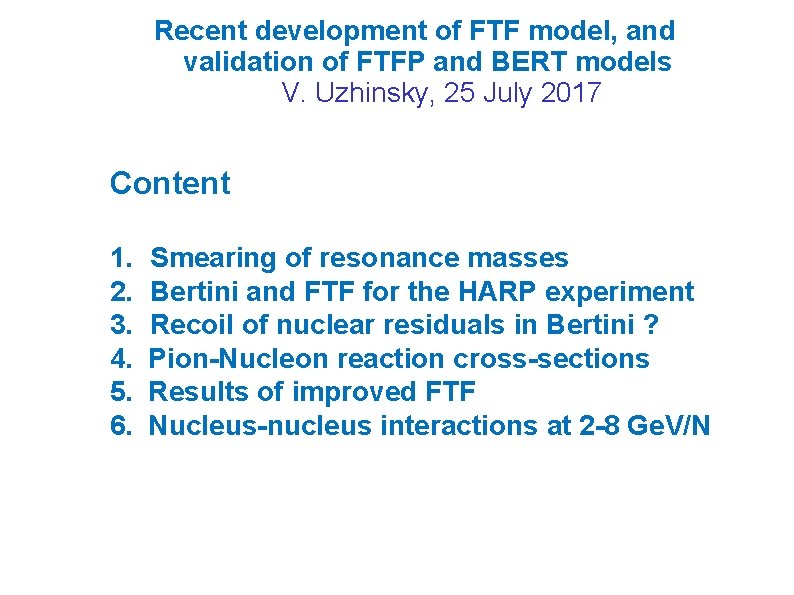
1. Smearing of resonance masses Class G 4 Excited. String. Decay: // -------- Sampling mass of unstable hadronic resonances -------- Uzhi July 2017 Track. Definition = (*generated. Kinetic. Tracks)[a. Track]->Get. Definition(); if(Track. Definition->Is. Short. Lived()) { G 4 double New. Track. Mass = Br. W. Sample. Mass( Track. Definition, Track. Definition->Get. PDGMass() + 5. 0*Track. Definition->Get. PDGWidth() ); G 4 Lorentz. Vector Tmp=G 4 Lorentz. Vector((*generated. Kinetic. Tracks)[a. Track]->Get 4 Momentum()); Tmp. set. E(std: : sqrt(sqr(New. Track. Mass) + Tmp. vect(). mag 2())); (*generated. Kinetic. Tracks)[a. Track]->Set 4 Momentum(Tmp); } // ----------------------------------------------- 3
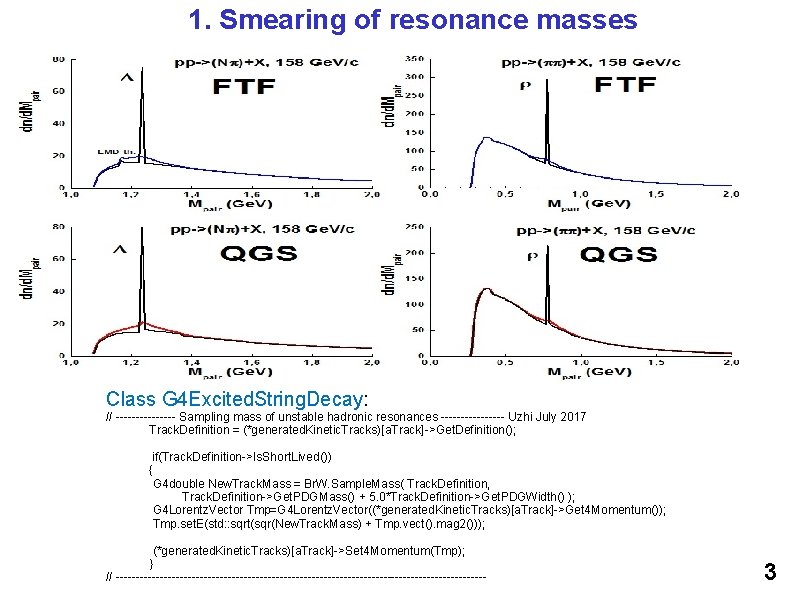
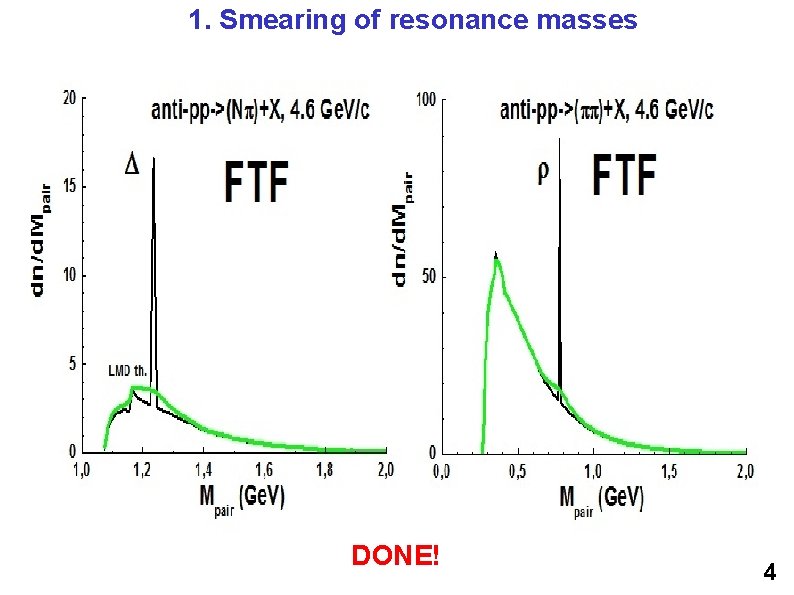
1. Smearing of resonance masses DONE! 4
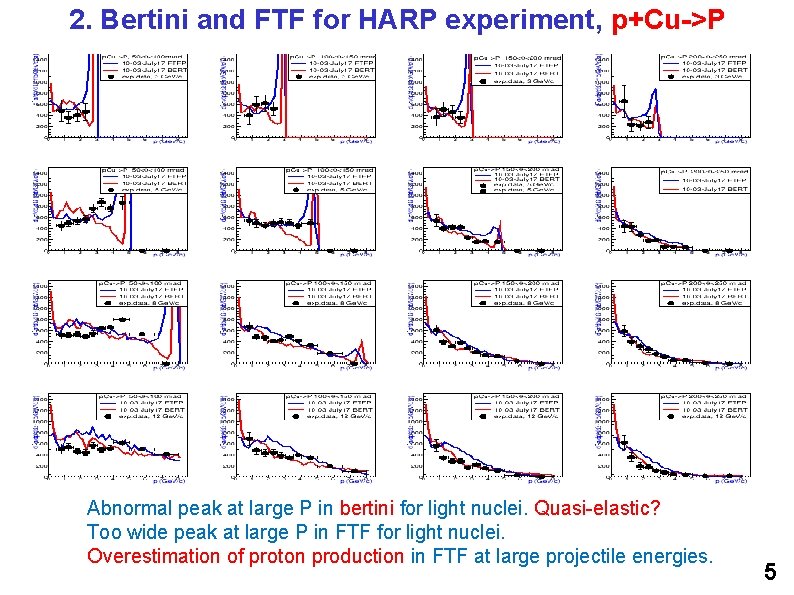
2. Bertini and FTF for HARP experiment, p+Cu->P Abnormal peak at large P in bertini for light nuclei. Quasi-elastic? Too wide peak at large P in FTF for light nuclei. Overestimation of proton production in FTF at large projectile energies. 5
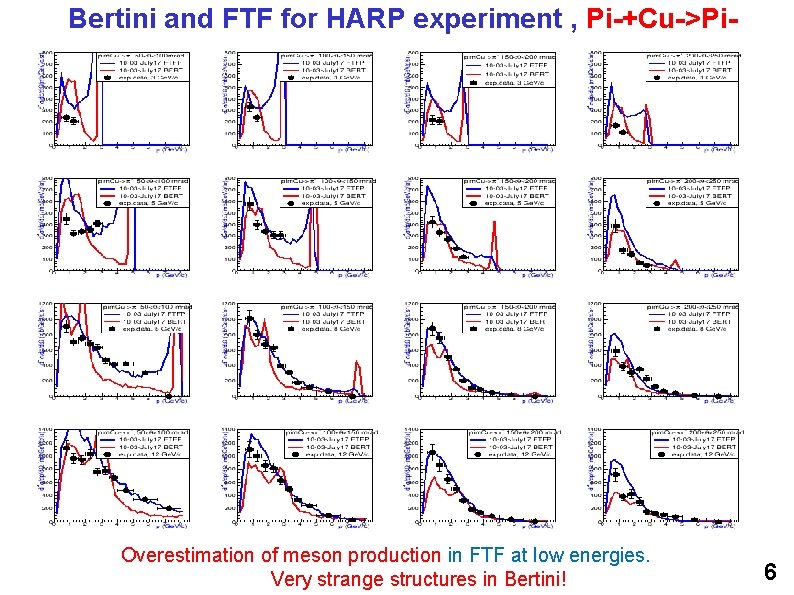
Bertini and FTF for HARP experiment , Pi-+Cu->Pi- Overestimation of meson production in FTF at low energies. Very strange structures in Bertini! 6
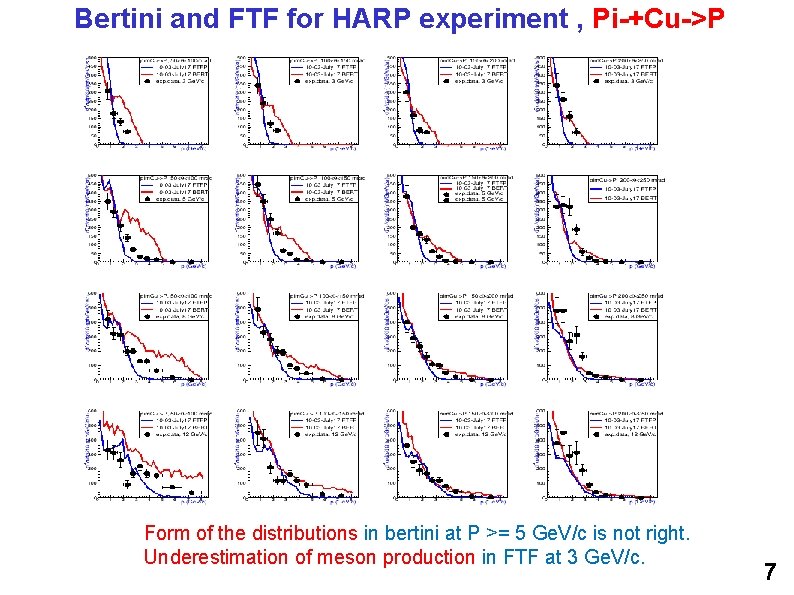
Bertini and FTF for HARP experiment , Pi-+Cu->P Form of the distributions in bertini at P >= 5 Ge. V/c is not right. Underestimation of meson production in FTF at 3 Ge. V/c. 7
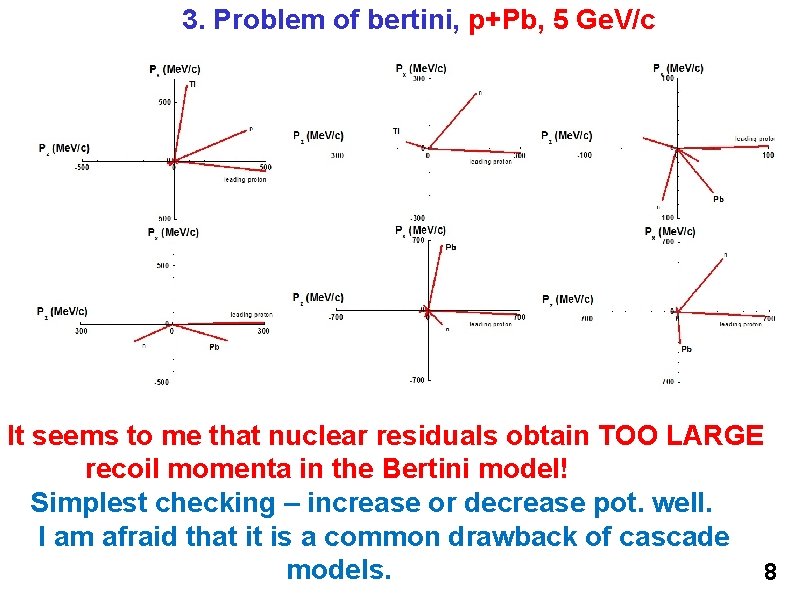
3. Problem of bertini, p+Pb, 5 Ge. V/c It seems to me that nuclear residuals obtain TOO LARGE recoil momenta in the Bertini model! Simplest checking – increase or decrease pot. well. I am afraid that it is a common drawback of cascade models. 8
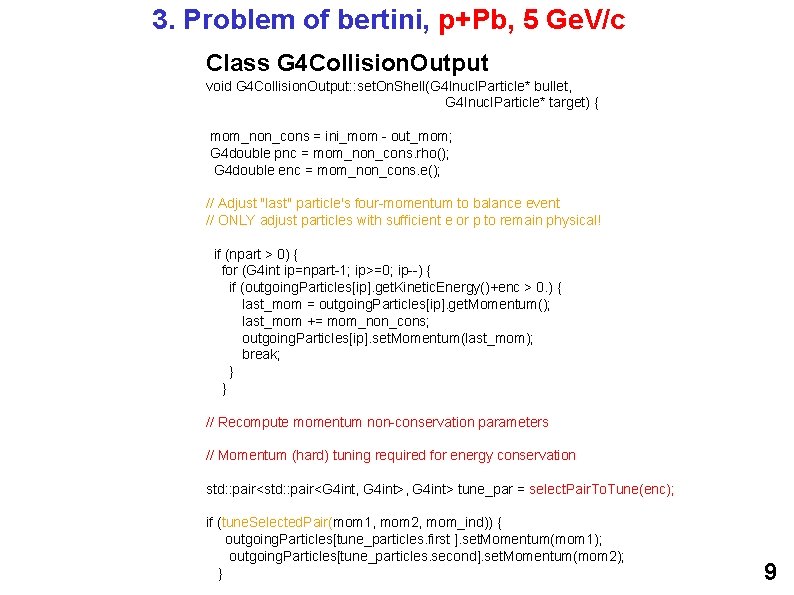
3. Problem of bertini, p+Pb, 5 Ge. V/c Class G 4 Collision. Output void G 4 Collision. Output: : set. On. Shell(G 4 Inucl. Particle* bullet, G 4 Inucl. Particle* target) { mom_non_cons = ini_mom - out_mom; G 4 double pnc = mom_non_cons. rho(); G 4 double enc = mom_non_cons. e(); t // Adjust "last" particle's four-momentum to balance event // ONLY adjust particles with sufficient e or p to remain physical! if (npart > 0) { for (G 4 int ip=npart-1; ip>=0; ip--) { if (outgoing. Particles[ip]. get. Kinetic. Energy()+enc > 0. ) { last_mom = outgoing. Particles[ip]. get. Momentum(); last_mom += mom_non_cons; outgoing. Particles[ip]. set. Momentum(last_mom); break; } } // Recompute momentum non-conservation parameters // Momentum (hard) tuning required for energy conservation std: : pair<G 4 int, G 4 int> tune_par = select. Pair. To. Tune(enc); if (tune. Selected. Pair(mom 1, mom 2, mom_ind)) { outgoing. Particles[tune_particles. first ]. set. Momentum(mom 1); outgoing. Particles[tune_particles. second]. set. Momentum(mom 2); } 9
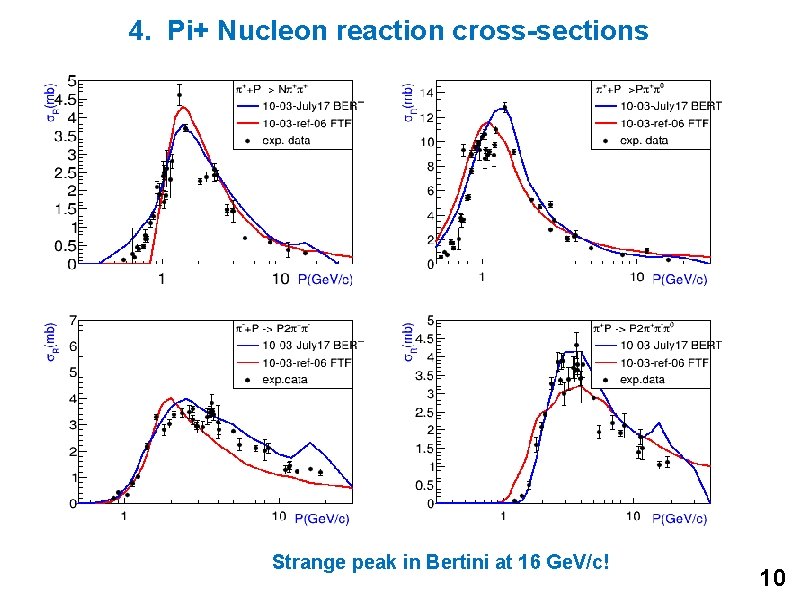
4. Pi+ Nucleon reaction cross-sections Strange peak in Bertini at 16 Ge. V/c! 10
4. Pi+ Nucleon reaction cross-sections Overestimation of 8 prong events in Bertini at 12 Ge. V/c! 11
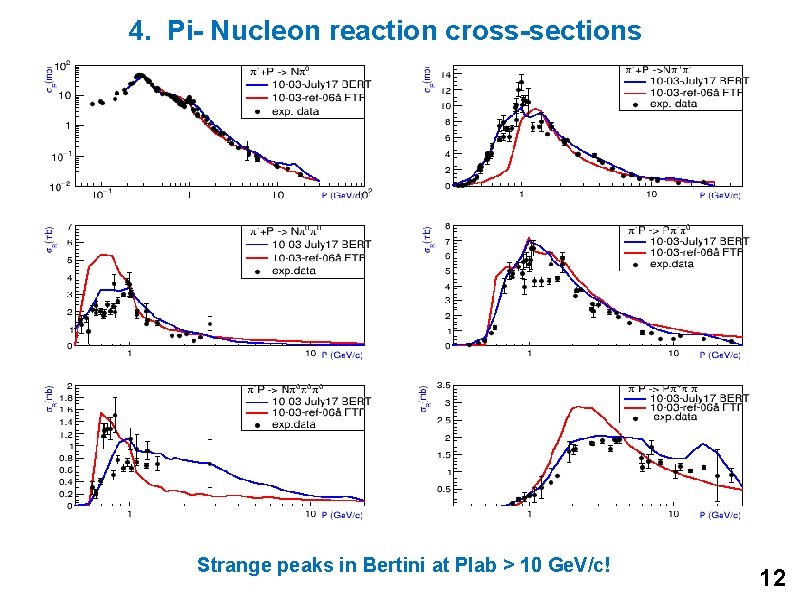
4. Pi- Nucleon reaction cross-sections Strange peaks in Bertini at Plab > 10 Ge. V/c! 12
4. Pi- Nucleon reaction cross-sections Underestimation of 4 prong events in Bertini at Plab > 3 Ge. V/c! It would be well to check the Bertini model at low energies. 13
4. Pi+ Nucleon reaction cross-sections Very strange structure in Xf distributions! It would be well to check the Bertini model at low energies. 14
4. Pi- Nucleon reaction cross-sections Very strange structure in Xf distributions! It would be well to check the Bertini model at low energies. 15
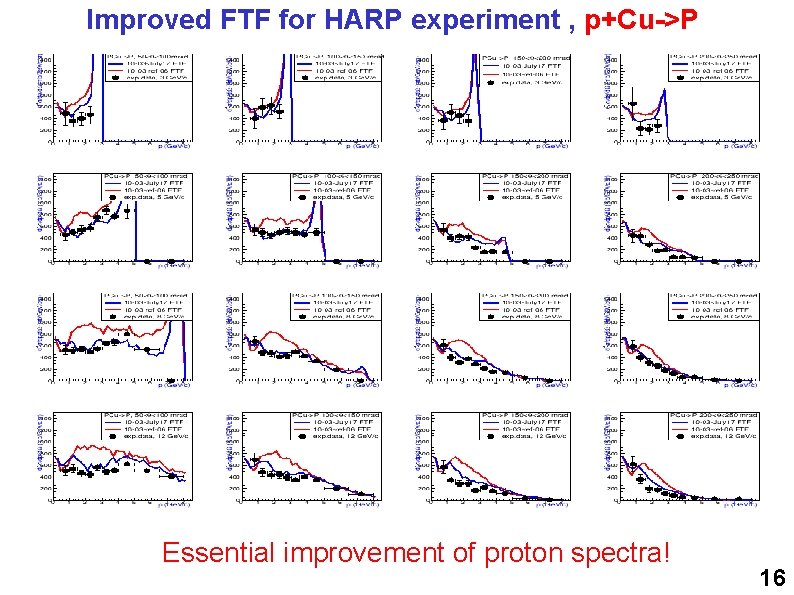
Improved FTF for HARP experiment , p+Cu->P Essential improvement of proton spectra! 16
Improved FTF for HARP experiment , p+Cu->Pi+ Essential improvement of the Pi+ spectra! 17
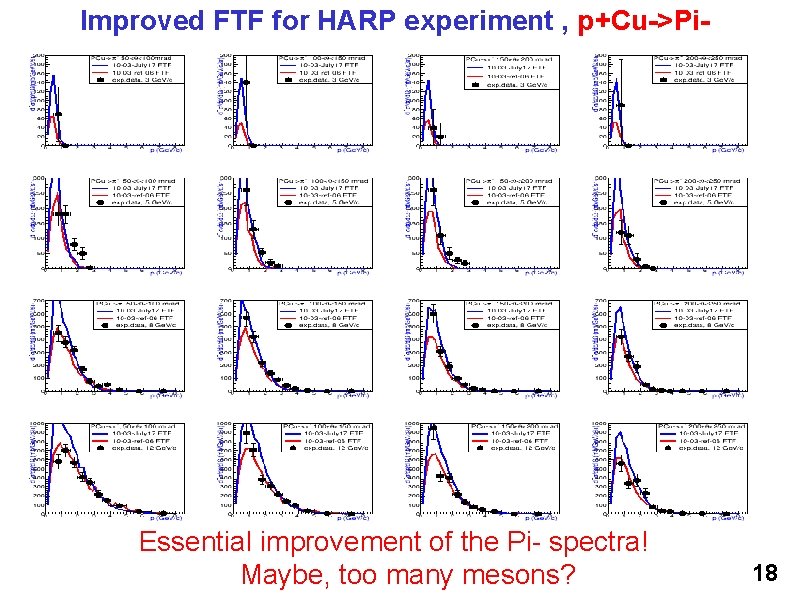
Improved FTF for HARP experiment , p+Cu->Pi- Essential improvement of the Pi- spectra! Maybe, too many mesons? 18
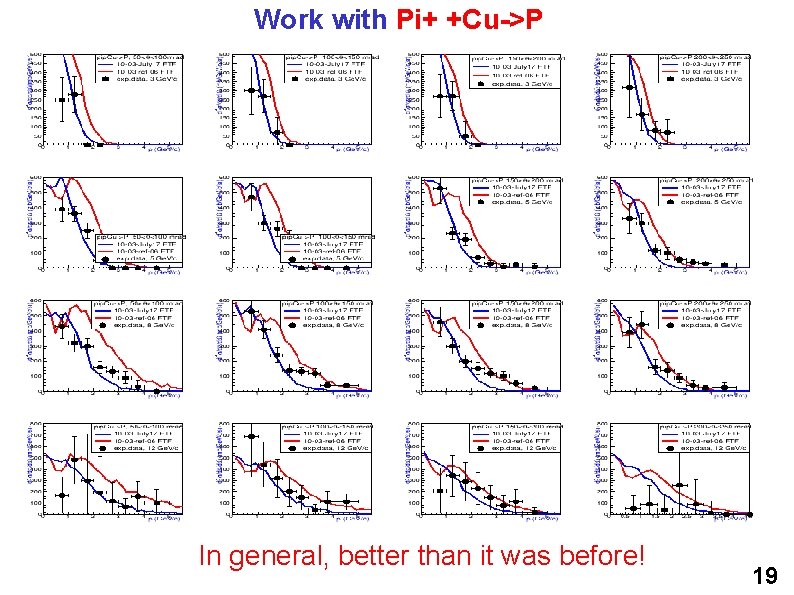
Work with Pi+ +Cu->P In general, better than it was before! 19
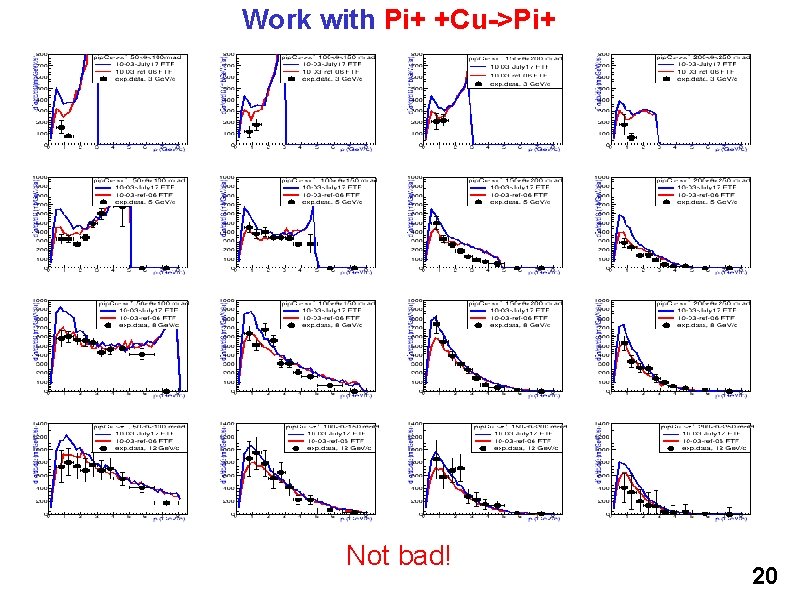
Work with Pi+ +Cu->Pi+ Not bad! 20
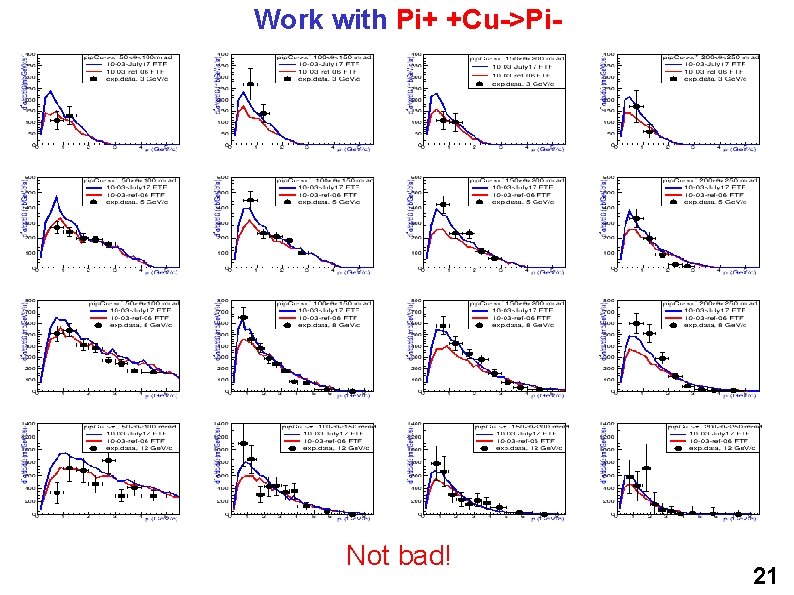
Work with Pi+ +Cu->Pi- Not bad! 21
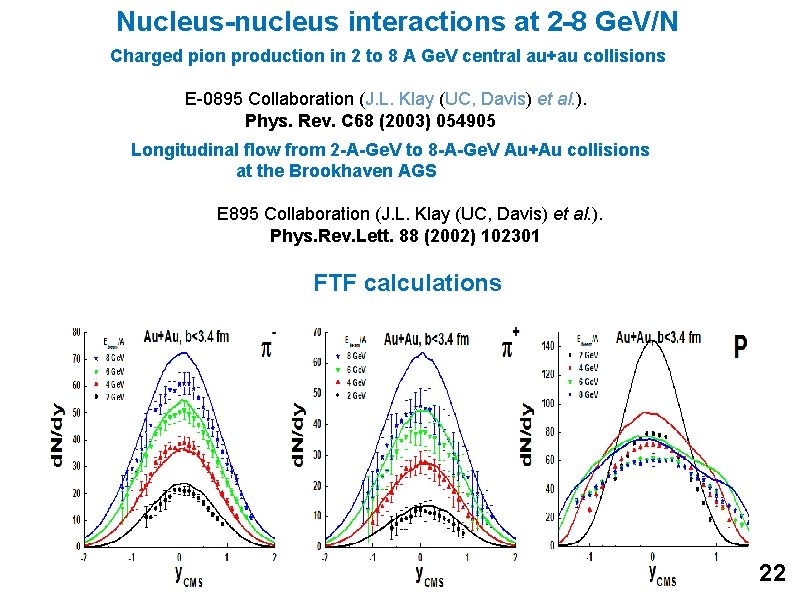
Nucleus-nucleus interactions at 2 -8 Ge. V/N Charged pion production in 2 to 8 A Ge. V central au+au collisions E-0895 Collaboration (J. L. Klay (UC, Davis) et al. ). Phys. Rev. C 68 (2003) 054905 Longitudinal flow from 2 -A-Ge. V to 8 -A-Ge. V Au+Au collisions at the Brookhaven AGS E 895 Collaboration (J. L. Klay (UC, Davis) et al. ). Phys. Rev. Lett. 88 (2002) 102301 FTF calculations 22
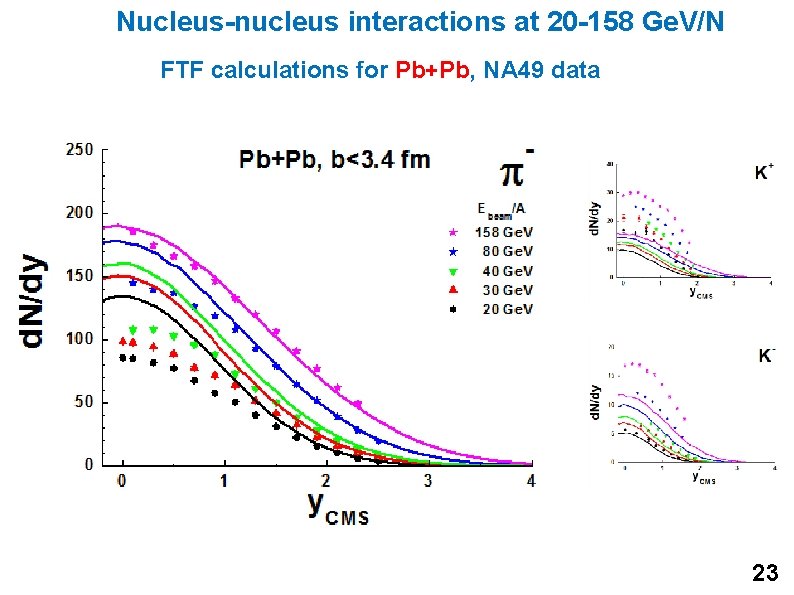
Nucleus-nucleus interactions at 20 -158 Ge. V/N FTF calculations for Pb+Pb, NA 49 data 23
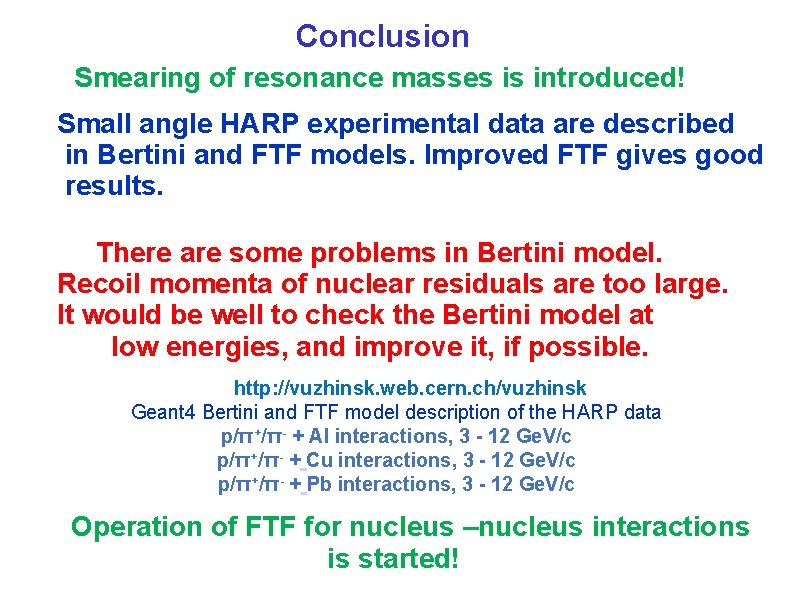
Conclusion Smearing of resonance masses is introduced! Small angle HARP experimental data are described in Bertini and FTF models. Improved FTF gives good results. There are some problems in Bertini model. Recoil momenta of nuclear residuals are too large. It would be well to check the Bertini model at low energies, and improve it, if possible. http: //vuzhinsk. web. cern. ch/vuzhinsk Geant 4 Bertini and FTF model description of the HARP data p/π+/π- + Al interactions, 3 - 12 Ge. V/c p/π+/π- + Cu interactions, 3 - 12 Ge. V/c p/π+/π- + Pb interactions, 3 - 12 Ge. V/c Operation of FTF for nucleus –nucleus interactions is started!