
Recent APS Storage Ring Instrumentation Developments Glenn Decker
- Slides: 25
Recent APS Storage Ring Instrumentation Developments Glenn Decker Advanced Photon Source Beam Diagnostics March 1, 2010
Ring Diagnostics Overview RF beam position monitor technology Photon counting applications Glenn Decker FLS 2010
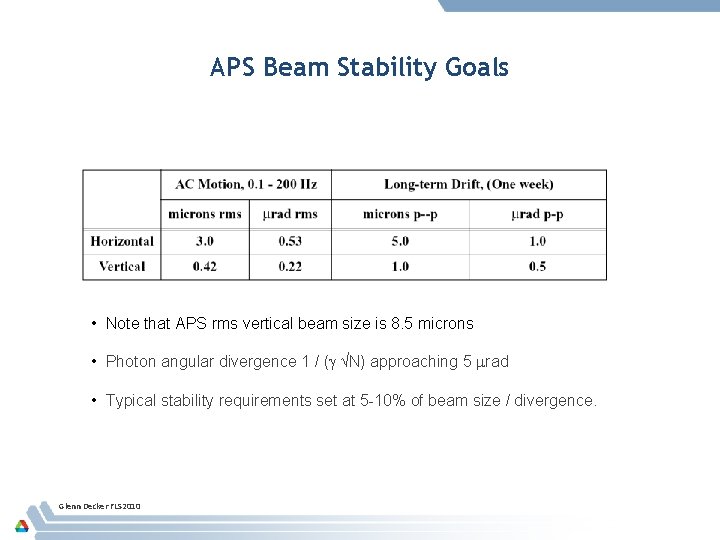
APS Beam Stability Goals • Note that APS rms vertical beam size is 8. 5 microns • Photon angular divergence 1 / (g √N) approaching 5 mrad • Typical stability requirements set at 5 -10% of beam size / divergence. Glenn Decker FLS 2010
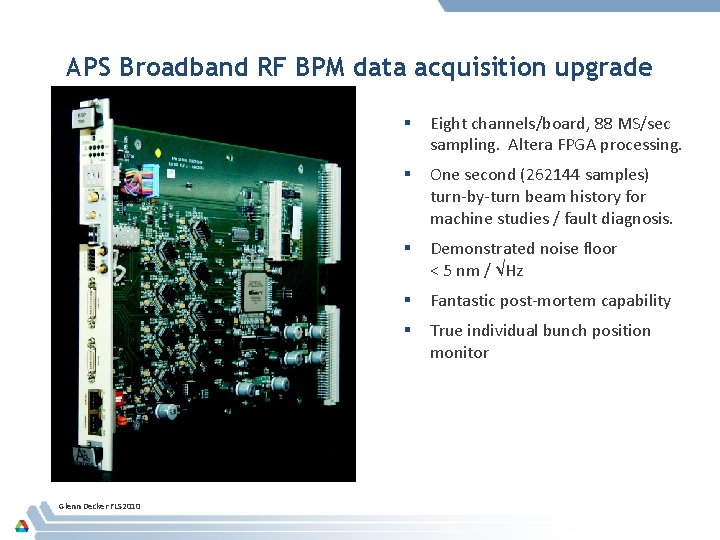
APS Broadband RF BPM data acquisition upgrade Eight channels/board, 88 MS/sec sampling. Altera FPGA processing. One second (262144 samples) turn-by-turn beam history for machine studies / fault diagnosis. Demonstrated noise floor < 5 nm / √Hz Fantastic post-mortem capability True individual bunch position monitor Glenn Decker FLS 2010
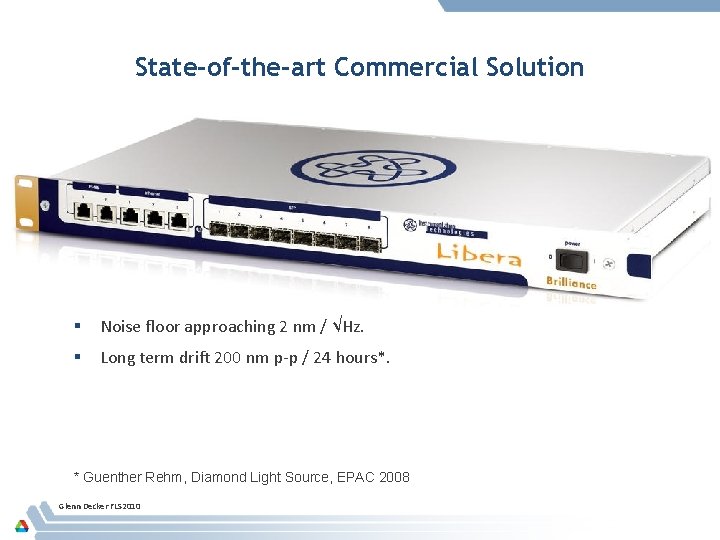
State-of-the-art Commercial Solution Noise floor approaching 2 nm / √Hz. Long term drift 200 nm p-p / 24 hours*. * Guenther Rehm, Diamond Light Source, EPAC 2008 Glenn Decker FLS 2010
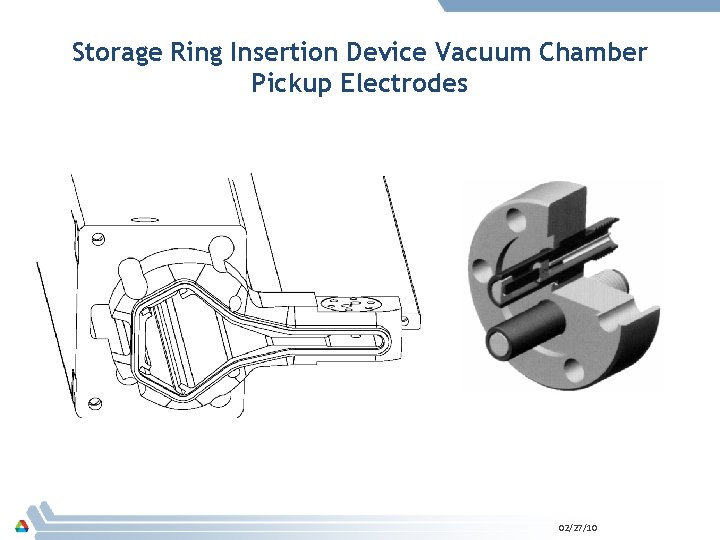
Storage Ring Insertion Device Vacuum Chamber Pickup Electrodes 02/27/10
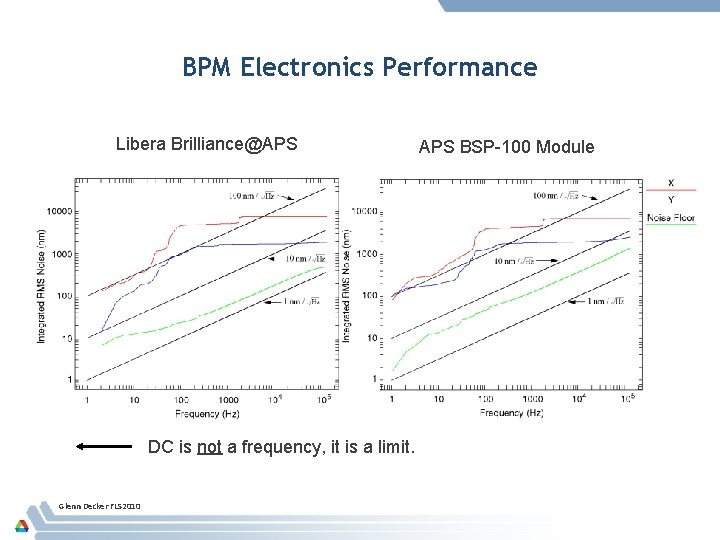
BPM Electronics Performance Libera Brilliance@APS DC is not a frequency, it is a limit. Glenn Decker FLS 2010 APS BSP-100 Module
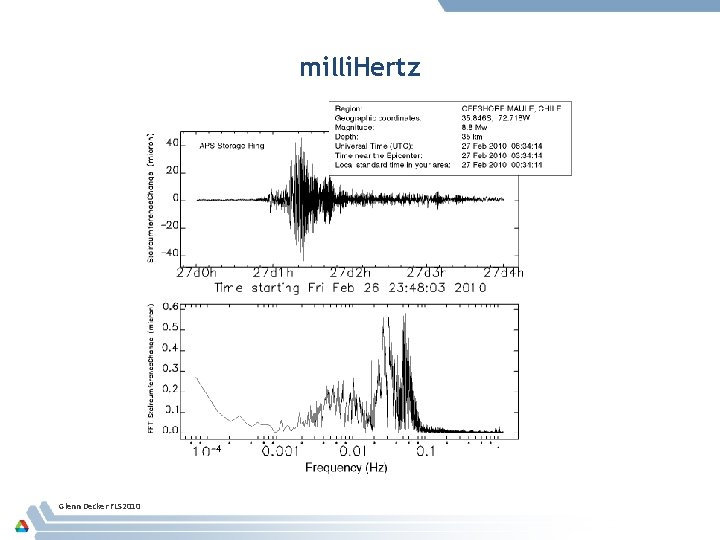
milli. Hertz Glenn Decker FLS 2010
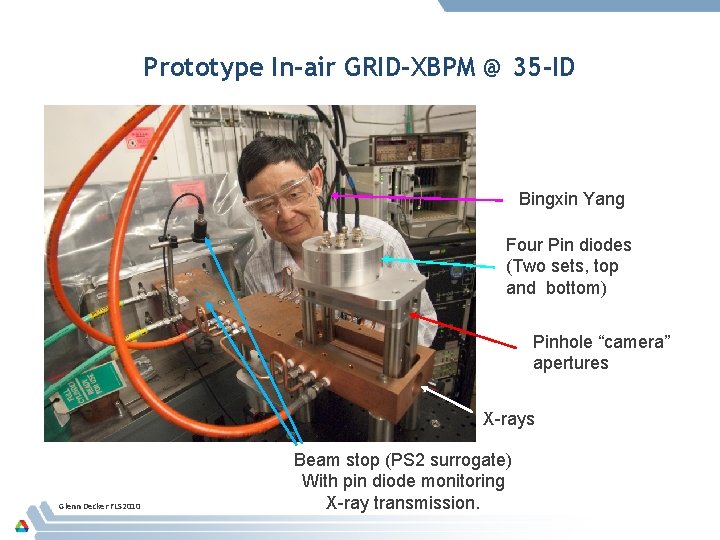
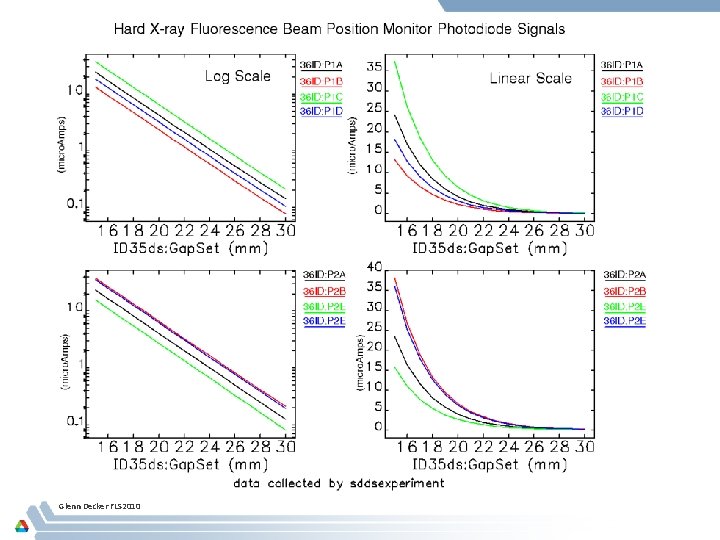
APS Front-end hard x-ray beam position monitor developments Extensive studies have taken place at the APS investigating copper x-ray fluorescence vs. photoemission for photon beam position monitoring. – Soft bending magnet radiation background essentially eliminated. – High power densities remain a challenge. An in-air prototype of a device of this type has been installed at 35 -ID and is undergoing extensive testing. Glenn Decker FLS 2010
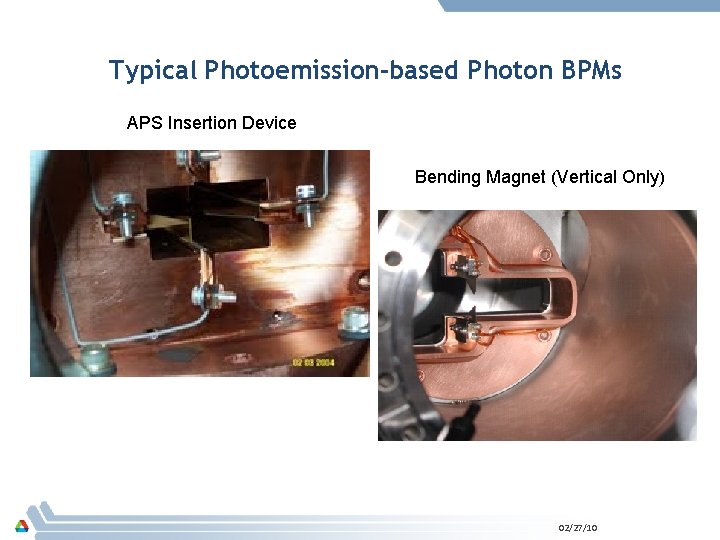
Typical Photoemission-based Photon BPMs APS Insertion Device Bending Magnet (Vertical Only) 02/27/10
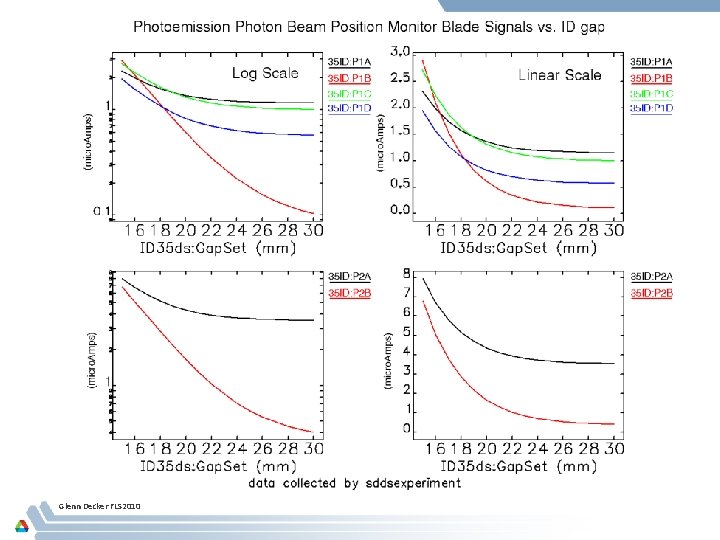
Glenn Decker FLS 2010
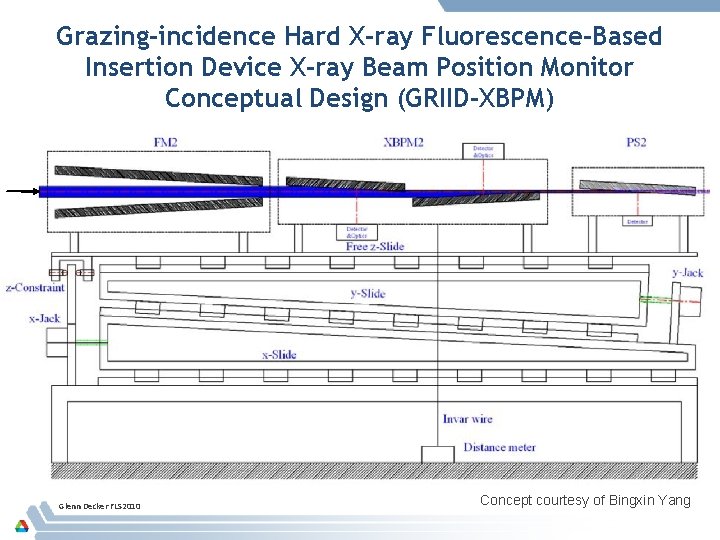
Grazing-incidence Hard X-ray Fluorescence-Based Insertion Device X-ray Beam Position Monitor Conceptual Design (GRIID-XBPM) Glenn Decker FLS 2010 Concept courtesy of Bingxin Yang
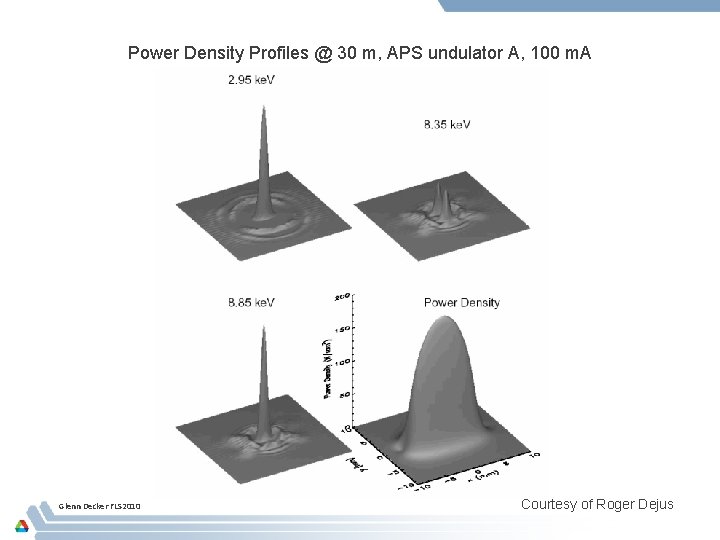
Power Density Profiles @ 30 m, APS undulator A, 100 m. A Glenn Decker FLS 2010 Courtesy of Roger Dejus
Prototype In-air GRID-XBPM @ 35 -ID Bingxin Yang Four Pin diodes (Two sets, top and bottom) Pinhole “camera” apertures X-rays Glenn Decker FLS 2010 Beam stop (PS 2 surrogate) With pin diode monitoring X-ray transmission.
Glenn Decker FLS 2010
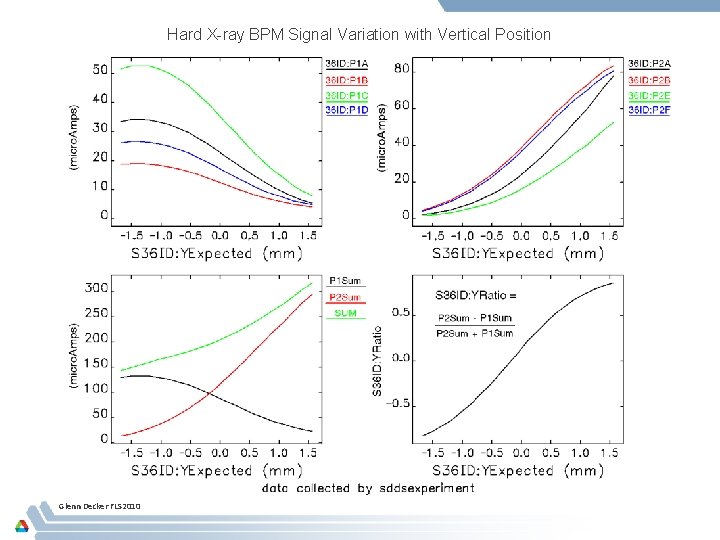
Hard X-ray BPM Signal Variation with Vertical Position Glenn Decker FLS 2010
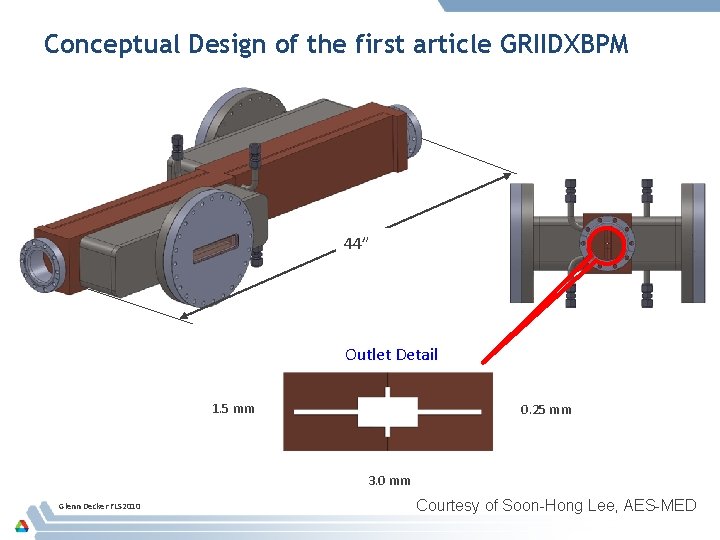
Conceptual Design of the first article GRIIDXBPM 44” Outlet Detail 1. 5 mm 0. 25 mm 3. 0 mm Glenn Decker FLS 2010 Courtesy of Soon-Hong Lee, AES-MED
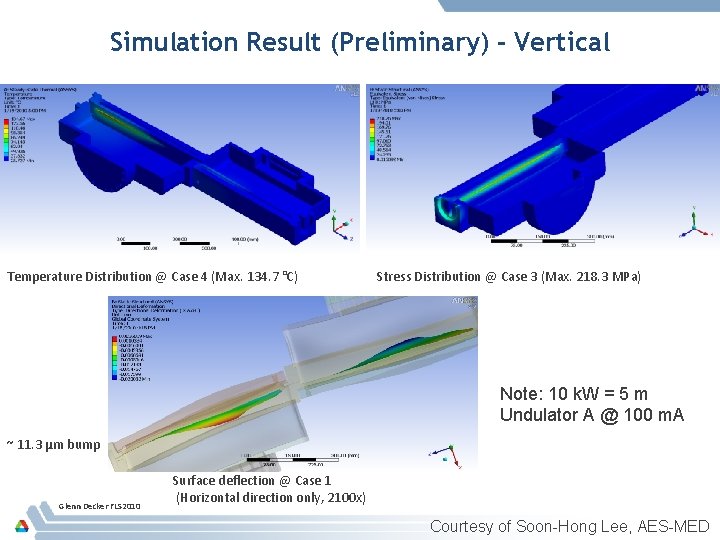
Simulation Result (Preliminary) - Vertical Temperature Distribution @ Case 4 (Max. 134. 7 °C) Stress Distribution @ Case 3 (Max. 218. 3 MPa) Note: 10 k. W = 5 m Undulator A @ 100 m. A ~ 11. 3 µm bump Glenn Decker FLS 2010 Surface deflection @ Case 1 (Horizontal direction only, 2100 x) Courtesy of Soon-Hong Lee, AES-MED
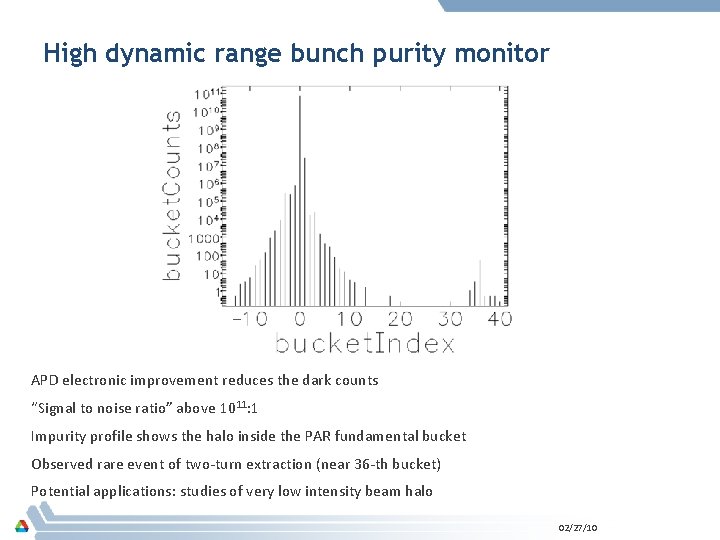
High dynamic range bunch purity monitor APD electronic improvement reduces the dark counts “Signal to noise ratio” above 1011: 1 Impurity profile shows the halo inside the PAR fundamental bucket Observed rare event of two-turn extraction (near 36 -th bucket) Potential applications: studies of very low intensity beam halo 02/27/10
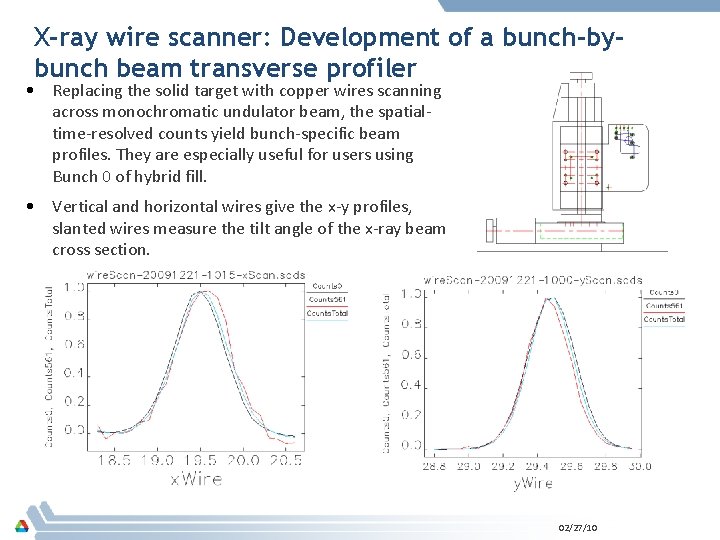
X-ray wire scanner: Development of a bunch-bybunch beam transverse profiler • Replacing the solid target with copper wires scanning across monochromatic undulator beam, the spatialtime-resolved counts yield bunch-specific beam profiles. They are especially useful for users using Bunch 0 of hybrid fill. • Vertical and horizontal wires give the x-y profiles, slanted wires measure the tilt angle of the x-ray beam cross section. 02/27/10
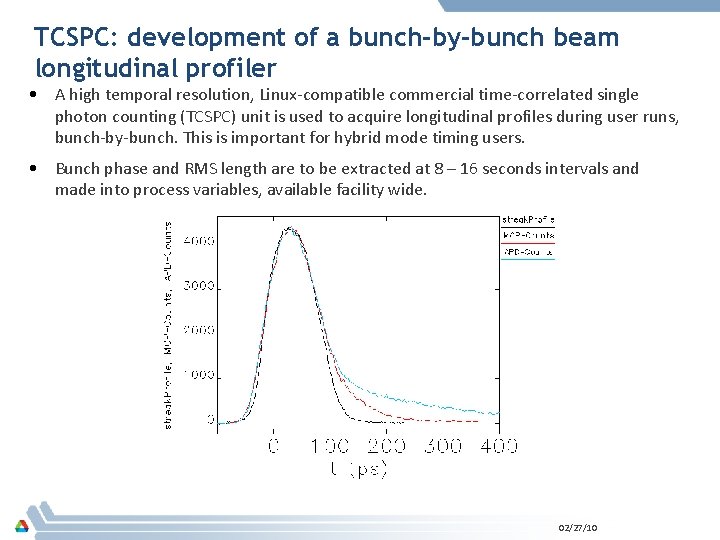
TCSPC: development of a bunch-by-bunch beam longitudinal profiler • A high temporal resolution, Linux-compatible commercial time-correlated single photon counting (TCSPC) unit is used to acquire longitudinal profiles during user runs, bunch-by-bunch. This is important for hybrid mode timing users. • Bunch phase and RMS length are to be extracted at 8 – 16 seconds intervals and made into process variables, available facility wide. 02/27/10
APS Storage Ring Diagnostics Summary Instrumentation supporting AC beam stability is well in hand. Long-term drift is quite challenging at the sub-micron scale. Photon bpm technology is evolving. Photon counting techniques provide several powerful tools associated with a beam diagnostics dedicated beamline Bunch purity w/ 10^11 dynamic range Bunch-by-bunch transverse profiles Bunch-by-bunch longitudinal profile Glenn Decker FLS 2010
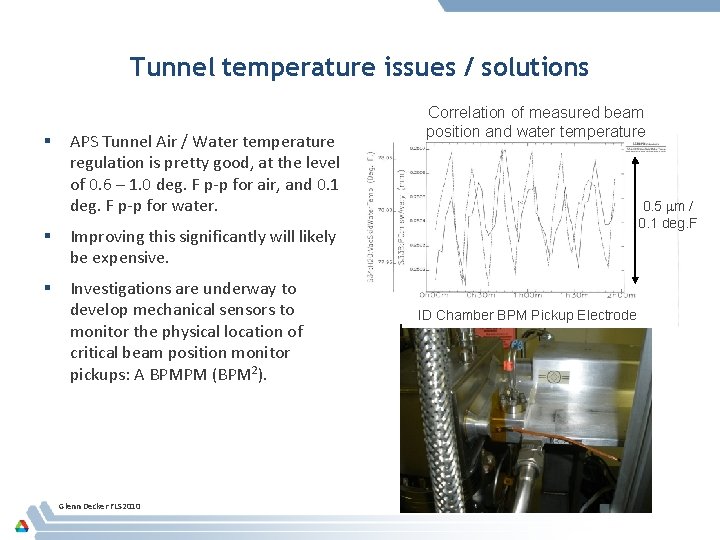
Tunnel temperature issues / solutions APS Tunnel Air / Water temperature regulation is pretty good, at the level of 0. 6 – 1. 0 deg. F p-p for air, and 0. 1 deg. F p-p for water. Correlation of measured beam position and water temperature 0. 5 mm / 0. 1 deg. F Improving this significantly will likely be expensive. Investigations are underway to develop mechanical sensors to monitor the physical location of critical beam position monitor pickups: A BPMPM (BPM 2). Glenn Decker FLS 2010 ID Chamber BPM Pickup Electrode
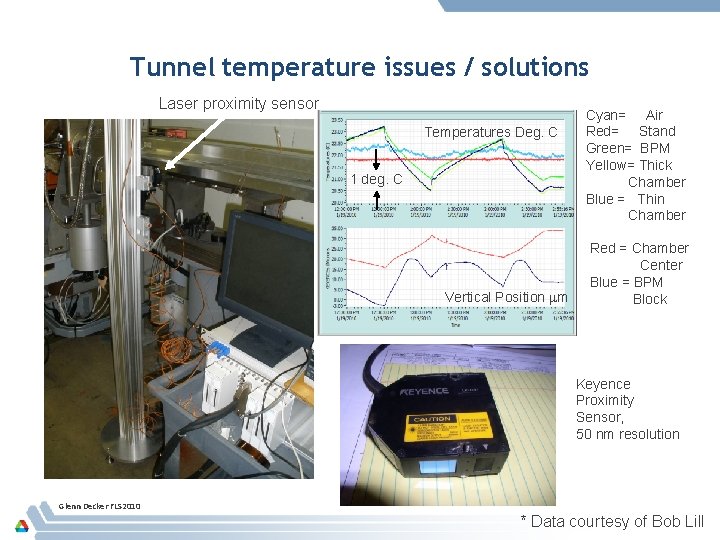
Tunnel temperature issues / solutions Laser proximity sensor Temperatures Deg. C 1 deg. C Vertical Position mm Cyan= Air Red= Stand Green= BPM Yellow= Thick Chamber Blue = Thin Chamber Red = Chamber Center Blue = BPM Block Keyence Proximity Sensor, 50 nm resolution Glenn Decker FLS 2010 * Data courtesy of Bob Lill
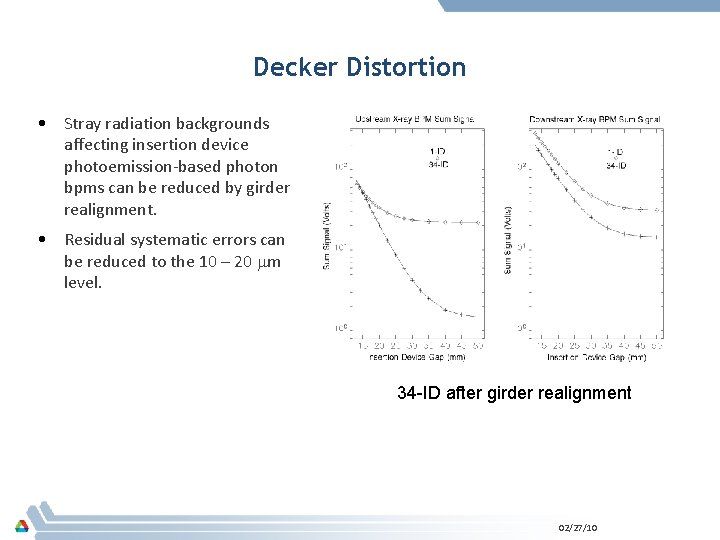
Decker Distortion • Stray radiation backgrounds affecting insertion device photoemission-based photon bpms can be reduced by girder realignment. • Residual systematic errors can be reduced to the 10 – 20 mm level. 34 -ID after girder realignment 02/27/10