
Recent and future trends in atmospheric methane Connecting
![Radiative forcing of climate, 1750 -Present: Important contributions from methane and ozone IPCC [2001]](https://slidetodoc.com/presentation_image_h2/8a5d7a7e2c16e9fe3760c3d781c364fd/image-3.jpg "Radiative forcing of climate, 1750 -Present: Important contributions from methane and ozone IPCC [2001]")
![IPCC [2001] scenarios project future growth Projections of future CH 4 emissions (Tg CH](https://slidetodoc.com/presentation_image_h2/8a5d7a7e2c16e9fe3760c3d781c364fd/image-5.jpg "IPCC [2001] scenarios project future growth Projections of future CH 4 emissions (Tg CH")
- Slides: 32
Recent and future trends in atmospheric methane: Connecting global chemistry, climate and ozone pollution Arlene M. Fiore (arlene. fiore@noaa. gov) Acknowledgments: Larry Horowitz, Chip Levy (NOAA/GFDL) Jason West, Vaishali Naik (Princeton University) Ellen Baum, Joe Chaisson (Clean Air Task Force) Funding from Luce Foundation via Clean Air Task Force Berkeley Atmospheric Sciences Symposium, September 29, 2006
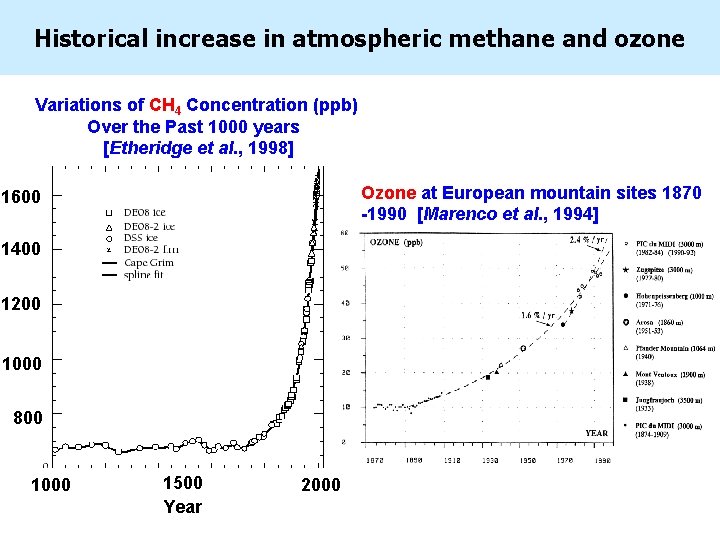
Historical increase in atmospheric methane and ozone Variations of CH 4 Concentration (ppb) Over the Past 1000 years [Etheridge et al. , 1998] Ozone at European mountain sites 1870 -1990 [Marenco et al. , 1994] 1600 1400 1200 1000 800 1000 1500 Year 2000
Radiative forcing of climate, 1750 -Present: Important contributions from methane and ozone IPCC [2001] Level of scientific understanding
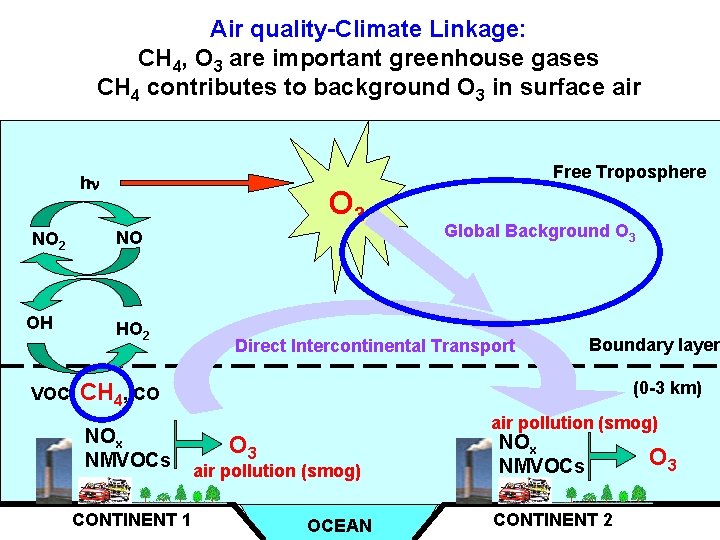
Air quality-Climate Linkage: CH 4, O 3 are important greenhouse gases CH 4 contributes to background O 3 in surface air Free Troposphere hn O 3 NO 2 NO OH HO 2 Global Background O 3 Direct Intercontinental Transport Boundary layer (0 -3 km) VOC, CH 4, CO NOx NMVOCs CONTINENT 1 air pollution (smog) O 3 air pollution (smog) OCEAN NOx NMVOCs CONTINENT 2 O 3
IPCC [2001] scenarios project future growth Projections of future CH 4 emissions (Tg CH 4) to 2100 Change in 10 -model mean surface O 3 2100 SRES A 2 - 2000 Attributed mainly to increases in methane and NOx [Prather et al. , 2003]
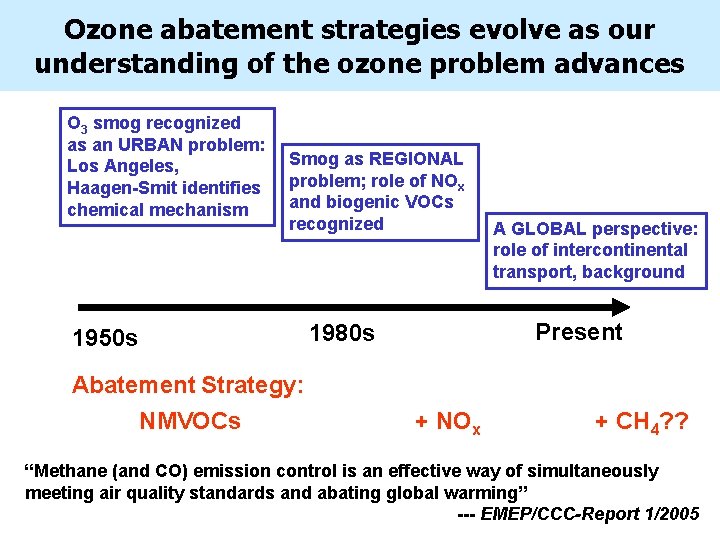
Ozone abatement strategies evolve as our understanding of the ozone problem advances O 3 smog recognized as an URBAN problem: Los Angeles, Haagen-Smit identifies chemical mechanism Smog as REGIONAL problem; role of NOx and biogenic VOCs recognized 1950 s Abatement Strategy: NMVOCs A GLOBAL perspective: role of intercontinental transport, background Present 1980 s + NOx + CH 4? ? “Methane (and CO) emission control is an effective way of simultaneously meeting air quality standards and abating global warming” --- EMEP/CCC-Report 1/2005
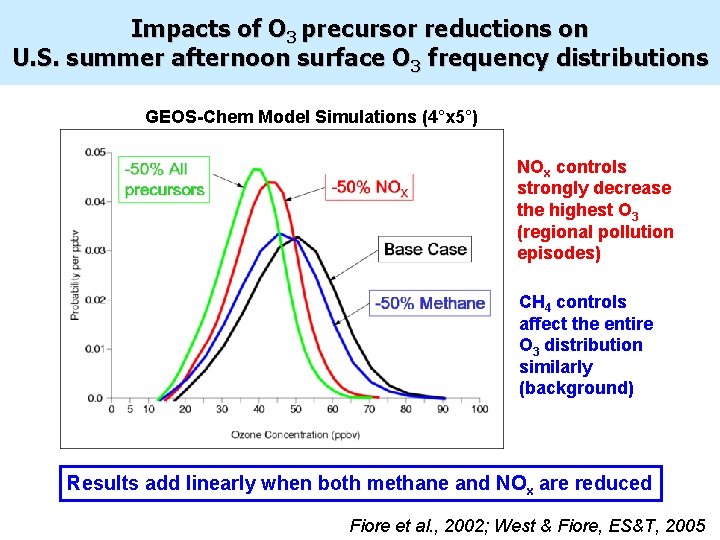
Impacts of O 3 precursor reductions on U. S. summer afternoon surface O 3 frequency distributions GEOS-Chem Model Simulations (4°x 5°) NOx controls strongly decrease the highest O 3 (regional pollution episodes) CH 4 controls affect the entire O 3 distribution similarly (background) Results add linearly when both methane and NOx are reduced Fiore et al. , 2002; West & Fiore, ES&T, 2005
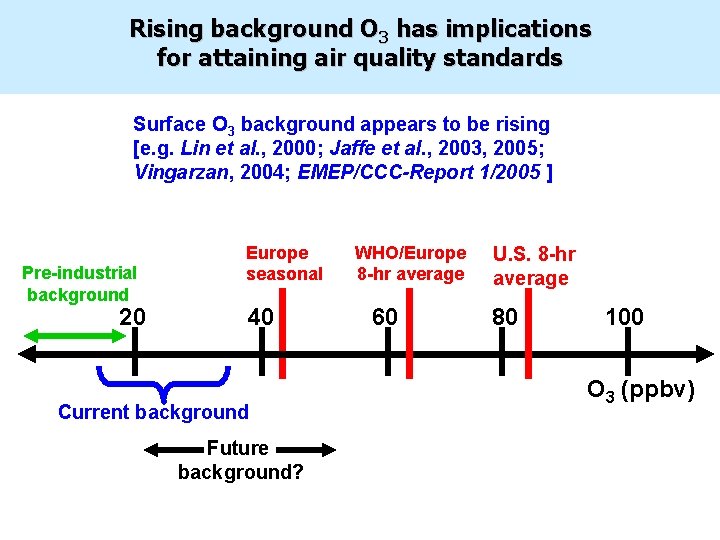
Rising background O 3 has implications for attaining air quality standards Surface O 3 background appears to be rising [e. g. Lin et al. , 2000; Jaffe et al. , 2003, 2005; Vingarzan, 2004; EMEP/CCC-Report 1/2005 ] Pre-industrial background 20 Europe seasonal 40 Current background Future background? WHO/Europe 8 -hr average 60 U. S. 8 -hr average 80 100 O 3 (ppbv)
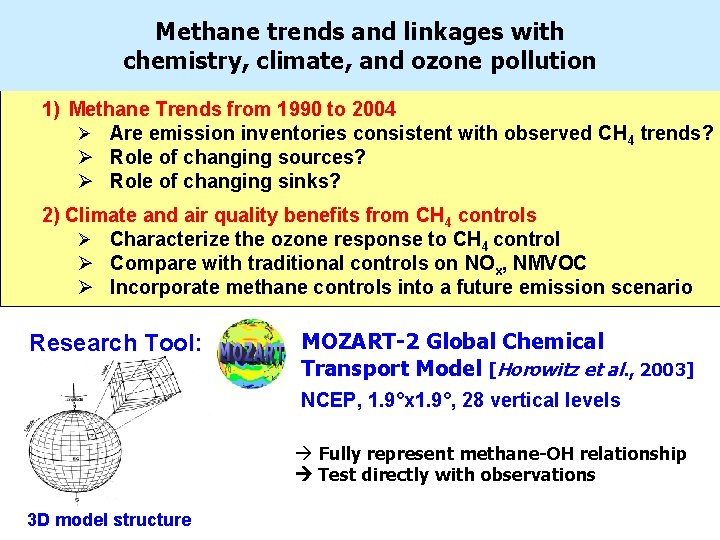
Methane trends and linkages with chemistry, climate, and ozone pollution 1) Methane Trends from 1990 to 2004 Ø Are emission inventories consistent with observed CH 4 trends? Ø Role of changing sources? Ø Role of changing sinks? 2) Climate and air quality benefits from CH 4 controls Ø Characterize the ozone response to CH 4 control Ø Compare with traditional controls on NOx, NMVOC Ø Incorporate methane controls into a future emission scenario Research Tool: MOZART-2 Global Chemical Transport Model [Horowitz et al. , 2003] NCEP, 1. 9°x 1. 9°, 28 vertical levels à Fully represent methane-OH relationship Test directly with observations 3 D model structure
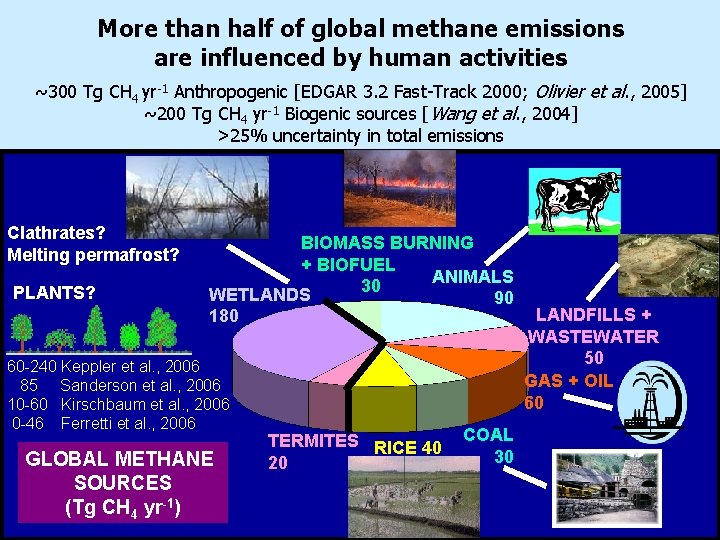
More than half of global methane emissions are influenced by human activities ~300 Tg CH 4 yr-1 Anthropogenic [EDGAR 3. 2 Fast-Track 2000; Olivier et al. , 2005] ~200 Tg CH 4 yr-1 Biogenic sources [Wang et al. , 2004] >25% uncertainty in total emissions Clathrates? Melting permafrost? PLANTS? BIOMASS BURNING + BIOFUEL ANIMALS 30 WETLANDS 90 180 60 -240 Keppler et al. , 2006 85 Sanderson et al. , 2006 10 -60 Kirschbaum et al. , 2006 0 -46 Ferretti et al. , 2006 GLOBAL METHANE SOURCES (Tg CH 4 yr-1) TERMITES RICE 40 20 COAL 30 LANDFILLS + WASTEWATER 50 GAS + OIL 60
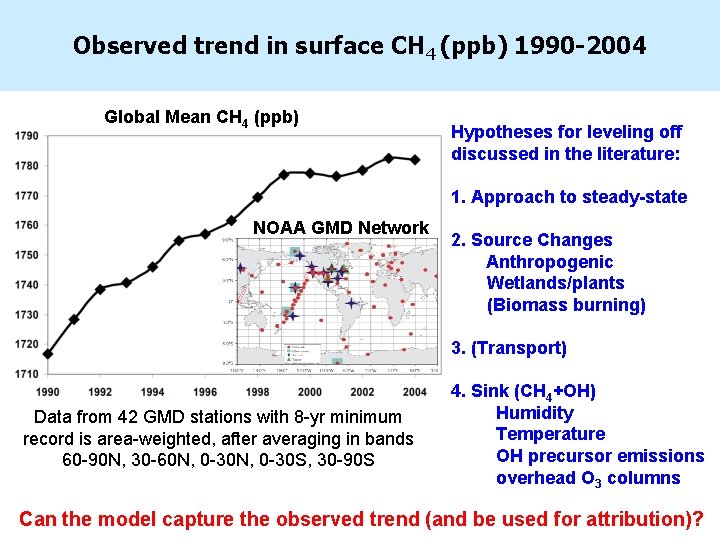
Observed trend in surface CH 4 (ppb) 1990 -2004 Global Mean CH 4 (ppb) Hypotheses for leveling off discussed in the literature: 1. Approach to steady-state NOAA GMD Network 2. Source Changes Anthropogenic Wetlands/plants (Biomass burning) 3. (Transport) Data from 42 GMD stations with 8 -yr minimum record is area-weighted, after averaging in bands 60 -90 N, 30 -60 N, 0 -30 S, 30 -90 S 4. Sink (CH 4+OH) Humidity Temperature OH precursor emissions overhead O 3 columns Can the model capture the observed trend (and be used for attribution)?
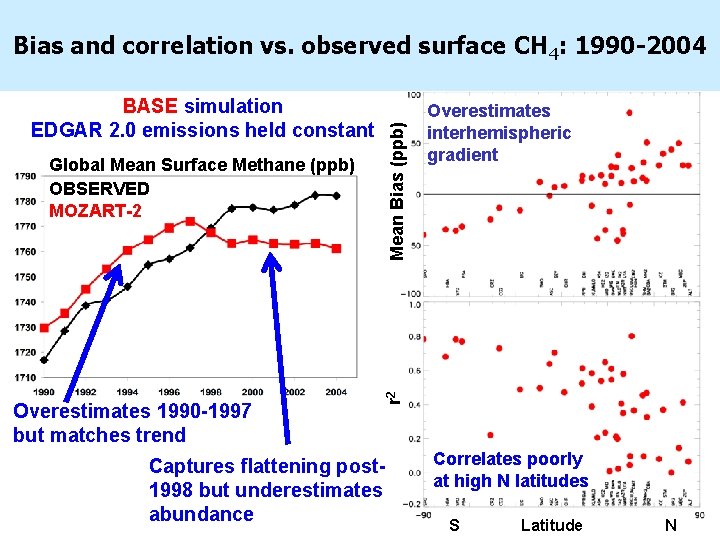
Bias and correlation vs. observed surface CH 4: 1990 -2004 Mean Bias (ppb) BASE simulation EDGAR 2. 0 emissions held constant Overestimates 1990 -1997 but matches trend r 2 Global Mean Surface Methane (ppb) OBSERVED MOZART-2 Overestimates interhemispheric gradient Captures flattening post 1998 but underestimates abundance Correlates poorly at high N latitudes S Latitude N
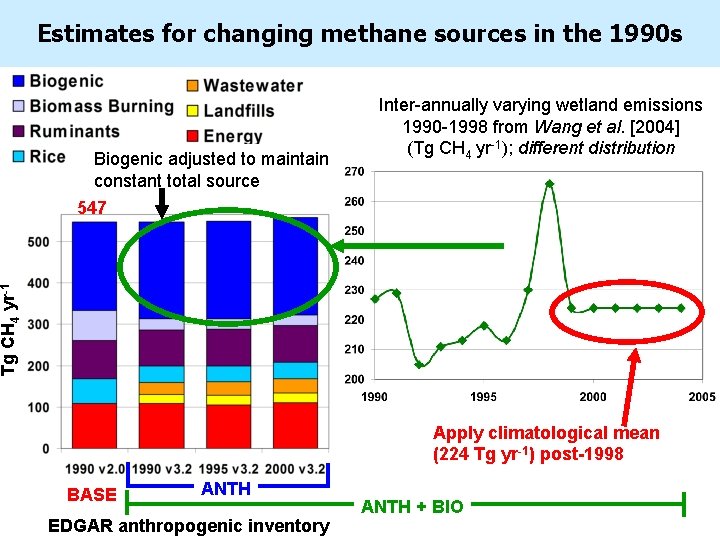
Estimates for changing methane sources in the 1990 s Biogenic adjusted to maintain constant total source Inter-annually varying wetland emissions 1990 -1998 from Wang et al. [2004] (Tg CH 4 yr-1); different distribution Tg CH 4 yr-1 547 Apply climatological mean (224 Tg yr-1) post-1998 BASE ANTH EDGAR anthropogenic inventory ANTH + BIO
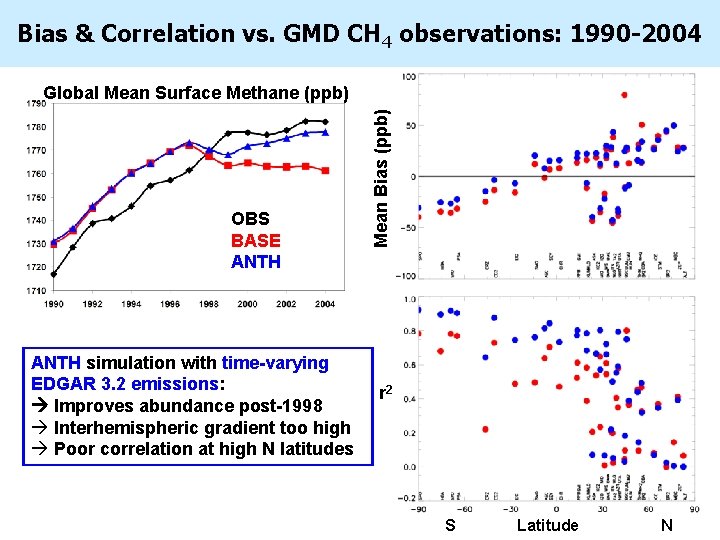
Bias & Correlation vs. GMD CH 4 observations: 1990 -2004 OBS BASE ANTH simulation with time-varying EDGAR 3. 2 emissions: Improves abundance post-1998 à Interhemispheric gradient too high à Poor correlation at high N latitudes Mean Bias (ppb) Global Mean Surface Methane (ppb) r 2 S Latitude N
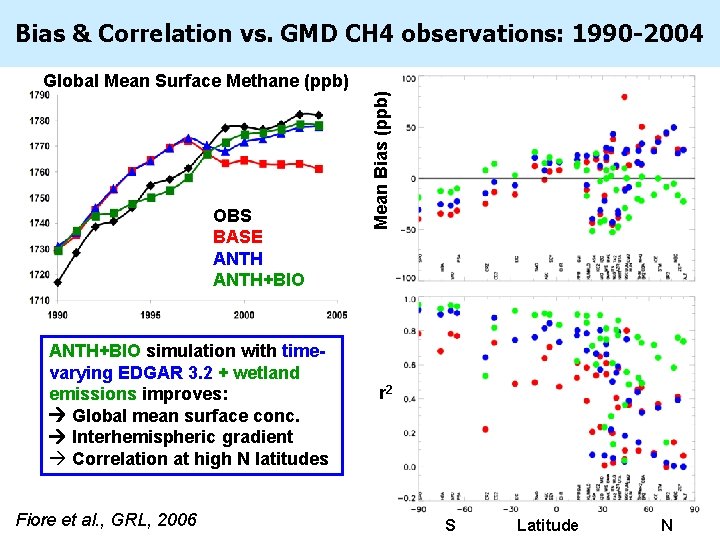
Bias & Correlation vs. GMD CH 4 observations: 1990 -2004 OBS BASE ANTH+BIO simulation with timevarying EDGAR 3. 2 + wetland emissions improves: Global mean surface conc. Interhemispheric gradient à Correlation at high N latitudes Fiore et al. , GRL, 2006 Mean Bias (ppb) Global Mean Surface Methane (ppb) r 2 S Latitude N
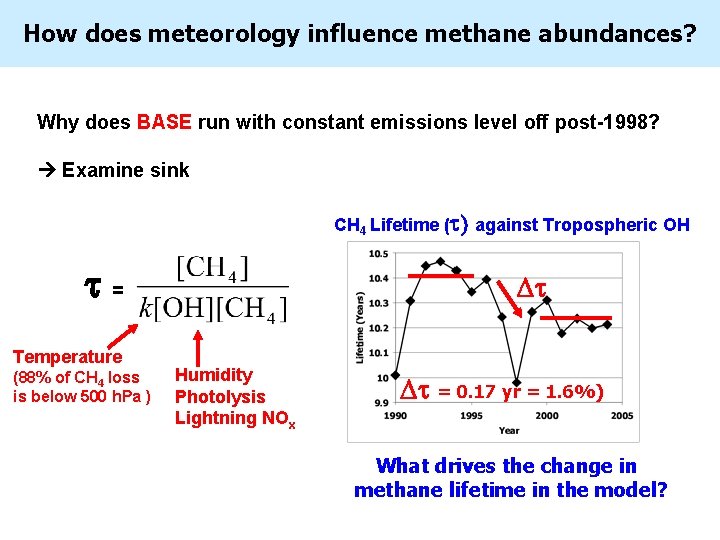
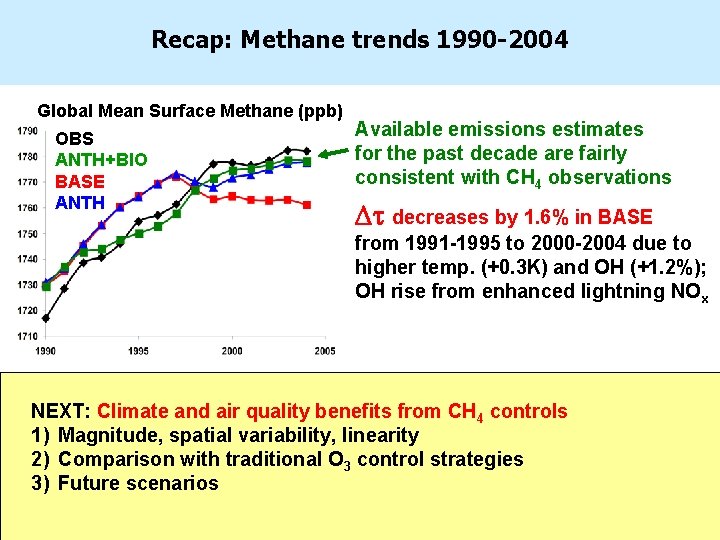
How does meteorology influence methane abundances? Why does BASE run with constant emissions level off post-1998? Examine sink CH 4 Lifetime (t) against Tropospheric OH t= Temperature (88% of CH 4 loss is below 500 h. Pa ) Dt Humidity Photolysis Lightning NOx Dt = 0. 17 yr = 1. 6%) What drives the change in methane lifetime in the model?
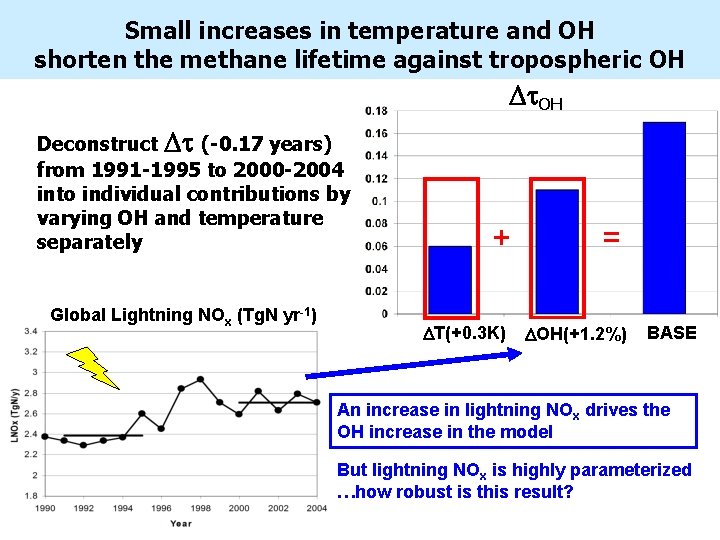
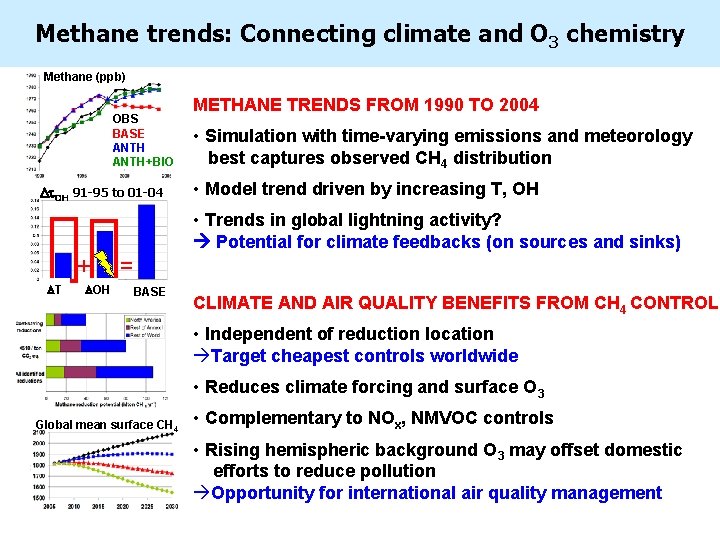
Small increases in temperature and OH shorten the methane lifetime against tropospheric OH Dt. OH Deconstruct Dt (-0. 17 years) from 1991 -1995 to 2000 -2004 into individual contributions by varying OH and temperature separately Global Lightning NOx (Tg. N yr-1) + DT(+0. 3 K) = DOH(+1. 2%) BASE An increase in lightning NOx drives the OH increase in the model But lightning NOx is highly parameterized …how robust is this result?
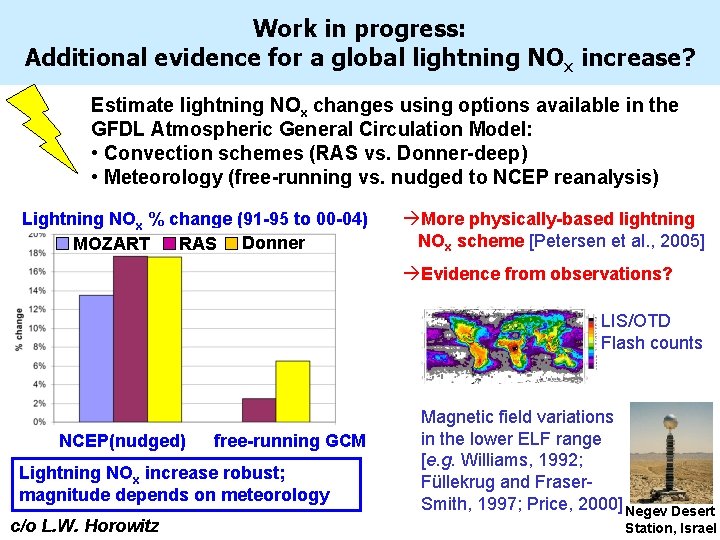
Work in progress: Additional evidence for a global lightning NOx increase? Estimate lightning NOx changes using options available in the GFDL Atmospheric General Circulation Model: • Convection schemes (RAS vs. Donner-deep) • Meteorology (free-running vs. nudged to NCEP reanalysis) Lightning NOx % change (91 -95 to 00 -04) RAS Donner MOZART àMore physically-based lightning NOx scheme [Petersen et al. , 2005] àEvidence from observations? LIS/OTD Flash counts NCEP(nudged) free-running GCM Lightning NOx increase robust; magnitude depends on meteorology c/o L. W. Horowitz Magnetic field variations in the lower ELF range [e. g. Williams, 1992; Füllekrug and Fraser. Smith, 1997; Price, 2000] Negev Desert Station, Israel
Recap: Methane trends 1990 -2004 Global Mean Surface Methane (ppb) OBS ANTH+BIO BASE ANTH Available emissions estimates for the past decade are fairly consistent with CH 4 observations Dt decreases by 1. 6% in BASE from 1991 -1995 to 2000 -2004 due to higher temp. (+0. 3 K) and OH (+1. 2%); OH rise from enhanced lightning NOx NEXT: Climate and air quality benefits from CH 4 controls 1) Magnitude, spatial variability, linearity 2) Comparison with traditional O 3 control strategies 3) Future scenarios
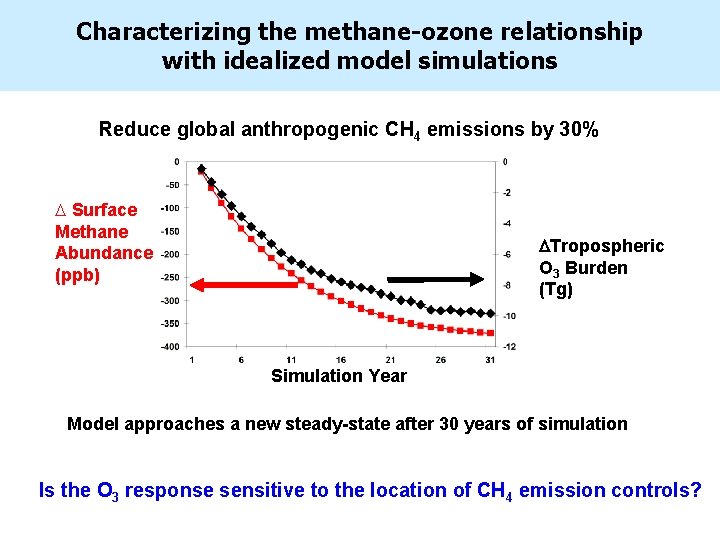
Characterizing the methane-ozone relationship with idealized model simulations Reduce global anthropogenic CH 4 emissions by 30% D Surface Methane Abundance (ppb) DTropospheric O 3 Burden (Tg) Simulation Year Model approaches a new steady-state after 30 years of simulation Is the O 3 response sensitive to the location of CH 4 emission controls?
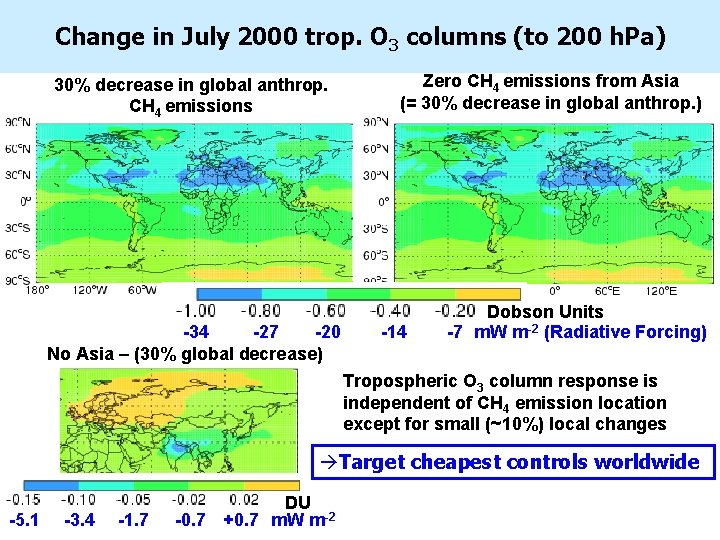
Change in July 2000 trop. O 3 columns (to 200 h. Pa) 30% decrease in global anthrop. CH 4 emissions -34 -27 -20 No Asia – (30% global decrease) Zero CH 4 emissions from Asia (= 30% decrease in global anthrop. ) -14 Dobson Units -7 m. W m-2 (Radiative Forcing) Tropospheric O 3 column response is independent of CH 4 emission location except for small (~10%) local changes àTarget cheapest controls worldwide -5. 1 -3. 4 -1. 7 DU -0. 7 +0. 7 m. W m-2
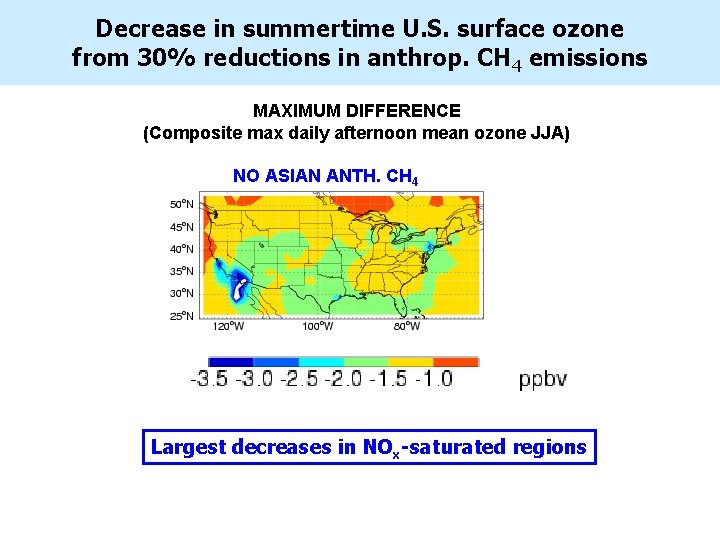
Decrease in summertime U. S. surface ozone from 30% reductions in anthrop. CH 4 emissions MAXIMUM DIFFERENCE (Composite max daily afternoon mean ozone JJA) NO ASIAN ANTH. CH 4 Largest decreases in NOx-saturated regions
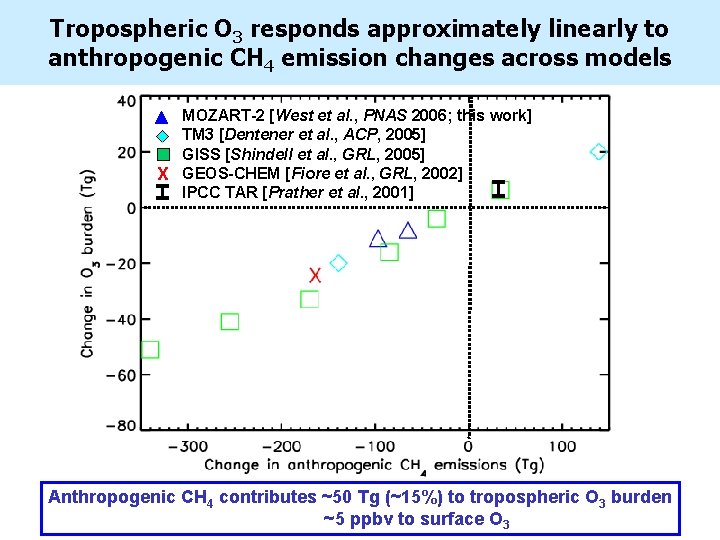
Tropospheric O 3 responds approximately linearly to anthropogenic CH 4 emission changes across models MOZART-2 [West et al. , PNAS 2006; this work] TM 3 [Dentener et al. , ACP, 2005] GISS [Shindell et al. , GRL, 2005] X GEOS-CHEM [Fiore et al. , GRL, 2002] IPCC TAR [Prather et al. , 2001] Anthropogenic CH 4 contributes ~50 Tg (~15%) to tropospheric O 3 burden ~5 ppbv to surface O 3
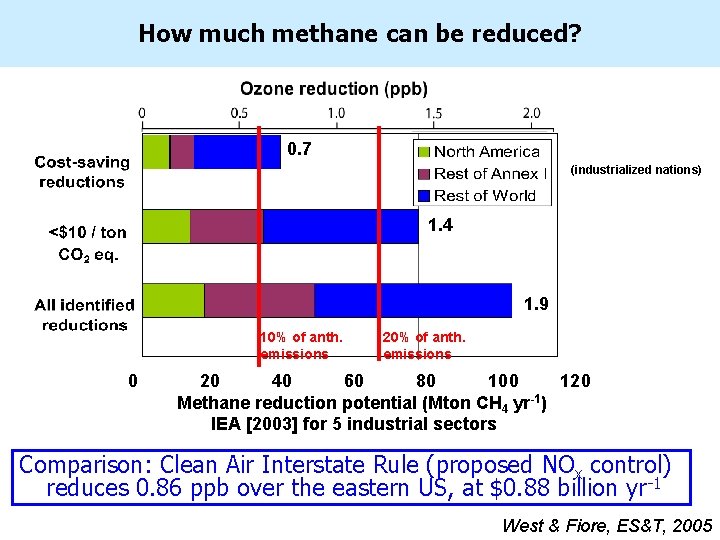
How much methane can be reduced? 0. 7 (industrialized nations) 1. 4 1. 9 10% of anth. emissions 0 20% of anth. emissions 20 40 60 80 100 120 Methane reduction potential (Mton CH 4 yr-1) IEA [2003] for 5 industrial sectors Comparison: Clean Air Interstate Rule (proposed NOx control) reduces 0. 86 ppb over the eastern US, at $0. 88 billion yr -1 West & Fiore, ES&T, 2005
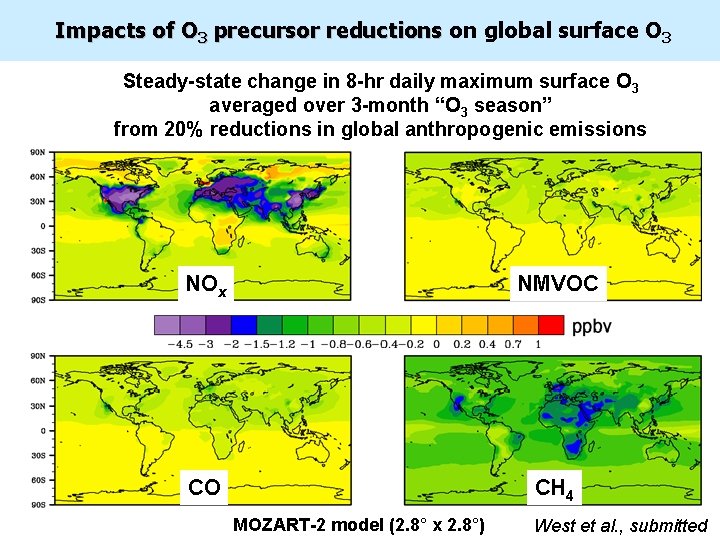
Impacts of O 3 precursor reductions on global surface O 3 Steady-state change in 8 -hr daily maximum surface O 3 averaged over 3 -month “O 3 season” from 20% reductions in global anthropogenic emissions NOx NMVOC CO CH 4 MOZART-2 model (2. 8° x 2. 8°) West et al. , submitted
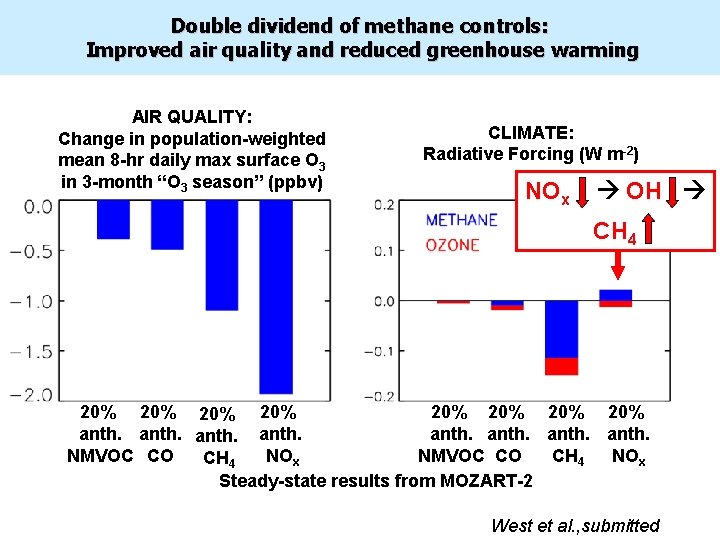
Double dividend of methane controls: Improved air quality and reduced greenhouse warming AIR QUALITY: Change in population-weighted mean 8 -hr daily max surface O 3 in 3 -month “O 3 season” (ppbv) CLIMATE: Radiative Forcing (W m-2) NOx OH CH 4 20% 20% anth. NMVOC CO NOx NMVOC CO CH 4 NOx CH 4 Steady-state results from MOZART-2 West et al. , submitted
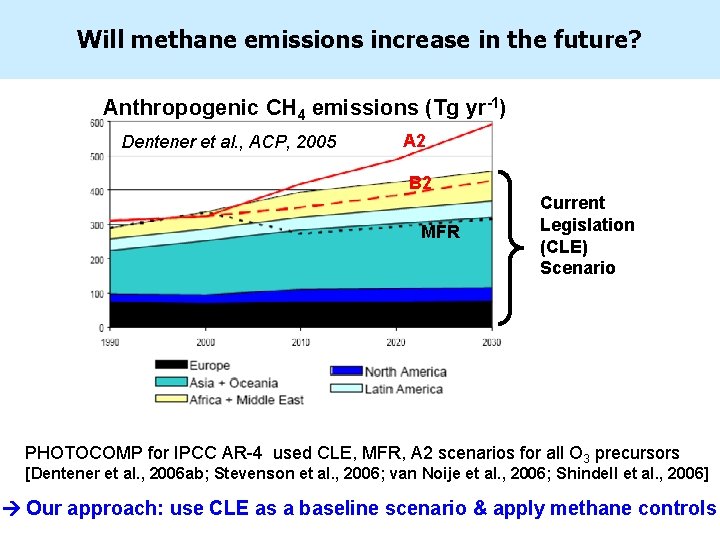
Will methane emissions increase in the future? Anthropogenic CH 4 emissions (Tg yr-1) Dentener et al. , ACP, 2005 A 2 B 2 MFR Current Legislation (CLE) Scenario PHOTOCOMP for IPCC AR-4 used CLE, MFR, A 2 scenarios for all O 3 precursors [Dentener et al. , 2006 ab; Stevenson et al. , 2006; van Noije et al. , 2006; Shindell et al. , 2006] Our approach: use CLE as a baseline scenario & apply methane controls
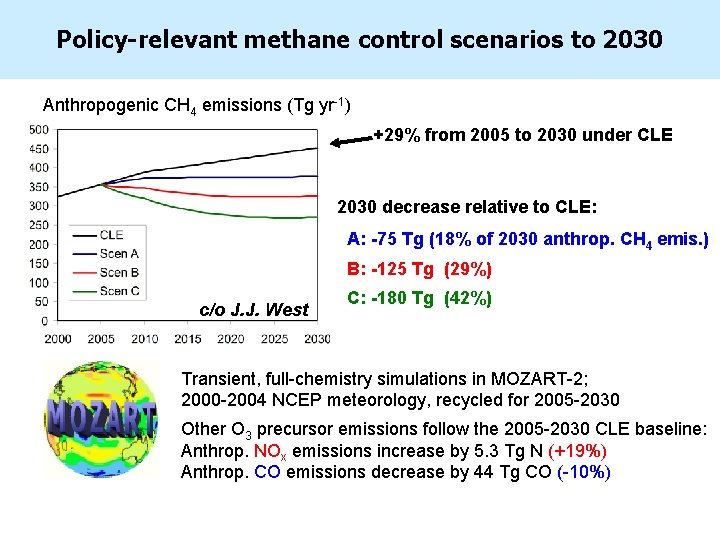
Policy-relevant methane control scenarios to 2030 Anthropogenic CH 4 emissions (Tg yr-1) +29% from 2005 to 2030 under CLE 2030 decrease relative to CLE: A: -75 Tg (18% of 2030 anthrop. CH 4 emis. ) B: -125 Tg (29%) c/o J. J. West C: -180 Tg (42%) Transient, full-chemistry simulations in MOZART-2; 2000 -2004 NCEP meteorology, recycled for 2005 -2030 Other O 3 precursor emissions follow the 2005 -2030 CLE baseline: Anthrop. NOx emissions increase by 5. 3 Tg N (+19%) Anthrop. CO emissions decrease by 44 Tg CO (-10%)
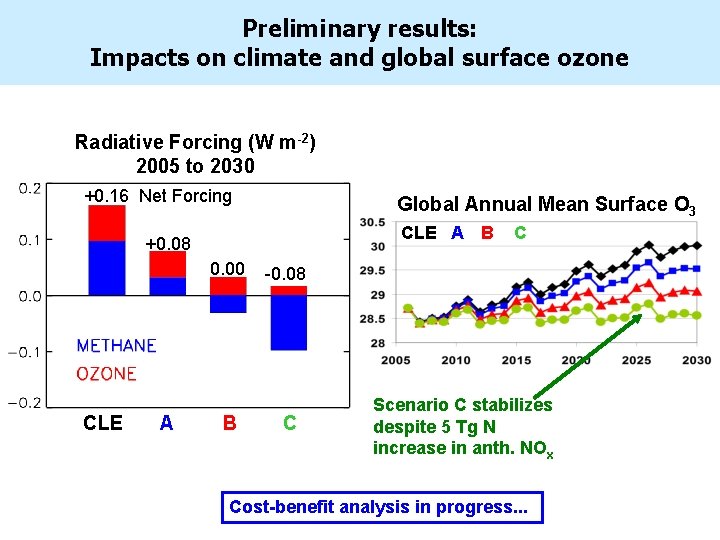
Preliminary results: Impacts on climate and global surface ozone Radiative Forcing (W m-2) 2005 to 2030 +0. 16 Net Forcing Global Annual Mean Surface O 3 CLE A B CLE C 2030 +0. 08 0. 00 CLE A B -0. 08 C Scenario C stabilizes despite 5 Tg N increase in anth. NOx Cost-benefit analysis in progress. . .
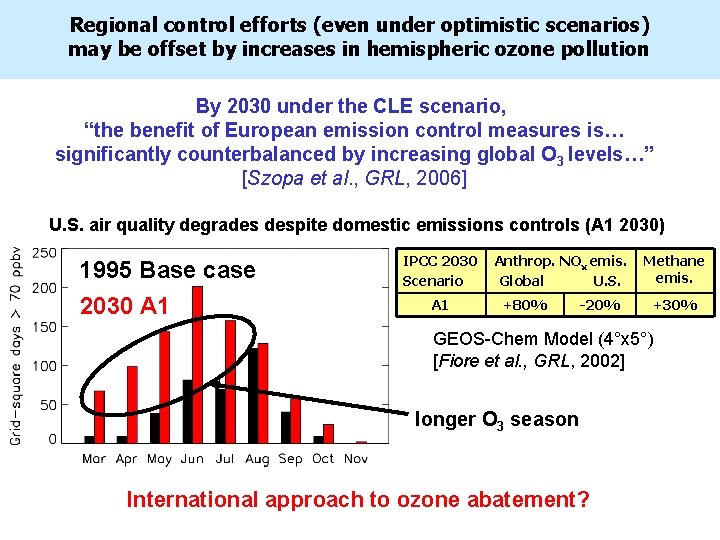
Regional control efforts (even under optimistic scenarios) may be offset by increases in hemispheric ozone pollution By 2030 under the CLE scenario, “the benefit of European emission control measures is… significantly counterbalanced by increasing global O 3 levels…” [Szopa et al. , GRL, 2006] U. S. air quality degrades despite domestic emissions controls (A 1 2030) 1995 Base case 2030 A 1 IPCC 2030 Scenario A 1 Anthrop. NOx emis. Global U. S. +80% -20% Methane emis. +30% GEOS-Chem Model (4°x 5°) [Fiore et al. , GRL, 2002] longer O 3 season International approach to ozone abatement?
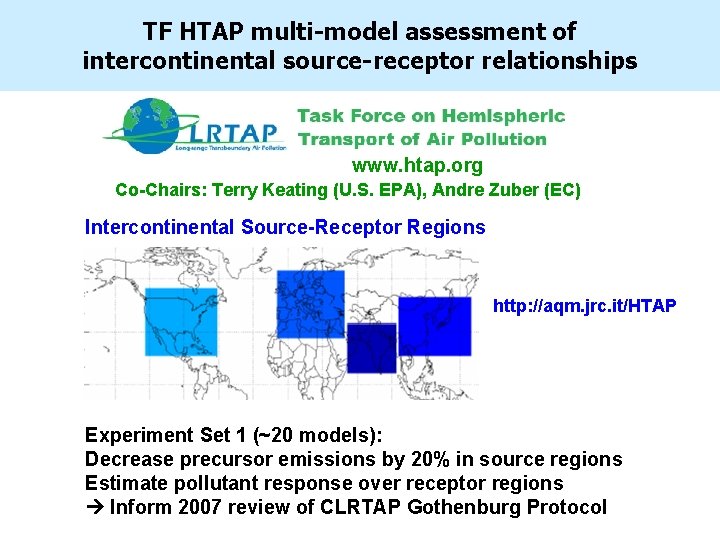
TF HTAP multi-model assessment of intercontinental source-receptor relationships www. htap. org Co-Chairs: Terry Keating (U. S. EPA), Andre Zuber (EC) Intercontinental Source-Receptor Regions http: //aqm. jrc. it/HTAP Experiment Set 1 (~20 models): Decrease precursor emissions by 20% in source regions Estimate pollutant response over receptor regions Inform 2007 review of CLRTAP Gothenburg Protocol
Methane trends: Connecting climate and O 3 chemistry Methane (ppb) OBS BASE ANTH+BIO Dt. OH 91 -95 to 01 -04 METHANE TRENDS FROM 1990 TO 2004 • Simulation with time-varying emissions and meteorology best captures observed CH 4 distribution • Model trend driven by increasing T, OH • Trends in global lightning activity? Potential for climate feedbacks (on sources and sinks) + DT DOH = BASE CLIMATE AND AIR QUALITY BENEFITS FROM CH 4 CONTROL • Independent of reduction location àTarget cheapest controls worldwide • Reduces climate forcing and surface O 3 Global mean surface CH 4 • Complementary to NOx, NMVOC controls • Rising hemispheric background O 3 may offset domestic efforts to reduce pollution àOpportunity for international air quality management