
Recent advances on Xray imaging with a single





- Slides: 50
Recent advances on X-ray imaging with a single photon counting system I. III. IV. V. VII. Introduction The system: microstrip detectors, RX 64 ASICs, testing methods Energy resolution and efficiency Spatial resolution Imaging results - mammography Imaging results - angiography Summary and outlook Luciano Ramello – Univ. Piemonte NURT 2003, October 27 -31, 2003 I. Principles 1 Orientale and INFN, Alessandria
G. Baldazzi 1, D. Bollini 1, A. E. Cabal Rodriguez 2, C. Ceballos Sanchez 2 , W. Dabrowski 3, A. Diaz Garcia 2, M. Gambaccini 4, P. Giubellino 5, M. Gombia 1, P. Grybos 3, M. Idzik 3, 5, J. Lopez Gaitan 10, A. Marzari-Chiesa 6, L. M. Montano Zetina 7, F. Prino 8, L. Ramello 8, A. Sarnelli 4, M. Sitta 8, K. Swientek 3, A. Taibi 4, E. Tomassi 6, A. Tuffanelli 4, P. Van Espen 9, P. Wiacek 3 1 University and INFN, Bologna, Italy; 2 CEADEN, Havana, Cuba; 3 University of Mining and Metallurgy, Cracow, Poland; 4 University and INFN, Ferrara, Italy; 5 INFN, Torino, Italy; 6 University of Torino, Italy; 7 CINVESTAV, Mexico City, Mexico; 8 University of Eastern Piedmont and INFN, Alessandria, Italy; 9 University of Antwerp, Belgium; 10 Univ. de los Andes, I. Principles 2 Colombia
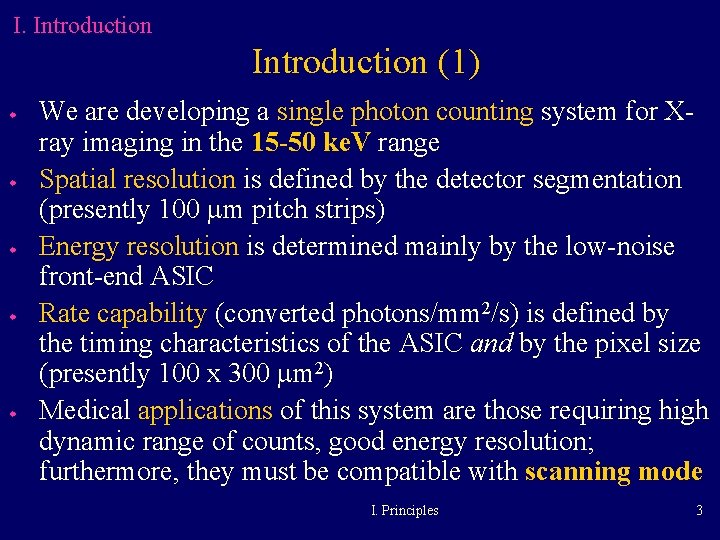
I. Introduction (1) w w w We are developing a single photon counting system for Xray imaging in the 15 -50 ke. V range Spatial resolution is defined by the detector segmentation (presently 100 mm pitch strips) Energy resolution is determined mainly by the low-noise front-end ASIC Rate capability (converted photons/mm 2/s) is defined by the timing characteristics of the ASIC and by the pixel size (presently 100 x 300 mm 2) Medical applications of this system are those requiring high dynamic range of counts, good energy resolution; furthermore, they must be compatible with scanning mode I. Principles 3
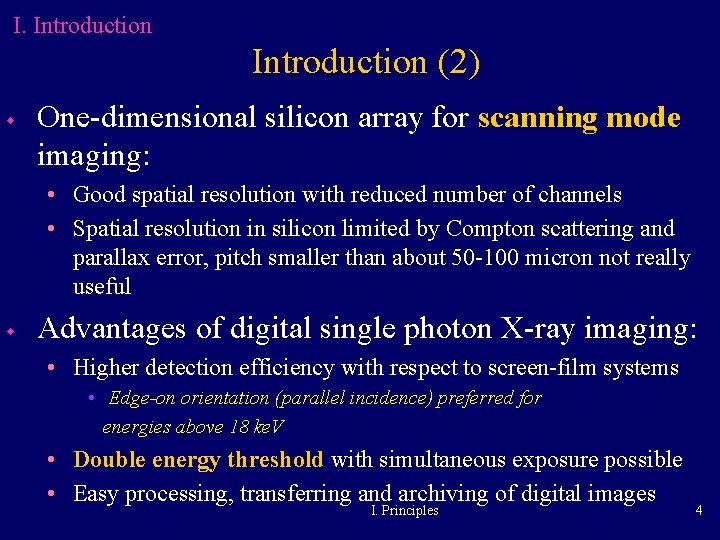
I. Introduction (2) w One-dimensional silicon array for scanning mode imaging: • Good spatial resolution with reduced number of channels • Spatial resolution in silicon limited by Compton scattering and parallax error, pitch smaller than about 50 -100 micron not really useful w Advantages of digital single photon X-ray imaging: • Higher detection efficiency with respect to screen-film systems • Edge-on orientation (parallel incidence) preferred for energies above 18 ke. V • Double energy threshold with simultaneous exposure possible • Easy processing, transferring and archiving of digital images I. Principles 4
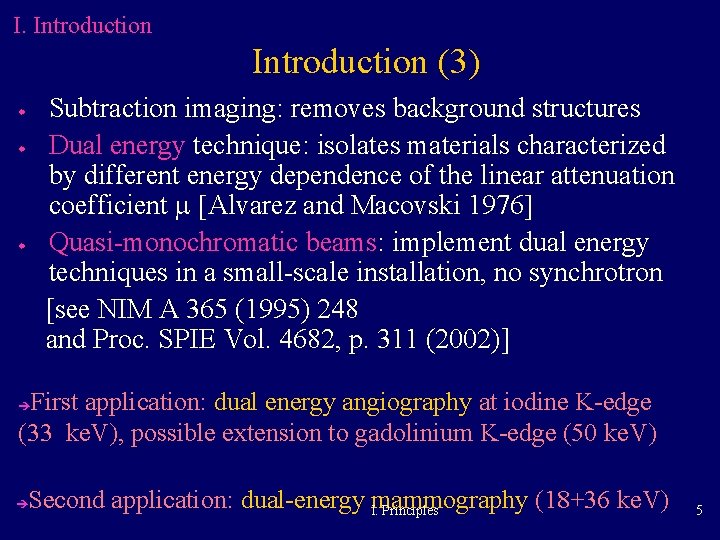
I. Introduction (3) Subtraction imaging: removes background structures Dual energy technique: isolates materials characterized by different energy dependence of the linear attenuation coefficient m [Alvarez and Macovski 1976] Quasi-monochromatic beams: implement dual energy techniques in a small-scale installation, no synchrotron [see NIM A 365 (1995) 248 and Proc. SPIE Vol. 4682, p. 311 (2002)] w w w First application: dual energy angiography at iodine K-edge (33 ke. V), possible extension to gadolinium K-edge (50 ke. V) è Second application: dual-energy I. mammography (18+36 ke. V) Principles è 5
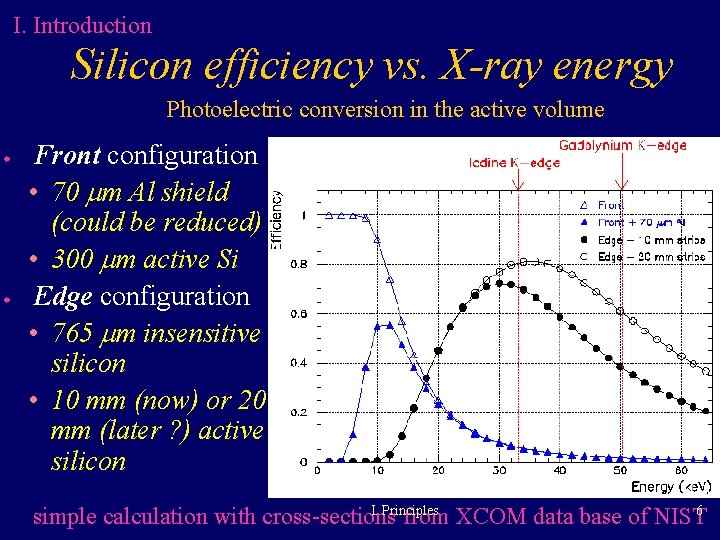
I. Introduction Silicon efficiency vs. X-ray energy Photoelectric conversion in the active volume w w Front configuration • 70 mm Al shield (could be reduced) • 300 mm active Si Edge configuration • 765 mm insensitive silicon • 10 mm (now) or 20 mm (later ? ) active silicon I. Principles simple calculation with cross-sections from XCOM data base of NIST 6
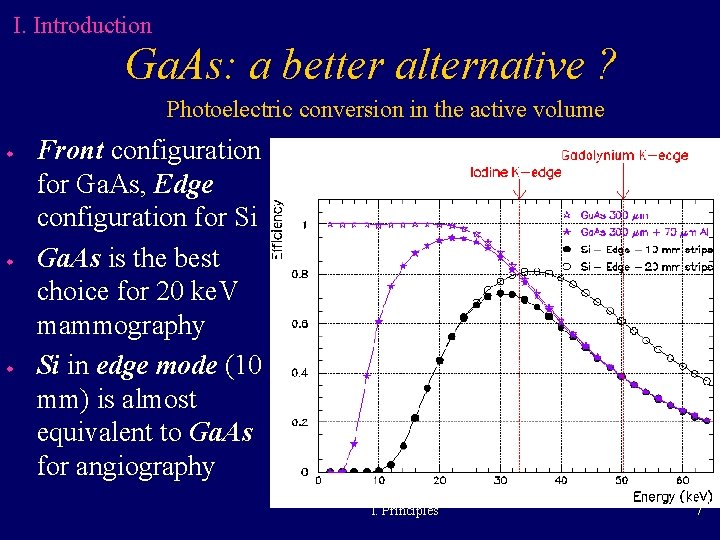
I. Introduction Ga. As: a better alternative ? Photoelectric conversion in the active volume w w w Front configuration for Ga. As, Edge configuration for Si Ga. As is the best choice for 20 ke. V mammography Si in edge mode (10 mm) is almost equivalent to Ga. As for angiography I. Principles 7
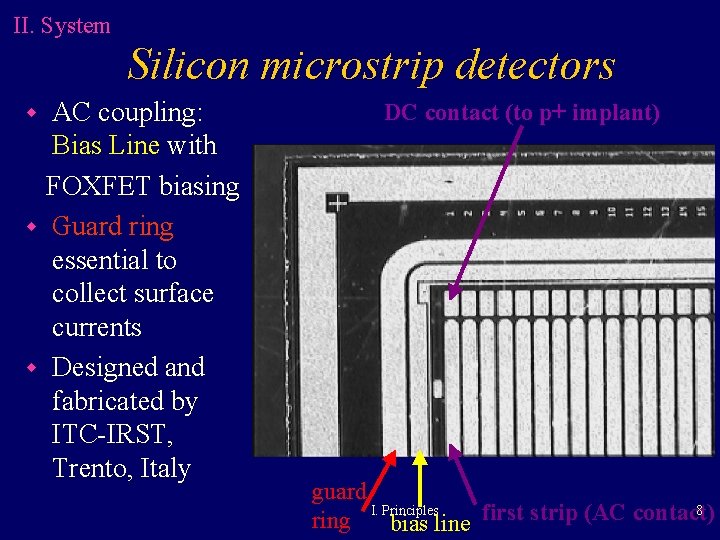
II. System Silicon microstrip detectors AC coupling: Bias Line with FOXFET biasing w Guard ring essential to collect surface currents w Designed and fabricated by ITC-IRST, Trento, Italy w DC contact (to p+ implant) guard I. Principles 8 first strip (AC contact) ring bias line
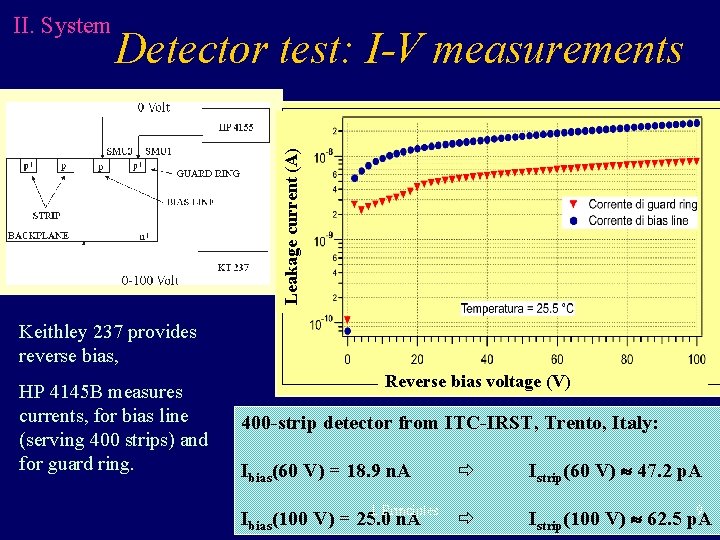
Detector test: I-V measurements Leakage current (A) II. System Keithley 237 provides reverse bias, HP 4145 B measures currents, for bias line (serving 400 strips) and for guard ring. Reverse bias voltage (V) 400 -strip detector from ITC-IRST, Trento, Italy: Ibias(60 V) = 18. 9 n. A I. Principles Ibias(100 V) = 25. 0 n. A Istrip(60 V) 47. 2 p. A 9 Istrip(100 V) 62. 5 p. A
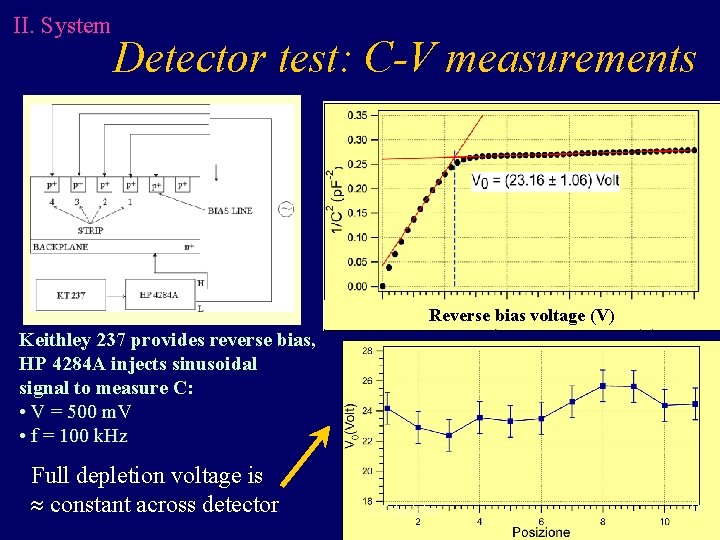
II. System Detector test: C-V measurements Reverse bias voltage (V) Keithley 237 provides reverse bias, HP 4284 A injects sinusoidal signal to measure C: • V = 500 m. V • f = 100 k. Hz Full depletion voltage is constant across detector I. Principles 10
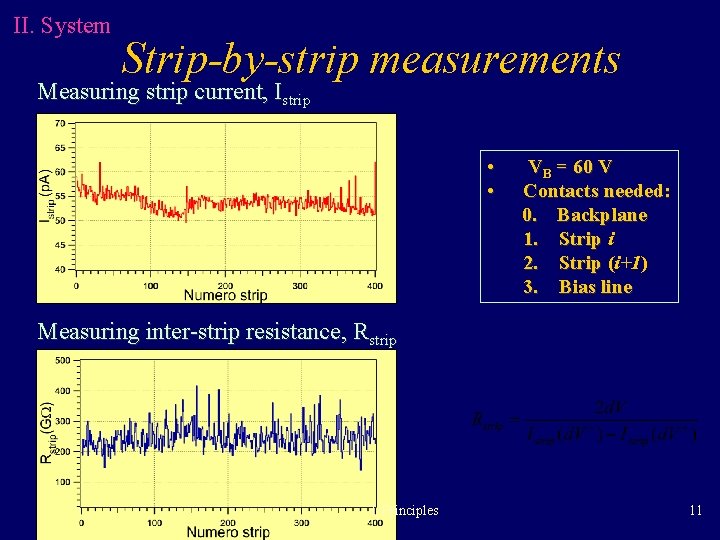
II. System Strip-by-strip measurements Measuring strip current, Istrip • • VB = 60 V Contacts needed: 0. Backplane 1. Strip i 2. Strip (i+1) 3. Bias line Measuring inter-strip resistance, Rstrip I. Principles 11
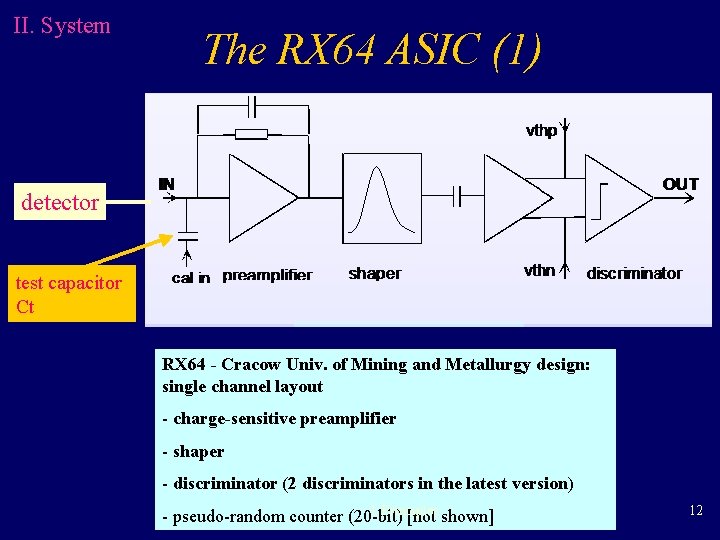
II. System The RX 64 ASIC (1) detector test capacitor Ct RX 64 - Cracow Univ. of Mining and Metallurgy design: single channel layout - charge-sensitive preamplifier - shaper - discriminator (2 discriminators in the latest version) I. Principles - pseudo-random counter (20 -bit) [not shown] 12
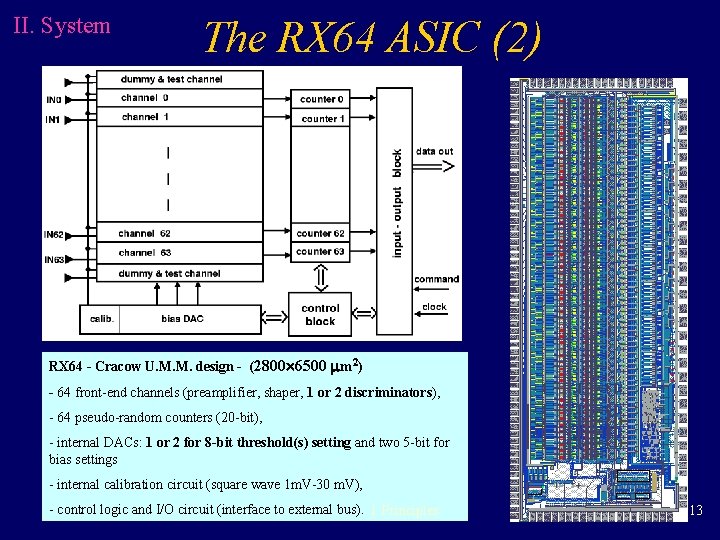
II. System The RX 64 ASIC (2) RX 64 - Cracow U. M. M. design - (2800 6500 m 2) - 64 front-end channels (preamplifier, shaper, 1 or 2 discriminators), - 64 pseudo-random counters (20 -bit), - internal DACs: 1 or 2 for 8 -bit threshold(s) setting and two 5 -bit for bias settings - internal calibration circuit (square wave 1 m. V-30 m. V), - control logic and I/O circuit (interface to external bus). I. Principles 13
II. System RX 64 ASIC testing Probe card testing before assembly on PCB becomes convenient when production yield is low: • Power consumption test • Test of the counter section • Full test of the analogue performance of the 64 channels, using both HIGH and LOW discriminator/counter sets The test is performed using the same power supplies, cables, DAQ hardware and software as for the final assembled system I. Principles 14
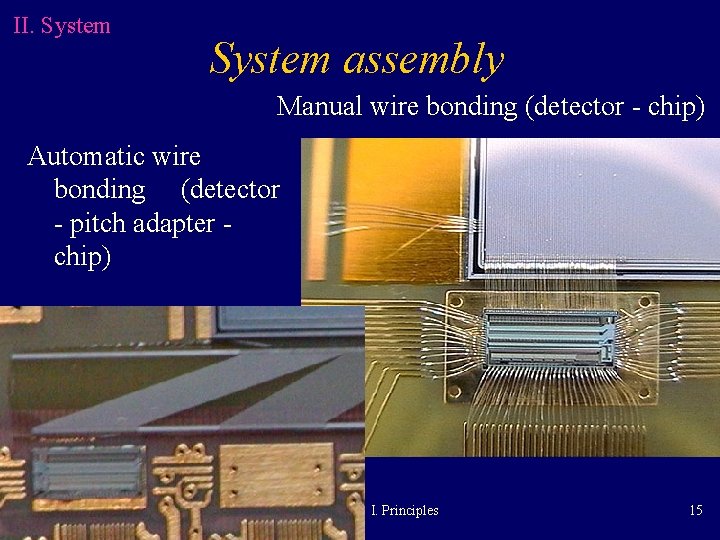
II. System assembly Manual wire bonding (detector - chip) Automatic wire bonding (detector - pitch adapter chip) I. Principles 15
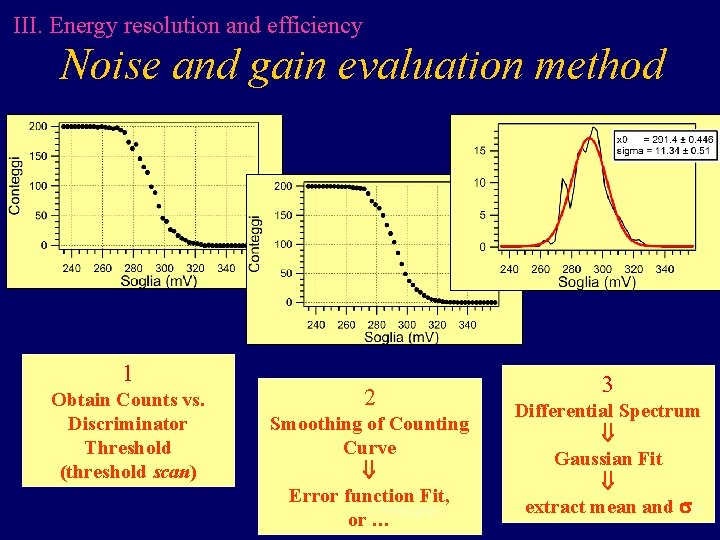
III. Energy resolution and efficiency Noise and gain evaluation method 1 Obtain Counts vs. Discriminator Threshold (threshold scan) 2 Smoothing of Counting Curve Error function Fit, I. Principles or … 3 Differential Spectrum Gaussian Fit extract mean and s 16
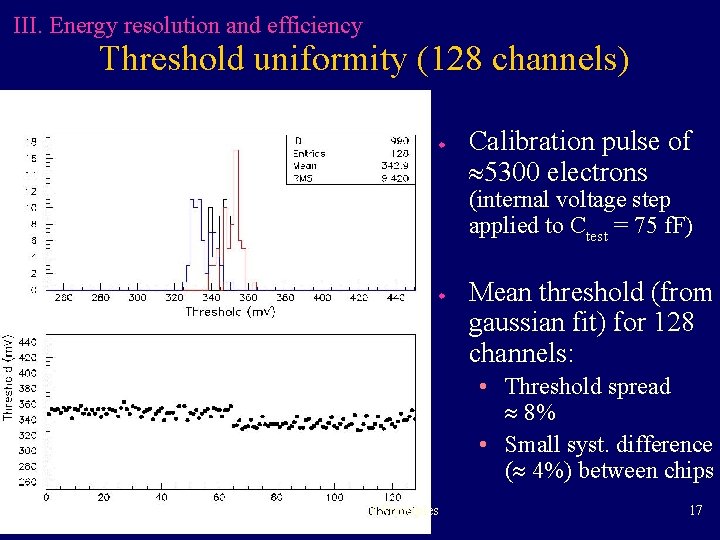
III. Energy resolution and efficiency Threshold uniformity (128 channels) w Calibration pulse of 5300 electrons (internal voltage step applied to Ctest = 75 f. F) w Mean threshold (from gaussian fit) for 128 channels: • Threshold spread 8% • Small syst. difference ( 4%) between chips I. Principles 17
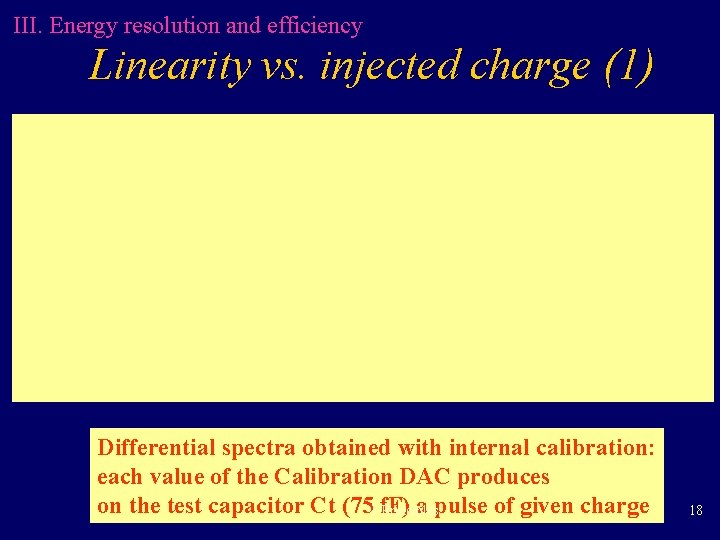
III. Energy resolution and efficiency Linearity vs. injected charge (1) Differential spectra obtained with internal calibration: each value of the Calibration DAC produces on the test capacitor Ct (75 I. f. F) a pulse of given charge Principles 18
III. Energy resolution and efficiency Linearity vs. injected charge (2) Injected charge (electrons) • the RX 64 chip is strictly linear up to 5500 electrons input charge (i. e. up to 20 ke. V X-ray energy) • a straight line fit within linearity range gives offset (a) & gain (b) I. Principles 19
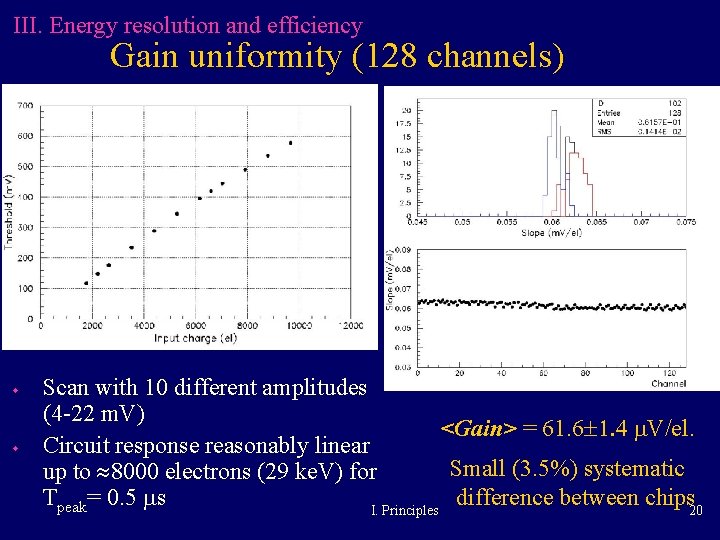
III. Energy resolution and efficiency Gain uniformity (128 channels) w w Scan with 10 different amplitudes (4 -22 m. V) <Gain> = 61. 6± 1. 4 m. V/el. Circuit response reasonably linear Small (3. 5%) systematic up to 8000 electrons (29 ke. V) for difference between chips 20 Tpeak= 0. 5 ms I. Principles
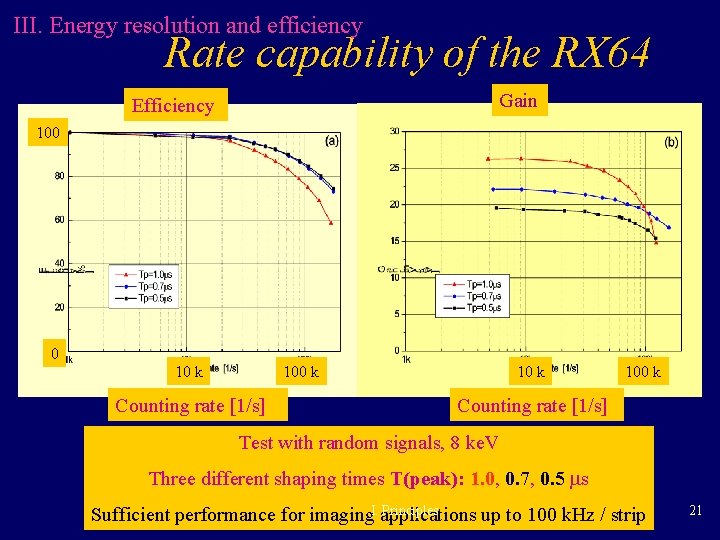
III. Energy resolution and efficiency Rate capability of the RX 64 Gain Efficiency 100 0 10 k 100 k Counting rate [1/s] Test with random signals, 8 ke. V Three different shaping times T(peak): 1. 0, 0. 7, 0. 5 ms Principles Sufficient performance for imaging. I. applications up to 100 k. Hz / strip 21
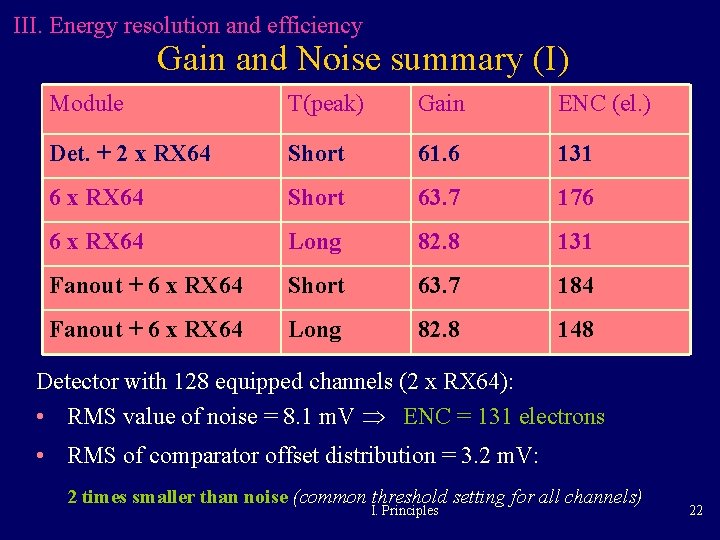
III. Energy resolution and efficiency Gain and Noise summary (I) Module T(peak) Gain ENC (el. ) Det. + 2 x RX 64 Short 61. 6 131 6 x RX 64 Short 63. 7 176 6 x RX 64 Long 82. 8 131 Fanout + 6 x RX 64 Short 63. 7 184 Fanout + 6 x RX 64 Long 82. 8 148 Detector with 128 equipped channels (2 x RX 64): • RMS value of noise = 8. 1 m. V Þ ENC = 131 electrons • RMS of comparator offset distribution = 3. 2 m. V: 2 times smaller than noise (common threshold setting for all channels) I. Principles 22
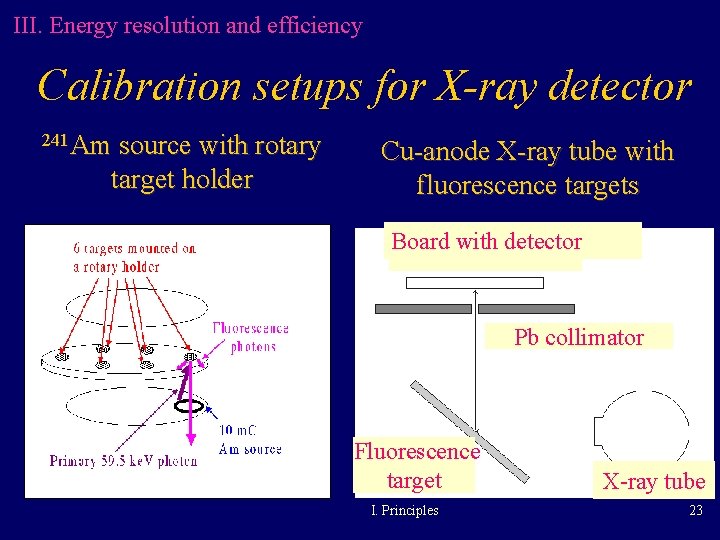
III. Energy resolution and efficiency Calibration setups for X-ray detector 241 Am source with rotary target holder Cu-anode X-ray tube with fluorescence targets Board with detector Pb collimator Fluorescence target I. Principles X-ray tube 23
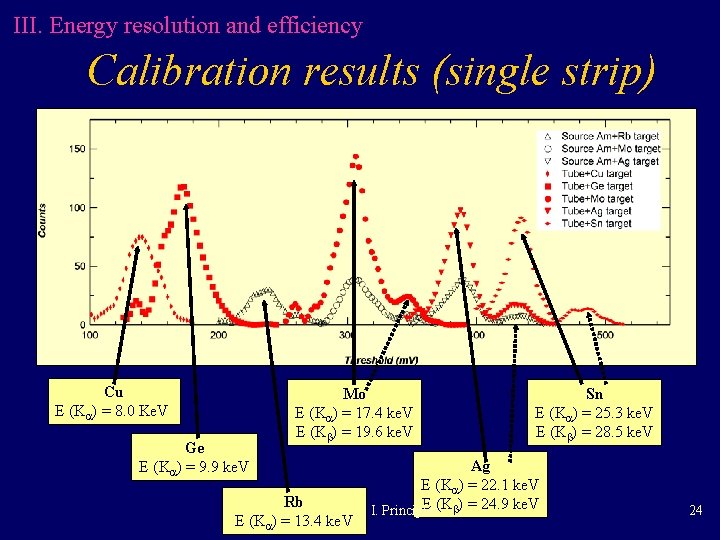
III. Energy resolution and efficiency Calibration results (single strip) Cu E (K ) = 8. 0 Ke. V Ge E (K ) = 9. 9 ke. V Mo E (K ) = 17. 4 ke. V E (K ) = 19. 6 ke. V Rb E (K ) = 13. 4 ke. V Sn E (K ) = 25. 3 ke. V E (K ) = 28. 5 ke. V Ag E (K ) = 22. 1 ke. V E (K ) = 24. 9 ke. V I. Principles 24
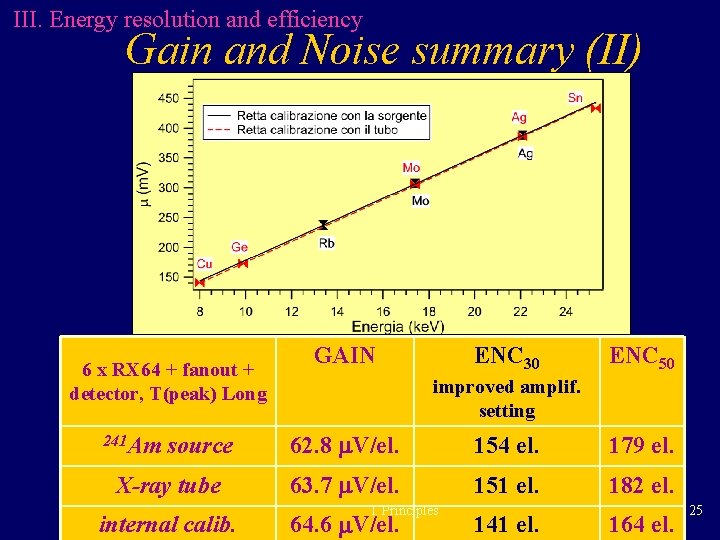
III. Energy resolution and efficiency Gain and Noise summary (II) 6 x RX 64 + fanout + detector, T(peak) Long 241 Am source X-ray tube internal calib. GAIN ENC 30 ENC 50 improved amplif. setting 62. 8 V/el. 154 el. 179 el. 63. 7 V/el. 151 el. 182 el. I. Principles 64. 6 V/el. 141 el. 164 el. 25
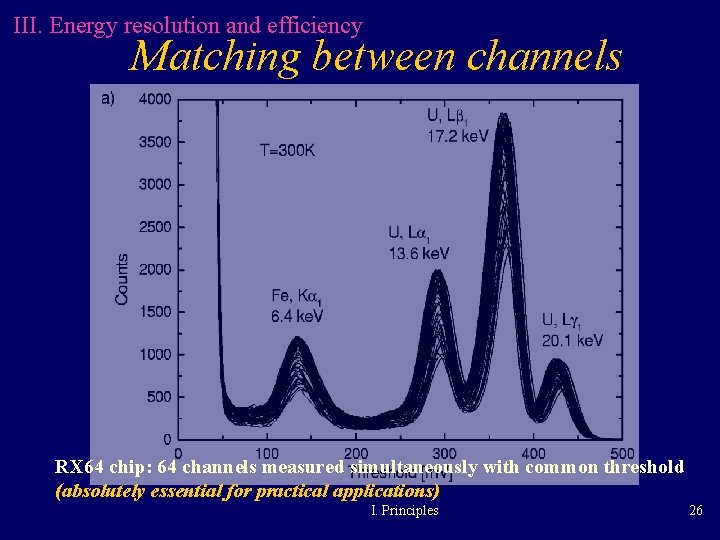
III. Energy resolution and efficiency Matching between channels RX 64 chip: 64 channels measured simultaneously with common threshold (absolutely essential for practical applications) I. Principles 26
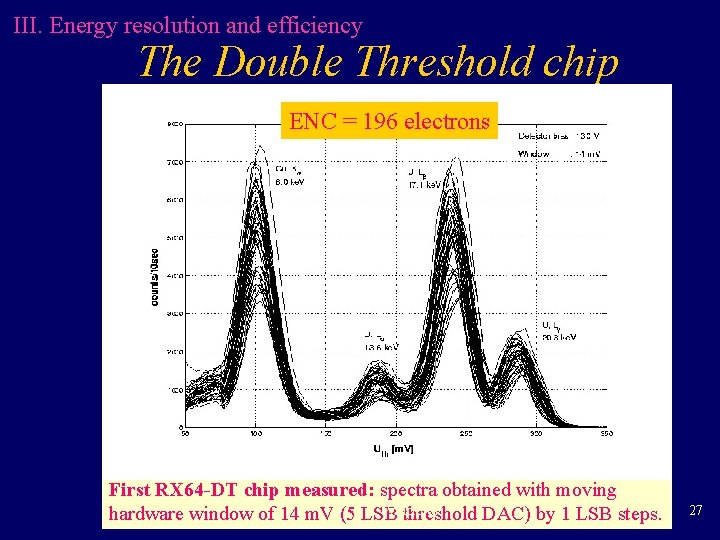
III. Energy resolution and efficiency The Double Threshold chip ENC = 196 electrons First RX 64 -DT chip measured: spectra obtained with moving I. Principles hardware window of 14 m. V (5 LSB threshold DAC) by 1 LSB steps. 27
III. Energy resolution and efficiency The conversion efficiency Quasi-monochromatic beam at 6 energies (18 -36 ke. V) Fluorescence setup with 4 targets (15. 7 -25. 0 ke. V) Preliminary analysis Detector was exposed to same beam flux in FRONT and EDGE mode The (not well kown) absolute beam flux cancels in the ratio: Counts(EDGE) / Counts(FRONT) I. Principles Experimental results compare well with GEANT 3. 21 simulations 28
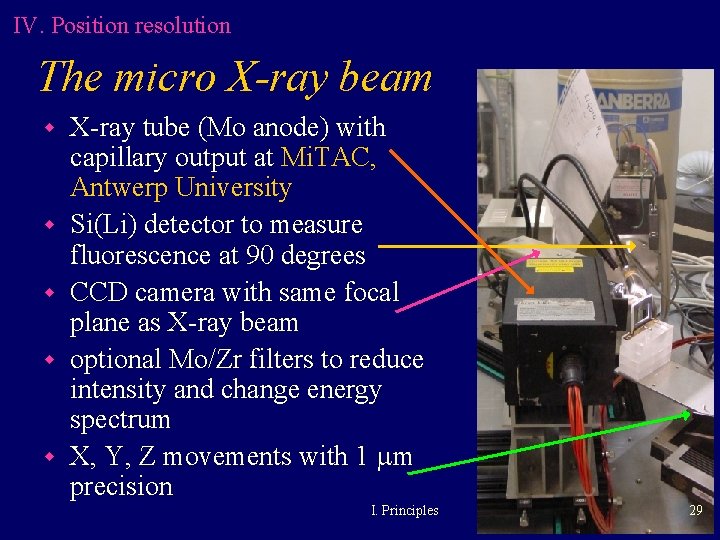
IV. Position resolution The micro X-ray beam w w w X-ray tube (Mo anode) with capillary output at Mi. TAC, Antwerp University Si(Li) detector to measure fluorescence at 90 degrees CCD camera with same focal plane as X-ray beam optional Mo/Zr filters to reduce intensity and change energy spectrum X, Y, Z movements with 1 mm precision I. Principles 29
IV. Position resolution Measuring the position resolution w w w X-ray tube (Mo anode) operated at 15 k. V and 40 k. V Silicon detector in front configuration (Al protection removed) Mo or Zr filter Horizontal scan (in/out of beam focus) by 1 mm steps to check focus Vertical scan (across strips) by 10 mm steps to measure position resolution I. Principles 30
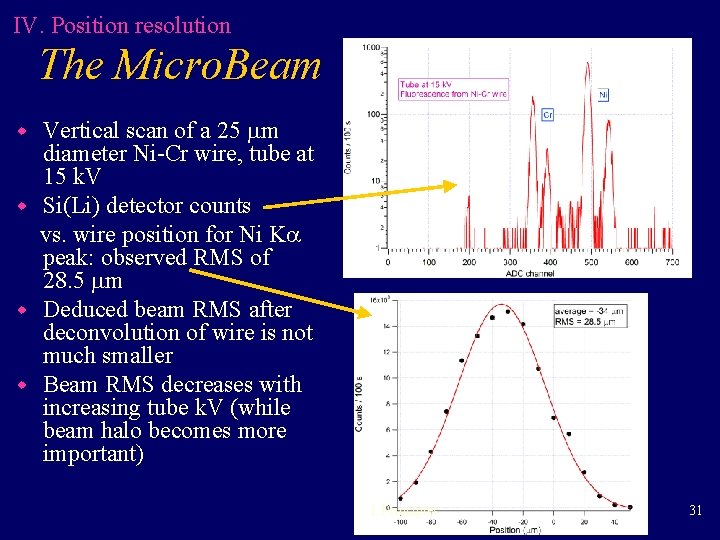
IV. Position resolution The Micro. Beam Vertical scan of a 25 mm diameter Ni-Cr wire, tube at 15 k. V w Si(Li) detector counts vs. wire position for Ni K peak: observed RMS of 28. 5 mm w Deduced beam RMS after deconvolution of wire is not much smaller w Beam RMS decreases with increasing tube k. V (while beam halo becomes more important) w I. Principles 31
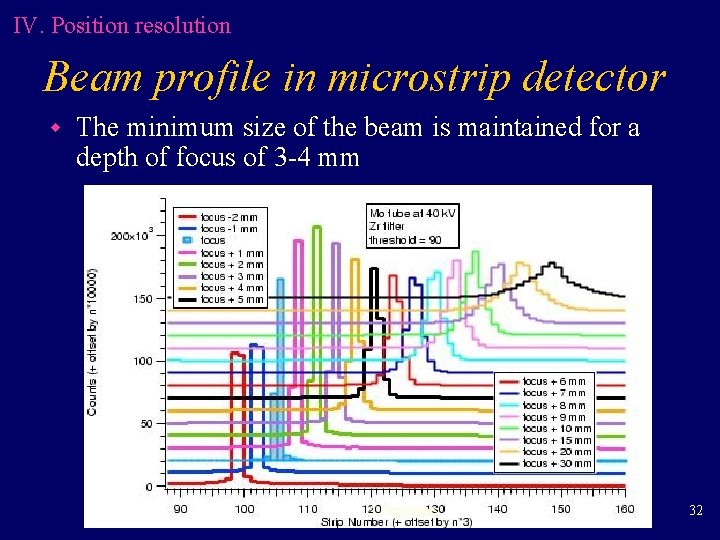
IV. Position resolution Beam profile in microstrip detector w The minimum size of the beam is maintained for a depth of focus of 3 -4 mm I. Principles 32
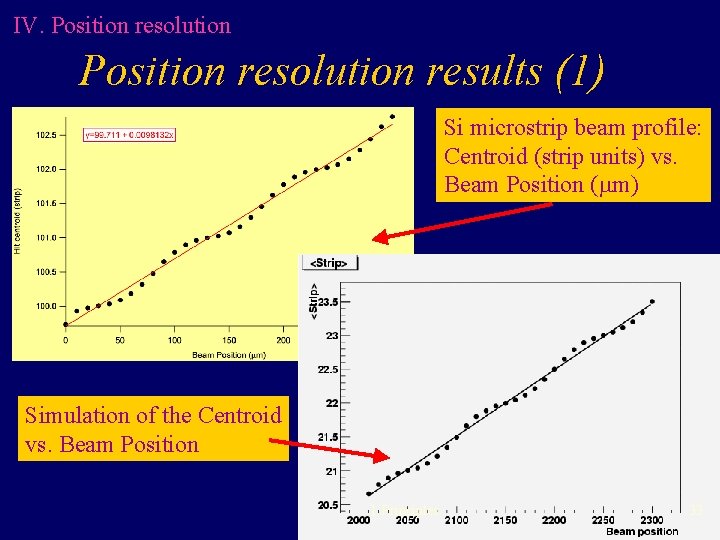
IV. Position resolution results (1) Si microstrip beam profile: Centroid (strip units) vs. Beam Position (mm) Simulation of the Centroid vs. Beam Position I. Principles 33
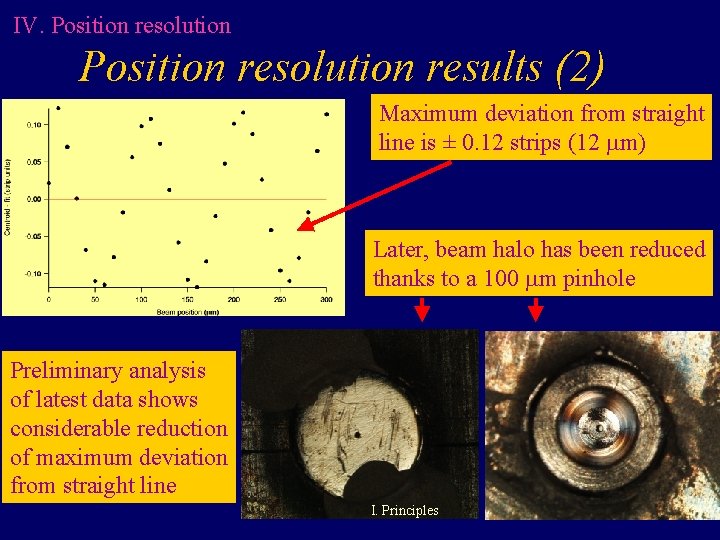
IV. Position resolution results (2) Maximum deviation from straight line is ± 0. 12 strips (12 mm) Later, beam halo has been reduced thanks to a 100 mm pinhole Preliminary analysis of latest data shows considerable reduction of maximum deviation from straight line I. Principles 34
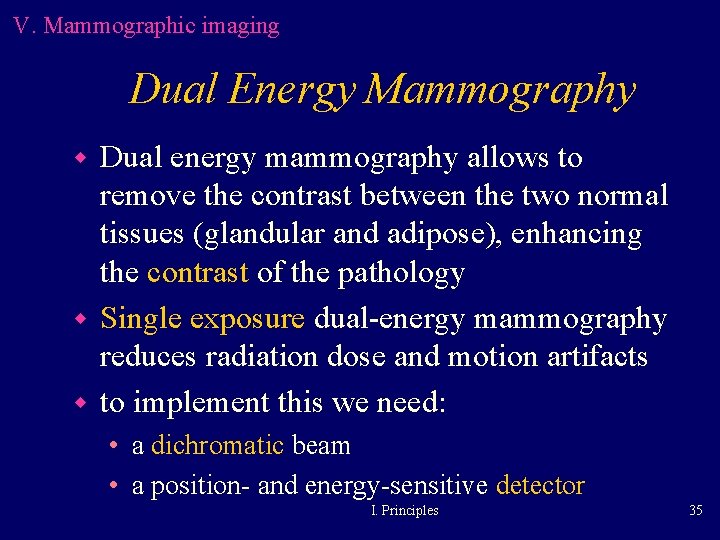
V. Mammographic imaging Dual Energy Mammography Dual energy mammography allows to remove the contrast between the two normal tissues (glandular and adipose), enhancing the contrast of the pathology w Single exposure dual-energy mammography reduces radiation dose and motion artifacts w to implement this we need: w • a dichromatic beam • a position- and energy-sensitive detector I. Principles 35
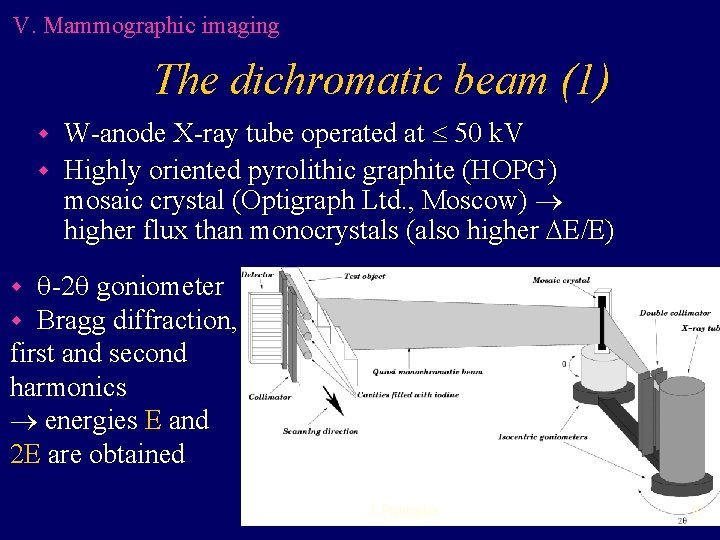
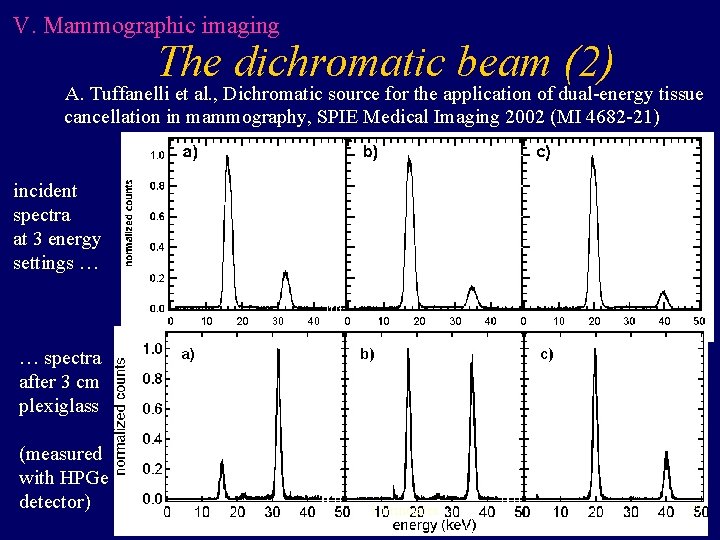
V. Mammographic imaging The dichromatic beam (1) W-anode X-ray tube operated at 50 k. V w Highly oriented pyrolithic graphite (HOPG) mosaic crystal (Optigraph Ltd. , Moscow) higher flux than monocrystals (also higher DE/E) w q-2 q goniometer Bragg diffraction, first and second harmonics energies E and 2 E are obtained w w I. Principles 36
V. Mammographic imaging The dichromatic beam (2) A. Tuffanelli et al. , Dichromatic source for the application of dual-energy tissue cancellation in mammography, SPIE Medical Imaging 2002 (MI 4682 -21) incident spectra at 3 energy settings … … spectra after 3 cm plexiglass (measured with HPGe detector) I. Principles 37
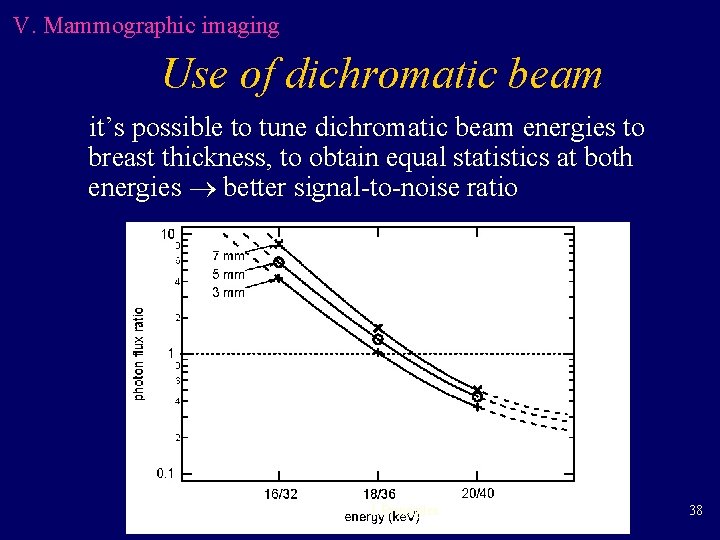
V. Mammographic imaging Use of dichromatic beam it’s possible to tune dichromatic beam energies to breast thickness, to obtain equal statistics at both energies better signal-to-noise ratio I. Principles 38
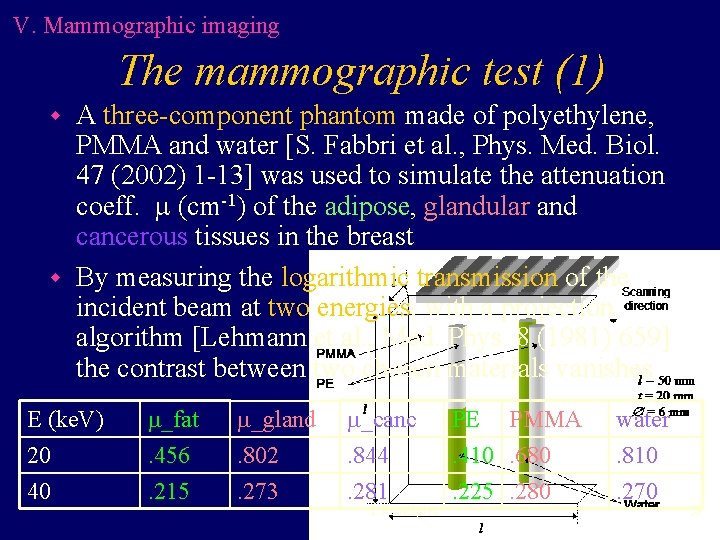
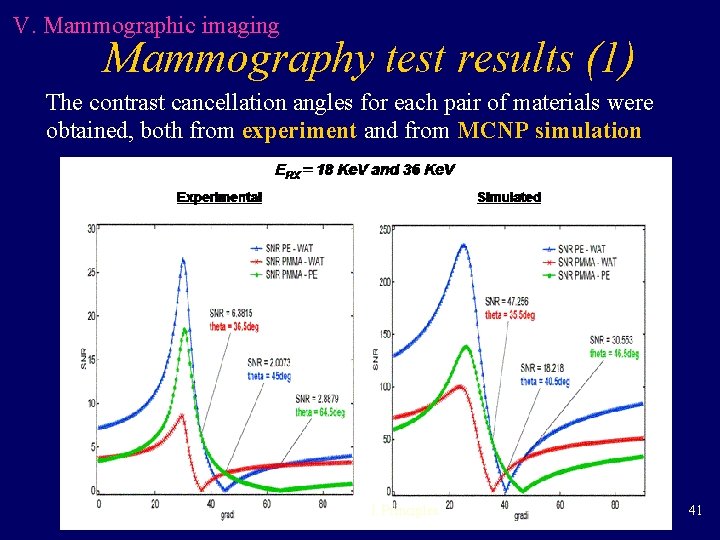
V. Mammographic imaging The mammographic test (1) A three-component phantom made of polyethylene, PMMA and water [S. Fabbri et al. , Phys. Med. Biol. 47 (2002) 1 -13] was used to simulate the attenuation coeff. m (cm-1) of the adipose, glandular and cancerous tissues in the breast w By measuring the logarithmic transmission of the incident beam at two energies, with a projection algorithm [Lehmann et al. , Med. Phys. 8 (1981) 659] the contrast between two chosen materials vanishes w E (ke. V) 20 40 m_fat. 456. 215 m_gland. 802. 273 m_canc. 844. 281 I. Principles PE PMMA. 410. 680. 225. 280 water. 810. 270 39
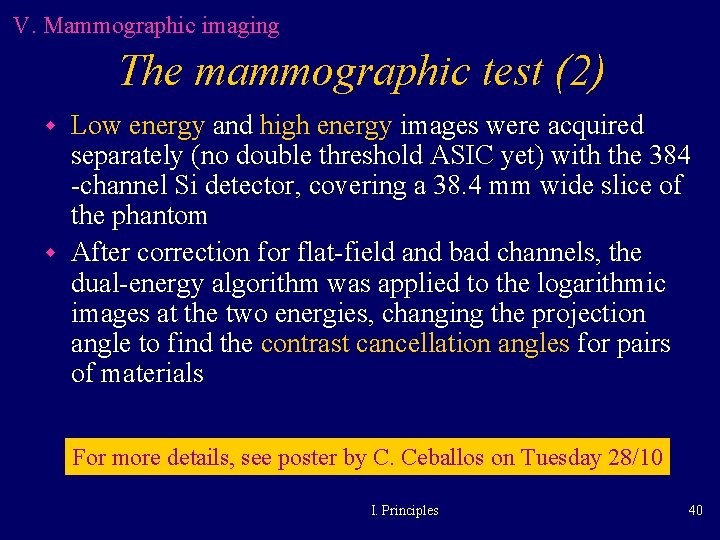
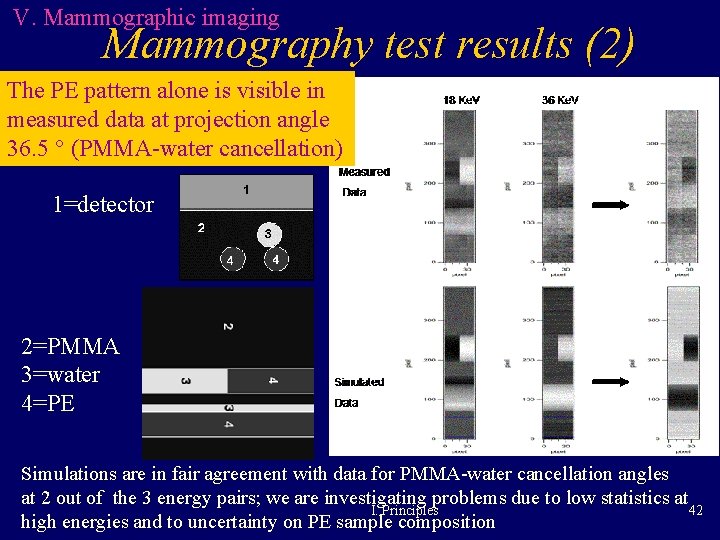
V. Mammographic imaging The mammographic test (2) Low energy and high energy images were acquired separately (no double threshold ASIC yet) with the 384 -channel Si detector, covering a 38. 4 mm wide slice of the phantom w After correction for flat-field and bad channels, the dual-energy algorithm was applied to the logarithmic images at the two energies, changing the projection angle to find the contrast cancellation angles for pairs of materials w For more details, see poster by C. Ceballos on Tuesday 28/10 I. Principles 40
V. Mammographic imaging Mammography test results (1) The contrast cancellation angles for each pair of materials were obtained, both from experiment and from MCNP simulation I. Principles 41
V. Mammographic imaging Mammography test results (2) The PE pattern alone is visible in measured data at projection angle 36. 5 ° (PMMA-water cancellation) 1=detector 2=PMMA 3=water 4=PE Simulations are in fair agreement with data for PMMA-water cancellation angles at 2 out of the 3 energy pairs; we are investigating problems due to low statistics at I. Principles 42 high energies and to uncertainty on PE sample composition
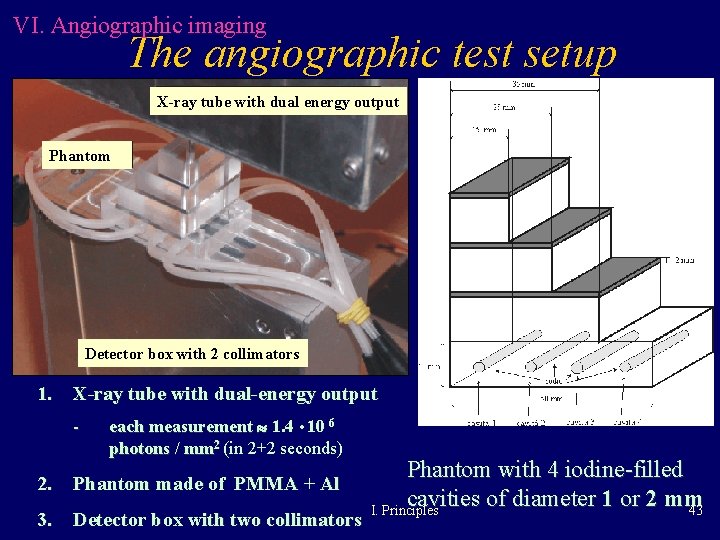
VI. Angiographic imaging The angiographic test setup X-ray tube with dual energy output Phantom Detector box with 2 collimators 1. X-ray tube with dual-energy output - each measurement 1. 4 • 10 6 photons / mm 2 (in 2+2 seconds) 2. Phantom made of PMMA + Al 3. Detector box with two collimators Phantom with 4 iodine-filled cavities of diameter 1 or 2 mm I. Principles 43
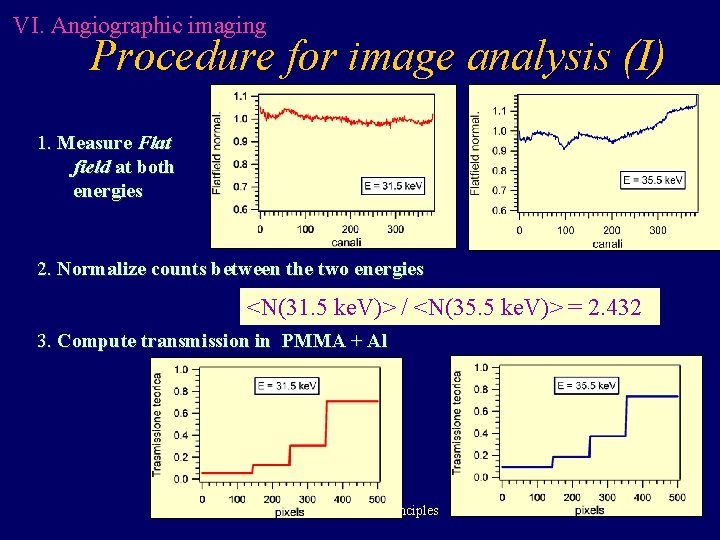
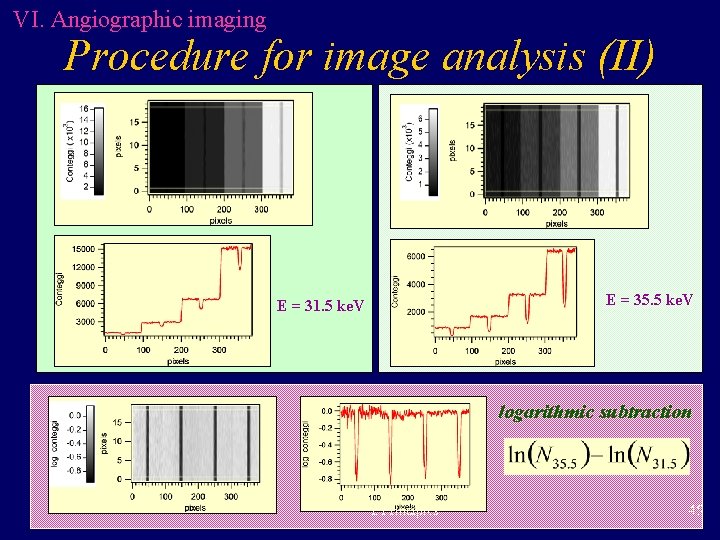
VI. Angiographic imaging Procedure for image analysis (I) 1. Measure Flat field at both energies 2. Normalize counts between the two energies <N(31. 5 ke. V)> / <N(35. 5 ke. V)> = 2. 432 3. Compute transmission in PMMA + Al I. Principles 44
VI. Angiographic imaging Procedure for image analysis (II) E = 35. 5 ke. V E = 31. 5 ke. V logarithmic subtraction I. Principles 45
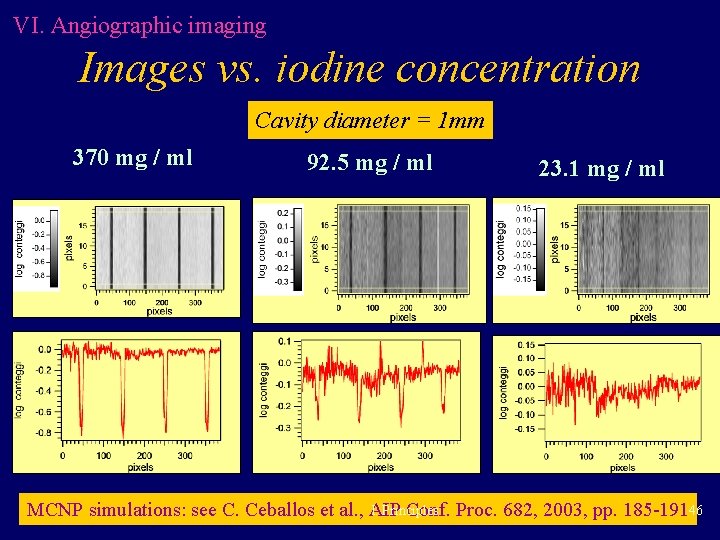
VI. Angiographic imaging Images vs. iodine concentration Cavity diameter = 1 mm 370 mg / ml 92. 5 mg / ml 23. 1 mg / ml I. Principles MCNP simulations: see C. Ceballos et al. , AIP Conf. Proc. 682, 2003, pp. 185 -19146
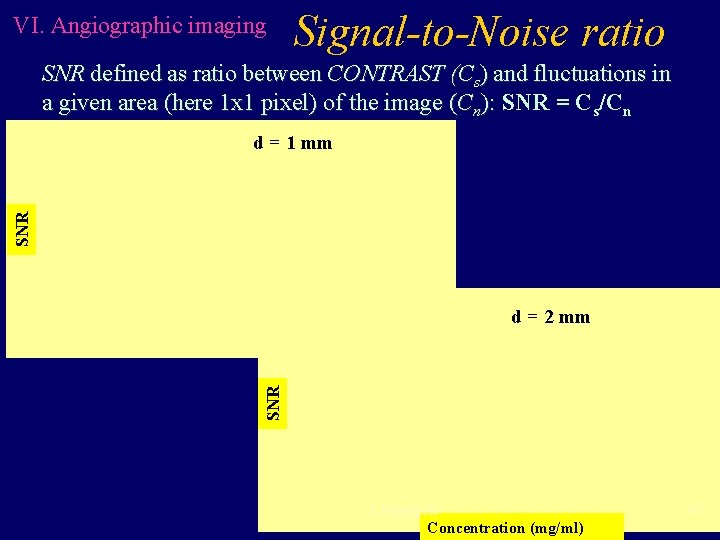
VI. Angiographic imaging Signal-to-Noise ratio SNR defined as ratio between CONTRAST (Cs) and fluctuations in a given area (here 1 x 1 pixel) of the image (Cn): SNR = Cs/Cn SNR d = 1 mm SNR d = 2 mm I. Principles Concentration (mg/ml) 47
VII. Conclusion Summary A relatively simple linear X-ray detector for scanning mode radiography was developed w Energy resolution (1. 3 ke. V FWHM at 22 ke. V) is well suited for the available quasi-monochromatic beams w Efficiency in edge mode (10 mm Si) is sufficient for D. E. mammography and angiography at iodine K-edge w Imaging results with phantoms show interesting SNR values, detailed simulations using MCNP and GEANT 3 were developed w I. Principles 48
VII. Conclusion w w w Outlook Exploit double threshold ASIC for D. E. Mammography (ASIC mass tests ongoing) Build larger detectors for full-size imaging Measure DQE and MTF with microbeam Angiography: implement synchronization with ECG Angiography: explore the Gadolinium option at 50 Ke. V I. Principles 49
VII. Conclusion w w w Thanks to. . . The organizers of NURT 2003 for this nice opportunity to present our results The Italian Ministry for Education, University and Research (MIUR) The Polish State Committee for Scientific Research INFN Torino for allowing access to technical staff and bonding facilities ICTP Trieste for travel and subsistence support to Cuban researchers The European Community for travel and subsistence support for students under the ALFA II programme (contract AML/B 7 -311/97/0666/II-0042) I. Principles 50