
Recent advances in shell evolution with shellmodel calculations


- Slides: 23
Recent advances in shell evolution with shell-model calculations Yutaka Utsuno Advanced Science Research Center, Japan Atomic Energy Agency Center for Nuclear Study, University of Tokyo In collaboration with T. Otsuka (Tokyo), N. Shimizu (CNS), Y. Tsunoda (Tokyo), M. Honma (Aizu), T. Mizusaki (Senshu), T. Togashi (CNS), T. Yoshida (CNS)
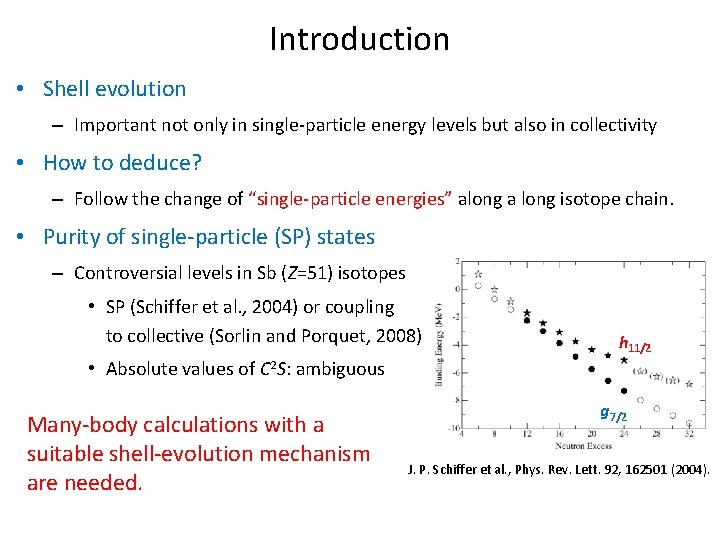
Introduction • Shell evolution – Important not only in single-particle energy levels but also in collectivity • How to deduce? – Follow the change of “single-particle energies” along a long isotope chain. • Purity of single-particle (SP) states – Controversial levels in Sb (Z=51) isotopes • SP (Schiffer et al. , 2004) or coupling to collective (Sorlin and Porquet, 2008) h 11/2 • Absolute values of C 2 S: ambiguous Many-body calculations with a suitable shell-evolution mechanism are needed. g 7/2 J. P. Schiffer et al. , Phys. Rev. Lett. 92, 162501 (2004).
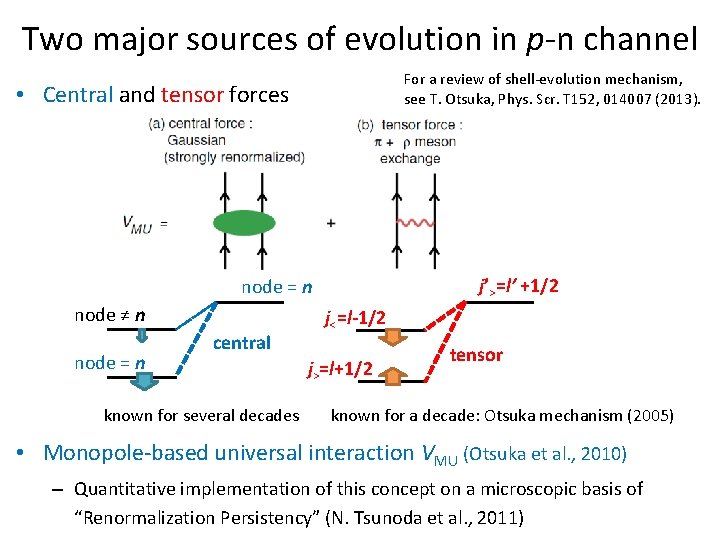
Two major sources of evolution in p-n channel For a review of shell-evolution mechanism, see T. Otsuka, Phys. Scr. T 152, 014007 (2013). • Central and tensor forces j’>=l’ +1/2 node = n node ≠ n node = n central known for several decades j<=l-1/2 j>=l+1/2 tensor known for a decade: Otsuka mechanism (2005) • Monopole-based universal interaction VMU (Otsuka et al. , 2010) – Quantitative implementation of this concept on a microscopic basis of “Renormalization Persistency” (N. Tsunoda et al. , 2011)
Topics to be discussed Shell evolution driven by the p-n force on the basis of largescale shell-model calculations 1. Evolution of single-particle-like states – Sb (Z=51) isotopes – Cu (Z=29) isotopes 2. Shape coexistence in Ni isotopes: Type II shell evolution 3. Evolution of the new N=34 magic number
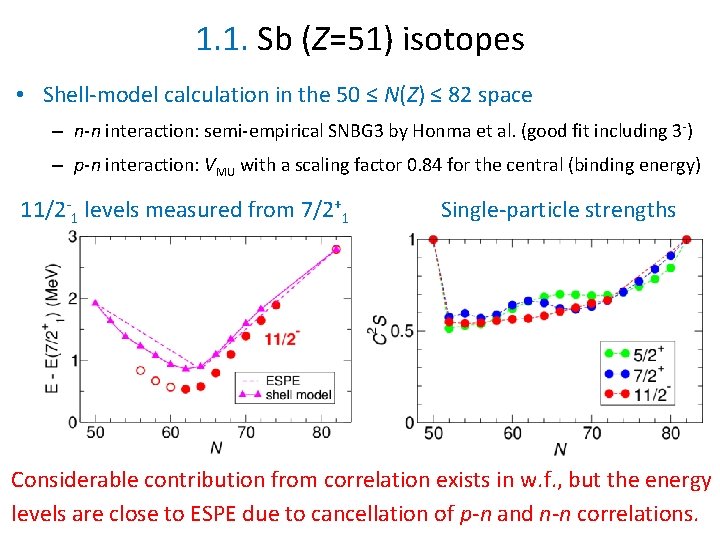
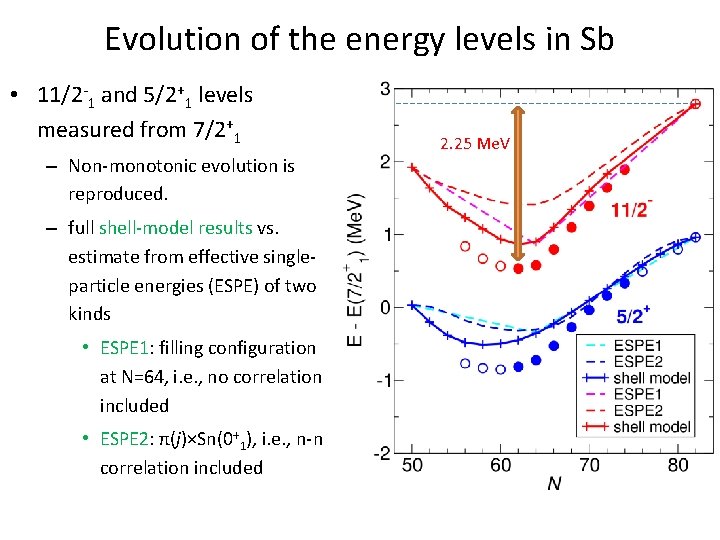
1. 1. Sb (Z=51) isotopes • Shell-model calculation in the 50 ≤ N(Z) ≤ 82 space – n-n interaction: semi-empirical SNBG 3 by Honma et al. (good fit including 3 -) – p-n interaction: VMU with a scaling factor 0. 84 for the central (binding energy) 11/2 -1 levels measured from 7/2+1 Single-particle strengths Considerable contribution from correlation exists in w. f. , but the energy levels are close to ESPE due to cancellation of p-n and n-n correlations.
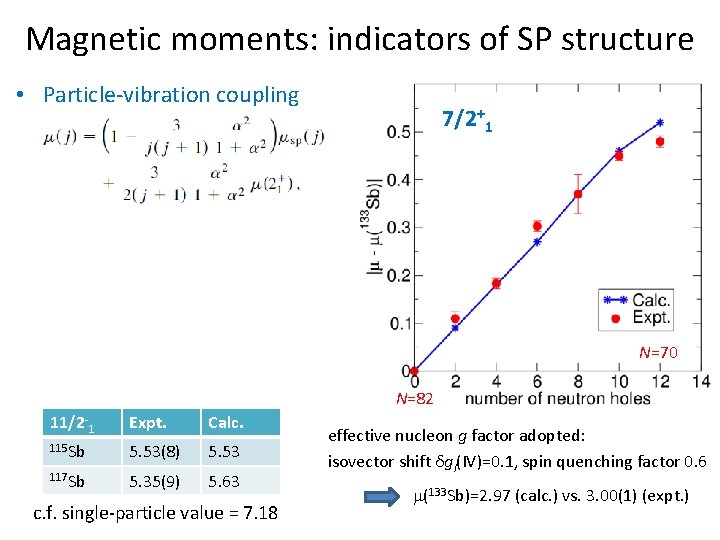
Magnetic moments: indicators of SP structure • Particle-vibration coupling 7/2+1 N=70 N=82 11/2 -1 Expt. Calc. 115 Sb 5. 53(8) 5. 53 117 Sb 5. 35(9) 5. 63 c. f. single-particle value = 7. 18 effective nucleon g factor adopted: isovector shift δgl(IV)=0. 1, spin quenching factor 0. 6 m(133 Sb)=2. 97 (calc. ) vs. 3. 00(1) (expt. )
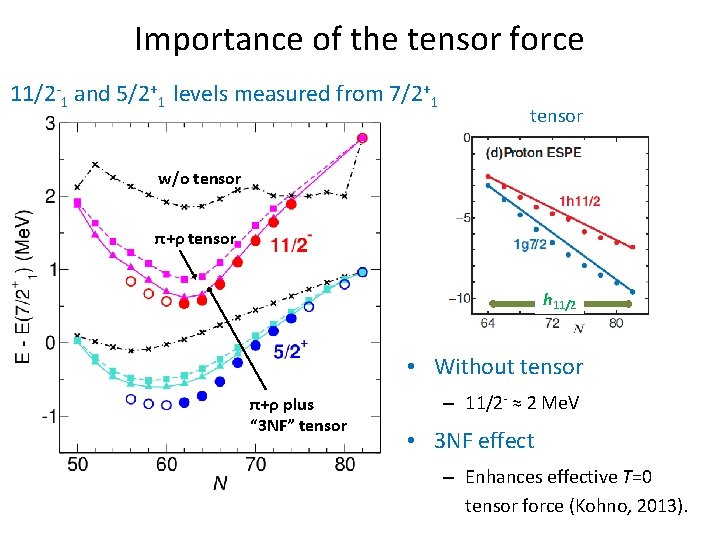
Importance of the tensor force 11/2 -1 and 5/2+1 levels measured from 7/2+1 tensor w/o tensor π+ρ tensor h 11/2 • Without tensor π+ρ plus “ 3 NF” tensor – 11/2 - ≈ 2 Me. V • 3 NF effect – Enhances effective T=0 tensor force (Kohno, 2013).
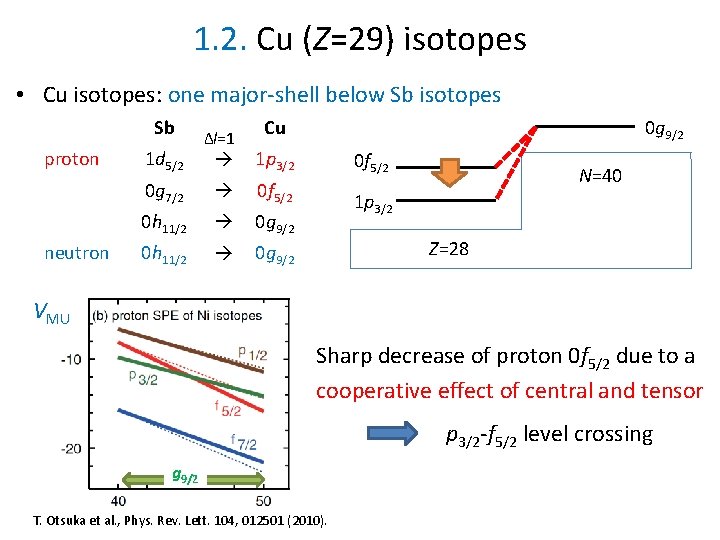
1. 2. Cu (Z=29) isotopes • Cu isotopes: one major-shell below Sb isotopes Sb proton neutron 1 d 5/2 Δl=1 0 g 9/2 Cu 1 p 3/2 0 g 7/2 0 f 5/2 0 h 11/2 0 g 9/2 0 f 5/2 N=40 1 p 3/2 Z=28 VMU Sharp decrease of proton 0 f 5/2 due to a cooperative effect of central and tensor p 3/2 -f 5/2 level crossing g 9/2 T. Otsuka et al. , Phys. Rev. Lett. 104, 012501 (2010).
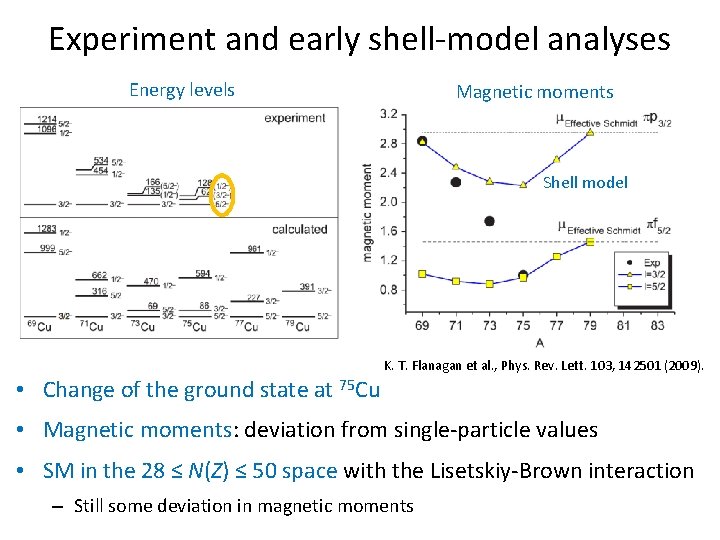
Experiment and early shell-model analyses Energy levels Magnetic moments Shell model K. T. Flanagan et al. , Phys. Rev. Lett. 103, 142501 (2009). • Change of the ground state at 75 Cu • Magnetic moments: deviation from single-particle values • SM in the 28 ≤ N(Z) ≤ 50 space with the Lisetskiy-Brown interaction – Still some deviation in magnetic moments
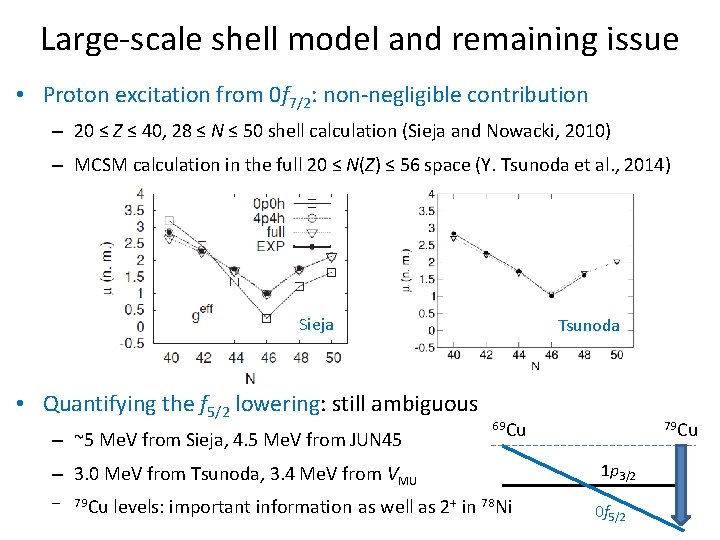
Large-scale shell model and remaining issue • Proton excitation from 0 f 7/2: non-negligible contribution – 20 ≤ Z ≤ 40, 28 ≤ N ≤ 50 shell calculation (Sieja and Nowacki, 2010) – MCSM calculation in the full 20 ≤ N(Z) ≤ 56 space (Y. Tsunoda et al. , 2014) Sieja • Quantifying the f 5/2 lowering: still ambiguous – ~5 Me. V from Sieja, 4. 5 Me. V from JUN 45 Tsunoda 69 Cu – 3. 0 Me. V from Tsunoda, 3. 4 Me. V from VMU – 79 Cu levels: important information as well as 2+ in 78 Ni 79 Cu 1 p 3/2 0 f 5/2
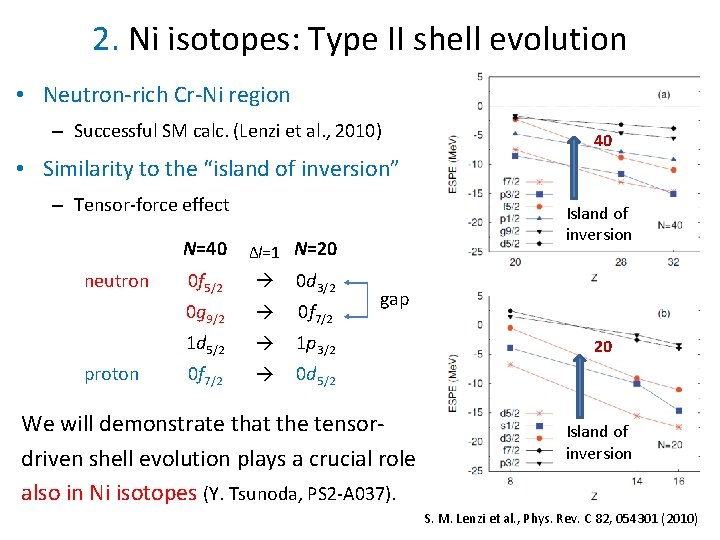
2. Ni isotopes: Type II shell evolution • Neutron-rich Cr-Ni region – Successful SM calc. (Lenzi et al. , 2010) 40 • Similarity to the “island of inversion” – Tensor-force effect N=40 neutron proton Island of inversion Δl=1 N=20 0 f 5/2 0 d 3/2 0 g 9/2 0 f 7/2 1 d 5/2 1 p 3/2 0 f 7/2 0 d 5/2 gap We will demonstrate that the tensordriven shell evolution plays a crucial role also in Ni isotopes (Y. Tsunoda, PS 2 -A 037). 20 Island of inversion S. M. Lenzi et al. , Phys. Rev. C 82, 054301 (2010)
MCSM calculations for 68 Ni Y. Tsunoda et al. , Phys. Rev. C 89, 031301(R) (2014). • Triple shape coexistence – Analysis of MCSM w. f. (talk of Shimizu on Thursday) – Similar to 186 Pb (Andreyev et al. , 2000) – Deformed 0+2: Supported by E 0 measurement (Suchyta et al. , 2014 and PS 2 -A 039)
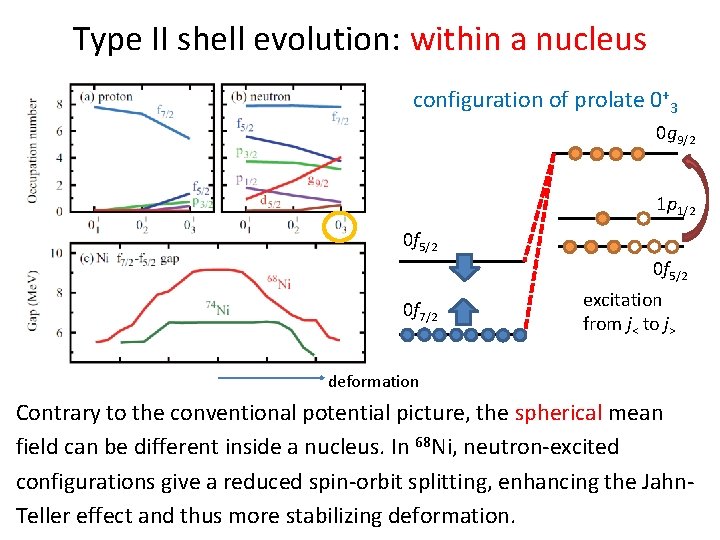
Type II shell evolution: within a nucleus configuration of prolate 0+3 0 g 9/2 1 p 1/2 0 f 5/2 0 f 7/2 excitation from j< to j> deformation Contrary to the conventional potential picture, the spherical mean field can be different inside a nucleus. In 68 Ni, neutron-excited configurations give a reduced spin-orbit splitting, enhancing the Jahn. Teller effect and thus more stabilizing deformation.
3. Evolution of the N=34 magic number • N=34 magic number (at Ca) D. Steppenbeck et al. , Nature 502, 207 (2013). – Predicted by Otsuka et al. in 2001, but no experimental signs were found before • Direct measurement of 2+1 for 54 Ca at RIBF – Establishing magicity (Steppenbeck et al. , 2013 and talk on Friday) • Very localized magic number – Sharp lowering of f 5/2 due to central and tensor
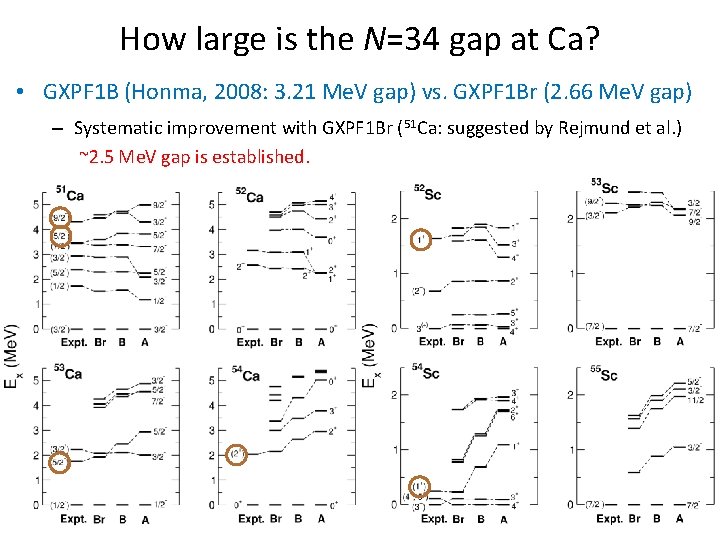
How large is the N=34 gap at Ca? • GXPF 1 B (Honma, 2008: 3. 21 Me. V gap) vs. GXPF 1 Br (2. 66 Me. V gap) – Systematic improvement with GXPF 1 Br (51 Ca: suggested by Rejmund et al. ) ~2. 5 Me. V gap is established.
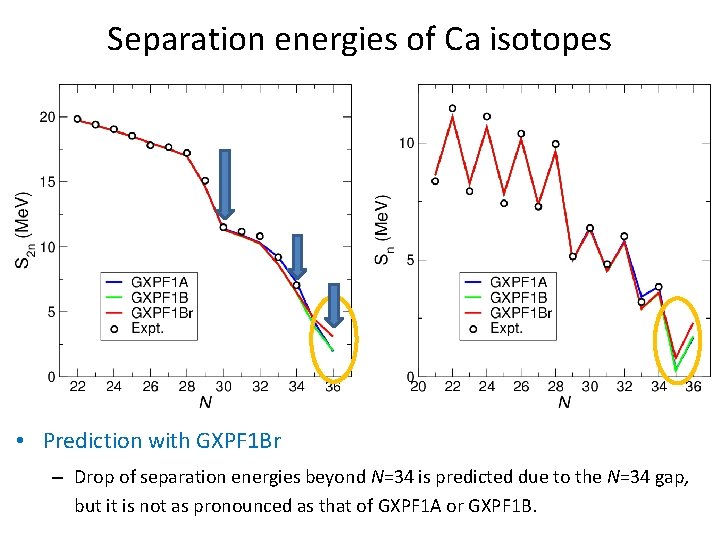
Separation energies of Ca isotopes • Prediction with GXPF 1 Br – Drop of separation energies beyond N=34 is predicted due to the N=34 gap, but it is not as pronounced as that of GXPF 1 A or GXPF 1 B.
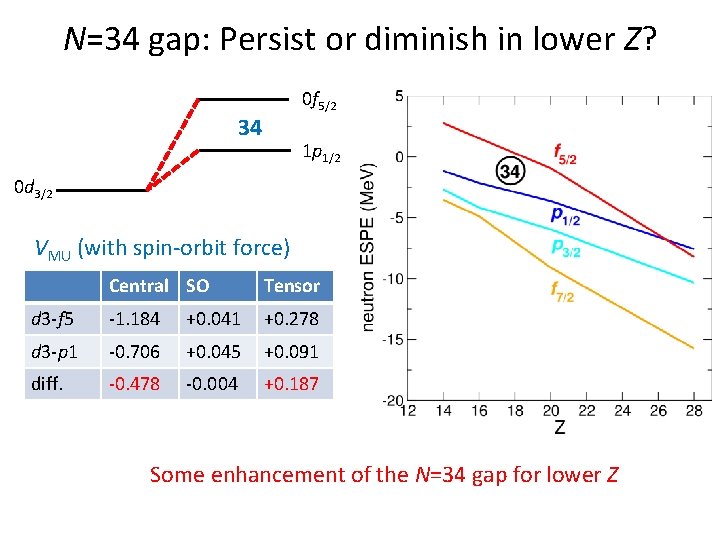
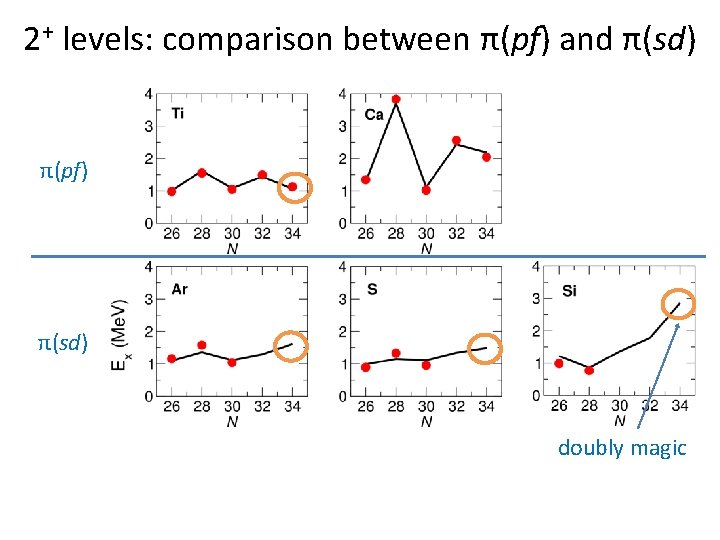
N=34 gap: Persist or diminish in lower Z? 0 f 5/2 34 1 p 1/2 0 d 3/2 VMU (with spin-orbit force) Central SO Tensor d 3 -f 5 -1. 184 +0. 041 +0. 278 d 3 -p 1 -0. 706 +0. 045 +0. 091 diff. -0. 478 -0. 004 +0. 187 Some enhancement of the N=34 gap for lower Z
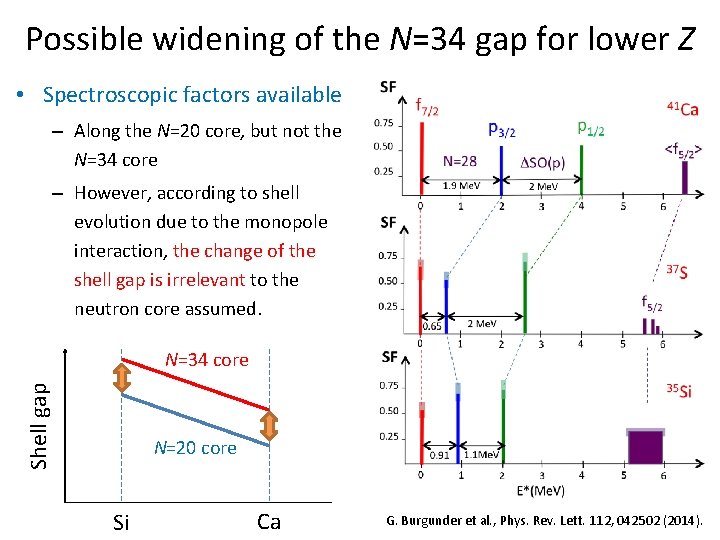
Possible widening of the N=34 gap for lower Z • Spectroscopic factors available – Along the N=20 core, but not the N=34 core – However, according to shell evolution due to the monopole interaction, the change of the shell gap is irrelevant to the neutron core assumed. Shell gap N=34 core N=20 core Si Ca G. Burgunder et al. , Phys. Rev. Lett. 112, 042502 (2014).
2+ levels: comparison between π(pf) and π(sd) π(pf) π(sd) doubly magic
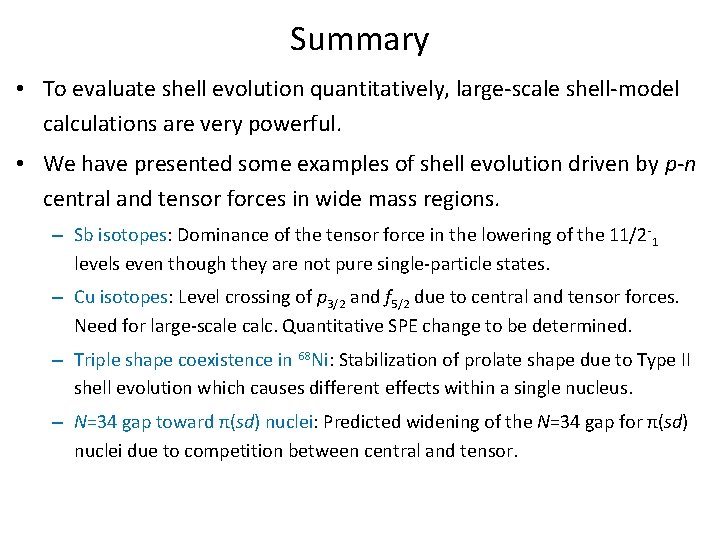
Summary • To evaluate shell evolution quantitatively, large-scale shell-model calculations are very powerful. • We have presented some examples of shell evolution driven by p-n central and tensor forces in wide mass regions. – Sb isotopes: Dominance of the tensor force in the lowering of the 11/2 -1 levels even though they are not pure single-particle states. – Cu isotopes: Level crossing of p 3/2 and f 5/2 due to central and tensor forces. Need for large-scale calc. Quantitative SPE change to be determined. – Triple shape coexistence in 68 Ni: Stabilization of prolate shape due to Type II shell evolution which causes different effects within a single nucleus. – N=34 gap toward π(sd) nuclei: Predicted widening of the N=34 gap for π(sd) nuclei due to competition between central and tensor.
backup
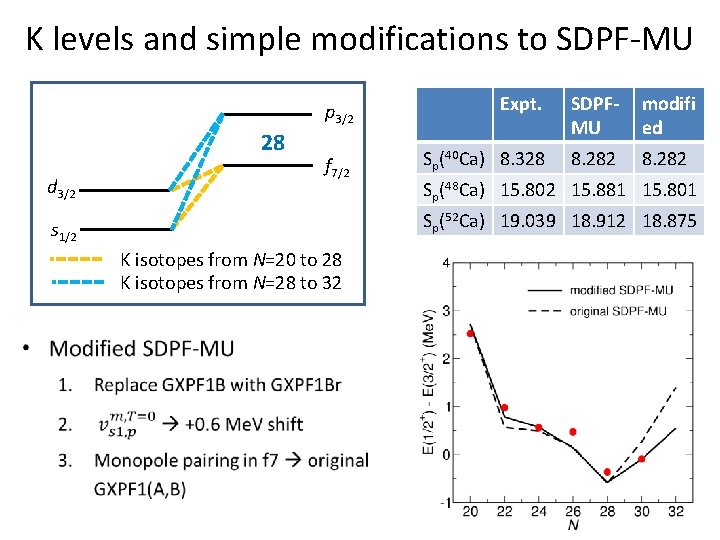
K levels and simple modifications to SDPF-MU 28 d 3/2 p 3/2 Expt. SDPFMU modifi ed f 7/2 Sp(40 Ca) 8. 328 8. 282 Sp(48 Ca) 15. 802 15. 881 15. 801 Sp(52 Ca) 19. 039 18. 912 18. 875 s 1/2 K isotopes from N=20 to 28 K isotopes from N=28 to 32
Evolution of the energy levels in Sb • 11/2 -1 and 5/2+1 levels measured from 7/2+1 – Non-monotonic evolution is reproduced. – full shell-model results vs. estimate from effective singleparticle energies (ESPE) of two kinds • ESPE 1: filling configuration at N=64, i. e. , no correlation included • ESPE 2: π(j)×Sn(0+1), i. e. , n-n correlation included 2. 25 Me. V