
Recent Advances in Chemical Weather Forecasting in Support

![Rishiri 227 1 21. 2 Height[km] DUST[μg/m 3] Lev =10, 30, 60, 90, 120,](https://slidetodoc.com/presentation_image/4fd62b22a17212a72a76f4ed9734049b/image-30.jpg "Rishiri 227 1 21. 2 Height[km] DUST[μg/m 3] Lev =10, 30, 60, 90, 120,")



- Slides: 45
Recent Advances in Chemical Weather Forecasting in Support of Atmospheric Chemistry Field Experiments Gregory R. Carmichael Department of Chemical & Biochemical Engineering Center for Global & Regional Environmental Research and the University of Iowa
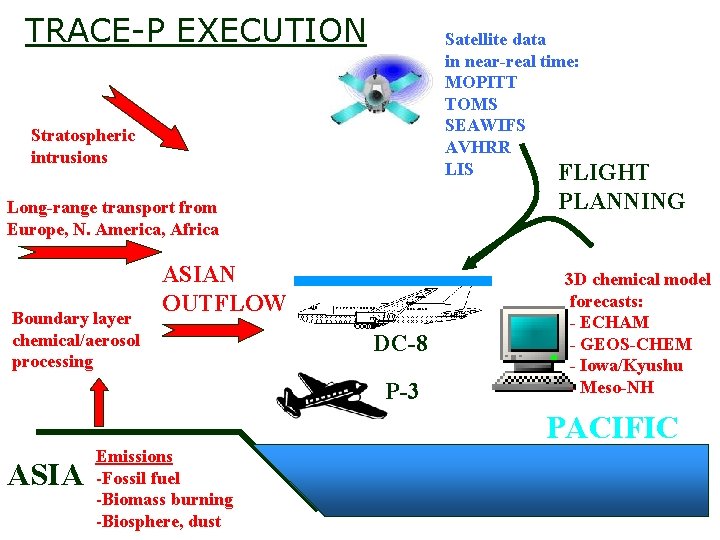
TRACE-P EXECUTION Satellite data in near-real time: MOPITT TOMS SEAWIFS AVHRR LIS FLIGHT Stratospheric intrusions PLANNING Long-range transport from Europe, N. America, Africa Boundary layer chemical/aerosol processing ASIAN OUTFLOW DC-8 P-3 3 D chemical model forecasts: - ECHAM - GEOS-CHEM - Iowa/Kyushu - Meso-NH PACIFIC ASIA Emissions -Fossil fuel -Biomass burning -Biosphere, dust PACIFIC
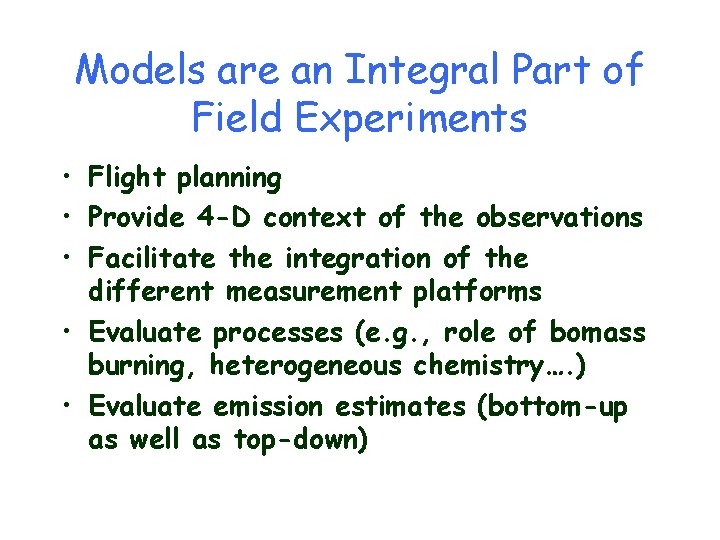
Models are an Integral Part of Field Experiments • Flight planning • Provide 4 -D context of the observations • Facilitate the integration of the different measurement platforms • Evaluate processes (e. g. , role of bomass burning, heterogeneous chemistry…. ) • Evaluate emission estimates (bottom-up as well as top-down)
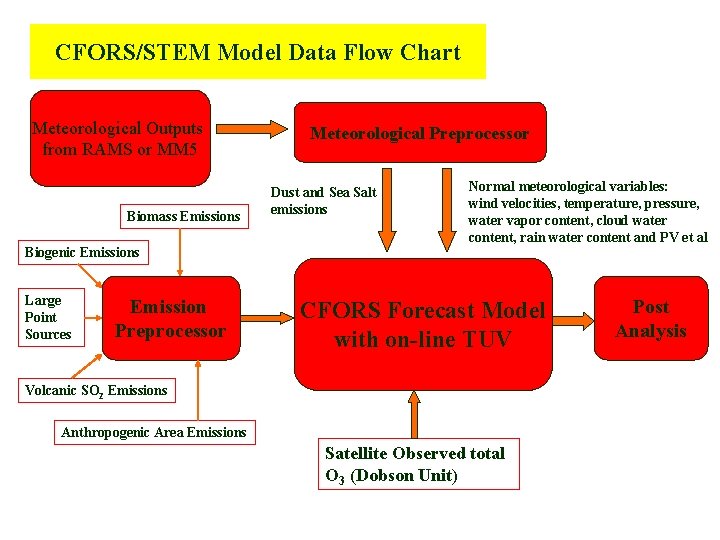
CFORS/STEM Model Data Flow Chart Meteorological Outputs from RAMS or MM 5 Biomass Emissions Meteorological Preprocessor Dust and Sea Salt emissions Normal meteorological variables: wind velocities, temperature, pressure, water vapor content, cloud water content, rain water content and PV et al Biogenic Emissions Large Point Sources Emission Preprocessor CFORS Forecast Model with on-line TUV Volcanic SO 2 Emissions Anthropogenic Area Emissions Satellite Observed total O 3 (Dobson Unit) Post Analysis
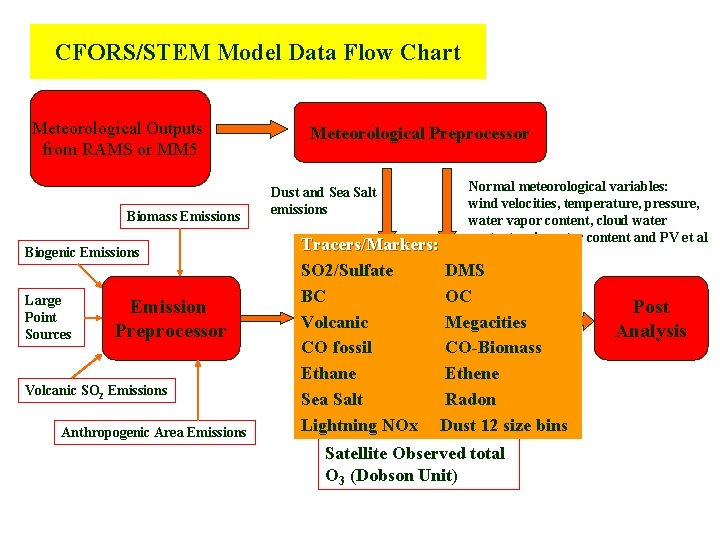
CFORS/STEM Model Data Flow Chart Meteorological Outputs from RAMS or MM 5 Biomass Emissions Biogenic Emissions Large Point Sources Emission Preprocessor Volcanic SO 2 Emissions Anthropogenic Area Emissions Meteorological Preprocessor Dust and Sea Salt emissions Normal meteorological variables: wind velocities, temperature, pressure, water vapor content, cloud water content, rain water content and PV et al Tracers/Markers: SO 2/Sulfate DMS BC OC CFORS Forecast Model Volcanic Megacities with on-line. CO-Biomass TUV CO fossil Ethane Ethene Sea Salt Radon Lightning NOx Dust 12 size bins Satellite Observed total O 3 (Dobson Unit) Post Analysis
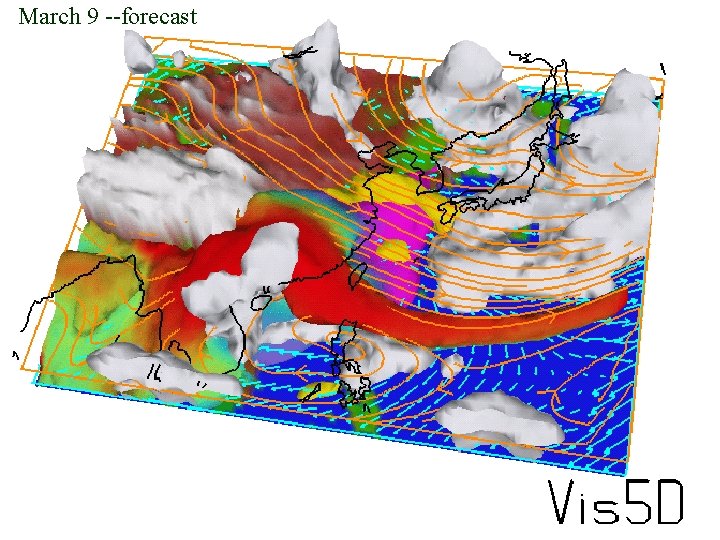
March 9 --forecast 3/9
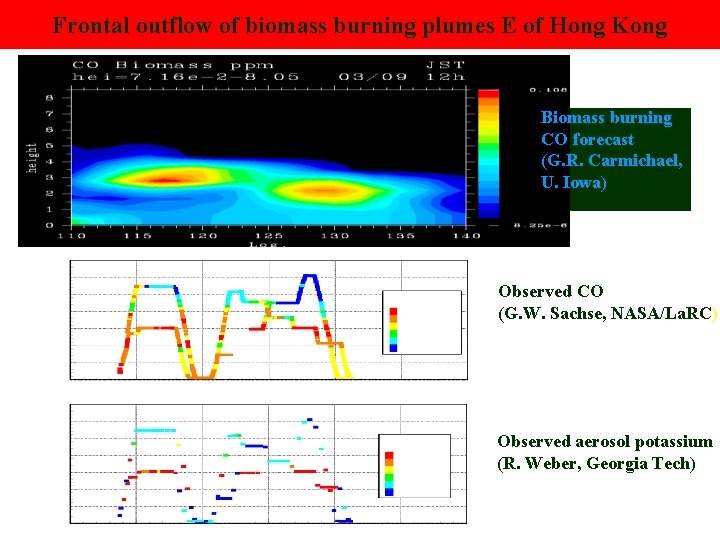
Frontal outflow of biomass burning plumes E of Hong Kong Biomass burning CO forecast (G. R. Carmichael, U. Iowa) Observed CO (G. W. Sachse, NASA/La. RC) Observed aerosol potassium (R. Weber, Georgia Tech)
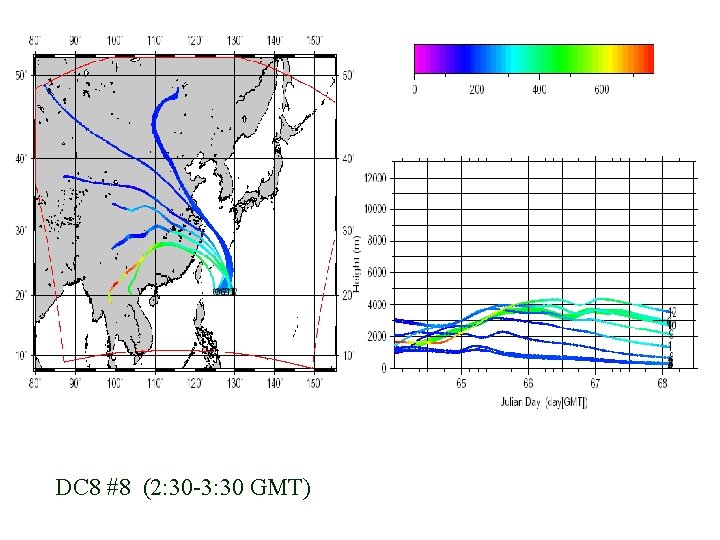
DC 8 #8 (2: 30 -3: 30 GMT)
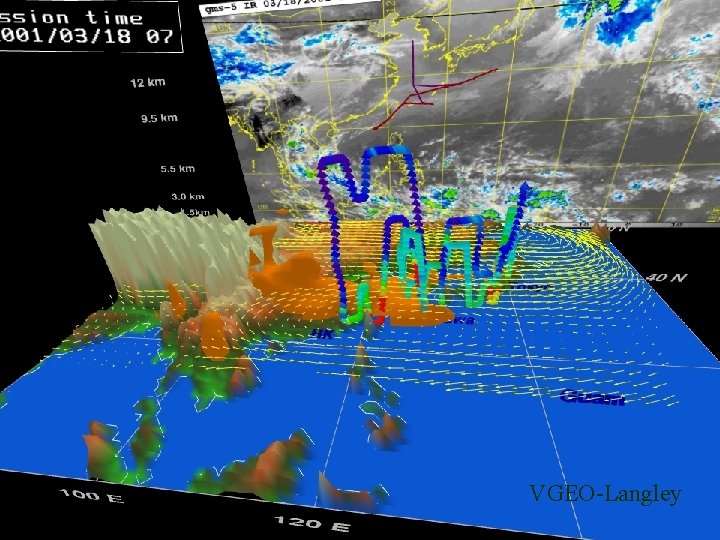
VGEO-Langley
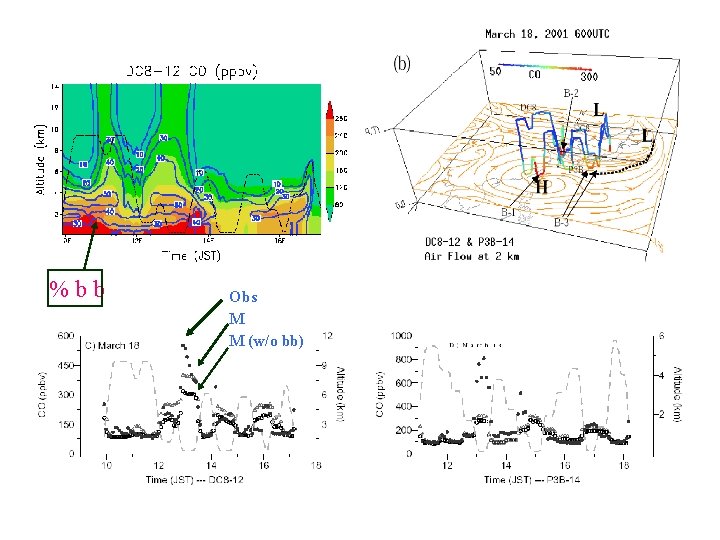
%bb Obs M M (w/o bb)
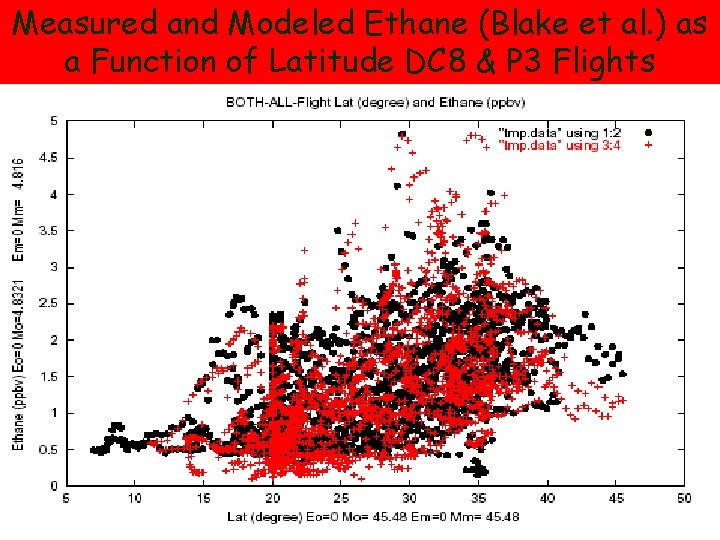
Measured and Modeled Ethane (Blake et al. ) as a Function of Latitude DC 8 & P 3 Flights
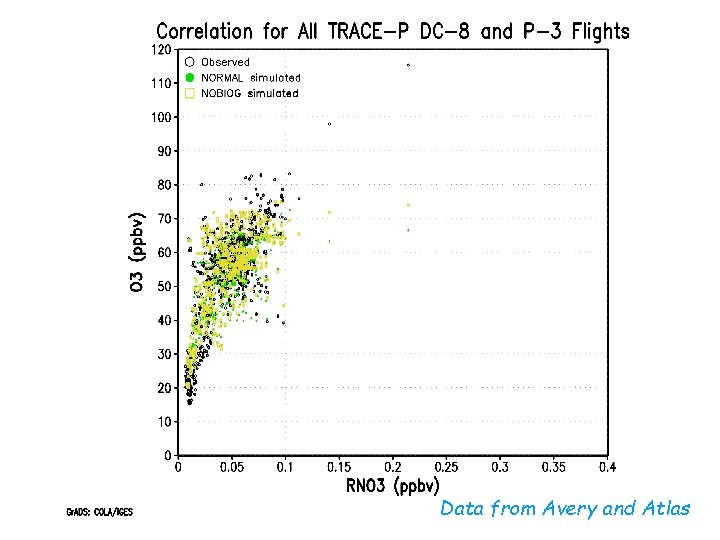
Data from Avery and Atlas
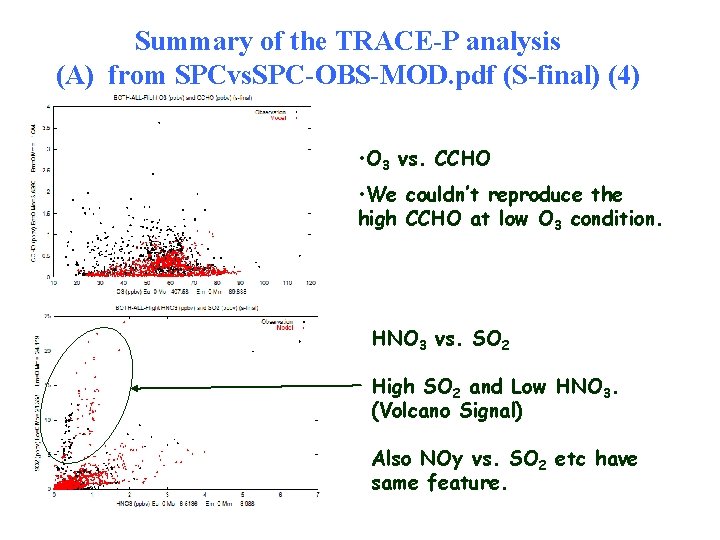
Summary of the TRACE-P analysis (A) from SPCvs. SPC-OBS-MOD. pdf (S-final) (4) • O 3 vs. CCHO • We couldn’t reproduce the high CCHO at low O 3 condition. HNO 3 vs. SO 2 High SO 2 and Low HNO 3. (Volcano Signal) Also NOy vs. SO 2 etc have same feature.
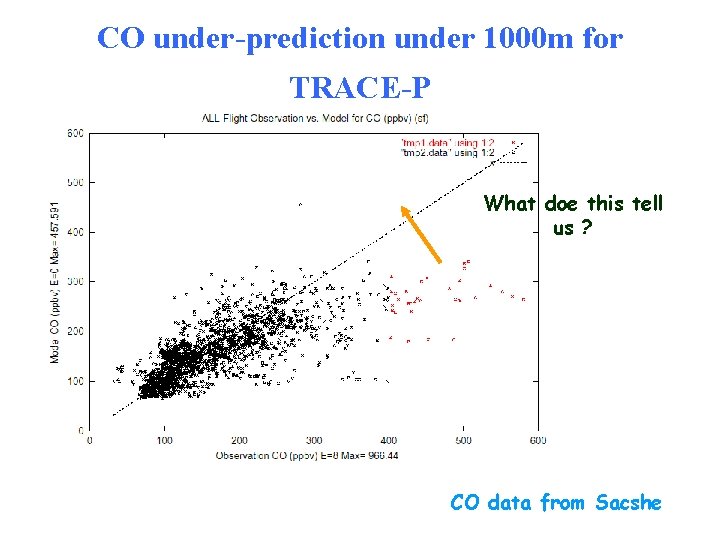
CO under-prediction under 1000 m for TRACE-P What doe this tell us ? CO data from Sacshe
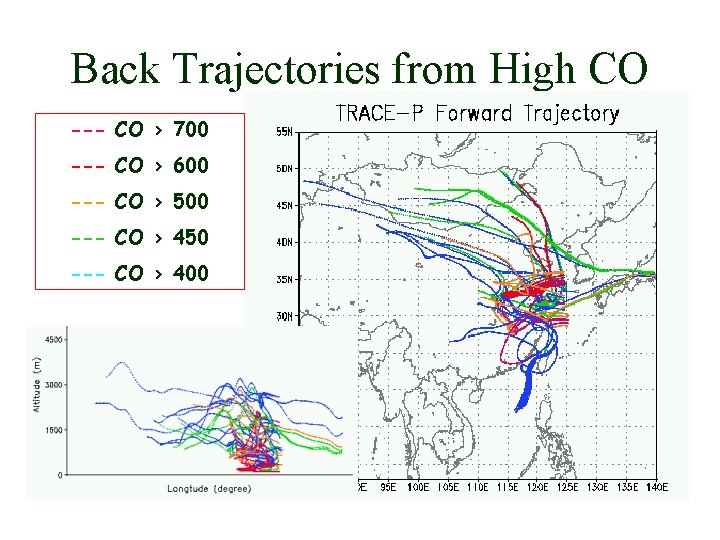
Back Trajectories from High CO point. --- CO > 700 --- CO > 600 --- CO > 500 --- CO > 450 --- CO > 400
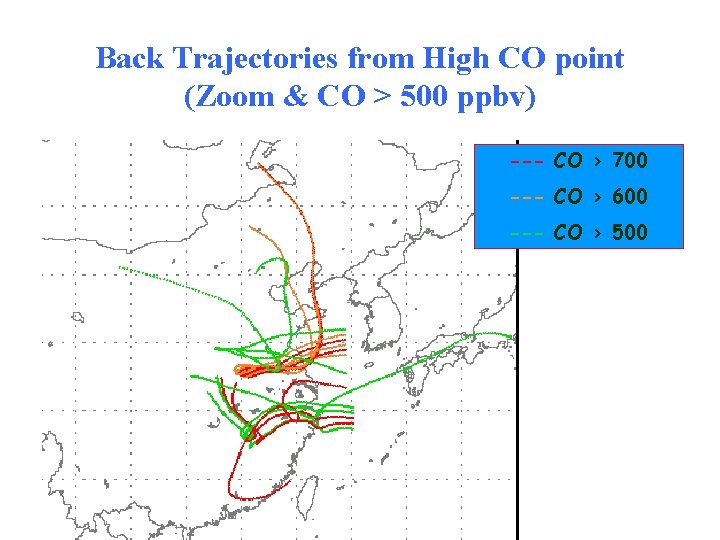
Back Trajectories from High CO point (Zoom & CO > 500 ppbv) --- CO > 700 --- CO > 600 --- CO > 500
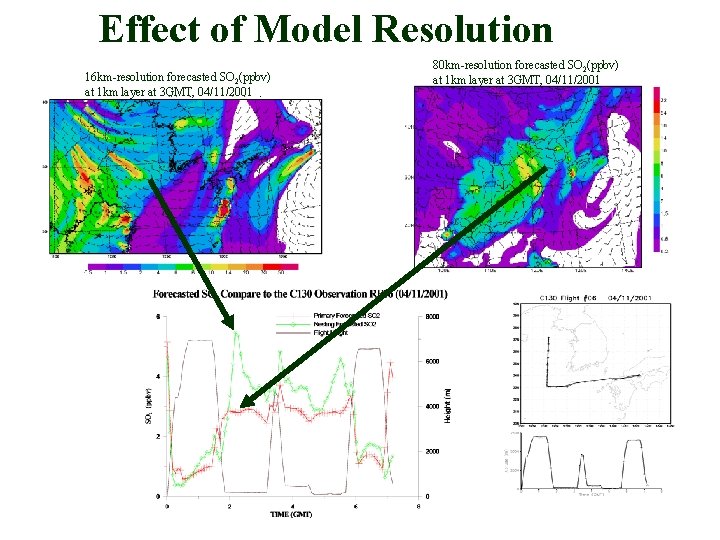
Effect of Model Resolution 16 km-resolution forecasted SO 2(ppbv) at 1 km layer at 3 GMT, 04/11/2001 80 km-resolution forecasted SO 2(ppbv) at 1 km layer at 3 GMT, 04/11/2001
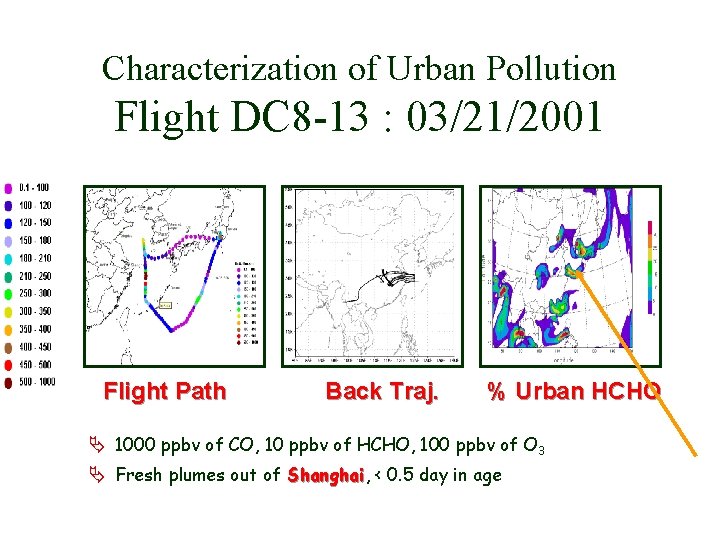
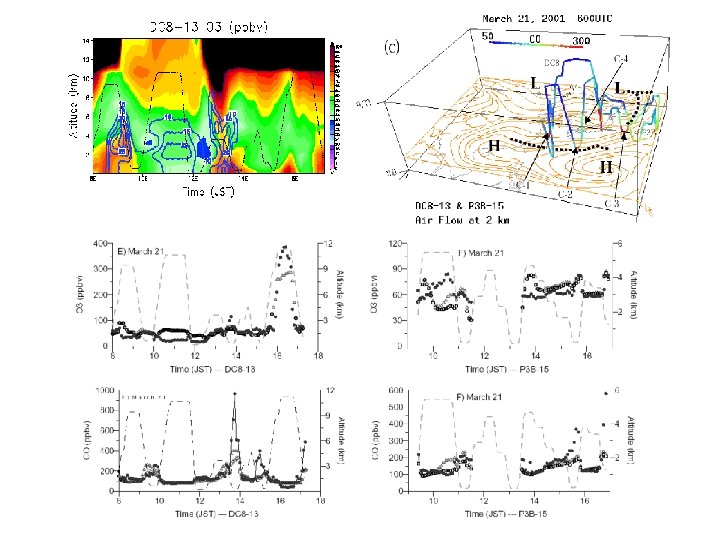
Characterization of Urban Pollution Flight DC 8 -13 : 03/21/2001 Flight Path Back Traj. % Urban HCHO Ä 1000 ppbv of CO, 10 ppbv of HCHO, 100 ppbv of O 3 Ä Fresh plumes out of Shanghai, Shanghai < 0. 5 day in age
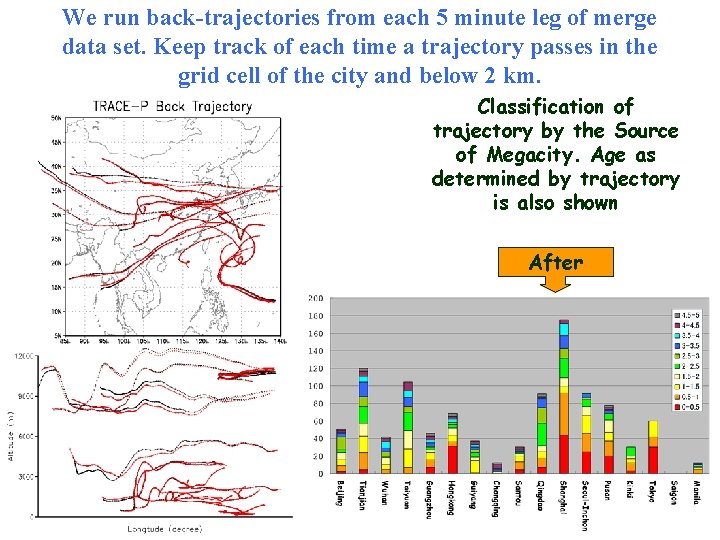
We run back-trajectories from each 5 minute leg of merge data set. Keep track of each time a trajectory passes in the grid cell of the city and below 2 km. Classification of trajectory by the Source of Megacity. Age as determined by trajectory is also shown After Before Big difference !!! We catch more number of fresh airmass from Shanghai and Seoul.
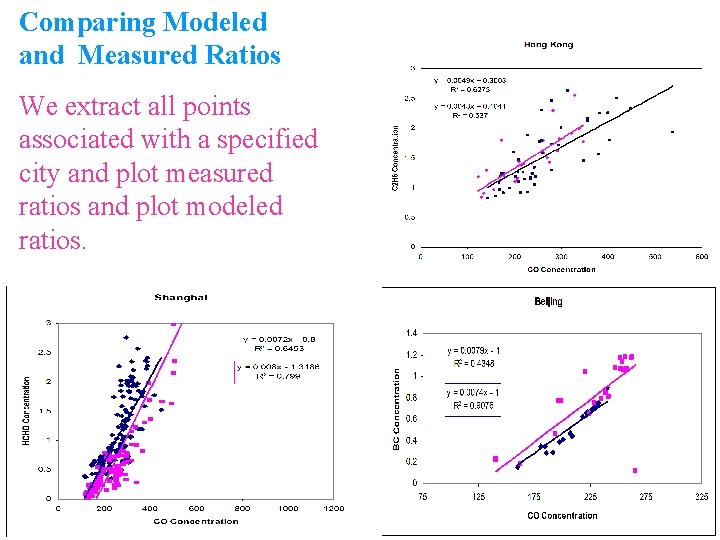
Comparing Modeled and Measured Ratios We extract all points associated with a specified city and plot measured ratios and plot modeled ratios.
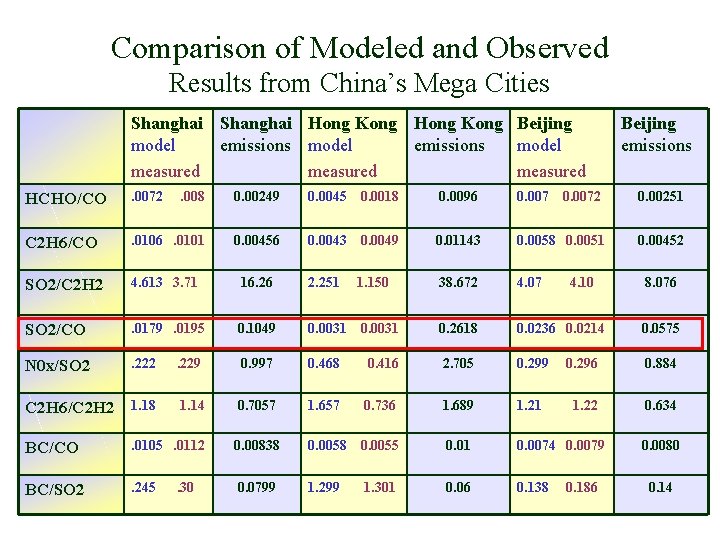
Comparison of Modeled and Observed Results from China’s Mega Cities Shanghai Hong Kong Beijing model emissions model measured Beijing emissions HCHO/CO . 0072 . 008 0. 00249 0. 0045 0. 0018 0. 0096 0. 0072 0. 00251 C 2 H 6/CO . 0106. 0101 0. 00456 0. 0043 0. 0049 0. 01143 0. 0058 0. 0051 0. 00452 SO 2/C 2 H 2 4. 613 3. 71 16. 26 2. 251 38. 672 4. 07 SO 2/CO . 0179. 0195 0. 1049 0. 0031 0. 2618 0. 0236 0. 0214 0. 0575 N 0 x/SO 2 . 229 0. 997 0. 468 0. 416 2. 705 0. 299 0. 296 0. 884 C 2 H 6/C 2 H 2 1. 18 1. 14 0. 7057 1. 657 0. 736 1. 689 1. 21 1. 22 0. 634 BC/CO . 0105. 0112 0. 00838 0. 0055 0. 01 0. 0074 0. 0079 BC/SO 2 . 245 0. 0799 1. 299 0. 06 0. 138 . 30 1. 150 1. 301 4. 10 0. 186 8. 076 0. 0080 0. 14
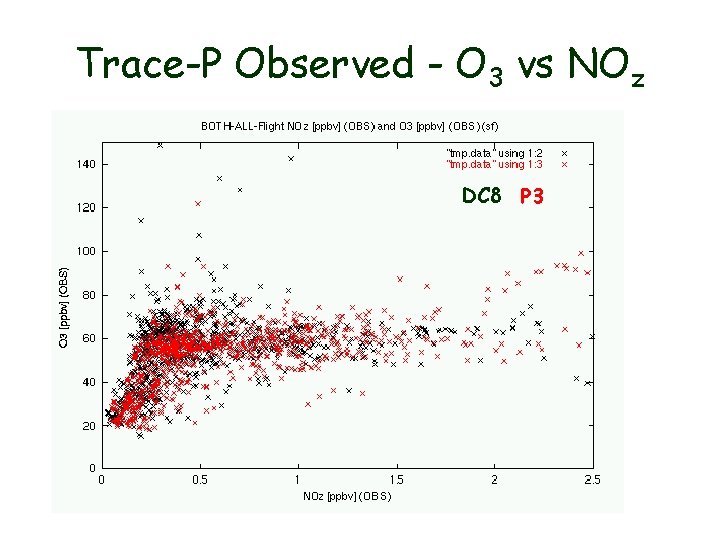
Trace-P Observed - O 3 vs NOz DC 8 P 3
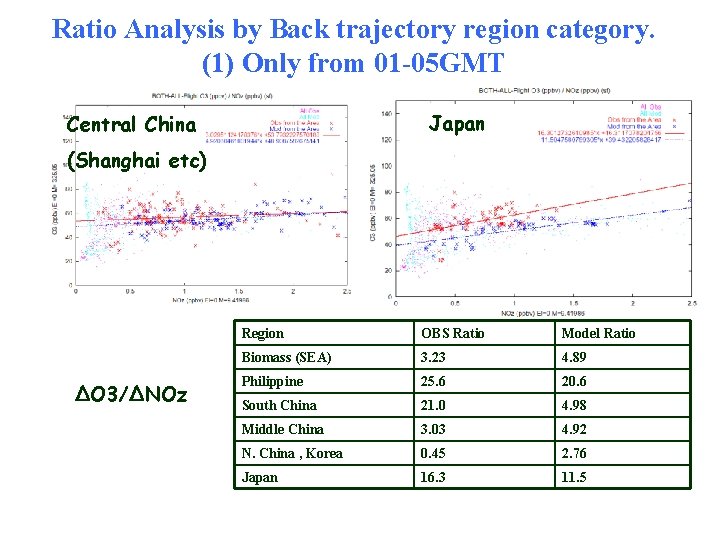
Ratio Analysis by Back trajectory region category. (1) Only from 01 -05 GMT Japan Central China (Shanghai etc) ΔO 3/ΔNOz Region OBS Ratio Model Ratio Biomass (SEA) 3. 23 4. 89 Philippine 25. 6 20. 6 South China 21. 0 4. 98 Middle China 3. 03 4. 92 N. China , Korea 0. 45 2. 76 Japan 16. 3 11. 5
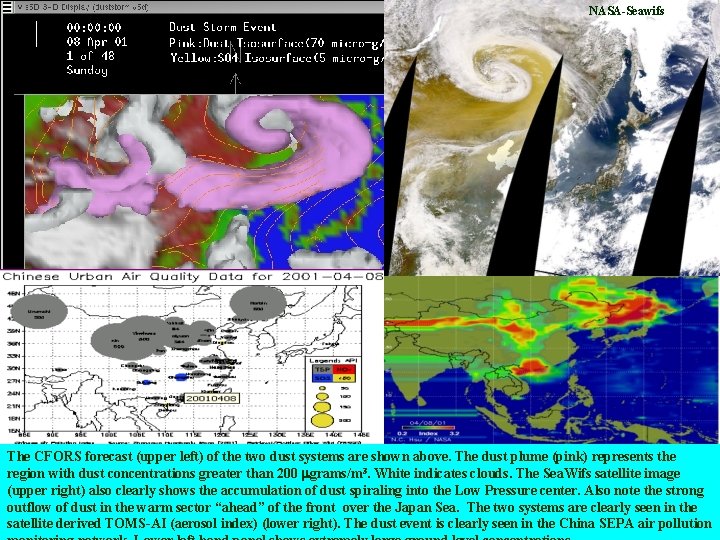
NASA-Seawifs The CFORS forecast (upper left) of the two dust systems are shown above. The dust plume (pink) represents the region with dust concentrations greater than 200 mgrams/m 3. White indicates clouds. The Sea. Wifs satellite image (upper right) also clearly shows the accumulation of dust spiraling into the Low Pressure center. Also note the strong outflow of dust in the warm sector “ahead” of the front over the Japan Sea. The two systems are clearly seen in the satellite derived TOMS-AI (aerosol index) (lower right). The dust event is clearly seen in the China SEPA air pollution
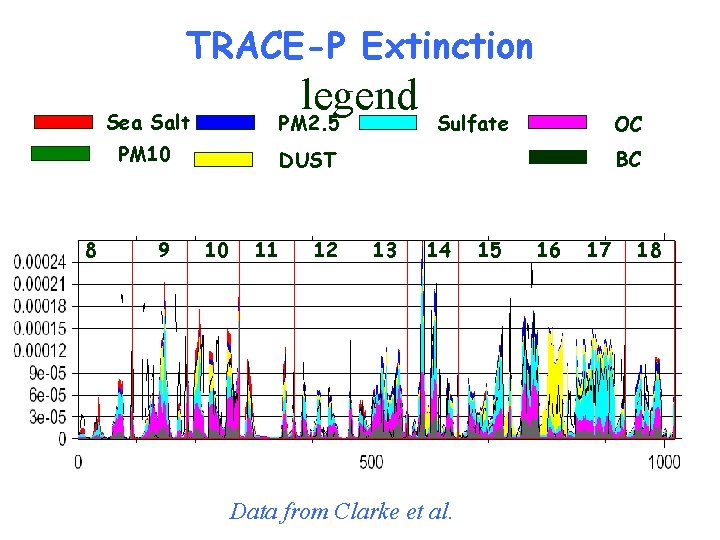
TRACE-P Extinction legend PM 2. 5 Sea Salt PM 10 8 9 Sulfate OC BC DUST 10 11 12 13 14 Data from Clarke et al. 15 16 17 18
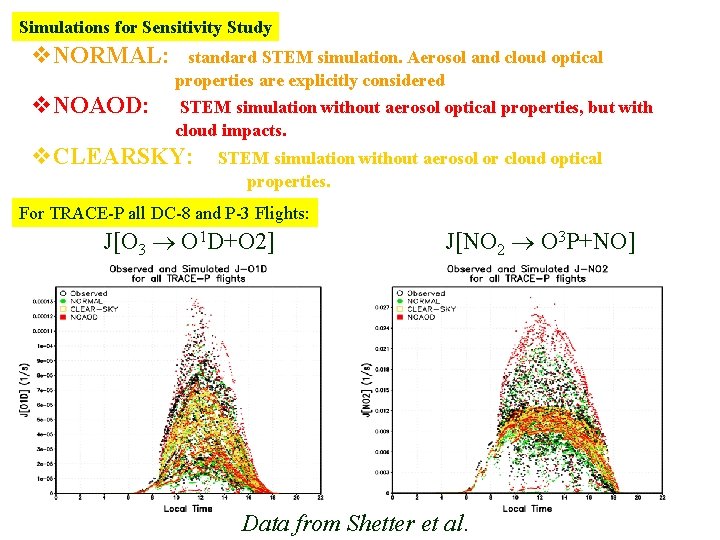
Simulations for Sensitivity Study v. NORMAL: standard STEM simulation. Aerosol and cloud optical properties are explicitly considered v. NOAOD: STEM simulation without aerosol optical properties, but with cloud impacts. v. CLEARSKY: STEM simulation without aerosol or cloud optical properties. For TRACE-P all DC-8 and P-3 Flights: J[O 3 O 1 D+O 2] J[NO 2 O 3 P+NO] Data from Shetter et al.
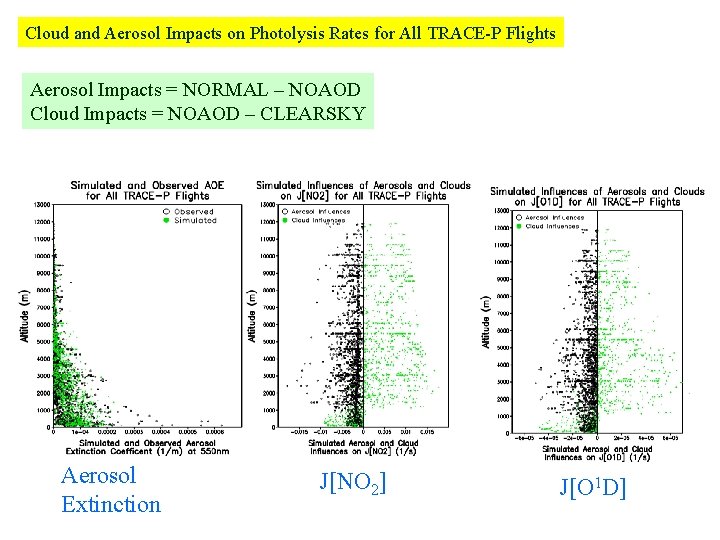
Cloud and Aerosol Impacts on Photolysis Rates for All TRACE-P Flights Aerosol Impacts = NORMAL – NOAOD Cloud Impacts = NOAOD – CLEARSKY Aerosol Extinction J[NO 2] J[O 1 D]
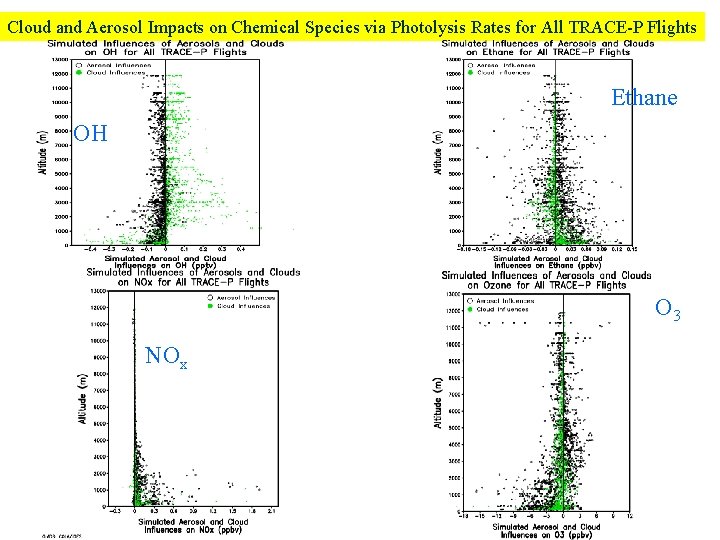
Cloud and Aerosol Impacts on Chemical Species via Photolysis Rates for All TRACE-P Flights Ethane OH O 3 NOx
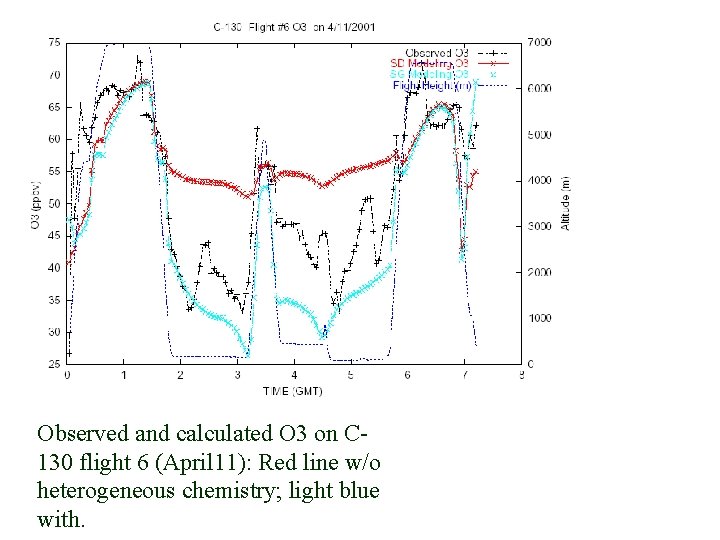
Observed and calculated O 3 on C 130 flight 6 (April 11): Red line w/o heterogeneous chemistry; light blue with.
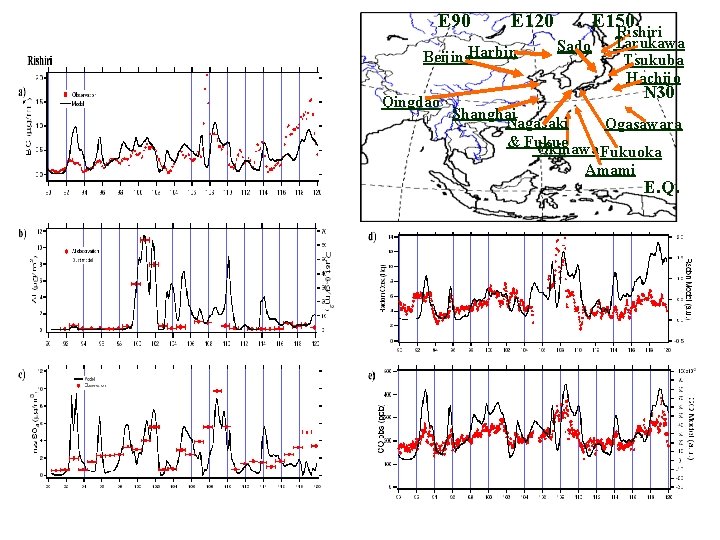
Rishiri 227 1 21. 2 Height[km] DUST[μg/m 3] Lev =10, 30, 60, 90, 120, 150, 180, 210 10 8 6 4 2 0 Qingdao OC[μg/m 3 Lev ] =0. 1, 0. 4, 0. 8, 1. 2, 1. 6, 2. 0, 2. 4, 2. 8, 3. 2 0. 1 8 6 4 2 0 3. 48 Height[km] 1. 15 :BC+OC :Sulfate AOD E 150 Rishiri Sado Tarukawa Tsukuba Hachijo N 30 Shanghai Nagasaki Ogasawara & Fukue Okinawa. Fukuoka Amami E. Q. 3] =0. 1, 0. 24, 0. 36, 0. 48, 0. 6, 0. 72, 0. 84, 0. 96, 1. 08 Lev BC[μg/m 0. 1 8 6 4 2 0 APRIL E 120 Beijing. Harbin Height[km] SO 4 [μg/m 3] Lev =1, 3, 6, 9, 12, 15, 18, 21 8 6 4 2 0 E 90 :DUST :Sea salt
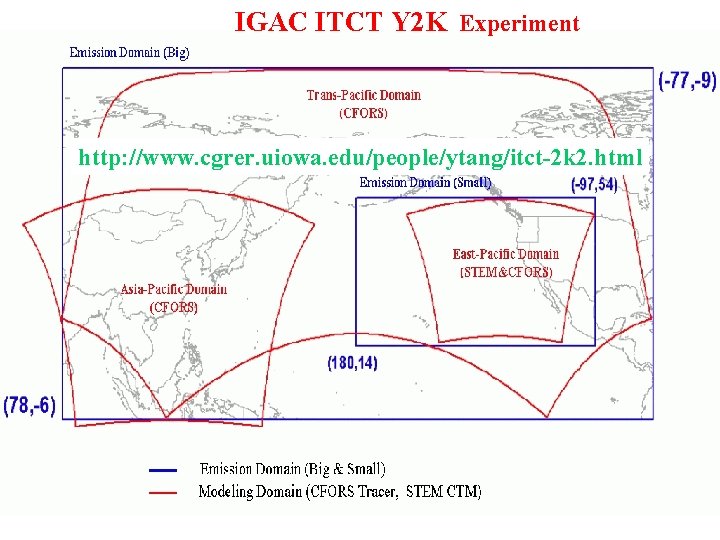
IGAC ITCT Y 2 K Experiment http: //www. cgrer. uiowa. edu/people/ytang/itct-2 k 2. html
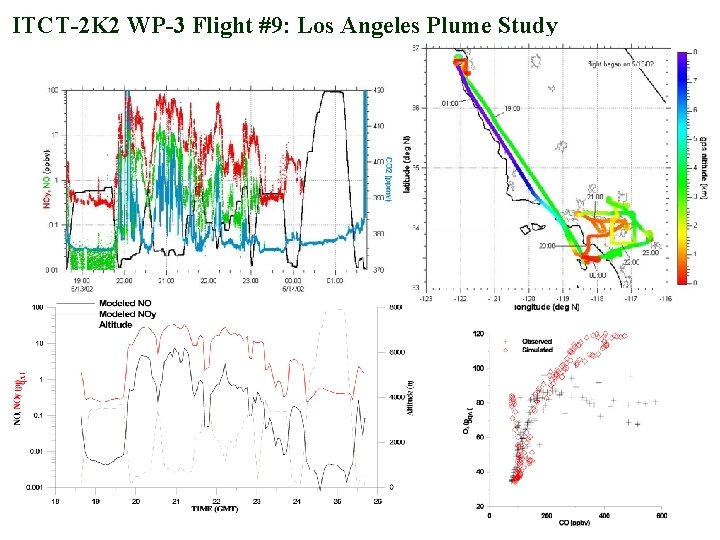
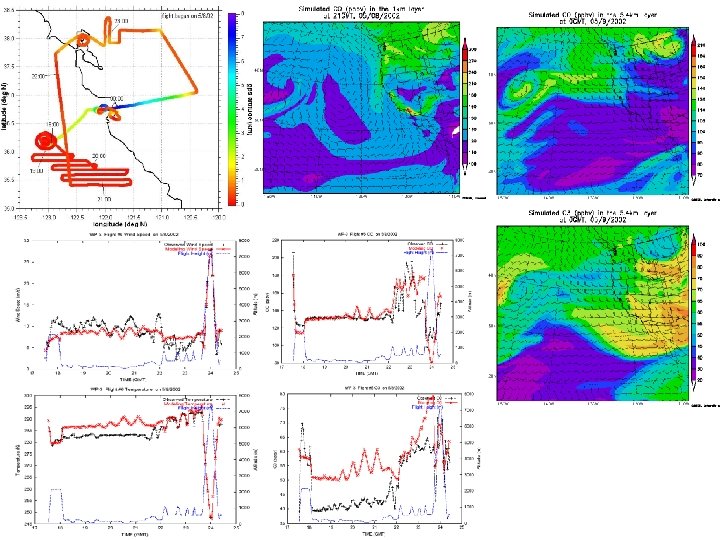
ITCT-2 K 2 WP-3 Flight #9: Los Angeles Plume Study
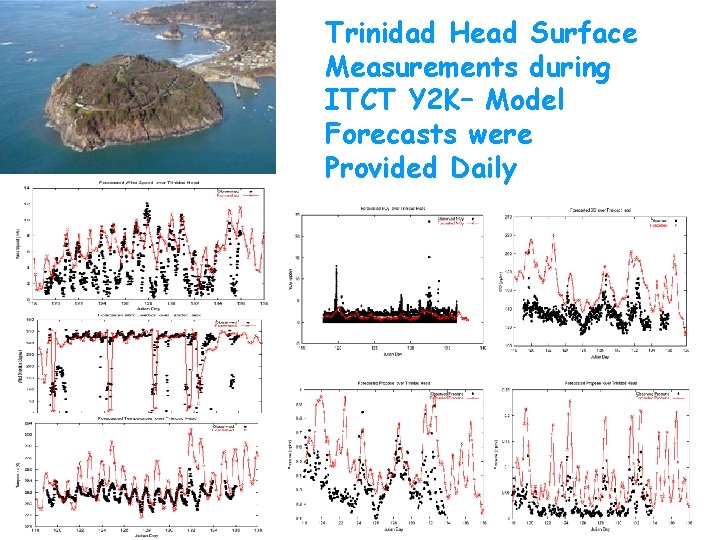
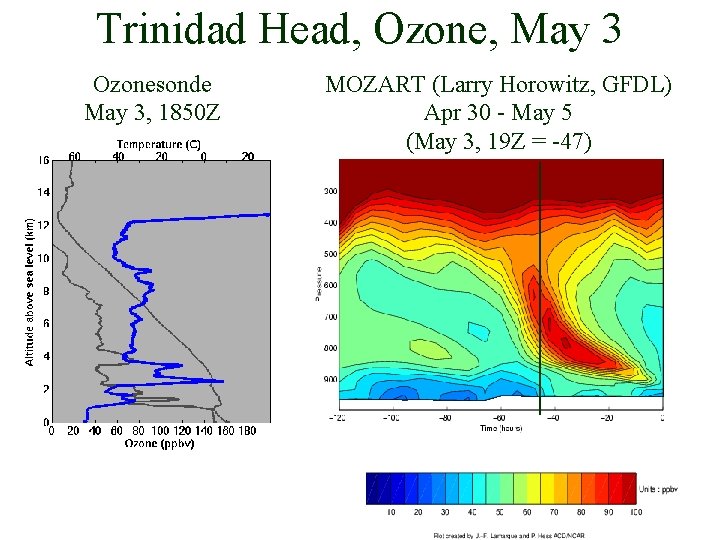
Trinidad Head Surface Measurements during ITCT Y 2 K– Model Forecasts were Provided Daily
Trinidad Head, Ozone, May 3 Ozonesonde May 3, 1850 Z MOZART (Larry Horowitz, GFDL) Apr 30 - May 5 (May 3, 19 Z = -47)
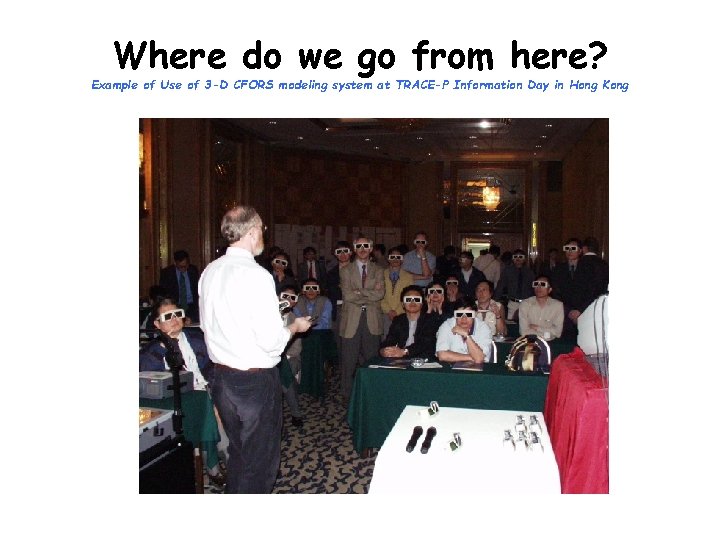
Where do we go from here? Example of Use of 3 -D CFORS modeling system at TRACE-P Information Day in Hong Kong
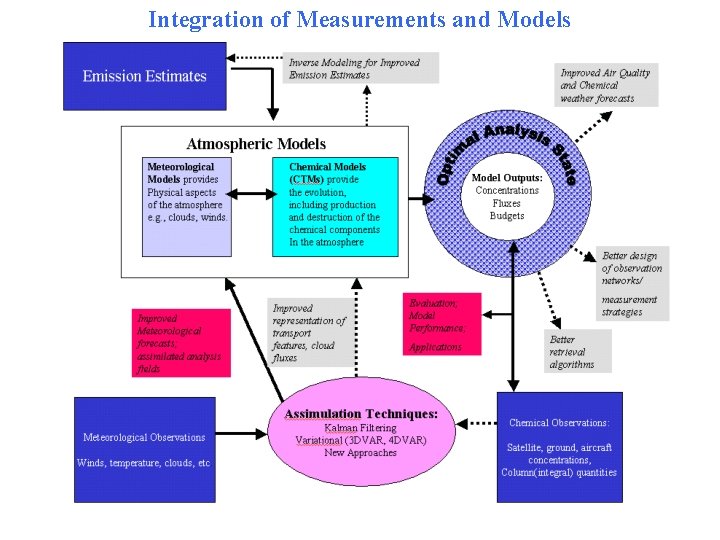
Goal: Better Integration of Measurements and Model Products • More evolvement of models in the design of the experiments • Data assimilation • What are the most useful forecast products? • More “sophisticated” use of measurements and models – e. g. , aerosol issues. • Better coupling between global and regional models • Measurers and modelers need to work even more closely as collaborators • With a goal of developing optimally merged data sets.
U. Iowa/Kyushu/Argonne/GFDL With support from NSF, NASA (ACMAP, GTE), NOAA, DOE
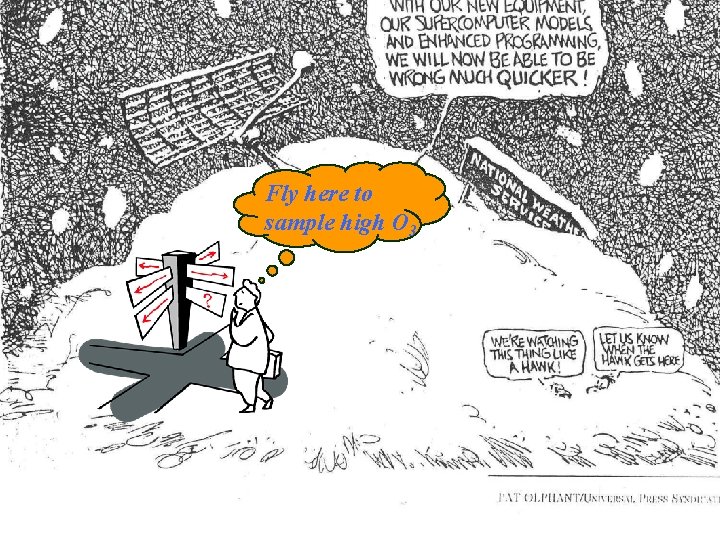
Fly here to sample high O 3
Integration of Measurements and Models
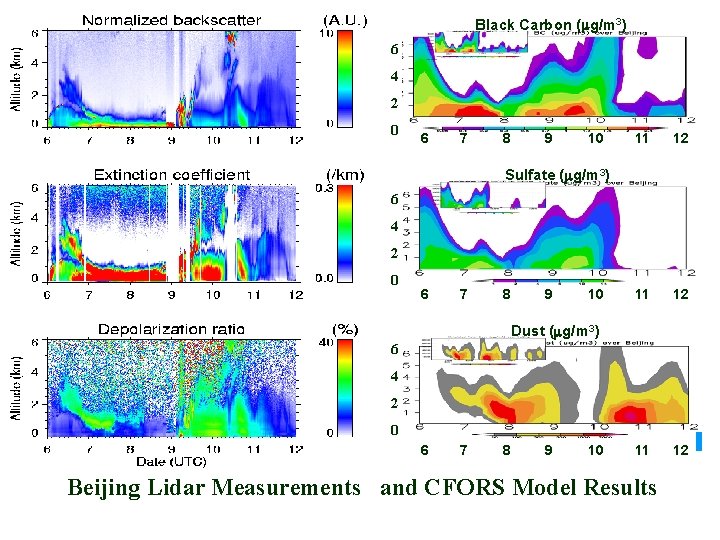
Black Carbon (mg/m 3) 6 4 2 0 6 7 8 9 10 11 12 Sulfate (mg/m 3) 6 4 2 0 6 7 8 9 10 Dust (mg/m 3) 6 4 2 0 6 7 8 9 10 Beijing Lidar Measurements and CFORS Model Results
E 90 E 120 Beijing. Harbin Qingdao E 150 Sado Rishiri Tarukawa Tsukuba Hachijo N 30 Shanghai Nagasaki Ogasawara & Fukue Okinawa Fukuoka Amami E. Q.