
Receiver Systems Alex Dunning The Basic Structure of
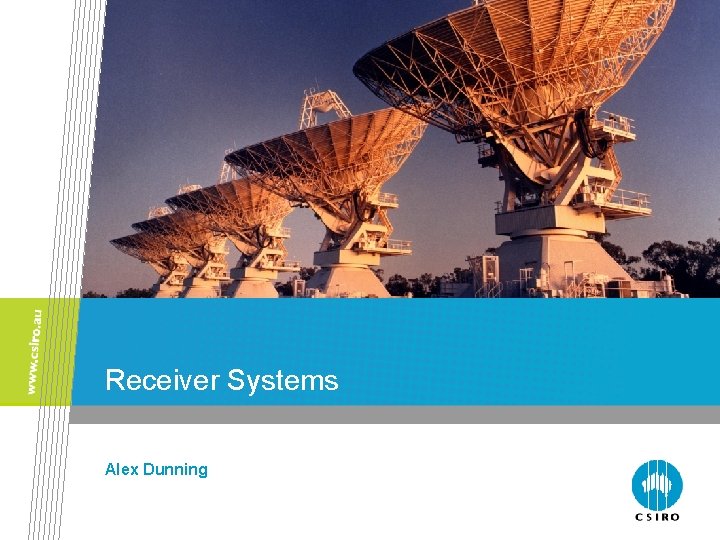
Receiver Systems Alex Dunning

The Basic Structure of a typical Radio Telescope CSIRO. Receiver Systems for Radio Astronomy Receiver Captures and amplifies the incoming radiation Conversion Filters and reduces the frequency of the microwave signal Digitiser Converts the analog signal to a digital bit stream Signal Processing / Correlator Divides signal into frequency bins and forms correlation products between signals
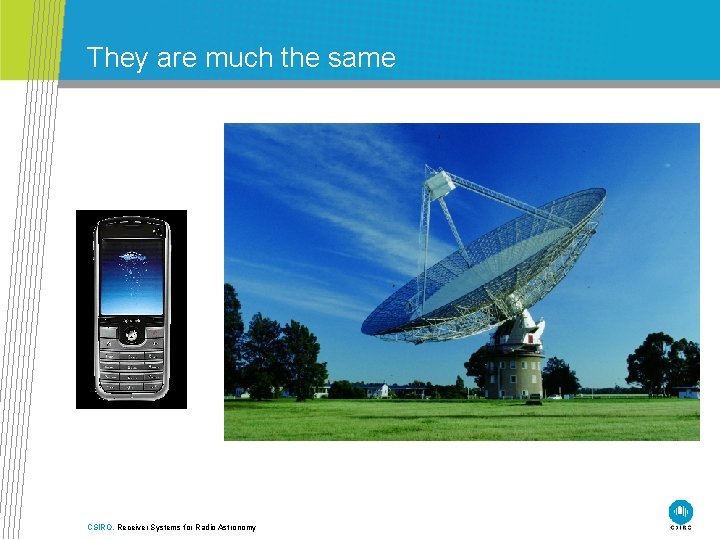
They are much the same CSIRO. Receiver Systems for Radio Astronomy
Radiotelescope Receivers CSIRO. Receiver Systems for Radio Astronomy
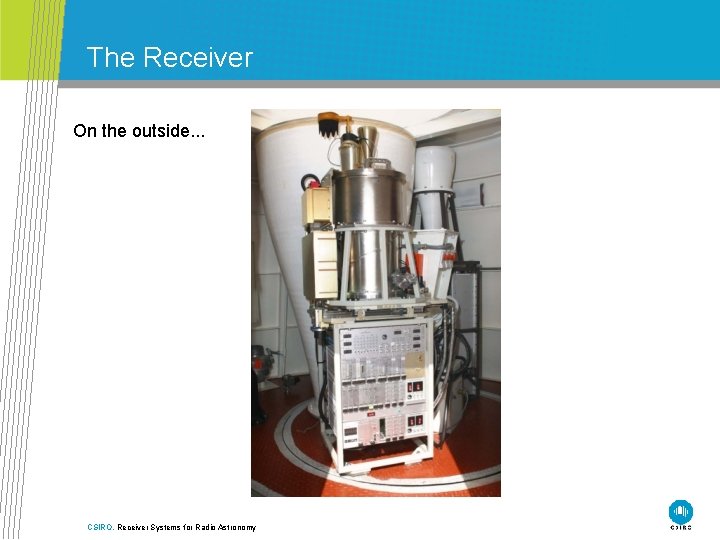
The Receiver On the outside. . . CSIRO. Receiver Systems for Radio Astronomy
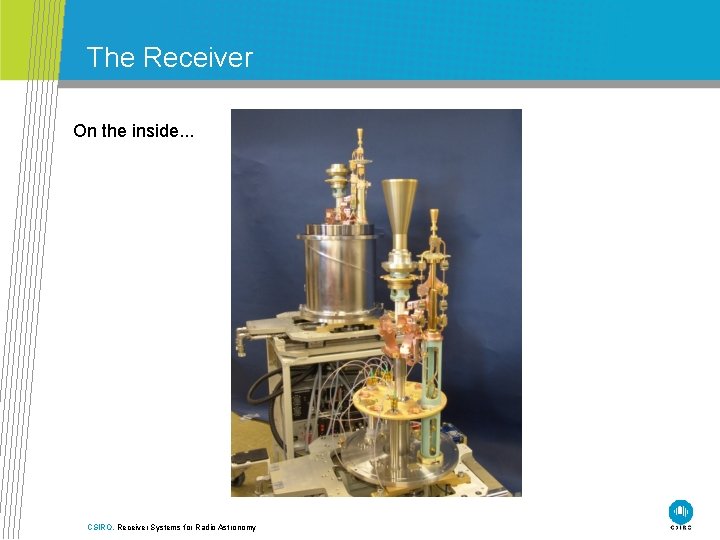
The Receiver On the inside. . . CSIRO. Receiver Systems for Radio Astronomy
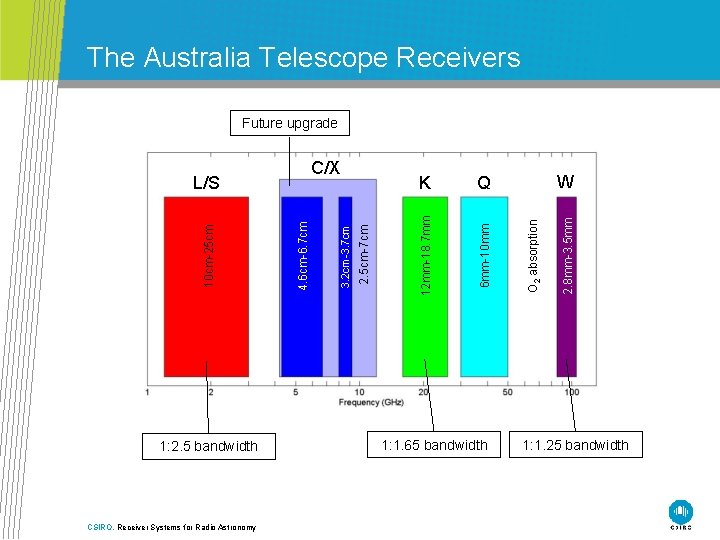
The Australia Telescope Receivers 1: 2. 5 bandwidth CSIRO. Receiver Systems for Radio Astronomy 1: 1. 65 bandwidth W 2. 8 mm-3. 5 mm Q O 2 absorption K 6 mm-10 mm 2. 5 cm-7 cm 4. 6 cm-6. 7 cm 10 cm-25 cm L/S 3. 2 cm-3. 7 cm C/X 12 mm-18. 7 mm Future upgrade 1: 1. 25 bandwidth

Where do they go? CSIRO. Receiver Systems for Radio Astronomy
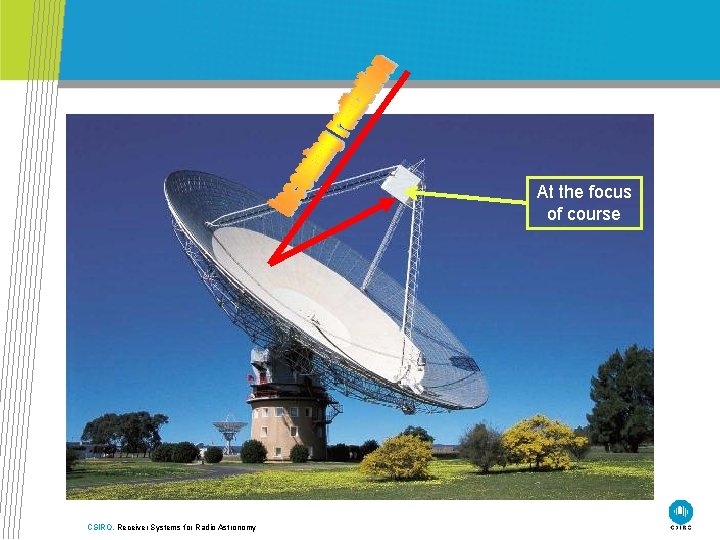
At the focus of course CSIRO. Receiver Systems for Radio Astronomy
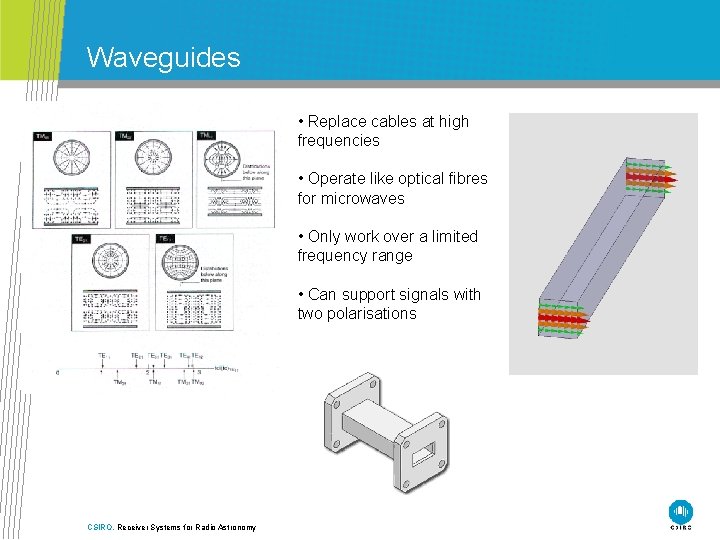
Waveguides • Replace cables at high frequencies • Operate like optical fibres for microwaves • Only work over a limited frequency range • Can support signals with two polarisations CSIRO. Receiver Systems for Radio Astronomy
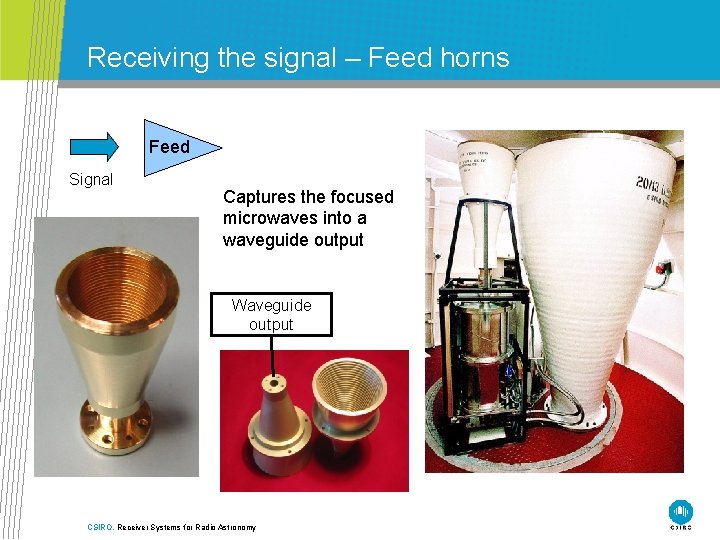
Receiving the signal – Feed horns Feed Signal Captures the focused microwaves into a waveguide output Waveguide output CSIRO. Receiver Systems for Radio Astronomy
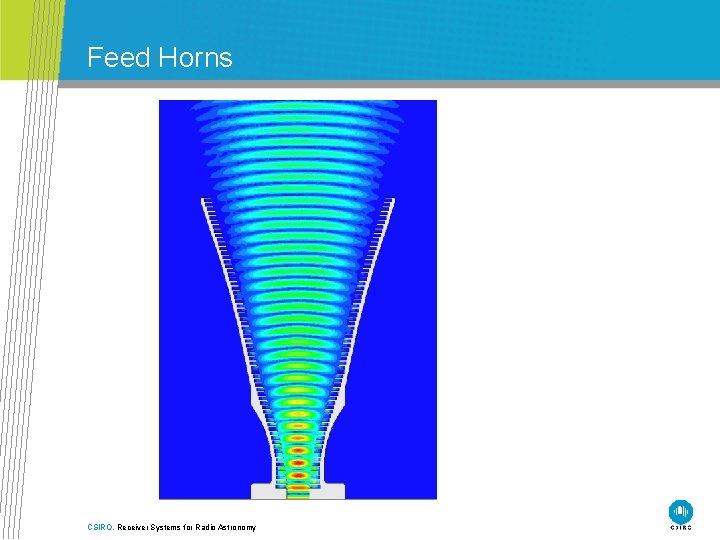
Feed Horns CSIRO. Receiver Systems for Radio Astronomy
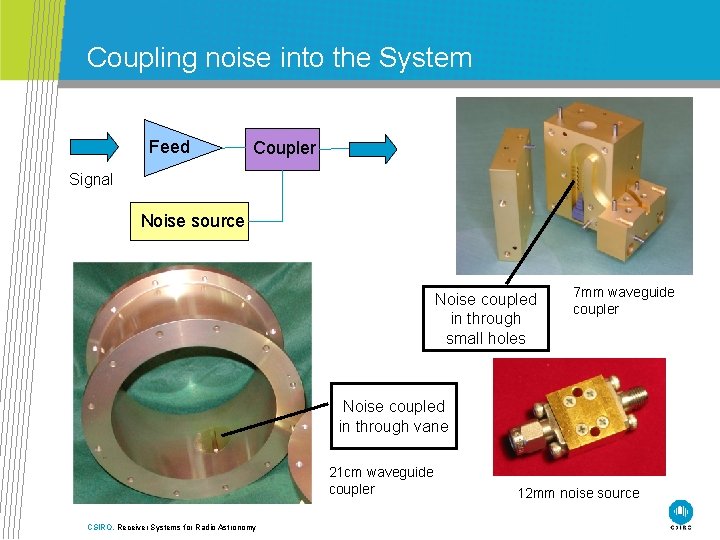
Coupling noise into the System Feed Coupler Signal Noise source Noise coupled in through small holes 7 mm waveguide coupler Noise coupled in through vane 21 cm waveguide coupler CSIRO. Receiver Systems for Radio Astronomy 12 mm noise source
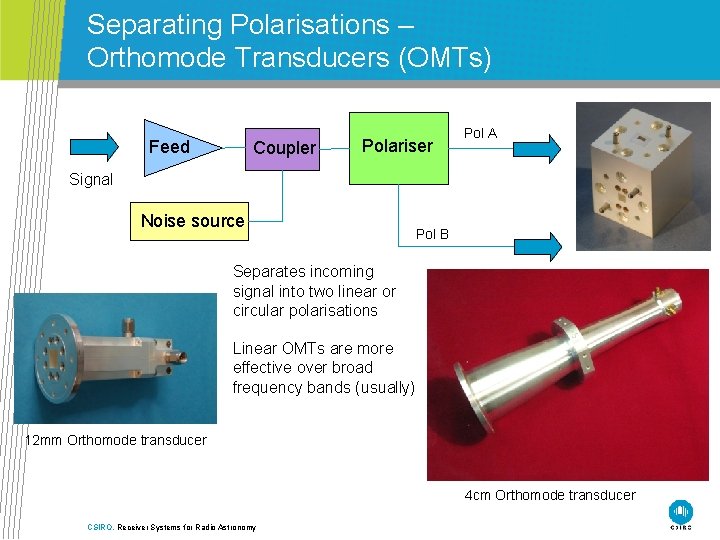
Separating Polarisations – Orthomode Transducers (OMTs) Feed Coupler Polariser Pol A Signal Noise source Pol B Separates incoming signal into two linear or circular polarisations Linear OMTs are more effective over broad frequency bands (usually) 12 mm Orthomode transducer 4 cm Orthomode transducer CSIRO. Receiver Systems for Radio Astronomy
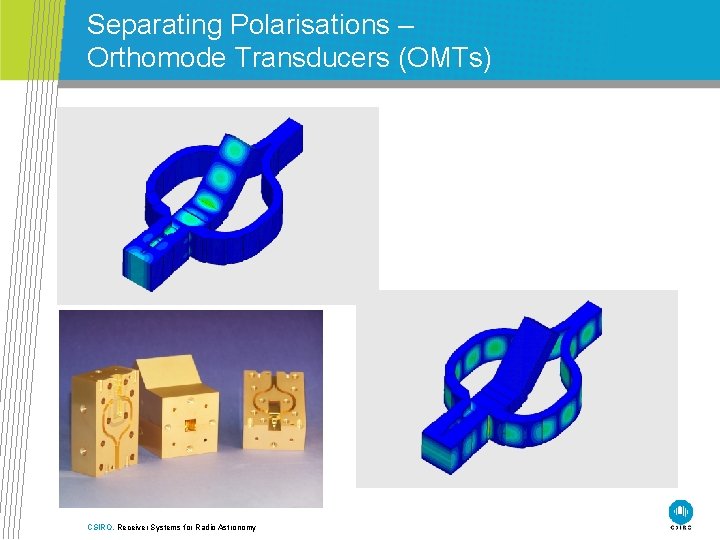
Separating Polarisations – Orthomode Transducers (OMTs) CSIRO. Receiver Systems for Radio Astronomy
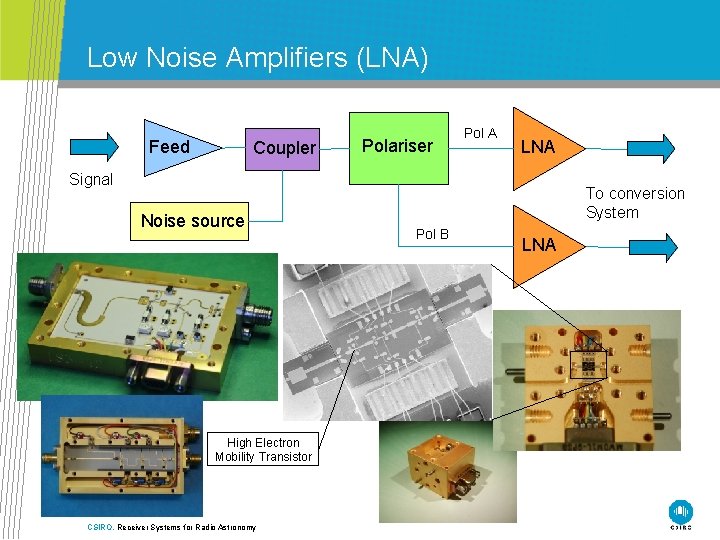
Low Noise Amplifiers (LNA) Feed Coupler Polariser Pol A LNA Signal Noise source High Electron Mobility Transistor CSIRO. Receiver Systems for Radio Astronomy To conversion System Pol B LNA
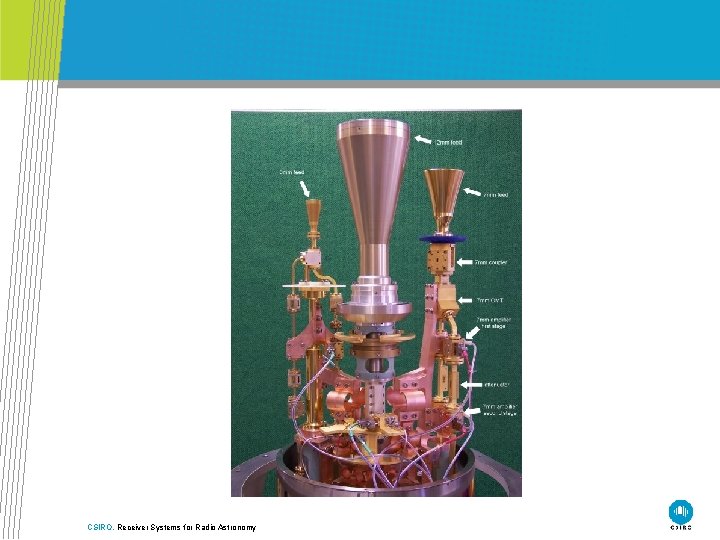
…. so though receiver topologies can be quite varied I am saying that this is a pretty typical structure of our receivers …………and the 3/7/12 mm systems reflect this. CSIRO. Receiver Systems for Radio Astronomy
CSIRO. Receiver Systems for Radio Astronomy
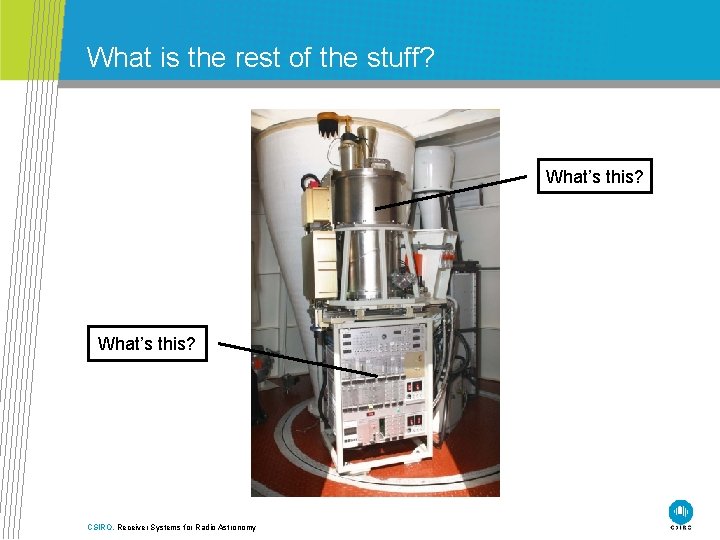
What is the rest of the stuff? What’s this? CSIRO. Receiver Systems for Radio Astronomy
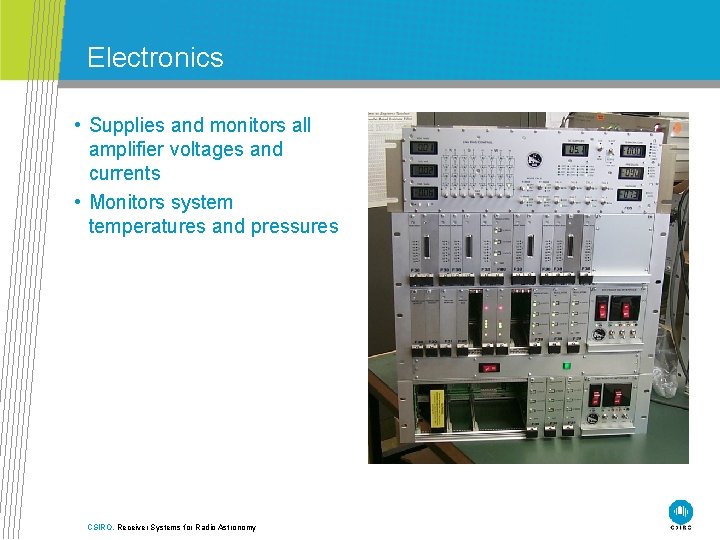
Electronics • Supplies and monitors all amplifier voltages and currents • Monitors system temperatures and pressures CSIRO. Receiver Systems for Radio Astronomy
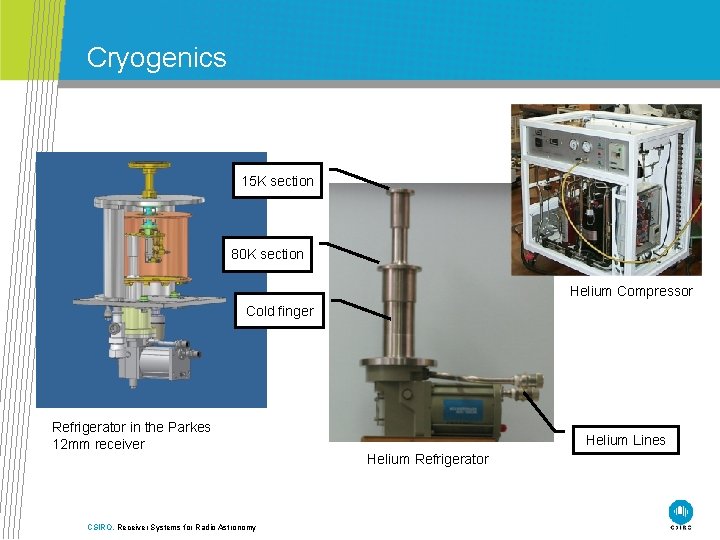
Cryogenics 15 K section 80 K section Helium Compressor Cold finger Refrigerator in the Parkes 12 mm receiver CSIRO. Receiver Systems for Radio Astronomy Helium Lines Helium Refrigerator
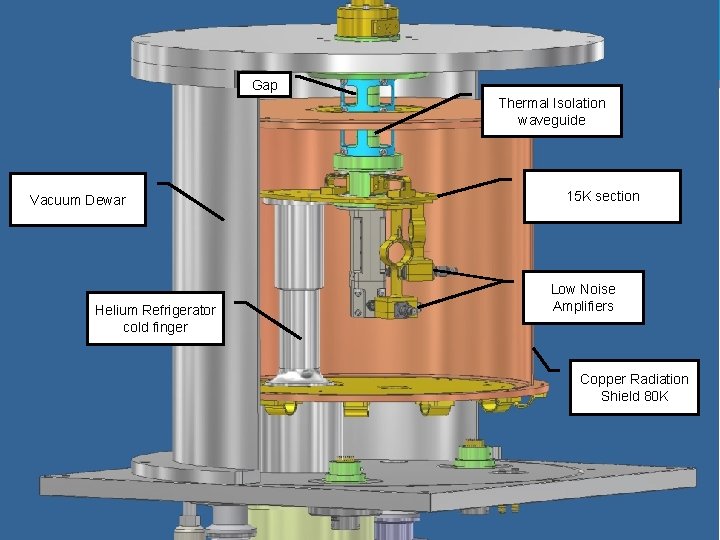
Gap Thermal Isolation waveguide Vacuum Dewar Helium Refrigerator cold finger 15 K section Low Noise Amplifiers Copper Radiation Shield 80 K CSIRO. Receiver Systems for Radio Astronomy

…. but why do we need to cool our receivers at all? …………well first CSIRO. Receiver Systems for Radio Astronomy
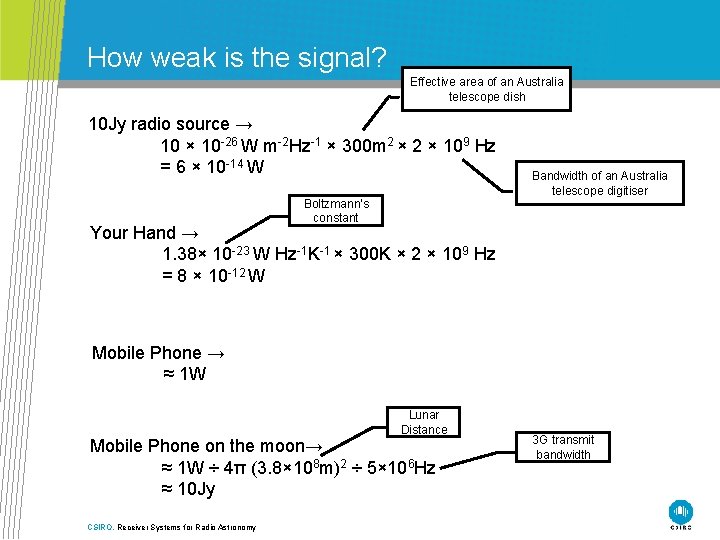
How weak is the signal? Effective area of an Australia telescope dish 10 Jy radio source → 10 × 10 -26 W m-2 Hz-1 × 300 m 2 × 10⁹ Hz = 6 × 10 -14 W Boltzmann's constant Bandwidth of an Australia telescope digitiser Your Hand → 1. 38× 10 -23 W Hz-1 K-1 × 300 K × 2 × 109 Hz = 8 × 10 -12 W Mobile Phone → ≈ 1 W Lunar Distance Mobile Phone on the moon→ ≈ 1 W ÷ 4π (3. 8× 10⁸ m)2 ÷ 5× 10⁶ Hz ≈ 10 Jy CSIRO. Receiver Systems for Radio Astronomy 3 G transmit bandwidth
Like your hand all the components in the receiver system contribute a thermal noise signal which masks the astronomical signal we are trying to observe By cooling the receiver we reduce these thermal sources of noise and improve the sensitivity of the receiver by 7 -10 times CSIRO. Receiver Systems for Radio Astronomy
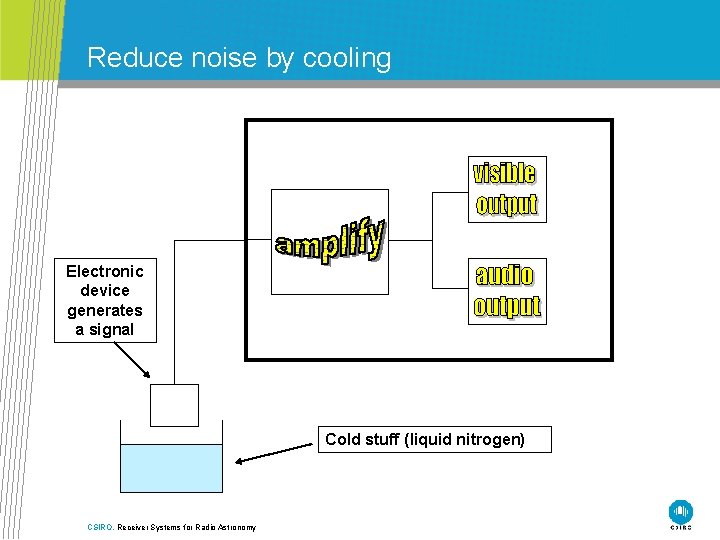
Reduce noise by cooling Electronic device generates a signal Cold stuff (liquid nitrogen) CSIRO. Receiver Systems for Radio Astronomy
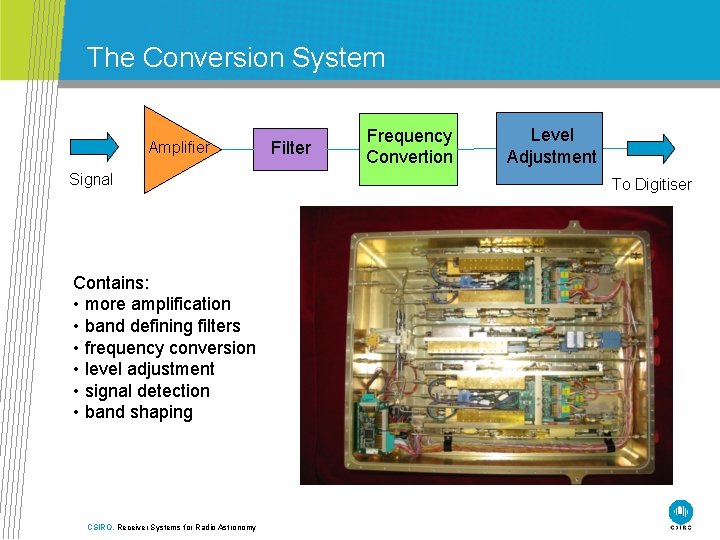
The Conversion System Amplifier Signal Contains: • more amplification • band defining filters • frequency conversion • level adjustment • signal detection • band shaping CSIRO. Receiver Systems for Radio Astronomy Filter Frequency Convertion Level Adjustment To Digitiser
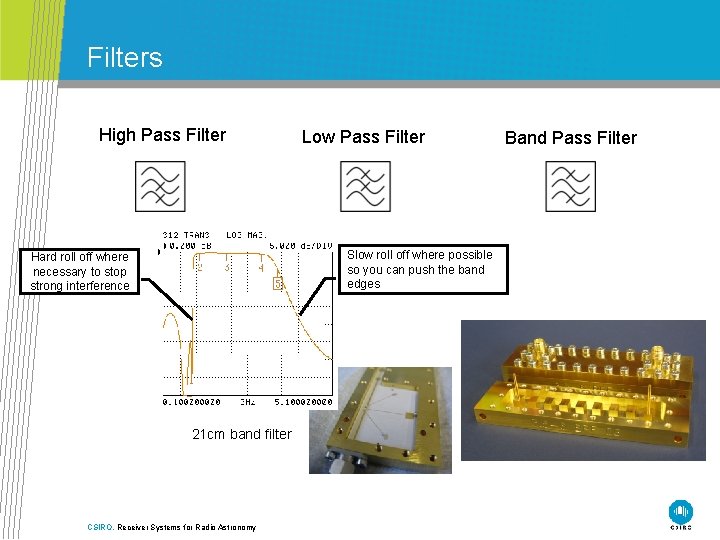
Filters High Pass Filter Low Pass Filter Slow roll off where possible so you can push the band edges Hard roll off where necessary to stop strong interference 21 cm band filter CSIRO. Receiver Systems for Radio Astronomy Band Pass Filter
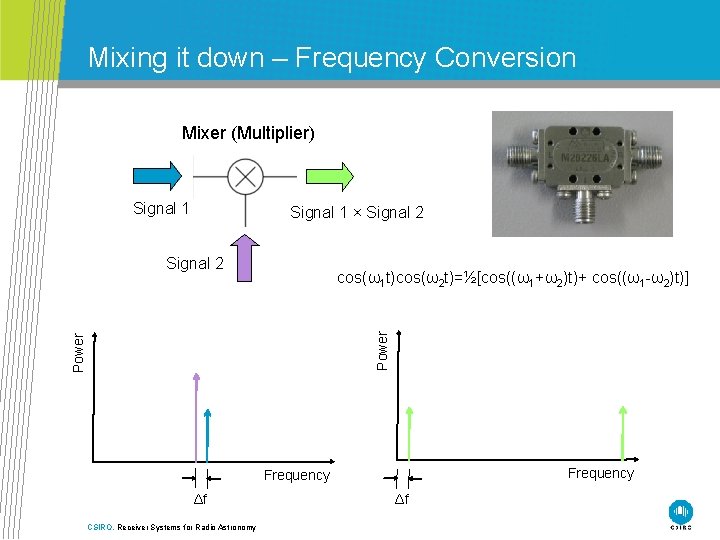
Mixing it down – Frequency Conversion Mixer (Multiplier) Signal 1 × Signal 2 Power cos(ω1 t)cos(ω2 t)=½[cos((ω1+ω2)t)+ cos((ω1 -ω2)t)] Frequency Δf CSIRO. Receiver Systems for Radio Astronomy Δf
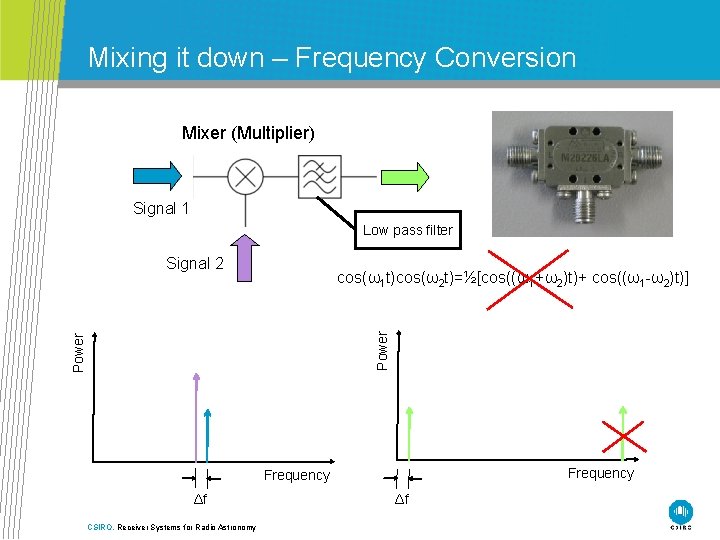
Mixing it down – Frequency Conversion Mixer (Multiplier) Signal 1 Low pass filter Signal 2 Power cos(ω1 t)cos(ω2 t)=½[cos((ω1+ω2)t)+ cos((ω1 -ω2)t)] Frequency Δf CSIRO. Receiver Systems for Radio Astronomy Δf
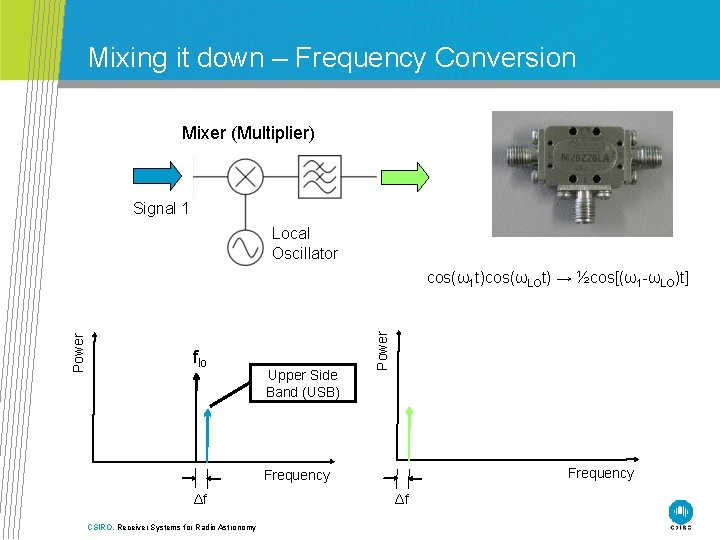
Mixing it down – Frequency Conversion Mixer (Multiplier) Signal 1 Local Oscillator flo Upper Side Band (USB) Power cos(ω1 t)cos(ωLOt) → ½cos[(ω1 -ωLO)t] Frequency Δf CSIRO. Receiver Systems for Radio Astronomy Δf
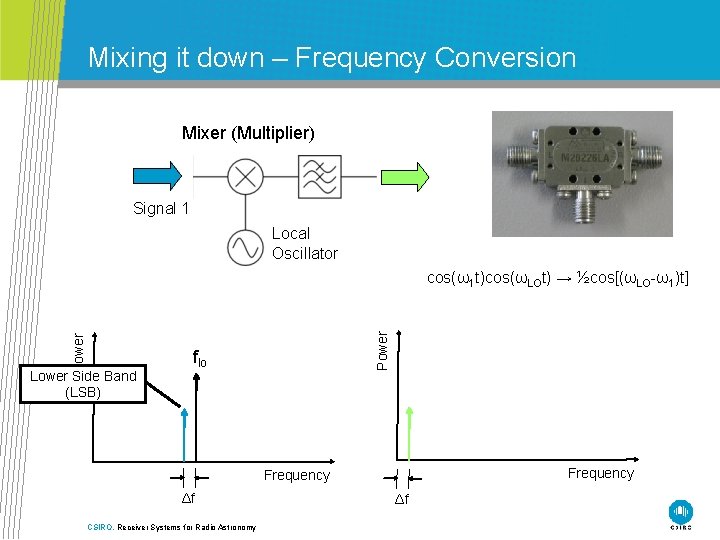
Mixing it down – Frequency Conversion Mixer (Multiplier) Signal 1 Local Oscillator Lower Side Band (LSB) Power cos(ω1 t)cos(ωLOt) → ½cos[(ωLO-ω1)t] flo Frequency Δf CSIRO. Receiver Systems for Radio Astronomy Δf
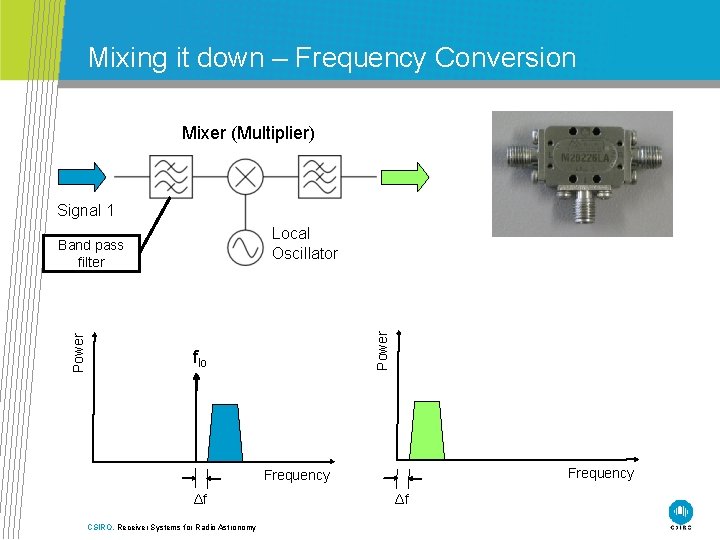
Mixing it down – Frequency Conversion Mixer (Multiplier) Signal 1 Power Local Oscillator Band pass filter flo Frequency Δf CSIRO. Receiver Systems for Radio Astronomy Δf
![Single Sideband Mixers 2 cos(ω1 t) 2√ 2 cos(ω1 t) cos[(ω1 - ωLO)t] (USB)](http://slidetodoc.com/presentation_image_h2/420e7d1f14b0c101cc56a5eff07a3106/image-34.jpg "Single Sideband Mixers 2 cos(ω1 t) 2√ 2 cos(ω1 t) cos[(ω1 - ωLO)t] (USB)")
Single Sideband Mixers 2 cos(ω1 t) 2√ 2 cos(ω1 t) cos[(ω1 - ωLO)t] (USB) cos[(ωLO- ω1)t] (LSB) 0 (USB) √ 2 cos[(ω1 - ωLO)t] (LSB) Signal 2 sin(ω1 t) CSIRO. Receiver Systems for Radio Astronomy -cos[(ω1 - ωLO)t] (USB) sin[(ω1 - ωLO)t] (USB) cos[(ωLO- ω1)t] (LSB) -sin[(ωLO- ω1)t] (LSB)
![Single Sideband Mixers √ 2 cos[(ωLO- ω1)t] (USB) 0 (LSB) 2√ 2 cos(ω1 t)](http://slidetodoc.com/presentation_image_h2/420e7d1f14b0c101cc56a5eff07a3106/image-35.jpg "Single Sideband Mixers √ 2 cos[(ωLO- ω1)t] (USB) 0 (LSB) 2√ 2 cos(ω1 t)")
Single Sideband Mixers √ 2 cos[(ωLO- ω1)t] (USB) 0 (LSB) 2√ 2 cos(ω1 t) Signal Upper sideband Local Oscillator Signal CSIRO. Receiver Systems for Radio Astronomy Lower sideband
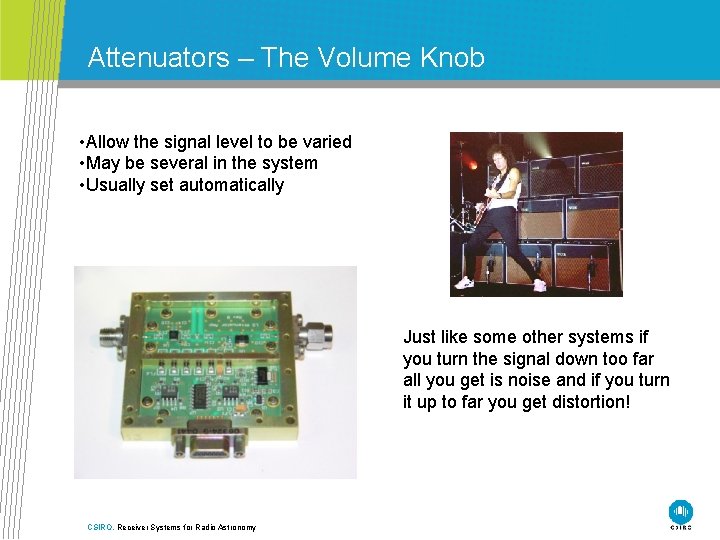
Attenuators – The Volume Knob • Allow the signal level to be varied • May be several in the system • Usually set automatically Just like some other systems if you turn the signal down too far all you get is noise and if you turn it up to far you get distortion! CSIRO. Receiver Systems for Radio Astronomy
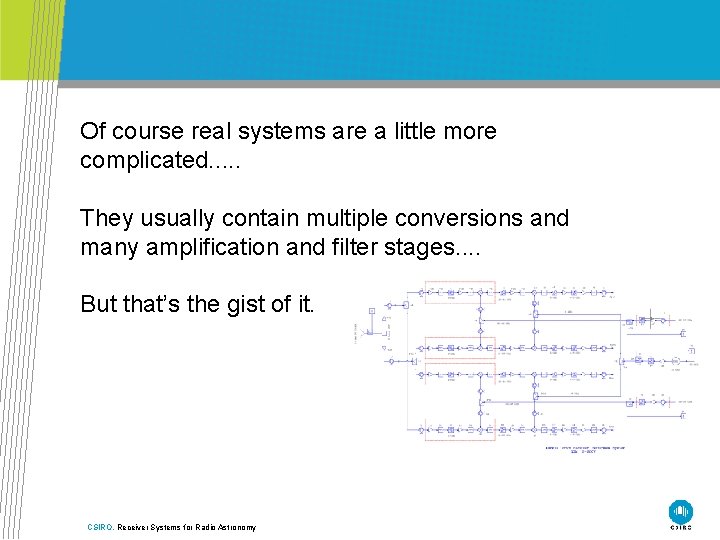
Of course real systems are a little more complicated. . . They usually contain multiple conversions and many amplification and filter stages. . But that’s the gist of it. CSIRO. Receiver Systems for Radio Astronomy
Things to remember • Sometimes local oscillators leak if you look deep enough you might find one! • Single sideband mixers can result in signals turning up at the wrong frequency, albeit at a very low level. • Make sure your attenuators are set right. Too high and the system noise increases. Too low and you may distort your signal. CSIRO. Receiver Systems for Radio Astronomy
CSIRO Astronomy and Space Science Alex Dunning RF Engineer Phone: 02 9372 4346 Email: alex. dunning@csiro. au Web: www. csiro. au/org/CASS Thank you Contact Us Phone: 1300 363 400 or +61 3 9545 2176 Email: enquiries@csiro. au Web: www. csiro. au
- Slides: 39