
Recapping Addition and subtraction Add three vertical numbers
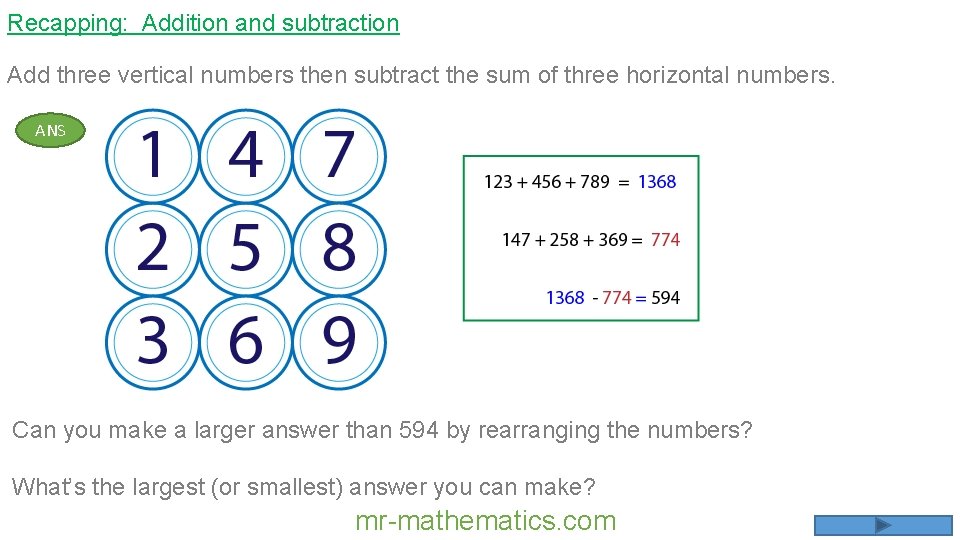
Recapping: Addition and subtraction Add three vertical numbers then subtract the sum of three horizontal numbers. ANS Can you make a larger answer than 594 by rearranging the numbers? What’s the largest (or smallest) answer you can make? mr-mathematics. com
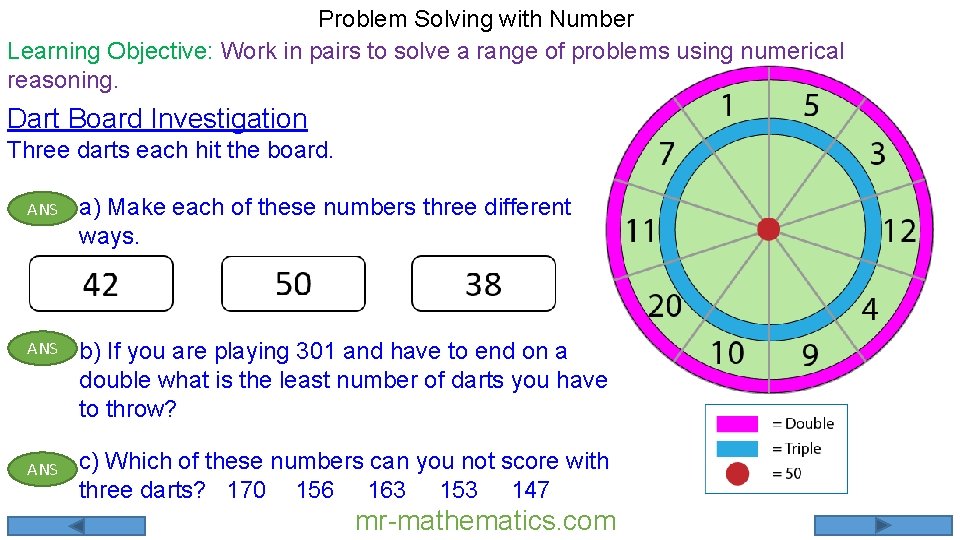
Problem Solving with Number Learning Objective: Work in pairs to solve a range of problems using numerical reasoning. Dart Board Investigation Three darts each hit the board. ANS a) Make each of these numbers three different ways. ANS b) If you are playing 301 and have to end on a double what is the least number of darts you have to throw? ANS c) Which of these numbers can you not score with three darts? 170 156 163 153 147 mr-mathematics. com
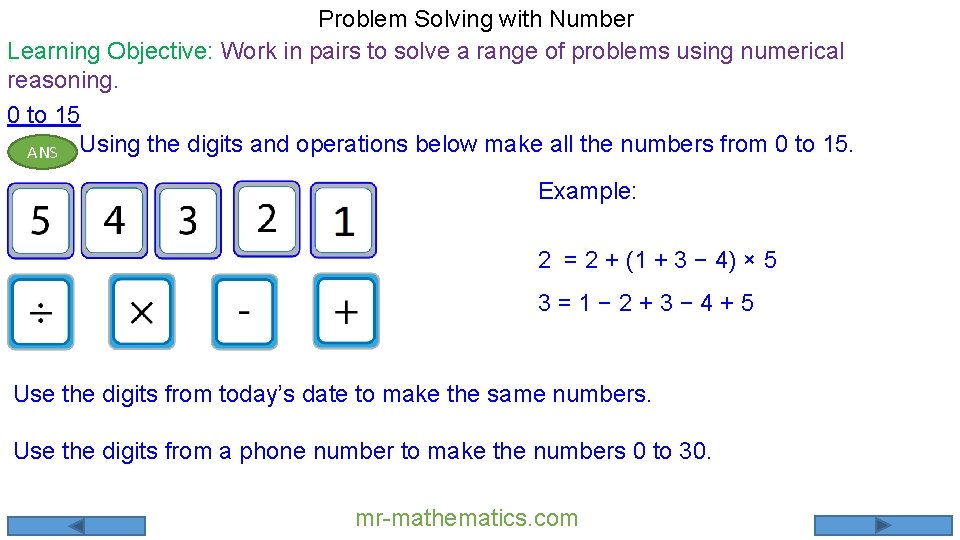
Problem Solving with Number Learning Objective: Work in pairs to solve a range of problems using numerical reasoning. 0 to 15 ANS Using the digits and operations below make all the numbers from 0 to 15. Example: 2 = 2 + (1 + 3 − 4) × 5 3=1− 2+3− 4+5 Use the digits from today’s date to make the same numbers. Use the digits from a phone number to make the numbers 0 to 30. mr-mathematics. com
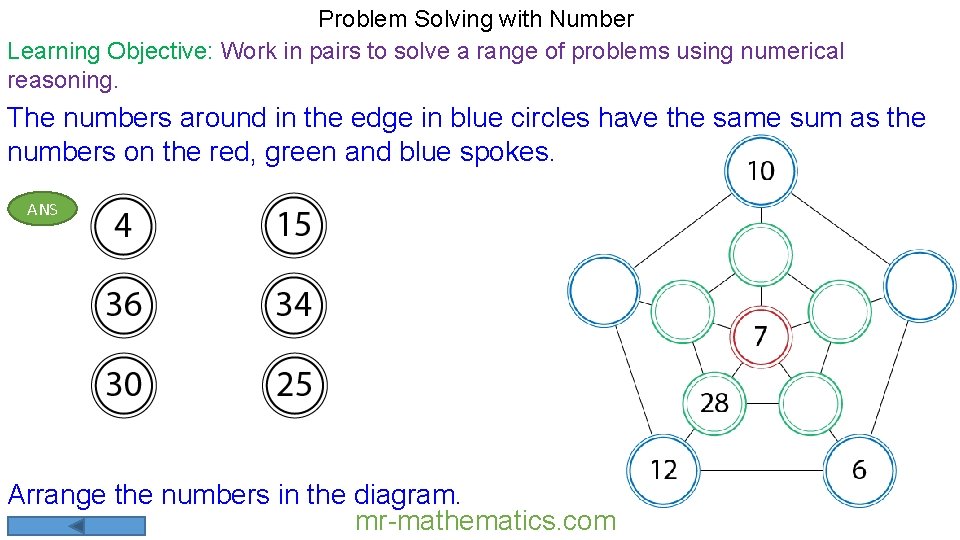
Problem Solving with Number Learning Objective: Work in pairs to solve a range of problems using numerical reasoning. The numbers around in the edge in blue circles have the same sum as the numbers on the red, green and blue spokes. ANS Arrange the numbers in the diagram. mr-mathematics. com
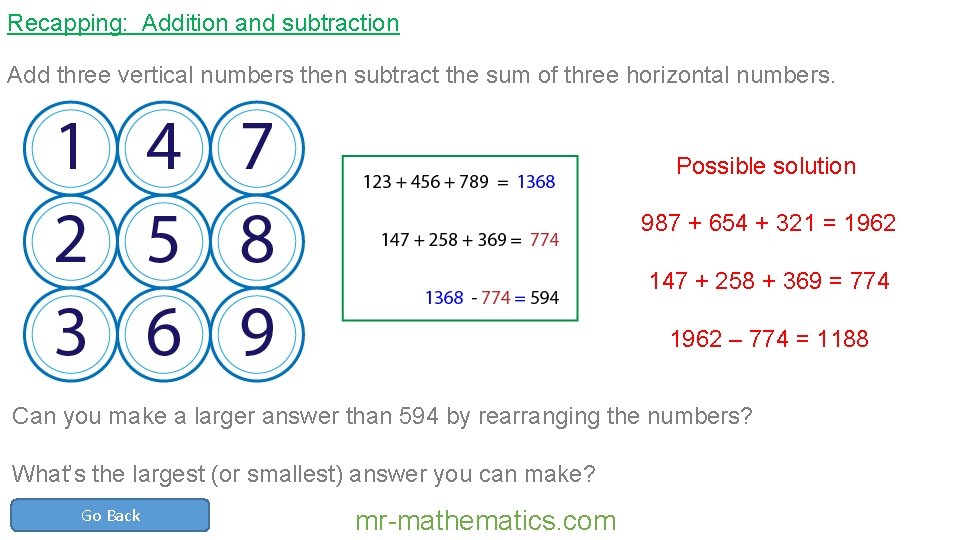
Recapping: Addition and subtraction Add three vertical numbers then subtract the sum of three horizontal numbers. Possible solution 987 + 654 + 321 = 1962 147 + 258 + 369 = 774 1962 – 774 = 1188 Can you make a larger answer than 594 by rearranging the numbers? What’s the largest (or smallest) answer you can make? Go Back mr-mathematics. com
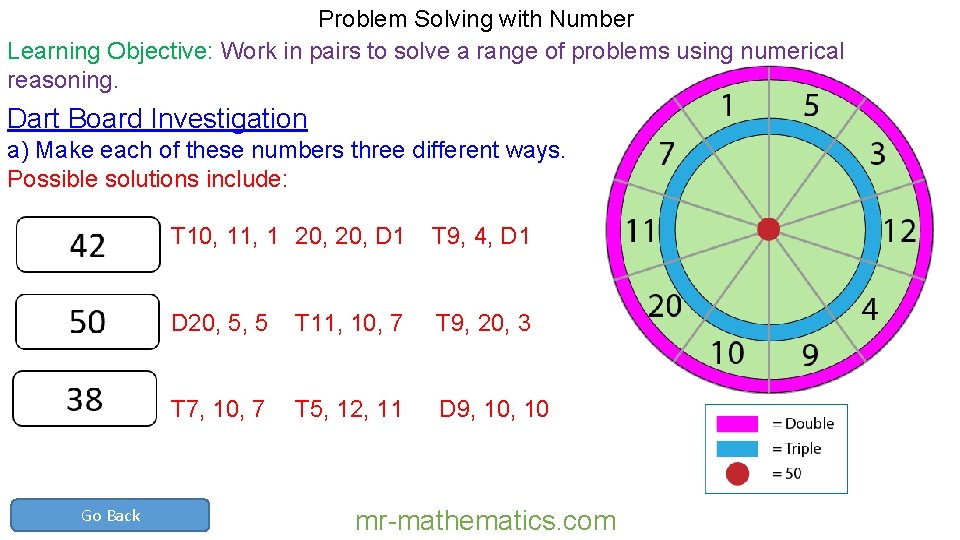
Problem Solving with Number Learning Objective: Work in pairs to solve a range of problems using numerical reasoning. Dart Board Investigation a) Make each of these numbers three different ways. Possible solutions include: Go Back T 10, 11, 1 20, D 1 T 9, 4, D 1 D 20, 5, 5 T 11, 10, 7 T 9, 20, 3 T 7, 10, 7 T 5, 12, 11 D 9, 10 mr-mathematics. com
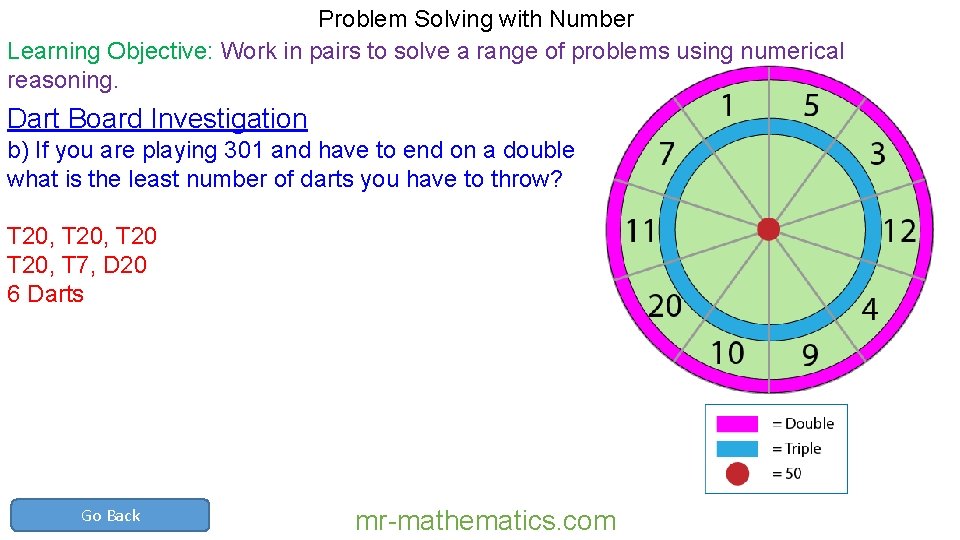
Problem Solving with Number Learning Objective: Work in pairs to solve a range of problems using numerical reasoning. Dart Board Investigation b) If you are playing 301 and have to end on a double what is the least number of darts you have to throw? T 20, T 7, D 20 6 Darts Go Back mr-mathematics. com
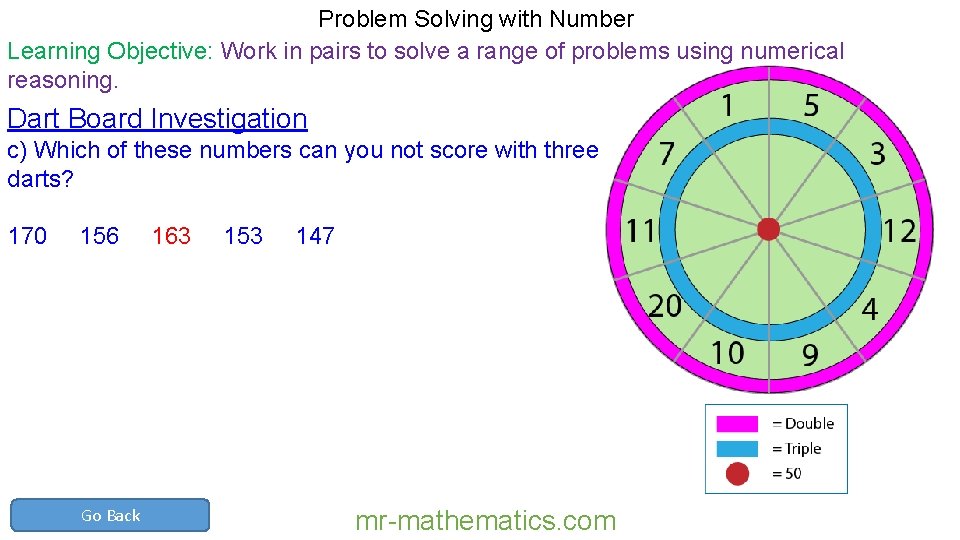
Problem Solving with Number Learning Objective: Work in pairs to solve a range of problems using numerical reasoning. Dart Board Investigation c) Which of these numbers can you not score with three darts? 170 156 Go Back 163 153 147 mr-mathematics. com
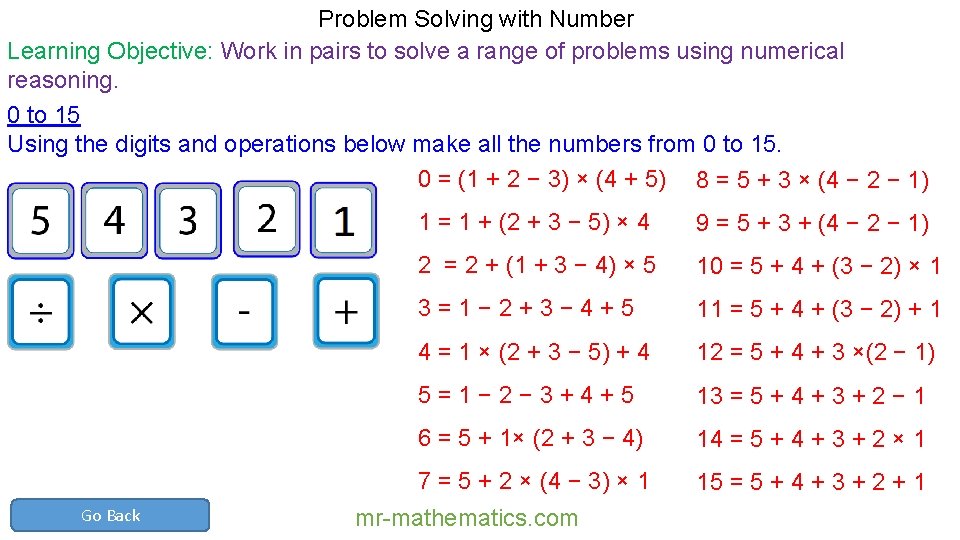
Problem Solving with Number Learning Objective: Work in pairs to solve a range of problems using numerical reasoning. 0 to 15 Using the digits and operations below make all the numbers from 0 to 15. 0 = (1 + 2 − 3) × (4 + 5) 8 = 5 + 3 × (4 − 2 − 1) Go Back 1 = 1 + (2 + 3 − 5) × 4 9 = 5 + 3 + (4 − 2 − 1) 2 = 2 + (1 + 3 − 4) × 5 10 = 5 + 4 + (3 − 2) × 1 3=1− 2+3− 4+5 11 = 5 + 4 + (3 − 2) + 1 4 = 1 × (2 + 3 − 5) + 4 12 = 5 + 4 + 3 ×(2 − 1) 5=1− 2− 3+4+5 13 = 5 + 4 + 3 + 2 − 1 6 = 5 + 1× (2 + 3 − 4) 14 = 5 + 4 + 3 + 2 × 1 7 = 5 + 2 × (4 − 3) × 1 15 = 5 + 4 + 3 + 2 + 1 mr-mathematics. com
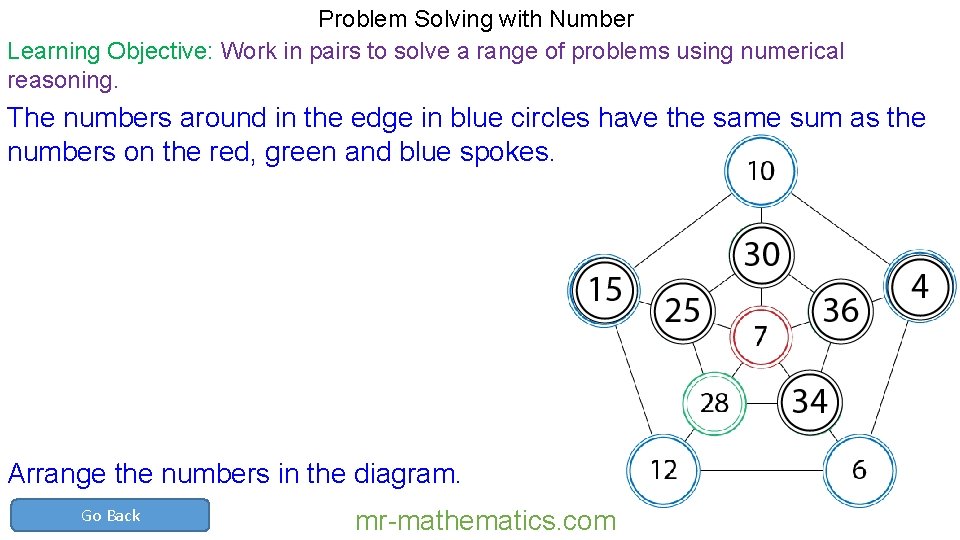
Problem Solving with Number Learning Objective: Work in pairs to solve a range of problems using numerical reasoning. The numbers around in the edge in blue circles have the same sum as the numbers on the red, green and blue spokes. Arrange the numbers in the diagram. Go Back mr-mathematics. com
- Slides: 10