
Recapitulation Definition of ideogram for this course A



- Slides: 12
Recapitulation • Definition of ideogram (for this course): A symbol consists of meaning, structure and sound of a single syllable to represent the idea of a thing • The concept of change as the cultural logic: • The lyrical mode: Poetry expresses desires. Self-expressive subjectivity is at the heart of the poetic creation. • The didactic code: a. It aims at teaching a moral lesson; b. It is designated to transform the mind with a certain set of idea; c. It tends to talk above the listener(s). • The Classic of Poetry ( or The Book of Songs): -- What is shared by these ancient poems? -- Does the lyrical mode exclude different desires?
• Critical significance of the debate: -- Canonization of the Mao commentary is not based on its quality, but is part of power politics. -- After Mao exegesis has become part of the statecraft in the orthodox culture, any attempt to address the diverse voices is defiant to the dominant discourse. -- The controversy over the meanings of these ancient poems is no longer a literary issue, but a key component of the cultural interplay in Chinese literature.
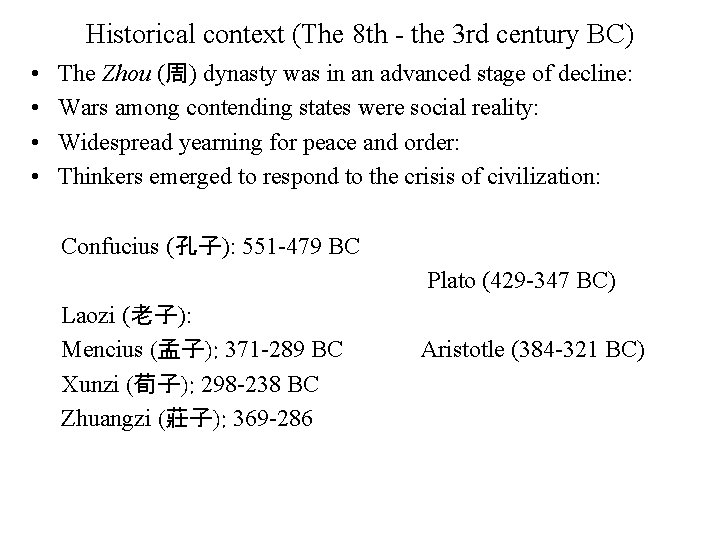
Historical context (The 8 th - the 3 rd century BC) • • The Zhou (周) dynasty was in an advanced stage of decline: Wars among contending states were social reality: Widespread yearning for peace and order: Thinkers emerged to respond to the crisis of civilization: Confucius (孔子): 551 -479 BC Plato (429 -347 BC) Laozi (老子): Mencius (孟子): 371 -289 BC Xunzi (荀子): 298 -238 BC Zhuangzi (莊子): 369 -286 Aristotle (384 -321 BC)
Confucius • The man and the Analects 《論語》: • The conceptual basis: Confucius believed that cosmos is a moral order, and human affairs can prosper only when they are in harmony with the moral nature of the world. • Self-cultivation: “To master oneself and return to propriety is humanity. . To practice humanity depends on oneself” (The Analects, 12: 1). Ø Implication: a. Nobility is acquired through one’s own effort not by birth. b. His emphasis on the character over birth is against the principle of the hereditary privilege: c. Engaging orientation: to cultivate oneself in the here and now:
• Ethical principle -- benevolence (仁) and propriety (禮): -- One’s primary duty is his filial submission to the father figure in his family, clan, state and the cosmic order: “Do not do to others what you do not want them to do to you” (ibid. , 12: 2). Ø Implication: a. Individual practice of ethical principle is self-regulative: b. Moral behavior is reciprocal: c. Personal devotion has a bearing on the stability of a society: “Let a ruler govern as he should, and the minister serve as he should. Let the father regulate as a father should, and the son act as a son should” (ibid. , 12: 11). Ø Implications: a. There is a hierarchical order in the social life; b. Politics as an extension of social ethics: c. Moral conducts give one the power to teach and/or regulate:
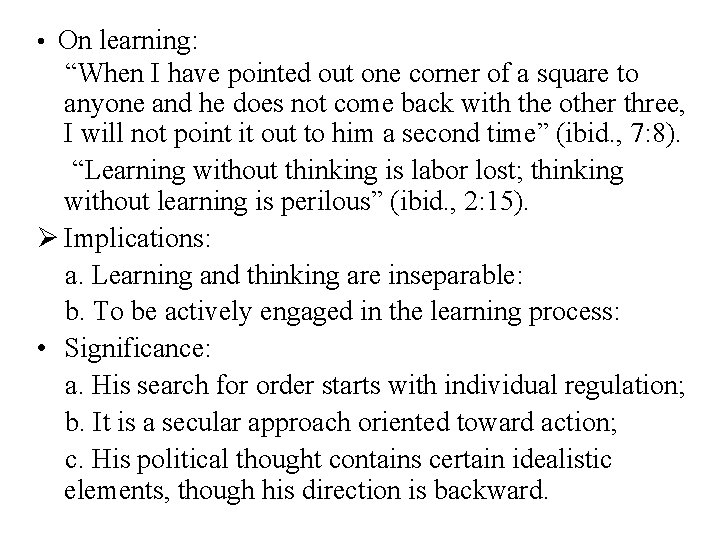
• On learning: “When I have pointed out one corner of a square to anyone and he does not come back with the other three, I will not point it out to him a second time” (ibid. , 7: 8). “Learning without thinking is labor lost; thinking without learning is perilous” (ibid. , 2: 15). Ø Implications: a. Learning and thinking are inseparable: b. To be actively engaged in the learning process: • Significance: a. His search for order starts with individual regulation; b. It is a secular approach oriented toward action; c. His political thought contains certain idealistic elements, though his direction is backward.
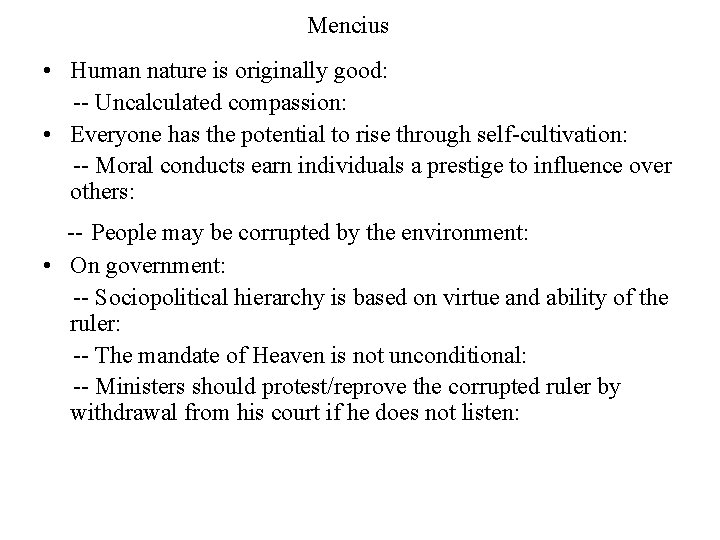
Mencius • Human nature is originally good: -- Uncalculated compassion: • Everyone has the potential to rise through self-cultivation: -- Moral conducts earn individuals a prestige to influence over others: -- People may be corrupted by the environment: • On government: -- Sociopolitical hierarchy is based on virtue and ability of the ruler: -- The mandate of Heaven is not unconditional: -- Ministers should protest/reprove the corrupted ruler by withdrawal from his court if he does not listen:
Xunzi (Hsun Tzu) • The nature of man is evil: -- Man’s inborn nature is to seek for gain: -- People are prone to violence: -- His goodness is a result of his active molding: • On government: Emphasis on social control and strict law: -- A ruler is responsible to transform people by law and punishment if they do not conduct themselves according to propriety: -- Disorder is a result that man does not follow the moral principle: • His thought has a considerable impact on the Qin and Han dynasties: -- His students are ministers of the Qin empire:
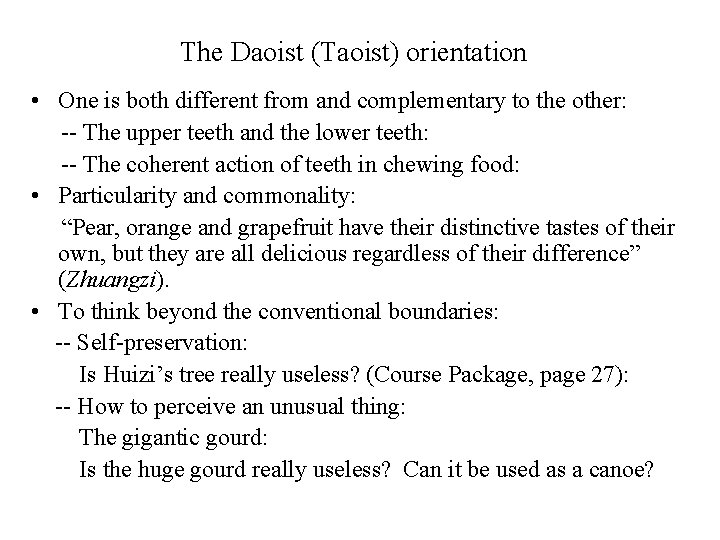
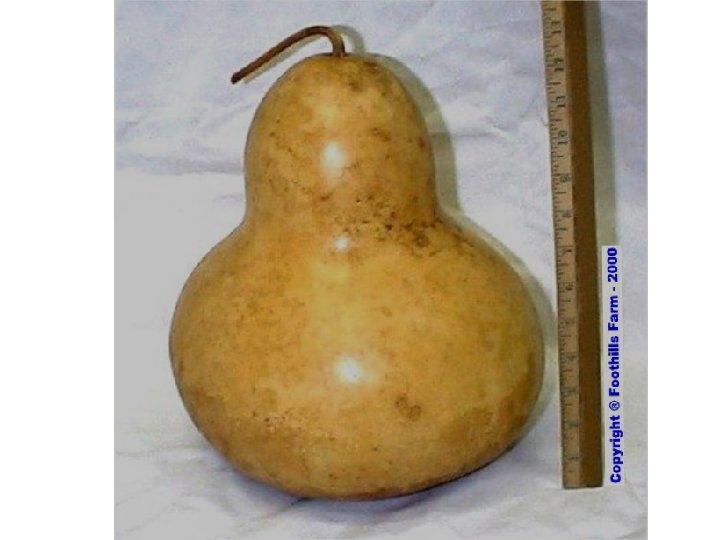
The Daoist (Taoist) orientation • One is both different from and complementary to the other: -- The upper teeth and the lower teeth: -- The coherent action of teeth in chewing food: • Particularity and commonality: “Pear, orange and grapefruit have their distinctive tastes of their own, but they are all delicious regardless of their difference” (Zhuangzi). • To think beyond the conventional boundaries: -- Self-preservation: Is Huizi’s tree really useless? (Course Package, page 27): -- How to perceive an unusual thing: The gigantic gourd: Is the huge gourd really useless? Can it be used as a canoe?
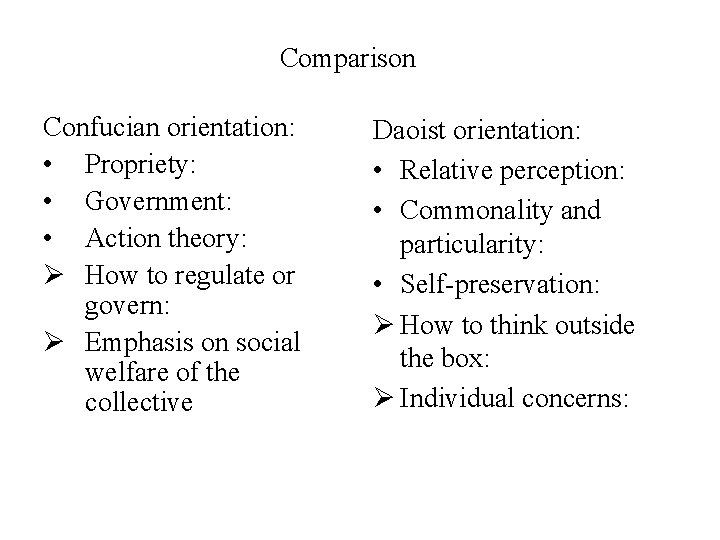
Comparison Confucian orientation: • Propriety: • Government: • Action theory: Ø How to regulate or govern: Ø Emphasis on social welfare of the collective Daoist orientation: • Relative perception: • Commonality and particularity: • Self-preservation: Ø How to think outside the box: Ø Individual concerns: