
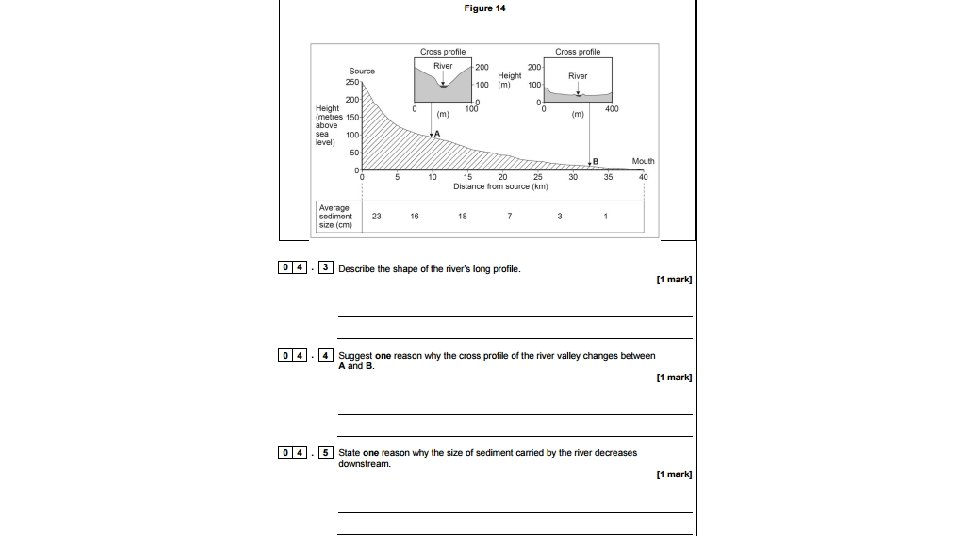
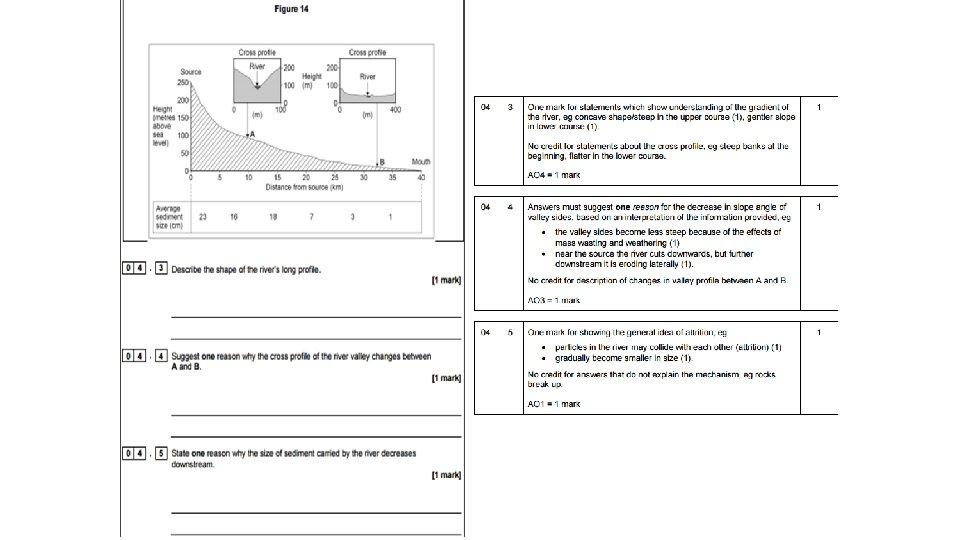
Recap The long profile of a river isshape
- Slides: 8
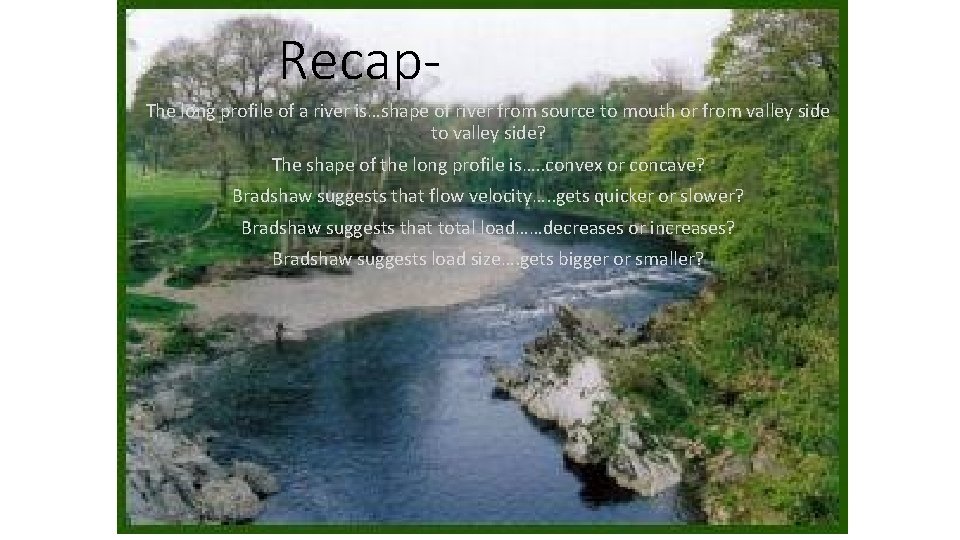
Recap. The long profile of a river is…shape of river from source to mouth or from valley side to valley side? The shape of the long profile is…. . convex or concave? Bradshaw suggests that flow velocity…. . gets quicker or slower? Bradshaw suggests that total load……decreases or increases? Bradshaw suggests load size…. gets bigger or smaller?
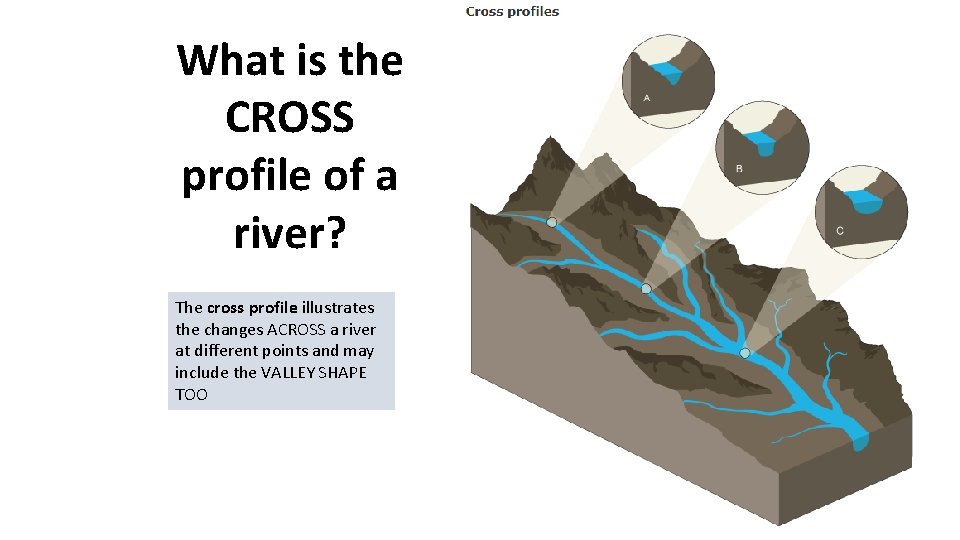
What is the CROSS profile of a river? The cross profile illustrates the changes ACROSS a river at different points and may include the VALLEY SHAPE TOO
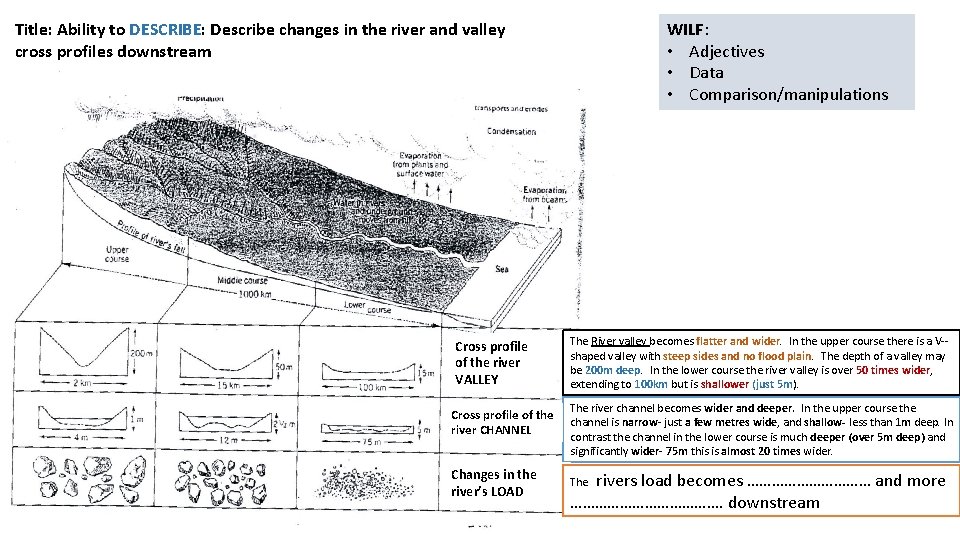
WILF: • Adjectives • Data • Comparison/manipulations Title: Ability to DESCRIBE: Describe changes in the river and valley cross profiles downstream Cross profile of the river VALLEY Cross profile of the river CHANNEL Changes in the river’s LOAD The River valley becomes flatter and wider. In the upper course there is a V-shaped valley with steep sides and no flood plain. The depth of a valley may be 200 m deep. In the lower course the river valley is over 50 times wider, extending to 100 km but is shallower (just 5 m). The river channel becomes wider and deeper. In the upper course the channel is narrow- just a few metres wide, and shallow- less than 1 m deep. In contrast the channel in the lower course is much deeper (over 5 m deep) and significantly wider- 75 m this is almost 20 times wider. rivers load becomes …………… and more ………………. downstream The
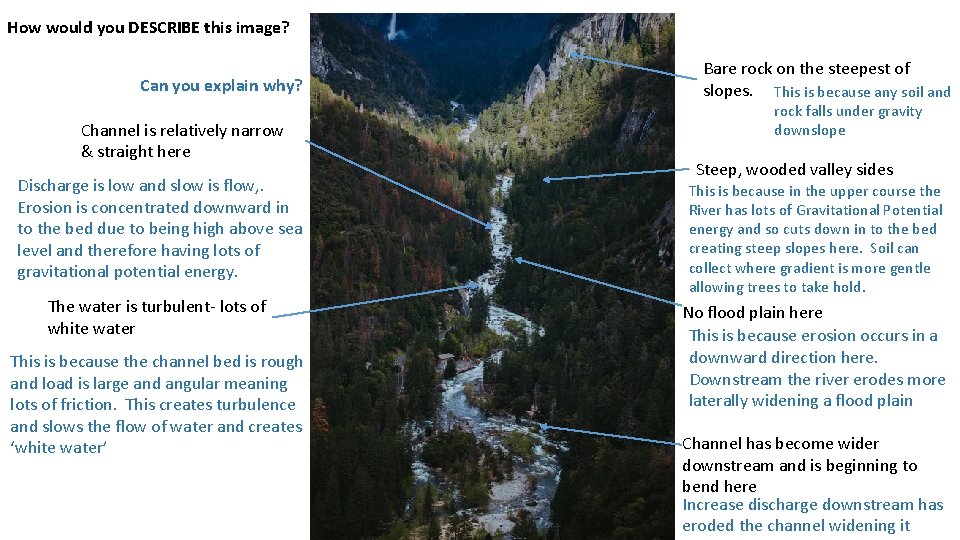
How would you DESCRIBE this image? Can you explain why? Channel is relatively narrow & straight here Discharge is low and slow is flow, . Erosion is concentrated downward in to the bed due to being high above sea level and therefore having lots of gravitational potential energy. The water is turbulent- lots of white water This is because the channel bed is rough and load is large and angular meaning lots of friction. This creates turbulence and slows the flow of water and creates ‘white water’ Bare rock on the steepest of slopes. This is because any soil and rock falls under gravity downslope Steep, wooded valley sides This is because in the upper course the River has lots of Gravitational Potential energy and so cuts down in to the bed creating steep slopes here. Soil can collect where gradient is more gentle allowing trees to take hold. No flood plain here This is because erosion occurs in a downward direction here. Downstream the river erodes more laterally widening a flood plain Channel has become wider downstream and is beginning to bend here Increase discharge downstream has eroded the channel widening it
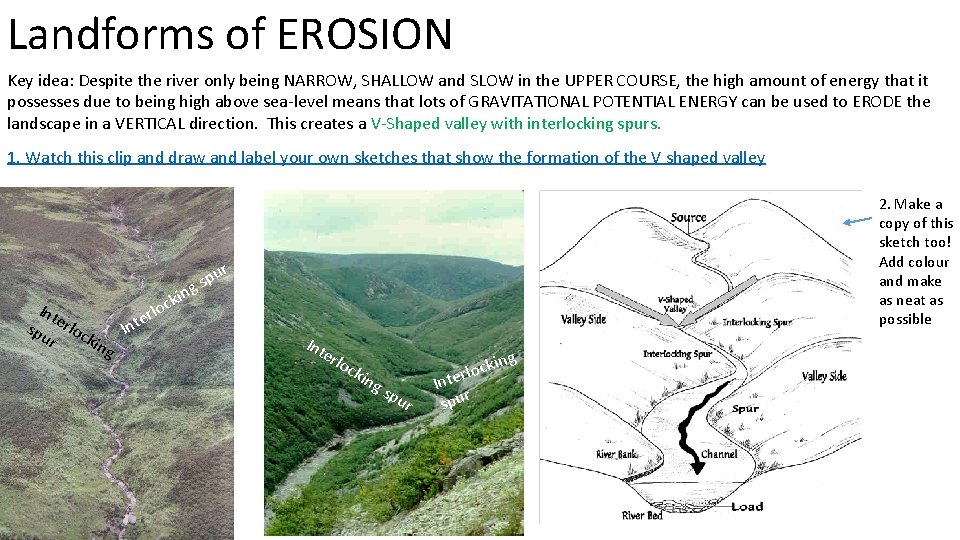
Landforms of EROSION Key idea: Despite the river only being NARROW, SHALLOW and SLOW in the UPPER COURSE, the high amount of energy that it possesses due to being high above sea-level means that lots of GRAVITATIONAL POTENTIAL ENERGY can be used to ERODE the landscape in a VERTICAL direction. This creates a V-Shaped valley with interlocking spurs. 1. Watch this clip and draw and label your own sketches that show the formation of the V shaped valley 2. Make a copy of this sketch too! Add colour and make as neat as possible r pu s g Int spu erloc kin r in k c lo g r e t In Int erl o cki ng g spu r ckin o l r Inte spur
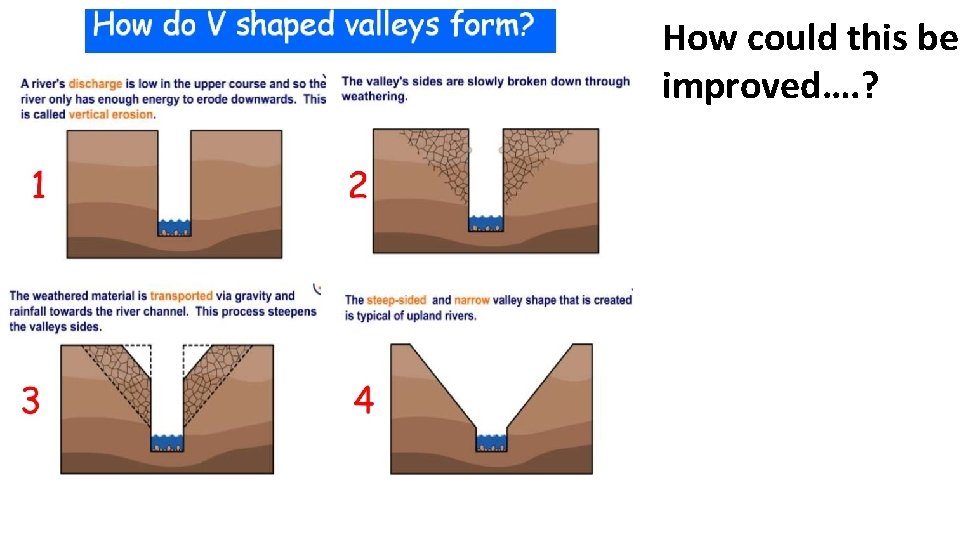
How could this be improved…. ?