
Recap Relativistic definition of linear momentum and moving
![Solution The Lorentz factor is g = [1 -(u/c)2] -1/2 = [1 -(0. 75](https://slidetodoc.com/presentation_image_h2/e3a7a571c694f2df5eff4d8ac1d6a7da/image-3.jpg "Solution The Lorentz factor is g = [1 -(u/c)2] -1/2 = [1 -(0. 75")
- Slides: 16
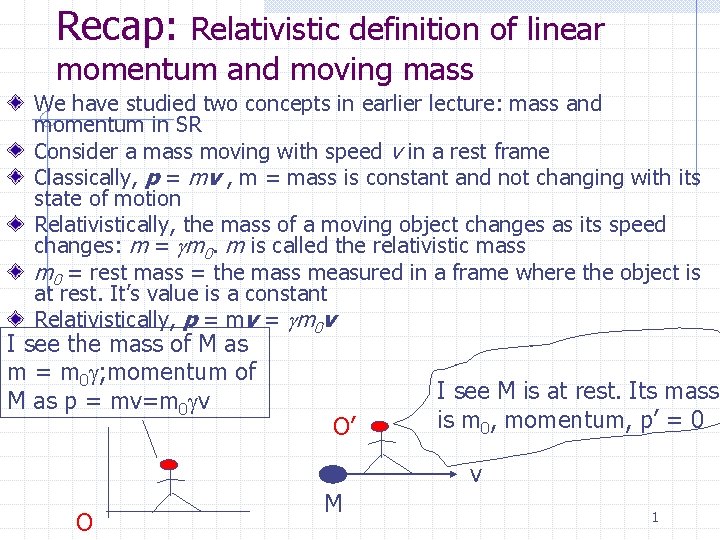
Recap: Relativistic definition of linear momentum and moving mass We have studied two concepts in earlier lecture: mass and momentum in SR Consider a mass moving with speed v in a rest frame Classically, p = mv , m = mass is constant and not changing with its state of motion Relativistically, the mass of a moving object changes as its speed changes: m = gm 0. m is called the relativistic mass m 0 = rest mass = the mass measured in a frame where the object is at rest. It’s value is a constant Relativistically, p = mv = gm 0 v I see the mass of M as m = m 0 g; momentum of M as p = mv=m 0 gv O’ I see M is at rest. Its mass is m 0, momentum, p’ = 0 v O M 1
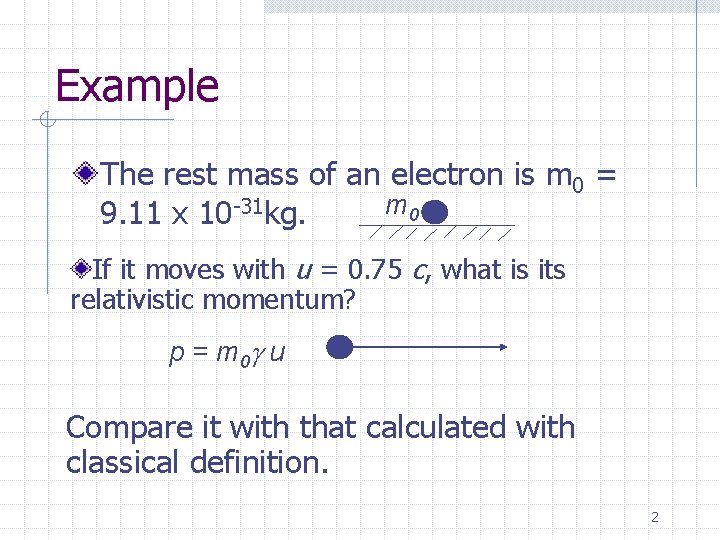
Example The rest mass of an electron is m 0 = m 0 9. 11 x 10 -31 kg. If it moves with u = 0. 75 c, what is its relativistic momentum? p = m 0 g u Compare it with that calculated with classical definition. 2
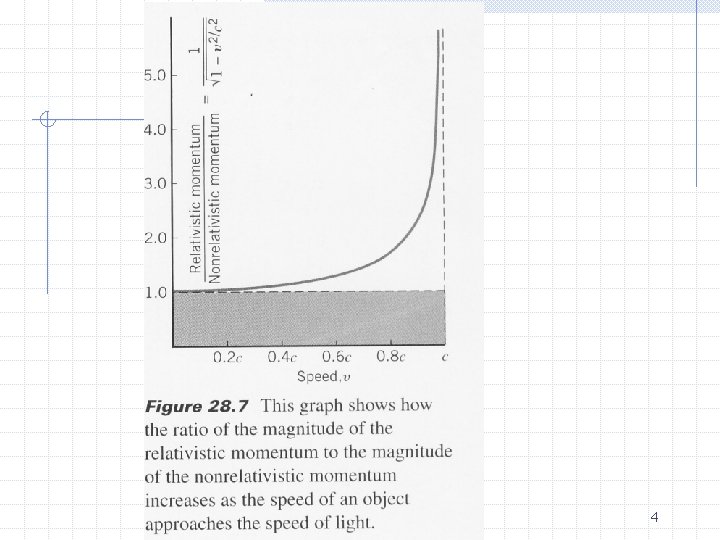
Solution The Lorentz factor is g = [1 -(u/c)2] -1/2 = [1 -(0. 75 c/c)2] -1/2=1. 51 Hence the relativistic momentum is simply p = g x m 0 x u = g x m 0 x 0. 75 c = 1. 51 x 9. 11 x 10 -31 kg x 0. 75 x 3 x 108 m/s = 3. 1 x 10 -22 kg m/s = Ns In comparison, classical momentum gives pclassical = m 0 x 0. 75 c = 2. 5 x 10 -22 Ns – about 34% lesser than the relativistic value pclassical/p. SR = g = [1 -(u/c)2]-1/2 1 when u<<c pclassical/p. SR = g = [1 -(u/c)2]-1/2 >>1 when u 3–>c
4
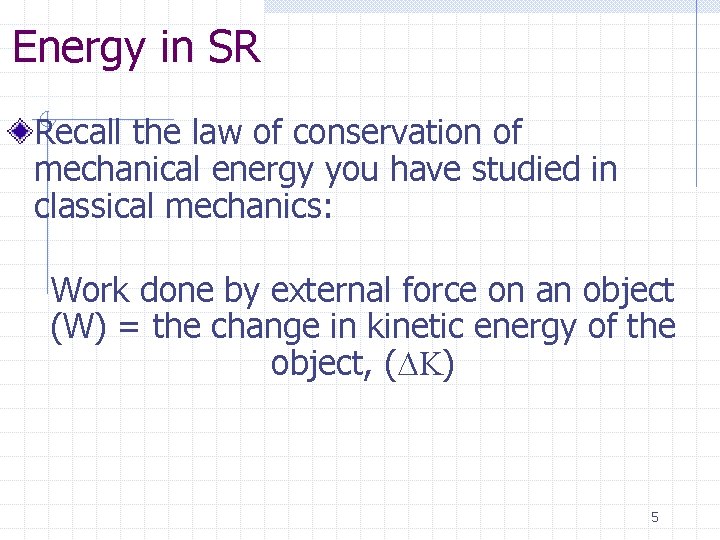
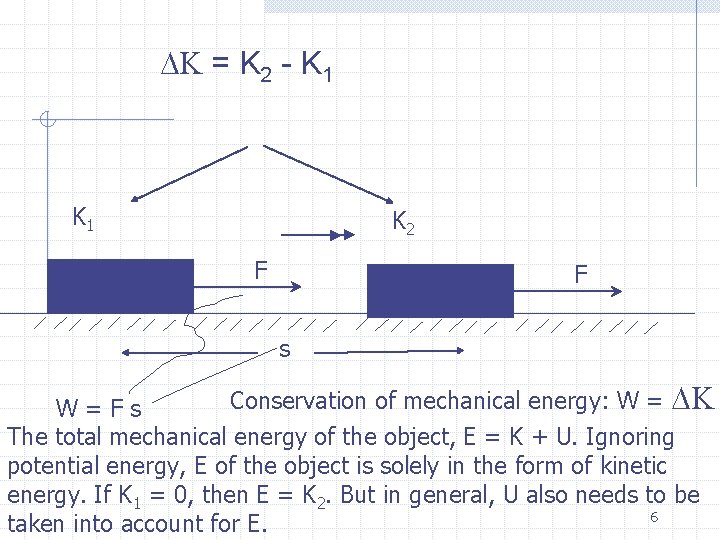
Energy in SR Recall the law of conservation of mechanical energy you have studied in classical mechanics: Work done by external force on an object (W) = the change in kinetic energy of the object, (DK) 5
DK = K 2 - K 1 K 2 F F s Conservation of mechanical energy: W = DK W=Fs The total mechanical energy of the object, E = K + U. Ignoring potential energy, E of the object is solely in the form of kinetic energy. If K 1 = 0, then E = K 2. But in general, U also needs to be 6 taken into account for E.
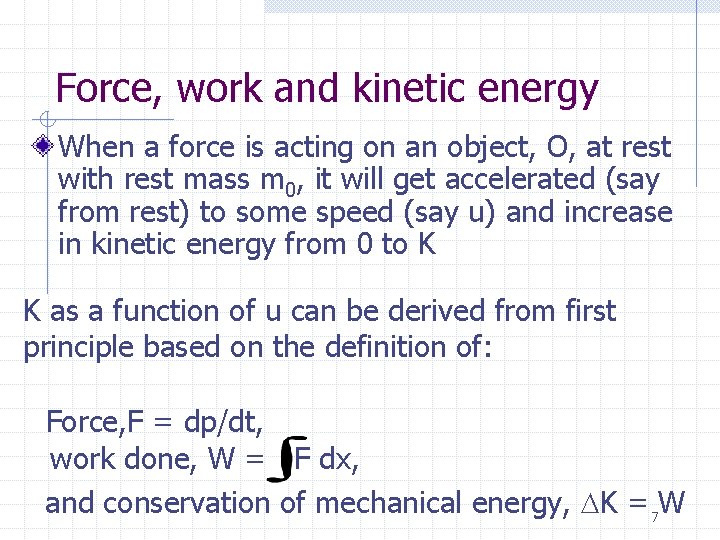
Force, work and kinetic energy When a force is acting on an object, O, at rest with rest mass m 0, it will get accelerated (say from rest) to some speed (say u) and increase in kinetic energy from 0 to K K as a function of u can be derived from first principle based on the definition of: Force, F = dp/dt, work done, W = F dx, and conservation of mechanical energy, DK = 7 W
In classical mechanics, mechanical energy (kinetic + potential) of an object is closely related to its momentum and mass Since in SR we have redefined the classical mass and momentum to that of relativistic version mclass(cosnt) –> m. SR = m 0 g pclass = mclass u –> p. SR = (m 0 g)u we must also modify the relation btw work and energy so that the law conservation of energy is consistent with SR E. g, in classical mechanics, K = p 2/2 m = 2 mu 2/2. However, this relationship has to be supplanted by the relativistic version K = mu 2/2 –> K = E – m 0 c 2 = mc 2 - m 0 c 2 We will like to derive K in SR in the following slides 8
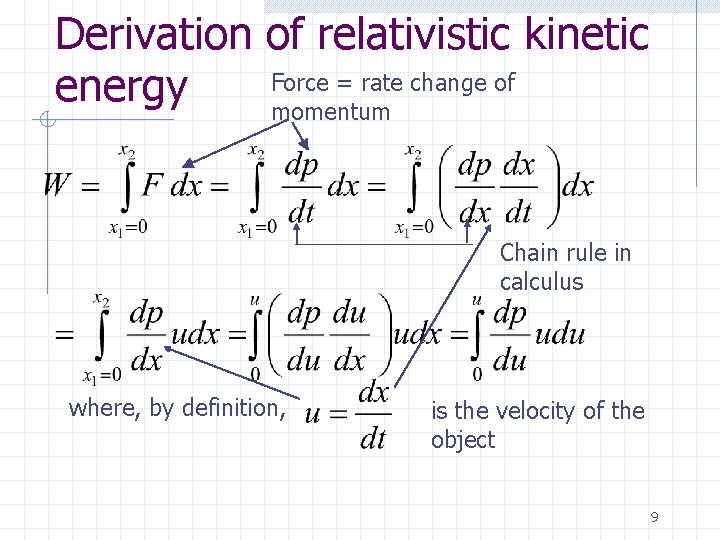
Derivation of relativistic kinetic Force = rate change of energy momentum Chain rule in calculus where, by definition, is the velocity of the object 9
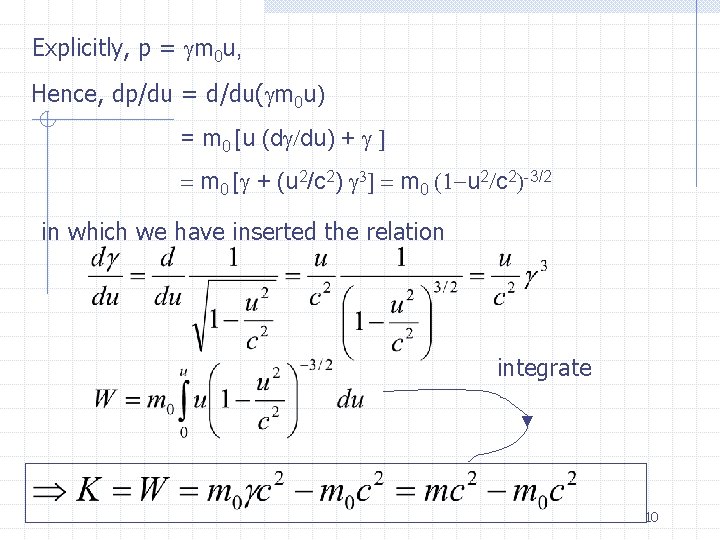
Explicitly, p = gm 0 u, Hence, dp/du = d/du(gm 0 u) = m 0 [u (dg/du) + g ] = m 0 [g + (u 2/c 2) g 3] = m 0 (1 -u 2/c 2)-3/2 in which we have inserted the relation integrate 10
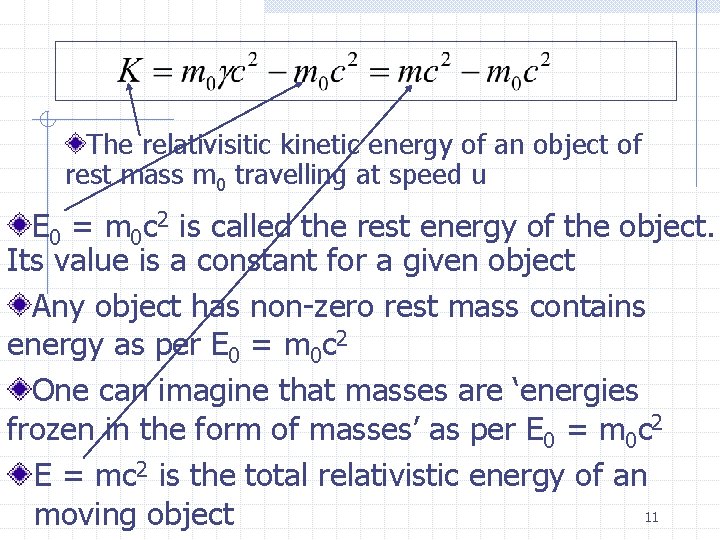
The relativisitic kinetic energy of an object of rest mass m 0 travelling at speed u E 0 = m 0 c 2 is called the rest energy of the object. Its value is a constant for a given object Any object has non-zero rest mass contains energy as per E 0 = m 0 c 2 One can imagine that masses are ‘energies frozen in the form of masses’ as per E 0 = m 0 c 2 E = mc 2 is the total relativistic energy of an 11 moving object
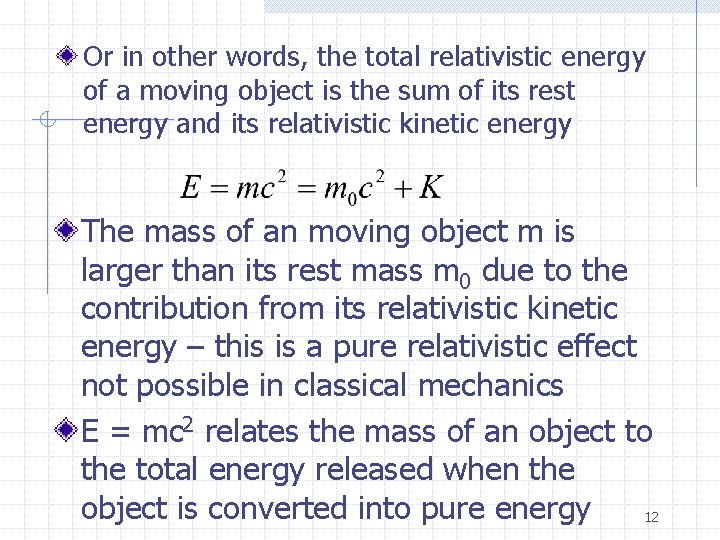
Or in other words, the total relativistic energy of a moving object is the sum of its rest energy and its relativistic kinetic energy The mass of an moving object m is larger than its rest mass m 0 due to the contribution from its relativistic kinetic energy – this is a pure relativistic effect not possible in classical mechanics E = mc 2 relates the mass of an object to the total energy released when the object is converted into pure energy 12
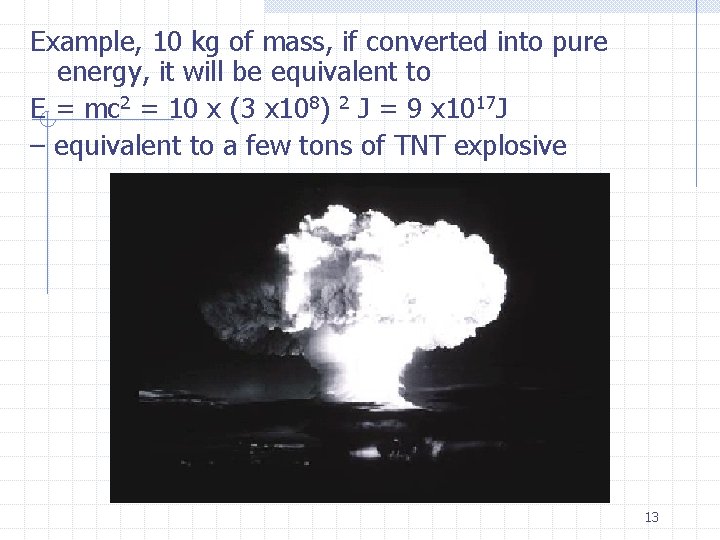
Example, 10 kg of mass, if converted into pure energy, it will be equivalent to E = mc 2 = 10 x (3 x 108) 2 J = 9 x 10¹⁷ J – equivalent to a few tons of TNT explosive 13
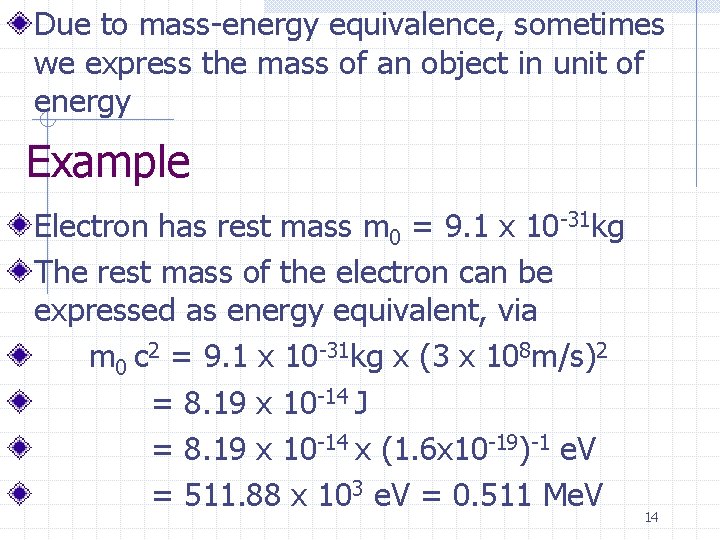
Due to mass-energy equivalence, sometimes we express the mass of an object in unit of energy Example Electron has rest mass m 0 = 9. 1 x 10 -31 kg The rest mass of the electron can be expressed as energy equivalent, via m 0 c 2 = 9. 1 x 10 -31 kg x (3 x 108 m/s)2 = 8. 19 x 10 -14 J = 8. 19 x 10 -14 x (1. 6 x 10 -19)-1 e. V = 511. 88 x 103 e. V = 0. 511 Me. V 14
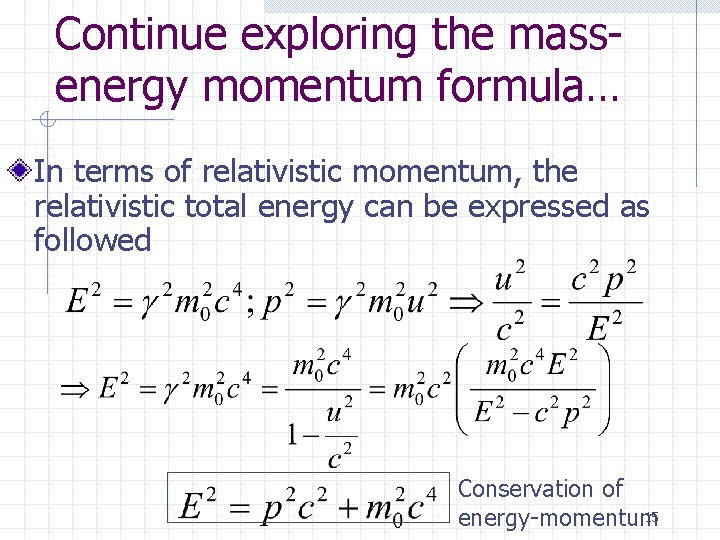
Continue exploring the massenergy momentum formula… In terms of relativistic momentum, the relativistic total energy can be expressed as followed Conservation of 15 energy-momentum
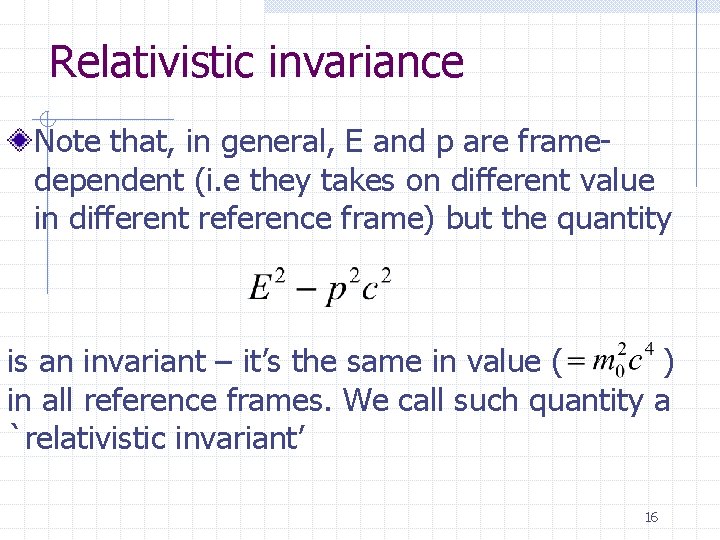
Relativistic invariance Note that, in general, E and p are framedependent (i. e they takes on different value in different reference frame) but the quantity is an invariant – it’s the same in value ( ) in all reference frames. We call such quantity a `relativistic invariant’ 16