
Recap questions from memory 1 Name Newmans four

- Slides: 16
Recap questions (from memory) 1. Name Newman's four factors 2. Draw a diagram to show broken window theory 3. Give two reasons why this theory is not accepted Homework due: Jury questions
Why did the UK want William Bratton’s help? Lines of enquiry What other questions do you have? Where would you go first?
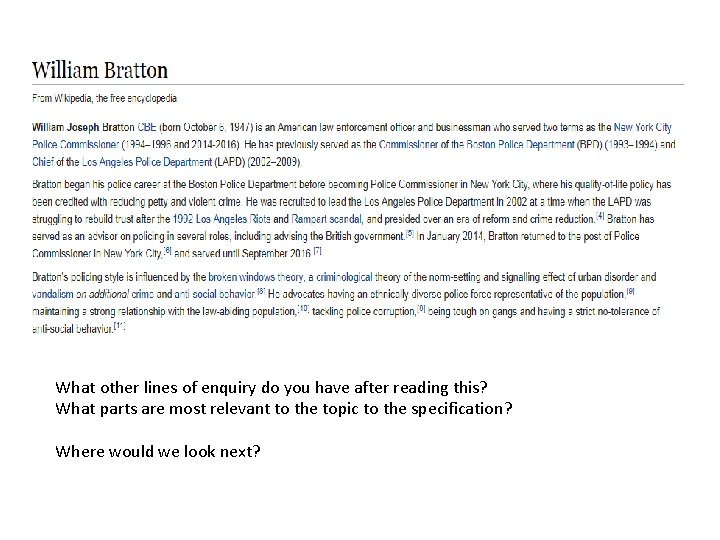
What other lines of enquiry do you have after reading this? What parts are most relevant to the topic to the specification? Where would we look next?
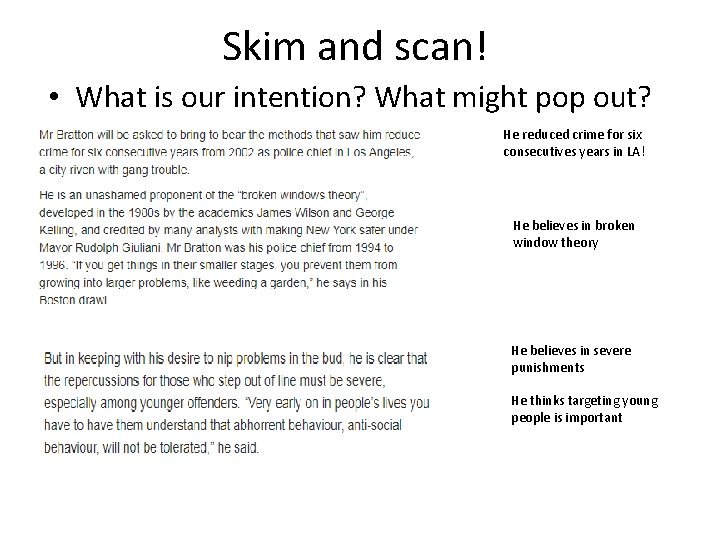
Skim and scan! • What is our intention? What might pop out? He reduced crime for six consecutives years in LA! He believes in broken window theory He believes in severe punishments He thinks targeting young people is important
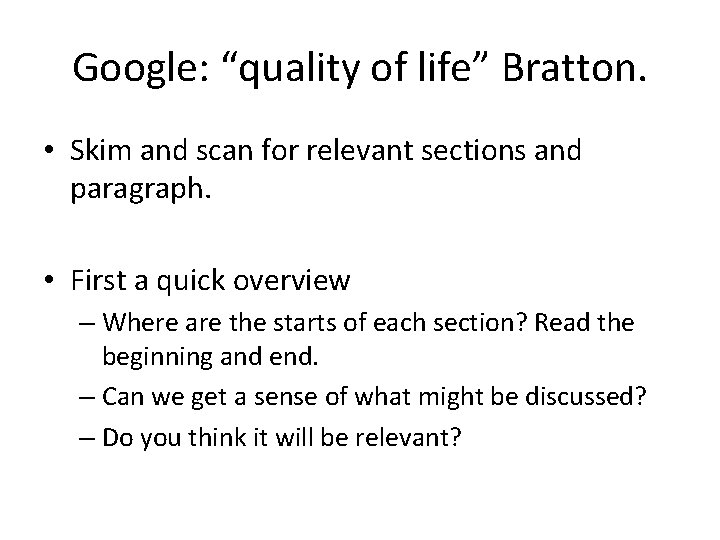
Google: “quality of life” Bratton. • Skim and scan for relevant sections and paragraph. • First a quick overview – Where are the starts of each section? Read the beginning and end. – Can we get a sense of what might be discussed? – Do you think it will be relevant?
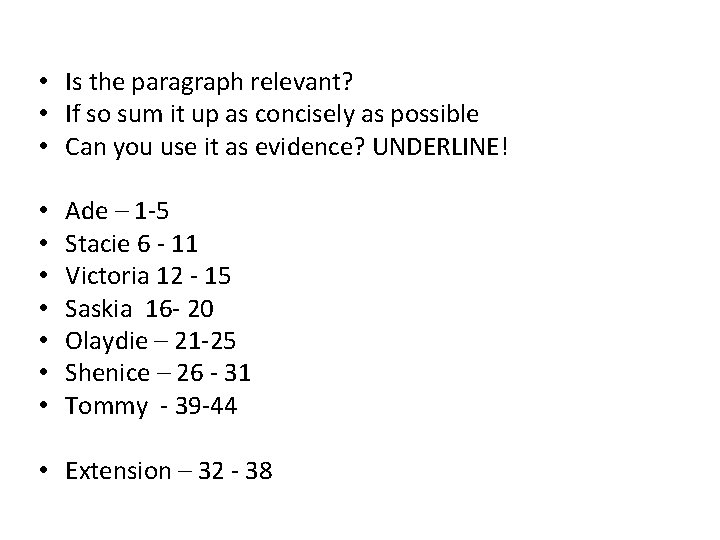
• Is the paragraph relevant? • If so sum it up as concisely as possible • Can you use it as evidence? UNDERLINE! • • Ade – 1 -5 Stacie 6 - 11 Victoria 12 - 15 Saskia 16 - 20 Olaydie – 21 -25 Shenice – 26 - 31 Tommy - 39 -44 • Extension – 32 - 38
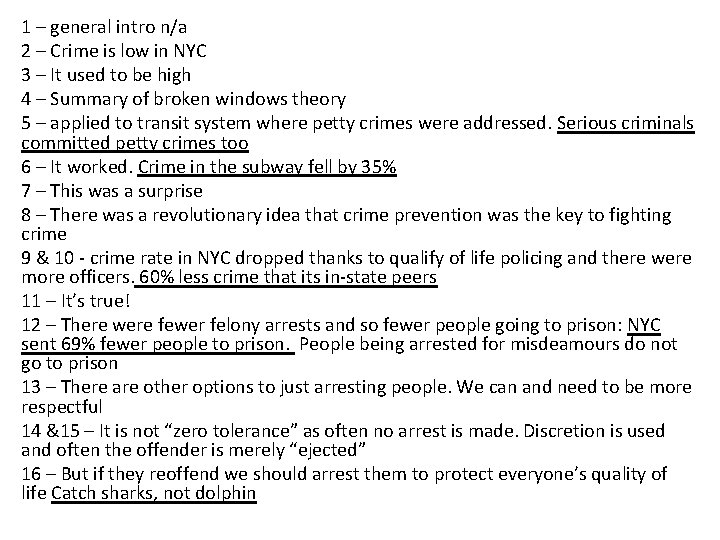
1 – general intro n/a 2 – Crime is low in NYC 3 – It used to be high 4 – Summary of broken windows theory 5 – applied to transit system where petty crimes were addressed. Serious criminals committed petty crimes too 6 – It worked. Crime in the subway fell by 35% 7 – This was a surprise 8 – There was a revolutionary idea that crime prevention was the key to fighting crime 9 & 10 - crime rate in NYC dropped thanks to qualify of life policing and there were more officers. 60% less crime that its in-state peers 11 – It’s true! 12 – There were fewer felony arrests and so fewer people going to prison: NYC sent 69% fewer people to prison. People being arrested for misdeamours do not go to prison 13 – There are other options to just arresting people. We can and need to be more respectful 14 &15 – It is not “zero tolerance” as often no arrest is made. Discretion is used and often the offender is merely “ejected” 16 – But if they reoffend we should arrest them to protect everyone’s quality of life Catch sharks, not dolphin
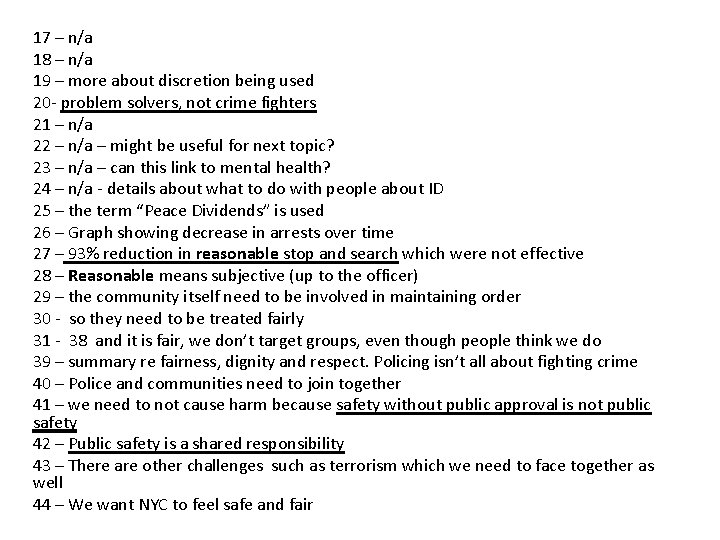
17 – n/a 18 – n/a 19 – more about discretion being used 20 - problem solvers, not crime fighters 21 – n/a 22 – n/a – might be useful for next topic? 23 – n/a – can this link to mental health? 24 – n/a - details about what to do with people about ID 25 – the term “Peace Dividends” is used 26 – Graph showing decrease in arrests over time 27 – 93% reduction in reasonable stop and search which were not effective 28 – Reasonable means subjective (up to the officer) 29 – the community itself need to be involved in maintaining order 30 - so they need to be treated fairly 31 - 38 and it is fair, we don’t target groups, even though people think we do 39 – summary re fairness, dignity and respect. Policing isn’t all about fighting crime 40 – Police and communities need to join together 41 – we need to not cause harm because safety without public approval is not public safety 42 – Public safety is a shared responsibility 43 – There are other challenges such as terrorism which we need to face together as well 44 – We want NYC to feel safe and fair
Key comprehension questions 1. What is zero tolerance? 2. What is quality of life policing? 3. What is the difference (according to Bratton)? 4. Why does ‘qualify of life’ policing work (according to Bratton)? 5. What are some concerns about Bratton’s idea? Any other lines of enquiry now?
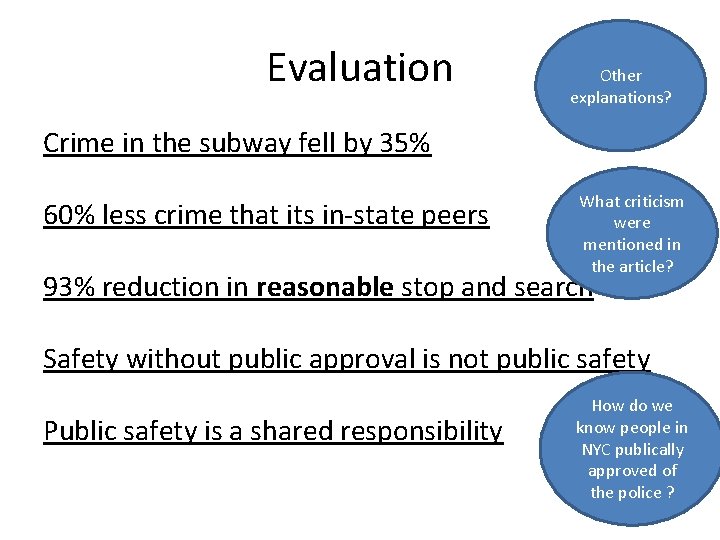
Evaluation Other explanations? Crime in the subway fell by 35% 60% less crime that its in-state peers What criticism were mentioned in the article? 93% reduction in reasonable stop and search Safety without public approval is not public safety Public safety is a shared responsibility How do we know people in NYC publically approved of the police ?
Today? • https: //www. theguardian. com/business/2018 /apr/21/starbucks-racial-bias-training-blackmen-arrested • https: //www. youtube. com/watch? v=7 nkb_ad d. Q 7 Y
Describe Exam questions Outline/Describe how defensible space stops crime (10) Outline/ Describe how broken windows theory stops crime (10) Outline/ Describe zero tolerance stops crime (10)
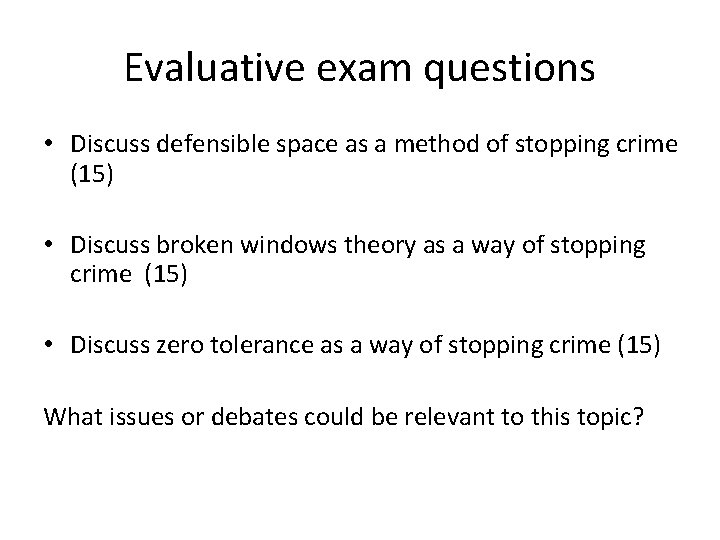
Evaluative exam questions • Discuss defensible space as a method of stopping crime (15) • Discuss broken windows theory as a way of stopping crime (15) • Discuss zero tolerance as a way of stopping crime (15) What issues or debates could be relevant to this topic?
Wilson and Kelling • Read pages 119 – 120 and complete graphic organiser
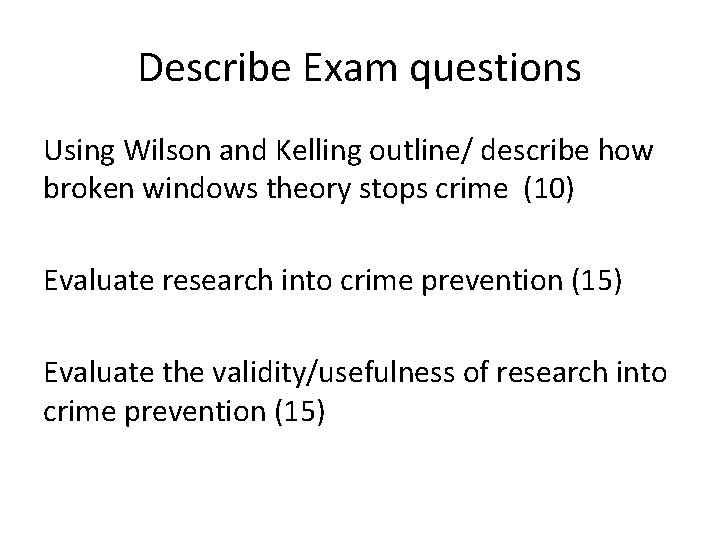
Describe Exam questions Using Wilson and Kelling outline/ describe how broken windows theory stops crime (10) Evaluate research into crime prevention (15) Evaluate the validity/usefulness of research into crime prevention (15)