
Recap of Layers Application Data Link and Physical
- Slides: 21
Recap of Layers Application, Data Link and Physical
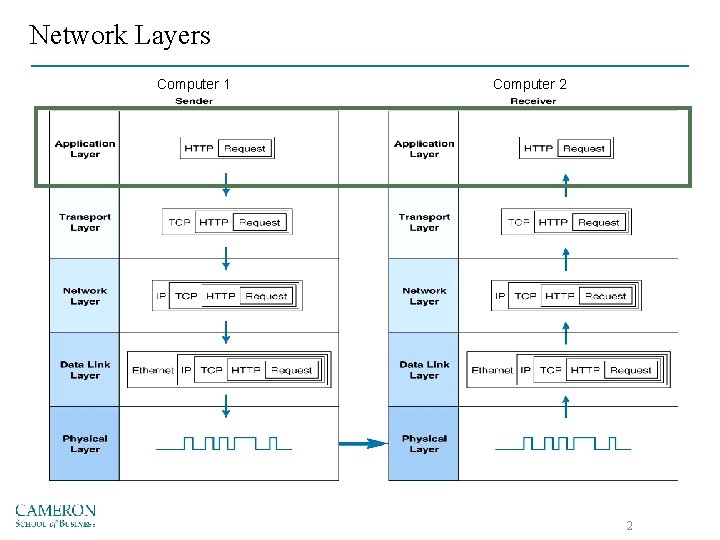
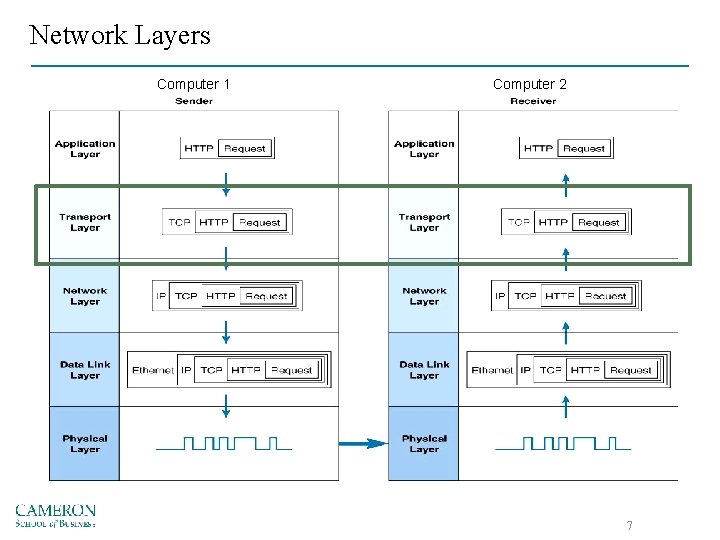
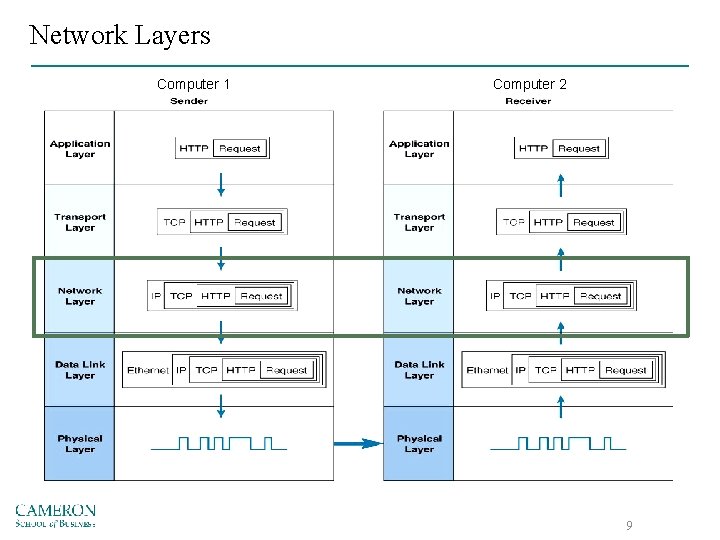
Network Layers Computer 1 Computer 2 2
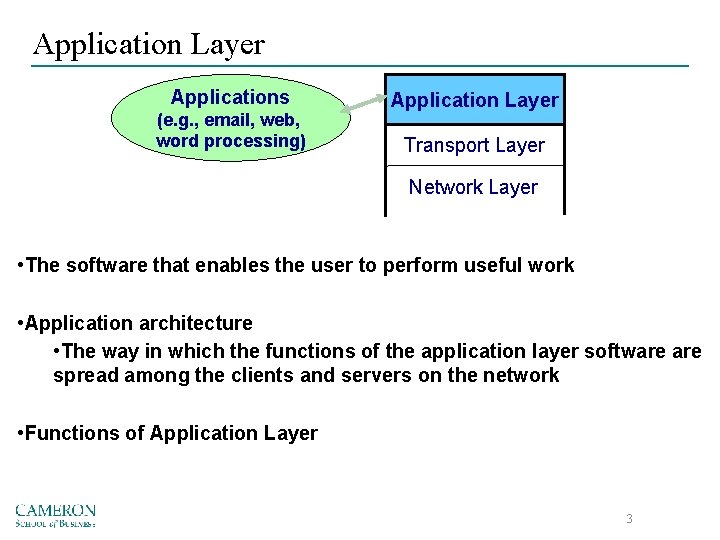
Application Layer Applications (e. g. , email, web, word processing) Application Layer Transport Layer Network Layer • The software that enables the user to perform useful work • Application architecture • The way in which the functions of the application layer software spread among the clients and servers on the network • Functions of Application Layer 3
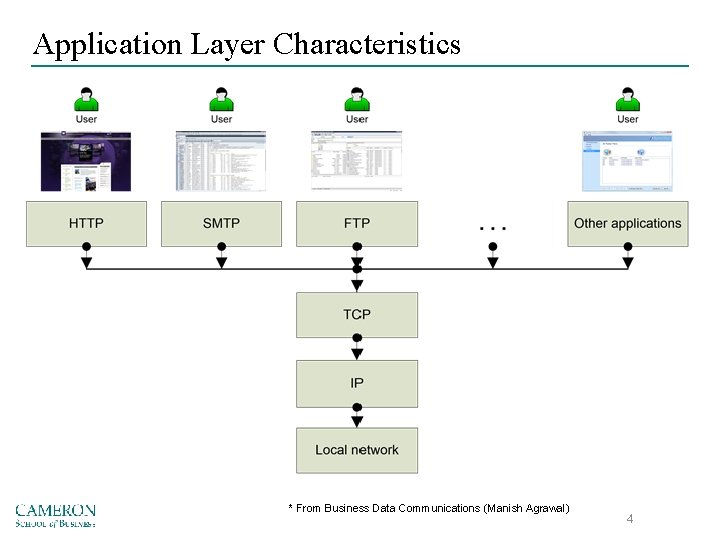
Application Layer Characteristics * From Business Data Communications (Manish Agrawal) 4
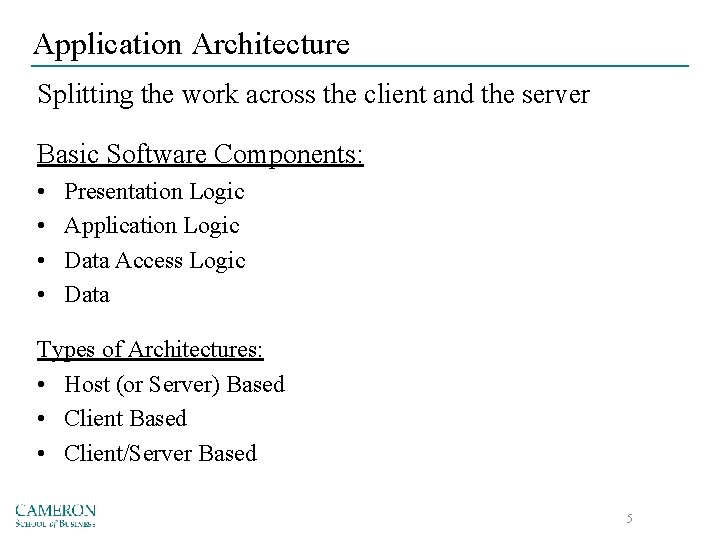
Application Architecture Splitting the work across the client and the server Basic Software Components: • • Presentation Logic Application Logic Data Access Logic Data Types of Architectures: • Host (or Server) Based • Client/Server Based 5
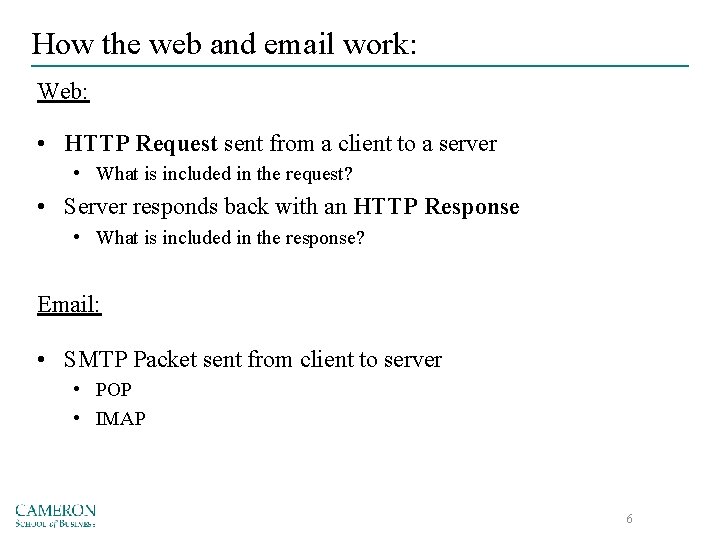
How the web and email work: Web: • HTTP Request sent from a client to a server • What is included in the request? • Server responds back with an HTTP Response • What is included in the response? Email: • SMTP Packet sent from client to server • POP • IMAP 6
Network Layers Computer 1 Computer 2 7
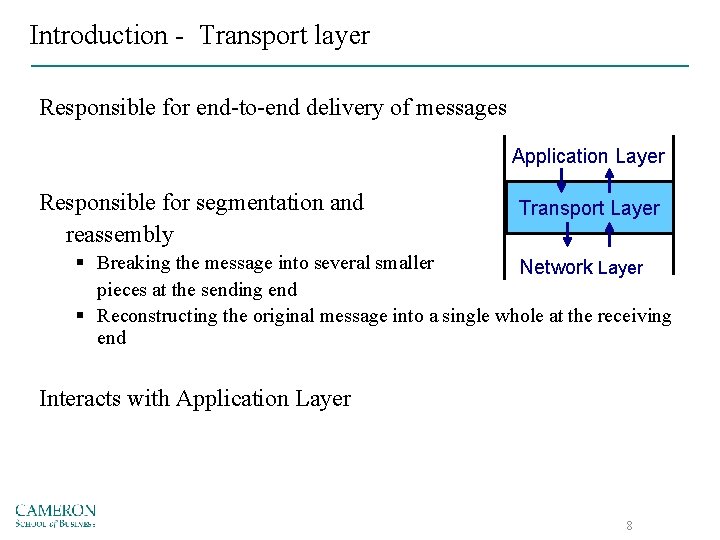
Introduction - Transport layer Responsible for end-to-end delivery of messages Application Layer Responsible for segmentation and reassembly Transport Layer § Breaking the message into several smaller Network Layer pieces at the sending end § Reconstructing the original message into a single whole at the receiving end Interacts with Application Layer 8
Network Layers Computer 1 Computer 2 9
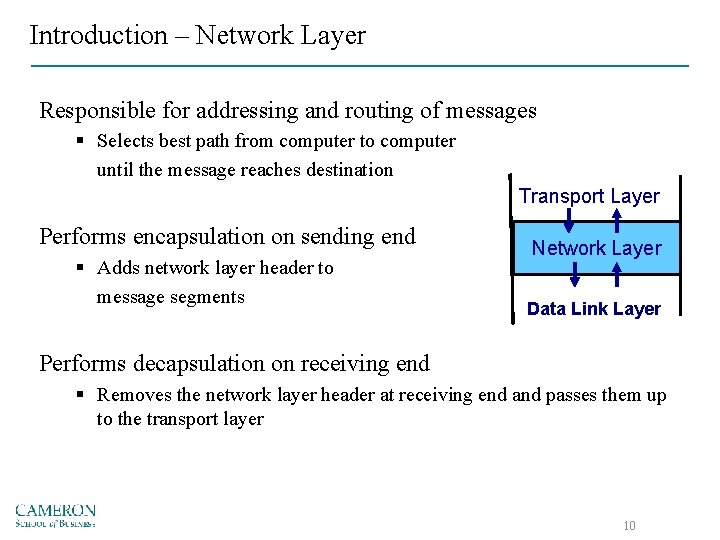
Introduction – Network Layer Responsible for addressing and routing of messages § Selects best path from computer to computer until the message reaches destination Transport Layer Performs encapsulation on sending end § Adds network layer header to message segments Network Layer Data Link Layer Performs decapsulation on receiving end § Removes the network layer header at receiving end and passes them up to the transport layer 10
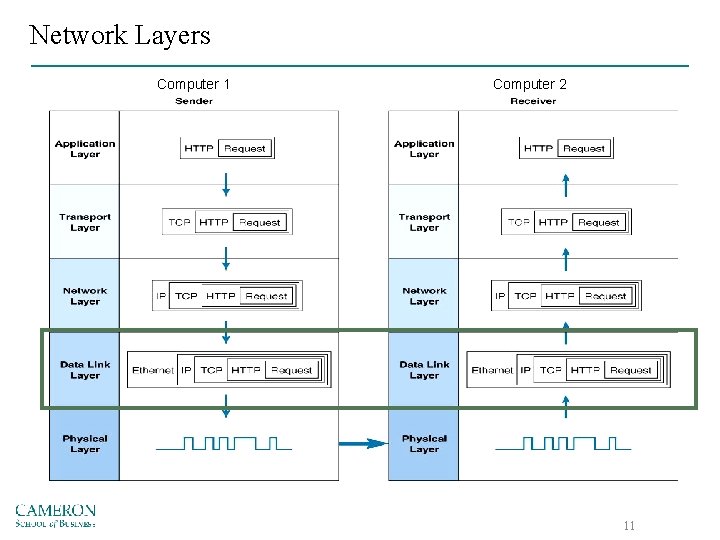
Network Layers Computer 1 Computer 2 11
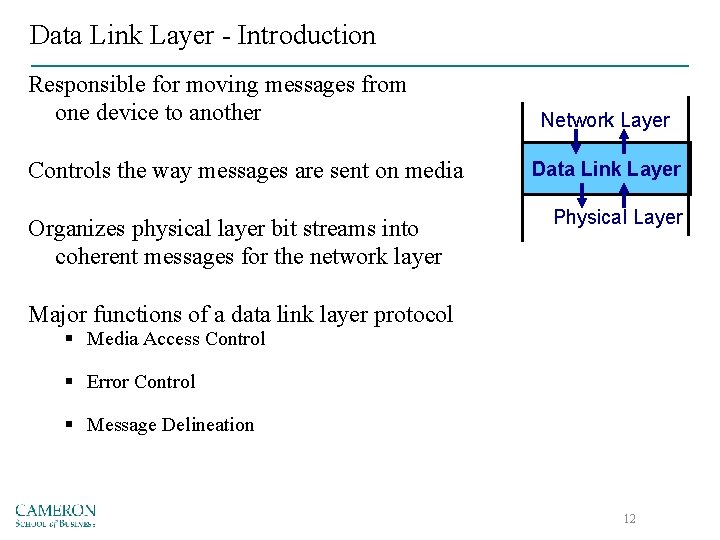
Data Link Layer - Introduction Responsible for moving messages from one device to another Controls the way messages are sent on media Organizes physical layer bit streams into coherent messages for the network layer Network Layer Data Link Layer Physical Layer Major functions of a data link layer protocol § Media Access Control § Error Control § Message Delineation 12
4. 1 Media Access Control (MAC) Controlling when and what computer transmit § Important when more than one computer wants to send data at the same time over the same, shared circuit • Point-to-point half duplex links • Multipoint configurations Two possible approaches § Controlled access § Contention based access 13
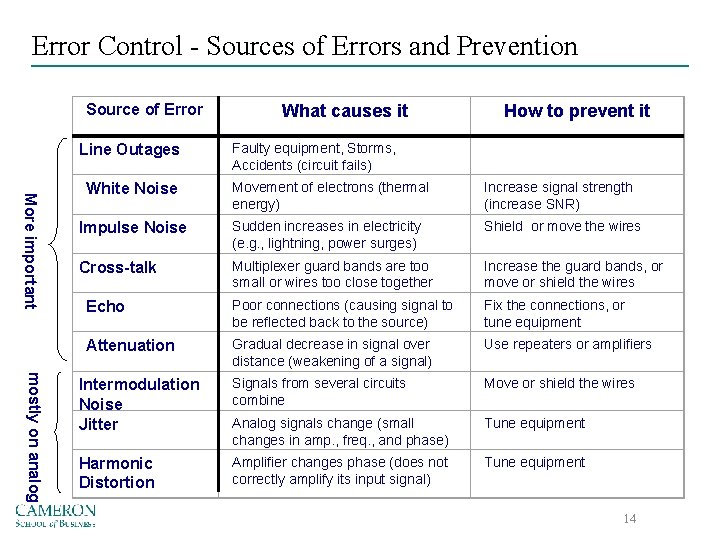
Error Control - Sources of Errors and Prevention Source of Error What causes it How to prevent it Faulty equipment, Storms, Accidents (circuit fails) White Noise Movement of electrons (thermal energy) Increase signal strength (increase SNR) Impulse Noise Sudden increases in electricity (e. g. , lightning, power surges) Shield or move the wires Cross-talk Multiplexer guard bands are too small or wires too close together Increase the guard bands, or move or shield the wires Poor connections (causing signal to be reflected back to the source) Fix the connections, or tune equipment Gradual decrease in signal over distance (weakening of a signal) Use repeaters or amplifiers Signals from several circuits combine Move or shield the wires Tune equipment Analog signals change (small changes in amp. , freq. , and phase) Harmonic Distortion Amplifier changes phase (does not correctly amplify its input signal) Tune equipment Line Outages More important Echo Attenuation mostly on analog Intermodulation Noise Jitter 14
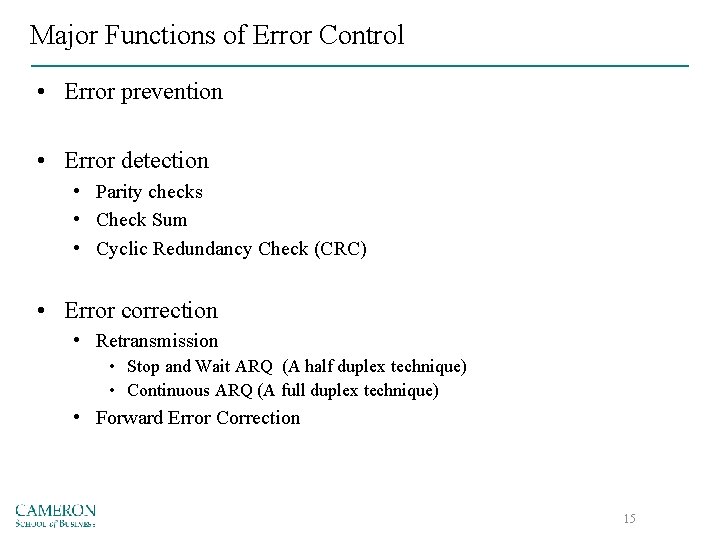
Major Functions of Error Control • Error prevention • Error detection • Parity checks • Check Sum • Cyclic Redundancy Check (CRC) • Error correction • Retransmission • Stop and Wait ARQ (A half duplex technique) • Continuous ARQ (A full duplex technique) • Forward Error Correction 15
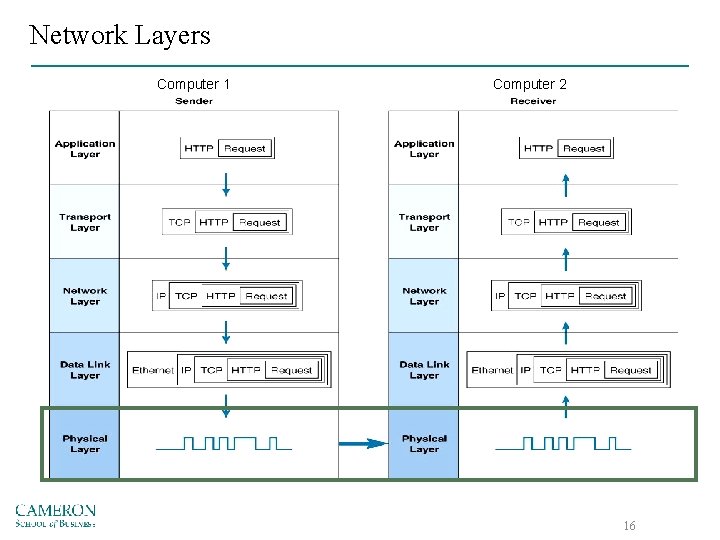
Network Layers Computer 1 Computer 2 16
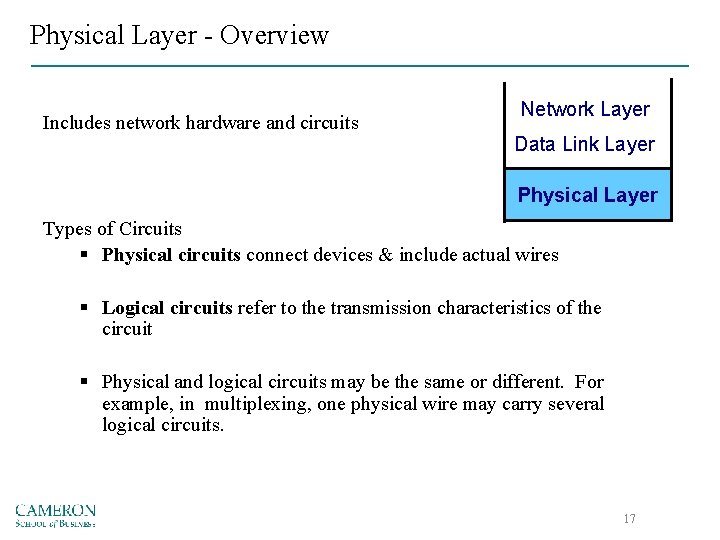
Physical Layer - Overview Includes network hardware and circuits Network Layer Data Link Layer Physical Layer Types of Circuits § Physical circuits connect devices & include actual wires § Logical circuits refer to the transmission characteristics of the circuit § Physical and logical circuits may be the same or different. For example, in multiplexing, one physical wire may carry several logical circuits. 17
Circuit Configurations & Data Flow Configuration: • Basic physical layout of the circuit • Configuration types: § Point-to-Point Configuration § Multipoint Configuration Data Flow (Transmission): • Simplex • Half-Duplex • Full-Duplex Multiplexing 18
Media Physical matter that carries the transmission • Signal transmitting properties of chosen media are important Types: • Guided Media • Radiated (Unguided) Media 19
Data Transmission Data - Representation of facts in a formalized manner suitable for communication, interpretation, or processing by humans or by automatic means Signal - Detectable transmitted energy that can be used to carry information Bits in a message can be sent on: § a single wire one after another (Serial transmission) § multiple wires simultaneously (Parallel transmission) Modes of transmission: • Serial Mode • Parallel Mode 20
Transmission Types Digital Transmission (Digital Data) – Voltage Encoding • • • Unipolar Bipolar NRZ Bipolar RZ Analog Transmission (Digital Data) – Modulation • • • Amplitude Modulation (AM) Frequency Modulation (FM) Phase Modulation (PM) Digital Transmission (Analog Data) § Requires a pair of special devices called Codec - Coder/decoder • A device that converts an analog voice signal into digital form • Converts it back to analog data at the receiving end • Used by the phone system 21