
RECAP OF CULTURAL DIMENSIONS THEORY Culture is the


- Slides: 29
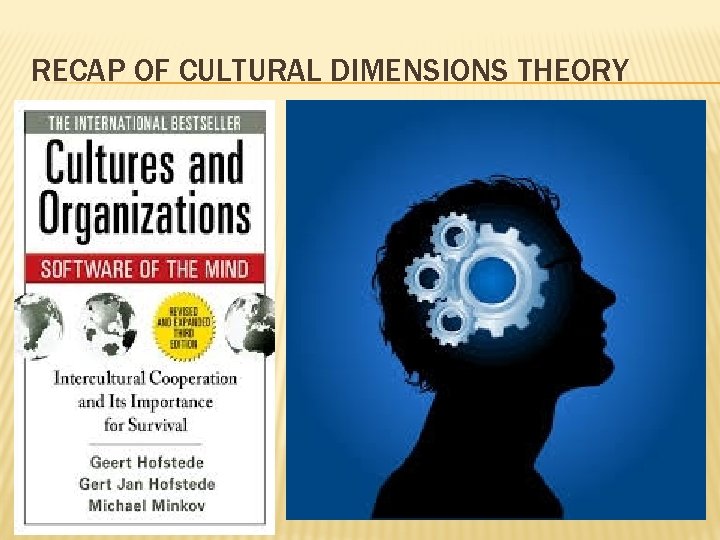
RECAP OF CULTURAL DIMENSIONS THEORY
“Culture is the collective programming of the mind distinguishing the members of one group or category of people from others”
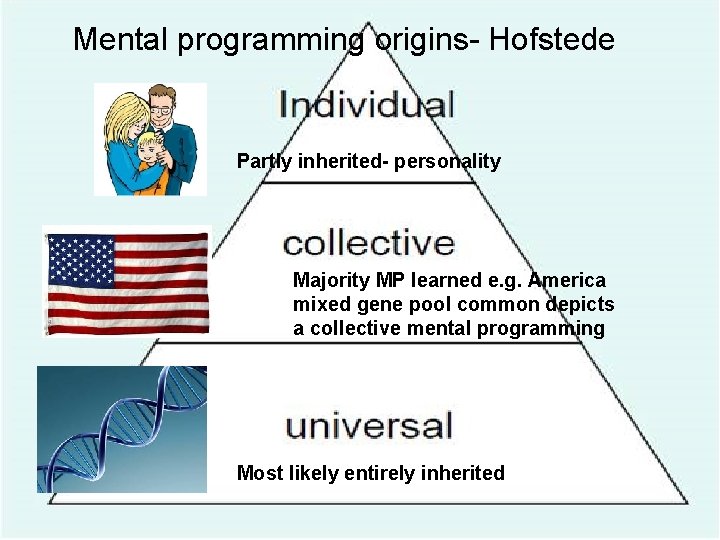
Mental programming origins- Hofstede Partly inherited- personality Majority MP learned e. g. America mixed gene pool common depicts a collective mental programming Most likely entirely inherited
CULTURAL DIMENSIONS THEORY Power distance society accept and expect that power is distributed unequally § Uncertainty avoidance future can never be known §
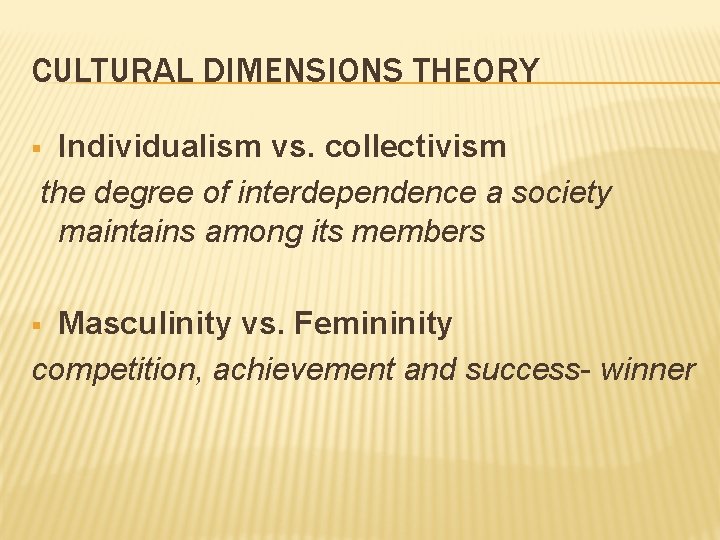
CULTURAL DIMENSIONS THEORY Individualism vs. collectivism the degree of interdependence a society maintains among its members § Masculinity vs. Femininity competition, achievement and success- winner §
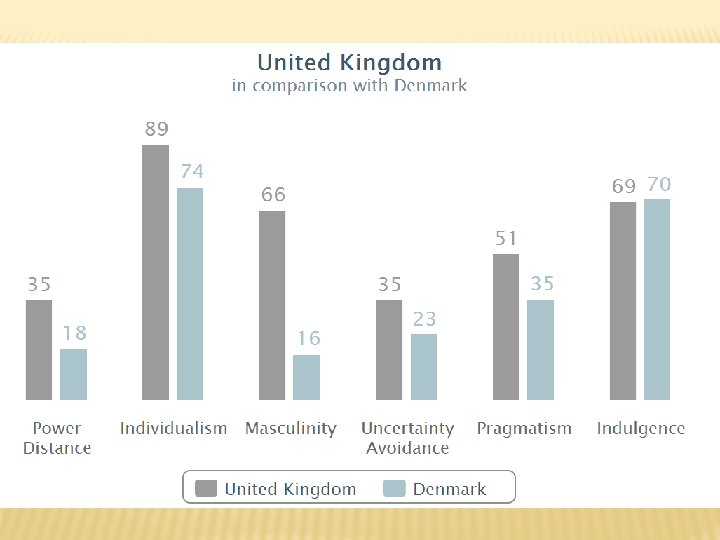
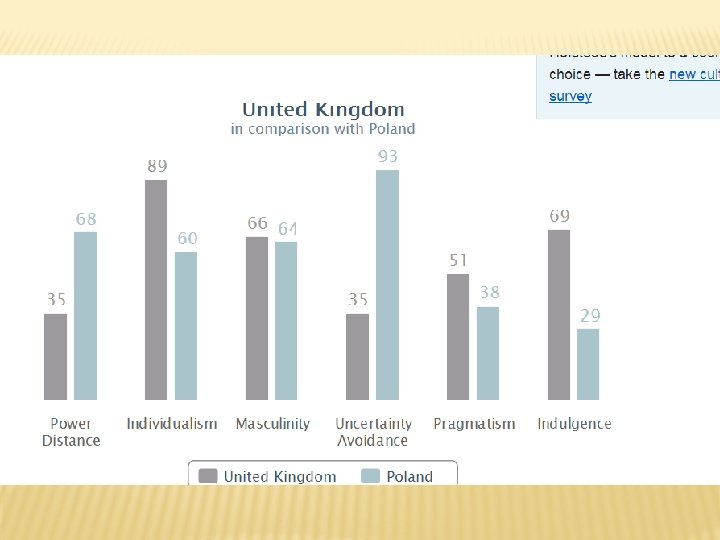
ADDITIONAL DIMENSIONS Pragmatic versus Normative (PRA) people in the past, as well as today, relate to the fact that so much that happens around us cannot be explained intermediate score of 51 in this dimension, a dominant preference in British culture cannot be determined
NORMATIVE strong desire to explain as much as possible People in such societies have a strong concern with establishing the absolute Truth and a need for personal stability
NORMATIVE exhibit great respect for social conventions and traditions small propensity to save for the future and a focus on achieving quick results
USA EXAMPLE OF A NORMATIVE COUNTRY Americans are prone to analyse new information to check whether it is true doesn’t make most Americans pragmatic should not be confused with the fact that Americans are very practical, being reflected by the “can-do” attitude strong ideas about what is “good” and “evil”.
issues such as abortion, use of drugs, euthanasia, weapons or the size and rights of the government versus the States and versus citizens. US is the one of the only “Caucasian” countries in the world where, since the beginning of the 20 th century, visiting church has increased also evident in some post-Soviet republics e. g. Russia American businesses measure their performance on a short-term basis
PRAGMATIC In societies with a pragmatic orientation, most people don’t have a need to explain everything it is impossible to understand fully the complexity of life
PRAGMATIC The challenge is not to know the truth but to live a virtuous life people believe that truth depends very much on situation, context and time. show an ability to accept contradictions adapt according to the circumstances strong propensity (tendency)save & invest, thriftiness and perseverance in achieving results
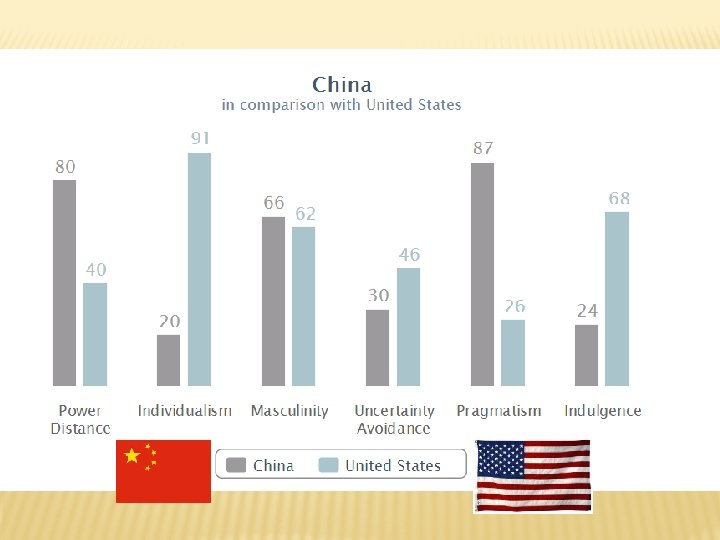
CHINA EXAMPLE China scores 87 in this dimension very pragmatic culture truth depends very much on situation, context and time ability to adapt traditions easily to changed conditions a strong propensity to save and invest, thriftiness, and perseverance in achieving results
ADDITIONAL DIMENSIONS Indulgence versus Restraint (IND) the extent to which people try to control their desires and impulses, based on the way they were raised Relatively weak control is called “indulgence” and relatively strong control is called “restraint” Cultures can, therefore, be described as indulgent or restrained.
INDULGENCE HIGH 69 EXAMPLE British culture is one that is classified as indulgent exhibit a willingness to realise their impulses and desires with regard to enjoying life and having fun possess a positive attitude and have a tendency towards optimism place a higher degree of importance on leisure time, act as they please and spend money as they wish
POLAND LOW 29 EXAMPLE Polish culture is one of restraint Societies with a low score in this dimension have a tendency to cynicism and pessimism in contrast to indulgent societies, restrained societies do not put much emphasis on leisure time and control the gratification of their desires have the perception that their actions are restrained by social norms and feel that indulging themselves is somewhat wrong
TROMPENAARS (1993) Extend work of Hofstede Intercultural communication in Business environments
UNIVERSALISM VS. PARTICULARISM What is more important, rules (logic & rationality) or relationships (rules less influence)?
NEUTRAL VS. EMOTIONAL Do we display our emotions? Affective cultures- emotions displayed openly Neutral cultures- emotions not displayed openly
SPECIFIC VS. DIFFUSE How separate we keep our private and working lives Relationships in and out of work
ACHIEVEMENT VS. ASCRIPTION Do we have to prove ourselves to receive status or is it given to us?
SEQUENTIAL VS. SYNCHRONIC Do we do things one at a time or several things at once?
INTERNAL VS. EXTERNAL CONTROL Do we control our environment or are we controlled by it? Individuals attempt to control environment Individuals accept their environment
CRITIQUE OF TROMPENAARS Draws to conclusions flaws in methodology