
Recap Oersted discovered magnetic field produced by a
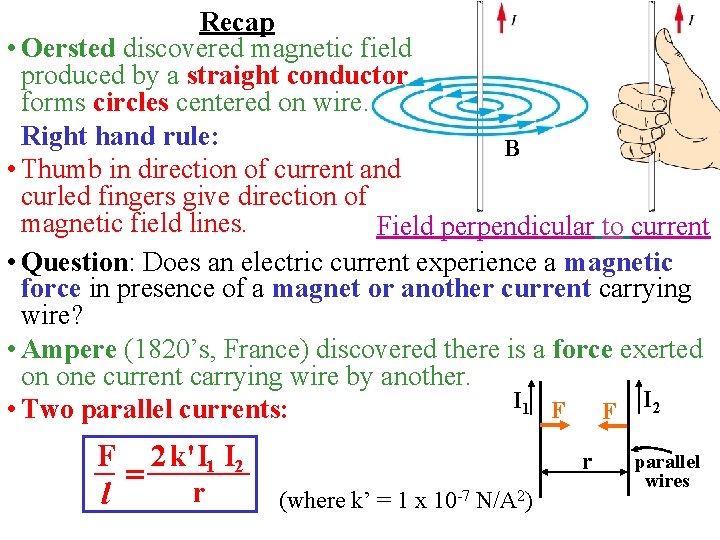
Recap • Oersted discovered magnetic field produced by a straight conductor forms circles centered on wire. Right hand rule: B • Thumb in direction of current and curled fingers give direction of magnetic field lines. Field perpendicular to current • Question: Does an electric current experience a magnetic force in presence of a magnet or another current carrying wire? • Ampere (1820’s, France) discovered there is a force exerted on one current carrying wire by another. I 1 F • Two parallel currents: F I 2 F 2 k' I 1 I 2 = r l r (where k’ = 1 x 10 -7 N/A 2) parallel wires
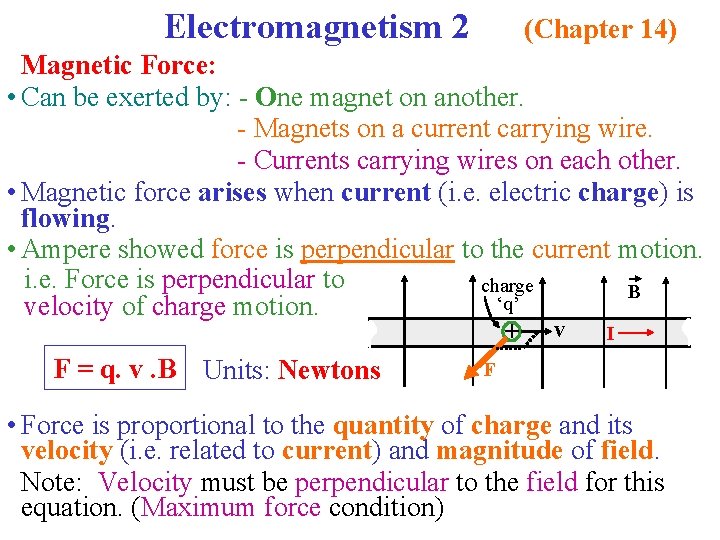
Electromagnetism 2 (Chapter 14) Magnetic Force: • Can be exerted by: - One magnet on another. - Magnets on a current carrying wire. - Currents carrying wires on each other. • Magnetic force arises when current (i. e. electric charge) is flowing. • Ampere showed force is perpendicular to the current motion. i. e. Force is perpendicular to charge B ‘q’ velocity of charge motion. + F = q. v. B Units: Newtons v I F • Force is proportional to the quantity of charge and its velocity (i. e. related to current) and magnitude of field. Note: Velocity must be perpendicular to the field for this equation. (Maximum force condition)
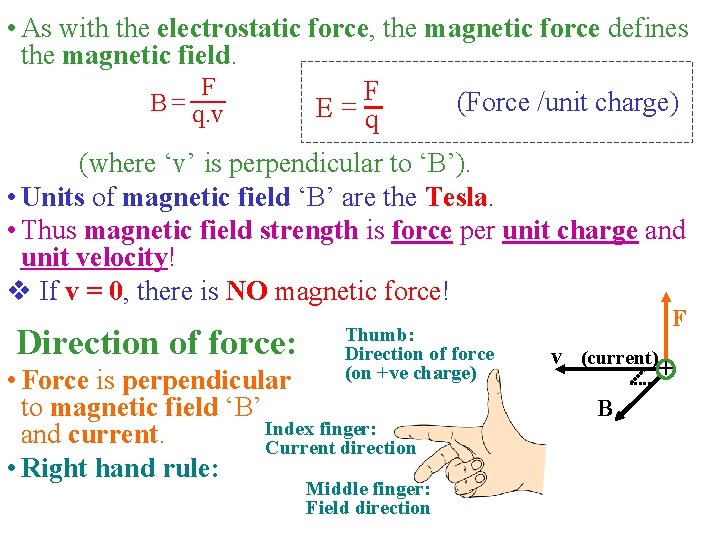
• As with the electrostatic force, the magnetic force defines the magnetic field. F F (Force /unit charge) B = q. v = E q (where ‘v’ is perpendicular to ‘B’). • Units of magnetic field ‘B’ are the Tesla. • Thus magnetic field strength is force per unit charge and unit velocity! v If v = 0, there is NO magnetic force! Direction of force: Thumb: Direction of force (on +ve charge) • Force is perpendicular to magnetic field ‘B’ Index finger: and current. Current direction • Right hand rule: Middle finger: Field direction F v (current) B +
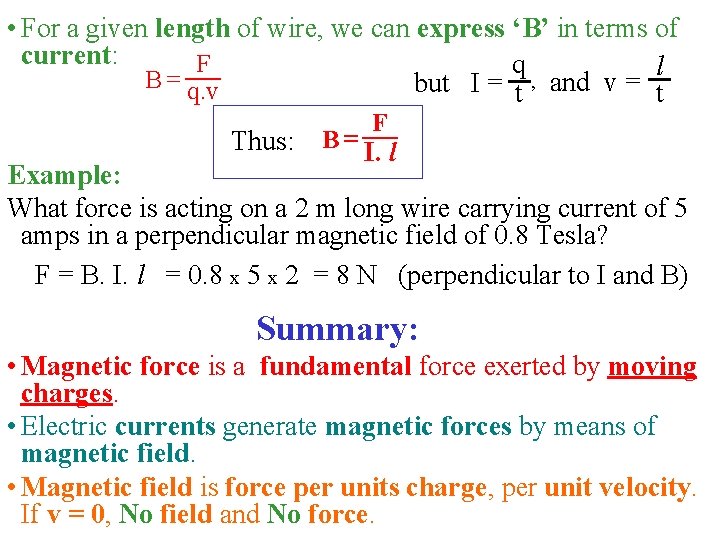
• For a given length of wire, we can express ‘B’ in terms of current: F q l = , B q. v but I = t and v = t F Thus: B = I. l Example: What force is acting on a 2 m long wire carrying current of 5 amps in a perpendicular magnetic field of 0. 8 Tesla? F = B. I. l = 0. 8 x 5 x 2 = 8 N (perpendicular to I and B) Summary: • Magnetic force is a fundamental force exerted by moving charges. • Electric currents generate magnetic forces by means of magnetic field. • Magnetic field is force per units charge, per unit velocity. If v = 0, No field and No force.
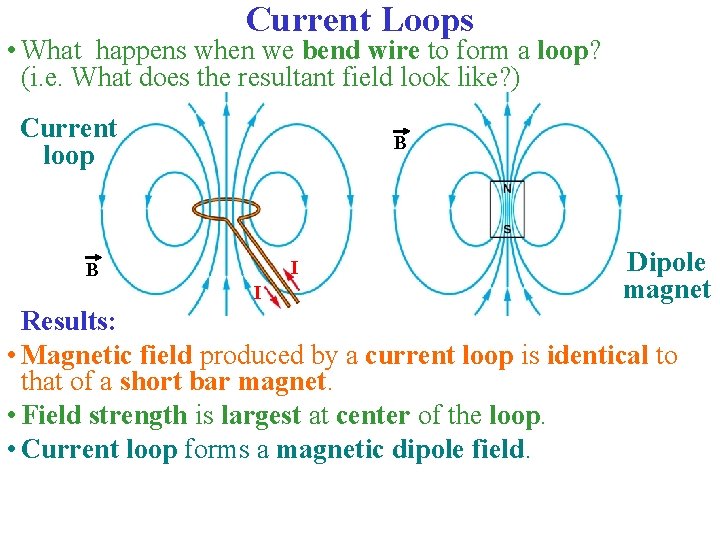
Current Loops • What happens when we bend wire to form a loop? (i. e. What does the resultant field look like? ) Current loop B I Dipole magnet Results: • Magnetic field produced by a current loop is identical to that of a short bar magnet. • Field strength is largest at center of the loop. • Current loop forms a magnetic dipole field.
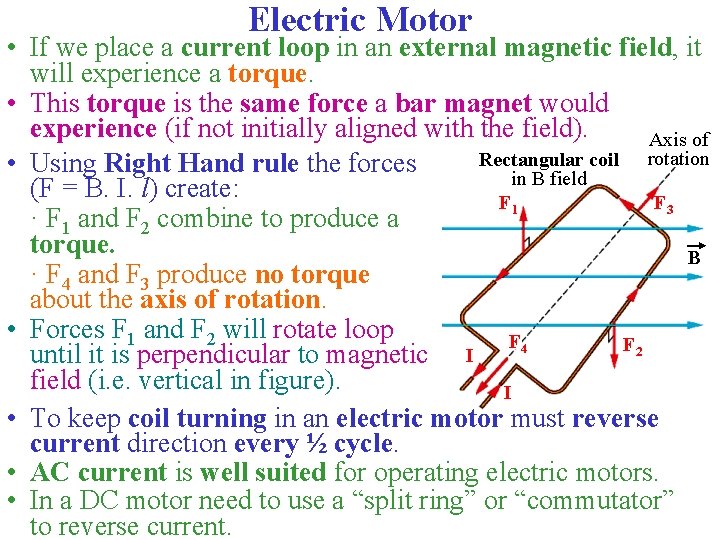
Electric Motor • If we place a current loop in an external magnetic field, it will experience a torque. • This torque is the same force a bar magnet would experience (if not initially aligned with the field). Axis of Rectangular coil rotation • Using Right Hand rule the forces in B field (F = B. I. l) create: F 3 F 1 · F 1 and F 2 combine to produce a torque. B · F 4 and F 3 produce no torque about the axis of rotation. • Forces F 1 and F 2 will rotate loop F 4 F 2 until it is perpendicular to magnetic I field (i. e. vertical in figure). I • To keep coil turning in an electric motor must reverse current direction every ½ cycle. • AC current is well suited for operating electric motors. • In a DC motor need to use a “split ring” or “commutator” to reverse current.
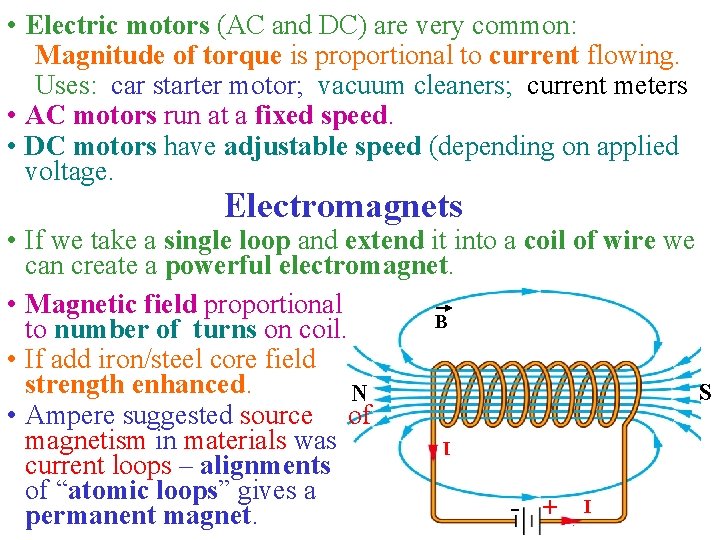
• Electric motors (AC and DC) are very common: Magnitude of torque is proportional to current flowing. Uses: car starter motor; vacuum cleaners; current meters • AC motors run at a fixed speed. • DC motors have adjustable speed (depending on applied voltage. Electromagnets • If we take a single loop and extend it into a coil of wire we can create a powerful electromagnet. • Magnetic field proportional B to number of turns on coil. • If add iron/steel core field strength enhanced. S N • Ampere suggested source of magnetism in materials was I current loops – alignments of “atomic loops” gives a - + I permanent magnet.
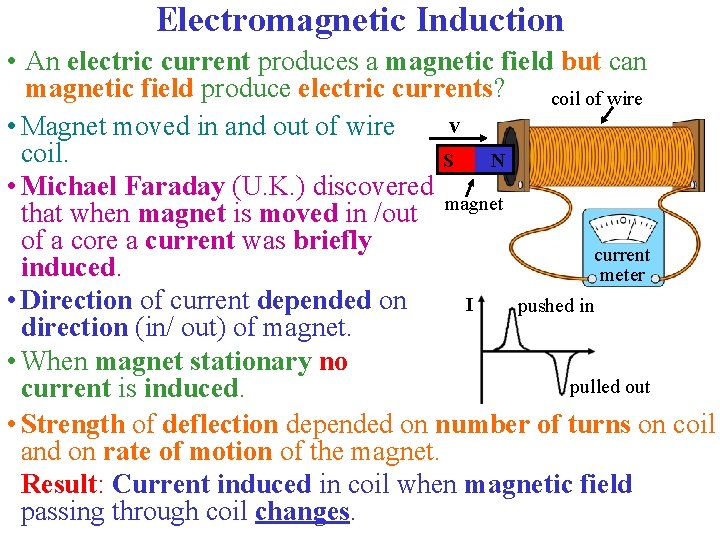
Electromagnetic Induction • An electric current produces a magnetic field but can magnetic field produce electric currents? coil of wire v • Magnet moved in and out of wire coil. S N • Michael Faraday (U. K. ) discovered that when magnet is moved in /out magnet of a core a current was briefly current induced. meter • Direction of current depended on I pushed in direction (in/ out) of magnet. • When magnet stationary no pulled out current is induced. • Strength of deflection depended on number of turns on coil and on rate of motion of the magnet. Result: Current induced in coil when magnetic field passing through coil changes.
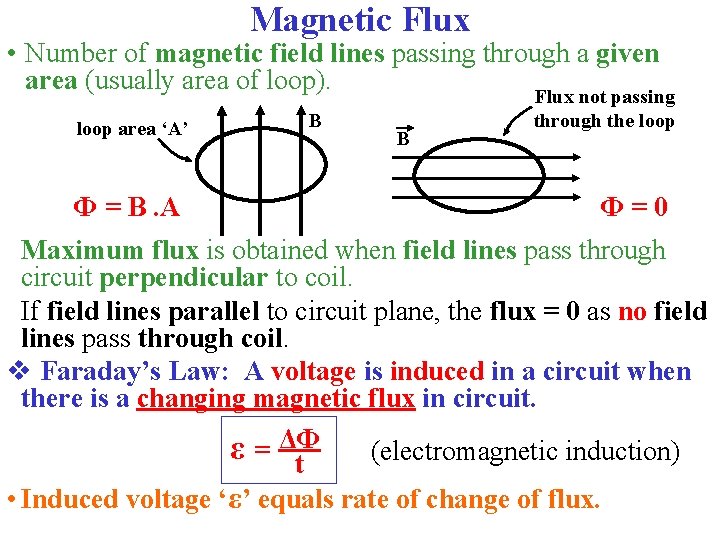
Magnetic Flux • Number of magnetic field lines passing through a given area (usually area of loop). Flux not passing loop area ‘A’ Ф = B. A B B through the loop Ф=0 Maximum flux is obtained when field lines pass through circuit perpendicular to coil. If field lines parallel to circuit plane, the flux = 0 as no field lines pass through coil. v Faraday’s Law: A voltage is induced in a circuit when there is a changing magnetic flux in circuit. ε = ΔФ (electromagnetic induction) t • Induced voltage ‘ε’ equals rate of change of flux.
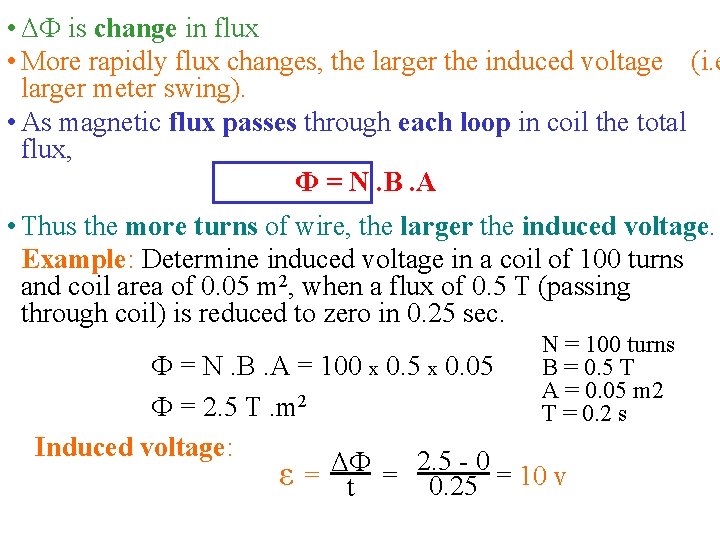
• ΔФ is change in flux • More rapidly flux changes, the larger the induced voltage (i. e larger meter swing). • As magnetic flux passes through each loop in coil the total flux, Ф = N. B. A • Thus the more turns of wire, the larger the induced voltage. Example: Determine induced voltage in a coil of 100 turns and coil area of 0. 05 m 2, when a flux of 0. 5 T (passing through coil) is reduced to zero in 0. 25 sec. N = 100 turns B = 0. 5 T A = 0. 05 m 2 T = 0. 2 s Ф = N. B. A = 100 x 0. 5 x 0. 05 Ф = 2. 5 T. m 2 Induced voltage: 2. 5 - 0 ΔФ ε = t = 0. 25 = 10 v
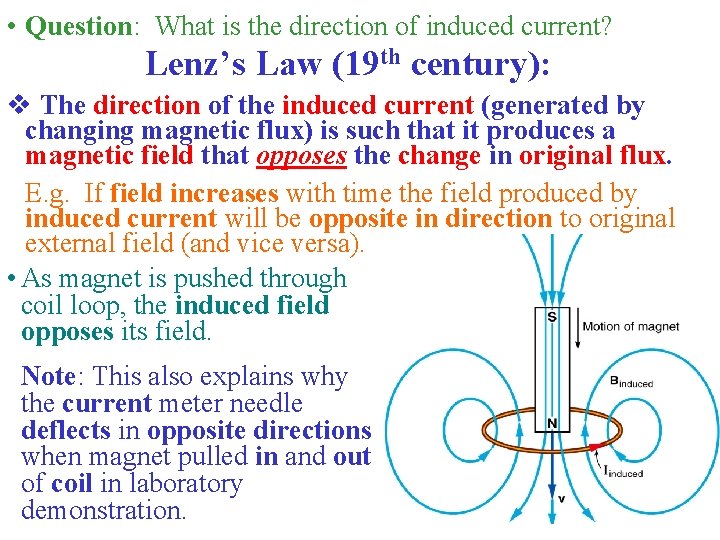
• Question: What is the direction of induced current? Lenz’s Law (19 th century): v The direction of the induced current (generated by changing magnetic flux) is such that it produces a magnetic field that opposes the change in original flux. E. g. If field increases with time the field produced by induced current will be opposite in direction to original external field (and vice versa). • As magnet is pushed through coil loop, the induced field opposes its field. Note: This also explains why the current meter needle deflects in opposite directions when magnet pulled in and out of coil in laboratory demonstration.

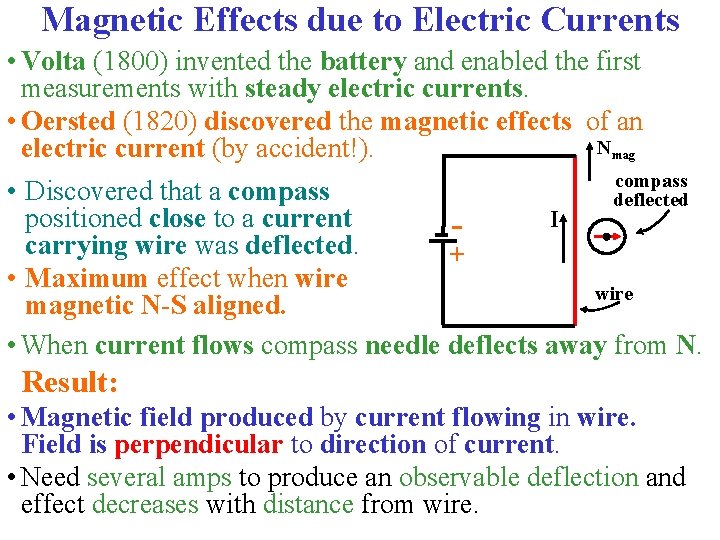
Magnetic Effects due to Electric Currents • Volta (1800) invented the battery and enabled the first measurements with steady electric currents. • Oersted (1820) discovered the magnetic effects of an Nmag electric current (by accident!). compass • Discovered that a compass deflected positioned close to a current I carrying wire was deflected. + • Maximum effect when wire magnetic N-S aligned. • When current flows compass needle deflects away from N. Result: • Magnetic field produced by current flowing in wire. Field is perpendicular to direction of current. • Need several amps to produce an observable deflection and effect decreases with distance from wire.
- Slides: 13