
Recap Newtons 3 rd law Action and Reaction
- Slides: 17
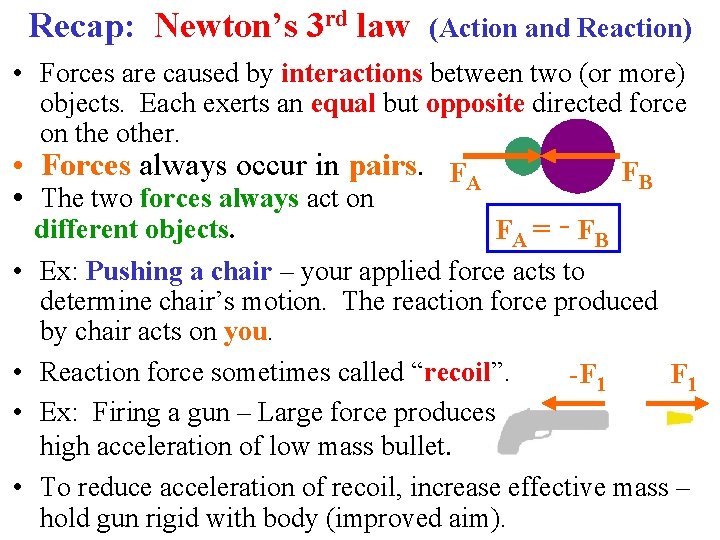
Recap: Newton’s 3 rd law (Action and Reaction) • Forces are caused by interactions between two (or more) objects. Each exerts an equal but opposite directed force on the other. • Forces always occur in pairs. FA FB • The two forces always act on different objects. FA = - FB • Ex: Pushing a chair – your applied force acts to determine chair’s motion. The reaction force produced by chair acts on you. • Reaction force sometimes called “recoil”. -F 1 • Ex: Firing a gun – Large force produces high acceleration of low mass bullet. • To reduce acceleration of recoil, increase effective mass – hold gun rigid with body (improved aim).
Internal and External Forces: • External forces act on the object to cause motion. • An internal force has no effect on the object’s overall motion. Examples: Internal force 1. You cannot lift yourself up and fly!! All the forces you can exert on yourself are counteracted and net force = 0, as no interaction with external objects. 2. You cannot push a car from the inside!! If you push forward on steering wheel, it pushes you back against your seat, net force = 0!
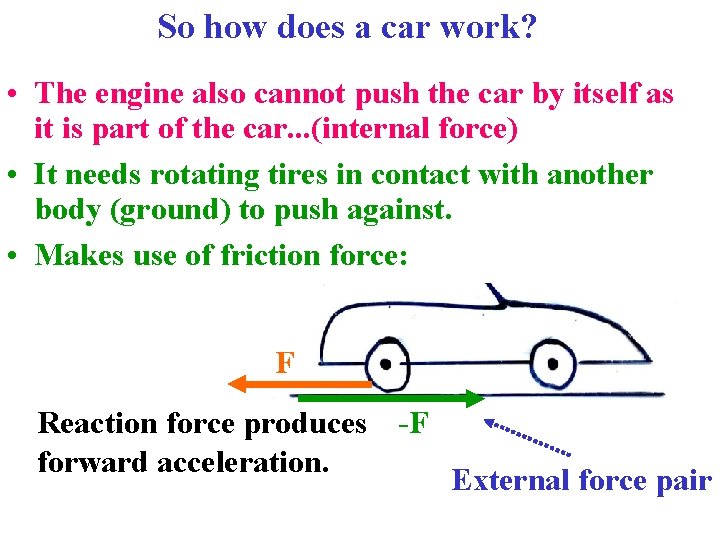
So how does a car work? • The engine also cannot push the car by itself as it is part of the car. . . (internal force) • It needs rotating tires in contact with another body (ground) to push against. • Makes use of friction force: F Reaction force produces -F forward acceleration. External force pair
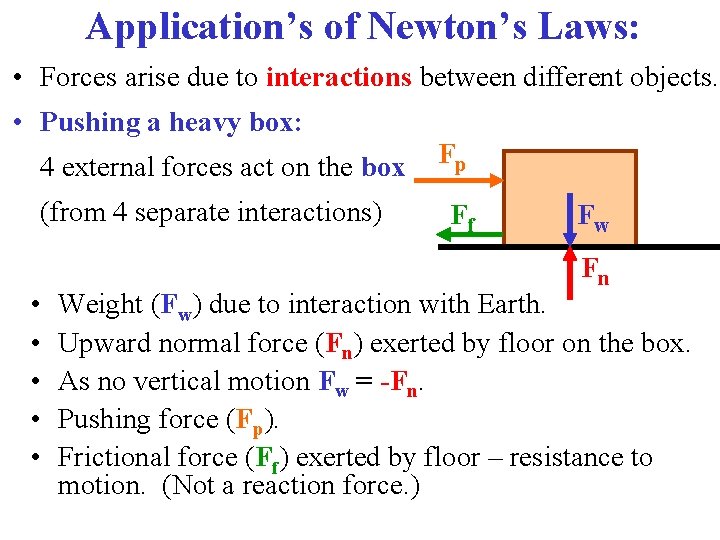
Application’s of Newton’s Laws: • Forces arise due to interactions between different objects. • Pushing a heavy box: 4 external forces act on the box (from 4 separate interactions) • • • Fp Ff Fw Fn Weight (Fw) due to interaction with Earth. Upward normal force (Fn) exerted by floor on the box. As no vertical motion Fw = -Fn. Pushing force (Fp). Frictional force (Ff) exerted by floor – resistance to motion. (Not a reaction force. )
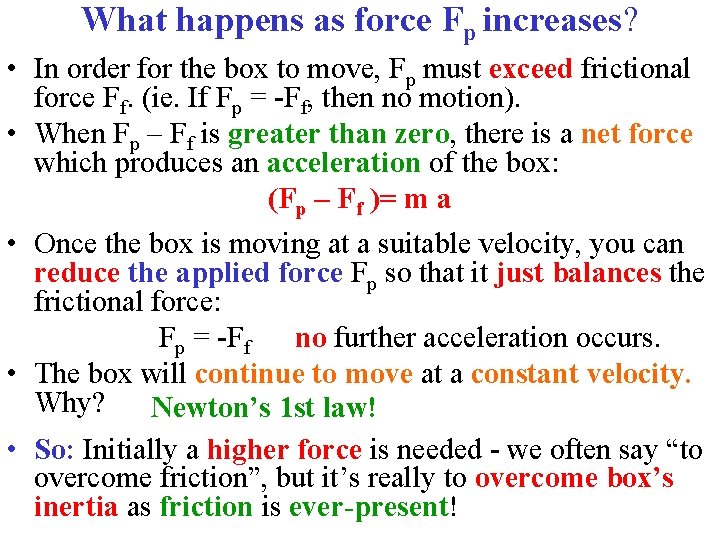
What happens as force Fp increases? • In order for the box to move, Fp must exceed frictional force Ff. (ie. If Fp = -Ff, then no motion). • When Fp – Ff is greater than zero, there is a net force which produces an acceleration of the box: (Fp – Ff )= m a • Once the box is moving at a suitable velocity, you can reduce the applied force Fp so that it just balances the frictional force: Fp = -Ff no further acceleration occurs. • The box will continue to move at a constant velocity. Why? Newton’s 1 st law! • So: Initially a higher force is needed - we often say “to overcome friction”, but it’s really to overcome box’s inertia as friction is ever-present!
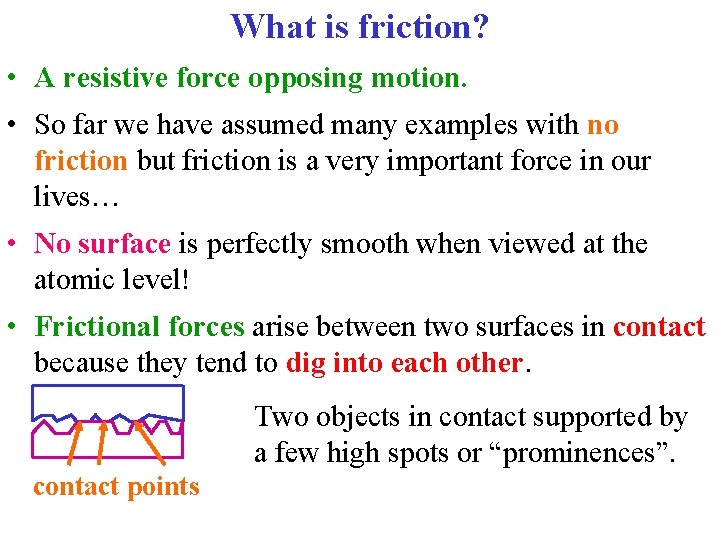
What is friction? • A resistive force opposing motion. • So far we have assumed many examples with no friction but friction is a very important force in our lives… • No surface is perfectly smooth when viewed at the atomic level! • Frictional forces arise between two surfaces in contact because they tend to dig into each other. Two objects in contact supported by a few high spots or “prominences”. contact points
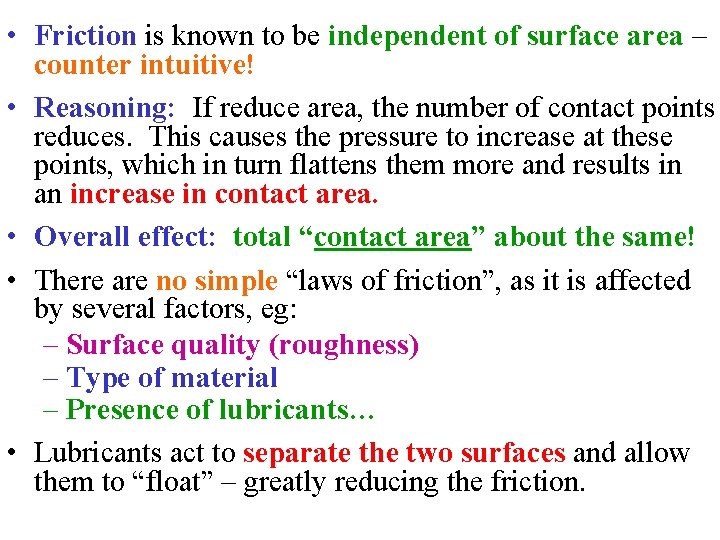
• Friction is known to be independent of surface area – counter intuitive! • Reasoning: If reduce area, the number of contact points reduces. This causes the pressure to increase at these points, which in turn flattens them more and results in an increase in contact area. • Overall effect: total “contact area” about the same! • There are no simple “laws of friction”, as it is affected by several factors, eg: – Surface quality (roughness) – Type of material – Presence of lubricants… • Lubricants act to separate the two surfaces and allow them to “float” – greatly reducing the friction.
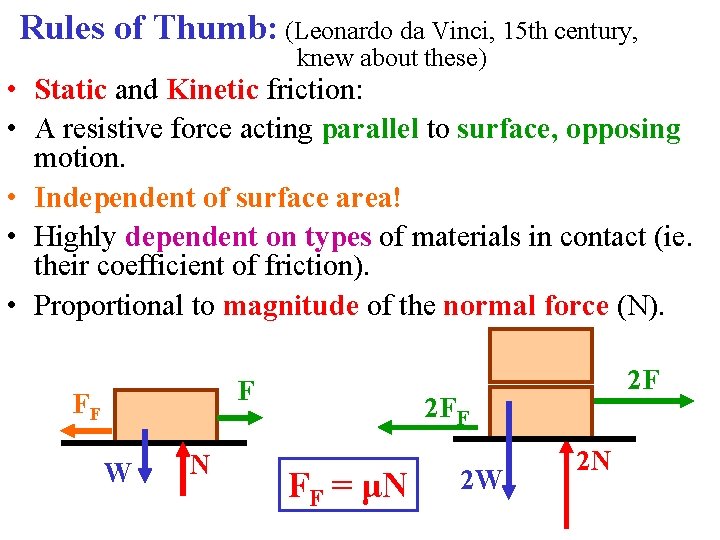
Rules of Thumb: (Leonardo da Vinci, 15 th century, knew about these) • Static and Kinetic friction: • A resistive force acting parallel to surface, opposing motion. • Independent of surface area! • Highly dependent on types of materials in contact (ie. their coefficient of friction). • Proportional to magnitude of the normal force (N). F FF W N 2 FF FF = μN 2 W Fw 2 N 2 F
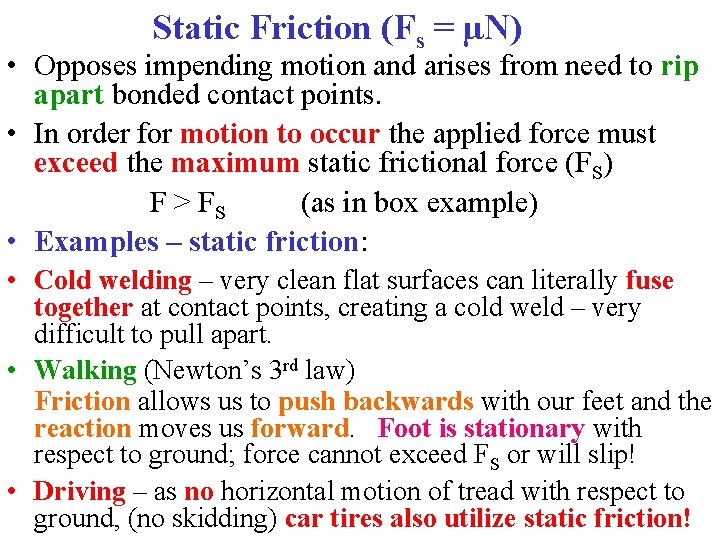
Static Friction (Fs = µN) • Opposes impending motion and arises from need to rip apart bonded contact points. • In order for motion to occur the applied force must exceed the maximum static frictional force (FS) F > FS (as in box example) • Examples – static friction: • Cold welding – very clean flat surfaces can literally fuse together at contact points, creating a cold weld – very difficult to pull apart. • Walking (Newton’s 3 rd law) Friction allows us to push backwards with our feet and the reaction moves us forward. Foot is stationary with respect to ground; force cannot exceed FS or will slip! • Driving – as no horizontal motion of tread with respect to ground, (no skidding) car tires also utilize static friction!
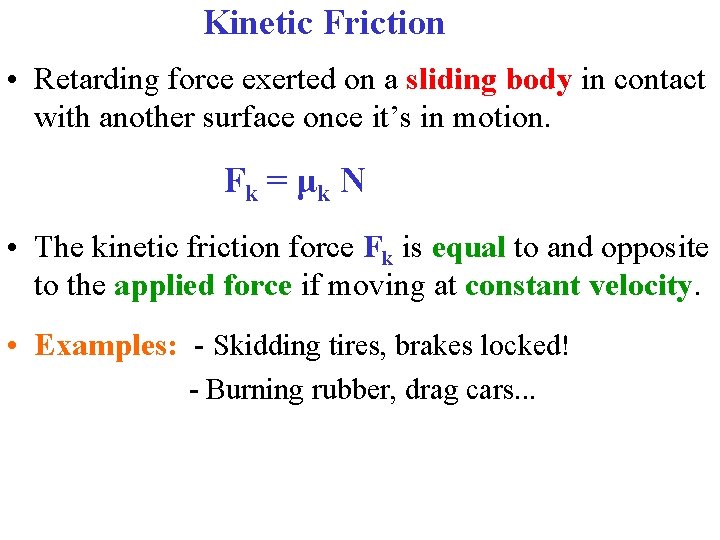
Kinetic Friction • Retarding force exerted on a sliding body in contact with another surface once it’s in motion. Fk = μk N • The kinetic friction force Fk is equal to and opposite to the applied force if moving at constant velocity. • Examples: - Skidding tires, brakes locked! - Burning rubber, drag cars. . .
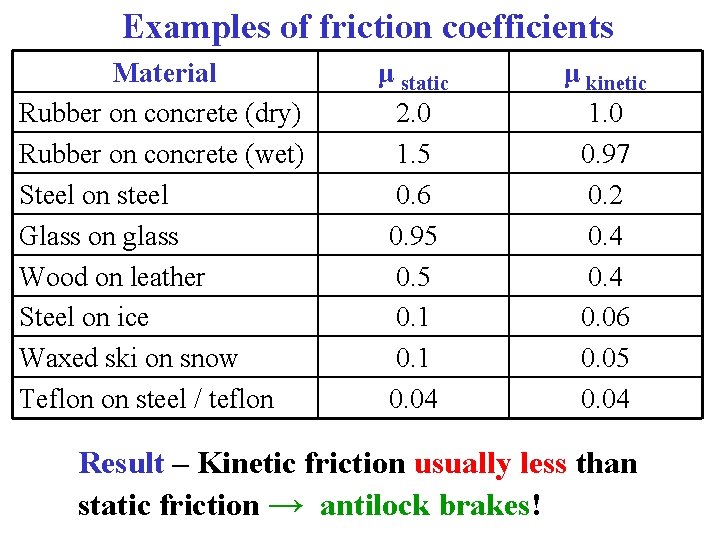
Examples of friction coefficients Material Rubber on concrete (dry) Rubber on concrete (wet) Steel on steel Glass on glass Wood on leather Steel on ice Waxed ski on snow Teflon on steel / teflon μ static 2. 0 1. 5 0. 6 0. 95 0. 1 0. 04 μ kinetic 1. 0 0. 97 0. 2 0. 4 0. 06 0. 05 0. 04 Result – Kinetic friction usually less than static friction → antilock brakes!
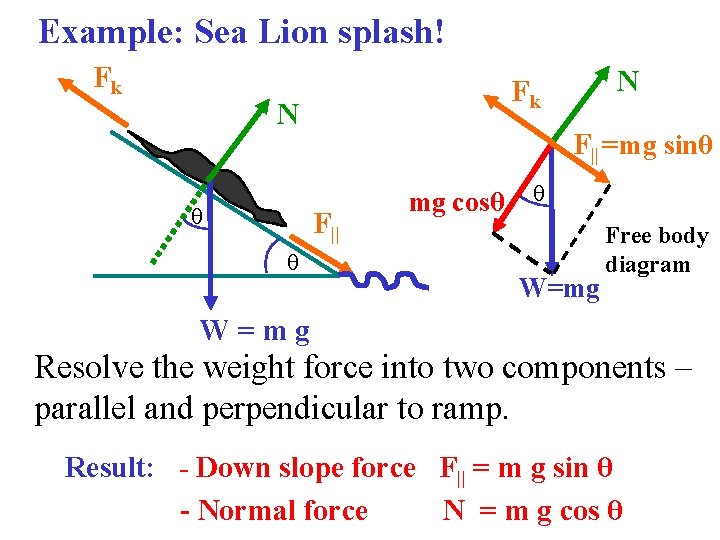
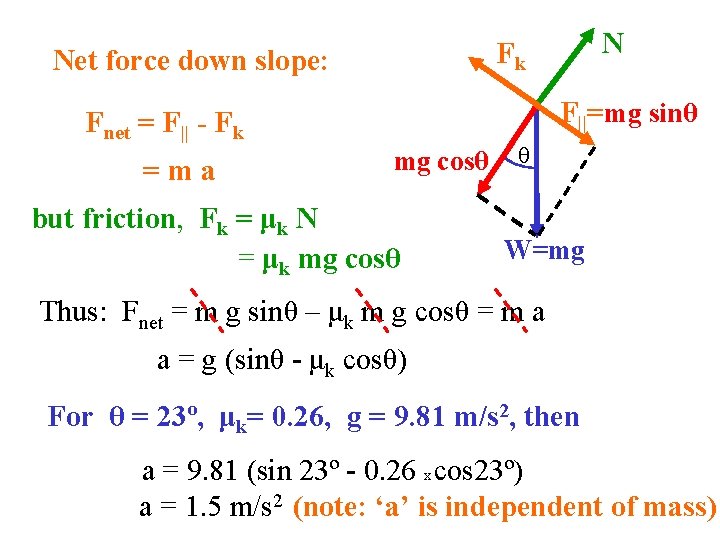
Example: Sea Lion splash! Fk N θ F|| =mg sinθ F|| θ N Fk mg cosθ θ W=mg Free body diagram W=mg Resolve the weight force into two components – parallel and perpendicular to ramp. Result: - Down slope force F|| = m g sin θ - Normal force N = m g cos θ
Net force down slope: F||=mg sinθ Fnet = F|| - Fk =ma N Fk mg cosθ but friction, Fk = μk N = μk mg cosθ θ W=mg Thus: Fnet = m g sinθ – μk m g cosθ = m a a = g (sinθ - μk cosθ) For θ = 23º, μk= 0. 26, g = 9. 81 m/s 2, then a = 9. 81 (sin 23º - 0. 26 x cos 23º) a = 1. 5 m/s 2 (note: ‘a’ is independent of mass)
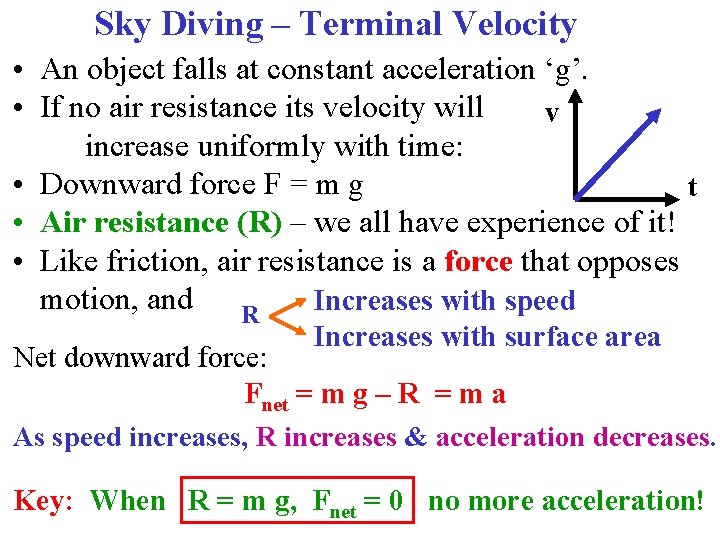
Sky Diving – Terminal Velocity • An object falls at constant acceleration ‘g’. • If no air resistance its velocity will v increase uniformly with time: • Downward force F = m g t • Air resistance (R) – we all have experience of it! • Like friction, air resistance is a force that opposes motion, and Increases with speed R Increases with surface area Net downward force: Fnet = m g – R = m a As speed increases, R increases & acceleration decreases. Key: When R = m g, Fnet = 0 no more acceleration!
• The condition when R = m g is called “terminal velocity”. Terminal velocity depends on object’s WEIGHT! • Thus, more massive (heavier) objects will have a higher terminal velocity! • A feather is light and has a large surface area, therefore its terminal velocity will be very low. • A sky diver’s terminal velocity is much larger, about 100 mph (160 km/hr) depending on weight and surface area. • This is the origin of Aristotle’s mistake, when he mistook the reason why heavier objects fall faster than lighter ones! • Note: Terminal velocity not limited to gases. • In a liquid the resistance force R is usually much larger and terminal velocity occurs at lower velocities.
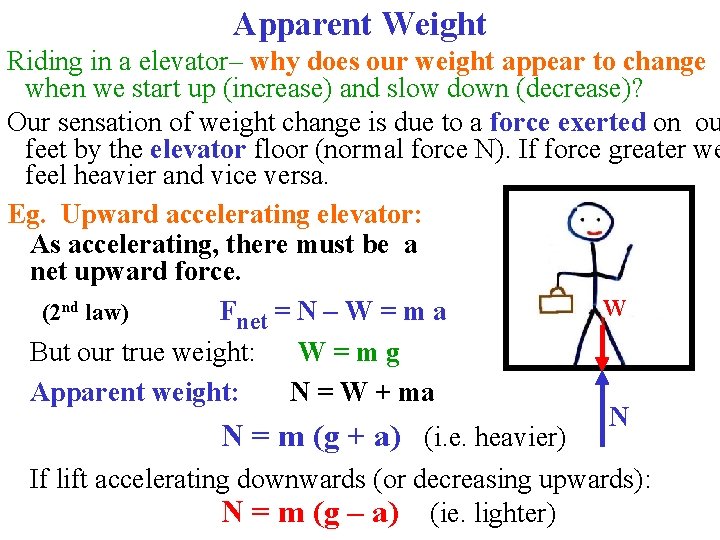
Apparent Weight Riding in a elevator– why does our weight appear to change when we start up (increase) and slow down (decrease)? Our sensation of weight change is due to a force exerted on ou feet by the elevator floor (normal force N). If force greater we feel heavier and vice versa. Eg. Upward accelerating elevator: As accelerating, there must be a net upward force. W (2 nd law) Fnet = N – W = m a But our true weight: W=mg Apparent weight: N = W + ma N N = m (g + a) (i. e. heavier) If lift accelerating downwards (or decreasing upwards): N = m (g – a) (ie. lighter)
Free-Falling • When you jump off a wall, or throw a ball or drop a rock in a pool, the object is free-falling ie. falling under the influence of gravity. • Question: What happens to our apparent weight in free-fall? • Nasty Exp: Cut elevator wires so its downward acceleration a = g (i. e. free-fall)! • Apparent weight N = m (g – a) • But a = g, so N = 0 i. e. no normal force. • “Weightless” is zero apparent weight. • Everything is falling at same rate, so no normal force is needed to support your weight. • Ex: Aircraft flying in a parabolic path can create weightless conditions for up to 30 s! • Spacecraft / astronauts in orbit are weightless as they (and the spacecraft) are continuously free-falling towards the Earth!!