
Recap maximum likelihood estimation Since Set partial derivatives

- Slides: 28
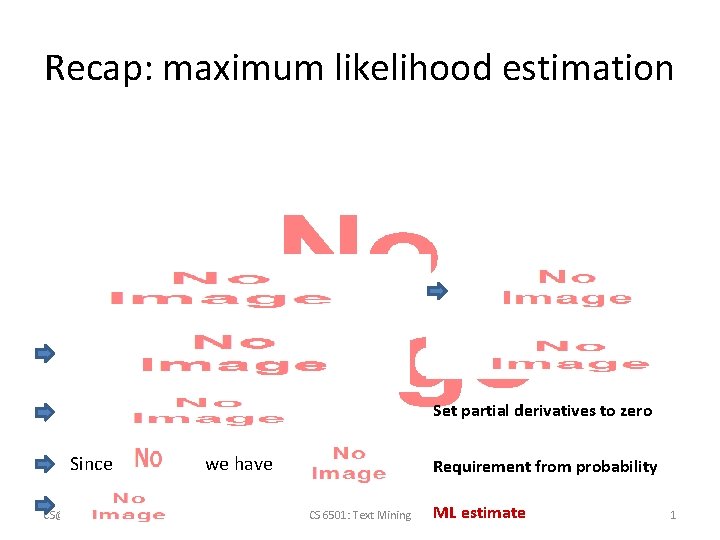
Recap: maximum likelihood estimation • Since Set partial derivatives to zero we have Requirement from probability CS@UVa CS 6501: Text Mining ML estimate 1
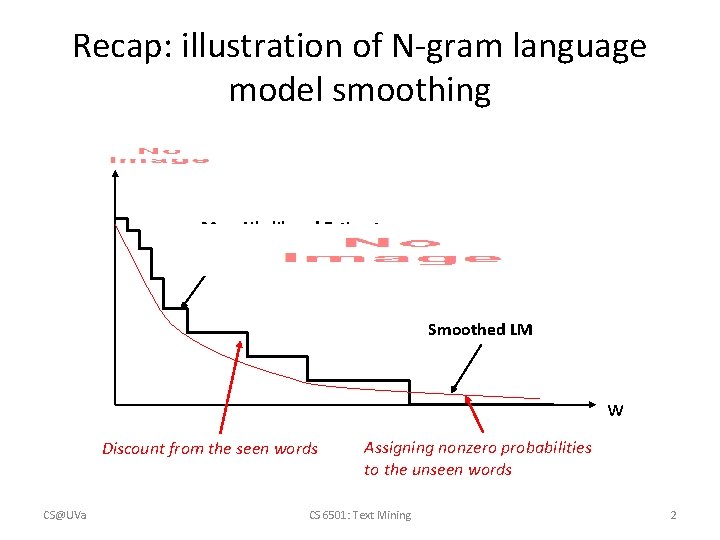
Recap: illustration of N-gram language model smoothing Max. Likelihood Estimate Smoothed LM w Discount from the seen words CS@UVa Assigning nonzero probabilities to the unseen words CS 6501: Text Mining 2
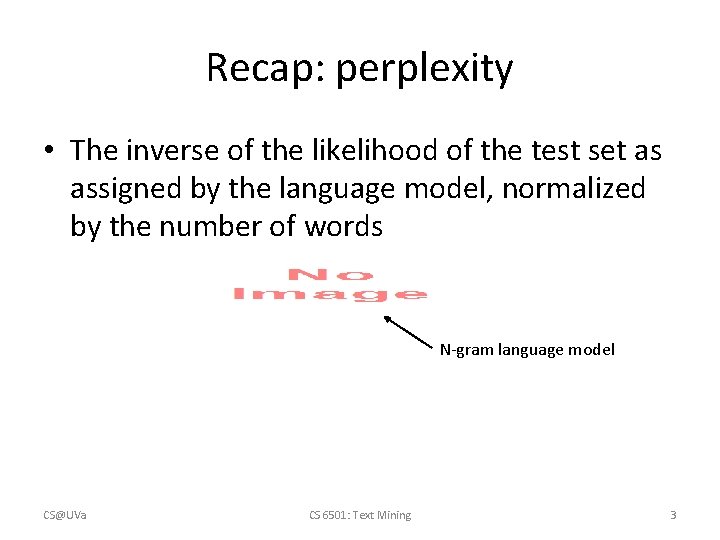
Recap: perplexity • The inverse of the likelihood of the test set as assigned by the language model, normalized by the number of words N-gram language model CS@UVa CS 6501: Text Mining 3
Latent Semantic Analysis Hongning Wang CS@UVa
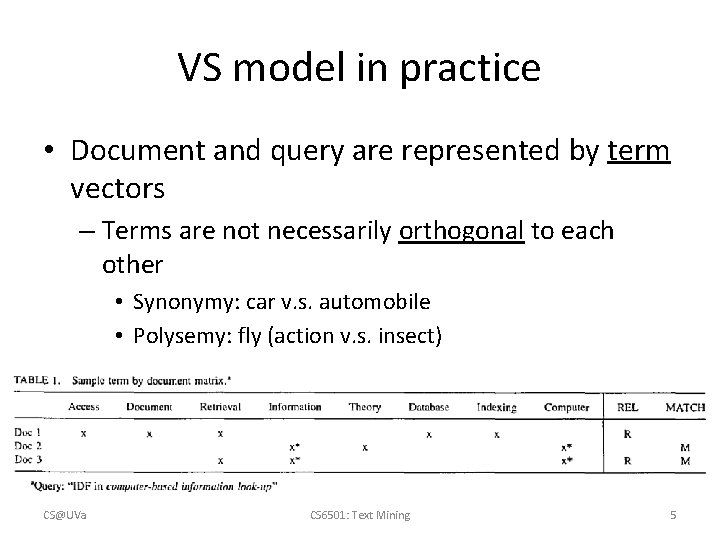
VS model in practice • Document and query are represented by term vectors – Terms are not necessarily orthogonal to each other • Synonymy: car v. s. automobile • Polysemy: fly (action v. s. insect) CS@UVa CS 6501: Text Mining 5
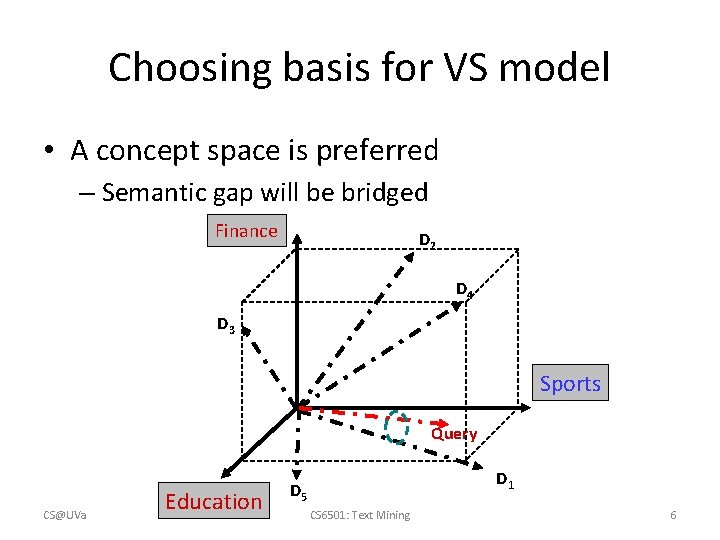
Choosing basis for VS model • A concept space is preferred – Semantic gap will be bridged Finance D 2 D 4 D 3 Sports Query CS@UVa Education D 1 D 5 CS 6501: Text Mining 6
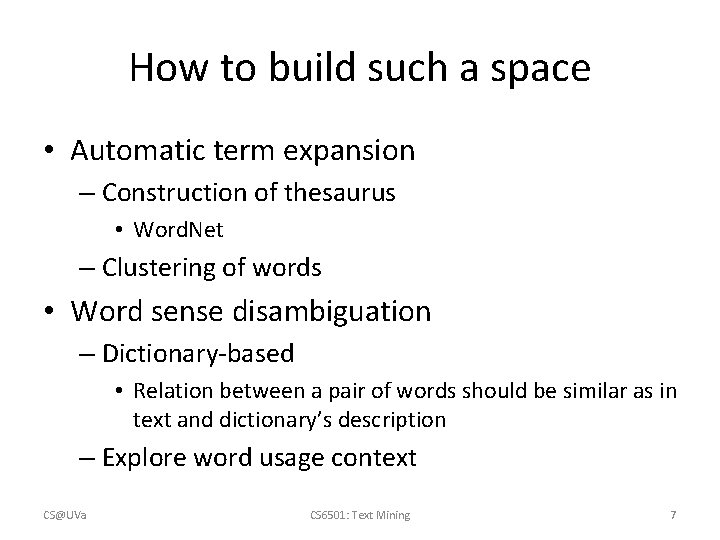
How to build such a space • Automatic term expansion – Construction of thesaurus • Word. Net – Clustering of words • Word sense disambiguation – Dictionary-based • Relation between a pair of words should be similar as in text and dictionary’s description – Explore word usage context CS@UVa CS 6501: Text Mining 7
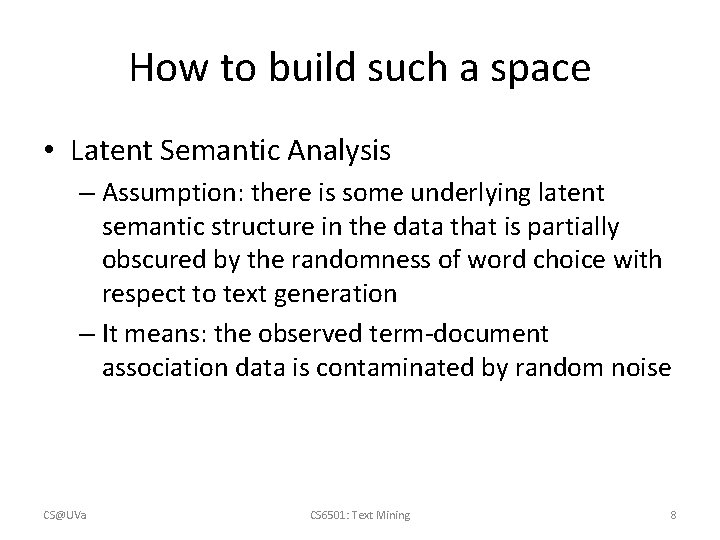
How to build such a space • Latent Semantic Analysis – Assumption: there is some underlying latent semantic structure in the data that is partially obscured by the randomness of word choice with respect to text generation – It means: the observed term-document association data is contaminated by random noise CS@UVa CS 6501: Text Mining 8
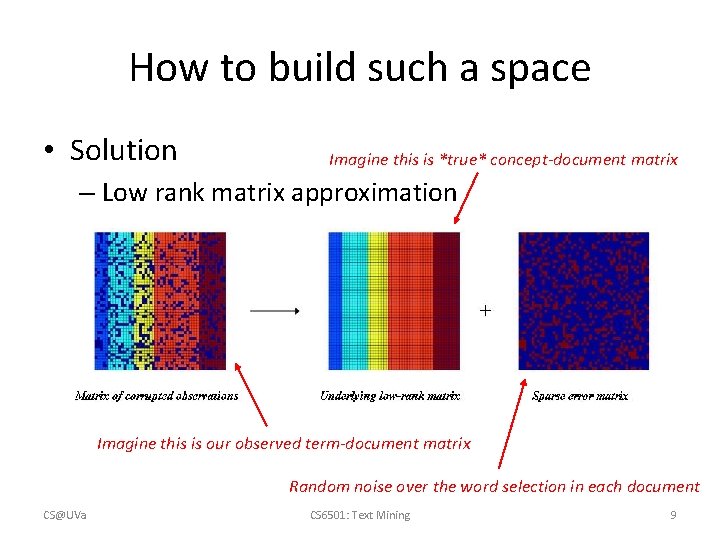
How to build such a space • Solution Imagine this is *true* concept-document matrix – Low rank matrix approximation Imagine this is our observed term-document matrix Random noise over the word selection in each document CS@UVa CS 6501: Text Mining 9
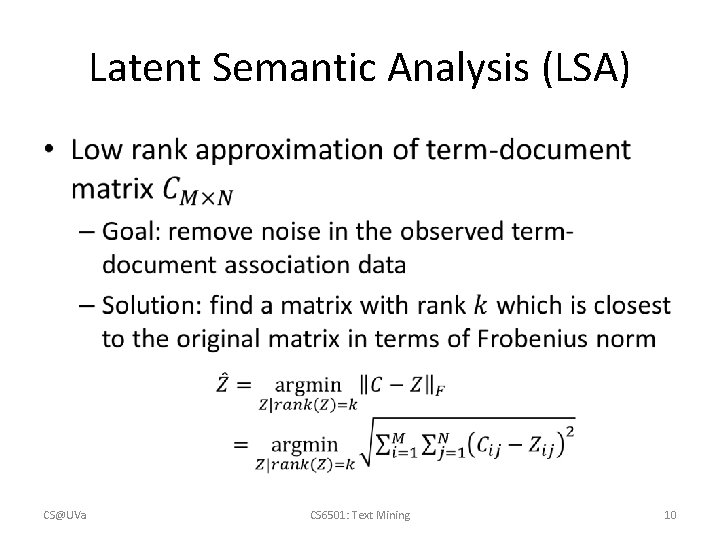
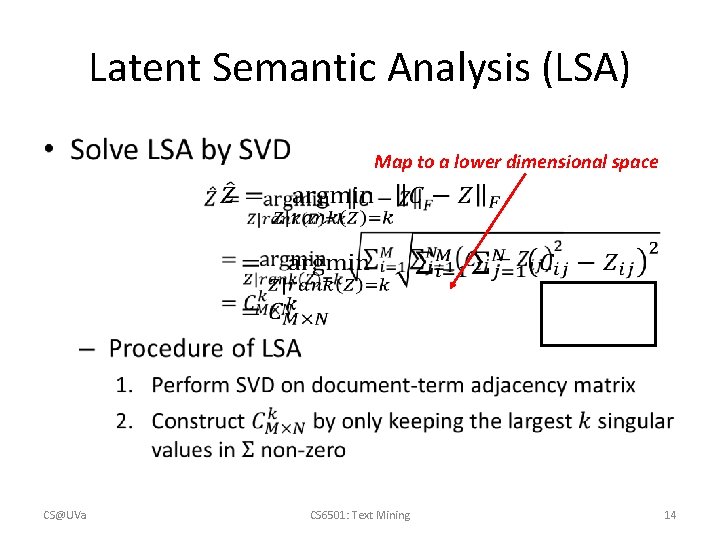
Latent Semantic Analysis (LSA) • CS@UVa CS 6501: Text Mining 10
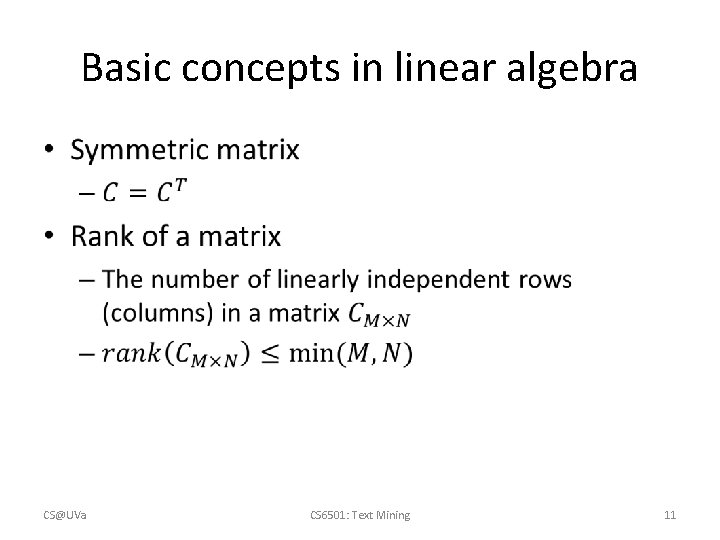
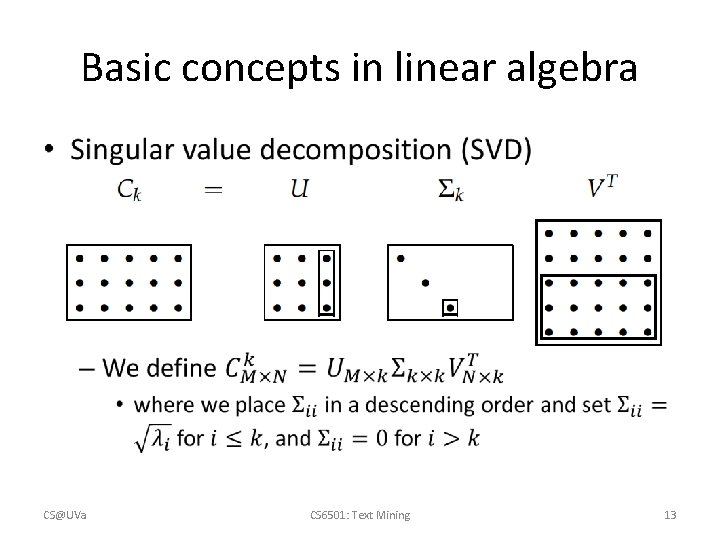
Basic concepts in linear algebra • CS@UVa CS 6501: Text Mining 11
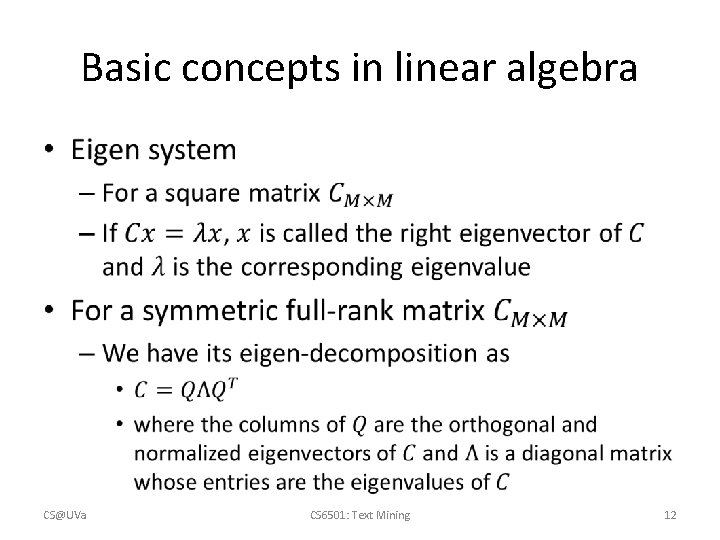
Basic concepts in linear algebra • CS@UVa CS 6501: Text Mining 12
Basic concepts in linear algebra • CS@UVa CS 6501: Text Mining 13
Latent Semantic Analysis (LSA) • Map to a lower dimensional space CS@UVa CS 6501: Text Mining 14
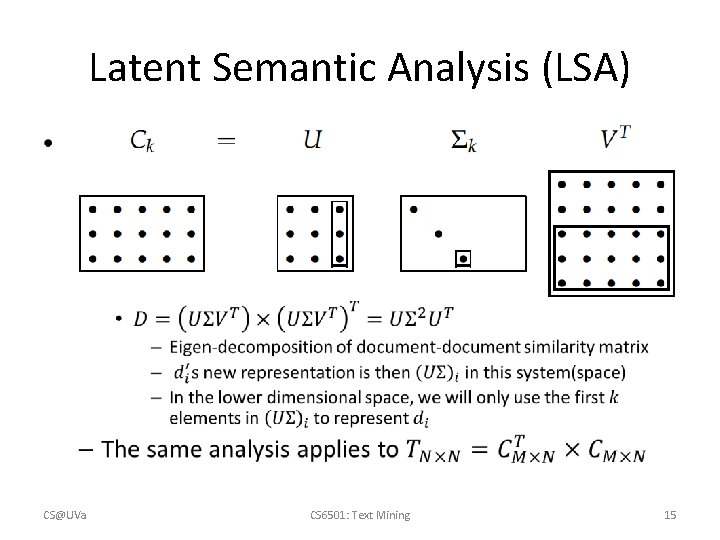
Latent Semantic Analysis (LSA) • CS@UVa CS 6501: Text Mining 15
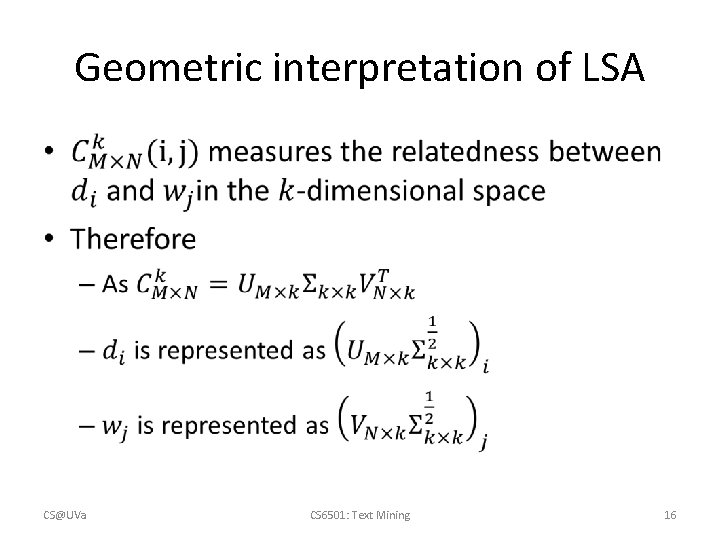
Geometric interpretation of LSA • CS@UVa CS 6501: Text Mining 16
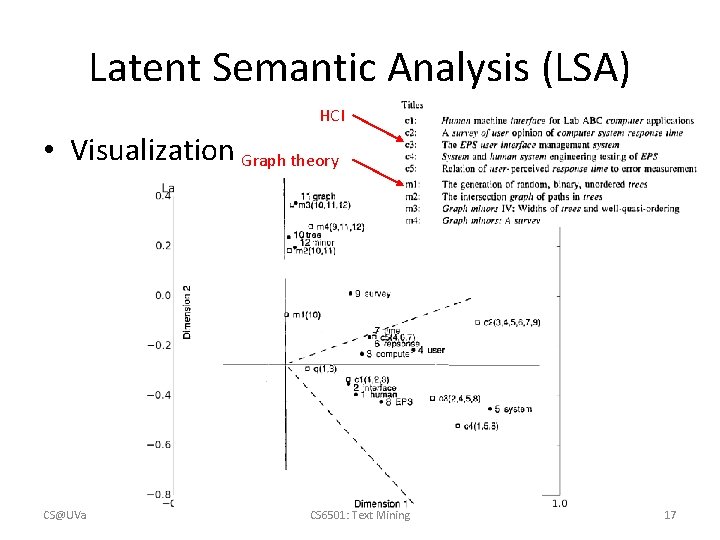
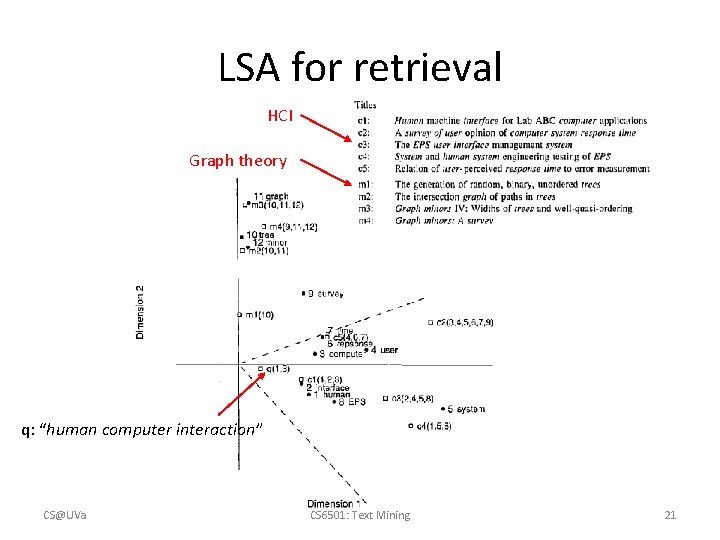
Latent Semantic Analysis (LSA) HCI • Visualization Graph theory CS@UVa CS 6501: Text Mining 17
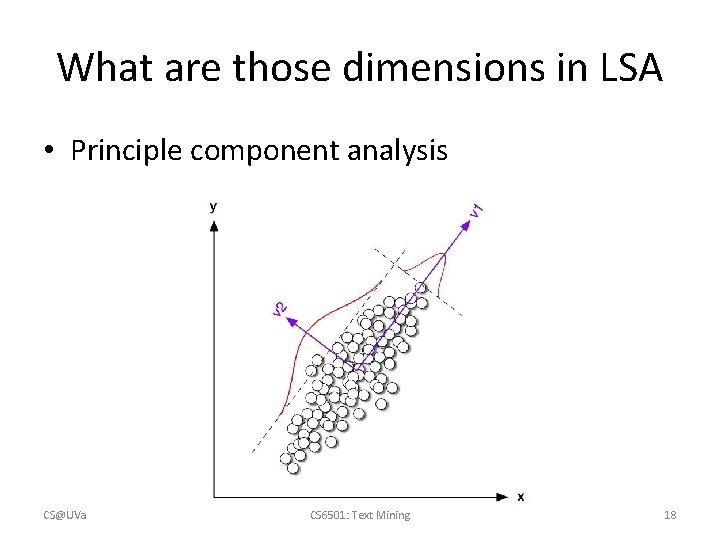
What are those dimensions in LSA • Principle component analysis CS@UVa CS 6501: Text Mining 18
Latent Semantic Analysis (LSA) • What we have achieved via LSA – Terms/documents that are closely associated are placed near one another in this new space – Terms that do not occur in a document may still close to it, if that is consistent with the major patterns of association in the data – A good choice of concept space for VS model! CS@UVa CS 6501: Text Mining 19
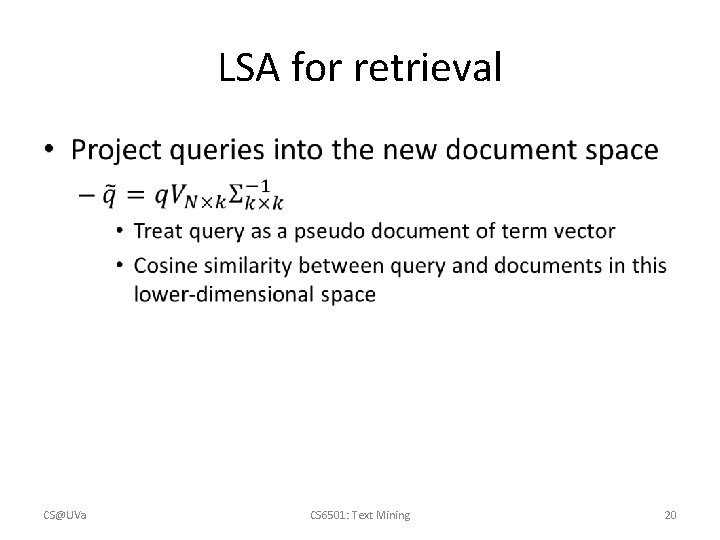
LSA for retrieval • CS@UVa CS 6501: Text Mining 20
LSA for retrieval HCI Graph theory q: “human computer interaction” CS@UVa CS 6501: Text Mining 21
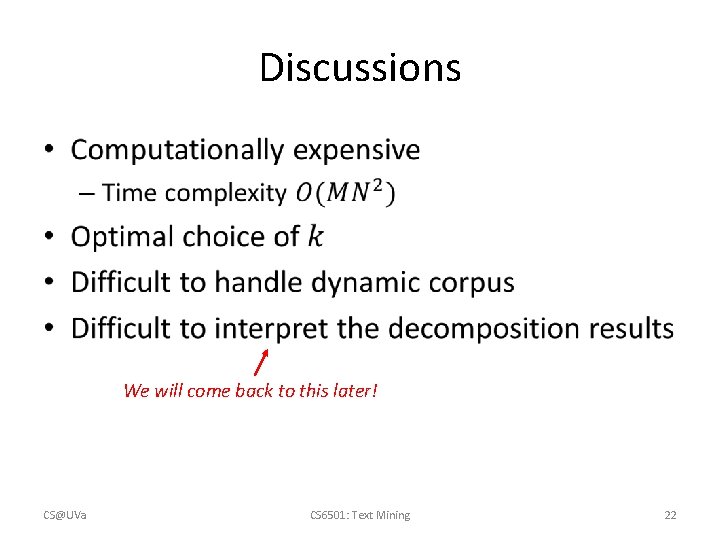
Discussions • We will come back to this later! CS@UVa CS 6501: Text Mining 22
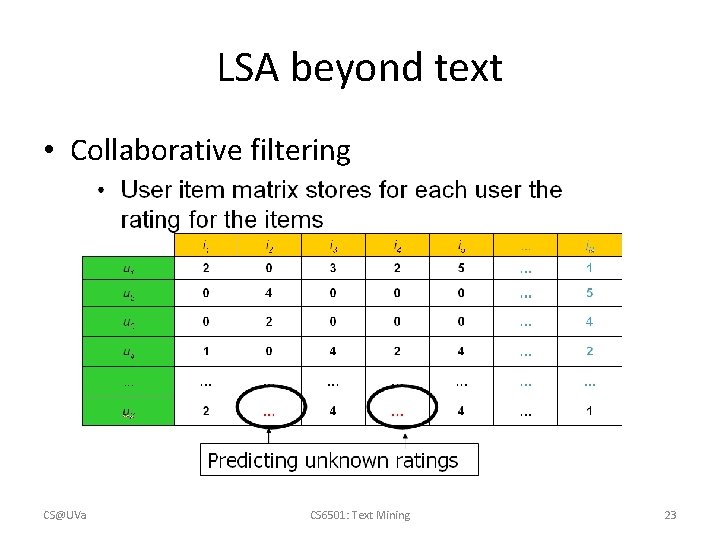
LSA beyond text • Collaborative filtering CS@UVa CS 6501: Text Mining 23
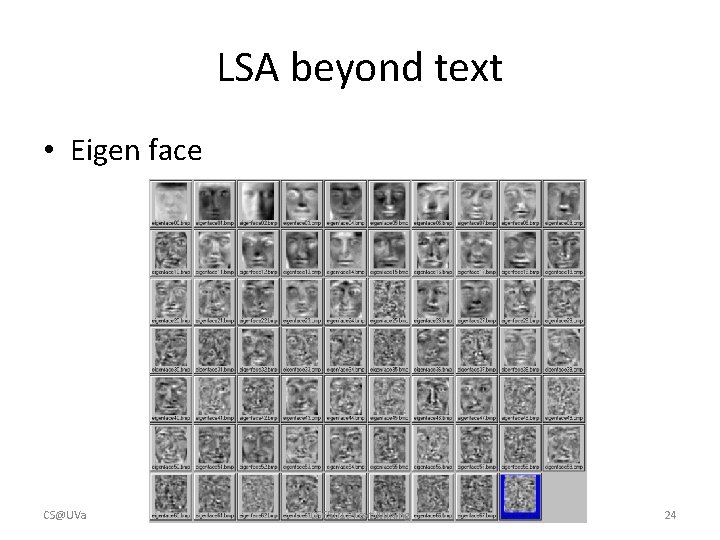
LSA beyond text • Eigen face CS@UVa CS 6501: Text Mining 24
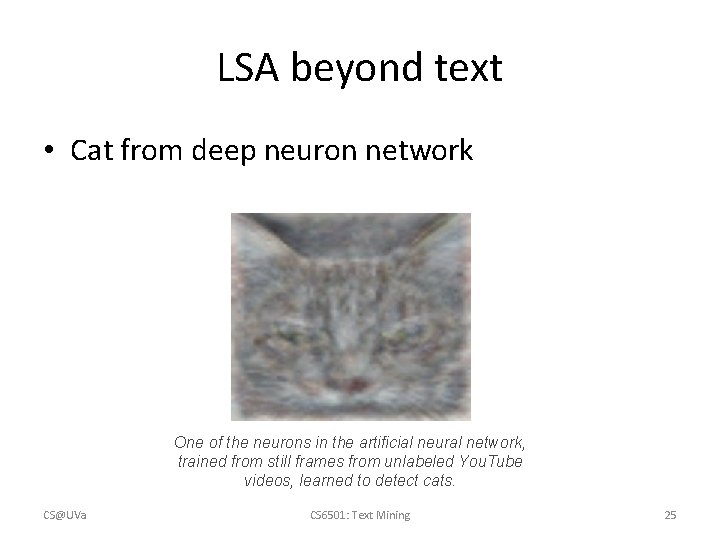
LSA beyond text • Cat from deep neuron network One of the neurons in the artificial neural network, trained from still frames from unlabeled You. Tube videos, learned to detect cats. CS@UVa CS 6501: Text Mining 25
What you should know • Assumptions in LSA • Interpretation of LSA – Low rank matrix approximation – Eigen-decomposition of co-occurrence matrix for documents and terms CS@UVa CS 6501: Text Mining 26
Today’s reading • Introduction to information retrieval – Chapter 13: Matrix decompositions and latent semantic indexing • Deerwester, Scott C. , et al. "Indexing by latent semantic analysis. " JAs. Is 41. 6 (1990): 391 -407. CS@UVa CS 6501: Text Mining 27
Happy Lunar New Year! CS@UVa CS 6501: Text Mining 28