
Recap lecture 25 Intersection of two regular languages


- Slides: 29
Recap lecture 25 Intersection of two regular languages is regular, examples, non regular languages, example 1
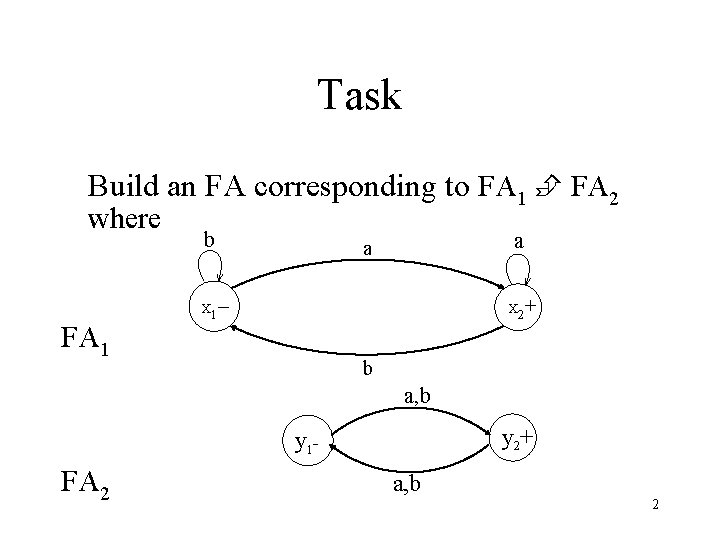
Task Build an FA corresponding to FA 1 FA 2 where b a a – FA 1 + X 1 X 2 b a, b y 2+ y 1 - FA 2 a, b 2
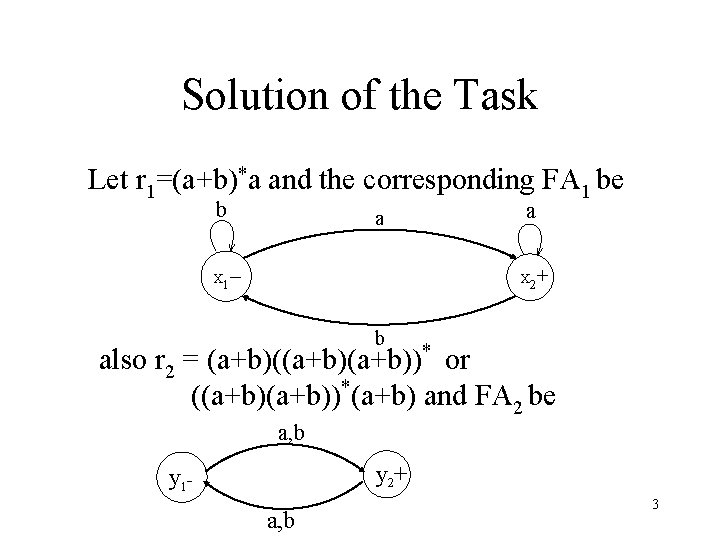
Solution of the Task Let r 1=(a+b)*a and the corresponding FA 1 be b a – a + X 1 X 2 b also r 2 = (a+b)(a+b))* or ((a+b))*(a+b) and FA 2 be a, b y 2+ y 1 a, b 3
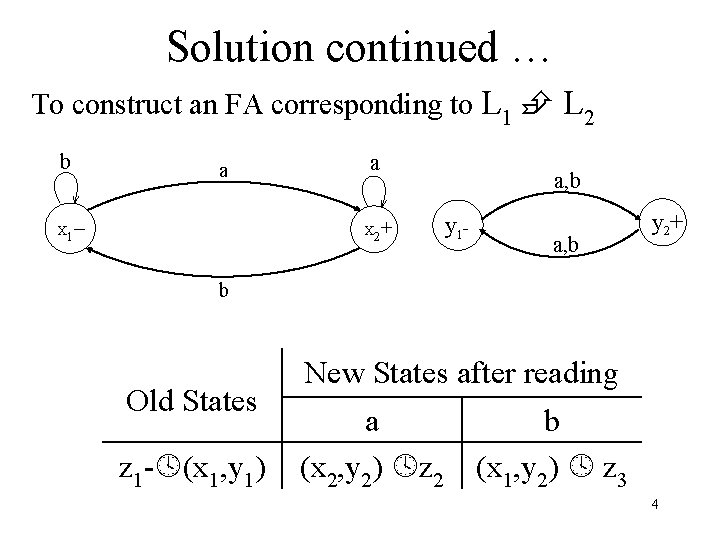
Solution continued … To construct an FA corresponding to L 1 L 2 b a – a a, b + X 1 X 2 y 1 - a, b y 2+ b Old States z 1 - (x 1, y 1) New States after reading a (x 2, y 2) z 2 b (x 1, y 2) z 3 4
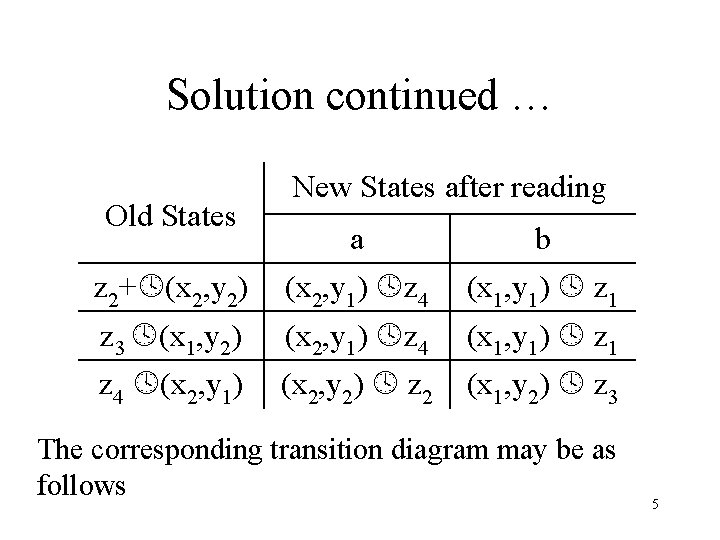
Solution continued … Old States New States after reading a b z 2+ (x 2, y 2) (x 2, y 1) z 4 (x 1, y 1) z 1 z 3 (x 1, y 2) (x 2, y 1) z 4 (x 1, y 1) z 1 z 4 (x 2, y 1) (x 2, y 2) z 2 (x 1, y 2) z 3 The corresponding transition diagram may be as follows 5
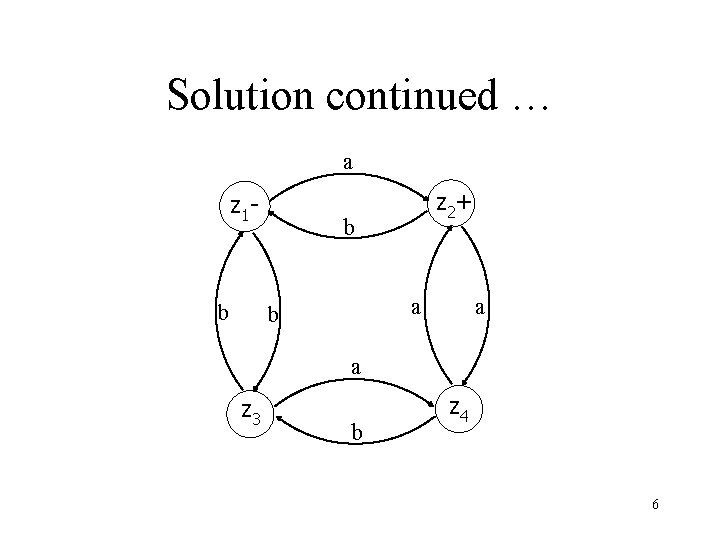
Solution continued … a z 1 - b z 2 + b a a z 3 b z 4 6
Example Consider the language L = {Λ, ab, aabb, aaabbb, …} i. e. {an bn : n=0, 1, 2, 3, …} Suppose, it is required to prove that this language is nonregular. Let, contrary, L be a regular language then by Kleene’s theorem it must be accepted by an FA, say, F. Since every FA has finite number of states then the language L (being infinite) accepted by F must have words of length more than the number of states. Which shows that, F must contain a circuit. 7
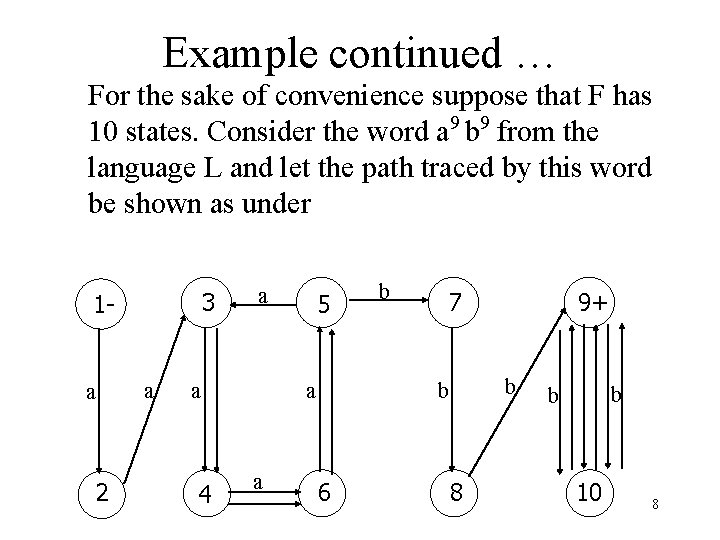
Example continued … For the sake of convenience suppose that F has 10 states. Consider the word a 9 b 9 from the language L and let the path traced by this word be shown as under 3 1 - a a 2 a a 4 5 a a b 7 b b 6 9+ 8 b b 10 8
Example continued … But, looping the circuit generated by the states 3, 4, 6, 5, 3 with a-edges once more, F also accepts the word a 9+4 b 9, while a 13 b 9 is not a word in L. It may also be observed that, because of the circuit discussed above, F also accepts the words a 9(a 4 )m b 9, m = 1, 2, 3, … Moreover, there is another circuit generated by the states 9, 10, 9. Including the possibility of looping this circuit, F accepts the words a 9(a 4 )m b 9(b 2 )n where m, n=0, 1, 2, 3, …(m and n not being 0 simultaneously). Which shows that F accepts words that are not belonging to L. 9
Example continued … Similarly for finding FAs accepting other words from L, they will also accept the words which do not belong to L. Thus there is no FA which accepts the language L. which shows, by Kleene’s theorem, that the language L can’t be expressed by any regular expression. It may be noted that apparently anbn seems to be a regular expression of L, but in fact it is not. The observations made from this example, generalize theorem ( also called the Pumping lemma) regarding the infinite regular 10 language as follows
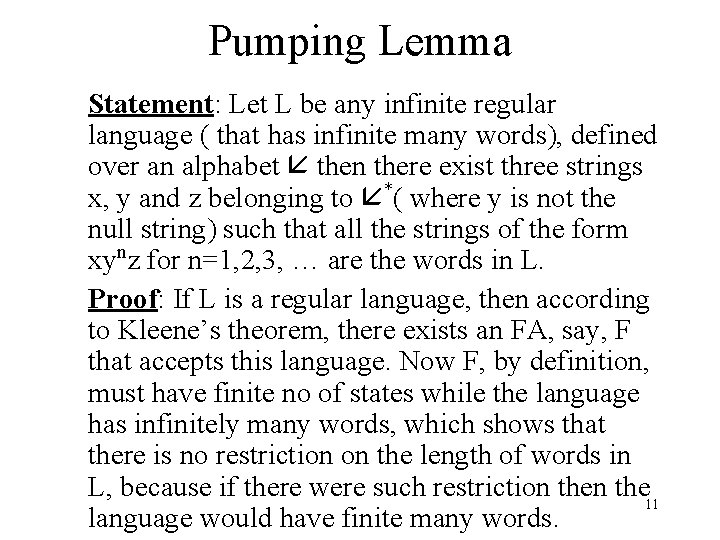
Pumping Lemma Statement: Let L be any infinite regular language ( that has infinite many words), defined over an alphabet then there exist three strings x, y and z belonging to *( where y is not the null string) such that all the strings of the form xynz for n=1, 2, 3, … are the words in L. Proof: If L is a regular language, then according to Kleene’s theorem, there exists an FA, say, F that accepts this language. Now F, by definition, must have finite no of states while the language has infinitely many words, which shows that there is no restriction on the length of words in L, because if there were such restriction the 11 language would have finite many words.
Proof continued … Let w be a word in the language L, so that the length of word is greater than the number of states in F. In this case the path generated by the word w, is such that it cannot visit a new state for each letter i. e. there is a circuit in this path. The word w, in this case, may be divided into three parts 1. The substring which generates the path from initial state to the state which is revisited first while reading the word w. This part can be called x and x can be a null string. 12
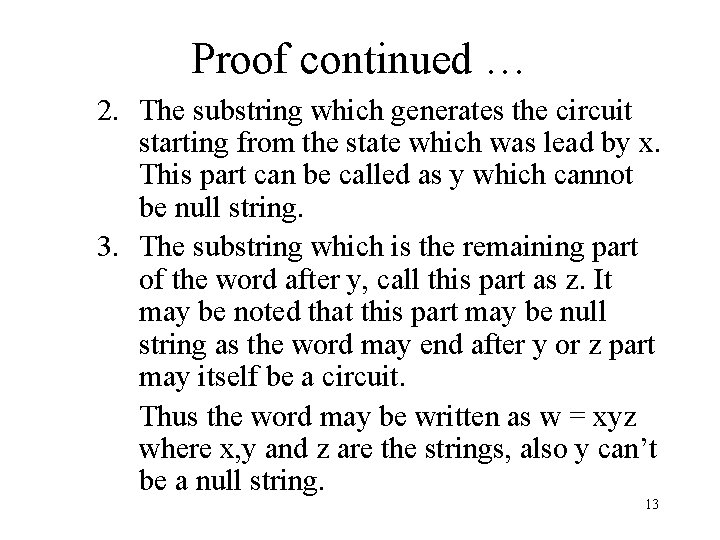
Proof continued … 2. The substring which generates the circuit starting from the state which was lead by x. This part can be called as y which cannot be null string. 3. The substring which is the remaining part of the word after y, call this part as z. It may be noted that this part may be null string as the word may end after y or z part may itself be a circuit. Thus the word may be written as w = xyz where x, y and z are the strings, also y can’t be a null string. 13
Proof continued … Now this is obvious that, looping the circuit successively, the words xyyz, xyyyyz, … will also be accepted by this FA i. e. xynz, n=1, 2, 3, … will be words in L. Remark: In the above theorem, it is not affected if the z-part has circuit. To prove theorem it is only to find a circuit and then looping that circuit, is all that is needed. While looping the circuit the volume of the string y (or z) is pumped, so theorem is also called the Pumping lemma. Following are the examples 14
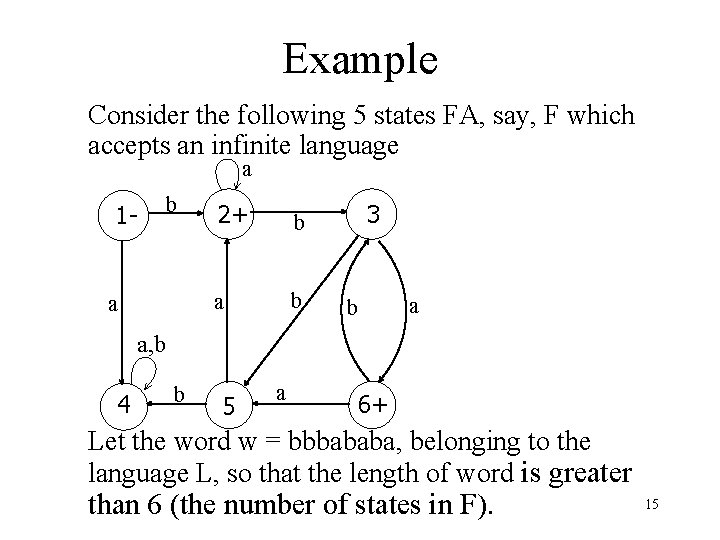
Example Consider the following 5 states FA, say, F which accepts an infinite language a 1 - b a 2+ b a b 3 a b a, b 4 b 5 a 6+ Let the word w = bbbababa, belonging to the language L, so that the length of word is greater than 6 (the number of states in F). 15
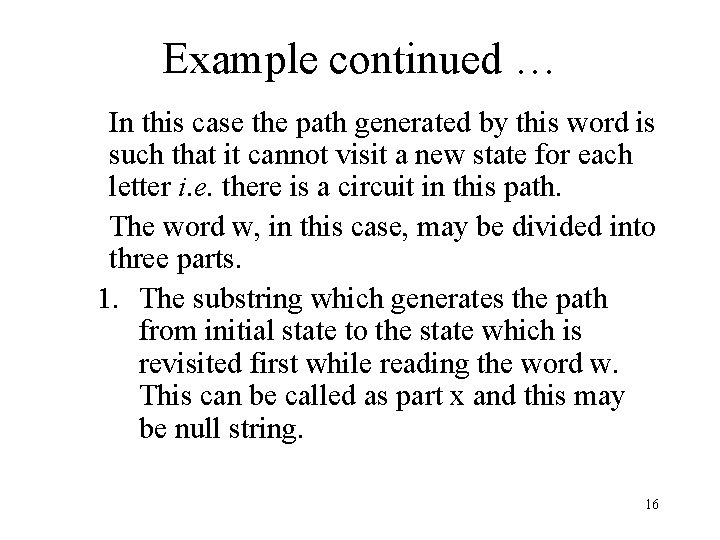
Example continued … In this case the path generated by this word is such that it cannot visit a new state for each letter i. e. there is a circuit in this path. The word w, in this case, may be divided into three parts. 1. The substring which generates the path from initial state to the state which is revisited first while reading the word w. This can be called as part x and this may be null string. 16
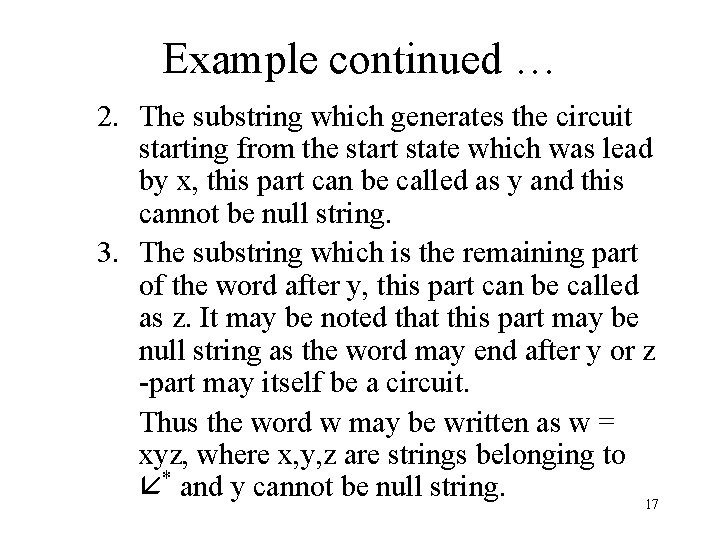
Example continued … 2. The substring which generates the circuit starting from the start state which was lead by x, this part can be called as y and this cannot be null string. 3. The substring which is the remaining part of the word after y, this part can be called as z. It may be noted that this part may be null string as the word may end after y or z -part may itself be a circuit. Thus the word w may be written as w = xyz, where x, y, z are strings belonging to * and y cannot be null string. 17
Example continued … The state 2 is such that it is revisited first while reading the word w. So the word w can be decomposed, according to pumping lemma, as w = xyz = (b)(bba)(baba) If y-part of w is continuously pumped, the resulting strings will be accepted by F and hence will be words in the language accepted by F. Thus, by pumping lemma, the language accepted by F is regular. Remark: If the pumping lemma is applied directly on the language L = {an bn : n=0, 1, 2, 3, …}, it can be observed that for the word w = (aaa)(aaaabbbb)(bbb) 18
Remark continued … where x = aaa, y = aaaabbbb and z = bbb xyyz will contain as many number of a’s as there are b’s but this string will not belong to L because the substring ab can occur at the most once in the words of L, while the string xyyz contains the substring ab twice. On the other hand if y-part consisting of only a’s or b’s, then xyyz will contain number of a’s different from number of b’s. This shows that pumping lemma does not hold and hence the language is not regular. 19
Example Consider the language EQUAL, of strings, defined over Σ={a, b}, with number of a’s equal to number of b’s, i. e. EQUAL = {Λ , ab, aabb, abab, baba, abba, …} From the definition of EQUAL, it is clear that {an bn } = a* b* EQUAL Obviously a* b* defines a regular language while {an bn } has been proved nonregular. 20
Example continued … Using theorem that intersection of two regular languages is, regular; it can be proved that the EQUAL is not regular. Because if it is considered regular then the language {an bn } will, being intersection of regular languages, be regular language, which is impossible. Following are the remarks regarding these examples 21
Remarks 1. In the previous examples, languages are proved to be regular or nonregular using pumping lemma. In fact to prove a certain language to be regular, it is not needed to use the full force of pumping lemma i. e. for a word with length greater than the number of states of the machine, decomposing the word into xyz and for a language to be regular it is sufficient that xyyz is in L. The condition that xynz is in L for n>2, provides that the language is infinite. 22
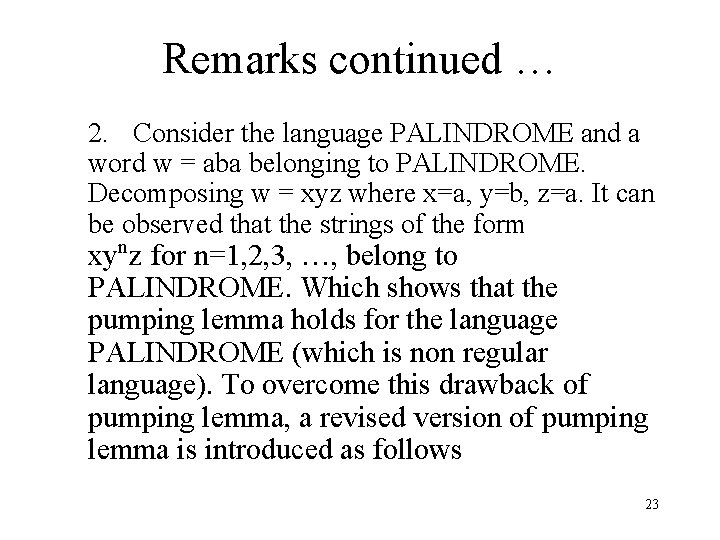
Remarks continued … 2. Consider the language PALINDROME and a word w = aba belonging to PALINDROME. Decomposing w = xyz where x=a, y=b, z=a. It can be observed that the strings of the form xynz for n=1, 2, 3, …, belong to PALINDROME. Which shows that the pumping lemma holds for the language PALINDROME (which is non regular language). To overcome this drawback of pumping lemma, a revised version of pumping lemma is introduced as follows 23
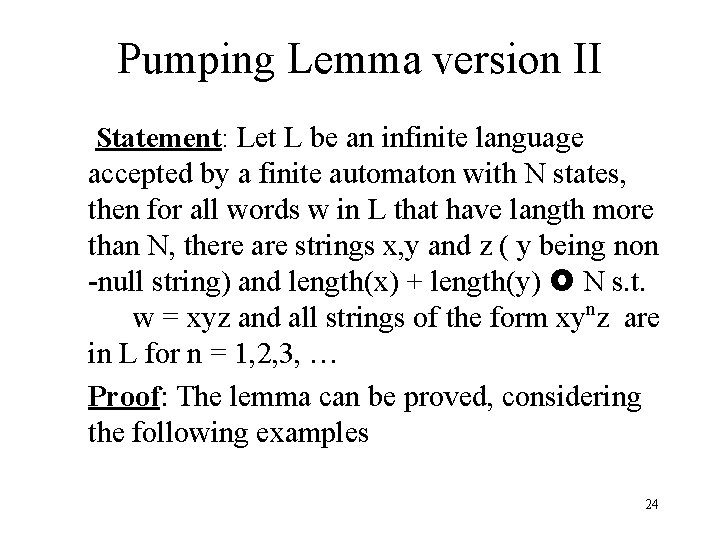
Pumping Lemma version II Statement: Let L be an infinite language accepted by a finite automaton with N states, then for all words w in L that have langth more than N, there are strings x, y and z ( y being non -null string) and length(x) + length(y) N s. t. w = xyz and all strings of the form xynz are in L for n = 1, 2, 3, … Proof: The lemma can be proved, considering the following examples 24
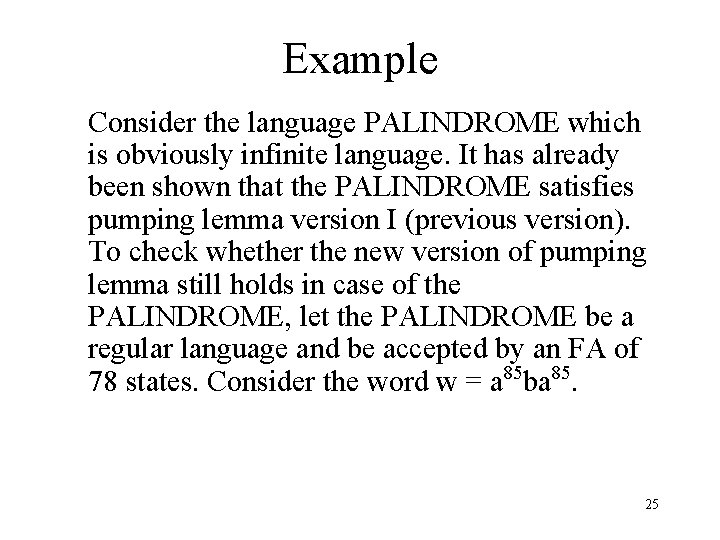
Example Consider the language PALINDROME which is obviously infinite language. It has already been shown that the PALINDROME satisfies pumping lemma version I (previous version). To check whether the new version of pumping lemma still holds in case of the PALINDROME, let the PALINDROME be a regular language and be accepted by an FA of 78 states. Consider the word w = a 85 ba 85. 25
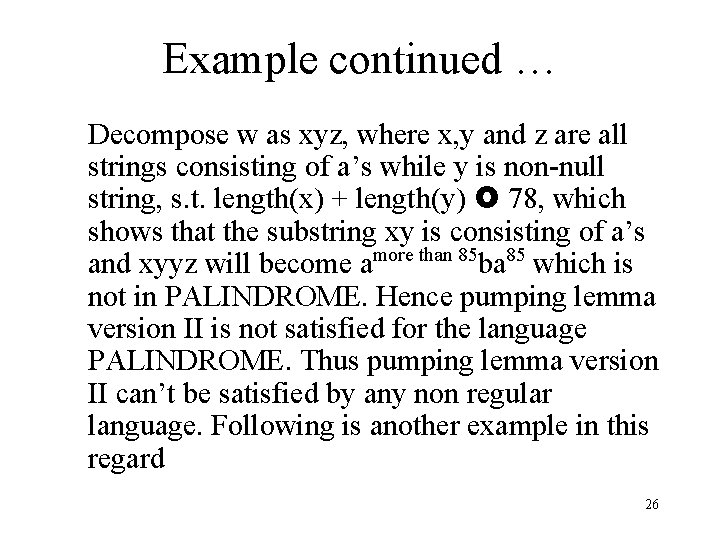
Example continued … Decompose w as xyz, where x, y and z are all strings consisting of a’s while y is non-null string, s. t. length(x) + length(y) 78, which shows that the substring xy is consisting of a’s and xyyz will become amore than 85 ba 85 which is not in PALINDROME. Hence pumping lemma version II is not satisfied for the language PALINDROME. Thus pumping lemma version II can’t be satisfied by any non regular language. Following is another example in this regard 26
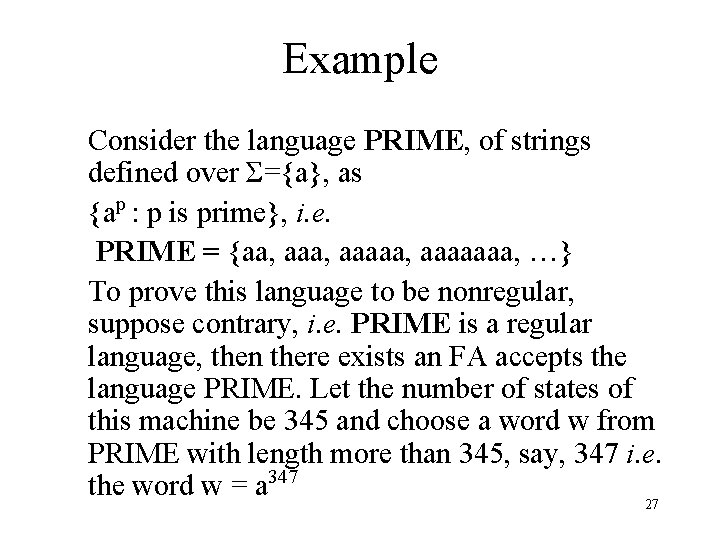
Example Consider the language PRIME, of strings defined over Σ={a}, as {ap : p is prime}, i. e. PRIME = {aa, aaaaa, aaaaaaa, …} To prove this language to be nonregular, suppose contrary, i. e. PRIME is a regular language, then there exists an FA accepts the language PRIME. Let the number of states of this machine be 345 and choose a word w from PRIME with length more than 345, say, 347 i. e. the word w = a 347 27
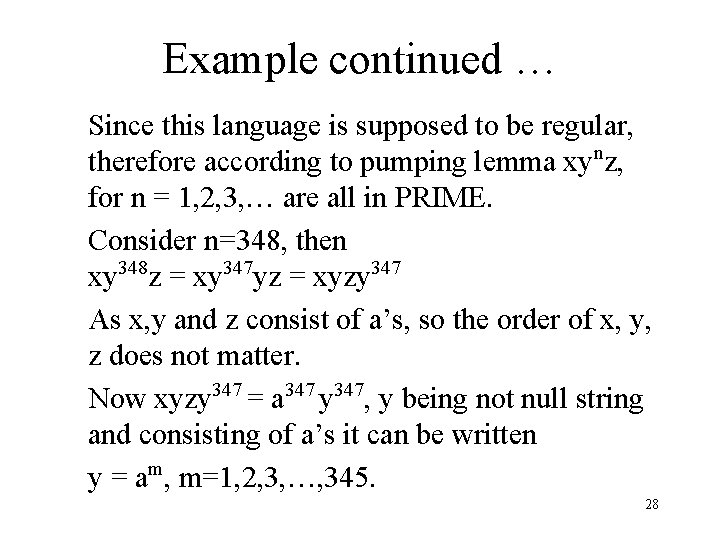
Example continued … Since this language is supposed to be regular, therefore according to pumping lemma xynz, for n = 1, 2, 3, … are all in PRIME. Consider n=348, then xy 348 z = xy 347 yz = xyzy 347 As x, y and z consist of a’s, so the order of x, y, z does not matter. Now xyzy 347 = a 347 y 347, y being not null string and consisting of a’s it can be written y = am, m=1, 2, 3, …, 345. 28
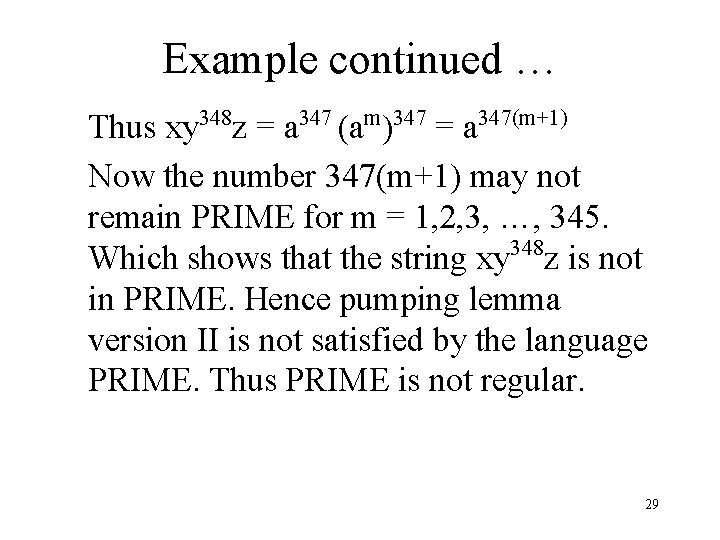
Example continued … Thus xy 348 z = a 347 (am)347 = a 347(m+1) Now the number 347(m+1) may not remain PRIME for m = 1, 2, 3, …, 345. 348 Which shows that the string xy z is not in PRIME. Hence pumping lemma version II is not satisfied by the language PRIME. Thus PRIME is not regular. 29