
RECAP 1 whats the difference between statedependent forgetting
RECAP 1. what’s the difference between state-dependent forgetting and context dependent forgetting? 2. Outline the research to support context-dependent forgetting 3. Outline the research to support state-dependent forgetting
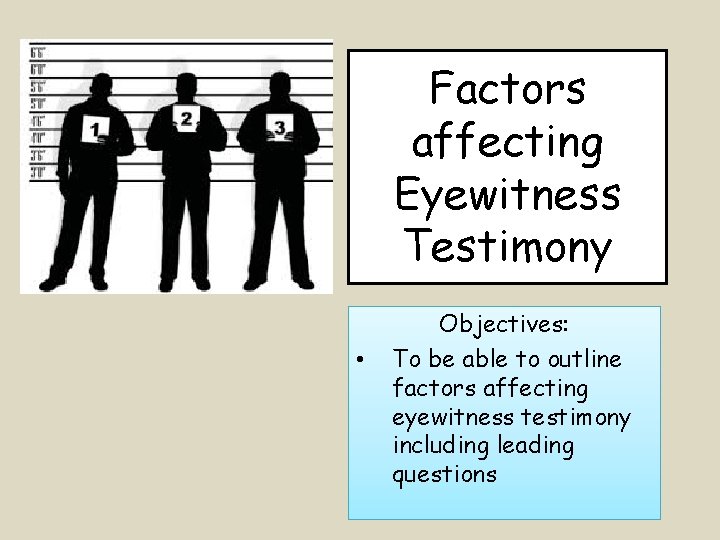
Factors affecting Eyewitness Testimony • Objectives: To be able to outline factors affecting eyewitness testimony including leading questions
Key Word • Eyewitness Testimony The testimony, based on memory, of an individual who saw an incident take place. EWT is important because…
Starter • Can your memories be changed? • https: //www. youtube. com/watch? v=il 0 u 2 s_WGXA
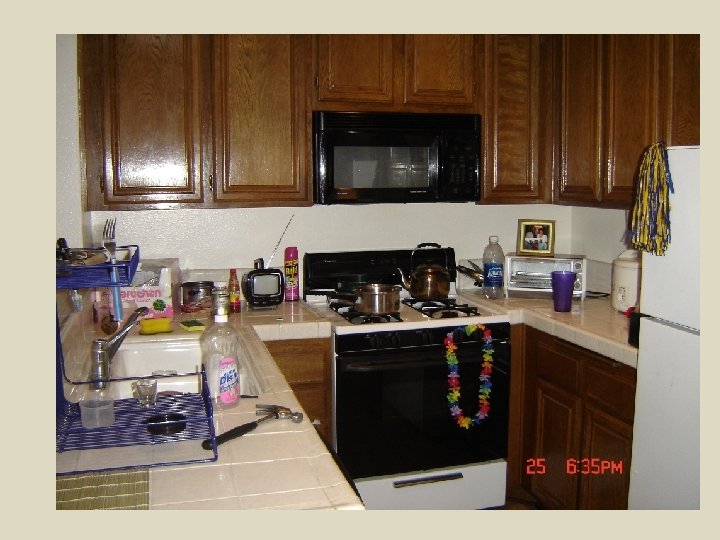
□Refrigerator □Oven □Cabinets □Dish rack □Toaster □Microwave □ Toaster oven □ Coffee maker □ Rice cooker □ Cereal box □ Pot □ Pan □ Sink □ Kitchen magnet □ Salt and pepper shaker □ Can opener Item list□ Fan □ Paper towel holder □ Cup □ Plate □ Dish towel □ Spoon □ Fork □ Bowl □ Washing up liquid □ Fruit □ Picture frame □ Water bottle □ Oven mitt □ Plant □ Watch □ Knife set/block □ Fire extinguisher □ Purse □ Clock □ Hawaiian garland □ Pom pom □ Television □ Pill bottle □ Cell phone □ Hammer □ Shoes □ Perfume □ Mr. Potato Head □ Book □ Baseball glove/mitt □ Iron □ Deodorant
Item list □Refrigerator □Oven □Cabinets □Dish rack □Toaster □Microwave □ Toaster oven □ Coffee maker □ Rice cooker □ Cereal box □ Pot □ Pan □ Sink □ Kitchen magnet □ Salt and pepper shaker □ Can opener □ Paper towel holder □ Cup □ Plate □ Dish towel □ Spoon □ Fork □ Bowl □ Washing up liquid □ Fruit □ Picture frame □ Water bottle □ Oven mitt □ Plant □ Watch □ Knife set/block □ Fan □ Fire extinguisher □ Purse □ Clock □ Hawaiian garland □ Pom pom □ Television □ Pill bottle □ Cell phone □ Hammer □ Shoes □ Perfume □ Mr. Potato Head □ Book □ Baseball glove/mitt □ Iron □ Deodorant

Who would you most trust to have given a good account?
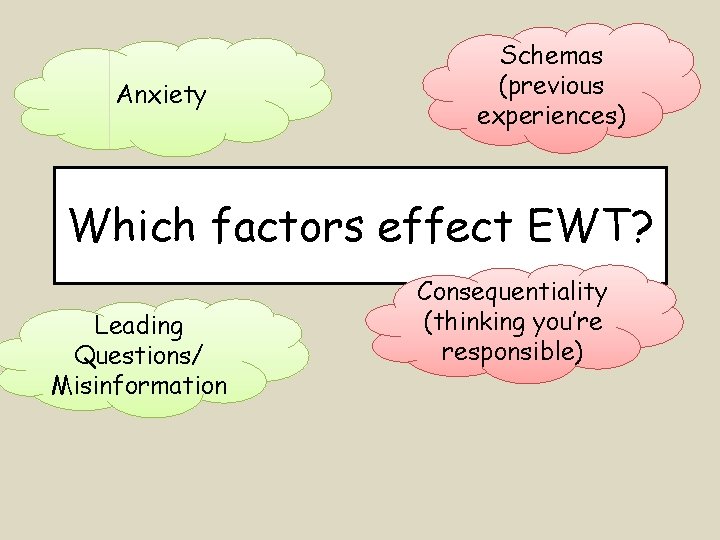
Anxiety Schemas (previous experiences) Which factors effect EWT? Leading Questions/ Misinformation Consequentiality (thinking you’re responsible)
Key Terms Misleading information: incorrect information given to the eye witness usually after the event (post-event information). This can be leading questions or post-event discussion between other witnesses and people. Leading question: a question which, because of the way it was phrased, suggests a certain answer. “was the knife in the accused’s left hand? ” this suggests that the answer is left hand. Post-event discussion (PED): occurs when there is more than one witness to an event. Witnesses may discuss what they have seen with co-witnesses or with other people. This may influence the accuracy of each witness’s recall of the event.
Car Crash Video http: //www. youtube. com/ watch? v=Rg 5 b. BJQOL 74 Watch the video and answer the questions on your sheet.
Loftus and Palmer An investigation into leading questions. Notice that there were different sheets, one said ‘bumped’ the other said ‘smashed’ – what did our experiment show? What is a leading question?
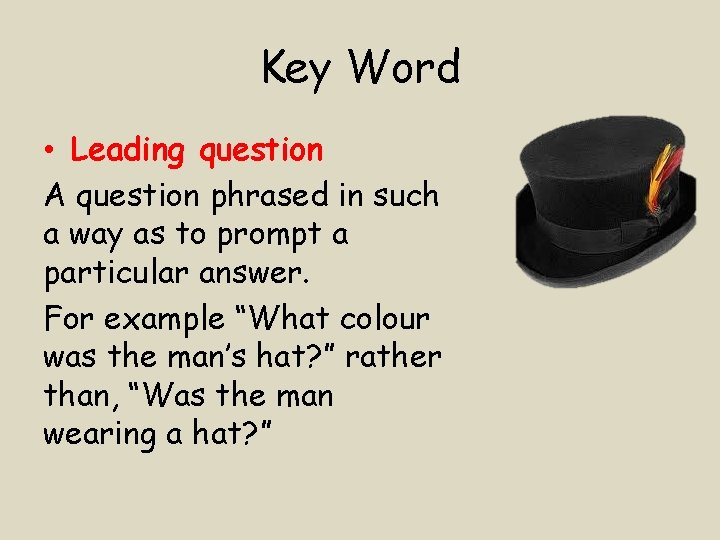
Key Word • Leading question A question phrased in such a way as to prompt a particular answer. For example “What colour was the man’s hat? ” rather than, “Was the man wearing a hat? ”
Research into Leading Questions • Loftus and Palmer (1974) • Loftus (1975)
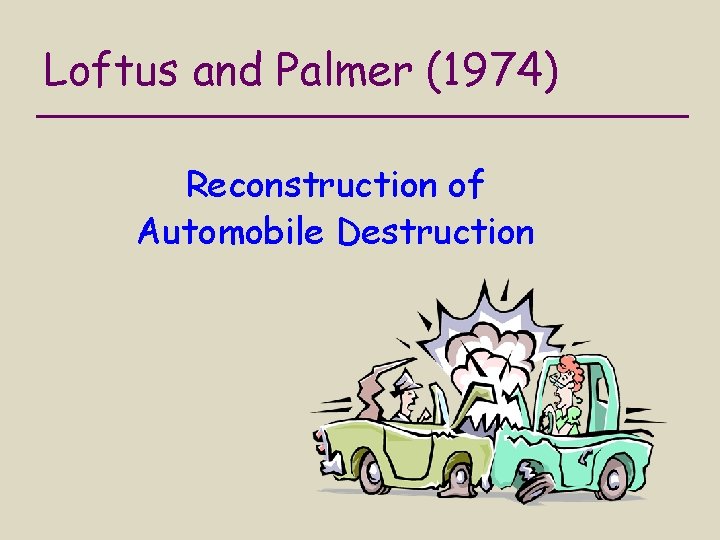
Loftus and Palmer (1974) Reconstruction of Automobile Destruction
Aim To investigate how information provided to a witness after an event will influence their memory of that event
Method – Experiment 1 • 45 student participants were shown short video clips • They were split into 5 groups, with 9 participants in each one • All of the participants were asked: ‘About how fast were the cars going when they ____ each other’ • Each group was given a different verb to fill in the blank. These verbs were ‘smashed, collided, bumped, hit or contacted’. Therefore the independent variable was the verb used. • The dependent variable was the estimate of speed given by the participants
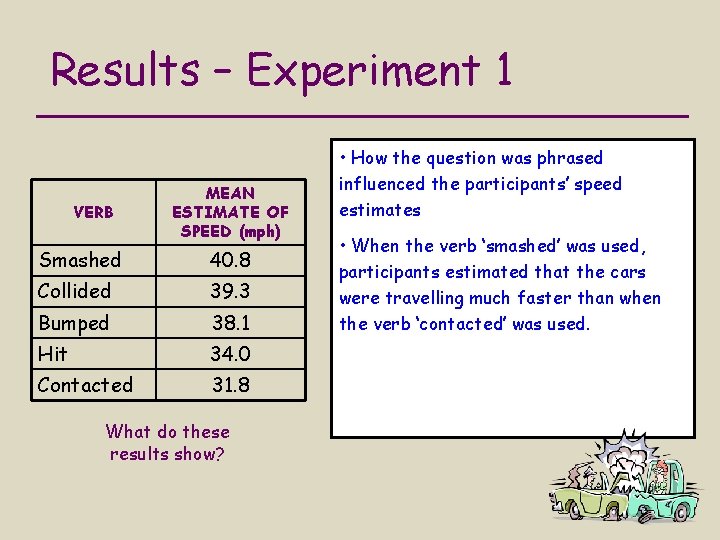
Results – Experiment 1 VERB MEAN ESTIMATE OF SPEED (mph) Smashed 40. 8 Collided 39. 3 Bumped 38. 1 Hit 34. 0 Contacted 31. 8 What do these results show? • How the question was phrased influenced the participants’ speed estimates • When the verb ‘smashed’ was used, participants estimated that the cars were travelling much faster than when the verb ‘contacted’ was used.
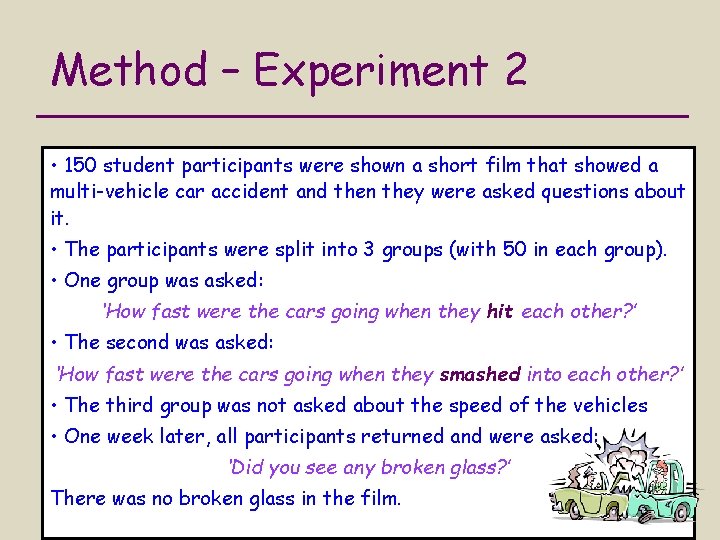
Method – Experiment 2 • 150 student participants were shown a short film that showed a multi-vehicle car accident and then they were asked questions about it. • The participants were split into 3 groups (with 50 in each group). • One group was asked: ‘How fast were the cars going when they hit each other? ’ • The second was asked: ‘How fast were the cars going when they smashed into each other? ’ • The third group was not asked about the speed of the vehicles • One week later, all participants returned and were asked: ‘Did you see any broken glass? ’ There was no broken glass in the film.
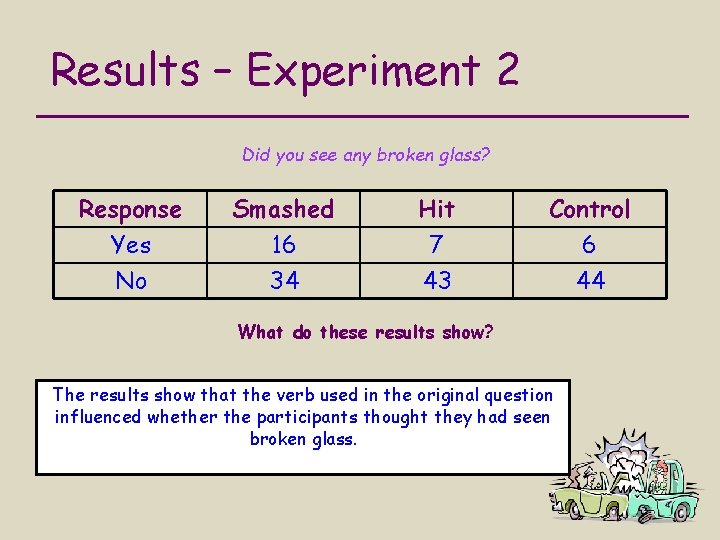
Results – Experiment 2 Did you see any broken glass? Response Yes No Smashed 16 34 Hit 7 43 Control 6 44 What do these results show? The results show that the verb used in the original question influenced whether the participants thought they had seen broken glass.
Why do leading questions affect EWT? • Response-bias explanation suggests the wording of the question has no real effect on the participants memory as such, but influences how they decide to answer e. g the word ‘smashed’ encourages participants to increase the speed estimate • substitution explanation – the wording of a leading question actually changes the participants memory of the film clip. Participants who heard ‘smashed’ were more likely to report a broken headlight (there wasn’t actually a broken headlight) later on than those who heard ‘hit’.
Evaluation • Discuss the evaluation of Loftus & Palmer • Can you think of any strengths? • Are there any limitations? • Complete your booklet using page 59
Post-event discussion • When co-witnesses to a crime discuss it with each other (post-event discussion), their eye-witness testimonies become contaminated. • This is because they combine (mis)information from other witnesses with their own memories. Research to support… Read page 28 of your booklet and highlight key points.
Test Yourself… 1. Which of the following was not a cue word in the experiment by Loftus and Palmer? a) Smashed b) Contacted c) Knocked d) Hit The correct answer is… c) Knocked
Test Yourself… 2. The DV in the first experiment was… a) Estimate of speed b) The verb ‘smashed’ c) The question about broken glass d) The film The correct answer is… a) Estimate of Speed
Test Yourself… 3. In Experiment 1, how many experimental conditions were there? a) 1 b) 3 c) 5 d) 7 The correct answer is… c) 5
Test Yourself… 4. In Experiment 2, how many experimental groups were there? a) 1 b) 2 c) 3 d) 4 The correct answer is… b) 2
Test Yourself… 5. In Experiment 2, participants were tested immediately and then asked to return for some more questions. How long afterwards was this? a) 1 day b) 3 days c) 1 week d) 2 weeks The correct answer is… c) 1 week
Test Yourself… 6. In Experiment 2, which group saw the most broken glass? a) The ‘smashed’ group b) The ‘collided’ group c) The ‘hit’ group d) The control group The correct answer is… a) The ‘smashed’ group
Test Yourself… 7. Which of the following is true? a) Experiment 1 and 2 were both repeated measures b) Experiment 1 and 2 were both independent measures c) Only Experiment 1 was repeated measures d) Only experiment 1 was independent measures The correct answer is… Experiment 1 and 2 were both independent measures b)
Test Yourself… 8. The participants in this study were: a) Children b) Students c) Teachers d) Adults The correct answer is… Students b)
Supporting evidence – A 03 P: there is further supporting the fact that leading questions can distort EWT EE: Loftus (1975) found that 17% percent of participants who watched a video of a car ride and were asked ‘how fast was the car going when it passed the white barn’ recalled seeing a barn a week later E: this supports the idea that post-event information added to a memory after the event has occurred, can affect recall.
Exam Question “Outline and evaluate research into the effects of leading questions on eyewitness testimony (12)”
- Slides: 33