
RecallLecture 5 Zener effect and Zener diode When

- Slides: 17
Recall-Lecture 5 • Zener effect and Zener diode – When a Zener diode is reverse-biased, it acts at the breakdown region, when it is forward biased, it acts like a normal PN junction diode • Avalanche Effect – Gain kinetic energy – hit another atom – produce electron and hole pair
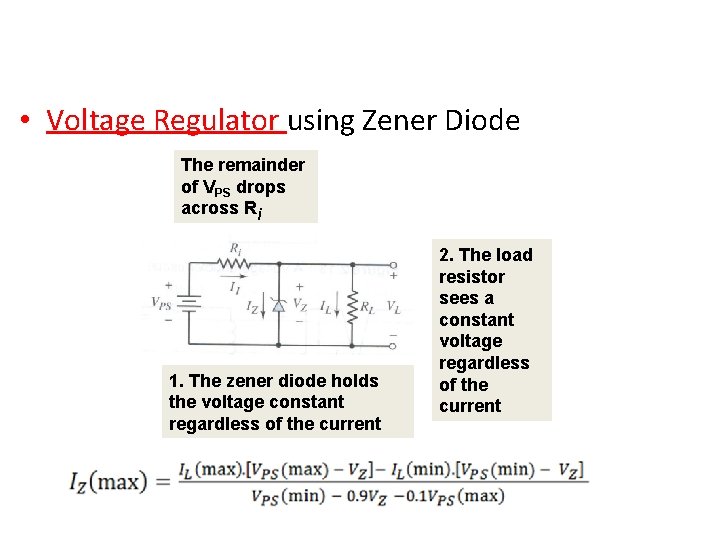
• Voltage Regulator using Zener Diode The remainder of VPS drops across Ri 1. The zener diode holds the voltage constant regardless of the current 2. The load resistor sees a constant voltage regardless of the current
FULL WAVE RECTIFIER • Center-Tapped • Bridge
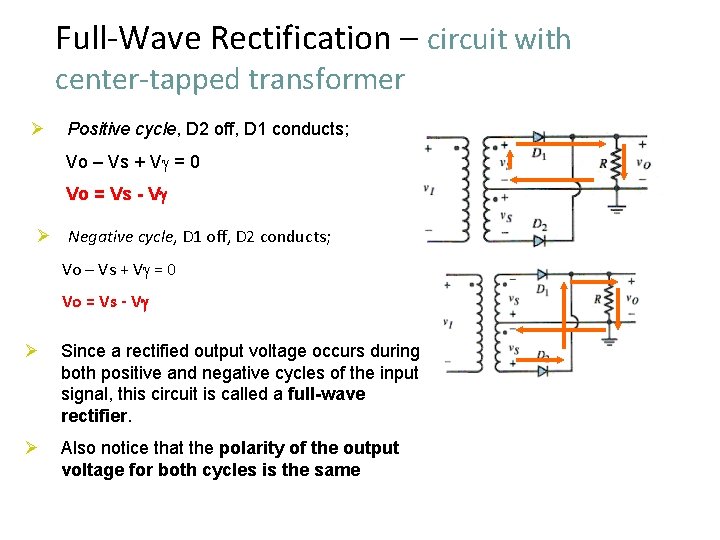
Full-Wave Rectification – circuit with center-tapped transformer Ø Positive cycle, D 2 off, D 1 conducts; Vo – Vs + V = 0 Vo = Vs - V Ø Negative cycle, D 1 off, D 2 conducts; Vo – Vs + V = 0 Vo = Vs - V Ø Since a rectified output voltage occurs during both positive and negative cycles of the input signal, this circuit is called a full-wave rectifier. Ø Also notice that the polarity of the output voltage for both cycles is the same
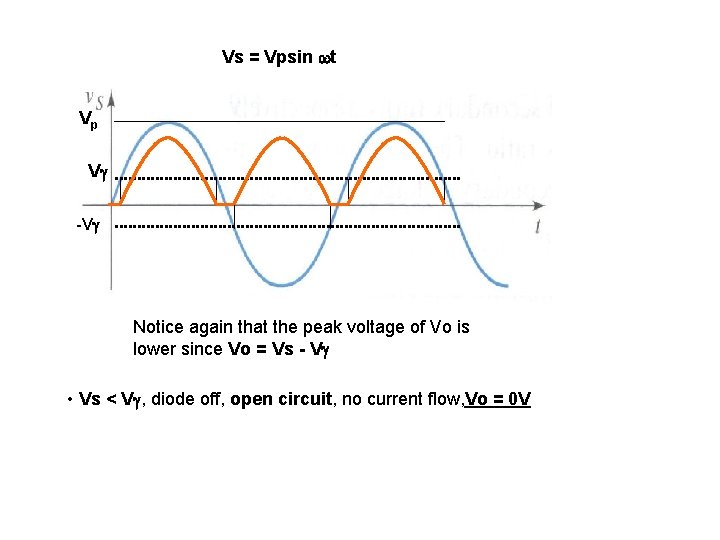
Vs = Vpsin t Vp V -V Notice again that the peak voltage of Vo is lower since Vo = Vs - V • Vs < V , diode off, open circuit, no current flow, Vo = 0 V
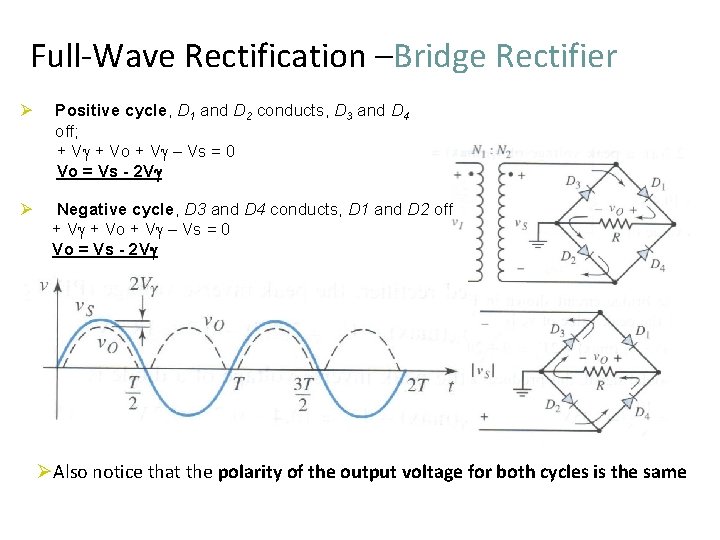
Full-Wave Rectification –Bridge Rectifier Ø Positive cycle, D 1 and D 2 conducts, D 3 and D 4 off; + Vo + V – Vs = 0 Vo = Vs - 2 V Ø Negative cycle, D 3 and D 4 conducts, D 1 and D 2 off + Vo + V – Vs = 0 Vo = Vs - 2 V ØAlso notice that the polarity of the output voltage for both cycles is the same
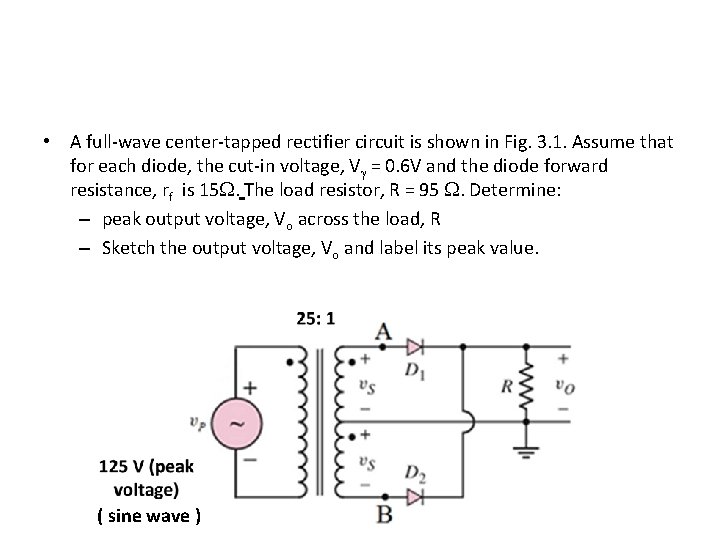
• A full-wave center-tapped rectifier circuit is shown in Fig. 3. 1. Assume that for each diode, the cut-in voltage, V = 0. 6 V and the diode forward resistance, rf is 15. The load resistor, R = 95 . Determine: – peak output voltage, Vo across the load, R – Sketch the output voltage, Vo and label its peak value. ( sine wave )
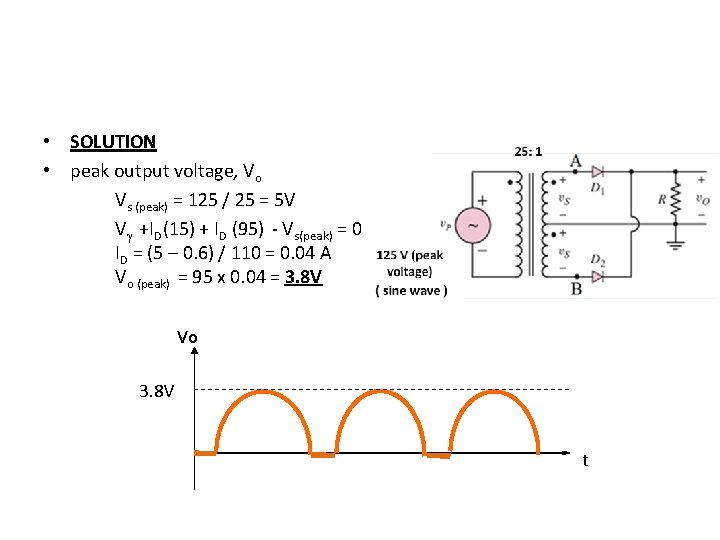
• SOLUTION • peak output voltage, Vo Vs (peak) = 125 / 25 = 5 V V +ID(15) + ID (95) - Vs(peak) = 0 ID = (5 – 0. 6) / 110 = 0. 04 A Vo (peak) = 95 x 0. 04 = 3. 8 V Vo 3. 8 V t
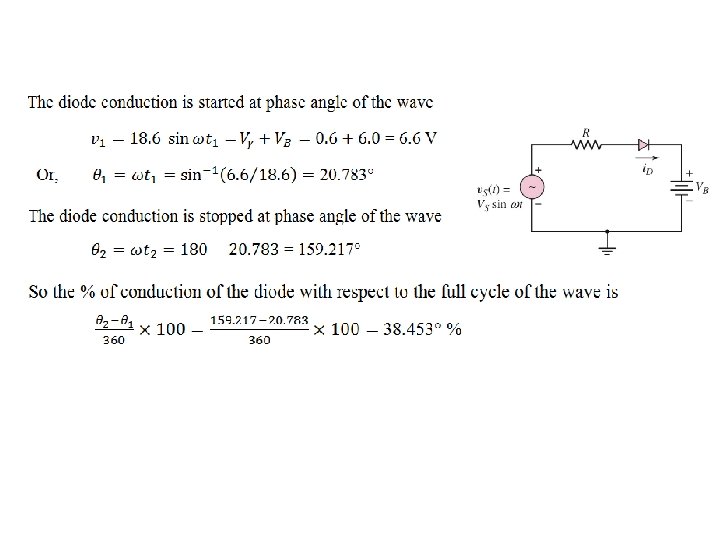
Duty Cycle: The fraction of the wave cycle over which the diode is conducting.
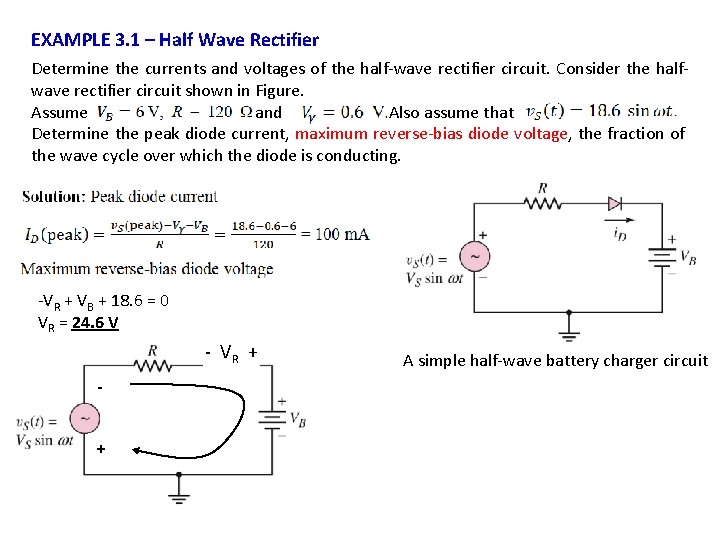
EXAMPLE 3. 1 – Half Wave Rectifier Determine the currents and voltages of the half-wave rectifier circuit. Consider the halfwave rectifier circuit shown in Figure. Assume and . Also assume that Determine the peak diode current, maximum reverse-bias diode voltage, the fraction of the wave cycle over which the diode is conducting. -VR + VB + 18. 6 = 0 VR = 24. 6 V - VR + + A simple half-wave battery charger circuit
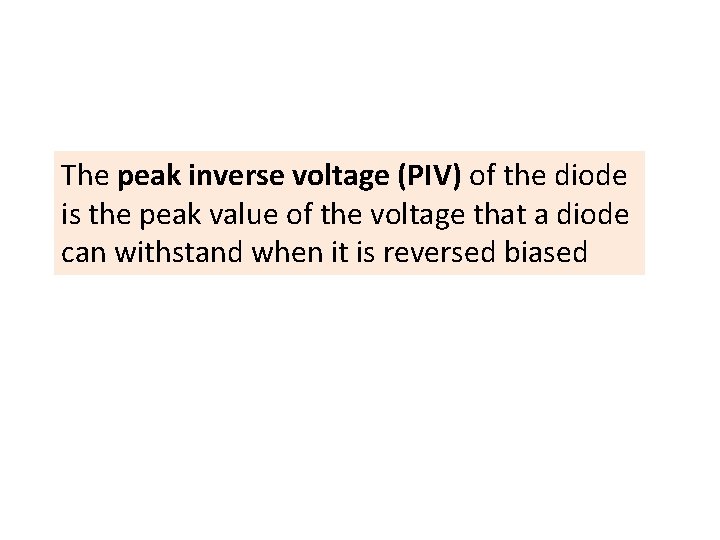
The peak inverse voltage (PIV) of the diode is the peak value of the voltage that a diode can withstand when it is reversed biased
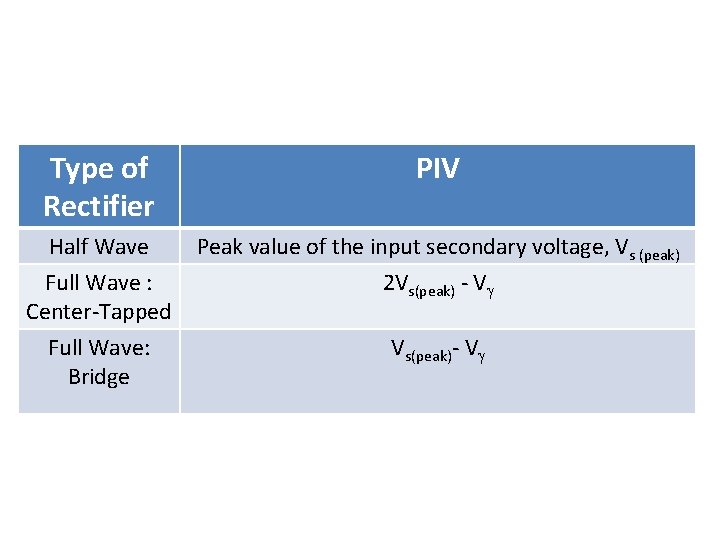
Type of Rectifier PIV Half Wave Full Wave : Center-Tapped Full Wave: Bridge Peak value of the input secondary voltage, Vs (peak) 2 Vs(peak) - V Vs(peak)- V
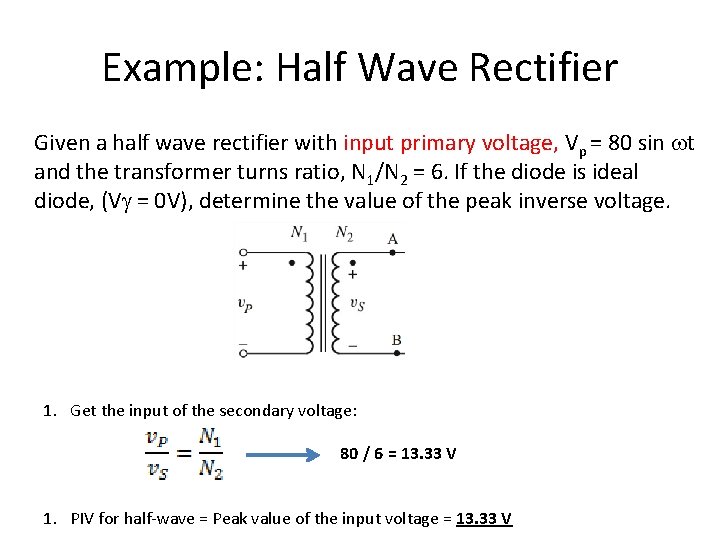
Example: Half Wave Rectifier Given a half wave rectifier with input primary voltage, Vp = 80 sin t and the transformer turns ratio, N 1/N 2 = 6. If the diode is ideal diode, (V = 0 V), determine the value of the peak inverse voltage. 1. Get the input of the secondary voltage: 80 / 6 = 13. 33 V 1. PIV for half-wave = Peak value of the input voltage = 13. 33 V
EXAMPLE 3. 2 Calculate the transformer turns ratio and the PIV voltages for each type of the full wave rectifier a) center-tapped b) bridge Assume the input voltage of the transformer is 220 V (rms), 50 Hz from ac main line source. The desired peak output voltage is 9 volt; also assume diodes cut-in voltage = 0. 6 V.
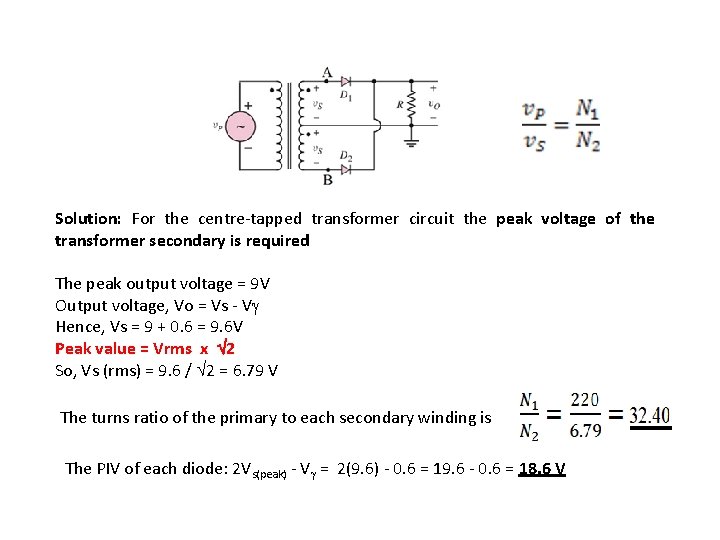
Solution: For the centre-tapped transformer circuit the peak voltage of the transformer secondary is required The peak output voltage = 9 V Output voltage, Vo = Vs - V Hence, Vs = 9 + 0. 6 = 9. 6 V Peak value = Vrms x 2 So, Vs (rms) = 9. 6 / 2 = 6. 79 V The turns ratio of the primary to each secondary winding is The PIV of each diode: 2 Vs(peak) - V = 2(9. 6) - 0. 6 = 19. 6 - 0. 6 = 18. 6 V
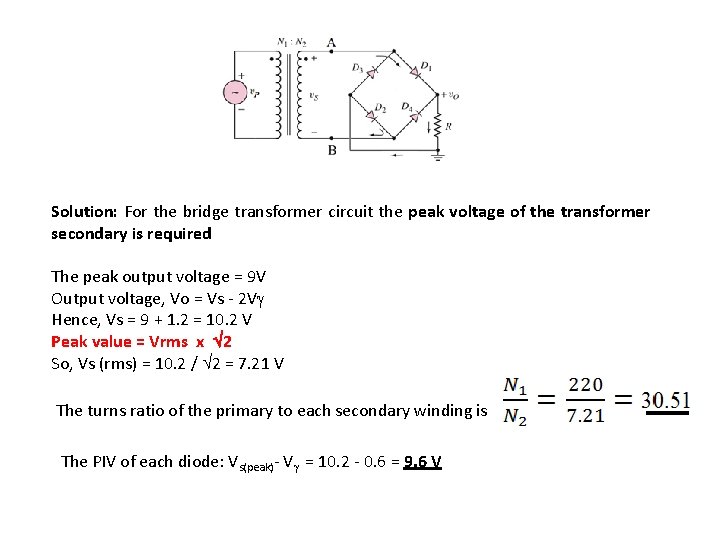
Solution: For the bridge transformer circuit the peak voltage of the transformer secondary is required The peak output voltage = 9 V Output voltage, Vo = Vs - 2 V Hence, Vs = 9 + 1. 2 = 10. 2 V Peak value = Vrms x 2 So, Vs (rms) = 10. 2 / 2 = 7. 21 V The turns ratio of the primary to each secondary winding is The PIV of each diode: Vs(peak)- V = 10. 2 - 0. 6 = 9. 6 V