
RecallLecture 5 l DC Analysis l Representation of

- Slides: 25
Recall-Lecture 5 l DC Analysis l Representation of diode into three models l l l Ideal case – model 1 with V = 0 Piecewise linear model 2 with V has a constant value Piecewise linear model 3 with V and forward resistance, rf
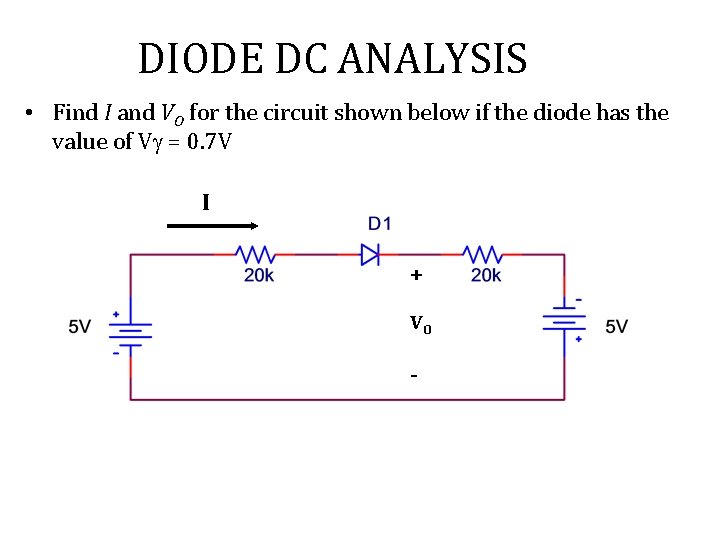
DIODE DC ANALYSIS • Find I and VO for the circuit shown below if the diode has the value of V = 0. 7 V I + VO - I = 0. 2325 m. A VO = -0. 35 V
MULTIPLE DIODE CIRCUITS
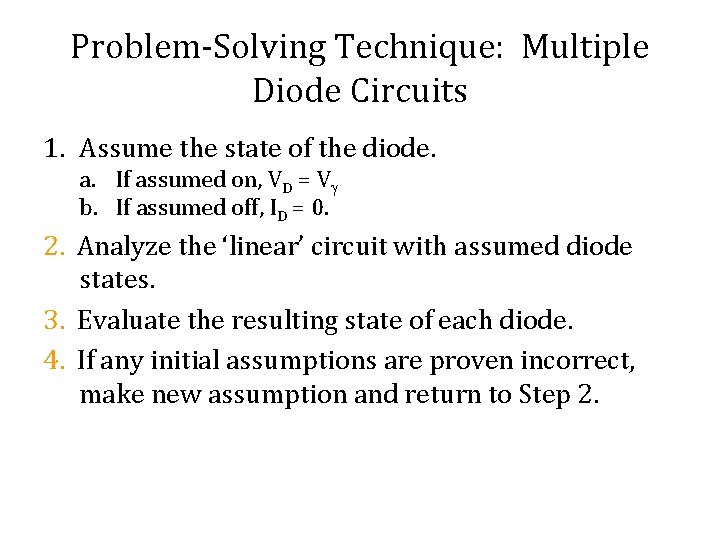
Problem-Solving Technique: Multiple Diode Circuits 1. Assume the state of the diode. a. If assumed on, VD = V b. If assumed off, ID = 0. 2. Analyze the ‘linear’ circuit with assumed diode states. 3. Evaluate the resulting state of each diode. 4. If any initial assumptions are proven incorrect, make new assumption and return to Step 2.
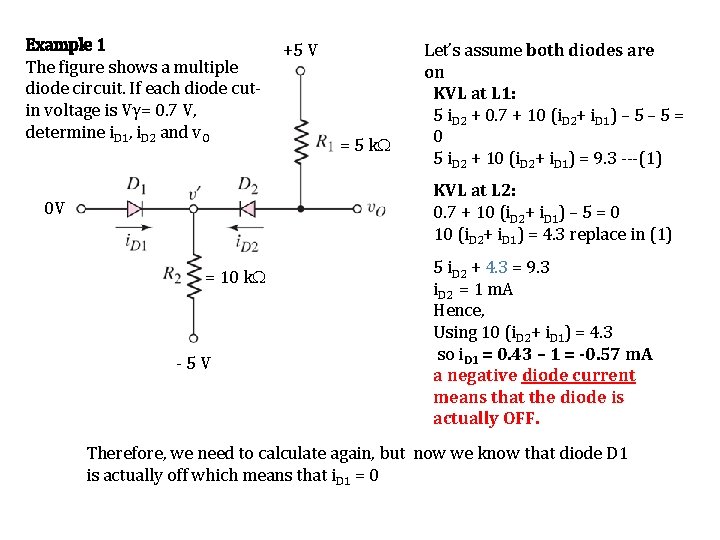
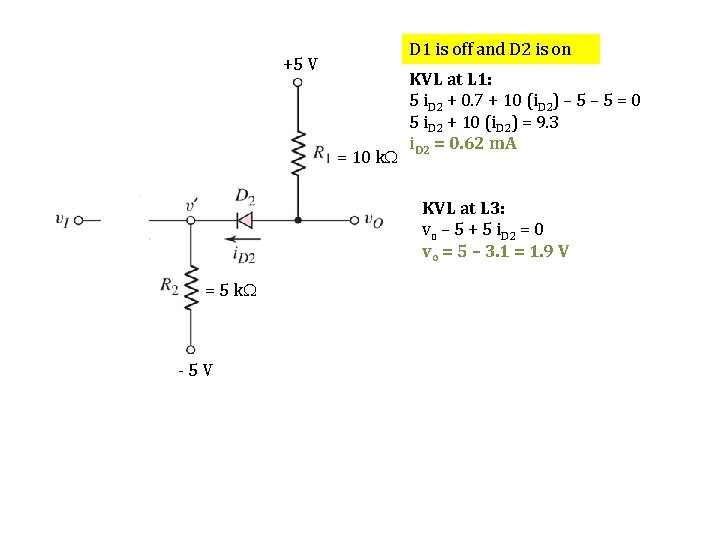
Example 1 The figure shows a multiple diode circuit. If each diode cutin voltage is Vγ= 0. 7 V, determine i. D 1, i. D 2 and v. O +5 V = 5 k Let’s assume both diodes are on KVL at L 1: 5 i. D 2 + 0. 7 + 10 (i. D 2+ i. D 1) – 5 = 0 5 i. D 2 + 10 (i. D 2+ i. D 1) = 9. 3 ---(1) KVL at L 2: 0. 7 + 10 (i. D 2+ i. D 1) – 5 = 0 10 (i. D 2+ i. D 1) = 4. 3 replace in (1) 0 V = 10 k -5 V 5 i. D 2 + 4. 3 = 9. 3 i. D 2 = 1 m. A Hence, Using 10 (i. D 2+ i. D 1) = 4. 3 so i. D 1 = 0. 43 – 1 = -0. 57 m. A a negative diode current means that the diode is actually OFF. Therefore, we need to calculate again, but now we know that diode D 1 is actually off which means that i. D 1 = 0
D 1 is off and D 2 is on +5 V = 10 k KVL at L 1: 5 i. D 2 + 0. 7 + 10 (i. D 2) – 5 = 0 5 i. D 2 + 10 (i. D 2) = 9. 3 i. D 2 = 0. 62 m. A KVL at L 3: vo – 5 + 5 i. D 2 = 0 vo = 5 – 3. 1 = 1. 9 V = 5 k -5 V
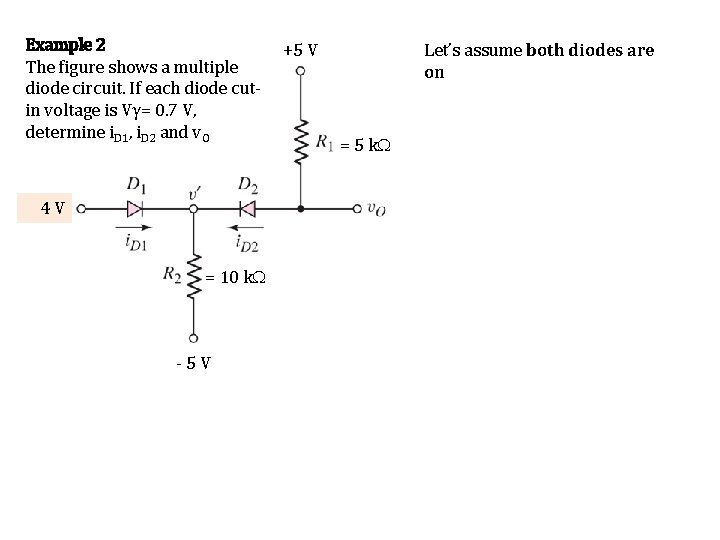
Example 2 The figure shows a multiple diode circuit. If each diode cutin voltage is Vγ= 0. 7 V, determine i. D 1, i. D 2 and v. O 4 V = 10 k -5 V So calculate vo : KVL at L 3: vo – 5 + 5 i. D 2 = 0 vo = 5 – 1 = 4 V Let’s assume both diodes are on +5 V = 5 k KVL at L 1: 5 i. D 2 + 0. 7 + 10 (i. D 2+ i. D 1) – 5 = 0 5 i. D 2 + 10 (i. D 2+ i. D 1) = 9. 3 ---(1) KVL at L 2: 0. 7 + 10 (i. D 2+ i. D 1) – 5 -4 = 0 10 (i. D 2+ i. D 1) = 8. 3 replace in (1) 5 i. D 2 + 8. 3 = 9. 3 i. D 2 = 0. 2 m. A Hence, 10 (i. D 2+ i. D 1) = 8. 3 so i. D 1 = 0. 83 – 0. 2 = 0. 63 m. A Both currents have positive values which means that our assumption is correct
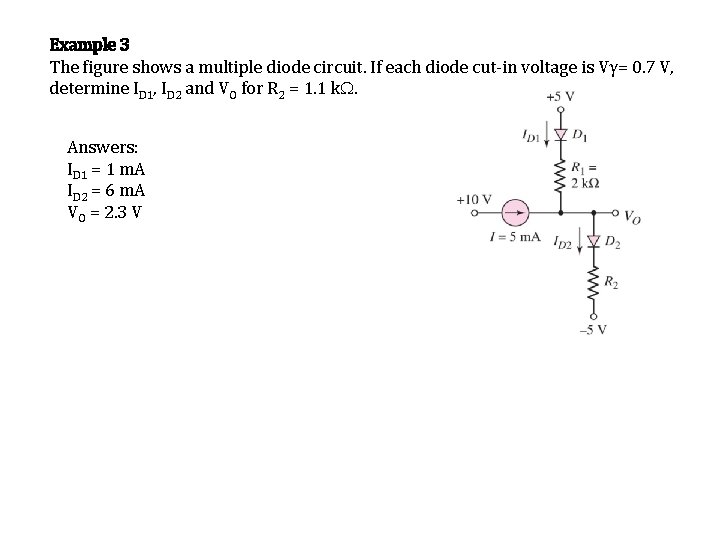
Example 3 The figure shows a multiple diode circuit. If each diode cut-in voltage is Vγ= 0. 7 V, determine ID 1, ID 2 and VO for R 2 = 1. 1 k. Answers: ID 1 = 1 m. A ID 2 = 6 m. A VO = 2. 3 V
DIODE AC EQUIVALENT
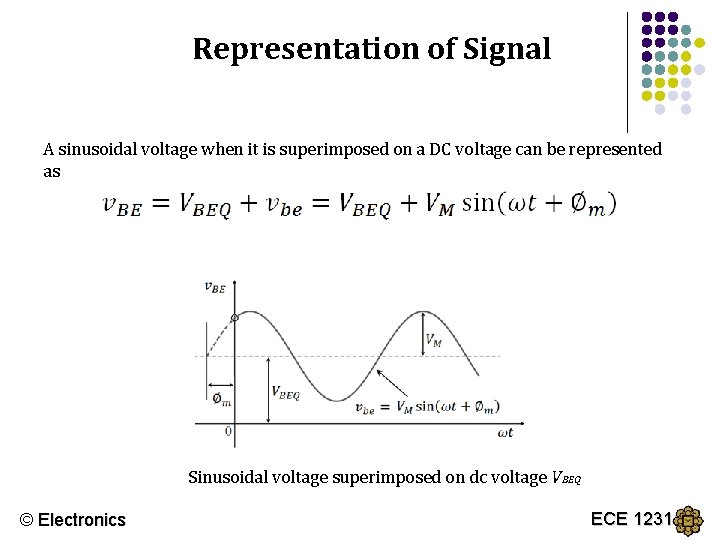
Representation of Signal A sinusoidal voltage when it is superimposed on a DC voltage can be represented as Sinusoidal voltage superimposed on dc voltage VBEQ © Electronics ECE 1231
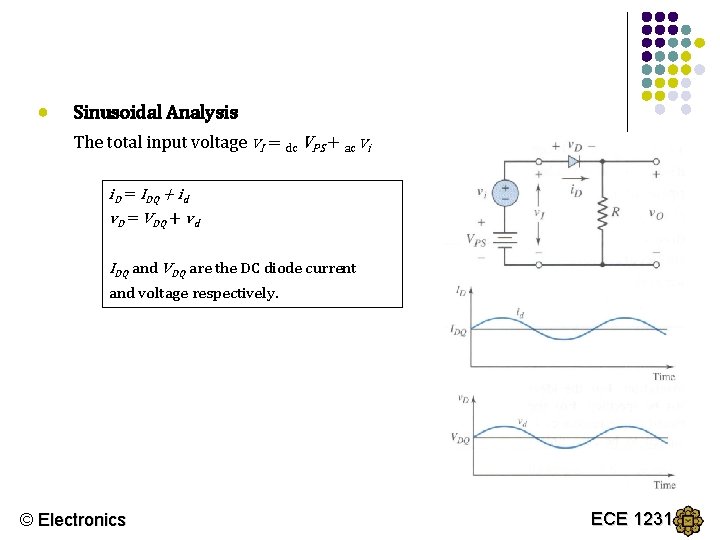
● Sinusoidal Analysis The total input voltage v. I = dc VPS + ac vi i. D = IDQ + id v. D = VDQ + vd IDQ and VDQ are the DC diode current and voltage respectively. © Electronics ECE 1231
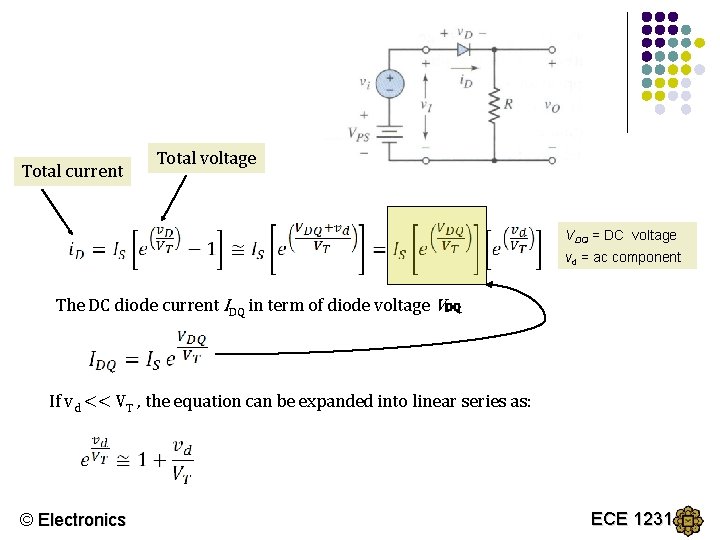
Total current Total voltage VDQ = DC voltage vd = ac component The DC diode current IDQ in term of diode voltage VDQ If vd << VT , the equation can be expanded into linear series as: © Electronics ECE 1231
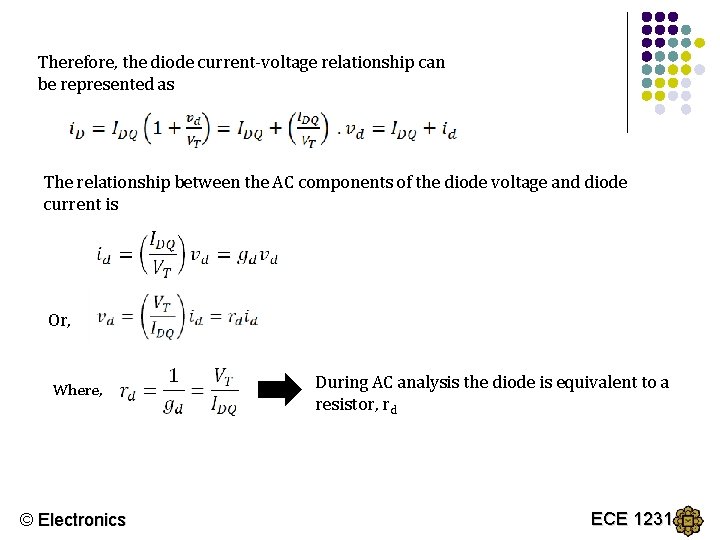
Therefore, the diode current-voltage relationship can be represented as The relationship between the AC components of the diode voltage and diode current is Or, Where, © Electronics During AC analysis the diode is equivalent to a resistor, rd ECE 1231
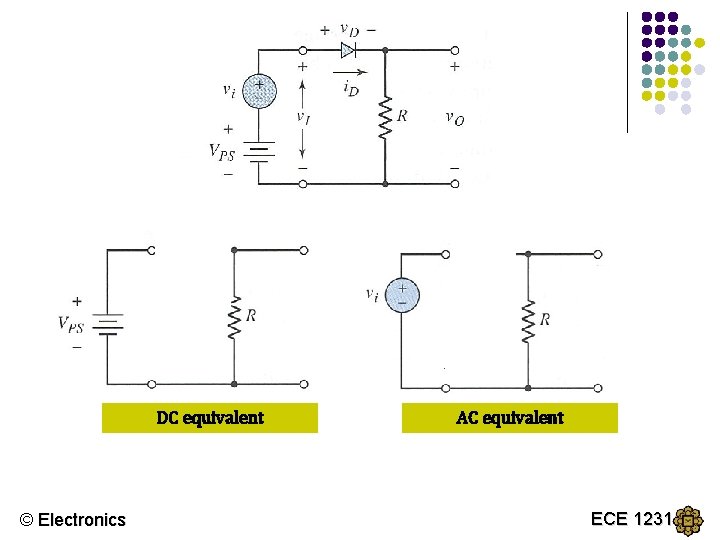
VDQ = V + - IDQ DC equivalent © Electronics rd id AC equivalent ECE 1231
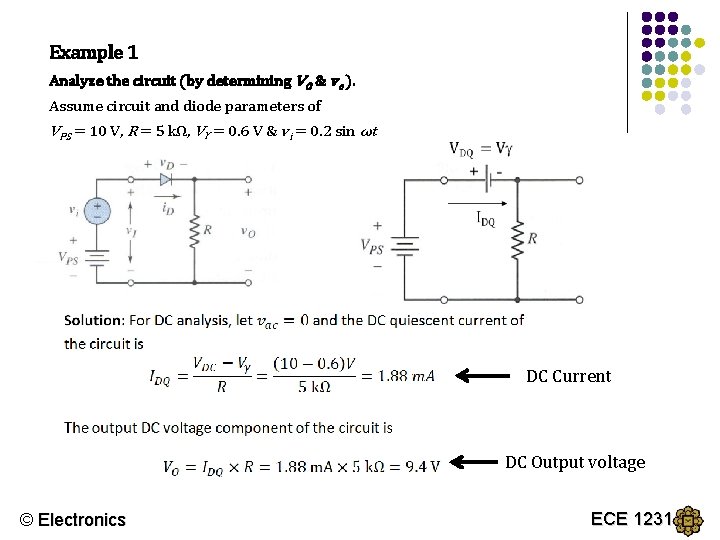
Example 1 Analyze the circuit (by determining VO & vo ). Assume circuit and diode parameters of VPS = 10 V, R = 5 kΩ, Vγ = 0. 6 V & vi = 0. 2 sin ωt DC Current DC Output voltage © Electronics ECE 1231
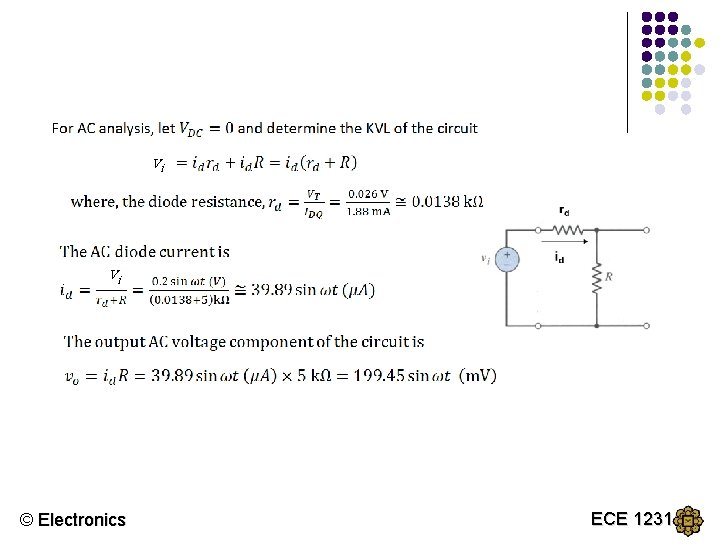
vi vi © Electronics ECE 1231
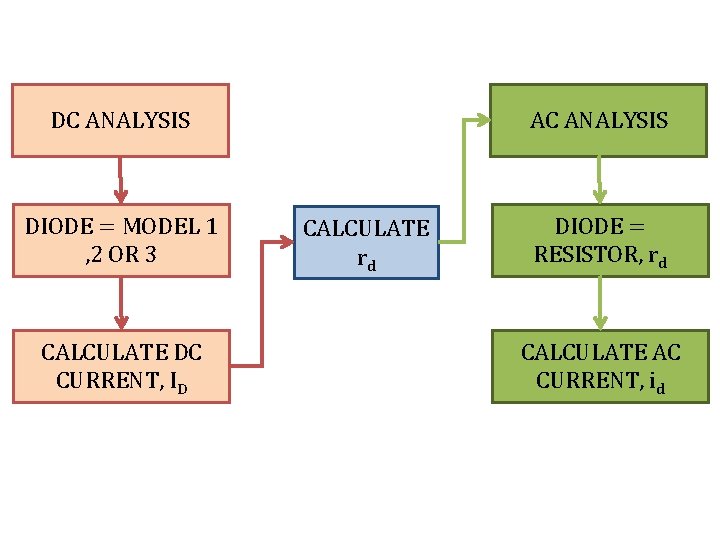
DC ANALYSIS DIODE = MODEL 1 , 2 OR 3 CALCULATE DC CURRENT, ID AC ANALYSIS CALCULATE rd DIODE = RESISTOR, rd CALCULATE AC CURRENT, id
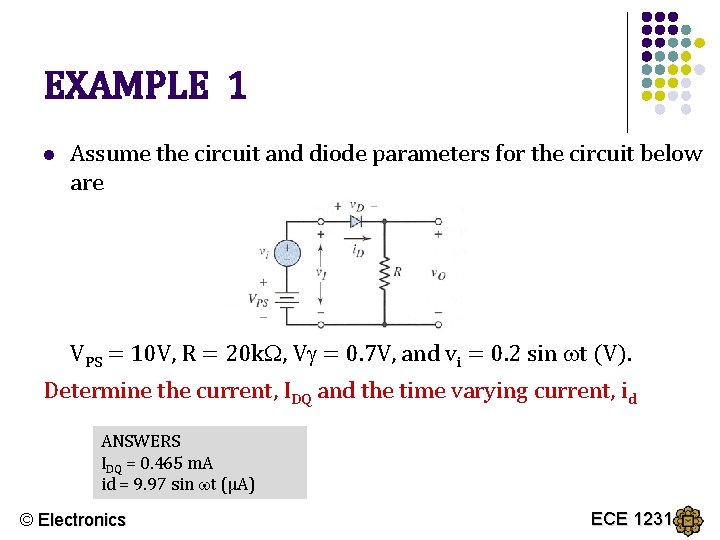
EXAMPLE 1 l Assume the circuit and diode parameters for the circuit below are VPS = 10 V, R = 20 k , V = 0. 7 V, and vi = 0. 2 sin t (V). Determine the current, IDQ and the time varying current, id ANSWERS IDQ = 0. 465 m. A id = 9. 97 sin t (µA) © Electronics ECE 1231
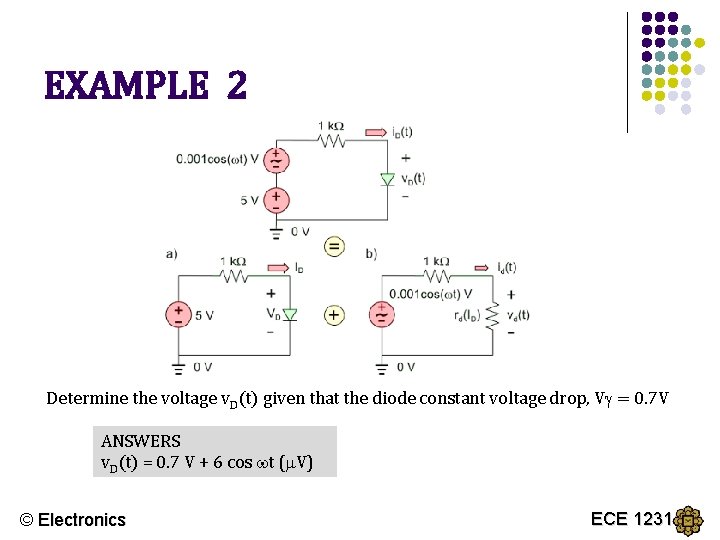
EXAMPLE 2 Determine the voltage v. D(t) given that the diode constant voltage drop, V = 0. 7 V ANSWERS v. D(t) = 0. 7 V + 6 cos t ( V) © Electronics ECE 1231
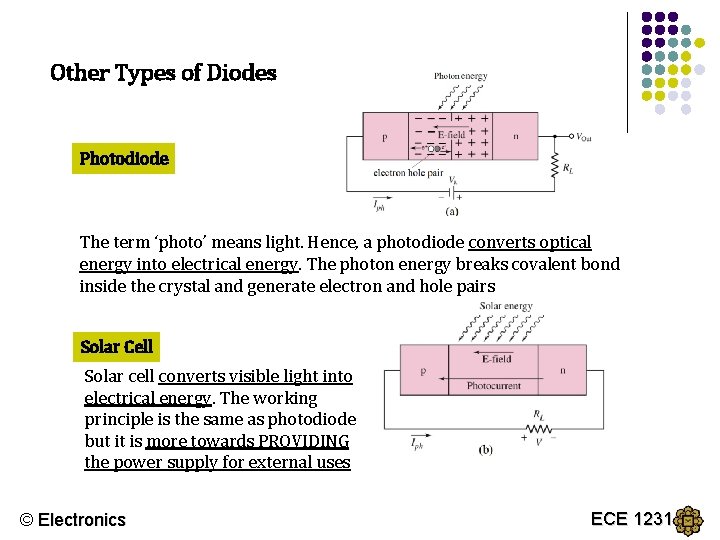
Other Types of Diodes Photodiode The term ‘photo’ means light. Hence, a photodiode converts optical energy into electrical energy. The photon energy breaks covalent bond inside the crystal and generate electron and hole pairs Solar Cell Solar cell converts visible light into electrical energy. The working principle is the same as photodiode but it is more towards PROVIDING the power supply for external uses © Electronics ECE 1231
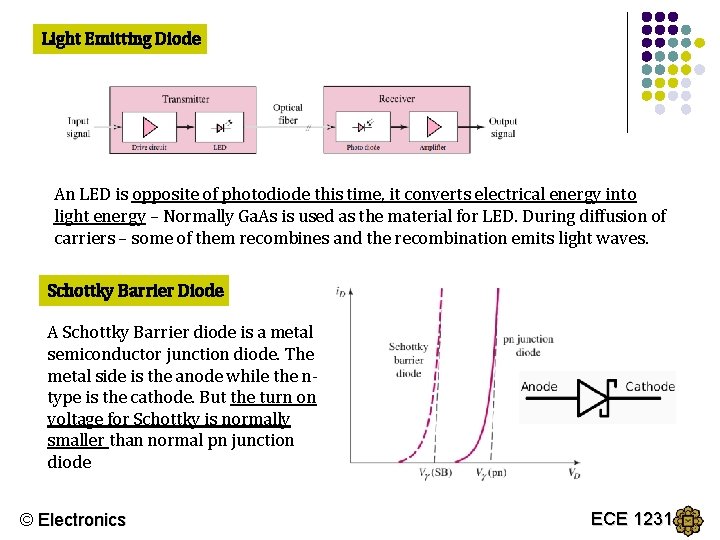
Light Emitting Diode An LED is opposite of photodiode this time, it converts electrical energy into light energy – Normally Ga. As is used as the material for LED. During diffusion of carriers – some of them recombines and the recombination emits light waves. Schottky Barrier Diode A Schottky Barrier diode is a metal semiconductor junction diode. The metal side is the anode while the ntype is the cathode. But the turn on voltage for Schottky is normally smaller than normal pn junction diode © Electronics ECE 1231
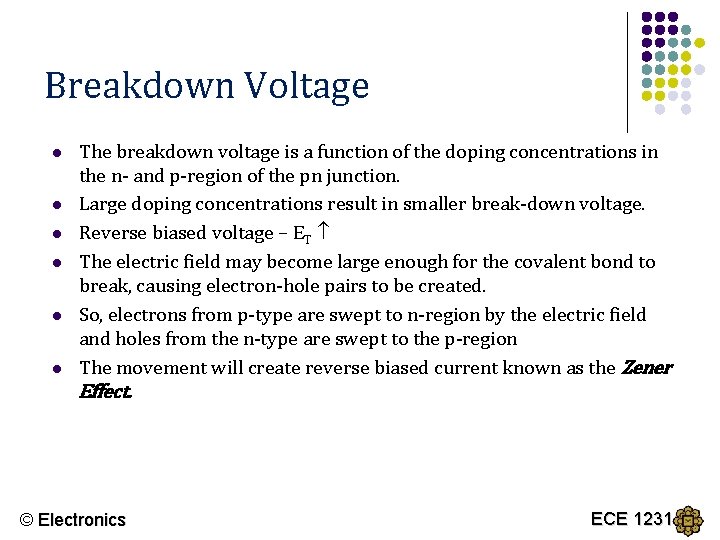
Breakdown Voltage l l l The breakdown voltage is a function of the doping concentrations in the n- and p-region of the pn junction. Large doping concentrations result in smaller break-down voltage. Reverse biased voltage – ET The electric field may become large enough for the covalent bond to break, causing electron-hole pairs to be created. So, electrons from p-type are swept to n-region by the electric field and holes from the n-type are swept to the p-region The movement will create reverse biased current known as the Zener Effect. © Electronics ECE 1231
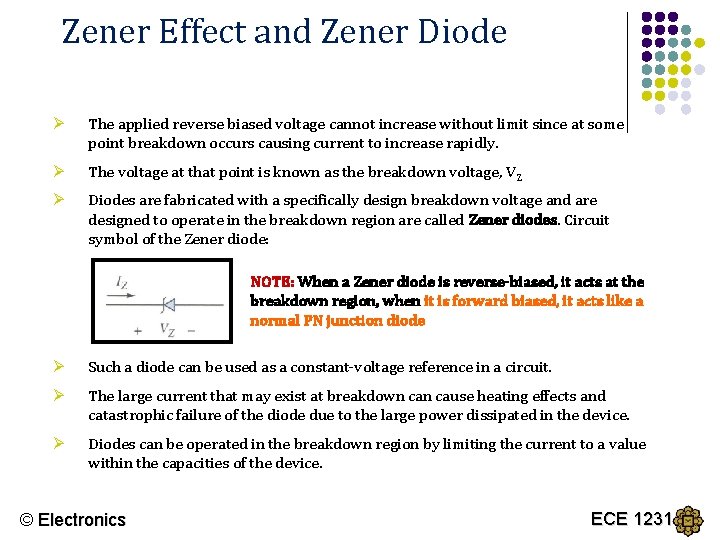
Zener Effect and Zener Diode Ø The applied reverse biased voltage cannot increase without limit since at some point breakdown occurs causing current to increase rapidly. Ø The voltage at that point is known as the breakdown voltage, VZ Ø Diodes are fabricated with a specifically design breakdown voltage and are designed to operate in the breakdown region are called Zener diodes. Circuit symbol of the Zener diode: NOTE: When a Zener diode is reverse-biased, it acts at the breakdown region, when it is forward biased, it acts like a normal PN junction diode Ø Such a diode can be used as a constant-voltage reference in a circuit. Ø The large current that may exist at breakdown cause heating effects and catastrophic failure of the diode due to the large power dissipated in the device. Ø Diodes can be operated in the breakdown region by limiting the current to a value within the capacities of the device. © Electronics ECE 1231
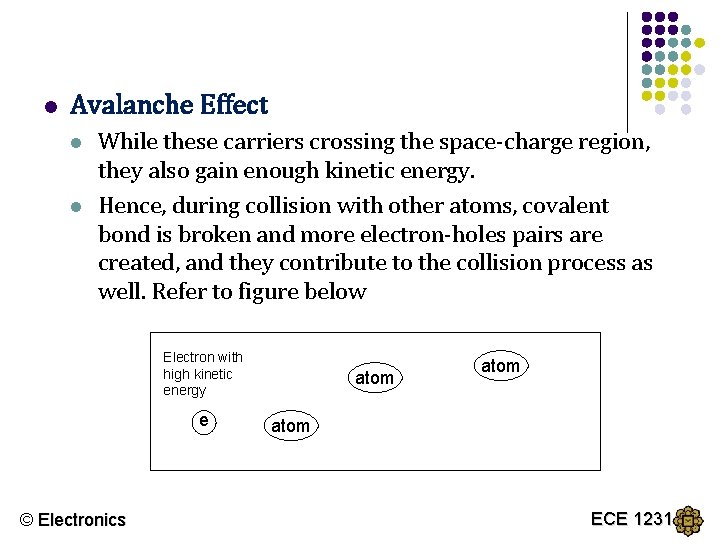
l Avalanche Effect l l While these carriers crossing the space-charge region, they also gain enough kinetic energy. Hence, during collision with other atoms, covalent bond is broken and more electron-holes pairs are created, and they contribute to the collision process as well. Refer to figure below Electron with high kinetic energy e © Electronics e h atom eh atom ECE 1231
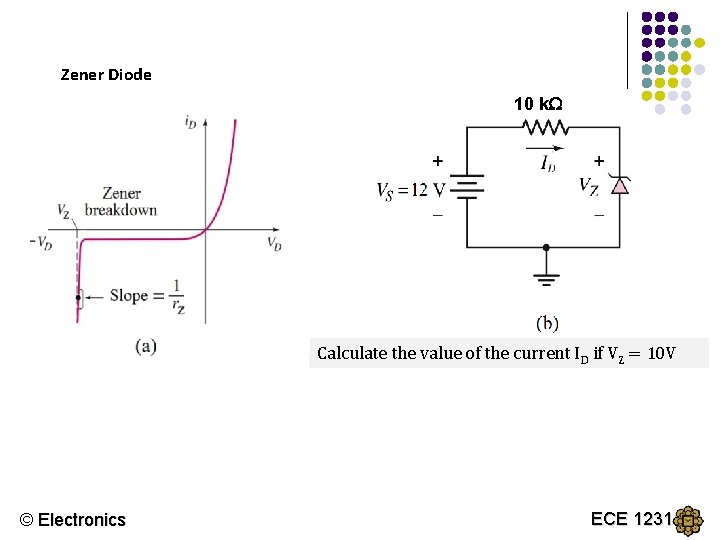
Zener Diode 10 k Calculate the value of the current ID if VZ = 10 V ANSWER: ID = 0. 2 m. A © Electronics ECE 1231