
Recall that for a real valued function from


- Slides: 8
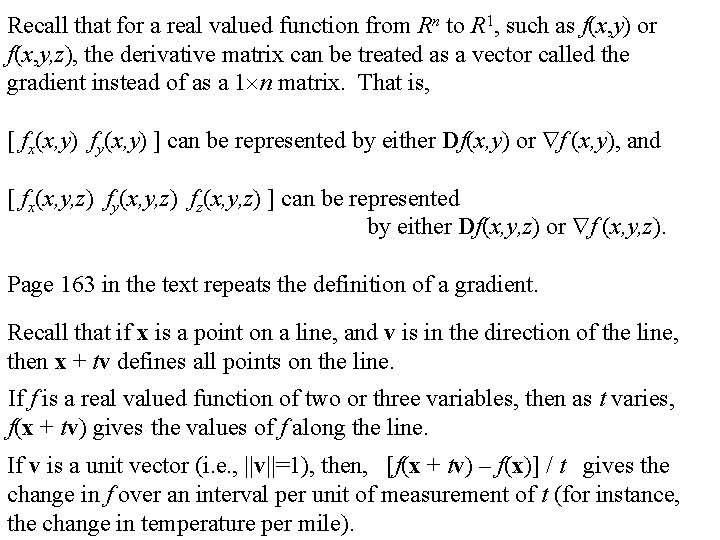
Recall that for a real valued function from Rn to R 1, such as f(x, y) or f(x, y, z), the derivative matrix can be treated as a vector called the gradient instead of as a 1 n matrix. That is, [ fx(x, y) fy(x, y) ] can be represented by either Df(x, y) or f (x, y), and [ fx(x, y, z) fy(x, y, z) fz(x, y, z) ] can be represented by either Df(x, y, z) or f (x, y, z). Page 163 in the text repeats the definition of a gradient. Recall that if x is a point on a line, and v is in the direction of the line, then x + tv defines all points on the line. If f is a real valued function of two or three variables, then as t varies, f(x + tv) gives the values of f along the line. If v is a unit vector (i. e. , ||v||=1), then, [f(x + tv) – f(x)] / t gives the change in f over an interval per unit of measurement of t (for instance, the change in temperature per mile).
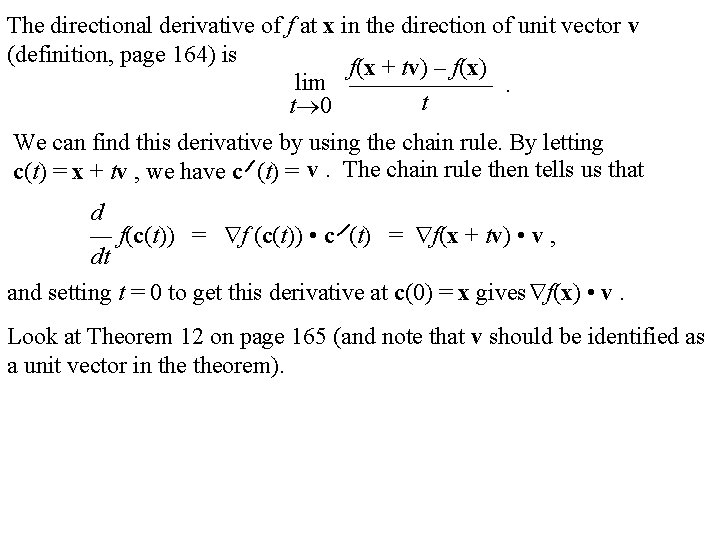
The directional derivative of f at x in the direction of unit vector v (definition, page 164) is f(x + tv) – f(x) lim ——————. t t 0 We can find this derivative by using the chain rule. By letting c(t) = x + tv , we have c (t) = v. The chain rule then tells us that d — f(c(t)) = f (c(t)) • c (t) = f(x + tv) • v , dt and setting t = 0 to get this derivative at c(0) = x gives f(x) • v. Look at Theorem 12 on page 165 (and note that v should be identified as a unit vector in theorem).
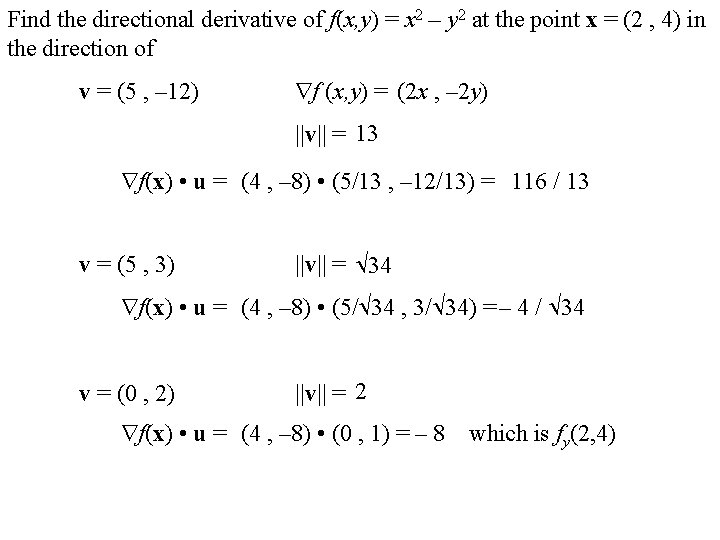
Find the directional derivative of f(x, y) = x 2 – y 2 at the point x = (2 , 4) in the direction of v = (5 , – 12) f (x, y) = (2 x , – 2 y) ||v|| = 13 f(x) • u = (4 , – 8) • (5/13 , – 12/13) = 116 / 13 v = (5 , 3) ||v|| = 34 f(x) • u = (4 , – 8) • (5/ 34 , 3/ 34) = – 4 / 34 v = (0 , 2) ||v|| = 2 f(x) • u = (4 , – 8) • (0 , 1) = – 8 which is fy(2, 4)
Find a formula for the directional derivative of f(x, y, z) = xy 3 – z 2 at each point on the path c(t) = (5 sin t , 4 cos t , 3 cos t) for 0 t , in the direction of the tangent vector to the path. f (x, y, z) = (y 3 , 3 xy 2 , – 2 z) x = c(t) = (5 sin t , 4 cos t , 3 cos t) v = c (t) = (5 cos t , – 4 sin t , – 3 sin t) ||v|| = 5 f(x) • u = (64 cos 3 t , 240(sin t)(cos 2 t) (5 cos t , – 4 sin t , – 3 sin t) , – 6 cos t) • —————— = 5 320 cos 4 t – 960(sin 2 t)(cos 2 t) + 18(cos t)(sin t) ————————— 5
Note that if is the angle between the vectors f(x) and a unit vector v, then f(x) • v = || f(x)|| ||v|| cos = || f(x)|| cos . This is maximized when = 0 ( f(x) and v point in the same direction) and is minimized when = ( f(x) and v point in opposite directions). On page 166, look at Theorem 13 and the comment which immediately follows. Find the direction in which f(x, y) = 3 x 2 – 2 y 2 + xy increases the fastest from the point (– 4 , 5). f (x, y) = fx i + fy j = (6 x + y)i + (x – 4 y)j f (– 4 , 5) = – 19 i – 24 j Find the direction in which T(x, y, z) = e–x + e– 2 y + e 3 z decreases the fastest from the point (1 , 1/2 , – 1/3). T (x, y, z) = fx i + fy j + fz k = – e–xi – 2 e– 2 yj + 3 e 3 zk – T (1 , 1/2 , – 1/3) = (i + 2 j – 3 k) / e
Consider the curve in R 2 defined by f(x, y) = b (which is a level curve of the function z = f(x, y)). If c(t) = (x(t) , y(t)) describes a path on the curve f(x, y) = b, then Consider z = x 2 + y 2. One level curve is x 2 + y 2 = 1. One path on the curve is c(t) = (cos t , sin t) for 0 t /2. f(x(t) , y(t)) = f(c(t)) = b (cos t)2 + (sin t)2 = 1 d — f(x(t) , y(t)) = 0 dt d — [(cos t)2 + (sin t)2] = 0 dt Df(x, y) Dc(t) = 0 f(c(t)) • c (t) = 0 – 2(cos t)(sin t) + 2(sin t)(cos t) = 0 – sin t 2 cos t 2 sin t = 0 cos t y x
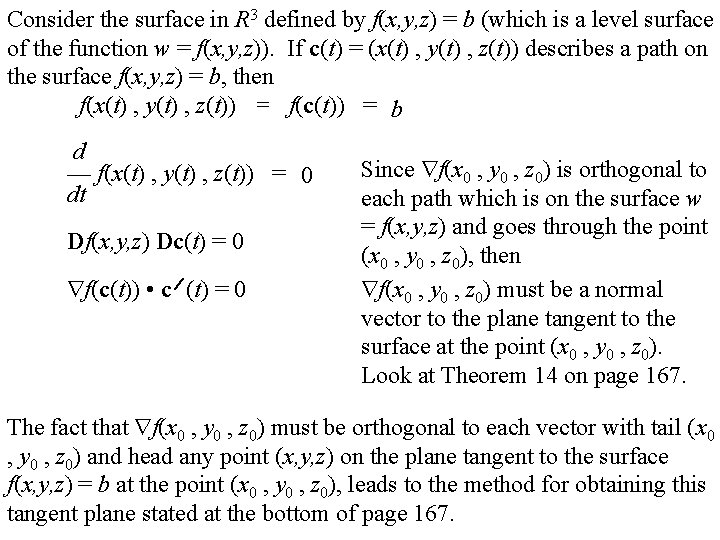
Consider the surface in R 3 defined by f(x, y, z) = b (which is a level surface of the function w = f(x, y, z)). If c(t) = (x(t) , y(t) , z(t)) describes a path on the surface f(x, y, z) = b, then f(x(t) , y(t) , z(t)) = f(c(t)) = b d — f(x(t) , y(t) , z(t)) = 0 dt Df(x, y, z) Dc(t) = 0 f(c(t)) • c (t) = 0 Since f(x 0 , y 0 , z 0) is orthogonal to each path which is on the surface w = f(x, y, z) and goes through the point (x 0 , y 0 , z 0), then f(x 0 , y 0 , z 0) must be a normal vector to the plane tangent to the surface at the point (x 0 , y 0 , z 0). Look at Theorem 14 on page 167. The fact that f(x 0 , y 0 , z 0) must be orthogonal to each vector with tail (x 0 , y 0 , z 0) and head any point (x, y, z) on the plane tangent to the surface f(x, y, z) = b at the point (x 0 , y 0 , z 0), leads to the method for obtaining this tangent plane stated at the bottom of page 167.
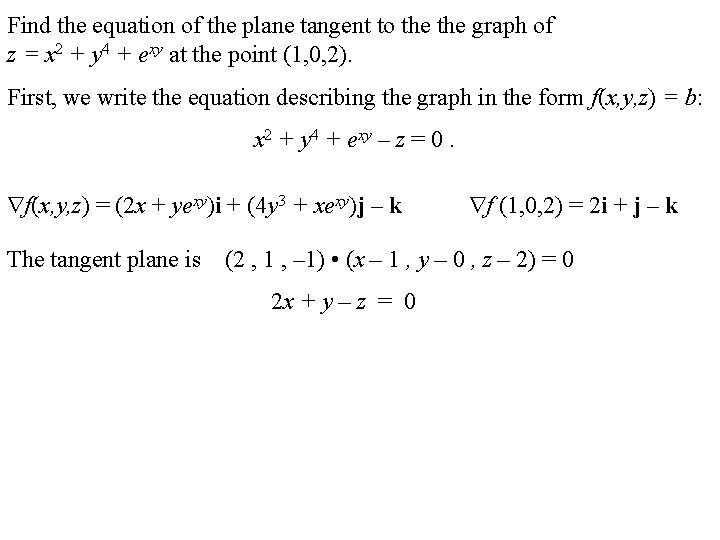
Find the equation of the plane tangent to the graph of z = x 2 + y 4 + exy at the point (1, 0, 2). First, we write the equation describing the graph in the form f(x, y, z) = b: x 2 + y 4 + exy – z = 0. f(x, y, z) = (2 x + yexy)i + (4 y 3 + xexy)j – k The tangent plane is f (1, 0, 2) = 2 i + j – k (2 , 1 , – 1) • (x – 1 , y – 0 , z – 2) = 0 2 x + y – z = 0