
RECALL EVENT INVESTIGATION PATIENT LOOK BACK Federal State
RECALL / EVENT INVESTIGATION & PATIENT LOOK BACK Federal, State and AABB requirements for nonconforming product investigation and recipient look back for adverse impact Stacy Ralston MPH, CLS (ASCP), RAC Transfusion Svc. Supervisor Kaiser South Sacramento Medical Center
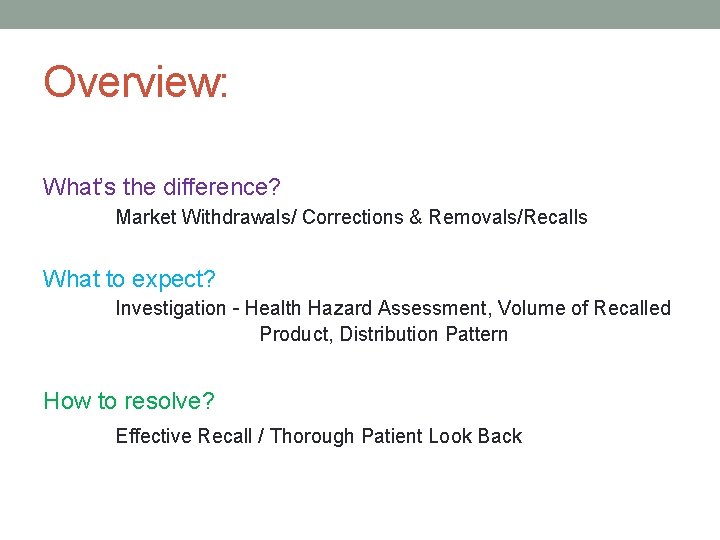
Overview: What’s the difference? Market Withdrawals/ Corrections & Removals/Recalls What to expect? Investigation – Health Hazard Assessment, Volume of Recalled Product, Distribution Pattern How to resolve? Effective Recall / Thorough Patient Look Back

Market Withdrawals • Market Withdrawals - Not subject to reporting! • Do not reduce a risk to health / No legal violation • Stock Recoveries • Routine Servicing The Chobani Market withdrawal!
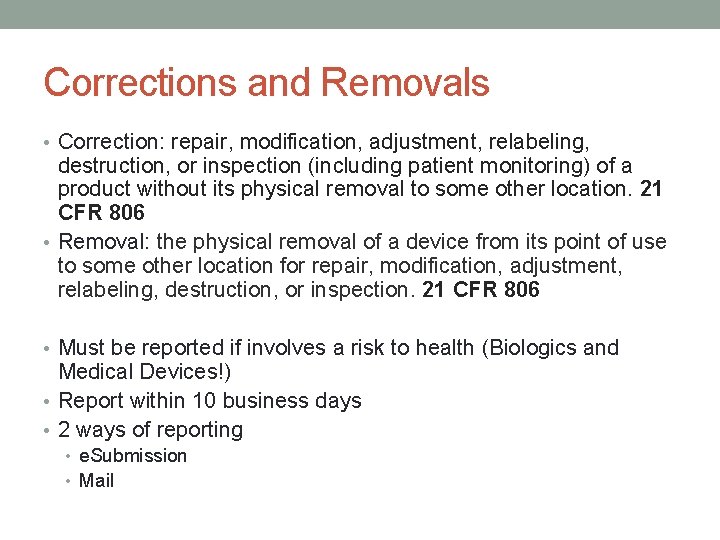
Corrections and Removals • Correction: repair, modification, adjustment, relabeling, destruction, or inspection (including patient monitoring) of a product without its physical removal to some other location. 21 CFR 806 • Removal: the physical removal of a device from its point of use to some other location for repair, modification, adjustment, relabeling, destruction, or inspection. 21 CFR 806 • Must be reported if involves a risk to health (Biologics and Medical Devices!) • Report within 10 business days • 2 ways of reporting • e. Submission • Mail
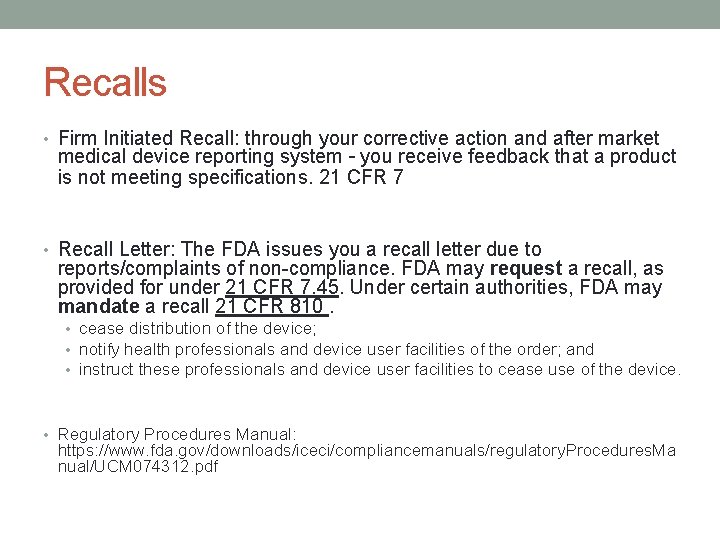
Recalls • Firm Initiated Recall: through your corrective action and after market medical device reporting system – you receive feedback that a product is not meeting specifications. 21 CFR 7 • Recall Letter: The FDA issues you a recall letter due to reports/complaints of non-compliance. FDA may request a recall, as provided for under 21 CFR 7. 45. Under certain authorities, FDA may mandate a recall 21 CFR 810. • cease distribution of the device; • notify health professionals and device user facilities of the order; and • instruct these professionals and device user facilities to cease use of the device. • Regulatory Procedures Manual: https: //www. fda. gov/downloads/iceci/compliancemanuals/regulatory. Procedures. Ma nual/UCM 074312. pdf
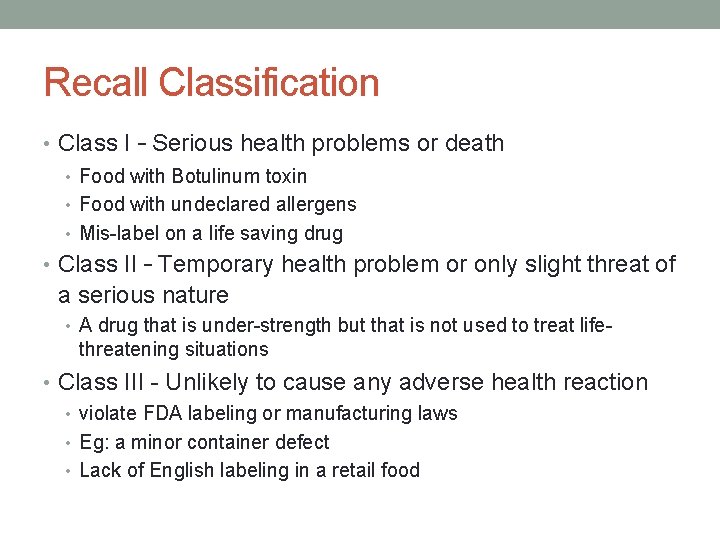
Recall Classification • Class I – Serious health problems or death • Food with Botulinum toxin • Food with undeclared allergens • Mis-label on a life saving drug • Class II – Temporary health problem or only slight threat of a serious nature • A drug that is under-strength but that is not used to treat life- threatening situations • Class III - Unlikely to cause any adverse health reaction • violate FDA labeling or manufacturing laws • Eg: a minor container defect • Lack of English labeling in a retail food
Products Subject to Recall • human drugs • animal drugs • medical devices • radiation-emitting products • vaccines • blood and blood products • transplantable human tissue • animal feed • cosmetics • about 80 percent of the foods eaten in the United States
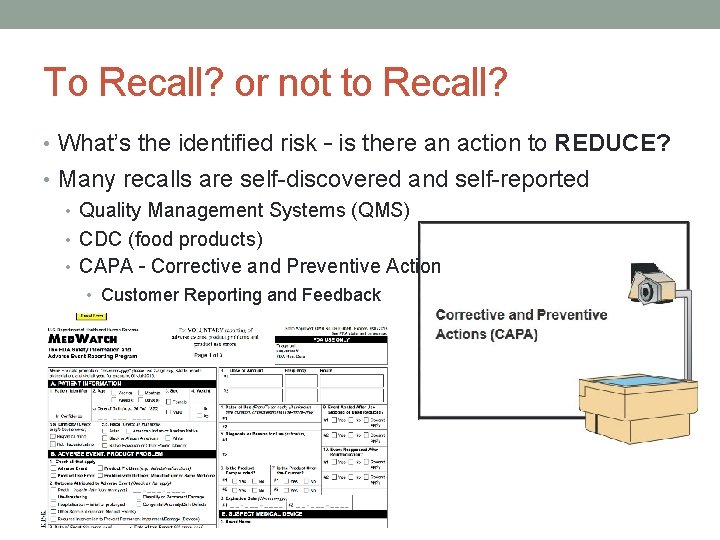
To Recall? or not to Recall? • What’s the identified risk – is there an action to REDUCE? • Many recalls are self-discovered and self-reported • Quality Management Systems (QMS) • CDC (food products) • CAPA – Corrective and Preventive Action • Customer Reporting and Feedback
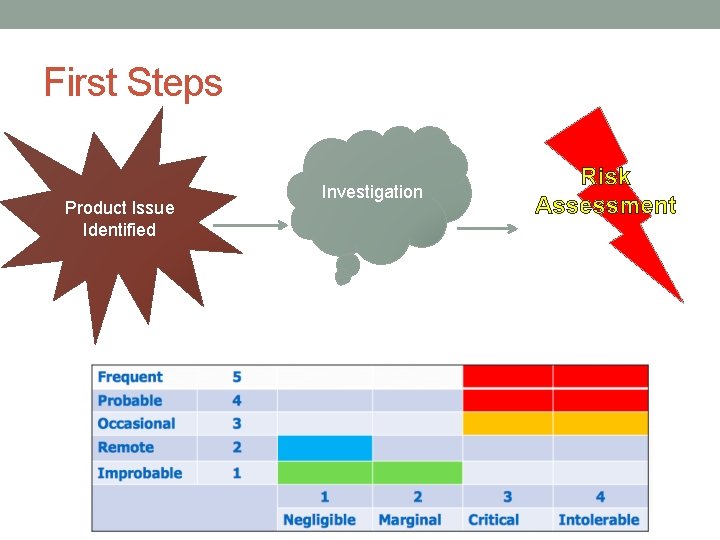
First Steps Product Issue Identified Investigation Risk Assessment
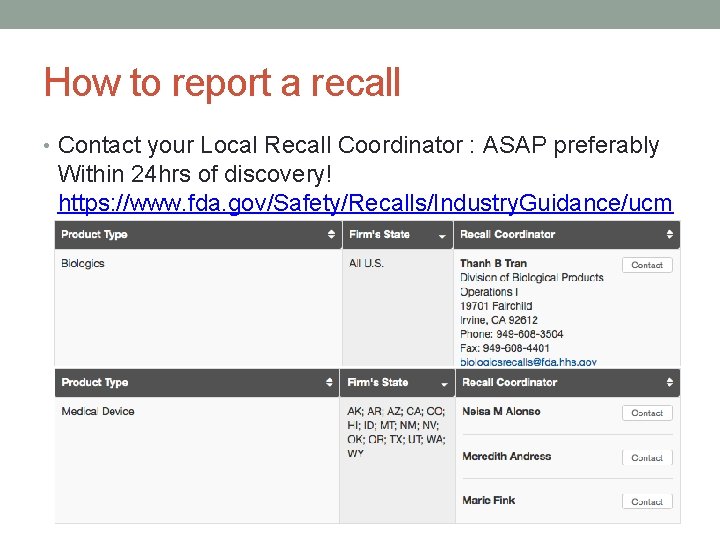
How to report a recall • Contact your Local Recall Coordinator : ASAP preferably Within 24 hrs of discovery! https: //www. fda. gov/Safety/Recalls/Industry. Guidance/ucm 129334. htm
Recall Submission 1) Product Information 2) Codes 3) Recalling Firm 4) Manufacturer 5) Firm at Fault for violation 6) Reason for Recall 7) Health Hazard Assessment – FDA support! 8) Volume of Recalled Product 9) Distribution Pattern 10) Recall Strategy- FDA support!
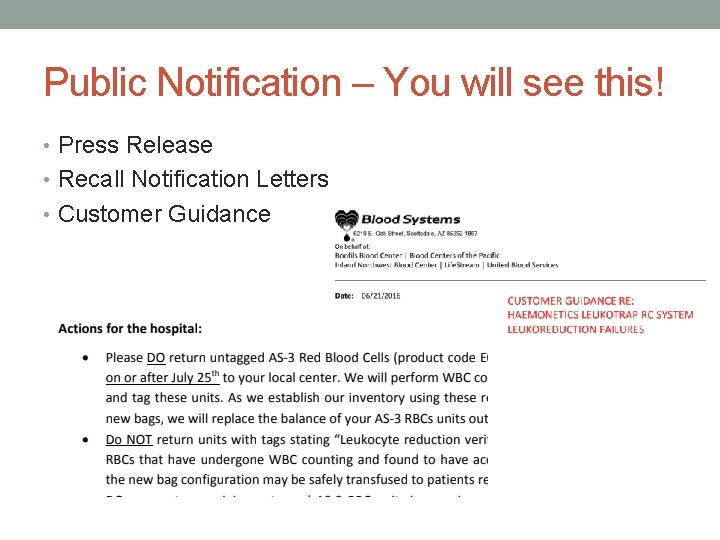
Public Notification – You will see this! • Press Release • Recall Notification Letters • Customer Guidance
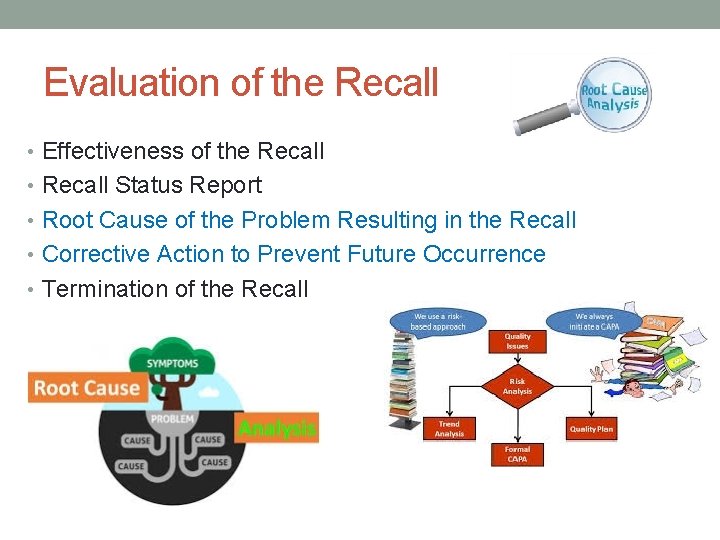
Evaluation of the Recall • Effectiveness of the Recall • Recall Status Report • Root Cause of the Problem Resulting in the Recall • Corrective Action to Prevent Future Occurrence • Termination of the Recall
Most Common Reasons for Biological Product Deviations (BPD) and Blood Component Recalls • BPDS (Effect on Safety, Purity, or Potency) • Malaria travel/ Residence • Variant Creutzfeldt-Jakob Disease Travel/Residence • Post-Donation Illness • Tattoo • Donor Deferral Missed (via incorrect donor identification) • Blood Component Recall • Collection Sterility and Arm Preparation • Storage Temperatures • Production According to c. GMP • Donor Suitability • Product Quality Control AABB Technical Manual 18 th Edition
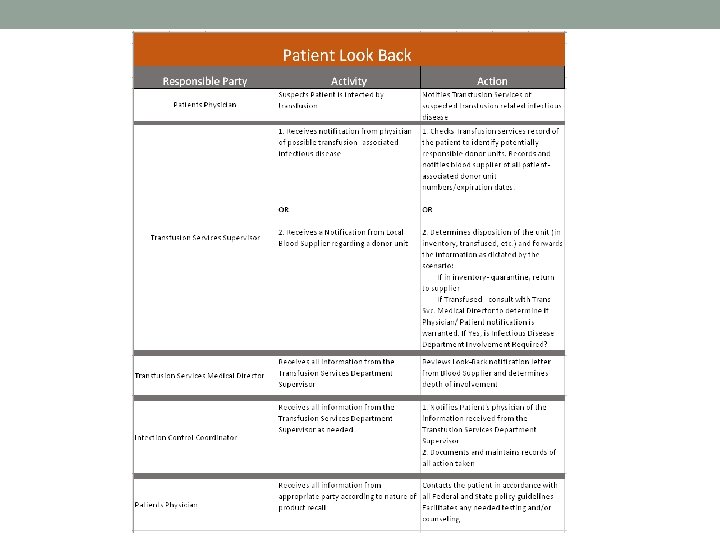
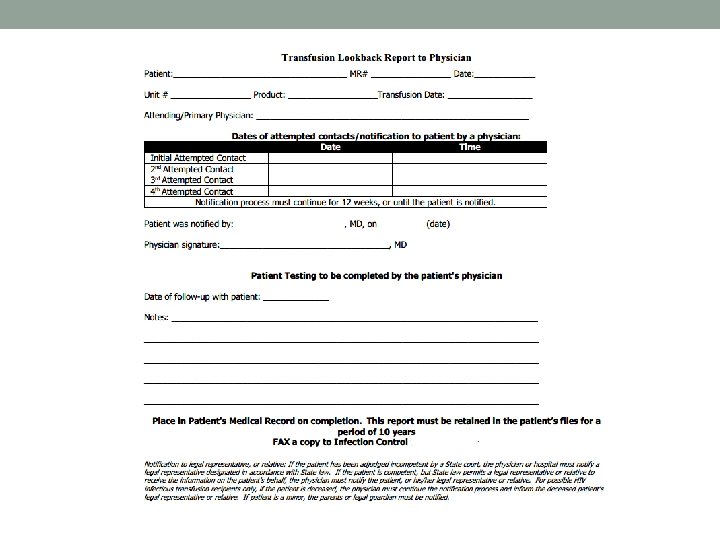
Patient Look Back Act Immediately Upon Notification of Recall! • Should be given: • Unit #’s/Component/Group/Date of Donation/Date Shipped • Check Inventory & Product History Review • If in Inventory – QUARANTINE (Return to Supplier if indicated in customer instructions to do so) • If Transfused – Document Patient Name/MRN/Date Transfused/MD • Review Information with Transfusion Svc Medical Director or Blood Supplier Medical Director to determine due course • If physician and patient notification are required, Involvement of the Infectious Disease Department may be needed. • Counseling of the patient and/or significant others may be necessary • Retain ALL Documentation for at least 10 years!
College of American Pathologists • TRM. 42120 Blood Component Recall and Quarantine • There is a procedure to identify and quarantine suspect blood components in the inventory when notice is received about donors who have tested reactive for an infectious disease and/or have been recalled by the supplier. • TRM. 42135 Blood Supplier Notifications • The transfusion service has a procedure for managing quarantines, recalls, and market withdrawals issued by its blood suppliers. • TRM. 42170 Notification of Providers and Recipients • The transfusion service has a written procedure consistent with federal, national, stat, and local regulations for notification and counseling, as appropriate (e. g. components potentially infectious for HCV and HIV), of providers and recipients of a potentially infectious blood components.
42 CFR 482. 27 (b) and (c) • (b) Standard: Potentially infectious blood and blood components • 1. Potentially human immunodeficiency virus (HIV) infectious blood and blood • • • components. 2. Potentially hepatitis C virus (HCV) infectious blood and blood components. 3. Services furnished by an outside blood collecting establishment. 4. Quarantine and disposition of blood and blood components pending completion of testing. 5. Recordkeeping by the hospital. 6. Patient notification. 7. Timeframe for notification 8. Content of notification. 9. Policies and procedures. 10. Notification to legal representative or relative. 11. Applicability. • (c) General blood safety issues. • 1. Appropriate testing and quarantining of infectious blood and blood components. • 2. Notification and counseling of beneficiaries that may have received infectious blood and blood components.
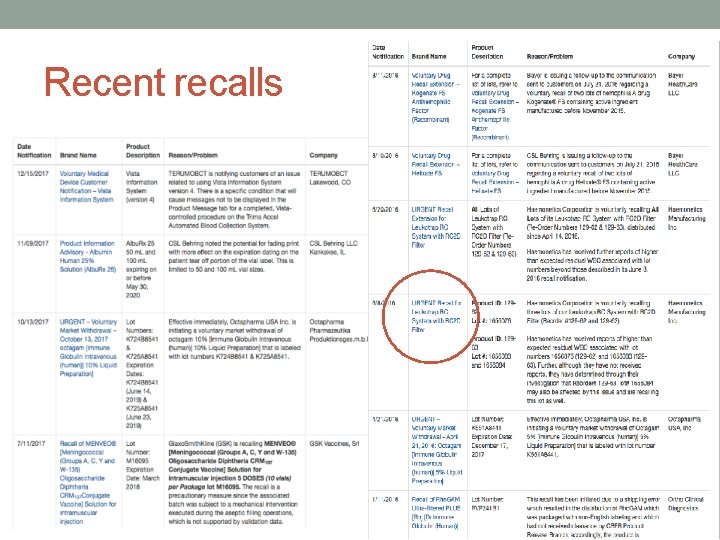
Recent recalls
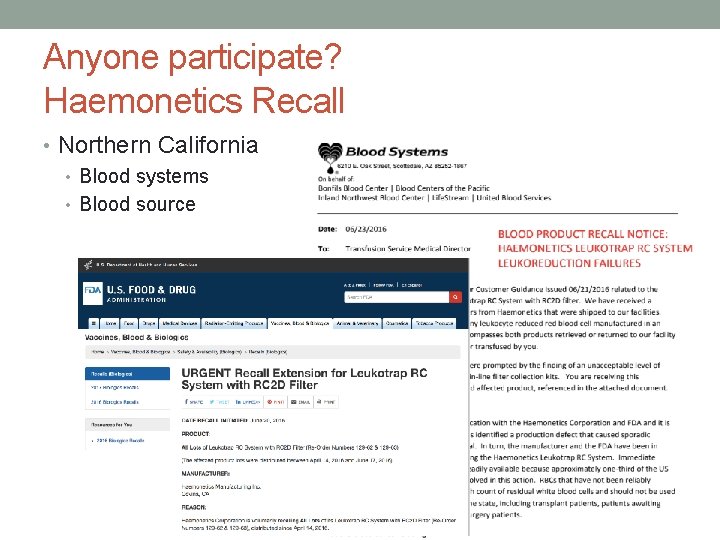
Anyone participate? Haemonetics Recall • Northern California • Blood systems • Blood source
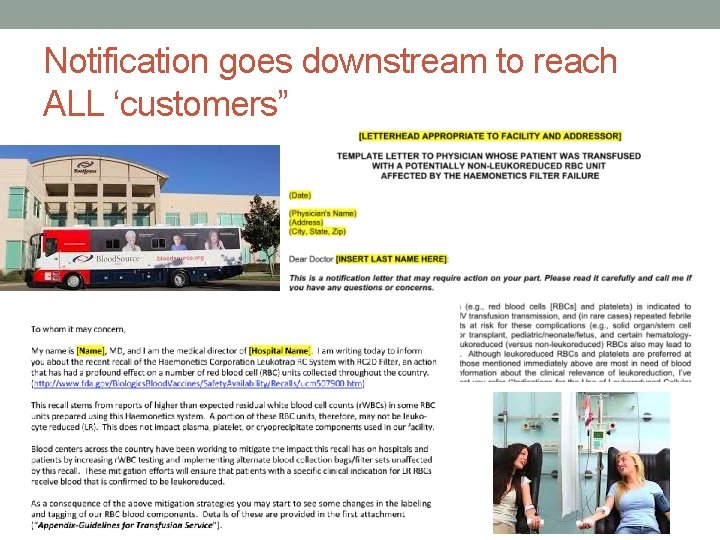
Notification goes downstream to reach ALL ‘customers”
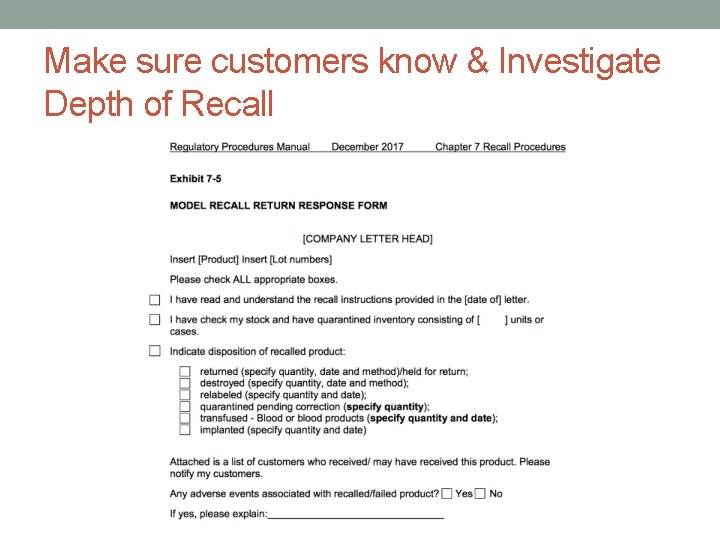
Make sure customers know & Investigate Depth of Recall
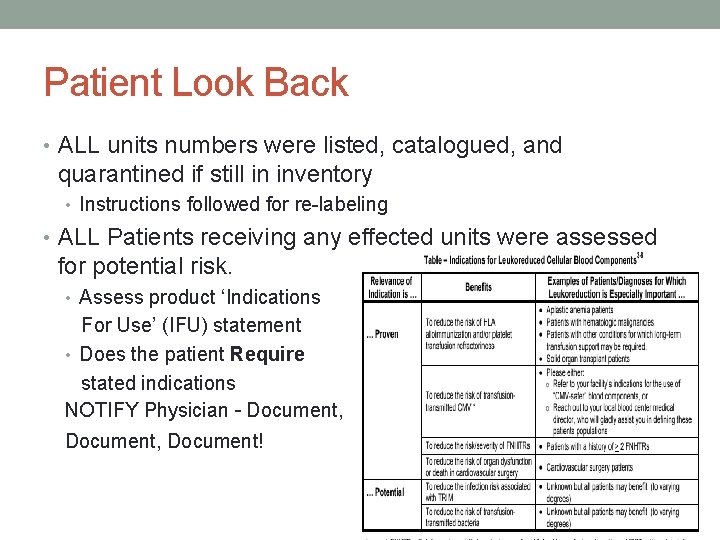
Patient Look Back • ALL units numbers were listed, catalogued, and quarantined if still in inventory • Instructions followed for re-labeling • ALL Patients receiving any effected units were assessed for potential risk. • Assess product ‘Indications For Use’ (IFU) statement • Does the patient Require stated indications NOTIFY Physician – Document, Document!
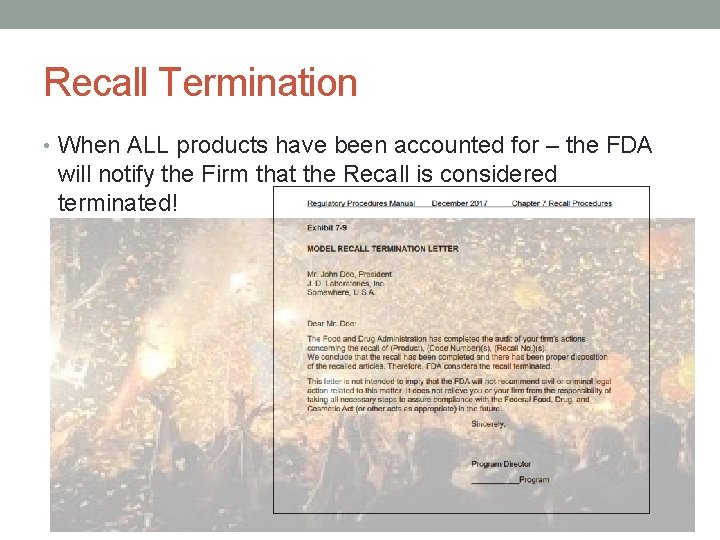
Recall Termination • When ALL products have been accounted for – the FDA will notify the Firm that the Recall is considered terminated!
Keeping Track • Digital Tracking Tool – Classic Excel File! • Patient Letters should be maintained in EMR • New Trial; 2018 - Document Control Data Base - Standard Process Control Form in QSI • Transfusion Services: Product Recalls • Modify as needed with information • Upload letters/ pdfs • One central location
References • AABB Standards, current ed. • AABB Technical Manual, current ed. • College of American Pathologists • Transfusion Medicine Checklist | 08. 21. 201 • FDA Guidance: • Guidance for Industry: Product Recalls, Including Removals and Corrections • 21 CFR 610. 46 -48, 42 CRF 482. 27 -28, 21 CFR Part 7, Subparts A and C, 21 CFR Part 806
Questions? https: //www. utest. com/articles/101 -manual-and-automation-software-testing-interview-questions-and-answers
- Slides: 28