
Rebuilding for Learning Enhancing School Improvement Addressing Barriers
Rebuilding for Learning Enhancing School Improvement: Addressing Barriers to Learning And Re-engaging Students
The Imperative for a Comprehensive System of Learning Supports


The Nation’s Report Card – National Center for Education Statistics Trend in NAEP reading average scores for 9 -year-old students Trend in NAEP reading average scores for 13 -year-old students Trend in NAEP reading average scores for 17 -year-old students

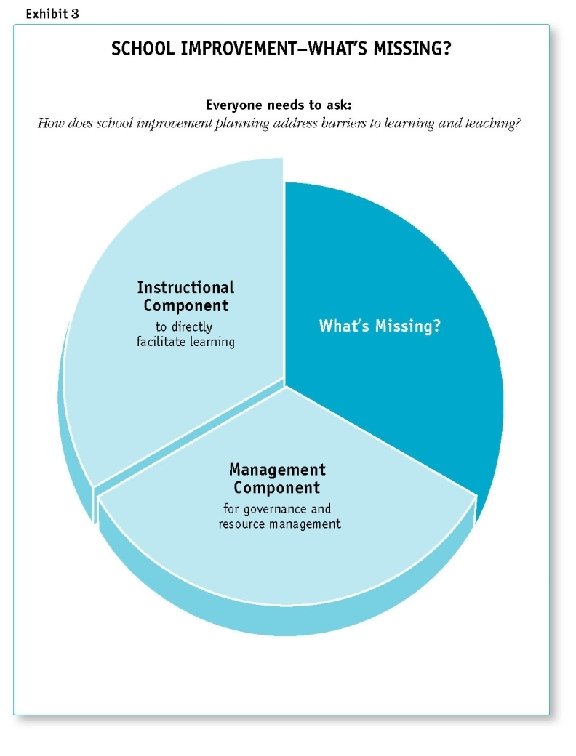
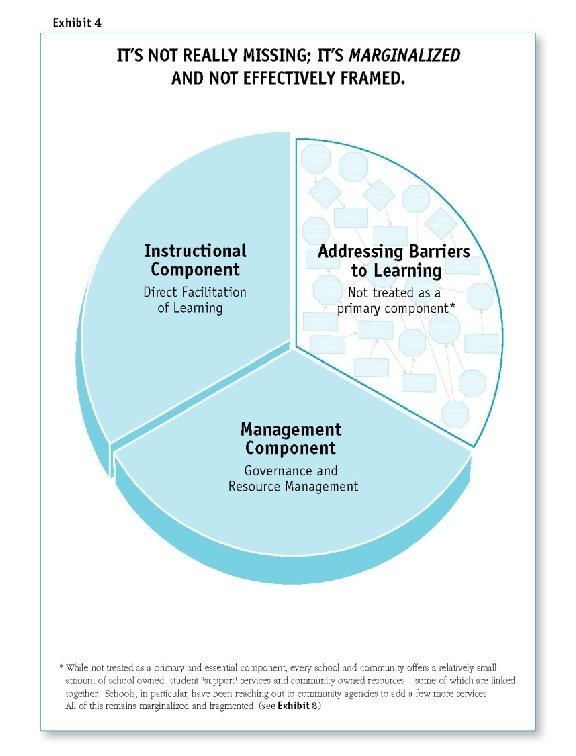
Three Lenses for Seeing What’s Missing in School Improvement Planning
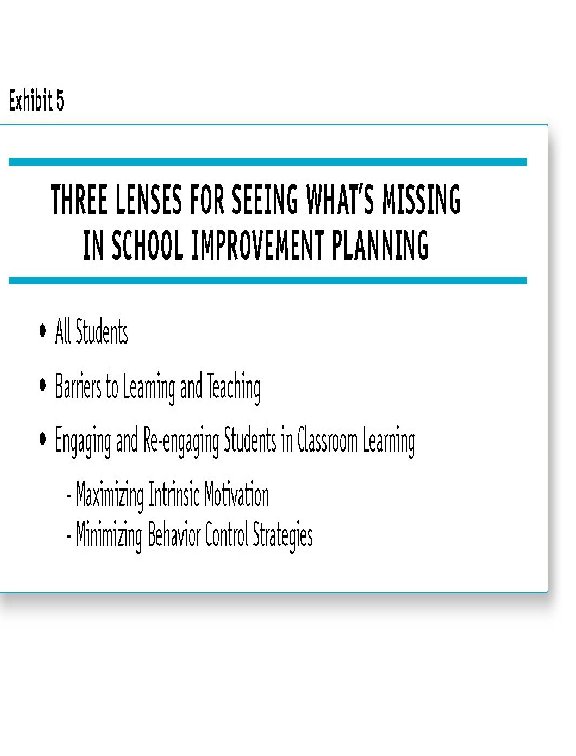
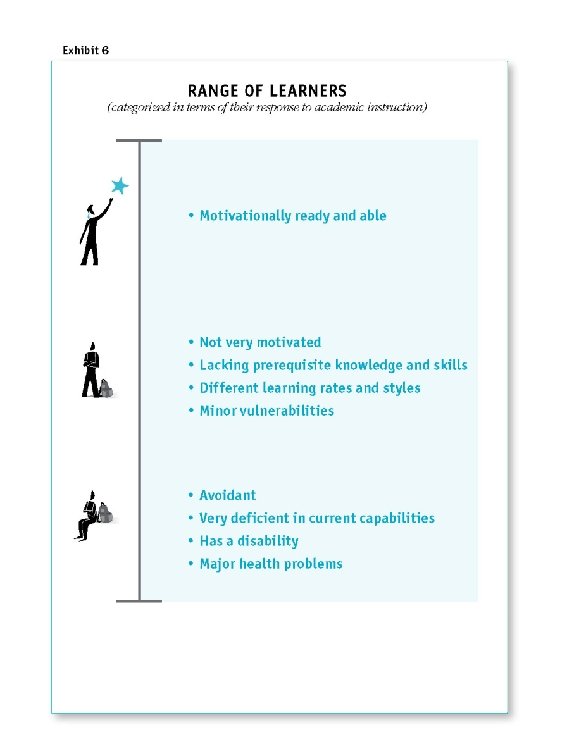
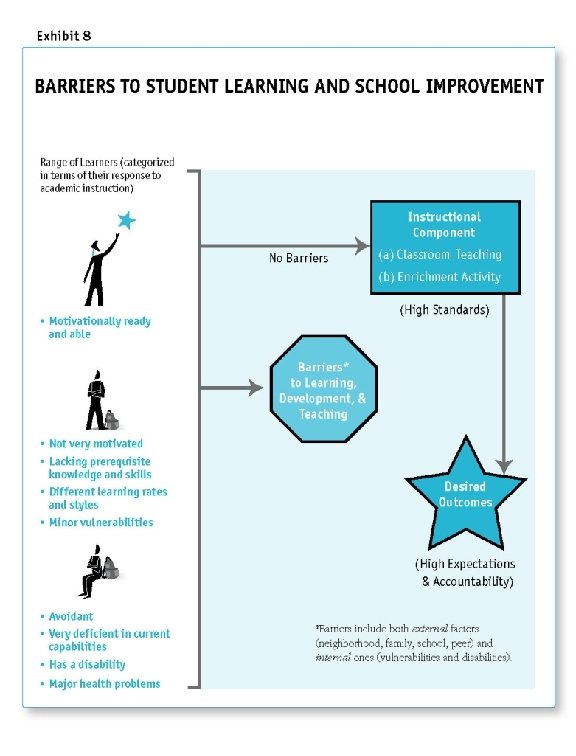
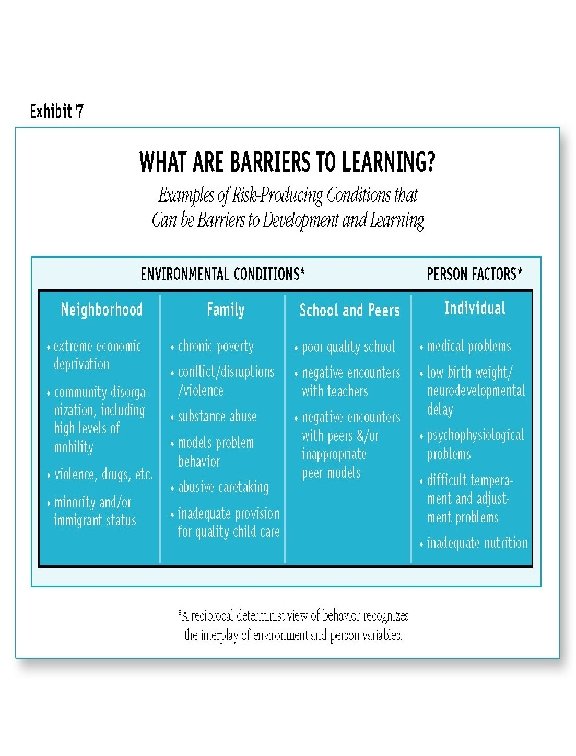
Caution: Don’t misinterpret the term • Barriers to Learning It encompasses much more than a deficit model of students. And, it is part of a holistic approach that emphasizes the importance of • Protective Buffers (e. g. , strengths, assets, resiliency, accommodations) and • Promoting Full Development

ABOUT SCHOOL ENGAGEMENT AND RE-ENGAGEMENT A growing research literature is addressing these matters. For example, see: “School Engagement: Potential of the Concept, State of the Evidence” (2004) by J. Fredricks, P. Blumenfeld, & A. Paris. Review of Educational Research, 74, 59 -109. These researchers conclude: Engagement is associated with positive academic outcomes, including achievement and persistence in school; and it is higher in classrooms with supportive teachers and peers, challenging and authentic tasks, opportunities for choice, and sufficient structure.
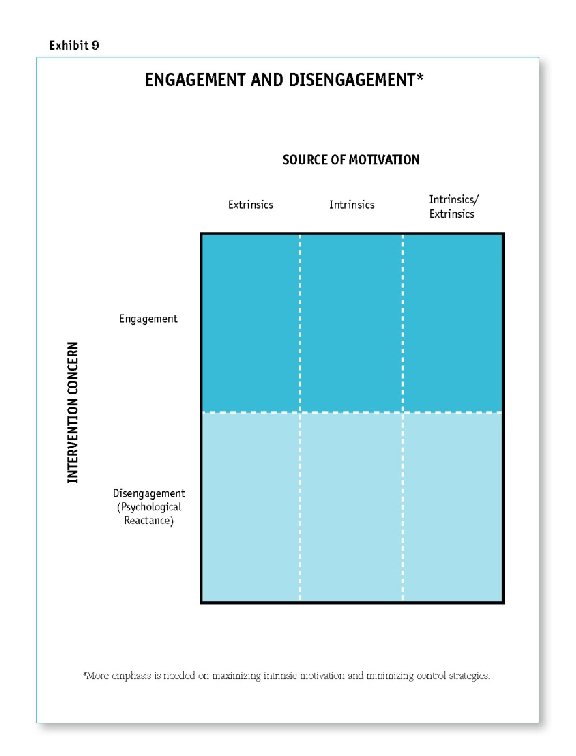
Engagement is defined in three ways in the research literature: • Behavioral engagement draws on the idea of participation; it includes involvement in academic and social or extracurricular activities and is considered crucial for achieving positive academic outcomes and preventing dropping out. • Emotional engagement encompasses positive and negative reactions to teachers, classmates, academics, and school and is presumed to create ties to an institution and influence willingness to do the work. • Cognitive engagement draws on the idea of investment; it incorporates thoughtfulness and willingness to exert the effort necessary to comprehend complex ideas and master difficult skills. A Key Outcome of Engagement is Higher Achievement. The evidence from a variety of studies is summarized to show that engagement positively influences achievement A Key Outcome of Disengagement is Dropping Out. The evidence shows behavioral disengagement is a precursor of dropping out.
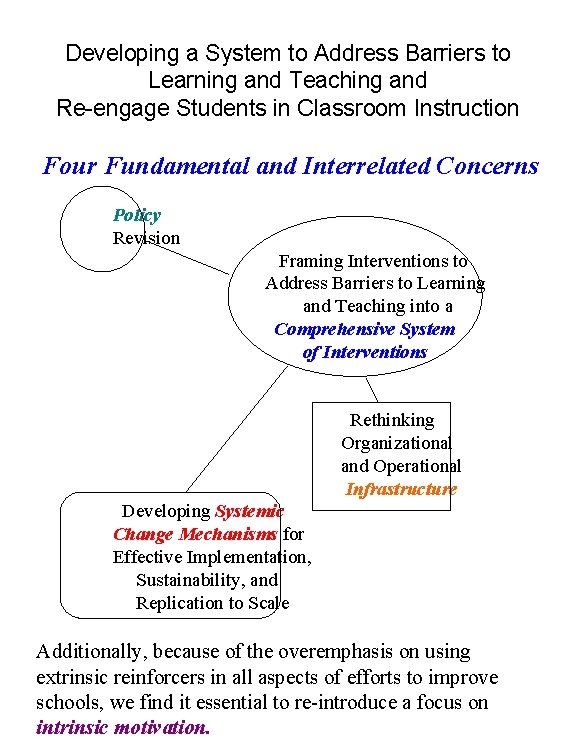
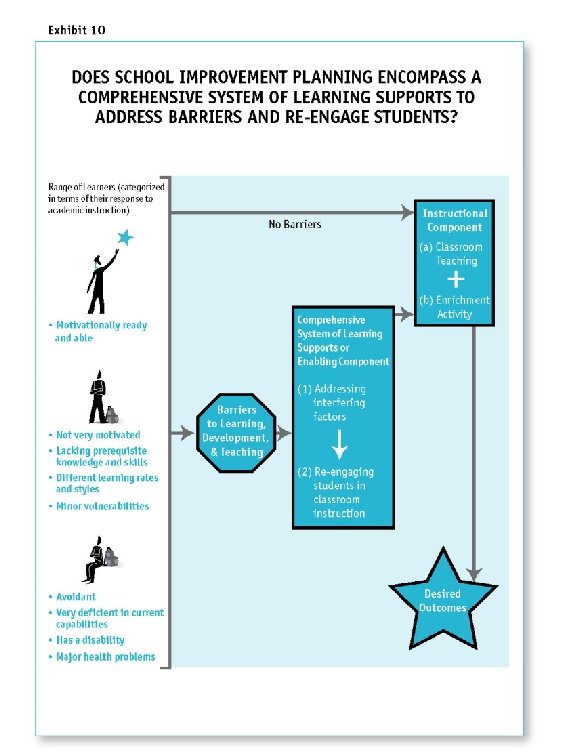
Developing a System to Address Barriers to Learning and Teaching and Re-engage Students in Classroom Instruction Four Fundamental and Interrelated Concerns Policy Revision Framing Interventions to Address Barriers to Learning and Teaching into a Comprehensive System of Interventions Rethinking Organizational and Operational Infrastructure Developing Systemic Change Mechanisms for Effective Implementation, Sustainability, and Replication to Scale Additionally, because of the overemphasis on using extrinsic reinforcers in all aspects of efforts to improve schools, we find it essential to re-introduce a focus on intrinsic motivation.
The real difficulty in changing the course of any enterprise lies not in developing new ideas but in escaping old ones. John Maynard Keynes
Moving Forward: Enhancing Policy for School Improvement
################### In 2002, the Council of Chief State School Officers has adopted the following as the organization’s new mission statement: CCSSO, through leadership, advocacy, and service, assists chief state school officers and their organizations in achieving the vision of an American education system that enables all children to succeed in school, work, and life. ###################
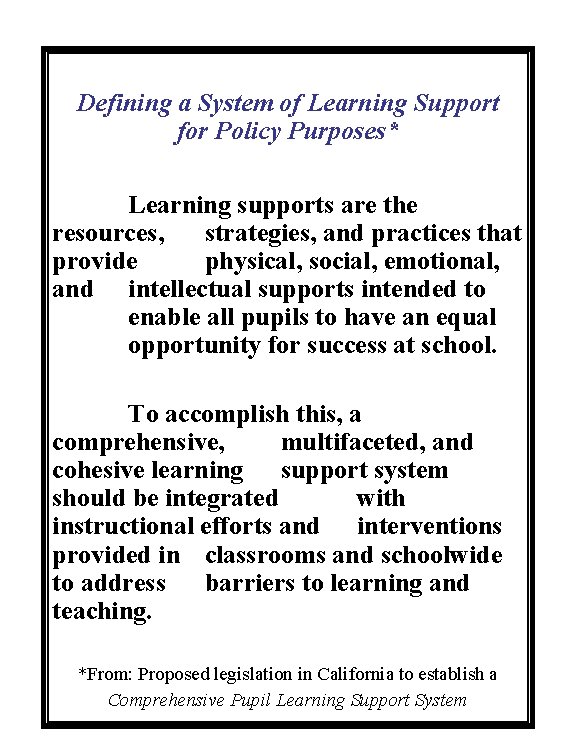
Defining a System of Learning Support for Policy Purposes* Learning supports are the resources, strategies, and practices that provide physical, social, emotional, and intellectual supports intended to enable all pupils to have an equal opportunity for success at school. To accomplish this, a comprehensive, multifaceted, and cohesive learning support system should be integrated with instructional efforts and interventions provided in classrooms and schoolwide to address barriers to learning and teaching. *From: Proposed legislation in California to establish a Comprehensive Pupil Learning Support System
Moving Forward: Framing Interventions to Address Barriers to Learning and Teaching into a Comprehensive System of Learning Supports
School systems are not responsible for meeting every need of their students. But. . . when the need directly affects learning, the school must meet the challenge. Carnegie Task Force on Education
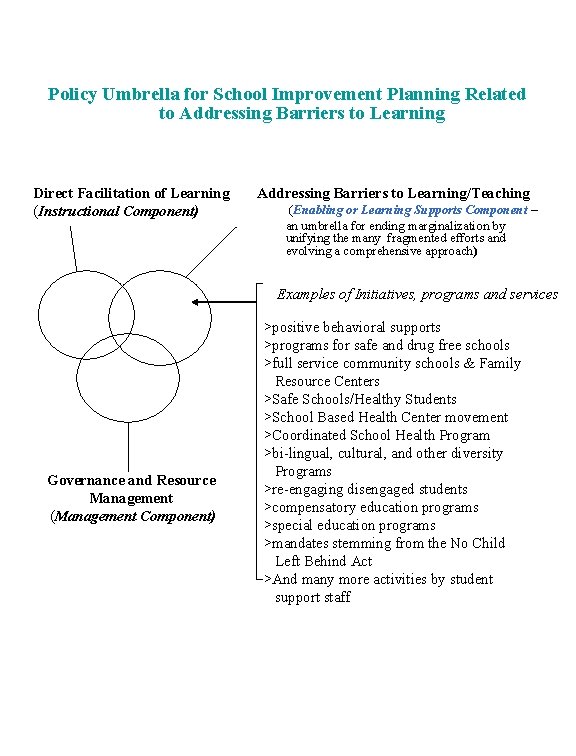
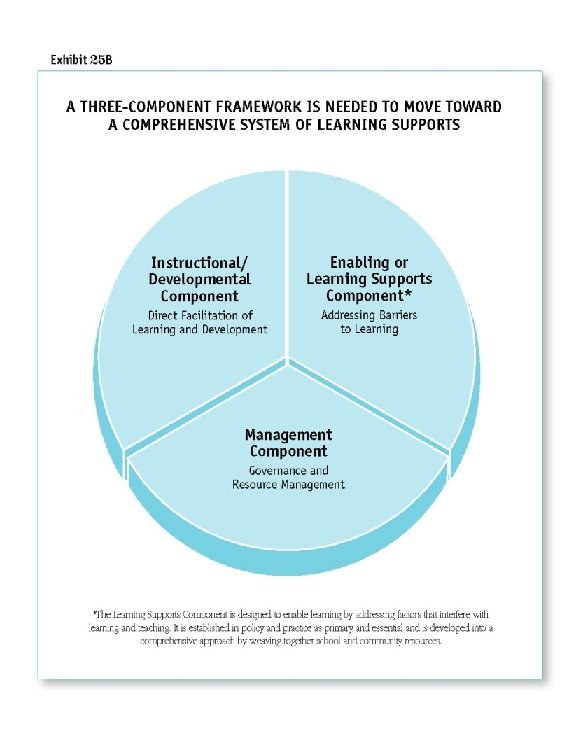
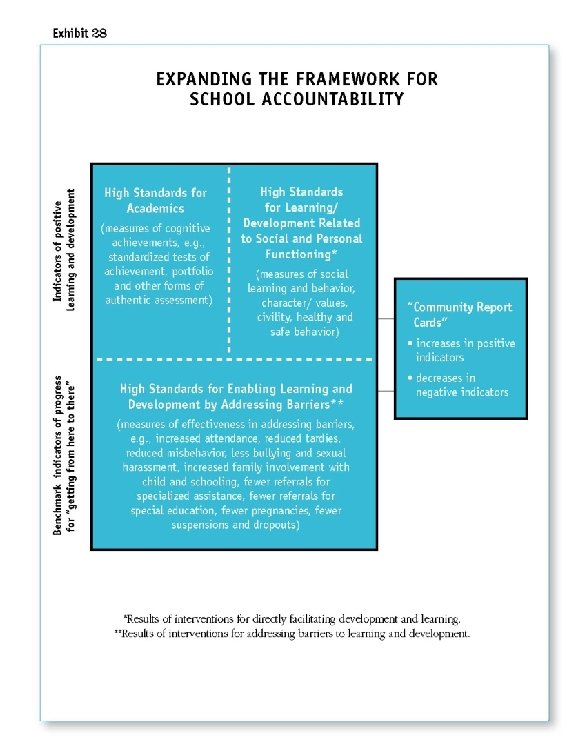
Policy Umbrella for School Improvement Planning Related to Addressing Barriers to Learning Direct Facilitation of Learning (Instructional Component) Addressing Barriers to Learning/Teaching (Enabling or Learning Supports Component – an umbrella for ending marginalization by unifying the many fragmented efforts and evolving a comprehensive approach) Examples of Initiatives, programs and services Governance and Resource Management (Management Component) >positive behavioral supports >programs for safe and drug free schools >full service community schools & Family Resource Centers >Safe Schools/Healthy Students >School Based Health Center movement >Coordinated School Health Program >bi-lingual, cultural, and other diversity Programs >re-engaging disengaged students >compensatory education programs >special education programs >mandates stemming from the No Child Left Behind Act >And many more activities by student support staff
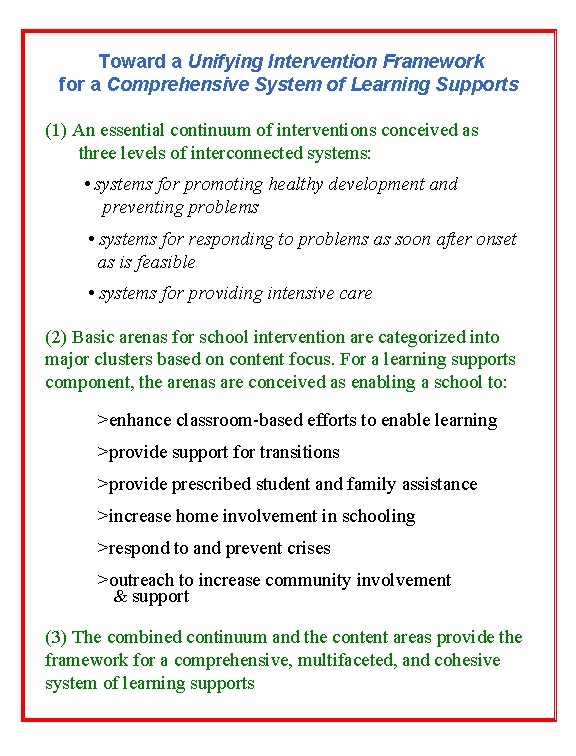
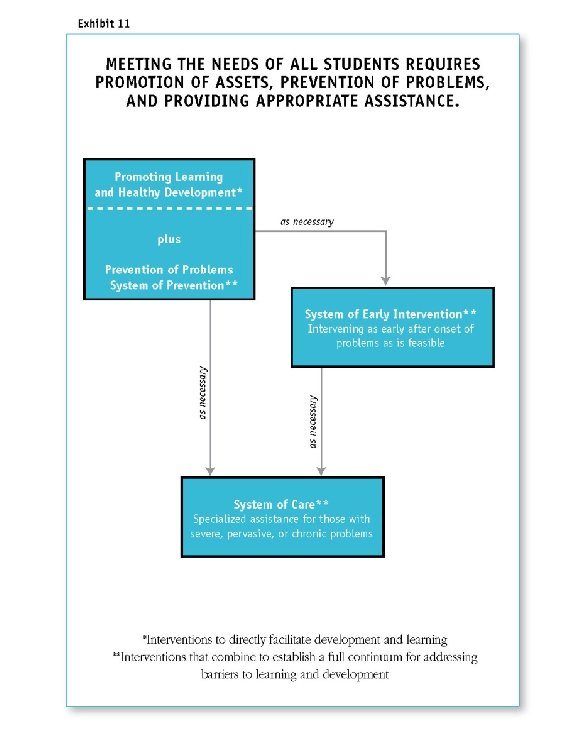
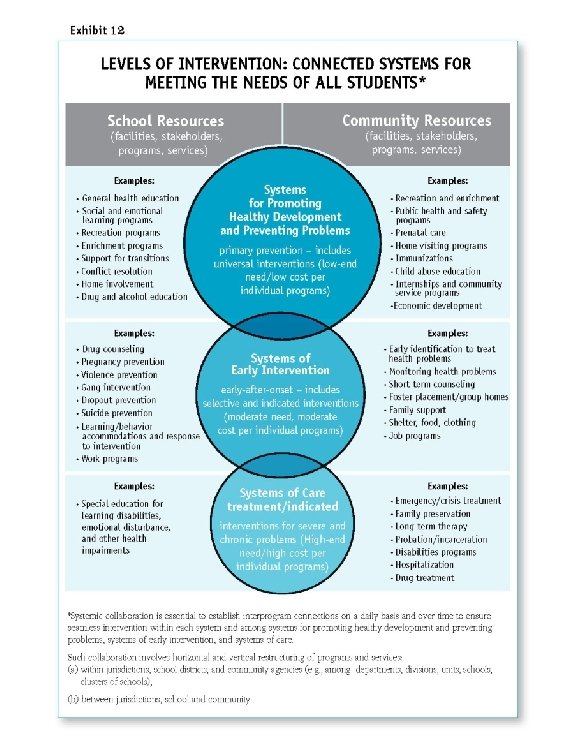
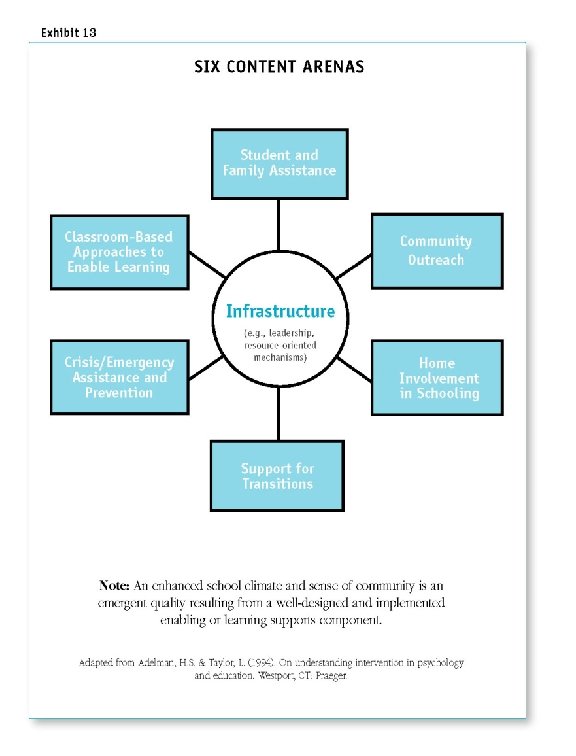
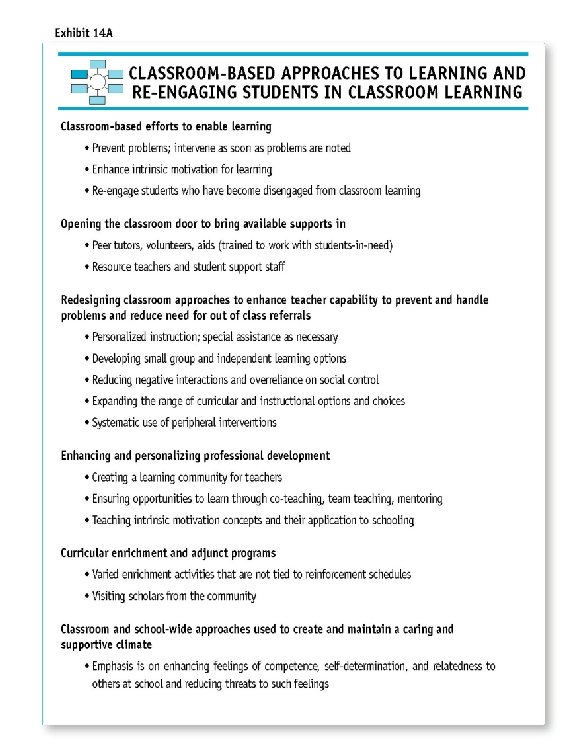
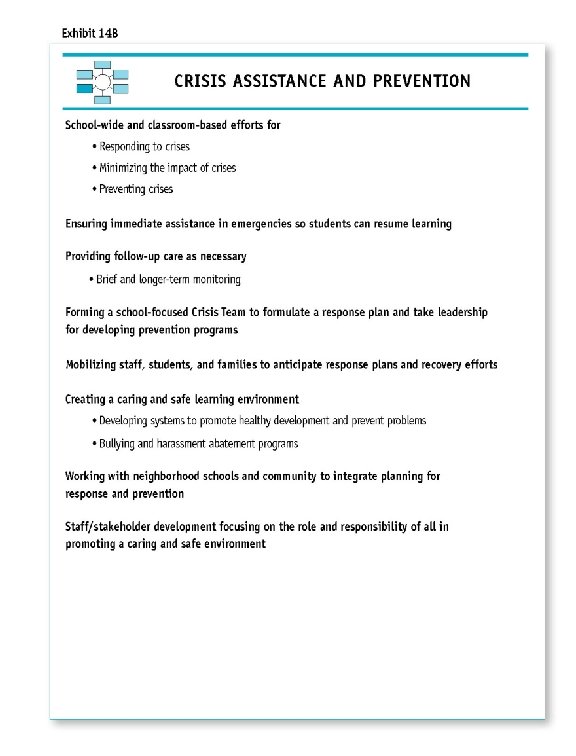
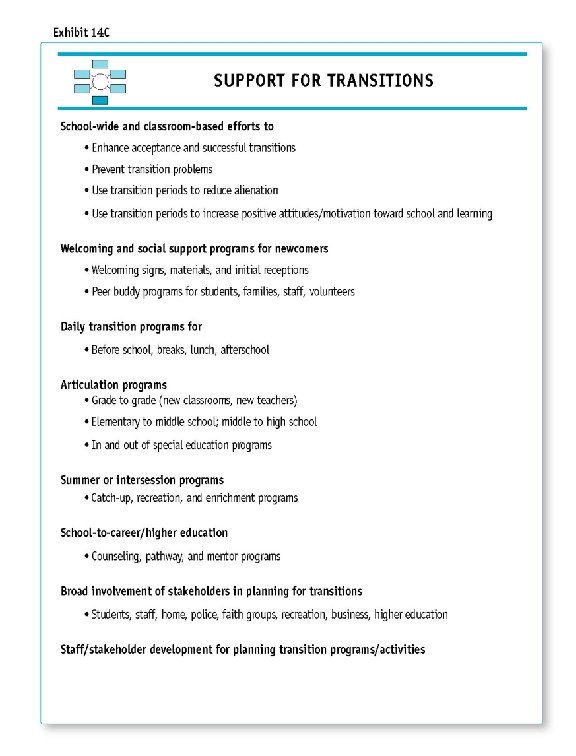
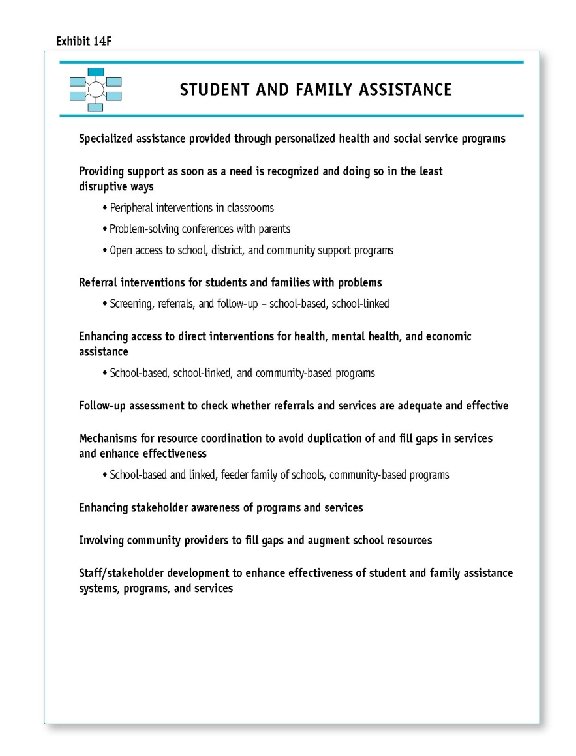
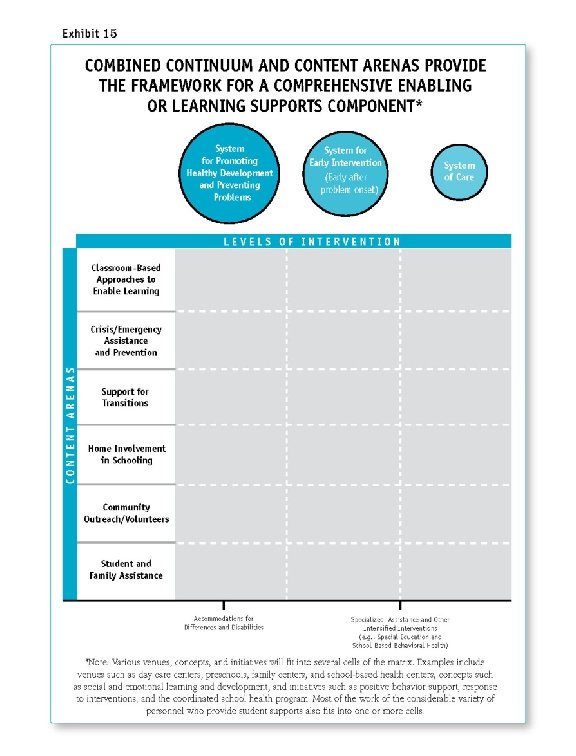
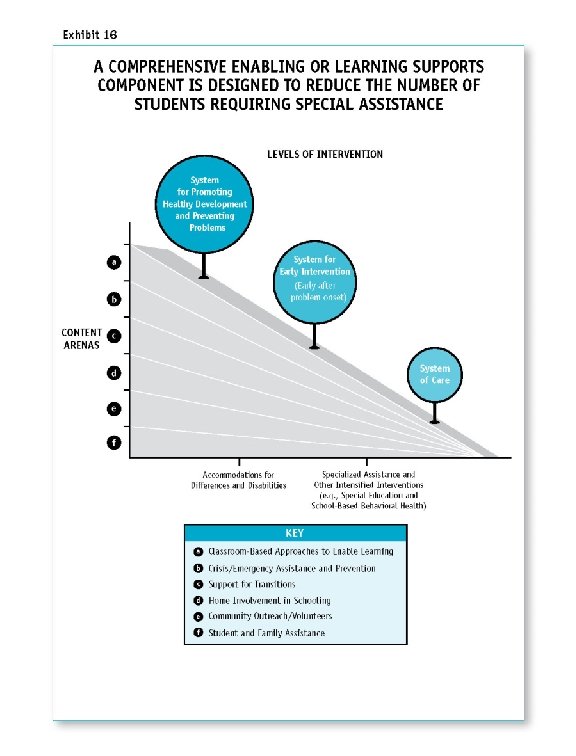
Toward a Unifying Intervention Framework for a Comprehensive System of Learning Supports (1) An essential continuum of interventions conceived as three levels of interconnected systems: • systems for promoting healthy development and preventing problems • systems for responding to problems as soon after onset as is feasible • systems for providing intensive care (2) Basic arenas for school intervention are categorized into major clusters based on content focus. For a learning supports component, the arenas are conceived as enabling a school to: >enhance classroom-based efforts to enable learning >provide support for transitions >provide prescribed student and family assistance >increase home involvement in schooling >respond to and prevent crises >outreach to increase community involvement & support (3) The combined continuum and the content areas provide the framework for a comprehensive, multifaceted, and cohesive system of learning supports
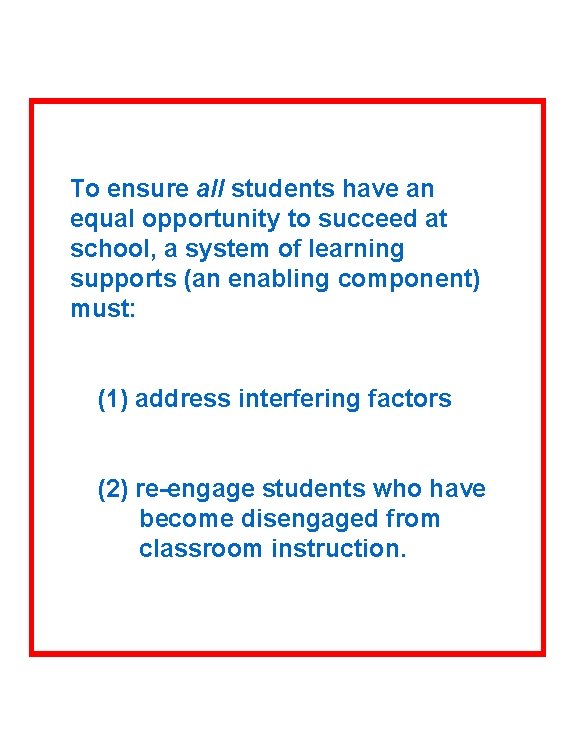
To ensure all students have an equal opportunity to succeed at school, a system of learning supports (an enabling component) must: (1) address interfering factors (2) re-engage students who have become disengaged from classroom instruction.
An Enabling or Learning Support Component Defining Major Arenas that every school needs to operationalize in order to address barriers to learning EVERY DAY

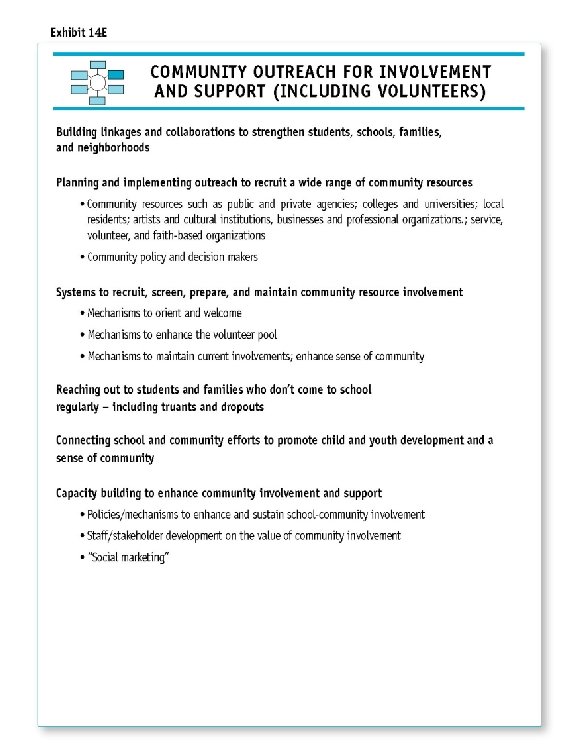
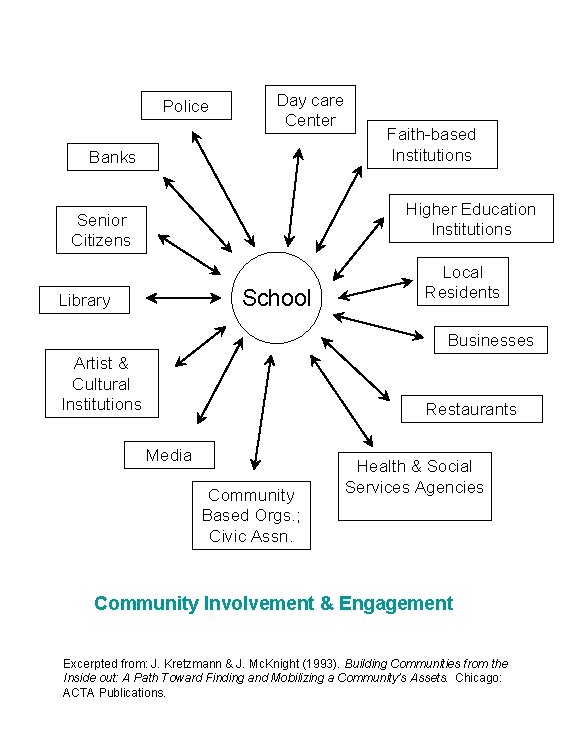
Police Day care Center Banks Faith-based Institutions Higher Education Institutions Senior Citizens School Library Local Residents Businesses Artist & Cultural Institutions Restaurants Media Community Based Orgs. ; Civic Assn. Health & Social Services Agencies Community Involvement & Engagement Excerpted from: J. Kretzmann & J. Mc. Knight (1993). Building Communities from the Inside out: A Path Toward Finding and Mobilizing a Community’s Assets. Chicago: ACTA Publications.

We just missed the school bus. Don’t worry. I heard the principal say no child will be left behind. /
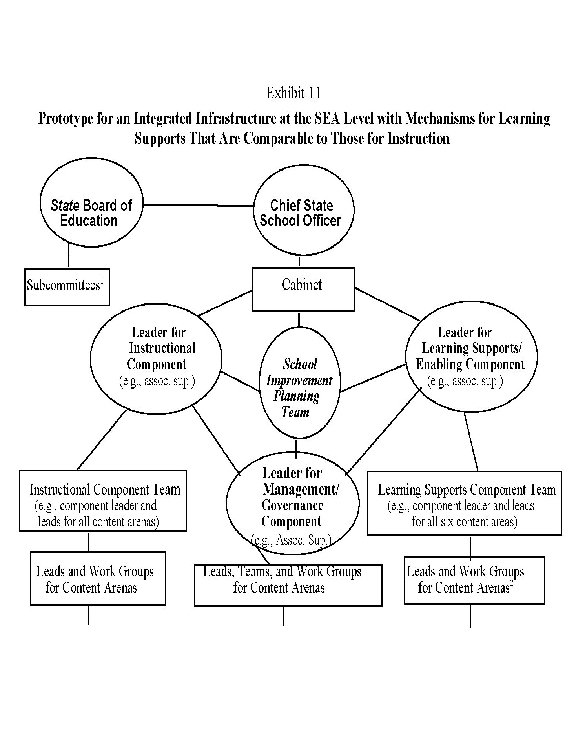
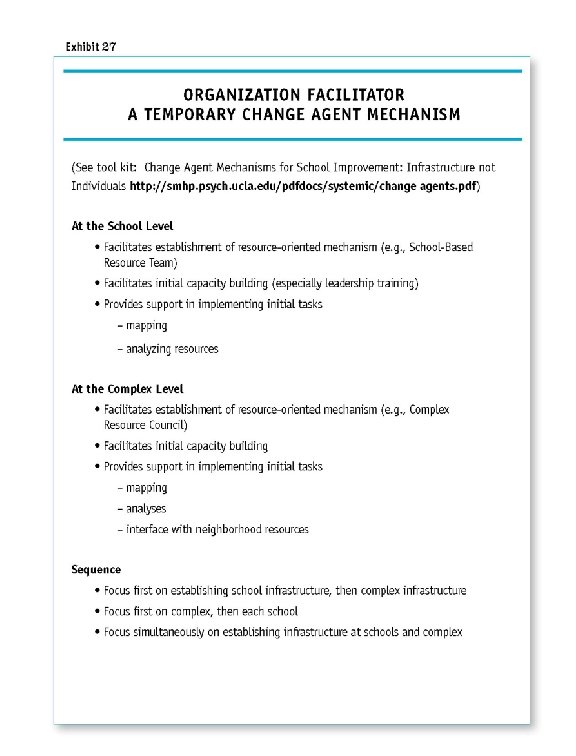
Moving Forward: Rethinking Organizational and Operational Infrastructure
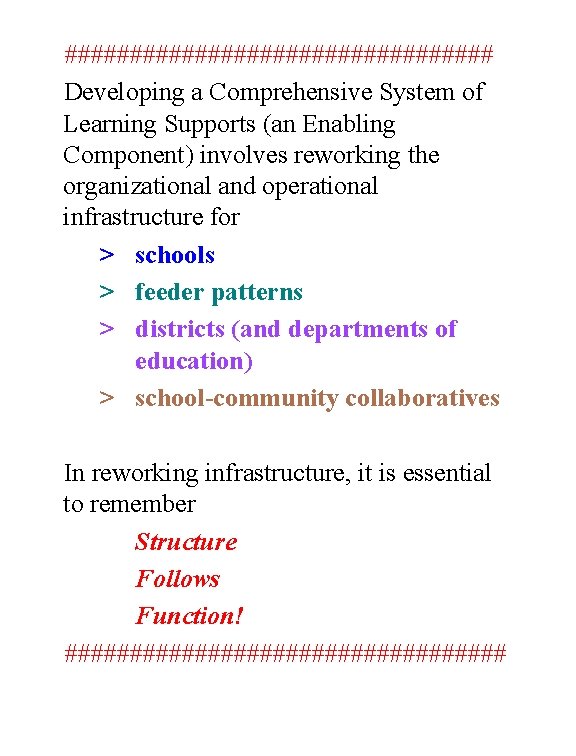
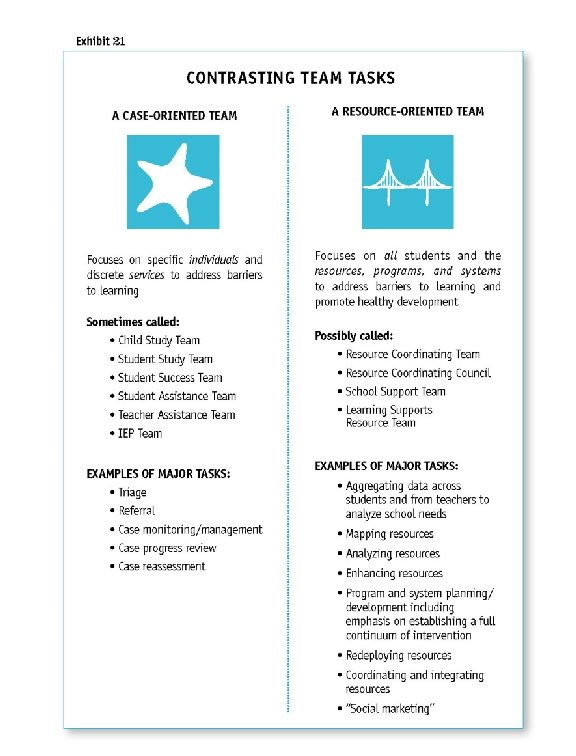
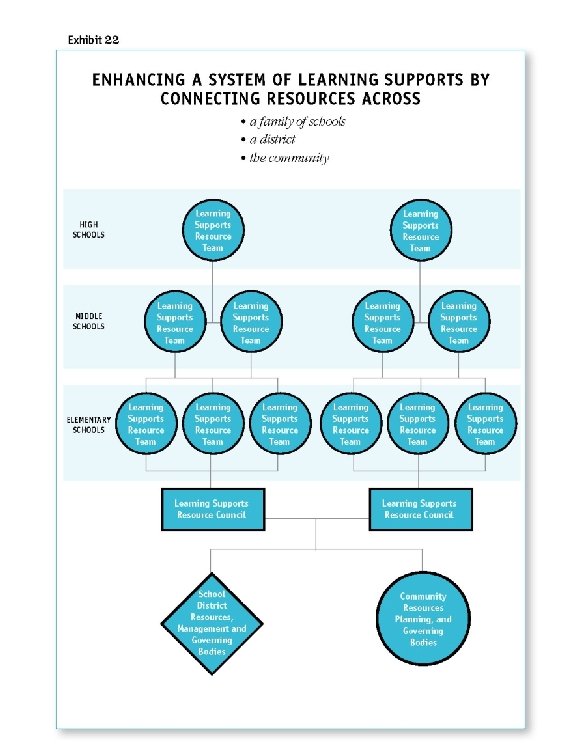
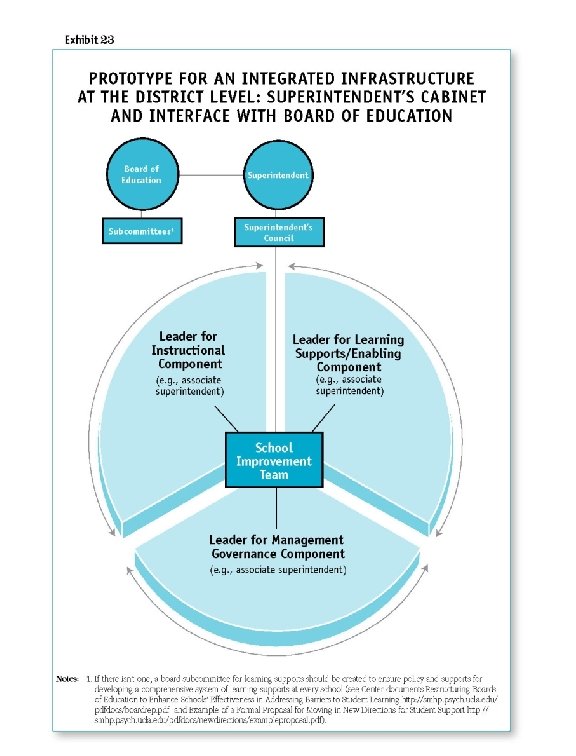
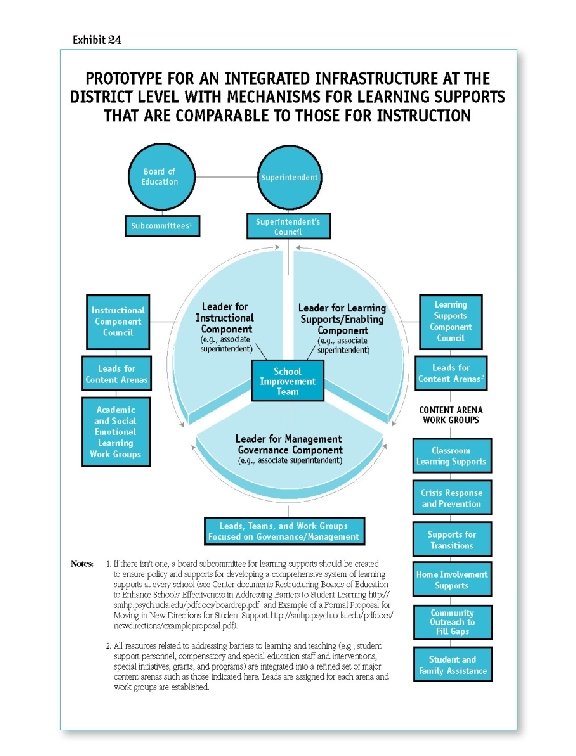
################# Developing a Comprehensive System of Learning Supports (an Enabling Component) involves reworking the organizational and operational infrastructure for > schools > feeder patterns > districts (and departments of education) > school-community collaboratives In reworking infrastructure, it is essential to remember Structure Follows Function! #################
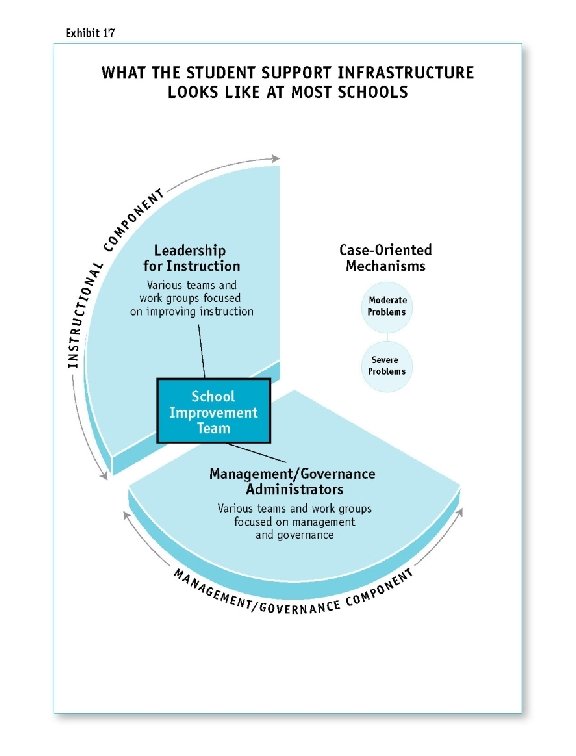
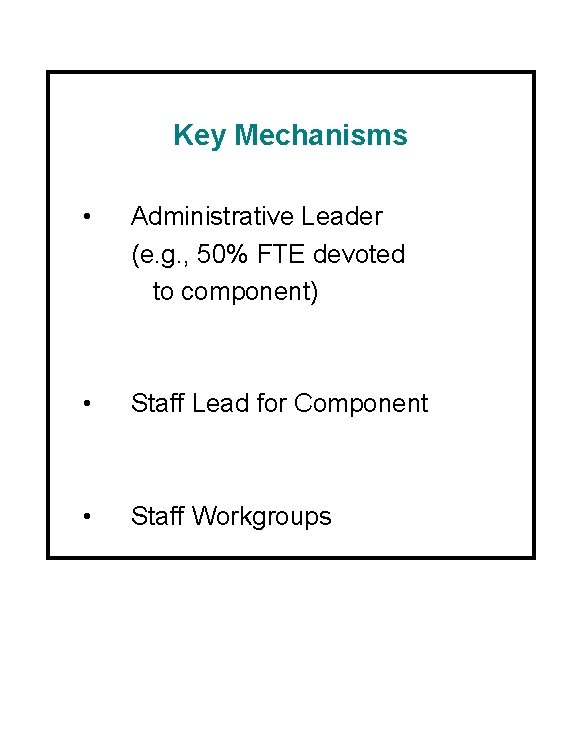
Key Mechanisms • Administrative Leader (e. g. , 50% FTE devoted to component) • Staff Lead for Component • Staff Workgroups
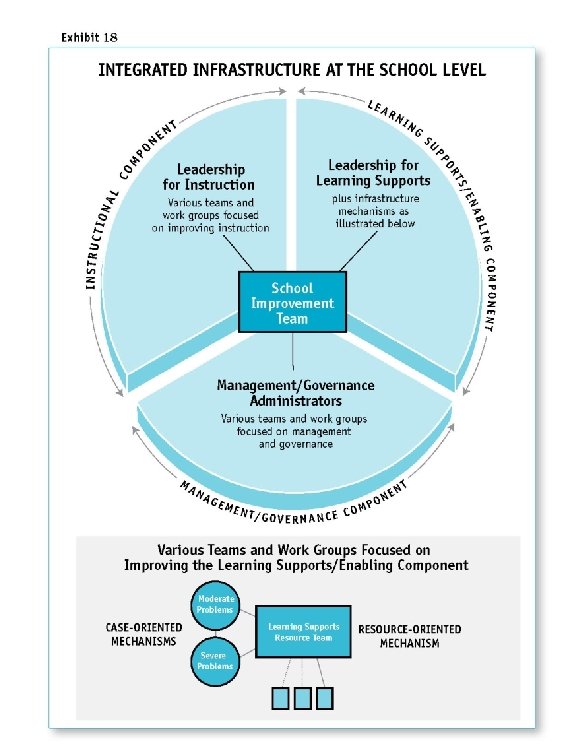
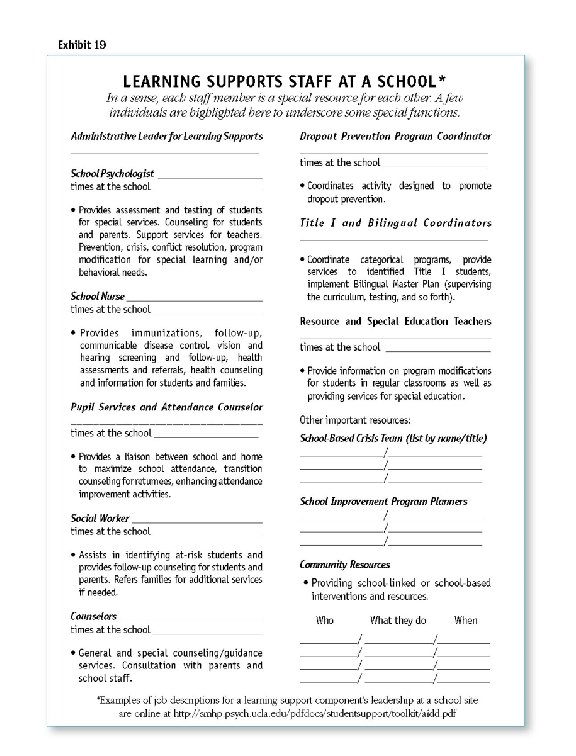
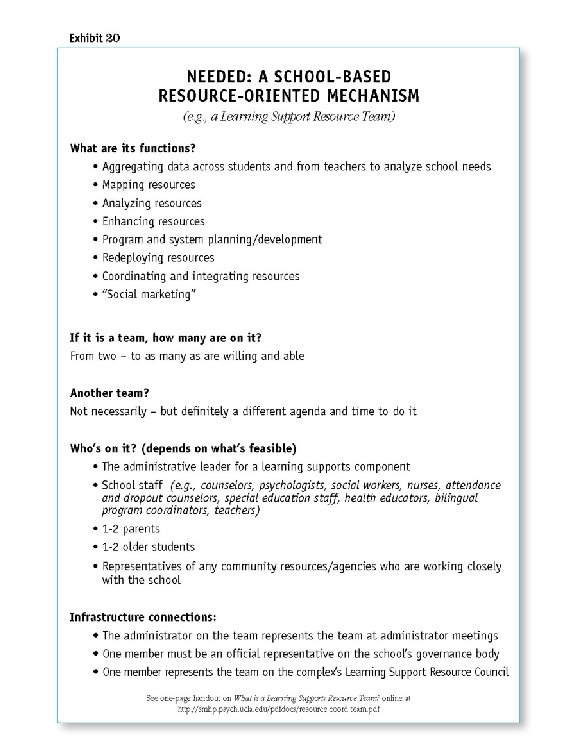
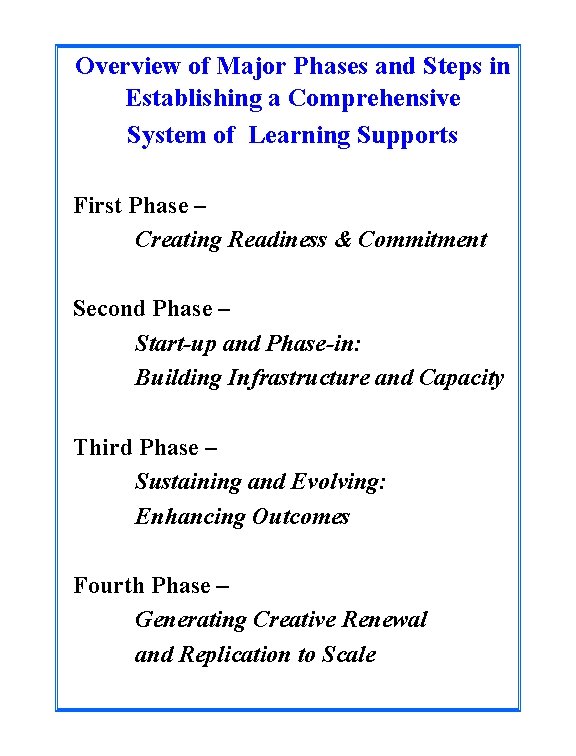
Overview of Major Phases and Steps in Establishing a Comprehensive System of Learning Supports First Phase – Creating Readiness & Commitment Second Phase – Start-up and Phase-in: Building Infrastructure and Capacity Third Phase – Sustaining and Evolving: Enhancing Outcomes Fourth Phase – Generating Creative Renewal and Replication to Scale
Building Capacity for Engagement & Re-engagement: Staff Development Focusing on Intrinsic Motivation
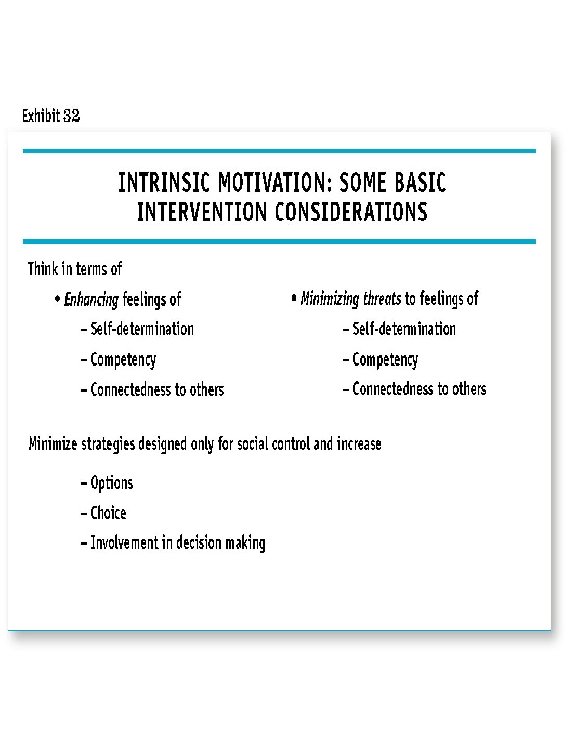
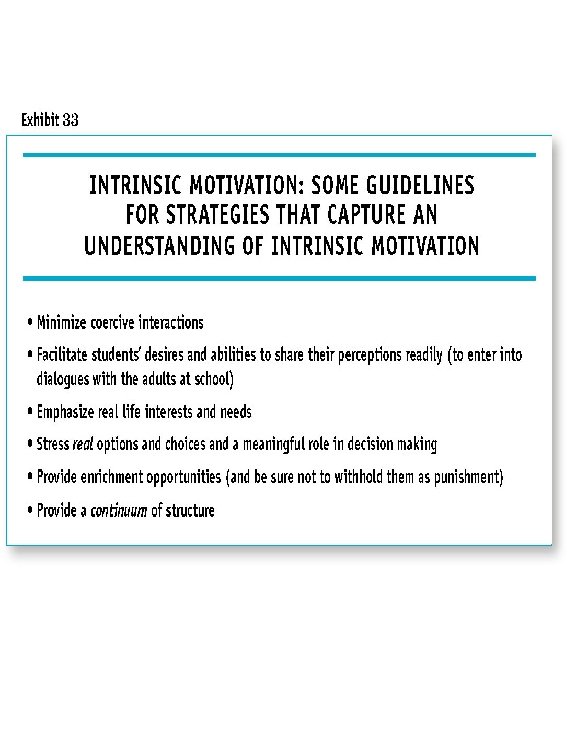
For Staff Development: (1) Enhancing understanding of intrinsic motivation (2) How to reduce overemphasis on behavior control to minimize psychological reactance and disengagement (3) How to re-engage students who have become disengaged
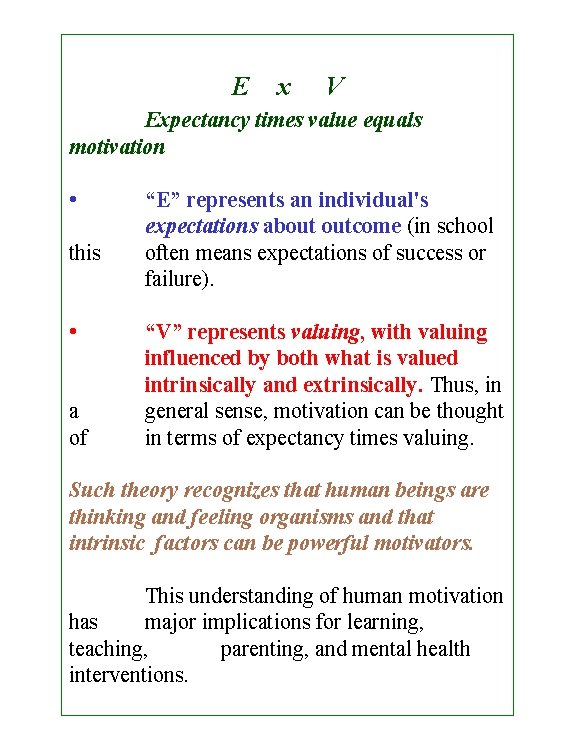
E x V Expectancy times value equals motivation • this • a of “E” represents an individual's expectations about outcome (in school often means expectations of success or failure). “V” represents valuing, with valuing influenced by both what is valued intrinsically and extrinsically. Thus, in general sense, motivation can be thought in terms of expectancy times valuing. Such theory recognizes that human beings are thinking and feeling organisms and that intrinsic factors can be powerful motivators. This understanding of human motivation has major implications for learning, teaching, parenting, and mental health interventions.

################ I suspect that many children would learn arithmetic, and learn it better, if it were illegal. John Holt (1989) ################
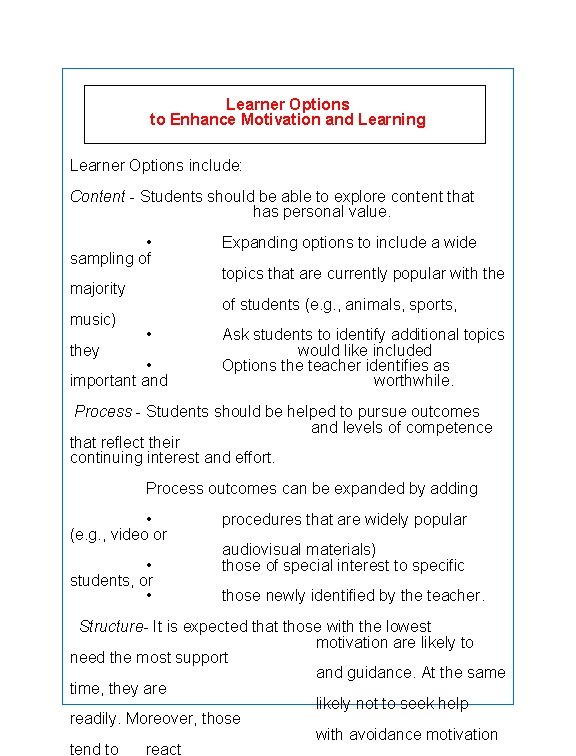
Learner Options to Enhance Motivation and Learning Learner Options include: Content - Students should be able to explore content that has personal value. • sampling of majority music) they Expanding options to include a wide topics that are currently popular with the of students (e. g. , animals, sports, • • important and Ask students to identify additional topics would like included Options the teacher identifies as worthwhile. Process - Students should be helped to pursue outcomes and levels of competence that reflect their continuing interest and effort. Process outcomes can be expanded by adding • (e. g. , video or • students, or • procedures that are widely popular audiovisual materials) those of special interest to specific those newly identified by the teacher. Structure- It is expected that those with the lowest motivation are likely to need the most support and guidance. At the same time, they are likely not to seek help readily. Moreover, those with avoidance motivation tend to react
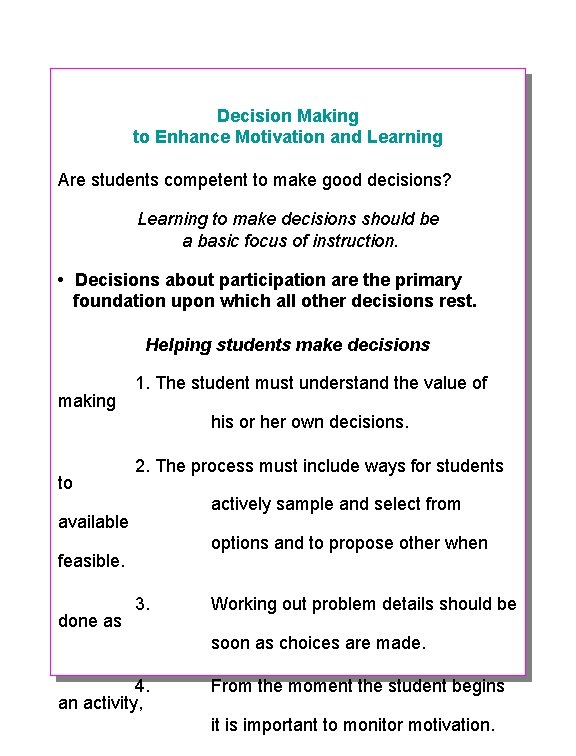
Decision Making to Enhance Motivation and Learning Are students competent to make good decisions? Learning to make decisions should be a basic focus of instruction. • Decisions about participation are the primary foundation upon which all other decisions rest. Helping students make decisions making 1. The student must understand the value of his or her own decisions. to 2. The process must include ways for students actively sample and select from available options and to propose other when feasible. done as 3. Working out problem details should be soon as choices are made. 4. an activity, From the moment the student begins it is important to monitor motivation.
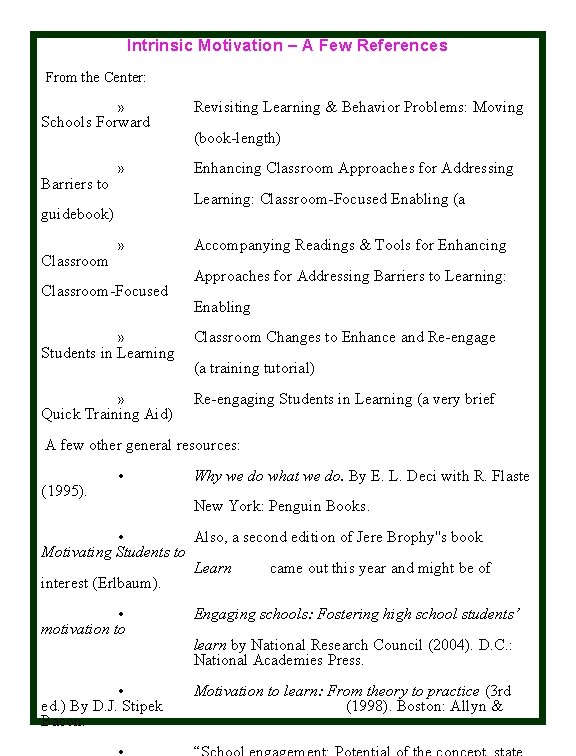
Intrinsic Motivation – A Few References From the Center: » Schools Forward Barriers to » (book-length) Enhancing Classroom Approaches for Addressing Learning: Classroom-Focused Enabling (a guidebook) Classroom Revisiting Learning & Behavior Problems: Moving » Classroom-Focused Accompanying Readings & Tools for Enhancing Approaches for Addressing Barriers to Learning: Enabling » Students in Learning Classroom Changes to Enhance and Re-engage » Quick Training Aid) Re-engaging Students in Learning (a very brief (a training tutorial) A few other general resources: (1995). • Why we do what we do. By E. L. Deci with R. Flaste New York: Penguin Books. • Also, a second edition of Jere Brophy''s book Motivating Students to Learn came out this year and might be of interest (Erlbaum). • motivation to Engaging schools: Fostering high school students’ • ed. ) By D. J. Stipek Bacon. Motivation to learn: From theory to practice (3 rd (1998). Boston: Allyn & learn by National Research Council (2004). D. C. : National Academies Press.
Getting from Here to There • enhancing understanding of systemic change • taking action Implementing innovation = Systemic change = Escaping old ideas
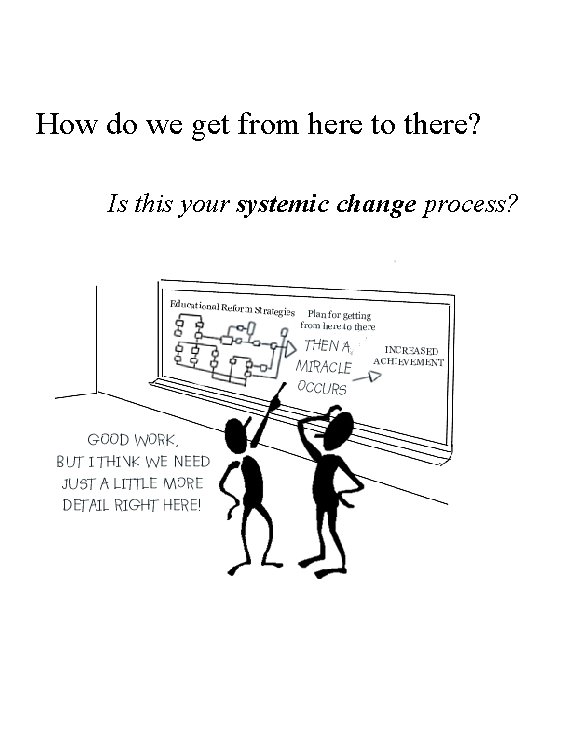
How do we get from here to there? Is this your systemic change process?
Questions? ? Concerns. . . Comments!!!!!!
- Slides: 71