
Rebecca Olsen Introduction to Sheltered Instruction Observation Protocol
Rebecca Olsen Introduction to Sheltered Instruction Observation Protocol
Group Norms and Expectations -We will start and finish on time -We will have one conversation -We will silence our cell phones -We will be positive, respectful, and encouraging For the Good of the Order
Goals – By 2020, 90% of 3 rd-grade students will read on or above grade level. – By 2018, our graduation rate will be 90%. – By 2018, we will close the achievement gap between subgroups by 10 percentage points while increasing the performance of all subgroups.
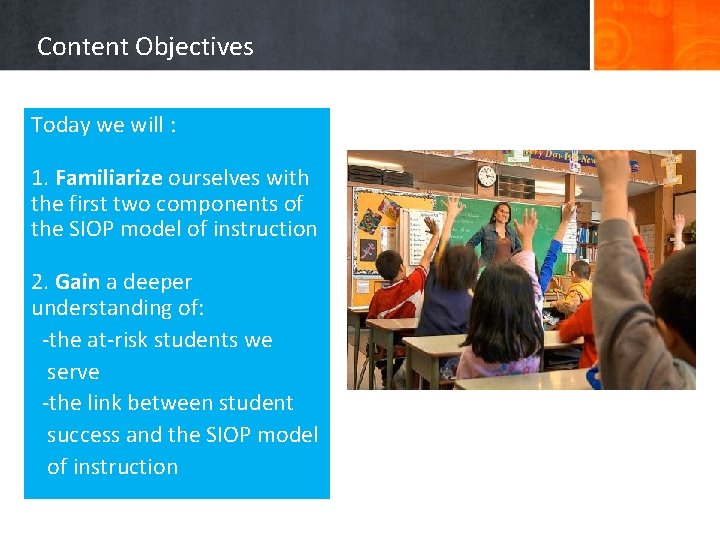
Content Objectives Today we will : 1. Familiarize ourselves with the first two components of the SIOP model of instruction 2. Gain a deeper understanding of: -the at-risk students we serve -the link between student success and the SIOP model of instruction
Language Objectives We will… 1. Evaluate the SIOP model of instruction by: -Identifying and articulating characteristics and challenges of LEP learners -Identifying the components of a SIOP lesson 2. Analyze the potential power of the SIOP strategies for our at risk students by: -Experiencing a lack of context and discussing its importance -Sorting words in a building vocabulary exercise

What is SIOP? SIOP is research based lesson components that are proven to support students’ academic and social language needs! SIOP makes grade-level academic content more accessible for LEP students while at the same time promoting their English language development. The 8 Components of SIOP 1. Lesson Preparation 2. Building Background 3. Comprehensible Input 4. High Yield Strategies 5. Interaction 6. Practice and Application 7. Lesson Delivery 8. Review and Assessment
Why SIOP? • A framework not a hierarchy • Leaves room for creativity • Connects content with language skills • For all grades and proficiency levels • Research-based • We can’t afford not to!
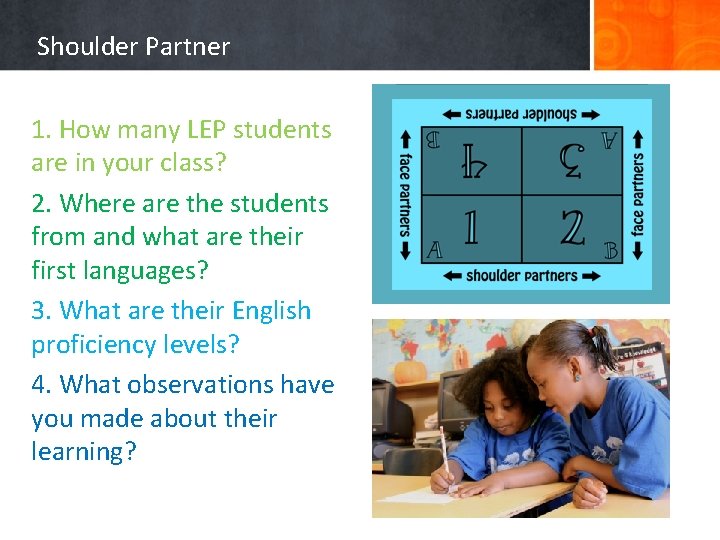
Shoulder Partner 1. How many LEP students are in your class? 2. Where are the students from and what are their first languages? 3. What are their English proficiency levels? 4. What observations have you made about their learning?
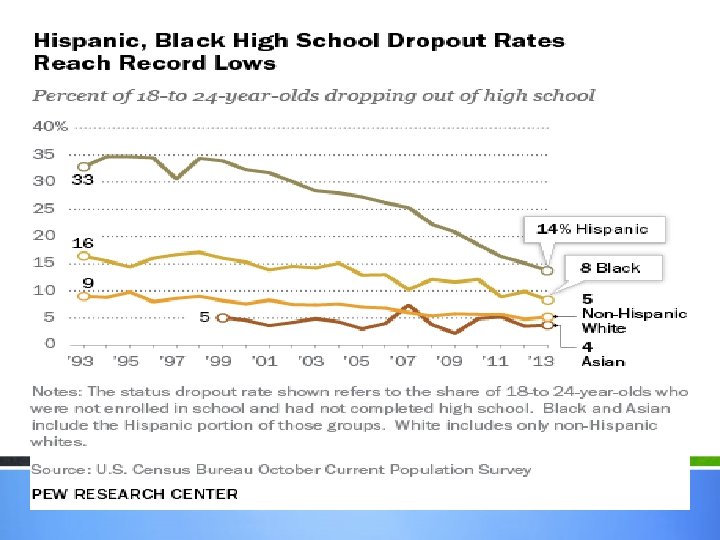
Who Are Our LEP Students? LEP EC AIG refugees developing readers shy kinesthetic diverse learners dropping out!
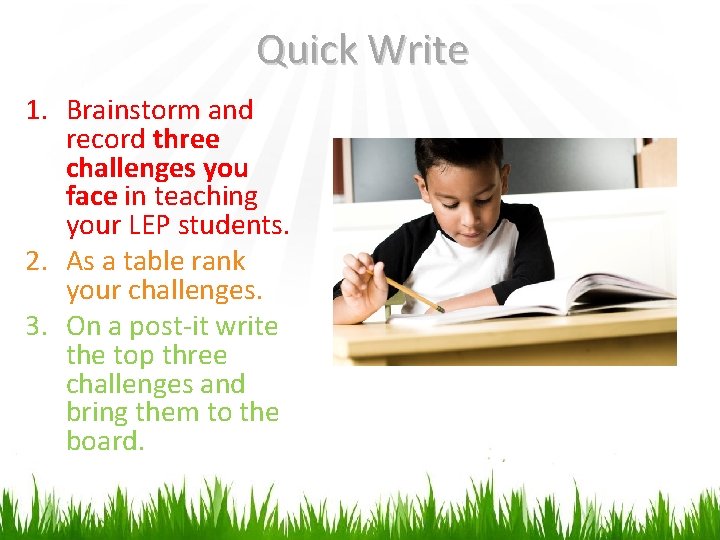
Quick Write 1. Brainstorm and record three challenges you face in teaching your LEP students. 2. As a table rank your challenges. 3. On a post-it write the top three challenges and bring them to the board.
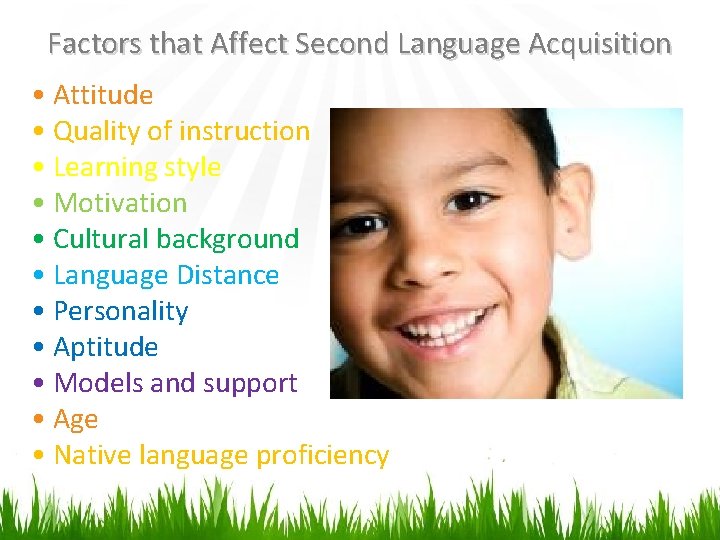
Factors that Affect Second Language Acquisition • Attitude • Quality of instruction • Learning style • Motivation • Cultural background • Language Distance • Personality • Aptitude • Models and support • Age • Native language proficiency
“The limits of my language are the limits of my world. ” -Ludwig Wittenstein
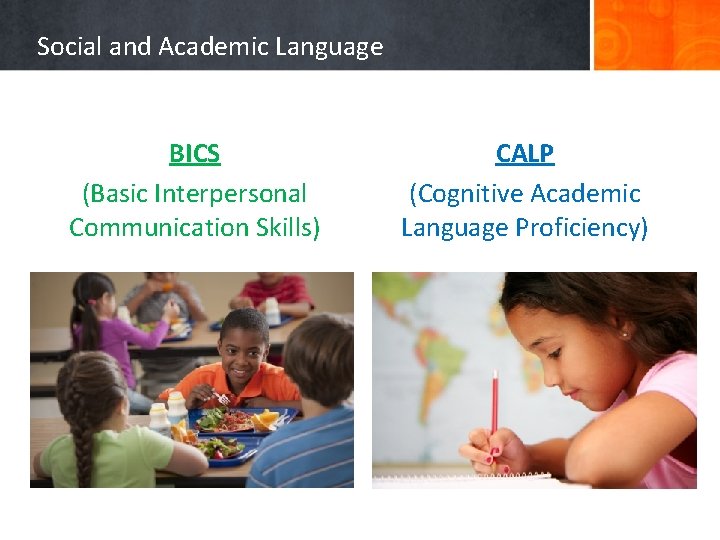
Social and Academic Language BICS (Basic Interpersonal Communication Skills) CALP (Cognitive Academic Language Proficiency)

The Iceberg Theory BICS CALP

Iceberg Analogy Conversational Language BICS by Cummins 1 -3 years Also known as Tier 1 words “Surface Structure” Academic Language CALPS 4– 10 years Also known as “deep structure” Tier 2 & 3 words

Basic Interpersonal Communication Skills (BICS) Characteristics: -Student can handle face-to-face conversations, which provide context clues through gestures, expressions and intonation (unlike text). -Students can converse fluently about familiar topics. -Acquisition of BICS is usually very rapid. Years to Acquire: -1 to 3 years or more Examples: “ Whatch’a doing? ” “Did you see that movie last night? ” “C’mon let’s go eat. ” “What book are we reading? ” Caution: -Use of common social language can cause the misperception that the student “speaks English, ” -Students’ need consistent language support. - Development of skills, especially those comparable to that of a native speaker takes TIME!
Cognitive Academic Language Proficiency (CALP) Characteristics: -This is the language of school, teachers, and texts. -This is a later stage, after instruction and exposure to academic language have taken place. -CALPS are more cognitively demanding and developed more slowly. Years to Acquire: - 4 to 10 years or more… Examples: “ The author is using onomatopoeia to catch the audience’s attention. ” “The parabola is divided by the parallel lines on the outer plane. ” Caution: - Adults may think the child “speaks English well, ” even if child is still acquiring these skills. -There are multiple components to language proficiency; listening, speaking, reading, and writing. Students may develop different levels of proficiency for each component. -Students may still need language support, even after exiting second language programs.
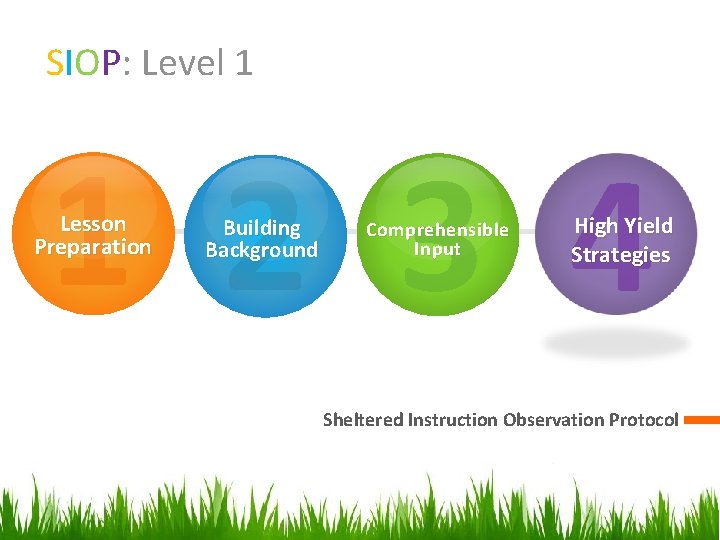
SIOP: Level 1 1 2 3 4 Lesson Preparation Building Background Comprehensible Input High Yield Strategies Sheltered Instruction Observation Protocol
1 LESSON PREPARATION Sheltered Instruction Observation Protocol
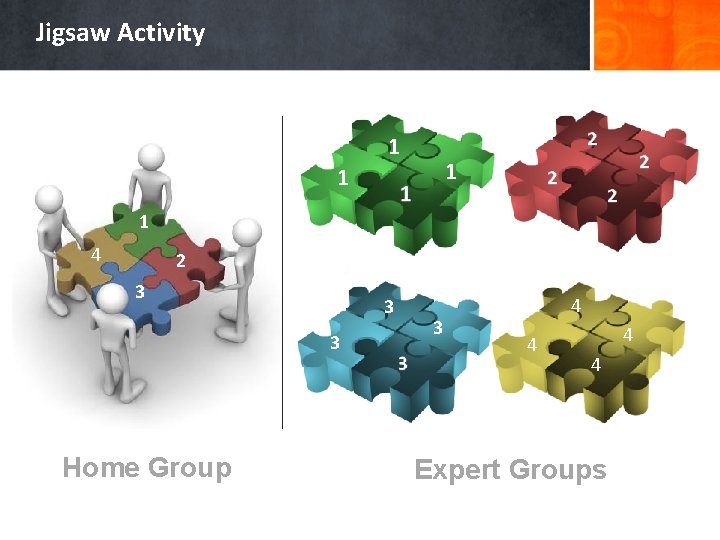
Jigsaw Activity 1 1 1 41 3 222 3 Home Group 3 3 3 4 4 Expert Groups
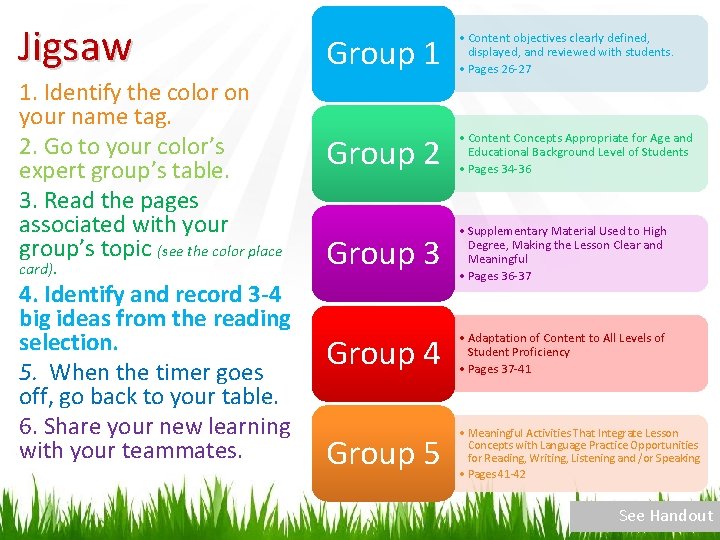
Jigsaw 1. Identify the color on your name tag. 2. Go to your color’s expert group’s table. 3. Read the pages associated with your group’s topic (see the color place card). 4. Identify and record 3 -4 big ideas from the reading selection. 5. When the timer goes off, go back to your table. 6. Share your new learning with your teammates. Group 1 • Content objectives clearly defined, displayed, and reviewed with students. • Pages 26 -27 Group 2 • Content Concepts Appropriate for Age and Educational Background Level of Students • Pages 34 -36 Group 3 • Supplementary Material Used to High Degree, Making the Lesson Clear and Meaningful • Pages 36 -37 Group 4 • Adaptation of Content to All Levels of Student Proficiency • Pages 37 -41 Group 5 • Meaningful Activities That Integrate Lesson Concepts with Language Practice Opportunities for Reading, Writing, Listening and /or Speaking • Pages 41 -42 See Handout
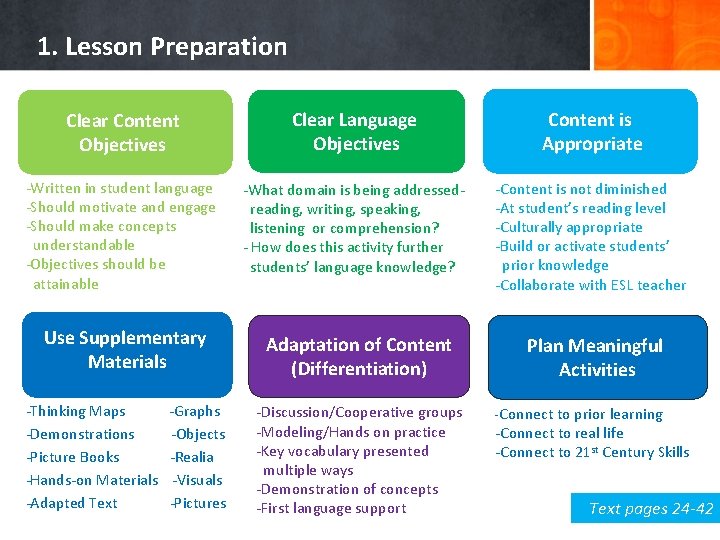
1. Lesson Preparation Clear Content Objectives Clear Language Objectives Content is Appropriate -Written in student language -Should motivate and engage -Should make concepts understandable -Objectives should be attainable -What domain is being addressedreading, writing, speaking, listening or comprehension? - How does this activity further students’ language knowledge? -Content is not diminished -At student’s reading level -Culturally appropriate -Build or activate students’ prior knowledge -Collaborate with ESL teacher Use Supplementary Materials -Thinking Maps -Demonstrations -Picture Books -Hands-on Materials -Adapted Text -Graphs -Objects -Realia -Visuals -Pictures Adaptation of Content (Differentiation) -Discussion/Cooperative groups -Modeling/Hands on practice -Key vocabulary presented multiple ways -Demonstration of concepts -First language support Plan Meaningful Activities -Connect to prior learning -Connect to real life -Connect to 21 st Century Skills Text pages 2324 -42
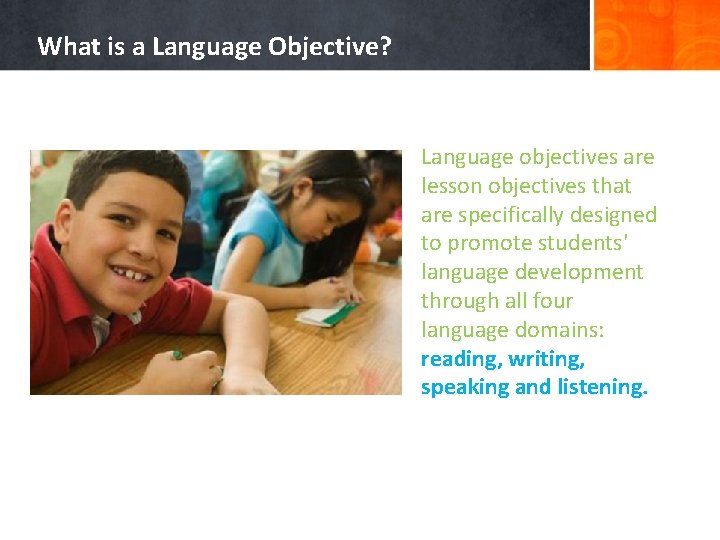
What is a Language Objective? Language objectives are lesson objectives that are specifically designed to promote students' language development through all four language domains: reading, writing, speaking and listening.
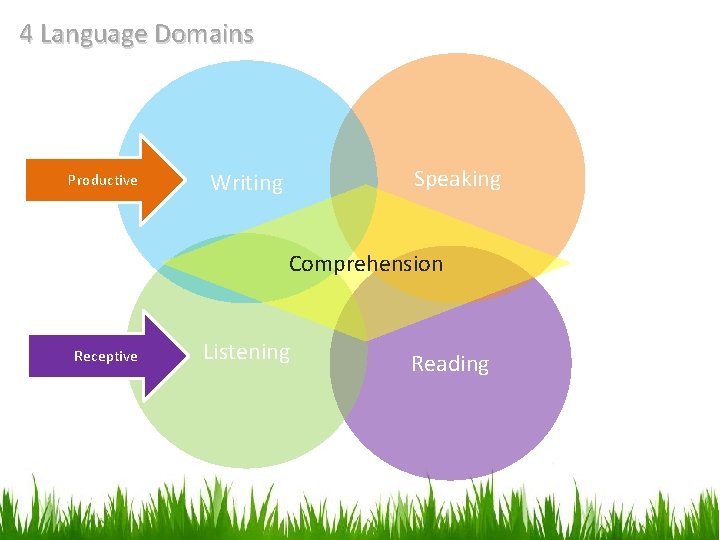
4 Language Domains Productive Speaking Writing Comprehension Receptive Listening Reading
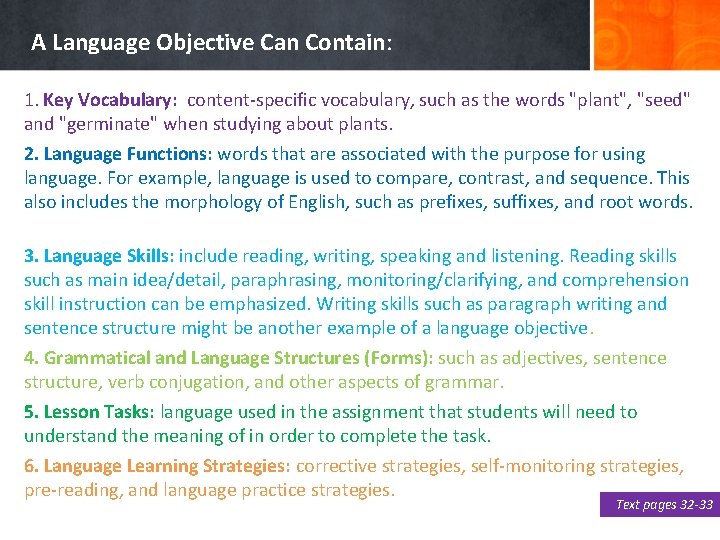
A Language Objective Can Contain: 1. Key Vocabulary: content-specific vocabulary, such as the words "plant", "seed" and "germinate" when studying about plants. 2. Language Functions: words that are associated with the purpose for using language. For example, language is used to compare, contrast, and sequence. This also includes the morphology of English, such as prefixes, suffixes, and root words. 3. Language Skills: include reading, writing, speaking and listening. Reading skills such as main idea/detail, paraphrasing, monitoring/clarifying, and comprehension skill instruction can be emphasized. Writing skills such as paragraph writing and sentence structure might be another example of a language objective. 4. Grammatical and Language Structures (Forms): such as adjectives, sentence structure, verb conjugation, and other aspects of grammar. 5. Lesson Tasks: language used in the assignment that students will need to understand the meaning of in order to complete the task. 6. Language Learning Strategies: corrective strategies, self-monitoring strategies, pre-reading, and language practice strategies. Text pages 32 -33
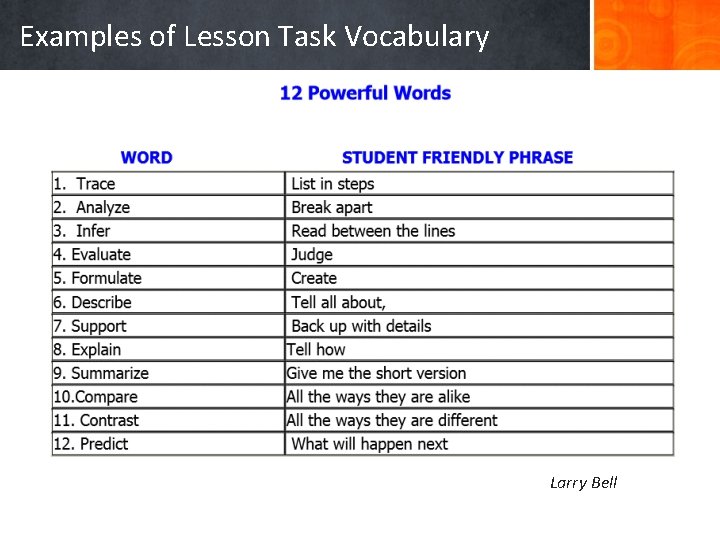
Examples of Lesson Task Vocabulary Larry Bell
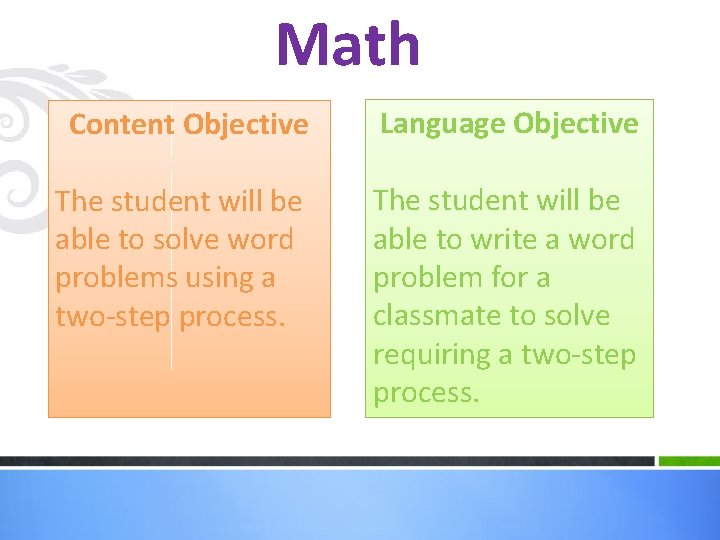
Math Content Objective Language Objective The student will be able to solve word problems using a two-step process. The student will be able to write a word problem for a classmate to solve requiring a two-step process.
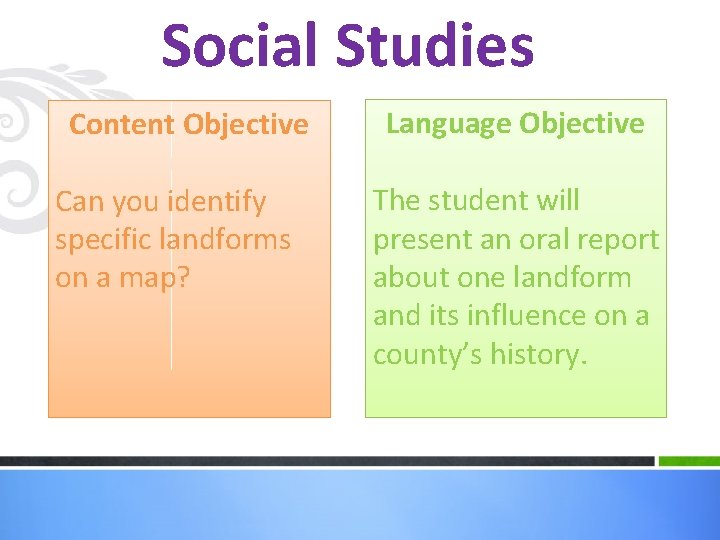
Social Studies Content Objective Can you identify specific landforms on a map? Language Objective The student will present an oral report about one landform and its influence on a county’s history.
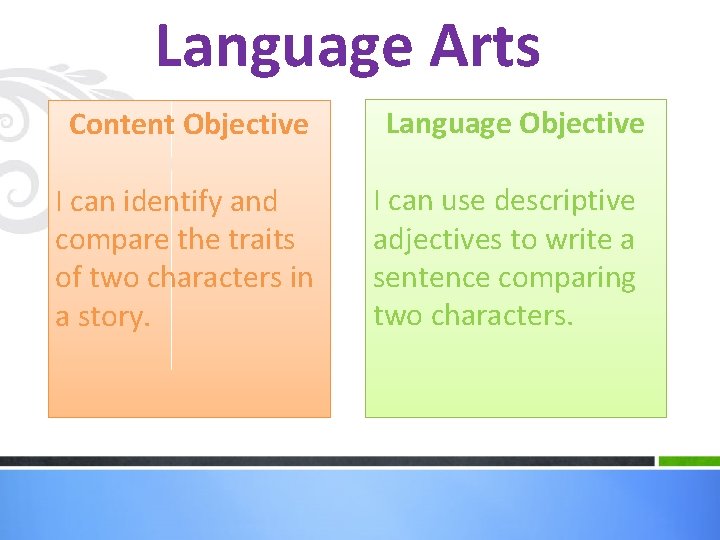
Language Arts Content Objective Language Objective I can identify and compare the traits of two characters in a story. I can use descriptive adjectives to write a sentence comparing two characters.
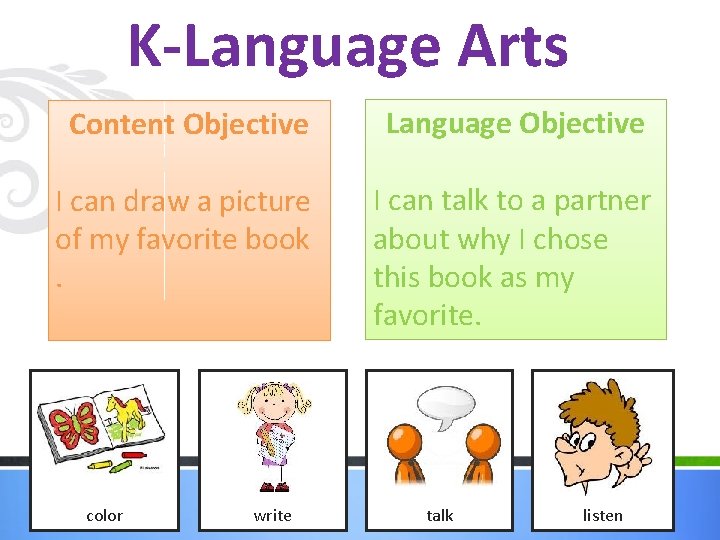
K-Language Arts Content Objective Language Objective I can draw a picture of my favorite book. I can talk to a partner about why I chose this book as my favorite. color write talk listen
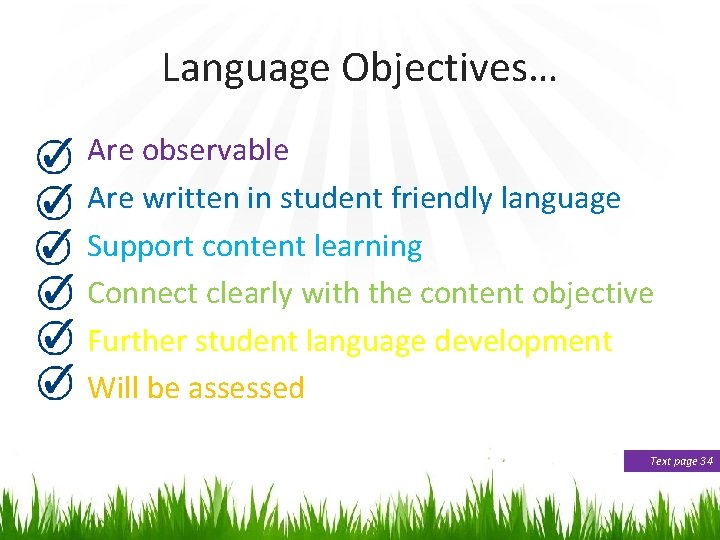
Language Objectives… Are observable Are written in student friendly language Support content learning Connect clearly with the content objective Further student language development Will be assessed Text page 34
Ask yourself… How will this lesson progress my students’ language abilities?
2 BUILDING BACKGROUND Sheltered Instruction Observation Protocol
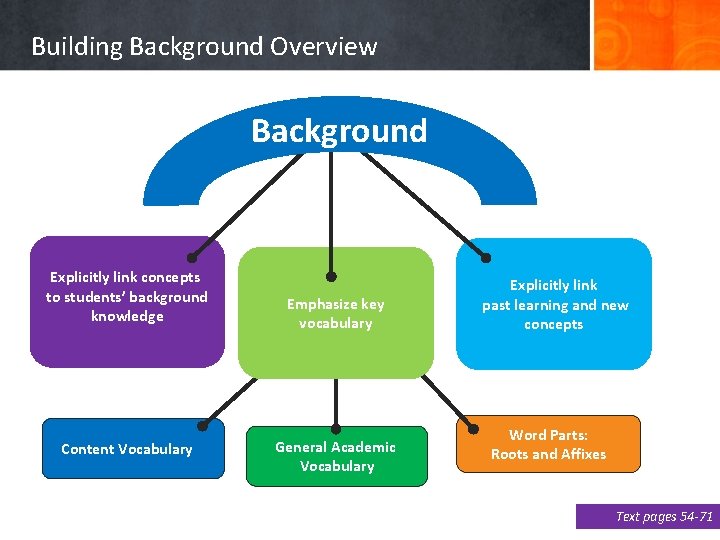
Building Background Overview Background Explicitly link concepts to students’ background knowledge Content Vocabulary Emphasize key vocabulary General Academic Vocabulary Explicitly link past learning and new concepts Word Parts: Roots and Affixes Text pages 54 -71
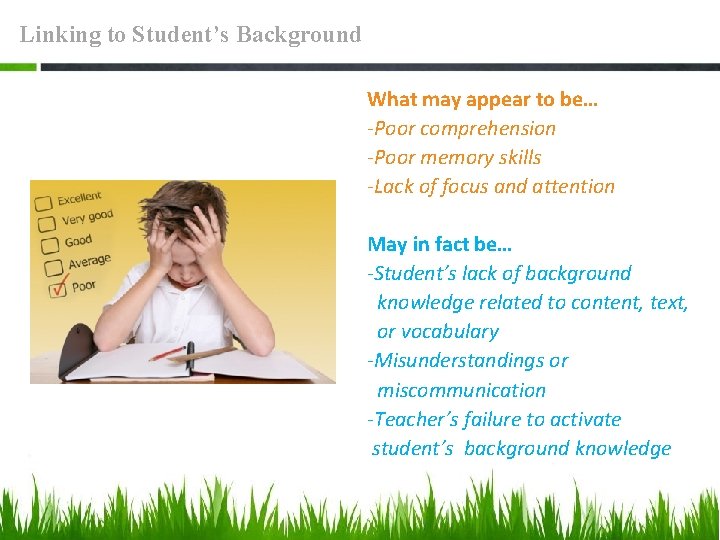
Linking to Student’s Background What may appear to be… -Poor comprehension -Poor memory skills -Lack of focus and attention May in fact be… -Student’s lack of background knowledge related to content, text, or vocabulary -Misunderstandings or miscommunication -Teacher’s failure to activate student’s background knowledge
Background anchors new knowledge… by connecting new knowledge to existing schema.
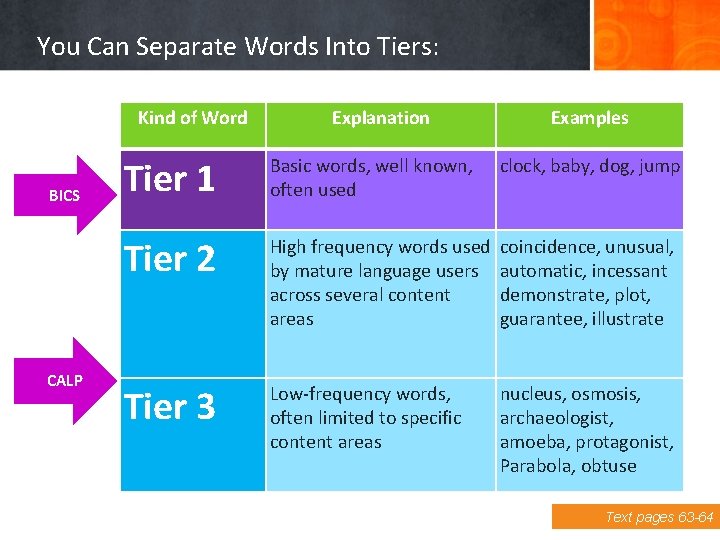
You Can Separate Words Into Tiers: Kind of Word BICS CALP Explanation Examples Tier 1 Basic words, well known, often used clock, baby, dog, jump Tier 2 High frequency words used by mature language users across several content areas coincidence, unusual, automatic, incessant demonstrate, plot, guarantee, illustrate Tier 3 Low-frequency words, often limited to specific content areas nucleus, osmosis, archaeologist, amoeba, protagonist, Parabola, obtuse Text pages 63 -64
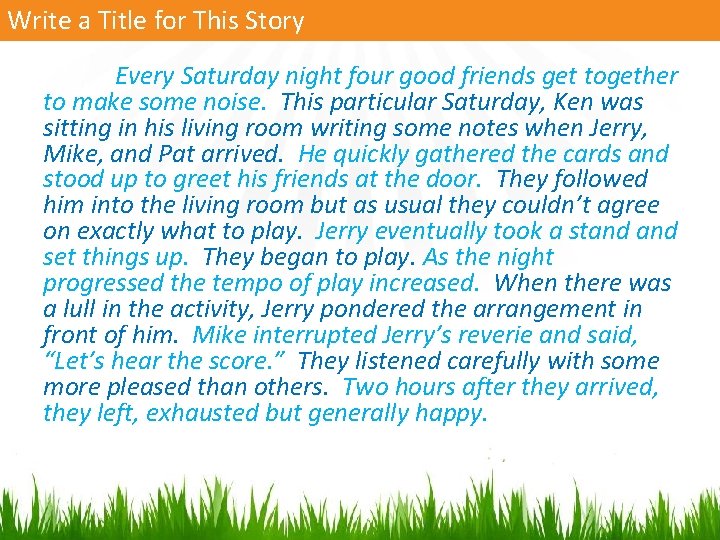
Write a Title for This Story Every Saturday night four good friends get together to make some noise. This particular Saturday, Ken was sitting in his living room writing some notes when Jerry, Mike, and Pat arrived. He quickly gathered the cards and stood up to greet his friends at the door. They followed him into the living room but as usual they couldn’t agree on exactly what to play. Jerry eventually took a stand set things up. They began to play. As the night progressed the tempo of play increased. When there was a lull in the activity, Jerry pondered the arrangement in front of him. Mike interrupted Jerry’s reverie and said, “Let’s hear the score. ” They listened carefully with some more pleased than others. Two hours after they arrived, they left, exhausted but generally happy.
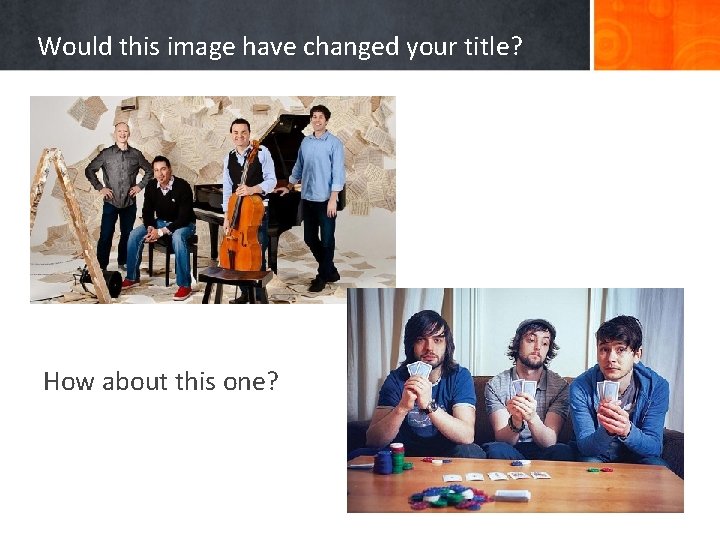
Would this image have changed your title? How about this one?
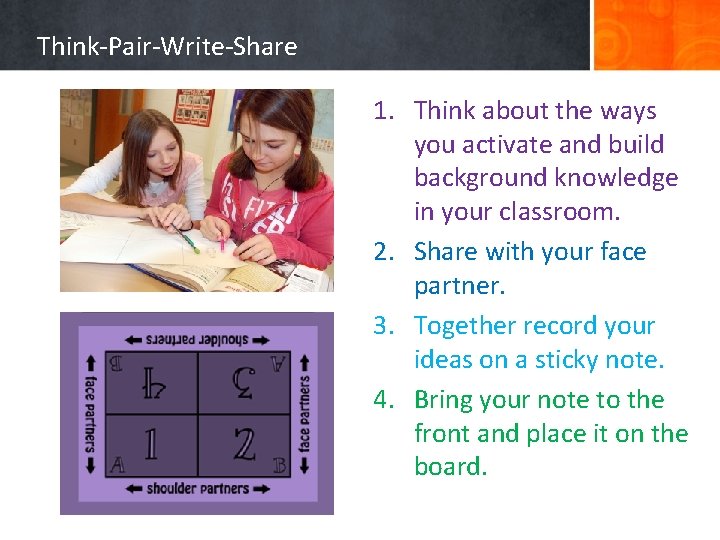
Think-Pair-Write-Share 1. Think about the ways you activate and build background knowledge in your classroom. 2. Share with your face partner. 3. Together record your ideas on a sticky note. 4. Bring your note to the front and place it on the board.
Building Background Teachers can… • Ask questions that preview upcoming topic • Develop background through meaningful activities • Intentionally discover information about student’s personal lives and link that information to lessons • Create lesson plans that intentionally link to student interests, experiences, and prior knowledge • Pre-load vocabulary
Critical Role of Vocabulary “Many ELL’s struggle with reading fluency, which might appear at first to be due to struggles with word recognition (phonological awareness and phonics). However, in many cases these struggles are often due to weakness in vocabulary, knowledge of sentence structure and phrasing. In addition as students encounter unfamiliar words in text, their speed and accuracy of reading will decrease and comprehension will suffer. ” -Best Practices in English Language Learner Pedagogy , Lexia Learning 2013
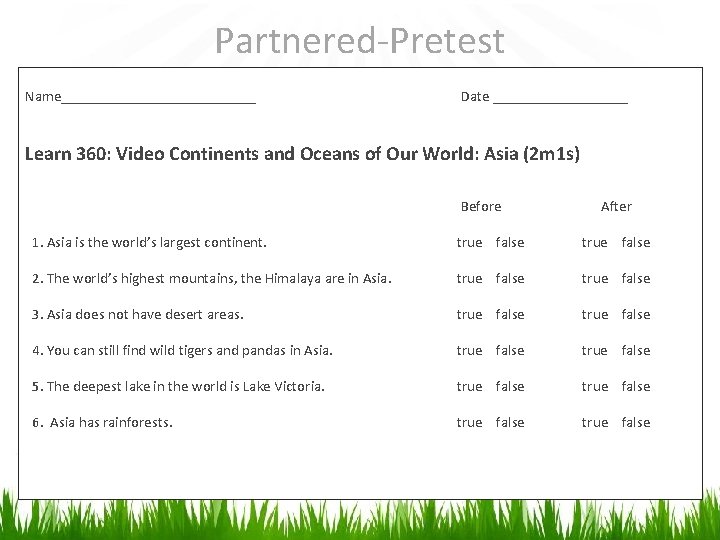
Partnered-Pretest Name_____________ Date _________ Learn 360: Video Continents and Oceans of Our World: Asia (2 m 1 s) Before After 1. Asia is the world’s largest continent. true false 2. The world’s highest mountains, the Himalaya are in Asia. true false 3. Asia does not have desert areas. true false 4. You can still find wild tigers and pandas in Asia. true false 5. The deepest lake in the world is Lake Victoria. true false 6. Asia has rainforests. true false
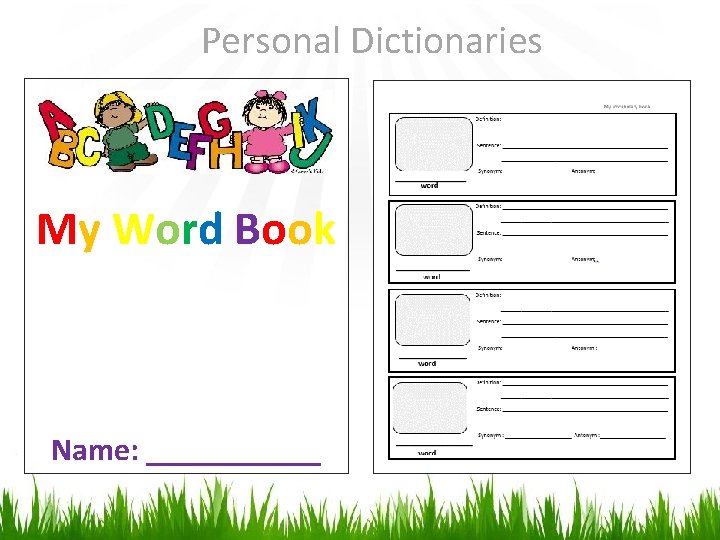
Personal Dictionaries My Word Book Name: ______
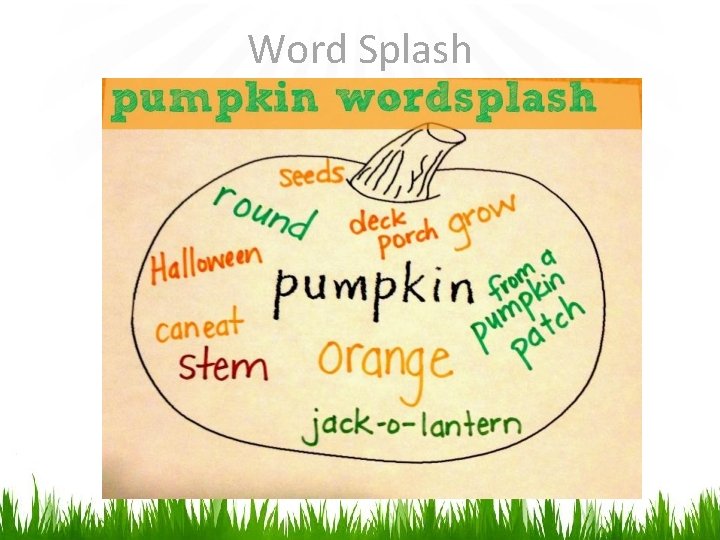
Word Splash
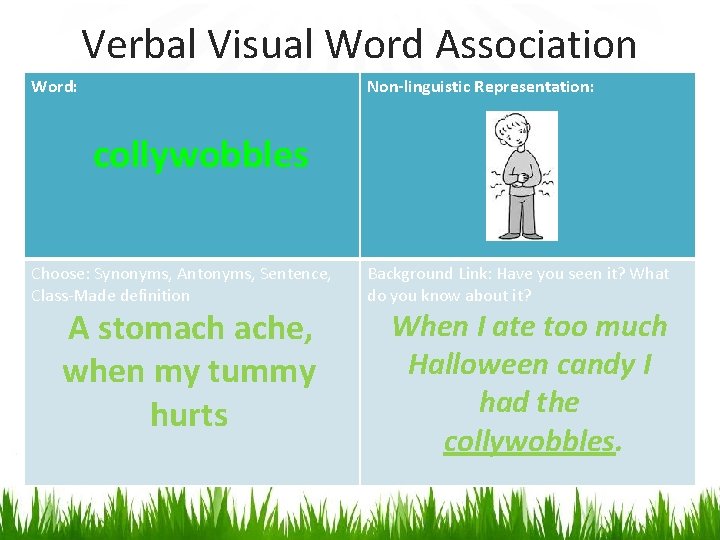
Verbal Visual Word Association Word: Non-linguistic Representation: collywobbles Choose: Synonyms, Antonyms, Sentence, Class-Made definition A stomach ache, when my tummy hurts Background Link: Have you seen it? What do you know about it? When I ate too much Halloween candy I had the collywobbles.
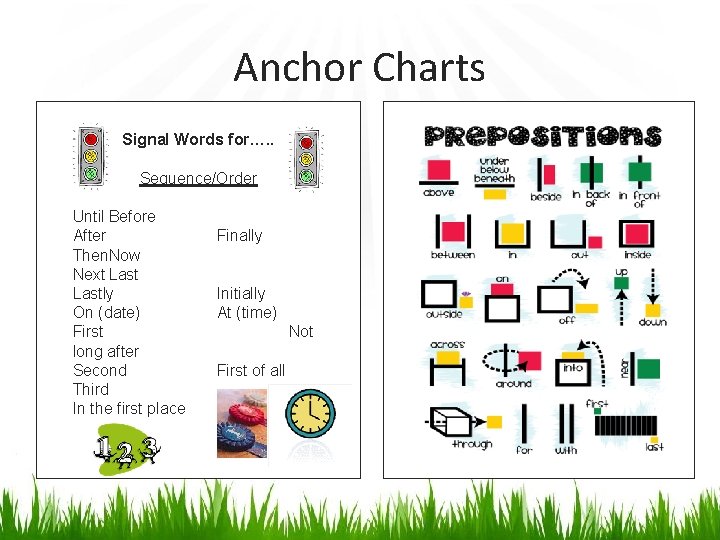
Anchor Charts Signal Words for…. . Sequence/Order Until Before After Then. Now Next Lastly On (date) First long after Second Third In the first place Finally Initially At (time) Not First of all
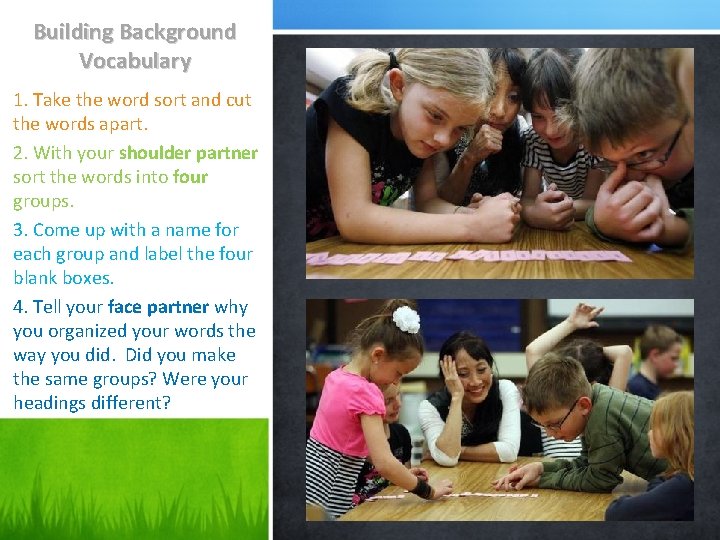
Building Background Vocabulary 1. Take the word sort and cut the words apart. 2. With your shoulder partner sort the words into four groups. 3. Come up with a name for each group and label the four blank boxes. 4. Tell your face partner why you organized your words the way you did. Did you make the same groups? Were your headings different?
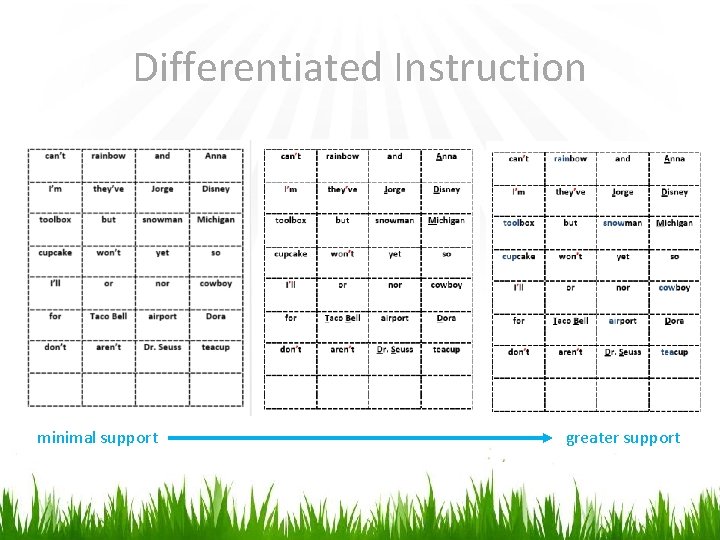
Differentiated Instruction minimal support greater support
Ideas for Building Background -Read alouds -Plot charts -Word sorts -Questioning -Student notebooks -Physical time lines -Anchor charts -Self-assessments -Personal dictionaries -Games -Graphic organizers -Think-pair-share -Videos Text pages 66 -71 -Pre-teaching -Partnered pretest -Word walls -Making connections -Videos -KWL charts -Journal entries -Word walls -Pictures
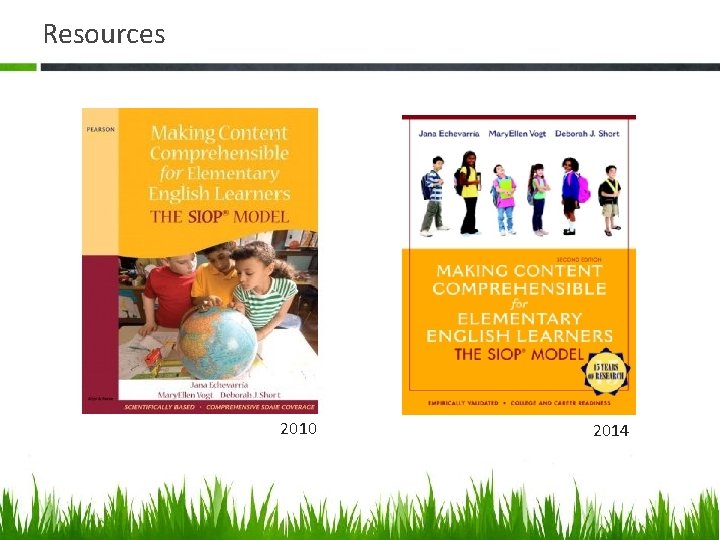
Resources 2010 2014
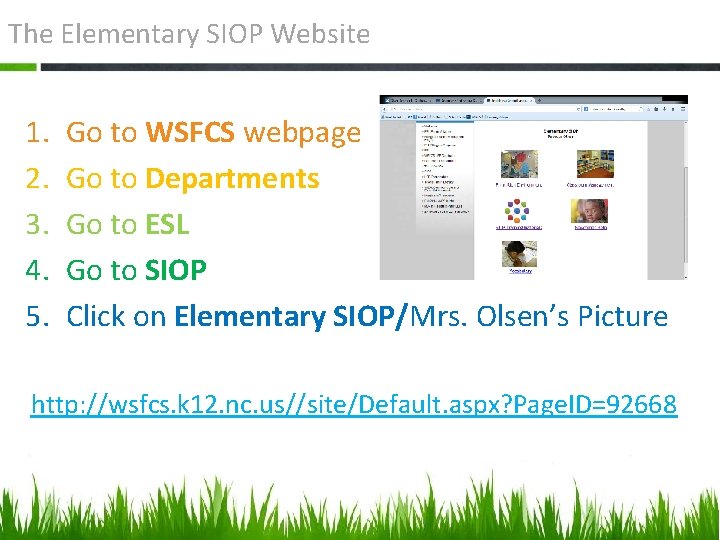
The Elementary SIOP Website 1. 2. 3. 4. 5. Go to WSFCS webpage Go to Departments Go to ESL Go to SIOP Click on Elementary SIOP/Mrs. Olsen’s Picture http: //wsfcs. k 12. nc. us//site/Default. aspx? Page. ID=92668
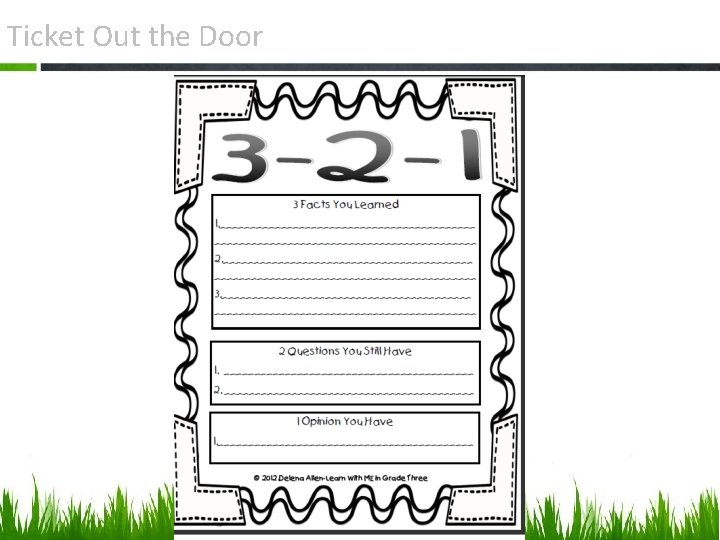
Ticket Out the Door
Questions? ?
Making learning accessible to ALL children Sheltered Instruction Observation Protocol For more information you can contact me at rlolsen@wsfcs. k 12. nc. us
Ticket Out the Door Take a Post-it and write one takeaway that you can begin incorporating into your instruction this week!
- Slides: 57