
Rebecca Ireland Homelessness Adviser Homelessness Advice and Support
Rebecca Ireland, Homelessness Adviser, Homelessness Advice and Support Team, MHCLG Rebecca. Ireland@communities. gov. uk • Intro to the HRA & why new legislation was needed • What the HRA intended to achieve with regard to single homelessness • What the Act has achieved so far for single homeless people • Why a call for evidence now and what’s the plan moving forward

Homelessness Reduction Act • Introduced via Private Members Bill DCLG Select Committee on homelessness took evidence of inconsistent/poor service, particularly to single people. Act commenced April 2018. • New duties to people who are homeless or threatened with homelessness within 56 days, irrespective of ‘priority need’ or ‘intentionality’. • Must assess circumstances and needs, including support needs, and take reasonable steps to try and prevent and/or relieve their homelessness, set out in a personalised housing plan (PHP) • Enhanced advice duty, with requirement to provide advice tailored to the needs of specified groups • Renewed Homelessness Code of Guidance • Introduction of the Duty to Refer in October 2018

Summary of Local Authority duties DUTY ADVICE ASSESSMENT PREVENTION RELIEF MAIN WHAT Provide free advice and info on homelessnes s, rights, access to services Assess homelessness, circumstances and needs of households who apply for assistance Take reasonable steps to prevent homelessness Personalised Housing Plan (PHP), keep under review Take reasonable steps to relieve homelessness Keep PHP under review Secure suitable (temporary) accommodation until the duty ends WHO All residents, including non -eligible Assess homelessness for all applicants who may be homeless or threatened with homelessness All applicants threatened with homelessness AND eligible for assistance Applicants actually homeless and eligible for assistance. Homeless, eligible, have priority need, & not intentionally homeless Bespoke advice for vulnerable groups – including people leaving custody Assess circumstances & needs if found to be homeless or threatened with AND eligible for assistance If no local connection can refer to another LA Provide interim accommodation if may have priority need If no local connection can refer to another LA 3
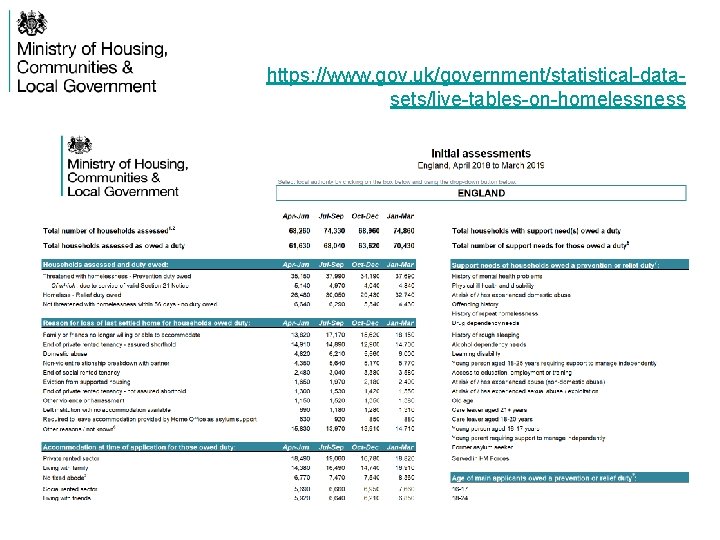
https: //www. gov. uk/government/statistical-datasets/live-tables-on-homelessness
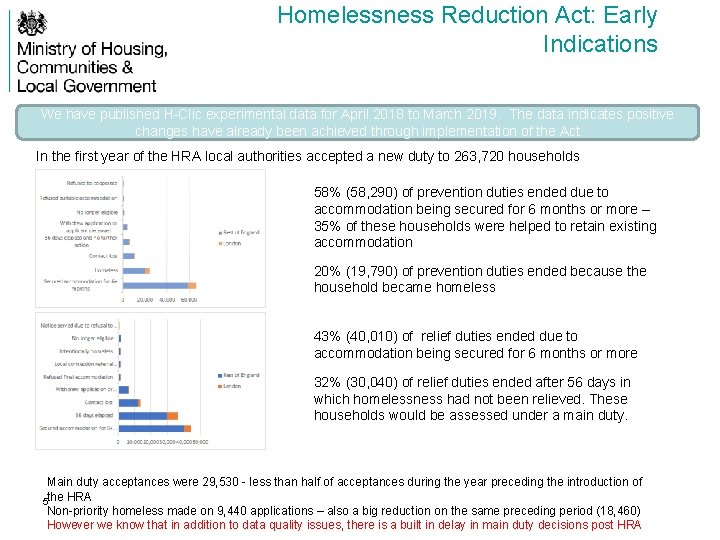
Homelessness Reduction Act: Early Indications We have published H-Clic experimental data for April 2018 to March 2019. The data indicates positive changes have already been achieved through implementation of the Act In the first year of the HRA local authorities accepted a new duty to 263, 720 households 58% (58, 290) of prevention duties ended due to accommodation being secured for 6 months or more – 35% of these households were helped to retain existing accommodation 20% (19, 790) of prevention duties ended because the household became homeless 43% (40, 010) of relief duties ended due to accommodation being secured for 6 months or more 32% (30, 040) of relief duties ended after 56 days in which homelessness had not been relieved. These households would be assessed under a main duty. Main duty acceptances were 29, 530 - less than half of acceptances during the year preceding the introduction of 5 the HRA Non-priority homeless made on 9, 440 applications – also a big reduction on the same preceding period (18, 460) However we know that in addition to data quality issues, there is a built in delay in main duty decisions post HRA
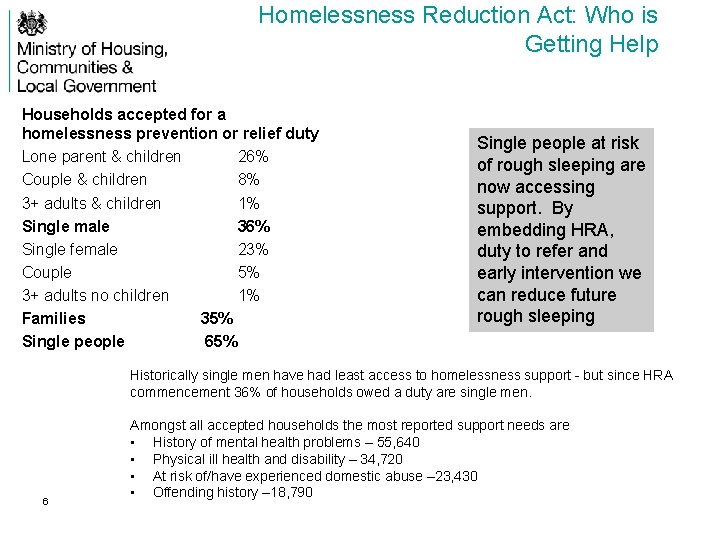
Homelessness Reduction Act: Who is Getting Help Households accepted for a homelessness prevention or relief duty Lone parent & children 26% Couple & children 8% 3+ adults & children 1% Single male 36% Single female 23% Couple 5% 3+ adults no children 1% Families 35% Single people 65% Single people at risk of rough sleeping are now accessing support. By embedding HRA, duty to refer and early intervention we can reduce future rough sleeping Historically single men have had least access to homelessness support - but since HRA commencement 36% of households owed a duty are single men. 6 Amongst all accepted households the most reported support needs are • History of mental health problems – 55, 640 • Physical ill health and disability – 34, 720 • At risk of/have experienced domestic abuse – 23, 430 • Offending history – 18, 790
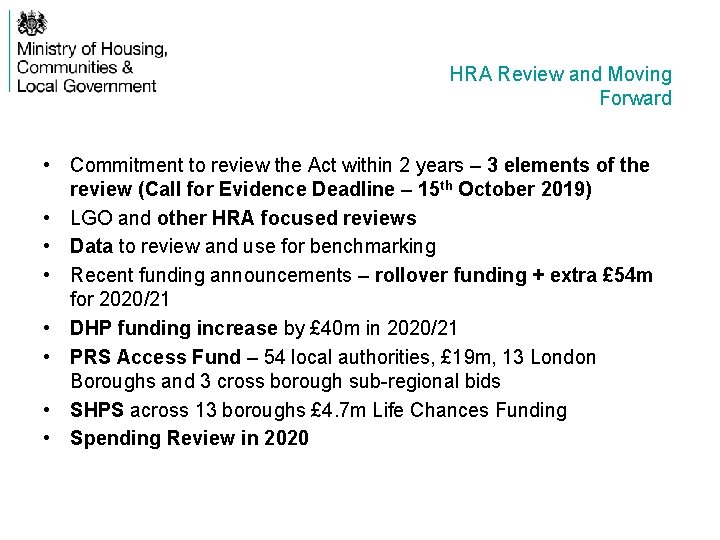
HRA Review and Moving Forward • Commitment to review the Act within 2 years – 3 elements of the review (Call for Evidence Deadline – 15 th October 2019) • LGO and other HRA focused reviews • Data to review and use for benchmarking • Recent funding announcements – rollover funding + extra £ 54 m for 2020/21 • DHP funding increase by £ 40 m in 2020/21 • PRS Access Fund – 54 local authorities, £ 19 m, 13 London Boroughs and 3 cross borough sub-regional bids • SHPS across 13 boroughs £ 4. 7 m Life Chances Funding • Spending Review in 2020
- Slides: 7